& ''' (
© 2010, IJARCS All Rights Reserved 146
Clustering Algorithms for Wireless Sensor Network: A Survey
S.Nithyakalyani*
Department of CSE, KSR College of Engineering
Tiruchengode, India, [email protected]
Dr.S.Suresh Kumar
Principal
Vivekanandha College of Technology for Women Tiruchengode, India,
Abstract:The last few years have seen an increased interest in the potential use of wireless sensor networks(WSNs) in various fields like disaster management, battle field surveillance, and border security surveillance as described by Quaritsch (2010), Hart (2006), Bokareva (2006) and Dudek (2009). In such applications, a large number of sensor nodes are deployed, which are often unattended and work autonomously. Clustering is a key technique used to extend the lifetime of a sensor network by reducing energy consumption (Younis 2003). It can also increase network scalability. Researchers in all fields of wireless sensor network believe that nodes are homogeneous, but some nodes may be of different energy to prolong the lifetime of a WSN and its reliability. In this paper, we study the impactof heterogeneity and survey different clustering algorithms for heterogeneous WSNs highlighting their objectives, features, complexity, etc.
Keywords:Clustering, Energy efficiency, Heterogeneity, Stability, WSN
I. INTRODUCTION
With the advances in the technology of micro electromechanical system (MEMS), developments in wireless communications and wireless sensor networks have also emerged (Akyildiz 2002). Wireless Sensor networks (WSNs) have become the one of the most interesting areas of research in the past few years. A WSN is composed of a number of wireless sensor nodes which form a sensor field and a sink. These large numbers of nodes, having the abilities to sense their surroundings, perform limited computation and communicate wirelessly form the WSNs. Specific functions such as sensing, tracking, and alerting as described by Shorey (2006), can be obtained through cooperation among these nodes. These functions make wireless sensors very useful for monitoring natural phenomena, environmental changes, controlling security, estimating traffic flows, monitoring military application, and tracking friendly forces in the battlefields. These tasks require high reliability of the sensor networks. To make sensor networks more reliable, the attention to research on heterogeneous wireless sensor networks has been increasing in recent past. A sensor network can be made scalable by assembling the sensor nodes into groups i.e. clusters. Every cluster has a leader, often referred to as the cluster head (CH). A CH may be elected by the sensors in a cluster or pre assigned by the network designer. The cluster membership may be fixed or variable. A number of clustering algorithms have been specifically designed for WSNs for scalability and efficient communication. The concept of cluster based routing is also utilized to perform energy efficient routing in WSNs. In a hierarchical architecture, higher energy nodes (cluster heads) can be used to process and send the information while low energy nodes can be used to perform the sensing. Some of routing protocols in this group are: LEACH (Heinzelman 2000), PEGASIS (Lindsey 2002), TEEN (Manjeshwar 2001) and APTEEN (Manjeshwar 2001).
Clustering algorithm has numerous advantages like 1. Clustering reduces the size of the outing table stored at the individual nodes by localizing the route set up within the cluster (Akkaya 2005).
2. Clustering can conserve communication bandwidth since it limits the scope of inter cluster interactions to CHs and avoids redundant exchange of messages among sensor nodes.
3. The CH can prolong the battery life of the individual sensors and the network lifetime as well by implementing optimized management strategies (Younis 2003).
4. Clustering cuts on topology maintenance overhead. Sensors would care only for connecting with their CHs (Hou 2005).
5. A CH can perform data aggregation in its cluster and decrease the number of redundant packets (Dasgupta 2003).
6. A CH can reduce the rate of energy consumption by scheduling activities in the cluster.
wireless sensor networks with comparison among them and classify depending upon clustering attributes described in section 3. Lastly, Section 5 concludes the survey work.
II. HETEROGENEOUS MODEL FOR WIRELESS SENSOR NETWORKS
This section presents a paradigm of heterogeneous wireless sensor network and discusses the impact of heterogeneous resources (Yarvis 2005).
A.Type of Resource Heterogeneity
There are three common types of resource heterogeneity in sensor nodes: computational heterogeneity, link heterogeneity, and energy heterogeneity.
# Computational heterogeneity: heterogeneous node has a more powerful microprocessor, and more memory, than the normal node. With the powerful computational resources, the heterogeneous nodes can provide complex data processing and longer term storage.
# Link heterogeneity: heterogeneous node has high bandwidth and long distance network transceiver than the normal node. Link heterogeneity can provide a more reliable data transmission.
# Energy heterogeneity: heterogeneous node is line powered, or its battery is replaceable.
Among above three types of resource heterogeneity, the most important heterogeneity is the energy heterogeneity because both computational heterogeneity and link heterogeneity will consume more energy resource.
B. Impact of Heterogeneity on Wireless Sensor Networks If we place some heterogeneous nodes in sensor network it shows the following benefits:
# Response time: Computational heterogeneity can decrease the processing latency and link heterogeneity can decrease the waiting time, hence response time is decreased.
# Lifetime: The average energy consumption will be less in heterogeneous sensor networks for forwarding a packet from the normal nodes to the sink, hence life time is increased. Further, it is also known that if in a network, heterogeneity is used properly then the response of the network is tripled and the network’s lifetime can be increased by 5fold
(Yarvis 2005).
C. Performance Measures
Some performance measures that are used to evaluate the performance of clustering protocols are listed below. # Network lifetime: It is the time interval from the start of operation (of the sensor network) until the death of the first alive node.
# Number of cluster heads per round: Instantaneous measure reflects the number of nodes which
would send directly to the sink, information aggregated from their cluster members.
# Number of nodes per round: This instantaneous measure reflects the total number of nodes and that of each type that has not yet expended all of their energy.
# Throughput: This includes the total rate of data sent over the network, the rate of data sent from cluster heads to the sink as well as the rate of data sent from the nodes to their cluster heads.
III. CLASSIFICATION OF CLUSTERING ATTRIBUTES Network architectural parameters like in network processing, node deployment and capabilities are best described
in (Abbasi 2007). Clustering objectives like load balancing and fault tolerance, increased connectivity, reduced delay, minimum cluster count, maximal network longevity are also described with reference to the homogeneous wireless sensor networks. Abbasi et al. (2007) also presented a classification of clustering attributes as clustering properties, cluster head capabilities and clustering process. Our survey of heterogeneous clustering algorithms is also based on some of the attributes described in (Abbasi 2007).Here summarized the set of attributes that can be used to categorize and differentiate clustering algorithms of HWSNs.
A. Cluster properties
Quite often, clustering schemes strive to achieve some characteristics for the generated clusters. Such characteristics can be related to the internal structure of the cluster or how it relates to others. The following are the relevant attributes: # Cluster Count: CHs are predetermined in some of the published approaches like Gupta et al. (2003), Verma (2008) and Li (2007), thus, the number of clusters is preset. CH selection algorithms generally pick randomly CHs from the deployed sensors hence yields variable number of clusters. Automatically determining number of clusters is a major issue in clustering algorithms.
# Intracluster Topology: Some clustering schemes are based on direct communication between a sensor and its designated CH, but sometimes multi hop sensor to CH connectivity is required.
# Connectivity of CH to BS: CHs send the aggregated data to the BS directly or indirectly with help of other CH nodes. It means there may exist a direct link or a multi hop link.
B.Cluster head Capabilities
The following attributes of the CH node are differentiating factors among clustering schemes:
# Mobility: CH may be stationary or movable. In most cases, they are stationary. But sometimes, CHs can move within a limited region to reposition themselves for better network performance.
# Node Types: Generally sensor nodes among the deployed sensors are designated as CHs, but sometimes sensor nodes equipped with significantly more computation and communication resources are selected as CHs.
# Role: Some of the main roles of the CHs are simply relaying the traffic, aggregation or fusion of the sensed data.
C. CH Selection Based on
# Initial Energy: It is vital parameter to select the CH. Algorithms generally consider it as initial parameter for grouping. That is energy of sensor while deployment.
# Residual Energy: After some of the rounds are completed, the cluster head selection should be based on the residual energy of the sensors.
# Average Energy of the Network: The average energy is used as the reference energy for each node. It is the ideal energy that each node should own in current round to keep the network alive. The above listed clustering attributes are used to classify the clustering algorithms in the next section.
© 2010, IJARCS All Rights Reserved 148
consumption. It can also increase network scalability and lifetime. In this section, we present a literature survey of distributed algorithms for clustering in WSNs. Clustering algorithms for HWSNs should be energy efficient to take the advantages of node heterogeneity. Clustering algorithms in this paper are classified based on two main criterions the energy efficiency and stability. Selection of cluster head in energy efficient techniques generally depends on the initial energy, residual energy, average energy of the network, or energy consumption rate or combination of these. The stable election protocols for clustered HWSN prolong the time interval before the death of first node i.e. stability period.
A. Energy Efficient Clustering Protocol for HWSNs
The concept of cluster based routing is also utilized to perform energy efficient routing in WSNs. Efficient organization of sensor nodes into clusters is useful in reducing energy consumption in WSNs. Many energy efficient routing protocols are designed based on the clustering structure of HWSNs like Haibo (2009), Lu (2008), Paruchuri (2005) and Liang (2009). Each clustering algorithm has mainly two phases: the cluster setup phase and steady state phase. For heterogeneous WSNs, a very critical task for clustering protocols is to select the cluster head so that least energy is consumed, and hence prolong the lifetime. In this section, we look into various energy efficient cluster head selection protocols for HWSNs like EEHC (Kumar 2009), DEEC (Qing 2006), SDEEC (Elbhiri 2009), DBEC (Duan 2007) and C4SD (MarinPerianu 2008).
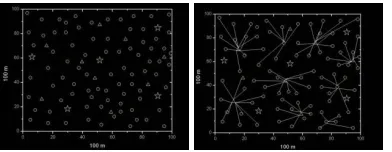
Energy Efficient Heterogeneous Clustered Scheme: Kumar et al. (2009) proposed an energy efficient clustered scheme for HWSNs based on weighted election probabilities of each node to become cluster head. It elects the cluster head in distributed fashion in hierarchal WSN. This algorithm is based on LEACH (Low Energy Adaptive Clustering Hierarchy), the most popular clustering protocol in WSN. In the LEACH algorithm, there are an optimal percentage of nodes that has to become cluster head in each round. This algorithm works on the election processes of the cluster head in presence of heterogeneity of nodes. Figure 1 shows heterogeneity of the network, the snapshots when all nodes are alive and how the normal nodes die after some rounds.
Fig1:(a) Network Structure and (b) Network after some rounds
Distributed Energy Efficient Clustering Algorithm for HWSN: Qing et al. (2006) Distributed multilevel clustering algorithm for heterogeneous wireless sensor networks. DEEC selects the cluster heads with the help of probability based on the ratio between residual energy of each node and the average energy of the network. How long different nodes would be cluster heads, is decided according to the initial and residual energy. The
authors assume that all the nodes of the wireless sensor network are equipped with different amount of energy, which is a source of heterogeneity. DEEC is also based on LEACH it rotates the cluster head role among all nodes to expend energy uniformity. Two levels of heterogeneous nodes are considered in this algorithm and after that a general solution for multilevel heterogeneity is obtained. Working of DEEC is as follows: all the nodes need to know the total energy and lifetime of the network. Average energy of the network is used as the reference energy. Thus, DEEC does not require any global knowledge of energy at every election round. When a new epoch begins, each node si computes the average probability pi by the total energy Etotal, while estimate value R of lifetime is broadcasted by the base station. Now pi is used to get the election threshold T(si). This threshold decides node si to be a cluster head in the current round. An improvement of this algorithm is proposed as Stochastic DEEC by Elbhiri, Saadane, and Aboutajdine (2009). The cluster head selection in overall network is based on nodes' residual energy in the Stochastic Energy Efficient Clustering (SDEEC). This protocol is based on DEEC with new strategies. The Stochastic strategy is the key idea where the intra clusters transmission is reduced. Like DEEC, this approach considers the two level heterogeneity, but it conserves energy by making non CH nodes sleep, unlike DEEC. This protocol divides the network into dynamic clusters. According to the protocol, all non CH nodes send data to respective CHs in their allocated transmission time. The CH node must keep its receiver on, in order to receive all the data from the nodes in the cluster. Some signal processing is performed by CH to compress the data into a single signal when all the data is received. After this phase, each CH sends the aggregated data to its prime CH. Each non CH can turn off to the sleep mode to conserve the energy. The drawback in the protocol is that if non CH nodes turn off to the sleep mode when CH is performing aggregation, how they will come to know about the next round of CH selection.
Distributed Energy Balance Clustering Protocol for HWSNs: In Distributed Energy Balance Clustering algorithm (DEBC), a probability based clustering algorithm was proposed by Chang min Duan and Hong Fan (2007). DEBC elects cluster heads based on the knowledge of the ratio between remaining energy of node and the average energy of the network. This protocol also considers two level heterogeneity and then it extends the results for multilevel heterogeneity. DEBC is different from LEACH, which make sure each node can be cluster head in each ni=1/p rounds. DEBC chooses ni according to the node i and remaining energy E k i in round k. pi denotes the probability of node I being cluster head in each ni rounds. With the help of pi, probabilities for advanced and normal nodes to be CH can be calculated and this can be further extended to multilevel heterogeneity.
directory of service registrations for the nodes in the cluster. Since the service discovery messages are exchanged only among the directory nodes and the distribution of workload according to the capabilities of the nodes, the communication costs are reduced. The proposed clustering algorithm reacts rapidly to topological changes of the sensor network by making decisions based only on the 1hop neighborhood information, avoids chain reactions and constructs a set of sparsely distributed CHs. The clustering algorithm is simulated and compared with distributed mobility adaptive clustering (DMAC) (Basagni 1999). The result shows that it outperforms DMAC.
B.Stability oriented Clustering Protocols for HWSNs The protocols discussed below increase the stability period of wireless sensor networks. Stability period is actually the time interval before the death of the first node. It is very important for the applications where the response from the sensor nodes must be reliable. Protocols surveyed in this category are: SEP (Smaragdakis 2004), EDFCM (Haibo), Base station initiated clustering (Varma 2008), ZREECR (Li 2007), DECP (Wang 2007) and a steady clustering scheme for HWSN (Liaw 2009).
Novel Stable Selection and Reliable Transmission Protocol for Clustered HWSN: H. Zhou et al. propose a model of energy and computation heterogeneity for heterogeneous wireless sensor networks. They also propose a protocol named Energy Dissipation Forecast and Clustering Management (EDFCM) for HWSNs. This algorithm balances the energy consumption round by round, which will provide the longest stability period for network. The heterogeneous model they consider is composed of three types of nodes including Type_0, Type_1 and some management nodes as shown in Figure 2. Type_0 and Type_1 nodes vary in capabilities of sensing, energy and software. They have the responsibility of sensing events, while the management nodes perform management of both types of nodes during cluster formation. EDFCM is specially proposed for heterogeneous networks to provide the longer lifetime and more reliable transmission service. Unlike the other energy efficient protocols, the process of cluster head selection in EDFCM is based on a method of one step energy consumption forecast. It uses the average energy consumptions of the two types of cluster heads in previous round for this purpose. The more remaining energy in a node after the operation of next round, higher the chances of node to be selected as a cluster head. In EDFCM protocol, the operation of network can be divided into two phases: cluster formation phase and data collecting phase. Cluster formation phase of EDFCM is very similar to that of LEACH, but there are two differences: (i) The selection probability is a weighted function.
(ii) It guarantees a stable number of cluster heads each round.
Fig2:(a) Network Structure and (b) Clustering in EDFCM (Haibo, In Press).
Base Station Initiated Dynamic Routing Protocol: S. Verma et al. (2008) propose a routing protocol that is based on clustering
[image:4.612.47.243.618.694.2]and uses heterogeneity in nodes to increase the network lifetime. In this scheme, some nodes which are stronger than other nodes in terms of power, computational capability and location awareness, work as the cluster heads. They forward information to their parents, towards the base station by aggregating all the information from their clusters members. Following assumptions are considered in this scheme: all nodes are deployed uniformly in the field and CHs will be assumed dead only when their energy is very less. There is no collision between inter cluster and intra cluster communication. Transmission power of the CH is adjusted in such a way that only single hop broadcast is possible. In this algorithm, how far a CH is from the BS, is defined as level.
Figure 3: Cluster hierarchy in sensing field (Verma et al. 2008). Low level means that CH is near to the BS and if level is high it means CH is away from BS accordingly. Data flow will be always from higher level to lower level. Decision of levels by base station is based on the range of the CH and normal node. Ranges of all the nodes are enough to ensure the connectivity and coverage. Structure of the network considered in this approach is shown in Figure 3. BS sets its level to zero and broadcasts a packet to initiate the scheme. Base station mentions that this packet is only for CHs. Since the CHs have different signal strength from normal nodes, they receive the packet and set their levels accordingly. When the CHs of first level are selected, they broadcast their level. CHs at lower level receive the packet according to the signal strength. They choose their parent from upper level CHs only. This process is repeated again and again until all CHs are connected. CH now broadcast a message that all sensor nodes should join the CH according to the RSS (Radio Signal Strength). Communication between CH and sensing nodes is single hop, while communication between different CH is multiple hops. All CHs sends their position, level and energy consumption to the BS at the end of the round. BS then analyzes the energy consumption of different CH at the same level.
© 2010, IJARCS All Rights Reserved 150
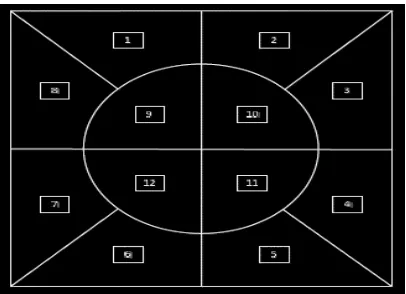
Figure 4: A schematic diagram of different size zones (Li et al. 2007).
To solve this problem, the authors propose a zone based solution named ZREECR. This protocol divides the network into fixed size zones, depending upon distance and orientation from base station as shown in Figure 4. There are 12 fixed side zones that are shown in the Figure 4. It is expected that clusters near to the BS have smaller cluster sizes because CHs have to relay the data from the farther CHs to the BS. In this way CHs will save some significant amount of energy in intra cluster Data processing as well as inter cluster relay traffic.
A distributed election clustering protocol (DECP) for HWSN: X. Wang et al. (2007) proposed a
distributed election clustering protocol named DECP for two level HWSN that prolongs stability region. DECP elects the CH based on remaining energy and communication cost. This protocol is based on Average Power Distinction (APD) to evaluate the power level of the nodes. This means that the nodes with high residual energy have more chances to become CH than nodes with less energy. In the clustering process, all the nodes broadcast its current energy information and in the meantime also collect the energy message from the other nodes. When nodes have sufficient information about its neighbors, such as distance and current energy, nodes calculate the communication cost and broadcast it to their neighbors. Now, CH nodes are elected based on the minimal cost. And all non cluster head nodes chose one nearest cluster head to join the cluster. This protocol provides better stability region and it also does not need global energy knowledge.
The steady clustering scheme for HWSN: A protocol based on SGCH (Steady Group Clustering Hierarchy) is proposed in (Liaw 2009). This protocol divides all nodes into groups by initial energy. This algorithm proceeds in two steps: grouping stage and data transmission stage. Groups are generally clusters. In this algorithm, BS broadcasts a Group Head Request (GHR) to all nodes. Every node sends back the acknowledgement (ACK) with ID and initial energy information. BS selects the group head by sending a Group Head GH message and group ID. Now every group head finds its member by sending group request message to all nodes. Following this way, algorithm forms the groups (clusters). Algorithm considers the multilevel heterogeneity of sensor nodes in terms of energy. Results show that stability period is prolonged.
V. CONCLUSION
Wireless sensor networks are an interesting area of research. Sensor networks are not always homogeneous, they may be heterogeneous too. Heterogeneous wireless sensor networks are more complex than homogeneous ones. Clustering is a good technique to reduce energy consumption and to provide stability of network in wireless sensor networks. This paper surveyed some of the research protocols in this area. Most of them are based on clustering. They are classified according to energy efficiency and stability of network. We summarize a number of schemes, stating their strengths and limitation. Finally we conclude that the heterogeneous wireless sensor networks are more suitable for real life applications as compared to the homogeneous counterpart.
VI. REFERENCES
[1] Abbasi, A.A. and Younis, M. (2007). A survey on clustering algorithms for wireless sensor networks. Computer Communications. 30: pp 2826–2841.
[2] Akkaya, K. and Younis, M. (2005). A survey on routing protocols for wireless sensor networks, Elsevier Journal of Ad Hoc Networks 3 (3): pp 325–349.
[3] Akyildiz, I.F., Su, W., Sankarasubramaniam, Y. and Cayirci, E. (2002). Wireless sensor networks: a survey. Computer Networks. 38 (4): pp 393–422.
[4] Basagni, S. (1999). Distributed clustering for ad hoc networks, in International Symposium on Parallel Architectures, Algorithms and Networks (ISPAN), IEEE Computer Society, Los Alamitos, CA, pp 310–315. [5] Bokareva, T., Hu, W., Kanhere, S., Ristic, B., Gordon, N.,
Bessell, T., Rutten, M. and Jha, S. (2006). Wireless sensor networks for battlefield surveillance. 2006.
[6] ChunHsien W., and YehChing C. (2007). Heterogeneous Wireless Sensor Network Deployment and Topology Control Based on Irregular Sensor Model: Advances in Grid and
Pervasive Computing Lecture Notes in Computer Science. 4459.
[7] Corchado, J.M., Bajo, J., Tapia, D.I. and Abraham, A. (2010). Using heterogeneous wireless sensor networks in a telemonitoring system for healthcare, IEEE Transactions on Information Technology in Biomedicine 14 (2): pp 234– 240.
[8] Dasgupta, K., Kalpakis, K. and Namjoshi, P. (2003). An efficient clustering– based heuristic for data gathering and aggregation in sensor networks, in: Proceedings of the IEEE Wireless Communications and Networking Conference (WCNC, 2003).
Proceedings of IEEE Sensors (SENSORS), Christchurch, Newzealand.
pp 591–596.
[10] Duan, C. and Fan, H. (2007). A Distributed Energy Balance Clustering Protocol for Heterogeneous Wireless Sensor Networks, Wireless Communications, Networking and Mobile Computing. WiCom 2007. International Conference on: pp 24692473.
[11] DuarteMelo, E.J. and Mingyan, L. (2002). Analysis of energy consumption and lifetime of heterogeneous wireless sensor networks: Global Telecommunications Conference. GLOBECOM '02. IEEE, 1: pp 2125.
[12] Dudek, D., Haas, C., Kuntz, A., Zitterbart, M., Krüger, D., Rothenpieler, P., Pfisterer, D. and Fischer, S. (2009). A wireless sensor network for border surveillance: Proceedings of the 7th ACM Conference on Embedded Networked Sensor Systems. pp 303304.
[13] Elbhiri, B., Saadane, R. and Aboutajdine, D. (2009). Stochastic Distributed EnergyEfficient Clustering (SDEEC) for heterogeneous wireless sensor networks: ICGSTCNIR Journal, 9 (2): pp 1117.
[14] Gupta, G. and Younis, M. (2003). Loadbalanced clustering in wireless sensor networks, in: Proceedings of the International Conference on Communication (ICC 2003). [15] Gupta, G. and Younis, M. (2003). Faulttolerant clustering
of wireless sensor networks, in: Proceedings of the IEEE Wireless Communication and Networks Conference (WCNC 2003), New Orleans, Louisiana.
[16]Haibo, Z., Yuanming, W. and Guangzhong, X. (2009). EDFM: a stable election Protocol based on energy dissipation forecast method for clustered heterogeneous wireless sensor networks, Proceedings of the 5th International Conference on Wireless communications, networking and mobile computing. pp 35443547.
[17] Haibo, Z., Yuanming, W., Yanqi, H. and Guangzhong, X. (In Press) A novel stable selection and reliable transmission protocol for clustered heterogeneous wireless sensor networks, Computer Communications, In Press, Corrected Proof.
[18] Hart, J.K. and Martinez, K. (2006). Environmental Sensor Networks: A revolution in the earth system science: EarthScience Reviews. 78: pp. 177191.
[19] Heinzelman, W., Chandrakasan, A. and Balakrishnan, H. (2000). Energyefficient communication protocol for wireless microsensor networks: in Proceedings of the 33rd Annual Hawaii International Conference on System Sciences, 10 (2): pp 47.
[20] Hou, Y.T., Shi, Y. and Sherali, H.D. (2005). On energy provisioning and relay node placement for wireless sensor networks, IEEE Transactions on Wireless Communications 4 (5): pp. 2579– 2590.
[21] Kumar, D., Aseri, T.C. and Patel, R.B. (2009). EEHC: Energy efficient heterogeneous clustered scheme for wireless sensor networks, Computer Communications. 32 (4): pp 662667.
[22] Kumar, D., Aseri, T.C. and Patel, R.B. (2009). Analysis On Deployment Cost And Network Performance For Heterogeneous Wireless Sensor Networks, International Journal of Computer science & Information Technology (IJCSIT). 1 (2): pp 109120.
[23]Li, X., Huang, D. and Yang, J. (2007). Energy Efficient Routing Protocol Based on Residual Energy and Energy Consumption Rate for Heterogeneous Wireless Sensor Networks, In: The 26th Chinese Control Conference, 5: pp 587–590.
[24] Li, X., Huang, D. and Sun, Z. (2007). A Routing Protocol for Balancing Energy Consumption in Heterogeneous Wireless Sensor Networks, MSN 2007, LNCS 4864: pp 79–88.
[25] Liang, Y. and Feng, Y. (2009). An EnergyAware Routing Algorithm for Heterogeneous Wireless Sensor Networks, Ninth International Conference on Hybrid Intelligent Systems. 2:
pp 275278.
[26] Liaw, J.J., D., ChenYi and YiJie, W. (2009). The Steady Clustering Scheme for Heterogeneous Wireless Sensor Networks, Ubiquitous, Autonomic and Trusted Computing, UICATC '09. Symposia and Workshops on, pp 336341. [27] Lindsey, S. and Raghavendra, C.S. (2002). PEGASIS:
power efficient gathering in sensor information systems, in: Proceedings of the IEEE Aerospace Conference.
[28] Lu, X., Spear, M., Levitt, K. and Wu, S.F. (2008). iBubble: Multikeyword Routing Protocol for Heterogeneous Wireless Sensor Networks, IEEE INFOCOM, pp 16421650.
[29] Lu, K., Qian, Y. and Hu, J. (2006). A framework for distributed key management schemes in heterogeneous wireless sensor networks. Performance, Computing, and Communications Conference, 2006. IPCCC 2006. 25th IEEE International , 7: pp 1012.
[30] Manjeshwar, A. and Agrawal, D.P. (2001). TEEN: a protocol for enhanced efficiency in wireless sensor networks, in: Proceedings of the 1st International Workshop on Parallel and Distributed Computing Issues in Wireless Networks and Mobile Computing.
[31] Manjeshwar, A. and Agarwal, D.P. (2002). APTEEN: a hybrid protocol for efficient routing and comprehensive information retrieval in wireless sensor networks, in: Parallel and Distributed Processing Symposium. Proceedings International, IPDPS 2002. pp 195–202 [32] MarinPerianu, R.S., Scholten, J., Havinga, P.J.M. and
Hartel, P.H. (2008). Cluster based service discovery for heterogeneous wireless sensor networks: International Journal of Parallel, Emergent and Distributed Systems, 23 (4): pp 325346.
[33] Paruchuri, V., Durresi, A. and Barolli, L. (2005). Energy Aware Routing Protocol for Heterogeneous Wireless Sensor Networks, Proceedings. Sixteenth International Workshop on Database and Expert Systems Applications, 26: pp 133137.
[34] Qing, L., Zhu Q. and Wang, M. (2006). Design of a distributed energy efficient Clustering algorithm for heterogeneous wireless sensor networks, Computer Communications. 29 (12), pp 22302237.
[35] Quaritsch, M., Kruggl, K., WischounigStrucl, D., Bhattacharya, S., Shah, M. and Rinner, B. (2010). Networked UAVs as aerial sensor network for disaster management applications: E & I Elektrotechnik und Informationstechnik. 127 (3): pp 5663.
© 2010, IJARCS All Rights Reserved 152
SIGMOBILE Mobile Computing and Communications Review. 6 (4): pp 5961.
[37] Shorey, R., Ananda, A. and Ooi, W.T. (2006). Mobile, wireless, and sensor networks," 1st edition, IEEE Press, John Wiley & Sons.. Smaragdakis, G., Matta, I. and Bestavros, A. (2004). SEP: A stable election protocol forclustered heterogeneous wireless sensor networks, In: Proc. of the International Workshop on SANPA 2004. pp 251261.
[39] Varma, S., Nigam, N. and Tiwary, U.S. (2008). Base station initiated dynamic routing protocol for Heterogeneous Wireless Sensor Network using clustering, Wireless Communication and Sensor Networks, WCSN 2008, pp 16.
[40] Wang, X. and Zhang, G. (2007). DECP: A Distributed Election Clustering Protocol for Heterogeneous Wireless
Sensor Networks, LNCS 4489: Proceedings of the 7th international conference on Computational Science, pp 105108.
[41] Yarvis, M., Kushalnagar, N. and Singh, H. (2005). Exploiting heterogeneity in sensor networks, IEEE INFOCOM, 2005.
[42] Younis, M., Youssef, M. and Arisha, K. (2003). Energyaware management in clusterbased sensor networks. Computer Networks. 43 (5): pp 649–668.