Volume 5, No. 4, April 2014 (Special Issue)
International Journal of Advanced Research in Computer Science
RESEARCH PAPER
Available Online at www.ijarcs.info
Comparison and Simulation of Various Image Compression and Enhancement
Techniques
Vaibhav B. Aundhakar
1, R. N. Khobragade
2and V. M. Thakare
31,2,3SGBAU Amravati University, Amravati Maharashtra
[email protected], [email protected], [email protected]
Abstract : A crucial step in the assessment of an image compression method is the evaluation of the perceived quality of the compressed images. To assess how image quality degrades with increasing compression rate different approaches are used. Here comparison between three image compression techniques is discussed. The aim of this paper is to compare various image compression techniques that overcome the drawbacks of those compression techniques which are discussed in this analytical paper. Second aim, of discussing compression studies, is to highlight and evaluate the utility of these methods in various domains. This evaluation on image compression techniques will be very useful for the development and improvement of new techniques.
Keywords—Edge extraction, image compression, image in painting, structure propagation, texture synthesis, visual redundancy, Autoregressive modeling, compression standards, image restoration.
I. INTRODUCTION
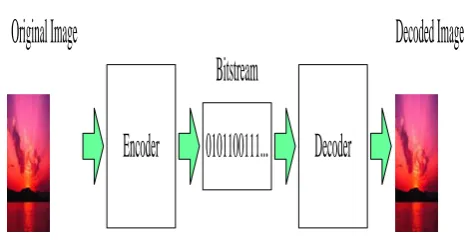
Image compression is considered as one of the interesting and growing it’s importance in both the fields of image and signal processing or more broadly in the field of multimedia. The basic aim behind the compression of image is to represent the image with the less no of pixels or how the image can be represented with the less no of bits. In other words Image compression is an application of data compression that encodes the original image with few bits. The objective of image compression is to reduce the redundancy in the image and to store or transmit data in an efficient form. In this framework, an original image is analyzed at the encoder side so that portions of the image are intentionally and automatically skipped. Instead, some information is extracted from these skipped regions and delivered to the decoder as assistant information in the compressed fashion. The delivered assistant information plays a key role in the proposed framework because it guides image in painting to accurately restore these regions at the decoder side. Moreover, to fully take advantage of the assistant information, a compression-oriented edge-based in painting algorithm is proposed for image restoration, integrating pixel-wise structure propagation and patch-wise texture synthesis. A practical system to verify the effectiveness of the compression approach in which edge map serves as assistant information and the edge extraction and region removal approaches are developed accordingly is also constructed. In the second method of down-sampled profiteered image remains a conventional square sample grid and it can be compressed and transmitted without any change to current image coding standards and systems. The decoder first decompresses the low-resolution image and then upconverts it to the original resolution in a constrained least squares restoration process, using a 2-D piecewise autoregressive model and the knowledge of directional low-pass prefiltering is applied to it.
Figure 1.1The basic flow of image compression coding
II. BACKROUND
Besides statistical redundancy, visual redundancy in videos and images has also been considered in several works. They are motivated by the generally accepted fact that minimizing overall pixel-wise distortion, such as mean square error (MSE), is not able to guarantee good perceptual quality of reconstructed visual objects, especially in low bit-rate scenarios. Thus, the human vision system (HVS) has been incorporated into compression schemes, trying to remove some visual redundancy and to improve coding efficiency as well as visual quality. Moreover, attempts have been made to develop compression techniques by identifying and utilizing features within images to achieve high coding efficiency.
The sign bit model has three distinct symbols and the magnitude model contains 65 symbols. A first-order adaptive arithmetic coding in entropy coding, the prediction errors are coded using separate entropy models for the sign bit and the magnitude. The sign bit model has three distinct symbols and the magnitude model contains 65 symbols.
All existing image codec’s of this type were developed for DCT-based image compression, therefore to overcome this problem an improvement is made the CADU using Low Bit-Rate Image Compression via Adaptive Down-Sampling and Constrained Least Squares Up conversion method is developed which is applicable to wavelet-based codec’s as well. There are some block-based image coding approaches proposed in early times in which the DCT-based image
Encoder
0101100111...
Decoder
Original Image
Decoded Image
coder does have comparable peak signal-to-noise ratio (PSNR) performance with that of wavelet coder. Hence a new significant map coding strategy for a DCT-based SPIHT coder approach is proposed. Rather than scaling down the redundancy in the color domain for some DWT-based methods the proposed method aims at reducing the redundancy caused by the similarity among the transformed coefficients of image blocks at different spatial locations. Combined significance map coding (CSMC) encodes the combined blocks. Otherwise, they will be encoded separately. However, to find similar blocks in an image takes lots of computation time. A fast analysis algorithm can be integrated with CSMC to determine whether the combined coding scheme should be applied, without using other coding tools such as re-ordering, intra prediction and RDO, CSMC is compared with H.264-I and JPEG2000. It yields constant improvement over SPIHT and JPEG2000, and even outperforms the H.264 intra-mode coder for some test images.
Previous image compression approaches deals with DCT based image coder that have comparable peak signal to noise ratio (PSNR) performance with that of the wavelet coder.
III. PREVIOUS WORK
An image compression framework provides visual quality rather than pixel-wise fidelity. In this framework, an original image is analyzed at the encoder side so that portions of the image are intentionally and automatically skipped. Instead, some information is extracted from these skipped regions and delivered to the decoder as assistant information in the compressed fashion. The delivered assistant information plays a key role in the proposed framework because it guides image in painting to accurately restore these regions at the decoder side [1].
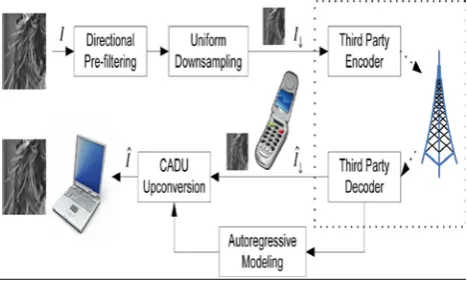
Another image compression techniques provides practical approach of uniform down sampling in image space and yet making the sampling adaptive by spatially varying, directional low-pass profiteering. The resulting down-sampled pre filtered image remains a conventional square sample grid, and, thus, it can be compressed and transmitted without any change to current image coding standards and systems. The decoder first decompresses the low-resolution image and then up converts it to the original resolution in a constrained least squares restoration process, using a 2-D piecewise autoregressive model and the knowledge of directional low-pass pre filtering is then applied to it [2].
Combined significance map coding (CSMC) to improve the coding efficiency of SPIHT when used with block-based discrete cosine transform (DCT). CSMC groups some blocks and encodes the combined significance map of one to several blocks together. Lots of bits spent in significance map coding can be saved when the trees constructed with block DCT coefficients have similar locality. From simulation results, CSMC improves significantly when in comparison with the original SPIHT coder using DWT and DCT [3].
IV. EXISTING METHODOLOGIES
A number of techniques have been implemented for image compression using different constraints and different
parameters like Pixel level coding, Predictive coding techniques, Transform-based image compression techniques Hybrid coding, DPCM based coding, Inter frame coding and so on. There are different methodologies that are implemented for image compression Edge based imprinting, Adaptive Down-Sampling and Constrained Least Squares Up conversion, Combined significance map coding for still image compression, Bi- level image compression using neural network etc.
Figure 1.2 Image compression with edge based im painting
In another approach of CADU encoder method of uniform down sampling, Out of the practical consideration the more compact representation of an image by decimating every other row and every other column of image.
Figure 1.3 CADU encoder of uniform down sampling with adaptive direction prefiltering
V. ANALYSIS & DISCUSSION
various for different images. The more complicated the image is the less gain can be provided. If the coding image has lots of details, the extracted edge map usually contains miscellaneous edges which make many blocks as necessary exemplars. Thus, only a limited no of regions can be removed however, 15% of bit saving is still provided by this JPEG based system without noticeable visual loss. The computational complexity of this scheme is relatively higher than that of the traditional coding schemes since at the encoder side extra edge extraction and exemplar selection is performed and at the decoder side impainting process is added.
By using the following function the redundancy is removed in the given image in which only one pixel is taken out of eight boring pixel.
In this method emphasis is given that the thinning process should not shorten the edge, thus only redundant pixels on the edge can be removed.
If a good metric is used to measure visual quality one can able to not only better evaluate this scheme but also further improvement in the performance rate distortion optimization is also possible, where distortion measures the perceptual quality in addition to statistical fidelity. Thus for visual quality comparison this enhancement scheme gives good parameter for image compression. The exemplar regions will have the same quality also additionally restored regions still have acceptable visual quality.
In low bit rate approach comparison is made between CADU with adaptive down sampling based image coder proposed by Lin and Dong. All the image codecs of this type were developed for DCT based image compression while the CADU method is applicable for the wavelet based codecs as well. Comparative study of JPEG 2000, quincunx coding method and method of uniform downsampling is also experimented. The main difference is in the upconversion process, the former method perform bicubic image interpolation followed by deconvolution step using wiener filter to reverse the pre filtering instead of solving a constrained least squares for image restoration problem.
The superior visual quality CADU J2K is due to the good fit of the piecewise autoregressive model to the edge structures and the fact that human visual system is highly sensitive to phase errors in reconstructed edges. CADU J2K image coding approach of down sampling with directional prefiltering at the encoder and edges preserving at the decoder offers an effective and punctual solution for subjective image coding.
CSMC owns a scalability property that is useful in bandwidth functioning environment. CSMC is regarded as one of the coding tools of DCT_SPIHT like intra prediction and RDO tools of H.246-1. By grouping few blocks together when the trees are constrained with DCT coefficients of these blocks have similar locality lots of bits are spent in significance map coding and can be accordingly saved. CSMC supports neither resolution scalability nor random spatial access provided by JPEG 2000.
CSMC has better performance than DCT_SPIHT, DWT_SPIHT and JPEG 2000 in all cases. CSMC is little bit inferior to the H.264-1 in [Leena] and [Baboon] but outperforms in H.264-1 in other images. CSMC is superior
to JPEG 2000 in all cases. And it even gives 0.8dB of improvement in [Barbara] Moreover when the comparison is in between Original DCT_SPIHT and CSMC, CSMC yields improvement for more than 0.8dB in most cases. In addition CSMC still owns scalability property that is useful in bandwidth fluctuating environment
VI. PROPOSSED METHODOLOGY
The first and most important thing to note in all above methods is the problem of the oversampling which can be removed with the use of specialised filters, which filters the unwanted frequencies and only desirable frequency can be obtained. Due to the removal of unwanted frequencies in image the quality of compressed image will be enhanced.
The second interesting problem is of visual redundancy which is present in the image and can be removed using following framework so, we propose an image coding framework in which currently developed vision techniques are incorporated with traditional transform-based coding methods to exploit visual redundancy in images, so that it can be removed effectively.
In our work two different approaches of edge preserving lossy image compression are incorporated with the aim of increasing compression ratio and picture quality in order to meet the challenges of achieving even high compression ratio following frame work should be implemented which also makes the system more convenient and efficient for user and the performance of the system can be increased beyond the expectations.
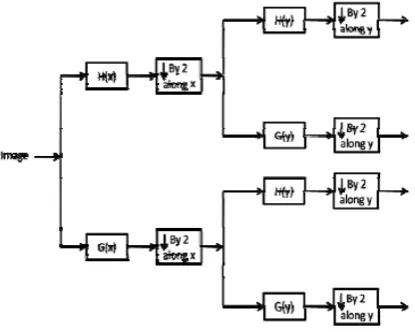
Figure 1.4 Two level decomposition using DWT
Along with the better image quality the better method of processing the image should be made out. In the transform-based compression techniques, the cost function is the energy of frequency contents of the image, which is concentrated in the lower values. Compression is achieved through the elimination of the higher energy or frequency values, which are less concentrated and therefore deemed less important
The two approaches which are suggested to be used in the image compression are as shown below:
A. Decomposition of edges without transformation
(dewt):
edges are down sampled twice and then transmitted as a vector representing the position of the images. The compressed image is reconstructed using the Inverse Discrete Wavelet Transform. The compression ratio is calculated between the compressed image and the original image. The PSNR value for an image is calculated at the reconstruction side between the reconstructed image and the original image. Following fig. shows the overall process flow.
Figure 1.5 Process flow of DEWT
B. Preservation of edges entirely (pee):
In this methodology, edges are preserved entirely without any distortion in it. The useful coordinates of the edge images are taken for processing. The original image is made to get subjected to the two levels of decompositions using Haar DWT. The valuable edge coordinates and decomposed image are used for reconstruction. At the reconstruction side, the Inverse Discrete Wavelet Transform is applied for two levels for the compressed image. Finally the edge image reconstructed from the edge coordinates are mapped with the reconstructed image. The compression ratio is calculated between the compressed image and the original image. The PSNR value for an image is calculated at the reconstruction side between the reconstructed image and the original image. Fig. 1.6 shows the overall process flow. The comparison between the existing method and proposed methods are shown in table1. The table shows that the proposed ‘PEE’ preserves the image quality without compensating the compression ratio.
Figure 1.6 Process flow of PEE
Table 1 showing comparisons
Above table shows the comparison between the existing methods and proposed method.
VII. POSSIBLE OUTCOME AND RESULTS
In the proposed methods two error metrics used to compare various image compression techniques are the Mean Square Error (MSE) and Peak Signal to Noise Ratio (PSNR) The MSE is the cumulative squared error between the compressed and original image whereas the PSNR is a measure of peak error and as seen in the inverse relation between the MSE and PSNR. This translates to a high value of PSNR. A higher value of PSNR is good because it means that the ratio of Signal to Noise is higher, here Signal is the original image and noise is the error in the reconstruction. So, a compression scheme having a lower MSE (and higher PSNR) can be recognised and better one.
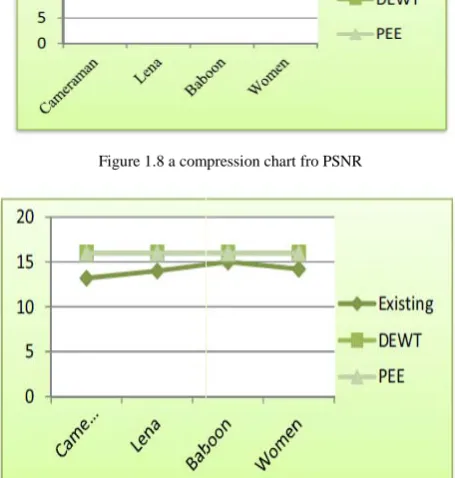
Fig 1.8 and 1.9 shows the performance comparisons between proposed method and existing methods proposed method outperforms the existing methods in terms of PSNR and compression ratio
Figure 1.8 a compression chart fro PSNR
Figure 1.9 b comparison chart for Compression Ratio
to -noise ratio values. In the proposed approaches both the edges and transformed coefficients positions are mapped appropriately with the intent to increase the compression ratio. From the comparison table and results, we can infer that both the proposed approaches outperform the existing method in terms of compression ratio and PSNR. The further works that can be carried out by selecting the appropriate coding method and better transformation to increase the peak signal- to noise ratio value and the compression ratio other parameters can also be taken in to consideration for analysis.
VIII. CONCLUSION
This paper presented a analysis of different image compression techniques used in the different fields of Computer graphics, medical images and Computer vision. It is very important and useful to analyze all the techniques for future purposes and inventions of new techniques. In this review of image compression study, the overview of various compression methodologies applied for digital image processing is explained briefly. The study also reviews the research on various research methodologies applied for image compression and various research issues in this field of study. In this Analytical paper, three methodologies are studied i.e. Edge based image impainting, Method of CADU encoder used for low bit rate and Combined significance map coding for still images.
The above mentioned method presents good results especially on extracting intersection edges. The reconstructed quality of structural regions is less sensitive to the additional structural exemplar ratio. All existing image codec’s of this type were developed for DCT-based image compression, whereas the CADU method is applicable to wavelet-based codecs as well. At low rates, the CADU-J2K method achieves up to 0.5 dB higher PSNR than JPEG 2000. CSMC improves significantly when in comparison with the original SPIHT coder using DWT and DCT. It also yields better performance than JPEG2000, and even outperforms the non-scalable H.264 intra-mode coder for some test images. The great advantage of these methods is that no coding table is required Some drawbacks of these methods includes, some of the regions of an image are skipped during encoding. Secondly, these methods require a much more expensive, nonstandard encoder. The proposed approach tries to fix these pitfalls to a great extent and tries
to provide much more effective and efficient results than the existing methodologies
Hence, this approach is extensively used in technologies in computer vision as well as computer Graphics and is also a useful enhancer of any existing image compression standard for improved low bit-rate performance. It is also used to improve the coding efficiency of SPIHT when used with block-based discrete cosine transform (DCT
IX. FUTURE SCOPE
Further improvements in these current schemes are still promising. First, the assistant information as well as the selected exemplars can be described and compressed into bit-stream in more compact fashion. Second, extraction of the distinctive features can be more flexible and adaptable. Besides edge information, there are other candidates, such as sketch and epitome which could be derived from source images to assist the vision technologies and the compression methods as well. In future the more efficient sampling methods are expected which will increase the compression ratio and with no information loss. Future research directions closely related to CSMC may include (I) developing an algorithm to find optimal GOB configuration for a specific image; instead of applying the greedy approach in each coding level; (II) designing an RDO-based algorithm for CSMC, such as how to distribute the side information to the total coding bits to achieve the best coding efficiency; (III) reducing the overhead caused during computation in CSMC
X. REFERENCES
[1]. Dong Liu, Xiaoyan Sun, Feng Wu, Senior, Shipeng Li, Member, IEEE, and Ya-Qin Zhang ,“Image Compression With Edge-Based Inpainting” ,IEEE Transactions on Circuits and Systems for Video Technology Vol. 17, No. 10,PP .620 to 638.October 2007.
[2]. Xiaolin Wu, Senior Member, IEEE, Xiangjun Zhang, and Xiaohan Wang. “Low Bit-Rate Image Compression via Adaptive Down-Sampling and Constrained Least Squares Up conversion”, IEEE Transactions on Image Processing. Vol. 18, No. 3, PP. 552 to 561. March 2009.