On the Complexity of Non-Projective Data-Driven Dependency Parsing
Ryan McDonald
Google Inc. 76 Ninth Avenue New York, NY 10028 [email protected]
Giorgio Satta
University of Padua via Gradenigo 6/A I-35131 Padova, Italy [email protected]
Abstract
In this paper we investigate several non-projective parsing algorithms for depen-dency parsing, providing novel polynomial time solutions under the assumption that each dependency decision is independent of all the others, called here the edge-factored model. We also investigate algorithms for projective parsing that account for non-local information, and present several hard-ness results. This suggests that it is unlikely that exact non-projective dependency pars-ing is tractable for any model richer than the edge-factored model.
1 Introduction
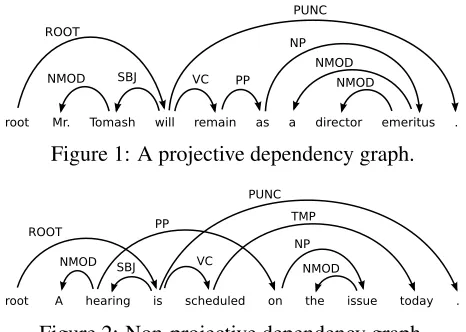
Dependency representations of natural language are a simple yet flexible mechanism for encoding words and their syntactic dependencies through directed graphs. These representations have been thoroughly studied in descriptive linguistics (Tesni`ere, 1959; Hudson, 1984; Sgall et al., 1986; Me´lˇcuk, 1988) and have been applied in numerous language process-ing tasks. Figure 1 gives an example dependency graph for the sentenceMr. Tomash will remain as a director emeritus, which has been extracted from the Penn Treebank (Marcus et al., 1993). Each edge in this graph represents a single syntactic dependency directed from a word to its modifier. In this rep-resentation all edges are labeled with the specific syntactic function of the dependency, e.g., SBJ for subject and NMOD for modifier of a noun. To sim-plify computation and some important definitions,
an artificial token is inserted into the sentence as the left most word and will always represent the root of the dependency graph. We assume all dependency graphs are directed trees originating out of a single node, which is a common constraint (Nivre, 2005).
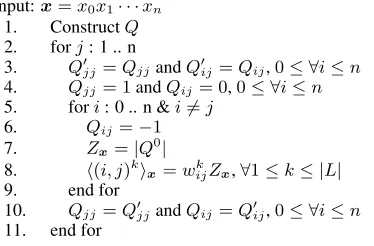
The dependency graph in Figure 1 is an exam-ple of a nested or projectivegraph. Under the as-sumption that the root of the graph is the left most word of the sentence, a projective graph is one where the edges can be drawn in the plane above the sen-tence with no two edges crossing. Conversely, a non-projective dependency graph does not satisfy this property. Figure 2 gives an example of a non-projective graph for a sentence that has also been extracted from the Penn Treebank. Non-projectivity arises due to long distance dependencies or in lan-guages with flexible word order. For many lan-guages, a significant portion of sentences require a non-projective dependency analysis (Buchholz et al., 2006). Thus, the ability to learn and infer non-projective dependency graphs is an important prob-lem in multilingual language processing.
Syntactic dependency parsing has seen a num-ber of new learning and inference algorithms which have raised state-of-the-art parsing accuracies for many languages. In this work we focus on data-drivenmodels of dependency parsing. These models are not driven by any underlying grammar, but in-stead learn to predict dependency graphs based on a set of parameters learned solely from a labeled corpus. The advantage of these models is that they negate the need for the development of grammars when adapting the model to new languages.
One interesting class of data-driven models are
Figure 1: A projective dependency graph.
Figure 2: Non-projective dependency graph.
those that assume each dependency decision is in-dependent modulo the global structural constraint that dependency graphs must be trees. Such mod-els are commonly referred to asedge-factoredsince their parameters factor relative to individual edges of the graph (Paskin, 2001; McDonald et al., 2005a). Edge-factored models have many computa-tional benefits, most notably that inference for non-projective dependency graphs can be achieved in polynomial time (McDonald et al., 2005b). The pri-mary problem in treating each dependency as in-dependent is that it is not a realistic assumption. Non-local information, such as arity (or valency) and neighbouring dependencies, can be crucial to obtaining high parsing accuracies (Klein and Man-ning, 2002; McDonald and Pereira, 2006). How-ever, in the data-driven parsing setting this can be partially adverted by incorporating rich feature rep-resentations over the input (McDonald et al., 2005a). The goal of this work is to further our current understanding of the computational nature of non-projective parsing algorithms for both learning and inference within the data-driven setting. We start by investigating and extending the edge-factored model of McDonald et al. (2005b). In particular, we ap-peal to the Matrix Tree Theorem for multi-digraphs to design polynomial-time algorithms for calculat-ing both the partition function and edge expecta-tions over all possible dependency graphs for a given sentence. To motivate these algorithms, we show that they can be used in many important learning and inference problems including min-risk decod-ing, training globally normalized log-linear mod-els, syntactic language modeling, and unsupervised
learning via the EM algorithm – none of which have previously been known to have exact non-projective implementations.
We then switch focus to models that account for non-local information, in particular arity and neigh-bouring parse decisions. For systems that model ar-ity constraints we give a reduction from the Hamilto-nian graph problem suggesting that the parsing prob-lem is intractable in this case. For neighbouring parse decisions, we extend the work of McDonald and Pereira (2006) and show that modeling vertical neighbourhoods makes parsing intractable in addi-tion to modeling horizontal neighbourhoods. A con-sequence of these results is that it is unlikely that exact non-projective dependency parsing is tractable for any model assumptions weaker than those made by the edge-factored models.
1.1 Related Work
There has been extensive work on data-driven de-pendency parsing for both projective parsing (Eis-ner, 1996; Paskin, 2001; Yamada and Matsumoto, 2003; Nivre and Scholz, 2004; McDonald et al., 2005a) and non-projective parsing systems (Nivre and Nilsson, 2005; Hall and N´ov´ak, 2005; McDon-ald et al., 2005b). These approaches can often be classified into two broad categories. In the first cat-egory are those methods that employ approximate inference, typically through the use of linear time shift-reduce parsing algorithms (Yamada and Mat-sumoto, 2003; Nivre and Scholz, 2004; Nivre and Nilsson, 2005). In the second category are those that employ exhaustive inference algorithms, usu-ally by making strong independence assumptions, as is the case for edge-factored models (Paskin, 2001; McDonald et al., 2005a; McDonald et al., 2005b). Recently there have also been proposals for exhaus-tive methods that weaken the edge-factored assump-tion, including both approximate methods (McDon-ald and Pereira, 2006) and exact methods through in-teger linear programming (Riedel and Clarke, 2006) or branch-and-bound algorithms (Hirakawa, 2006).
mini-mal dependency grammar is hard. In addition, the work of Kahane et al. (1998) provides a polynomial parsing algorithm for a constrained class of non-projective structures. Non-projective dependency parsing can be related to certain parsing problems defined for phrase structure representations, as for instance immediate dominance CFG parsing (Barton et al., 1987) and shake-and-bake translation (Brew, 1992).
Independently of this work, Koo et al. (2007) and Smith and Smith (2007) showed that the Matrix-Tree Theorem can be used to train edge-factored log-linear models of dependency parsing. Both stud-ies constructed implementations that compare favor-ably with the state-of-the-art. The work of Meil˘a and Jaakkola (2000) is also of note. In that study they use the Matrix Tree Theorem to develop a tractable bayesian learning algorithms for tree belief networks, which in many ways are closely related to probabilistic dependency parsing formalisms and the problems we address here.
2 Preliminaries
LetL = {l1, . . . , l|L|} be a set of permissible
syn-tactic edge labels and x = x0x1· · ·xn be a
sen-tence such thatx0=root. From this sentence we
con-struct a complete labeled directed graph (digraph)
Gx = (Vx, Ex)such that,
• Vx ={0,1, . . . , n}
• Ex={(i, j)k| ∀i, j∈Vxand1≤k≤ |L|}
Gx is a graph where each word in the sentence is a node, and there is a directed edge between every pair of nodes for every possible label. By its definition,
Gx is a multi-digraph, which is a digraph that may
have more than one edge between any two nodes. Let(i, j)krepresent thekthedge fromitoj.Gx
en-codes all possible labeled dependencies between the words ofx. Thus every possible dependency graph ofxmust be a subgraph ofGx.
Leti →+ j be a relation that is true if and only
if there is a non-empty directed path from nodeito node j in some graph under consideration. A di-rected spanning tree1 of a graph G, that originates
1
A directed spanning tree is commonly referred to as a ar-borescence in the graph theory literature.
out of node0, is any subgraphT = (VT, ET)such
that,
• VT =Vx andET ⊆Ex
• ∀j∈VT,0→+jif and only ifj6= 0
• If(i, j)k ∈ ET, then(i0, j)k
0
/
∈ ET, ∀i0 6= i
and/ork0 6=k.
DefineT(G)as the set of all directed spanning trees for a graphG. As McDonald et al. (2005b) noted, there is a one-to-one correspondence between span-ning trees of Gx and labeled dependency graphs
ofx, i.e., T(Gx) is exactly the set of all possible projective and non-projective dependency graphs for sentence x. Throughout the rest of this paper, we will refer to anyT ∈T(Gx)as a valid dependency graph for a sentencex. Thus, by definition, every valid dependency graph must be a tree.
3 Edge-factored Models
In this section we examine the class of models that assume each dependency decision is independent. Within this setting, every edge in an induced graph
Gxfor a sentencexwill have an associated weight wkij ≥0that maps thekth directed edge from node
ito nodejto a real valued numerical weight. These weights represents the likelihood of a dependency occurring from word wi to word wj with labellk. Define the weight of a spanning treeT = (VT, ET)
as the product of the edge weights
w(T) = Y
(i,j)k∈E T
wijk
It is easily shown that this formulation includes the projective model of Paskin (2001) and the non-projective model of McDonald et al. (2005b).
The definition of wk
ij depends on the context in
which it is being used. For example, in the work of McDonald et al. (2005b) it is simply a linear classi-fier that is a function of the words in the dependency, the label of the dependency, and any contextual fea-tures of the words in the sentence. In a generative probabilistic model (such as Paskin (2001)) it could represent the conditional probability of a word wj
being generated with a labellk given that the word
being modified iswi (possibly with some other
or the number of words betweenwiandwj). We will
attempt to make any assumptions about the formwk ij
clear when necessary.
For the remainder of this section we discuss three crucial problems for learning and inference while showing that each can be computed tractably for the non-projective case.
3.1 Finding the Argmax
The first problem of interest is finding the highest weighted tree for a given input sentencex
T = argmax
T∈T(Gx) Y
(i,j)k∈E T
wijk
McDonald et al. (2005b) showed that this can be solved in O(n2) for unlabeled parsing using the Chu-Liu-Edmonds algorithm for standard digraphs (Chu and Liu, 1965; Edmonds, 1967). Unlike most exact projective parsing algorithms, which use effi-cient bottom-up chart parsing algorithms, the Chu-Liu-Edmonds algorithm is greedy in nature. It be-gins by selecting the single best incoming depen-dency edge for each nodej. It then post-processes the resulting graph to eliminate cycles and then con-tinues recursively until a spanning tree (or valid dependency graph) results (see McDonald et al. (2005b) for details).
The algorithm is trivially extended to the multi-digraph case for use in labeled dependency parsing. First we note that if the maximum directed spanning tree of a multi-digraphGxcontains any edge(i, j)k, then we must havek = k∗ = argmaxkwkij. Oth-erwise we could simply substitute (i, j)k∗ in place of(i, j)kand obtain a higher weighted tree. There-fore, without effecting the solution to the argmax problem, we can delete all edges inGx that do not satisfy this property. The resulting digraph is no longer a multi-digraph and the Chu-Liu-Edmonds algorithm can be applied directly. The new runtime isO(|L|n2).
As a side note, thek-best argmax problem for di-graphs can be solved in O(kn2) (Camerini et al., 1980). This can also be easily extended to the multi-digraph case for labeled parsing.
3.2 Partition Function
A common step in many learning algorithms is to compute the sum over the weight of all the
possi-ble outputs for a given inputx. This value is often referred to as thepartition functiondue to its sim-ilarity with a value by the same name in statistical mechanics. We denote this value asZx,
Zx= X
T∈T(Gx)
w(T) = X
T∈T(Gx) Y
(i,j)k∈E T
wki,j
To compute this sum it is possible to use the Matrix Tree Theorem for multi-digraphs,
Matrix Tree Theorem (Tutte, 1984): Let G be a multi-digraph with nodes V = {0,1, . . . , n} and edges E. Define (Laplacian) matrix Q as a (n+ 1)×(n+ 1) matrix indexed from 0 to n. For alliand
j, define:
Qjj = X
i6=j,(i,j)k∈E
wkij & Qij = X
i6=j,(i,j)k∈E
−wijk
If the ith row and column are removed from Q to produce the matrixQi, then the sum of the weights of all directed spanning trees rooted at nodeiis equal to|Qi|(the determinant ofQi).
Thus, if we constructQfor a graphGx, then the de-terminant of the matrixQ0is equivalent toZx. The
determinant of ann×nmatrix can be calculated in numerous ways, most of which takeO(n3)(Cormen et al., 1990). The most efficient algorithms for cal-culating the determinant of a matrix use the fact that the problem is no harder than matrix multiplication (Cormen et al., 1990). Matrix multiplication cur-rently has known O(n2.38) implementations and it
has been widely conjectured that it can be solved in
O(n2)(Robinson, 2005). However, most algorithms with sub-O(n3)running times require constants that
are large enough to negate any asymptotic advantage for the case of dependency parsing. As a result, in this work we useO(n3)as the runtime for comput-ingZx.
Since it takesO(|L|n2)to construct the matrixQ, the entire runtime to computeZx isO(n3+|L|n2).
3.3 Edge Expectations
Another important problem for various learning paradigms is to calculate the expected value of each edge for an input sentencex,
h(i, j)kix= X
T∈T(Gx)
Input:x=x0x1· · ·xn
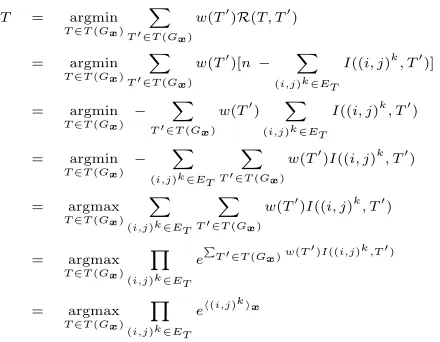
1. ConstructQ O(|L|n2)
2. forj: 1 .. n O(n)
3. Q0jj=QjjandQ0ij=Qij,0≤ ∀i≤n O(n)
4. Qjj= 1andQij= 0,0≤ ∀i≤n O(n)
5. fori: 0 .. n &i6=j O(n)
6. Qij=−1 O(1)
7. Zx=|Q0| O(n3)
8. h(i, j)kix=wijkZx,∀1≤k≤ |L| O(|L|) 9. end for
10. Qjj=Q0jjandQij=Q0ij,0≤ ∀i≤n O(n)
[image:5.612.76.263.61.184.2]11. end for
Figure 3: Algorithm to calculate h(i, j)kix in
O(n5+|L|n2).
where I((i, j)k, T) is an indicator function that is one when the edge(i, j)kis in the treeT.
To calculate the expectation for the edge (i, j)k, we can simply eliminate all edges(i0, j)k0 6= (i, j)k
from Gx and calculate Zx. Zx will now be equal
to the sum of the weights of all trees that con-tain (i, j)k. A naive implementation to compute the expectation of all|L|n2edges takesO(|L|n5+
|L|2n4), since calculatingZx takesO(n3 +|L|n2)
for a single edge. However, we can reduce this con-siderably by constructingQa single time and only making modifications to it when necessary. An al-gorithm is given in Figure 3.3 that has a runtime of
O(n5+|L|n2). This algorithm works by first con-structingQ. It then considers edges from the nodei
to the nodej. Now, assume that there is only a single edge fromitojand that that edge has a weight of1. Furthermore assume that this edge is the only edge directed into the node j. In this case Qshould be modified so thatQjj = 1,Qij =−1, andQi0j = 0,
∀i0 6=i, j(by the Matrix Tree Theorem). The value of Zx under this new Q will be equivalent to the weight of all trees containing the single edge fromi
tojwith a weight of 1. For a specific edge(i, j)kits
expectation is simplywkijZx, since we can factor out the weight 1 edge fromitojin all the trees that con-tribute toZxand multiply through the actual weight
for the edge. The algorithm then reconstructs Q and continues.
Following the work of Koo et al. (2007) and Smith and Smith (2007), it is possible to compute all ex-pectations inO(n3 +|L|n2) through matrix inver-sion. To make this paper self contained, we report here their algorithm adapted to our notation. First,
consider the equivalence,
∂logZx ∂wijk =
∂logZx ∂Zx
∂Zx ∂wkij
= 1
Zx X
T∈T(Gx) w(T)
wkij ×I((i, j) k, T)
As a result, we can re-write the edge expectations as,
h(i, j)ki=Zxwijk∂logZx
∂wkij =Zxw k ij
∂log|Q0|
∂wkij
Using the chain rule, we get,
∂log|Q0| ∂wkij =
X
i0,j0≥1
∂log|Q0| ∂(Q0)
i0j0
∂(Q0)i0j0
∂wijk
We assume the rows and columns of Q0 are in-dexed from 1 so that the indexes of QandQ0 co-incide. To calculateh(i, j)kiwheni, j >0, we can use the fact that∂log|X|/Xij = (X−1)ji and that ∂(Q0)i0j0/∂wk
ij is non zero only when i0 = iand j0 =jori0=j0 =jto get,
h(i, j)ki=Zxwkij[((Q0)−1)jj −((Q0)−1)ji]
Wheni = 0andj > 0the only non zero term of this sum is wheni0 =j0 =jand so
h(0, j)ki=Zxw0kj((Q0)−1)jj
Zxand(Q0)−1can both be calculated a single time,
each takingO(n3). Using these values, each expec-tation is computed inO(1). Coupled with with the fact that we need to construct Q and compute the expectation for all |L|n2 possible edges, in total it takes O(n3 +|L|n2) time to compute all edge ex-pectations.
Projective Non-Projective
argmax O(n3+|L|n2) O(|L|n2)
Zx O(n3+|L|n2) O(n3+|L|n2)
[image:6.612.318.538.359.530.2]h(i, j)kix O(n3+|L|n2) O(n3+|L|n2)
Table 1: Comparison of runtime for non-projective and projective algorithms.
edge expectation. Crucially, the nested property of projective structures allows edge expectations to be computed in O(n3)from the inside-outside values. It is straight-forward to extend the algorithms of Eis-ner (1996) and Paskin (2001) to the labeled case adding only a factor ofO(|L|n2).
Table 1 gives an overview of the computational complexity for the three problems considered here for both the projective and non-projective case. We see that the non-projective case compares favorably for all three problems.
4 Applications
To motivate the algorithms from Section 3, we present some important situations where each cal-culation is required.
4.1 Inference Based Learning
Many learning paradigms can be defined as inference-based learning. These include the per-ceptron (Collins, 2002) and its large-margin vari-ants (Crammer and Singer, 2003; McDonald et al., 2005a). In these settings, a models parameters are iteratively updated based on the argmax calculation for a single or set of training instances under the current parameter settings. The work of McDon-ald et al. (2005b) showed that it is possible to learn a highly accurate non-projective dependency parser for multiple languages using the Chu-Liu-Edmonds algorithm for unlabeled parsing.
4.2 Non-Projective Min-Risk Decoding
In min-risk decoding the goal is to find the depen-dency graph for an input sentencex, that on average has the lowest expected risk,
T = argmin
T∈T(Gx) X
T0∈T(G
x)
w(T0)R(T, T0)
whereR is a risk function measuring the error be-tween two graphs. Min-risk decoding has been
studied for both phrase-structure parsing and depen-dency parsing (Titov and Henderson, 2006). In that work, as is common with many min-risk decoding schemes, T(Gx) is not the entire space of parse
structures. Instead, this set is usually restricted to a small number of possible trees that have been pre-selected by some baseline system. In this subsection we show that when the risk function is of a specific form, this restriction can be dropped. The result is an exact min-risk decoding procedure.
LetR(T, T0) be the Hamming distance between two dependency graphs for an input sentencex =
x0x1· · ·xn,
R(T, T0) =n − X
(i,j)k∈E T
I((i, j)k, T0)
This is a common definition of risk between two graphs as it corresponds directly to labeled depen-dency parsing accuracy (McDonald et al., 2005a; Buchholz et al., 2006). Some algebra reveals,
T = argmin
T∈T(Gx) X
T0 ∈T(Gx)
w(T0)R(T , T0)
= argmin
T∈T(Gx) X
T0 ∈T(Gx)
w(T0)[n − X (i,j)k∈ET
I((i, j)k, T0)]
= argmin
T∈T(Gx)
− X
T0 ∈T(Gx)
w(T0) X
(i,j)k∈ET
I((i, j)k, T0)
= argmin
T∈T(Gx)
− X
(i,j)k∈ET
X
T0 ∈T(Gx)
w(T0)I((i, j)k, T0)
= argmax
T∈T(Gx) X
(i,j)k∈ET
X
T0 ∈T(Gx)
w(T0)I((i, j)k, T0)
= argmax
T∈T(Gx) Y
(i,j)k∈ET
e P
T0 ∈T(Gx)w(T0)I((i,j)k ,T0)
= argmax
T∈T(Gx) Y
(i,j)k∈ET
eh(i,j)kix
By setting the edge weights to wijk = eh(i,j)kix we
can directly solve this problem using the edge ex-pectation algorithm described in Section 3.3 and the argmax algorithm described in Section 3.1.
4.3 Non-Projective Log-Linear Models
nor-malized log-linear model,
p(T|x) =
Q
(i,j)k∈E Te
w·f(i,j,k)
P T0∈T(G
x) Q
(i,j)k∈E T0e
w·f(i,j,k)
=
Q
(i,j)k∈E
Tw
k ij P
T0∈T(G
x) Q
(i,j)k∈E T0w
k ij
= w(T)
Zx
Here, the weights wkij are potential functions over each edge defined as an exponentiated linear classi-fier with weight vectorw ∈ RN and feature vector
f(i, j, k) ∈ RN, wherefu(i, j, k) ∈
Rrepresents a
single dimension of the vectorf. The denominator, which is exactly the sum over all graph weights, is a normalization constant forcing the conditional prob-ability distribution to sum to one.
CRFs set the parameterswto maximize the log-likelihood of the conditional probability over a train-ing set of examplesT ={(xα, Tα)}
|T | α=1,
w= argmax
w
X
α
log p(Tα|xα)
This optimization can be solved through a vari-ety of iterative gradient based techniques. Many of these require the calculation of feature expecta-tions over the training set under model parameters for the previous iteration. First, we note that the feature functions factor over edges, i.e., fu(T) =
P
(i,j)k∈E
T fu(i, j, k). Because of this, we can use
edge expectations to compute the expectation of ev-ery featurefu. Lethfuixα represent the expectation
of featurefufor the training instancexα,
hfuixα =
X
T∈T(Gxα)
p(T|xα)fu(T)
= X
T∈T(Gxα)
p(T|xα)
X
(i,j)k∈ET
fu(i, j, k)
= X
T∈T(Gxα)
w(T)
Zx X
(i,j)k∈ET
fu(i, j, k)
= 1
Zx X
(i,j)k∈Exα
X
T∈T(Gx)
w(T)I((i, j)k, T)fu(i, j, k)
= 1
Zx X
(i,j)k∈Exα
h(i, j)kixαfu(i, j, k)
Thus, we can calculate the feature expectation per training instance using the algorithms for comput-ing Zx and edge expectations. Using this, we can
calculate feature expectations over the entire train-ing set,
hfuiT =
X
α
p(xα)hfuixα
wherep(xα)is typically set to1/|T |.
4.4 Non-projective Generative Parsing Models A generative probabilistic dependency model over some alphabet Σconsists of parameters pk
x,y
asso-ciated with each dependency from word x ∈ Σto wordy ∈ Σwith labellk ∈L. In addition, we
im-pose0≤pk
x,y ≤1and the normalization conditions P
y,kpkx,y = 1 for eachx ∈ Σ. We define a
gen-erative probability model pover trees T ∈ T(Gx)
and a sentencex = x0x1· · ·xnconditioned on the
sentence length, which is always known,
p(x, T|n) = p(x|T, n)p(T|n)
= Y
(i,j)k∈E T
pkxi,xj p(T|n)
We assume thatp(T|n) =βis uniform. This model is studied specifically by Paskin (2001). In this model, one can view the sentence as being generated recursively in a top-down process. First, a tree is generated from the distributionp(T|n). Then start-ing at the root of the tree, every word generates all of its modifiers independently in a recursive breadth-first manner. Thus, pkx,y represents the probability of the word x generating its modifier y with label
lk. This distribution is usually smoothed and is
of-ten conditioned on more information including the orientation of x relative toy (i.e., to the left/right) and distance between the two words. In the super-vised setting this model can be trained with maxi-mum likelihood estimation, which amounts to sim-ple counts over the data. Learning in the unsuper-vised setting requires EM and is discussed in Sec-tion 4.4.2.
Another generative dependency model of interest is that given by Klein and Manning (2004). In this model the sentence and tree are generated jointly, which allows one to drop the assumption thatp(T|n)
is uniform. This requires the addition to the model of parameterspx,STOPfor eachx ∈ Σ, with the
nor-malization conditionpx,STOP+
P
y,kpkx,y = 1. It is
(2004) to the non-projective case. However, the re-sulting distribution will be over multisets of words from the alphabet instead of strings. The discus-sion in this section is stated for the model in Paskin (2001); a similar treatment can be developed for the model in Klein and Manning (2004).
4.4.1 Language Modeling
A generative model of dependency structure might be used to determine the probability of a sen-tence x by marginalizing out all possible depen-dency trees,
p(x|n) = X
T∈T(Gx)
p(x, T|n)
= X
T∈T(Gx)
p(x|T, n)p(T|n)
= β X
T∈T(Gx) Y
(i,j)k∈E T
pkxi,xj =βZx
This probability can be used directly as a non-projective syntactic language model (Chelba et al., 1997) or possibly interpolated with a separate n-gram model.
4.4.2 Unsupervised Learning
In unsupervised learning we train our model on a sample of unannotated sentencesX = {xα}|X |α=1.
Let|xα| =nα andp(T|nα) = βα. We choose the
parameters that maximize the log-likelihood
|X |
X
α=1
log(p(xα|nα)) =
=
|X |
X
α=1
log( X
T∈T(Gxα)
p(xα|T, nα)) + |X |
X
α=1
log(βα),
viewed as a function of the parameters and subject to the normalization conditions, i.e.,P
y,kpkx,y = 1
andpk x,y ≥0.
Let xαi be the ith word of xα. By solving the
above constrained optimization problem with the usual Lagrange multipliers method one gets
pkx,y =
=
P|X | α=1 Zx1α
P
i:xαi=x,
j:xαj=y
h(i, j)kixα
P|X | α=1Z1xα
P y0,k0
P
i:xαi=x,
j0:xαj0=y0
h(i, j0)k0
ixα
,
where for eachxαthe expectationh(i, j)kixα is
de-fined as in Section 3, but with the weightw(T) re-placed by the probability distributionp(xα|T, nα).
The above |L| · |Σ|2 relations represent a
non-linear system of equations. There is no closed form solution in the general case, and one adopts the ex-pectation maximization (EM) method, which is a specialization of the standard fixed-point iteration method for the solution of non-linear systems. We start with some initial assignment of the parameters and at each iteration we use the induced distribu-tionp(xα|T, nα)to compute a refined value for the
parameters themselves. We are always guaranteed that the Kullback-Liebler divergence between two approximated distributions computed at successive iterations does not increase, which implies the con-vergence of the method to some local maxima (with the exception of saddle points).
Observe that at each iteration we can compute quantities h(i, j)kixα and Zxα in polynomial time
using the algorithms from Section 3 with pkxαi,xαj
in place ofwk
i,j. Furthermore, under some standard
conditions the fixed-point iteration method guaran-tees a constant number of bits of precision gain for the parameters at each iteration, resulting in overall polynomial time computation in the size of the input and in the required number of bits for the precision. As far as we know, this is the first EM learning algo-rithm for the model in Paskin (2001) working in the non-projective case. The projective case has been investigated in Paskin (2001).
5 Beyond Edge-factored Models
We have shown that several computational problems related to parsing can be solved in polynomial time for the class of non-projective dependency models with the assumption that dependency relations are mutually independent. These independence assump-tions are unwarranted, as it has already been estab-lished that modeling non-local information such as arity and nearby parsing decisions improves the ac-curacy of dependency models (Klein and Manning, 2002; McDonald and Pereira, 2006).
limited neighbourhood of other edges in the graph. Both kinds of models can no longer be considered edge-factored, since the likelihood of a dependency occurring in a particular analysis is now dependent on properties beyond the edge itself.
5.1 Arity
One feature of the edge-factored models is that no restriction is imposed on the arity of the nodes in the dependency trees. As a consequence, these models can generate dependency trees of unbounded arity. We show below that this is a crucial feature in the development of the complexity results we have ob-tained in the previous sections.
Let us assume a graph G(xφ) = (Vx, Ex)defined
as before, but with the additional condition that each node i ∈ Vx is associated with an integer value
φ(i) ≥ 0. T(G(xφ))is now defined as the set of all
directed spanning trees for G(xφ) rooted in node 0,
such that every nodei∈Vxhas arity smaller than or equal toφ(i). We now introduce a construction that will be used to establish several hardness results for the computational problems discussed in this paper. Recall that a Hamiltonian path in a directed graph
Gis a directed path that visits all of the nodes ofG
exactly once.
Let Gbe some directed graph with set of nodes
V = {1,2, . . . , n}. We construct a target graph
G(xφ) = (Vx, Ex) with Vx = V ∪ {0} (0 the root
node) and|L| = 1. For eachi, j ∈ Vx withi 6=j,
we add an edge (i, j)1 toEx. We setwi,j1 = 1 if there is an edge from itoj inG, or else if ior j
is the root node 0, and w1i,j = 0 otherwise. Fur-thermore, we set φ(i) = 1 for eachi ∈ Vx. This construction can be clearly carried out in log-space. Note that each T ∈ T(G(xφ))must be a monadic
tree with weight equal to either0or1. It is not dif-ficult to see that ifw(T) = 1, then when we remove the root node0fromTwe obtain a Hamiltonian path inG. Conversely, each Hamiltonian path inGcan be extended to a spanning tree T ∈ T(G(xφ)) with w(T) = 1, by adding the root node0.
Using the above observations, it can be shown that the solution of the argmax problem for G(xφ)
pro-vides some Hamiltonian directed path inG. The lat-ter search problem is FNP-hard, and is unlikely to be solved in polynomial time. Furthermore,
quan-tity Zx provides the count of the Hamiltonian
di-rected paths inG, and for eachi∈ V, the expecta-tionh(0, i)1ixprovides the count of the Hamiltonian
directed paths inGstarting from nodei. Both these counting problems are #P-hard, and very unlikely to have polynomial time solutions.
This result helps to relate the hardness of data-driven models to the commonly known hardness results in the grammar-driven literature given by Neuhaus and B¨oker (1997). In that work, an arity constraint is included in their minimal grammar.
5.2 Vertical and Horizontal Markovization In general, we would like to say that every depen-dency decision is dependent on every other edge in a graph. However, modeling dependency parsing in such a manner would be a computational nightmare. Instead, we would like to make a Markov assump-tion over the edges of the tree, in a similar way that a Markov assumption can be made for sequential classification problems in order to ensure tractable learning and inference.
Klein and Manning (2003) distinguish between two kinds of Markovization for unlexicalized CFG parsing. The first is vertical Markovization, which makes the generation of a non-terminal dependent on other non-terminals that have been generated at different levels in the phrase-structure tree. The second is horizontal Markovization, which makes the generation of a non-terminal dependent on other non-terminals that have been generated at the same level in the tree.
For dependency parsing there are analogous no-tions of vertical and horizontal Markovization for a given edge(i, j)k. First, let us define the vertical and horizontal neighbourhoods of (i, j)k. The vertical neighbourhood includes all edges in any path from the root to a leaf that passes through(i, j)k. The hor-izontal neighbourhood contains all edges (i, j0)k0. Figure 4 graphically displays the vertical and hor-izontal neighbourhoods for an edge in the depen-dency graph from Figure 1.
Figure 4: Vertical and Horizontal neighbourhood for the edge fromwilltoremain.
McDonald and Pereira (2006), it was shown that non-projective dependency parsing with horizontal Markovization is FNP-hard. In this study we com-plete the picture and show that vertical Markoviza-tion is also FNP-hard.
Consider a first-order vertical Markovization in which the score for a dependency graph factors over pairs of vertically adjacent edges2,
w(T) = Y
(h,i)k,(i,j)k0∈E T
k hiwk
0
ij
where khiwkij0 is the weight of including both edges
(h, i)k and(i, j)k0 in the dependency graph. Note
that this formulation does not include any contribu-tions from dependencies that have no vertically adja-cent neighbours, i.e., any edge(0, i)ksuch that there
is no edge(i, j)k0 in the graph. We can easily rec-tify this by inserting a second root node, say00, and including the weights k000wk
0
0i. To ensure that only
valid dependency graphs get a weight greater than zero, we can setkhiwijk0 = 0ifi= 00 andk00iwk
0
ij = 0
ifi6= 0.
Now, consider the NP-complete 3D-matching problem (3DM). As input we are given three sets of size m, call them A, B and C, and a set S ⊆
A×B×C. The 3DM problem asks if there is a set
S0 ⊆ S such that|S0| = mand for any two tuples
(a, b, c),(a0, b0, c0) ∈ S0 it is the case that a 6= a0,
b6=b0, andc6=c0.
2
McDonald and Pereira (2006) define this as a second-order Markov assumption. This is simply a difference in terminology and does not represent any meaningful distinction.
We can reduce the 3D-matching problem to the first-order vertical Markov parsing problem by con-structing a graph G = (V, E), such that L =
A∪B ∪C, V = {00,0} ∪A∪B ∪C andE =
{(i, j)k|i, j∈V, k∈L}. The setEcontains mul-tiple edges between ever pair of nodes, each edge taking on a label representing a single element of the setA∪B∪C. Now, definek000wk
0
0a = 1, for all a∈ Aandk, k0 ∈ A∪B∪C, andb0awcab = 1, for alla∈Aandb∈B andc∈C, andcabwcbc = 1, for all(a, b, c)∈S. All other weights are set to zero.
We show below that there exists a bijection be-tween the set of valid 3DMs forSand the set of non-zero weighted dependency graphs inT(G). First, it is easy to show that for any 3DMS0, there is a rep-resentative dependency graph that has a weight of
1. This graph simply consists of the edges (0, a)b,
(a, b)c, and(b, c)c, for all(a, b, c) ∈ S0, plus an ar-bitrarily labeled edge from00to0.
To prove the reverse, consider a graph with weight 1. This graph must have a weight 1 edge into the nodeaof the form(0, a)b since the graph must be spanning. By the definition of the weight function, in any non-zero weighted tree, a must have a sin-gle outgoing edge, and that edge must be directed into the nodeb. Let’s say that this edge is (a, b)c.
Then again by the weighting function, in any non-zero weighted graph,bmust have a single outgoing edge that is directed into c, in particular the edge
(b, c)c. Thus, for any node a, there is a single path directed out of it to a single leaf c ∈ C. We can then state that the only non-zero weighted depen-dency graph is one where eacha ∈ A, b ∈ B and
c∈Coccurs in exactly one ofmdisjoint paths from the root of the form0 → a → b → c. This is be-cause the label of the single edge going into nodea
will determine exactly the nodebthat the one outgo-ing edge fromamust go into. The label of that edge determines exactly the single outgoing edge fromb
into some nodec. Now, since the weighting func-tion ensures that the only non-zero weighted paths into any leaf nodeccorrespond directly to elements ofS, each of themdisjoint paths represent a single tuple in a 3DM. Thus, if there is a non-zero weighted graph inT(G), then it must directly correspond to a valid 3DM, which concludes the proof.
re-sult also holds for any arbitrary Markovization.
6 Discussion
In this paper we have shown that many important learning and inference problems can be solved effi-ciently for non-projective edge-factored dependency models by appealing to the Matrix Tree Theorem for multi-digraphs. These results extend the work of McDonald et al. (2005b) and help to further our understanding of when exact non-projective algo-rithms can be employed. When this analysis is cou-pled with the projective parsing algorithms of Eisner (1996) and Paskin (2001) we begin to get a clear pic-ture of the complexity for data-driven dependency parsing within an edge-factored framework. To fur-ther justify the algorithms presented here, we out-lined a few novel learning and inference settings in which they are required.
However, for the non-projective case, moving beyond edge-factored models will almost certainly lead to intractable parsing problems. We have pro-vided further evidence for this by proving the hard-ness of incorporating arity constraints and hori-zontal/vertical edge Markovization, both of which incorporate information unavailable to an edge-factored model. The hardness results provided here are also of interest since both arity constraints and Markovization can be incorporated efficiently in the projective case through the straight-forward augmentation of the underlying chart parsing algo-rithms used in the projective edge-factored models. This highlights a fundamental difference between the nature of projective parsing algorithms and non-projective parsing algorithms. On the projective side, all algorithms use a bottom-up chart parsing framework to search the space of nested construc-tions. On the non-projective side, algorithms are either greedy-recursive in nature (i.e., the Chu-Liu-Edmonds algorithm) or based on the calculation of the determinant of a matrix (i.e., the partition func-tion and edge expectafunc-tions).
Thus, the existence of bottom-up chart parsing algorithms for projective dependency parsing pro-vides many advantages. As mentioned above, it permits simple augmentation techniques to incorpo-rate non-local information such as arity constraints and Markovization. It also ensures the compatibility
of projective parsing algorithms with many impor-tant natural language processing methods that work within a bottom-up chart parsing framework, includ-ing information extraction (Miller et al., 2000) and syntax-based machine translation (Wu, 1996).
The complexity results given here suggest that polynomial chart-parsing algorithms do not exist for the non-projective case. Otherwise we should be able to augment them and move beyond edge-factored models without encountering intractability – just like the projective case. An interesting line of research is to investigate classes of non-projective structures that can be parsed with chart-parsing algo-rithms and how these classes relate to the languages parsable by other syntactic formalisms.
Acknowledgments
Thanks to Ben Taskar for pointing out the work of Meil˘a and Jaakkola (2000). Thanks to David Smith, Noah Smith and Michael Collins for making drafts of their EMNLP papers available.
References
G. E. Barton, R. C. Berwick, and E. S. Ristad. 1987.
Computational Complexity and Natural Language. MIT Press, Cambridge, MA.
C. Brew. 1992. Letting the cat out of the bag: Generation for Shake-and-Bake MT. InProc. COLING.
S. Buchholz, E. Marsi, A. Dubey, and Y. Krymolowski. 2006. CoNLL-X shared task on multilingual depen-dency parsing. InProc. CoNLL.
P. M. Camerini, L. Fratta, and F. Maffioli. 1980. Thek best spanning arborescences of a network. Networks, 10(2):91–110.
C. Chelba, D. Engle, F. Jelinek, V. Jimenez, S. Khudan-pur, L. Mangu, H. Printz, E.S. Ristad, R. Rosenfeld, A. Stolcke, and D. Wu. 1997. Structure and per-formance of a dependency language model. In Eu-rospeech.
Y.J. Chu and T.H. Liu. 1965. On the shortest arbores-cence of a directed graph. Science Sinica, 14:1396– 1400.
M. Collins. 2002. Discriminative training methods for hidden Markov models: Theory and experiments with perceptron algorithms. InProc. EMNLP.
K. Crammer and Y. Singer. 2003. Ultraconservative on-line algorithms for multiclass problems.JMLR.
J. Edmonds. 1967. Optimum branchings.Journal of Re-search of the National Bureau of Standards, 71B:233– 240.
J. Eisner. 1996. Three new probabilistic models for de-pendency parsing: An exploration. InProc. COLING.
K. Hall and V. N´ov´ak. 2005. Corrective modeling for non-projective dependency parsing. InProc. IWPT.
H. Hirakawa. 2006. Graph branch algorithm: An opti-mum tree search method for scored dependency graph with arc co-occurrence constraints. InProc. ACL.
R. Hudson. 1984.Word Grammar. Blackwell.
S. Kahane, A. Nasr, and O Rambow. 1998. Pseudo-projectivity: A polynomially parsable non-projective dependency grammar. InProc. ACL.
D. Klein and C.D. Manning. 2002. Fast exact natu-ral language parsing with a factored model. InProc. NIPS.
D. Klein and C. Manning. 2003. Accurate unlexicalized parsing. InProc. ACL.
D. Klein and C. Manning. 2004. Corpus-based induc-tion of syntactic structure: Models of dependency and constituency. InProc. ACL.
T. Koo, A. Globerson, X. Carreras, and M. Collins. 2007. Structured prediction models via the matrix-tree theo-rem. InProc. EMNLP.
J. Lafferty, A. McCallum, and F. Pereira. 2001. Con-ditional random fields: Probabilistic models for seg-menting and labeling sequence data. InProc. ICML.
M. Marcus, B. Santorini, and M. Marcinkiewicz. 1993. Building a large annotated corpus of En-glish: The Penn Treebank. Computational Linguistics, 19(2):313–330.
R. McDonald and F. Pereira. 2006. Online learning of approximate dependency parsing algorithms. InProc EACL.
R. McDonald, K. Crammer, and F. Pereira. 2005a. On-line large-margin training of dependency parsers. In
Proc. ACL.
R. McDonald, F. Pereira, K. Ribarov, and J. Hajiˇc. 2005b. Non-projective dependency parsing using spanning tree algorithms. InProc. HLT/EMNLP.
M. Meil˘a and T. Jaakkola. 2000. Tractable Bayesian learning of tree belief networks. InProc. UAI.
I.A. Me´lˇcuk. 1988. Dependency Syntax: Theory and Practice. State University of New York Press.
S. Miller, H. Fox, L.A. Ramshaw, and R.M. Weischedel. 2000. A novel use of statistical parsing to extract in-formation from text. InProc NAACL, pages 226–233.
P. Neuhaus and N. B¨oker. 1997. The complexity of recognition of linguistically adequate dependency grammars. InProc. ACL.
J. Nivre and J. Nilsson. 2005. Pseudo-projective depen-dency parsing. InProc. ACL.
J. Nivre and M. Scholz. 2004. Deterministic dependency parsing of english text. InProc. COLING.
J. Nivre. 2005. Dependency grammar and dependency parsing. Technical Report MSI report 05133, V¨axj¨o University: School of Mathematics and Systems Engi-neering.
M.A. Paskin. 2001. Cubic-time parsing and learning al-gorithms for grammatical bigram models. Technical Report UCB/CSD-01-1148, Computer Science Divi-sion, University of California Berkeley.
S. Riedel and J. Clarke. 2006. Incremental integer linear programming for non-projective dependency parsing. InProc. EMNLP.
S. Robinson. 2005. Toward an optimal algorithm for matrix multiplication. News Journal of the Society for Industrial and Applied Mathematics, 38(9).
P. Sgall, E. Hajiˇcov´a, and J. Panevov´a. 1986. The Mean-ing of the Sentence in Its Pragmatic Aspects. Reidel.
D.A. Smith and N.A. Smith. 2007. Probabilistic models of nonprojective dependency trees. InProc. EMNLP.
L. Tesni`ere. 1959.El´ements de syntaxe structurale´ . Edi-tions Klincksieck.
I. Titov and J. Henderson. 2006. Bayes risk minimiza-tion in natural language parsing. University of Geneva technical report.
W.T. Tutte. 1984. Graph Theory. Cambridge University Press.
W. Wang and M. P. Harper. 2004. A statistical constraint dependency grammar (CDG) parser. InWorkshop on Incremental Parsing: Bringing Engineering and Cog-nition Together (ACL).
D. Wu. 1996. A polynomial-time algorithm for statisti-cal machine translation. InProc. ACL.