A Perspective-Based Approach for Solving Textual Entailment Recognition
´
Oscar Ferr´andez, Daniel Micol, Rafael Mu ˜noz, and Manuel Palomar Natural Language Processing and Information Systems Group
Department of Computing Languages and Systems University of Alicante
San Vicente del Raspeig, Alicante 03690, Spain {ofe, dmicol, rafael, mpalomar}@dlsi.ua.es
Abstract
The textual entailment recognition system that we discuss in this paper represents a perspective-based approach composed of two modules that analyze text-hypothesis pairs from a strictly lexical and syntactic perspectives, respectively. We attempt to prove that the textual entailment recognition task can be overcome by performing indi-vidual analysis that acknowledges us of the maximum amount of information that each single perspective can provide. We compare this approach with the system we presented in the previous edition ofPASCAL Recognis-ing Textual Entailment Challenge, obtaining an accuracy rate17.98% higher.
1 Introduction
Textual entailment recognition has become a popu-lar Natural Language Processing task within the last few years. It consists in determining whether one text snippet (hypothesis) entails another one (text) (Glickman, 2005). To overcome this problem sev-eral approaches have been studied, being the Recog-nising Textual Entailment Challenge (RTE) (Bar-Haim et al., 2006; Dagan et al., 2006) the most re-ferred source for determining which one is the most accurate.
Many of the participating groups in previous edi-tions of RTE, including ourselves (Ferr´andez et al., 2006), designed systems that combined a variety of lexical, syntactic and semantic techniques. In our contribution to RTE-3 we attempt to solve the tex-tual entailment recognition task by analyzing two
different perspectives separately, in order to ac-knowledge the amount of information that an indi-vidual perspective can provide. Later on, we com-bine both modules to obtain the highest possible ac-curacy rate. For this purpose, we analyze the pro-vided corpora by using a lexical module, namely
DLSITE-1, and a syntactic one, namely DLSITE-2. Once all results have been obtained we perform a voting process in order to take into account all sys-tem’s judgments.
The remainder of this paper is structured as fol-lows. Section two describes the system we have built, providing details of the lexical and syntactic perspectives, and explains the difference with the one we presented in RTE-2. Third section presents the experimental results, and the fourth one provides our conclusions and describes possible future work.
2 System Specification
This section describes the system we have developed in order to participate in RTE-3. It is based on sur-face techniques of lexical and syntactic analysis. As the starting point we have used our previous system presented in the second edition of the RTE Chal-lenge (Ferr´andez et al., 2006). We have enriched it with two independent modules that are intended to detect some misinterpretations performed by this system. Moreover, these new modules can also rec-ognize entailment relations by themselves. The per-formance of each separate module and their combi-nation with our previous system will be detailed in section three.
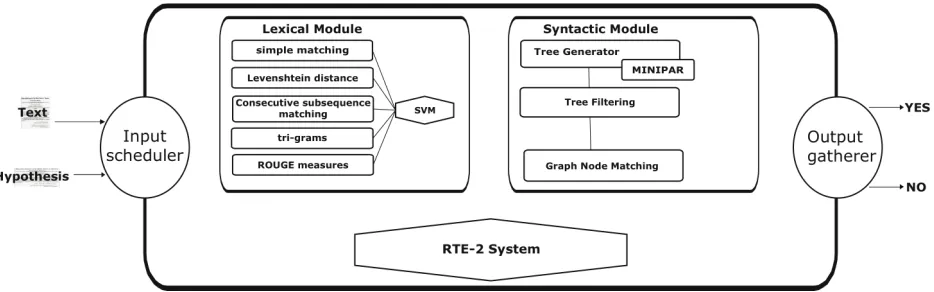
Next, Figure 1 represents a schematic view of the system we have developed.
Figure 1: System architecture.
As we can see in the previous Figure, our sys-tem is composed of three modules that are coordi-nated by an input scheduler. Its commitment is to provide the text-hypothesis pairs to each module in order to extract their corresponding similarity rates. Once all rates for a given text-hypothesis pair have been calculated, they will be processed by an output gatherer that will provide the final judgment. The method used to calculate the final entailment deci-sion consists in combining the outputs of both lex-ical and syntactic modules, and these outputs with our RTE-2 system’s judgment. The output gatherer will be detailed later in this paper when we describe the experimental results.
2.1 RTE-2 System
The approach we presented in the previous edition of RTE attempts to recognize textual entailment by de-termining whether the text and the hypothesis are re-lated using their respective derived logic forms, and by finding relations between their predicates using WordNet (Miller et al., 1990). These relations have a specific weight that provide us a score represent-ing the similarity of the derived logic forms and de-termining whether they are related or not.
For our participation in RTE-3 we decided to ap-ply our previous system because it allows us to han-dle some kinds of information that are not correctly managed by the new approaches developed for the current RTE edition.
2.2 Lexical Module
This method relies on the computation of a wide va-riety of lexical measures, which basically consists of
overlap metrics. Although in other related work this kind of metrics have already been used (Nicholson et al., 2006), the main contribution of this module is the fact that it only deals with lexical features with-out taking into account any syntactic nor semantic information. The following paragraphs list the con-sidered lexical measures.
Simple matching: initialized to zero. A boolean value is set to one if the hypothesis word appears in the text. The final weight is calculated as the sum of all boolean values and normalized dividing it by the length of the hypothesis.
Levenshtein distance: it is similar to simple match-ing. However, in this case we use the mentioned distance as the similarity measure between words. When the distance is zero, the increment value is one. On the other hand, if such value is equal to one, the increment is 0.9. Otherwise, it will be the inverse of the obtained distance.
this length, and the final accumulated weight is also normalized by the length of the hypothesis in words minus one. This measure is defined as follows:
CSmatch=
|H| X
i=2
f(SHi)
|H| −1 (1) where SHi contains the hypothesis’ subsequences of lengthi, andf(SHi)is defined as follows:
f(SHi) =
X
j∈SHi
match(j)
|H| −i+ 1 (2)
being match(j) equal to one if there exists an ele-mentkthat belongs to the set that contains the text’s subsequences of lengthi, such thatk=j.
One should note that this measure does not con-sider non-consecutive subsequences. In addition, it assigns the same relevance to all consecutive sub-sequences with the same length. Furthermore, the longer the subsequence is, the more relevant it will be considered.
Tri-grams: two sets containing tri-grams of letters belonging to the text and the hypothesis were cre-ated. All the occurrences in the hypothesis’ tri-grams set that also appear in the text’s will increase the accumulated weight in a factor of one unit. The weight is normalized by the size of the hypothesis’ tri-grams set.
ROUGE measures: considering the impact of n-gram overlap metrics in textual entailment, we be-lieve that the idea of integrating these measures1into our system is very appealing. We have implemented them as defined in (Lin, 2004).
Each measure is applied to the words, lemmas and stems belonging to the text-hypothesis pair. Within the entire set of measures, each one of them is con-sidered as a feature for the training and test stages of a machine learning algorithm. The selected one was a Support Vector Machine due to the fact that its properties are suitable for recognizing entailment.
2.3 Syntactic Module
The syntactic module we have built is composed of few submodules that operate collaboratively in order
1
The considered measures were ROUGE-N with n=2 and n=3, ROUGE-L, ROUGE-W and ROUGE-S with s=2 and s=3.
to obtain the highest possible accuracy by using only syntactic information.
The commitment of the first two submodules is to generate an internal representation of the syntac-tic dependency trees generated by MINIPAR (Lin, 1998). For this purpose we obtain the output of such parser for the text-hypothesis pairs, and then process it to generate an on-memory internal representation of the mentioned trees. In order to reduce our sys-tem’s noise and increase its accuracy rate, we only keep the relevant words and discard the ones that we believe do not provide useful information, such as determinants and auxiliary verbs. After this step has been performed we can proceed to compare the gen-erated syntactic dependency trees of the text and the hypothesis.
The graph node matching, termed alignment, be-tween both the text and the hypothesis consists in finding pairs of words in both trees whose lemmas are identical, no matter whether they are in the same position within the tree. Some authors have already designed similar matching techniques, such as the one described in (Snow et al., 2006). However, these include semantic constraints that we have decided not to consider. The reason of this decision is that we desired to overcome the textual entailment recogni-tion from an exclusively syntactic perspective. The formula that provides the similarity rate between the dependency trees of the text and the hypothesis in our system, denoted by the symbol ψ, is shown in Equation 3:
ψ(τ, λ) =X ν∈ξ
φ(ν) (3)
in Equation 4:
φ(β) =γ·σ·µ−δβ (4)
whereβ is a synset present in bothτ andλ,γ rep-resents the weight assigned toβ’s grammatical cat-egory (Table 1), σ the weight of β’s grammatical relationship (Table 2), µ an empirically calculated value that represents the weight difference between tree levels, andδβthe depth of the node that contains the synsetβinλ. The performed experiments reveal that the optimal value forµis1.1.
Grammatical category Weight
Verbs, verbs with one argument, verbs with two arguments, verbs taking clause as com-plement
1.0
Nouns, numbers 0.75
Beused as a linking verb 0.7
Adjectives, adverbs, noun-noun modifiers 0.5
[image:4.612.75.295.225.312.2]VerbsHaveandBe 0.3
Table 1: Weights assigned to the relevant grammati-cal categories.
Grammatical relationship Weight
Subject of verbs, surface subject, object of verbs, second object of ditransitive verbs
1.0
The rest 0.5
Table 2: Weights assigned to the grammatical rela-tionships.
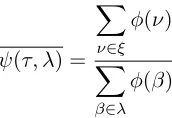
We would like to point out that a requirement of our system’s similarity measure is to be independent of the hypothesis length. Therefore, we must de-fine the normalized similarity rate, as represented in Equation 5:
ψ(τ, λ) =
X
ν∈ξ
φ(ν)
X
β∈λ
φ(β) (5)
Once the similarity value has been calculated, it will be provided to the user together with the cor-responding text-hypothesis pair identifier. It will be his responsibility to choose an appropriate threshold that will represent the minimum similarity rate to be considered as entailment between text and hypothe-sis. All values that are under such a threshold will be marked as not entailed.
3 System Evaluation
In order to evaluate our system we have generated several results using different combinations of all three mentioned modules. Since the lexical one uses a machine learning algorithm, it has to be run within a training environment. For this purpose we have trained our system with the corpora provided in the previous editions of RTE, and also with the develop-ment corpus from the current RTE-3 challenge. On the other hand, for the remainder modules the devel-opment corpora was used to set the thresholds that determine if the entailment holds.
The performed tests have been obtained by per-forming different combinations of the described modules. First, we have calculated the accuracy rates using only each single module separately. Later on we have combined those developed by our research group for this year’s RTE challenge, which areDLSITE-1 (the lexical one) and DLSITE-2 (the syntactic one). Finally we have performed a voting process between these two systems and the one we presented in RTE-2.
[image:4.612.142.228.541.600.2]RTE-2 test RTE-3 dev RTE-3 test
Overall Overall Overall IE IR QA SUM
RTE-2 system 0.5563 0.5523 0.5400 0.4900 0.6050 0.5100 0.5550 DLSITE-1 0.6188 0.7012 0.6563 0.5150 0.7350 0.7950 0.5800
[image:5.612.120.491.61.137.2]DLSITE-2 0.6075 0.6450 0.5925 0.5050 0.6350 0.6300 0.6000 DLSITE-1&2 0.6212 0.6900 0.6375 0.5150 0.7150 0.7400 0.5800 Voting 0.6300 0.6900 0.6375 0.5250 0.7050 0.7200 0.6000
Table 3: Results obtained with the corpora from RTE-2 and RTE-3.
3.1 Results Analysis
We will now perform an analysis of the results shown in the previous section. First, we would like to mention the fact that our system does not be-have correctly when it has to deal with long texts. Roughly 11% and 13% of the false positives of
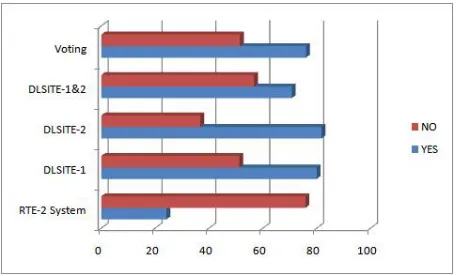
DLSITE-1 and DLSITE-2, respectively, are caused by misinterpretations of long texts. The underlying reason of these failures is the fact that it is easier to find a lexical and syntactic match when a long text is present in the pair, even if there is not entailment. In addition, we consider very appealing to show the accuracy rates corresponding to true and false entailment pairs individually. Figure 2 represents the mentioned rates for all system combinations that we displayed in Table 3.
Figure 2: Accuracy rates obtained for true and false entailments using the RTE-3 test corpus.
As we can see in Figure 2, the accuracy rates for true and false entailment pairs vary significantly. The modules we built for our participation in RTE-3 obtained high accuracy rates for true entailment text-hypothesis pairs, but in contrast they behaved worse in detecting false entailment pairs. This is the oppo-site to the system we presented in RTE-2, since it has a much higher accuracy rate for false cases than true
ones. When we combinedDLSITE-1andDLSITE-2, their accuracy rate for true entailments diminished, although, on the other hand, the rate for false ones raised. The voting between all three modules pro-vided a higher accuracy rate for false entailments be-cause the system we presented at RTE-2 performed well in these cases.
Finally, we would like to discuss some examples that lead to failures and correct forecasts by our two new approaches.
Pair 246 entailment=YES task=IR
T:Overall the accident rate worldwide for commercial aviation has been falling fairly dramatically especially during the period between 1950 and 1970, largely due to the introduction of new technology during this period.
H:Airplane accidents are decreasing.
Pair 246 is incorrectly classified by DLSITE-1
due to the fact that some words of the hypothesis do not appear in the same manner in the text, although they have similar meaning (e.g. airplane and aviation). However,DLSITE-2is able to establish a true entailment for this pair, since the hypothesis’ syntactic dependency tree can be matched within the text’s, and the similarity measure applied between lemmas obtains a high score. This fact produces that, in this case, the voting also achieves a correct prediction for pair 246.
Pair 736 entailment=YES task=SUM
T:In a security fraud case, Michael Milken was sentenced to 10 years in prison.
H:Milken was imprisoned for security fraud.
Pair 736 is correctly classified byDLSITE-1since there are matches for all hypothesis’ words (except
imprisoned) and some subsequences. In contrast,
[image:5.612.72.300.414.552.2]4 Conclusions and Future Work
This research provides independent approaches con-sidering mainly lexical and syntactic information. In order to achieve this, we expose and analyze a wide variety of lexical measures as well as syntactic struc-ture comparisons that attempt to solve the textual en-tailment recognition task. In addition, we propose several combinations between these two approaches and integrate them with our previous RTE-2 system by using a voting strategy.
The results obtained reveal that, although the combined approach provided the highest accuracy rates for the RTE-2 corpora, it has not accom-plished the expected reliability in the RTE-3 chal-lenge. Nevertheless, in both cases the lexical-based module achieved better results than the rest of the in-dividual approaches, being the optimal for our par-ticipation in RTE-3, and obtaining an accuracy rate of about 70% and 65% for the development and test corpus, respectively. One should note that these re-sults depend on the idiosyncrasies of the RTE cor-pora. However, these corpora are the most reliable ones for evaluating textual entailment recognizers.
Future work can be related to the development of a semantic module. Our system achieves good lexical and syntactic comparisons between texts, but we believe that we should take advantage of the se-mantic resources in order to achieve higher accuracy rates. For this purpose we plan to build a module that constructs characterized representations based on the text using named entities and role labeling in order to extract semantic information from a text-hypothesis pair. Another future research line could consist in applying different recognition techniques depending on the type of entailment task. We have noticed that the accuracy of our approach differs when the entailment is produced mainly by lexical or syntactic implications. We intend to establish an entailment typology and tackle each type by means of different points of view or approaches.
Acknowledgments
This research has been partially funded by the QALL-ME consortium, which is a 6th Framework Research Programme of the European Union (EU), contract number FP6-IST-033860 and by the Span-ish Government under the project CICyT number
TIN2006-1526-C06-01. It has also been supported by the undergraduate research fellowships financed by the Spanish Ministry of Education and Science, and the project ACOM06/90 financed by the Span-ish Generalitat Valenciana.
References
Roy Bar-Haim, Ido Dagan, Bill Dolan, Lisa Ferro, Danilo Giampiccolo, Bernardo Magnini, and Idan Szpektor. 2006. The Second PASCAL Recognising Textual
En-tailment Challenge. Proceedings of the Second
PAS-CAL Challenges Workshop on Recognising Textual Entailment, pages 1–9.
Ido Dagan, Oren Glickman, and Bernardo Magnini.
2006. The PASCAL Recognising Textual
Entail-ment Challenge. In Qui˜nonero-Candela et al.,
edi-tors, MLCW 2005, LNAI Volume 3944, pages 177–190. Springer-Verlag.
Oscar Ferr´andez, Rafael M. Terol, Rafael Mu˜noz, Patri-cio Mart´ınez-Barco, and Manuel Palomar. 2006. An approach based on Logic forms and wordnet
relation-ships to textual entailment performance. In
Proceed-ings of the Second PASCAL Challenges Workshop on Recognising Textual Entailment, pages 22–26, Venice, Italy.
Oren Glickman. 2005.Applied Textual Entailment
Chal-lenge. Ph.D. thesis, Bar Ilan University.
Dekang Lin. 1998. Dependency-based Evaluation of
MINIPAR. InWorkshop on the Evaluation of Parsing
Systems, Granada, Spain.
Chin-Yew Lin. 2004. ROUGE: A Package for
Auto-matic Evaluation of Summaries. In Stan
Szpakow-icz Marie-Francine Moens, editor,Text Summarization
Branches Out: Proceedings of the ACL-04 Workshop, pages 74–81, Barcelona, Spain, July. Association for Computational Linguistics.
George A. Miller, Richard Beckwith, Christiane Fell-baum, Derek Gross, and Katherine J. Miller. 1990. In-troduction to WordNet: An On-line Lexical Database.
International Journal of Lexicography, 3(4):235–244.
Jeremy Nicholson, Nicola Stokes, and Timothy Baldwin. 2006. Detecting Entailment Using an Extended Imple-mentation of the Basic Elements Overlap Metrics. In
Proceedings of the Second PASCAL Challenges Work-shop on Recognising Textual Entailment, pages 122– 127, Venice, Italy.
Rion Snow, Lucy Vanderwende, and Arul Menezes. 2006. Effectively using syntax for recognizing false
entailment. In Proceedings of the North American