Printed in Great Britain © The Company of Biologists Limited 1986
SHORT COMMUNICATION
CALCIUM-DEPENDENT ACTION POTENTIALS IN THE
PROTHORACIC GLAND OF MANDUCA SEXTA
BY EMMANUEL J. EUSEBIO AND WILLIAM J. MOODY Department of Zoology, University of Washington, Seattle, WA 98195, USA
Accepted 24 July 1986
The physiological changes which occur during insect moulting are brought about by the steroid hormone 20-hydroxyecdysone (Riddiford & Truman, 1978). The prohormone ecdysone is secreted by the bilaterally paired prothoracic glands (PGs) in response to prothoracicotropic hormone (PTTH) released from the brain (Bollenbacher, Agui, Granger & Gilbert, 1979). Recently, Smith, Gilbert & Bollenbacher (1985) demonstrated that Ca2+ is required for PTTH-stimulated ecdysone synthesis and, consequently, proposed the existence of a hormone-dependent calcium channel associated with the PTTH receptor. In the present study, we show for the first time the existence of voltage-dependent calcium channels in PG cells. Furthermore, we have observed electrical coupling between the cells which appears sufficiently strong to permit the propagation of an action potential throughout the gland in response to stimulation at a single location.
Larvae of the tobacco hornworm, Manduca sexta, were reared individually on an artificial diet (Bell & Joachim, 1978) at 26-27°C in a 17:7 L:D photoperiod. Both males and females were used. Specimens were gathered 3 days after the moult into the fifth instar, weighed, and anaesthetized by submersion in water. Individual glands, which appear as Y-shaped sheets of loosely attached translucent cells, were removed and placed in modified Weever's saline (in mmolF1): NaCl, 6-5; KC1, 33-5; CaCl2, 13-6; MgCl2, 7-6; dextrose, 166-5; KHCO3) 1-25; KH2PO4, 1-25
(Weeks & Truman, 1984). Sodium-free saline was made by replacing NaCl with an equimolar amount of choline chloride. Calcium-free saline was made by substituting Mg2+ for Ca2+. The gland was pinned out on a Sylgard platform in a perfusion chamber with a solution volume of 0-5 ml. Microelectrodes were pulled from thin-walled, 1-5mm o.d. capillary tubes and filled with 3moll"1 KC1. Recordings were made by implanting two electrodes, one for current passing and the other for recording, at various distances from each other. The current-passing microelectrode was broken to a resistance of 5-10 MQ, while the voltage-recording electrode was broken to a resistance of 10-20 MQ. The cells were impaled using a combination of negative capacitance oscillation and light tapping. Recordings were displayed on a digital oscilloscope and recorded on FM magnetic tape.
B 100 nA
n
20mvl0-2 s
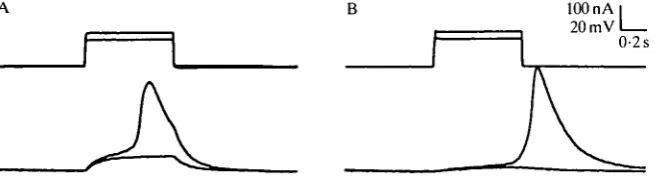
Fig. 1. Resting potential and electrical responses in prothoracic gland cells. (A) With the electrodes separated by approximately 15 cells, responses were elicited by 600 ms current injections of 120 nA and 140 nA. (B) In the same cell, shorter duration (100 ms) current pulses 125 nA and 140 nA in amplitude caused a passive response and a post-stimulation action potential. The small bumps on the main spike are probably due to the asyn-chronous firing of different cell populations which is discussed in the text.
After an initial period of experimentation with different electrode resistances and tip configurations, resting potentials of —60 to — 80 mV were obtained. The preparation was allowed to rest for 5-10 min after electrode insertion to ensure the stability of the recording. With intermittent saline flow, such conditions were maintained for up to 4h. It became more difficult to obtain stable resting potentials as the distance between impaled cells decreased, probably because of mechanical coupling between the cells.
Action potentials were consistently seen in the gland cells in response to depolarizing current pulses (Fig. 1). The amplitude and duration of the active response showed considerable variability from one preparation to another but, as discussed below, much of this can probably be accounted for by the cable properties of the system and variable placement of the two electrodes. Spike amplitude ranged from 55 to 70mV (peak voltage: —5 to +8mV), and duration from 600 to 800ms. Maximum rate of rise was of the order of 1 mV ms"1. It was notable that spontaneous action potentials were never seen after the initial impalement, nor was it possible to elicit repetitive action potentials in response to prolonged depolarizations. Fatigue of the active response occurred if repetitive depolarizing current pulses were delivered at intervals shorter than approximately 5 s. The apparent input resistance of the cell shown in Fig. 1A was 5X10⁴ Q, but such analyses were of little value since the cable properties of the intact gland make it very difficult to quantify the dispersal of applied current into cells surrounding the stimulating electrode.
Calcium spikes in prothoracic gland
533
100 nAI 20mVl
Control
[image:3.451.60.394.49.161.2]Ca2+-free
Fig. 2. Ionic dependence of the active response in prothoracic gland cells. (A) In normal saline, a spike was elicited by the injection of 135 nA into a nearby cell. After 4min in Ca2+-free saline the cell was depolarized above original threshold by current pulses greater than 300 nA, yet no active response was seen. The current trace for the largest pulse in Ca2+-free saline is not displayed here. (B) In a different preparation, 60 nA of current was required to cause an action potential in normal saline. After a 25-min application of Na+-free saline, the cell fired in response to 70 nA of injected current. The magnitude of the active response had decreased 4mV in the Na+-free solution.
because (1) both Na+-free and Ca2+-free solutions caused the decrease in resistance, while only Ca2+-free solutions blocked the spike generation, and (2) the decrease in input resistance in Ca +-free solutions was not reversible, whereas full action potential amplitude was restored upon return to normal saline. We conclude from these experiments that most, if not all, of the inward current underlying the action potential in these cells is carried by Ca .
To further investigate electrical coupling and action potential propagation be-tween cells, we performed experiments in which the recording electrode was moved progressively closer to a fixed stimulating electrode. Responses were not recorded at the site of stimulation because with our combination of electrode resistance and current amplitude, the bridge circuit was unreliable. In Fig. 3A, depolarizing current pulses were injected into a cell while membrane potential was being recorded five cells distant. The membrane in the cell penetrated with the recording electrode was depolarized by +10mV during the passive response and +67 mV during the active phase. Fig. 3B depicts subthreshold and active responses in the same gland with the electrodes approximately 20 cells apart. The passive response in the distant
A B 100 nA I
20mVl 0-2s
[image:3.451.65.393.479.571.2]cell decreased in comparison to the depolarization seen in the cell nearer the stimulus (+2 mV vs +10 mV), whereas the amplitude of the active response was independent of the distance between stimulating and recording sites. Thus, an all-or-none action potential appears to be able to propagate over the entire gland in response to stimulation at a single point. From a number of such experiments, we can get a rough idea of the cable properties of the gland: the steady-state passive response to injected current decreases e-fold for about every nine cells of distance over the gland. Occasionally, we observed mixed spike populations as shown in Fig. 4, apparently the results of asynchrony in the firing of different populations of cells. Based upon chronological appearance, we suggest that the smaller spike is the activation of channels in the stimulated cell, or in a limited area surrounding the point of stimulation, while the larger spike results from concerted firing of the entire gland.
Our results show that a majority, if not all, of the action potential seen in the PG can be attributed to the entry of Ca2+ through voltage-activated calcium channels and that the electrical coupling between cells allows the calcium influx to propagate across many, if not all, of the cells in the gland in response to a depolarizing point stimulus.
The presence of calcium-dependent action potentials suggests a possible role for voltage-dependent calcium influx in the PG. The most likely possibility is that calcium entry during electrical activity triggers the exocytotic release of ecdysone, given evidence that the steroid is transported out of PG cells by a vesicular mechanism (Sedlak, Marchione, Devorkin & Davino, 1983; Birkenbeil, 1983). In mammalian endocrine cells, a number of studies have demonstrated a relationship between depolarization, electrical activity and steroid release (e.g. see Lymangrover, Matthews & Saffran, 1982; Higuchi, Kaneko, Abel & Niswender, 1976). Another possibility is that calcium entry stimulates ecdysone synthesis. The calcium dependence of steroid synthesis has been demonstrated in the Manduca PG (Smith et al. 1985) as well in a variety of vertebrate cells (e.g. adrenal cortex, Lymangrover et al. 1982; ovarian cells, Veldhuis & Klase, 1982; Leydig cells, Moger, 1983).
100nA| 20mVl
0-2s
Calcium spikes in prothoracic gland 535
At least two possible mechanisms may operate to depolarize the PG in vivo. First, the gland may depolarize in response to PTTH, similar to the vertebrate A C T H -adrenocortical cell system (Lymangrover et al. 1982). A second possible effector of depolarization may be nervous stimulation. Although innervation of the PG in Manduca has not been demonstrated, neuronal connections have been reported in the PGs of other species (Singh, 1975; Birkenbeil & Agricola, 1980). Recently, Richter & Gersch (1983) presented electrophysiological evidence for nervous control in the PG in Periplaneta americana by comparing nervous activity in the prothoracic ganglion with ecdysteroid titres.
We are at present investigating the correlation between electrical activity and steroid release in the PG both in vivo and in vitro, to try to assess the physiological role of the voltage-dependent calcium channel.
We thank Drs James W. Truman and Lynn M. Riddiford for their helpful discussions, criticisms of the manuscript, and the animals used in this study. This research was supported by a NIH Grant HD17486 and a Research Career Development Award HD 00520 to WJM.
REFERENCES
BELL, R. A. & JOACHIM, F. A. (1978). Techniques for rearing laboratory colonies of tobacco hornworms and pink bollworms. Ann. ent. Soc. Am. 69, 365-375.
BIRKENBEIL, H. (1983). Ultrastructural and immunocytochemical investigation of ecdysteroid secretion by the prothoracic gland of the waxmoth Galleria mellonella. Cell Tissue Res. 229, 443-441.
BIRKENBEIL, H. & AGRICOLA, H. (1980). Die Innervierung der Prothorakaldruse von Periplaneta americana L. Zool.Anz. 204, 331—336.
BOLLENBACHER, W. E., AGUI, N., GRANGER, N. A. & GILBERT, L. I. (1979). In vitro activation of
insect prothoracic glands by the prothoracicotropic hormone. Proc. natn. Acad. Sci. U.SA. 76, 5148-5152.
HIGUCHI, T . , KANEKO, A., ABEL, J. H., JR & NISWENDER, G. D . (1976). Relationship between
membrane potential and progesterone release in ovine corpora lutea. Endocrinology 99, 1023-1032.
LYMANGROVER, J. R., MATTHEWS, E. K. & SAFFRAN, M. (1982). Membrane potential changes of
mouse adrenal zona fasciculata cells in response to adrenocorticotropin and adenosine 3',5'-monophosphate. Endocrinology 110, 462-468.
MOGER, W. H. (1983). Effects of the calcium-channel blockers cobalt, verapamil, and D600 on Leydig cell steroidogenesis. Biol. Reprod. 28, 528-535.
RICHTER, K. & GERSCH, M. (1983). Electrophysiological evidence of nervous involvement in the control of the prothoracic gland in Periplaneta americana. Experientia 39, 917-918.
RIDDIFORD, L. M. & TRUMAN, J. W. (1978). Biochemistry of insect hormones and insect growth regulators. In Biochemistry of Insects (ed. M. Rockstein). New York: Academic Press.
SEDLAK, B. J., MARCHIONE, L., DEVORKIN, B. & DAVINO, R. (1983). Correlations between
endocrine gland ultrastructure and hormone titers in the fifth larval instar of Manduca sexta. Gen. comp. Endocr. 52, 291-310.
SINGH, Y. N. (1975). The anatomy and innervation of the ecdysial glands of the mature larva of castor silk moth, Philosamia ricini Hutt. Experientia 31, 40-42.
SMITH, W. A., GILBERT, L. I. & BOLLENBACHER, W. E. (1985). Calcium-cyclic AMP interactions
VELDHUIS, J. D. & KXASE, P. A. (1982). Mechanisms by which calcium ions regulate the steroidogenic actions of luteinizing hormone in isolated ovarian cells in vitro. Endocrinology 111, 1-6.