International Journal of Advanced Research in Computer Science
REVIEW ARTICLE
Available Online at www.ijarcs.info
Towards Virtualization in Cloud Computing
Mohammad Masdari
Computer Engineering Department
Science and Research Branch, Islamic Azad University, West Azerbaijan, Iran
Behnam Zebardast
Computer Engineering Department
Science and Research Branch, Islamic Azad University, West Azerbaijan, Iran
Yaghoub Lotfi
Computer Engineering Department
Science and Research Branch, Islamic Azad University, West Azerbaijan, Iran
Abstract: Cloud computing is a model for easy access upon request network which can be configured to a set of computing resources (e.g., networks, servers, storage, services, and applications). It can be provided upon request with lowest labour and without the meddling of the user. Of serious problems faced by IT managers is Excessive number of single-purpose server hardware. The main reason for the increasing number of such hardware is incompatible applications which are running on different servers. As a result, system administrators prefer to run applications on separate servers. It imposes additional cost for service providers and users. In this paper, we discuss about the utilization of virtualization for server consolidation and to reduce the overall cost and reducing the number of servers.
Keywords: Cloud computing; virtualization; servers consolidation; reducing the overall cost
I. INTRODUCTION
The evolution of computing can be assumed in a way that it can be after water, electricity, gas and telephone as fifth essential element. In such cases, users try to access server based on their needs and no matter where a service is and how it is delivered [1, 2]. The IT experts have provided the diverse computing systems to meet needs of users which can noted as cluster computing [3], Grid computing [4] and recently cloud computing [3, 4]. The result was, users have found wide adoption in cloud computing technology rather than other Cyber computing technologies, after 2007 [5] An example of cloud computing is often virtualized resources as a service over the Web. Instead of personal data storage devices, they are on servers on the Internet. In the meantime, users have no knowledge or control over clouds and the technology infrastructure of data encoding [6]. Internet world is moving toward online store and information process. Now to edit a simple text file or merge two images we don’t need to install bulky and expensive programs such as Word or Photoshop, instead we can simply use an Internet-based service, without the need to purchase and install a program. Nowadays, cloud Computing is the only part of the world at a rapid pace that most companies are moving towards it [7]. Simply cloud computing is referred to an Internet-based implementation computing capabilities. The main idea states that Cloud Computing can provide hardware and software services through the Internet to users and organizations at all levels.in such a computing environment users have no ownership to provide service and they just use it [8] To Use cloud computing technology users need just to take a regular PC, high speed internet connection and a good browser and connect to their cloud. Two main reasons for using cloud computing is to maximize performance and minimize costs [9]. Cloud
computing reduce heavy hardware costs for companies. For example, we don’t need to buy a high capacity hard disks and advanced processors. Furthermore, there is no need for physical storage space but only pay for rent and put the information on the store tool and access our data. A cloud computing system is also faster boot and setup because in that case computers have fewer programs and process that will load into memory. The performance of this computer compared with other computing systems is optimized with maximum performance [10]. One of these methods to reduce the overall cost of server consolidation is virtualization [7] which is the most widely used method in cloud computing as a cloud computing infrastructure. In the second part of this article we will talk about cloud computing models. In the third part of the article the relationship between Grid computing and Cloud computing and virtualization in the application of these methods will be discussed. In fourth Part the relationship between virtualization and cloud computing models will be discussed and in the Fifth Part, ways to reduce the cost of cloud computing using virtualization will be discussed. Also we will conclude about the results of the study in the conclusion part in Section five.
II. CLOUDCOMPUTING
Cloud Computing has been introduced by the National Institute of Technology (NIST) to share resources and provide low-cost resources that can be accessed and configured with high-speed access [3].
Cloud Computing Models
1) Public cloud: Public cloud describes cloud computing in the original sense is common. The public cloud resources and applications are dynamically provided via the web [11].
2) Community Cloud: where there is a similar requirement
that several organizations have and seek for sharing the benefits of cloud computing infrastructure. It is more expensive but with more privacy and security policies to bring compatibility rather than public cloud [12].
3) Private cloud: Private Cloud is a cloud computing
infrastructure for internal use by an organization [11]. The main factor that separates private clouds and public clouds is Place and manner of maintenance of cloud infrastructure hardware. A private cloud enables greater control over all levels of cloud implementation (e.g., hardware, networking, operating systems, and software). Another advantage of private clouds is more security due to equipment located within the boundaries of the organization and the lack of communication with the outside world.
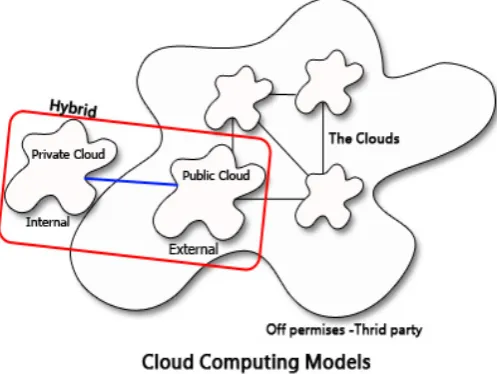
4) Hybrid cloud: Hybrid cloud is composed of several
[image:2.595.51.300.338.525.2]domestics or foreign providers [12]. Hybrid cloud is a good option for most of the businesses, and provides the combination of various services to users. Figure 1 shows a diagram of cloud computing models.
Figure 1. Diagram of cloud computing models
Layers of Cloud Computing Services
Cloud computing service providers offer their services based on three basic models [6]: Software as a Service (SaaS), platform as a service (PaaS), Infrastructure as a Service (IaaS). The virtualization has usage in each of these layers. Also in 2012, two other models named the network as a service (NaaS) and Communications as a Service (CaaS) have been officially identified by the International Telecommunication Union as part of the cloud computing model based on an ecosystem of cloud-based service categories. We explain them below [13, 14, and 15].
5) Software As a Service (SaaS): In this model, the cloud providers, installs cloud applications on the Cloud and users can access the application via the web and thus do not need to install software on client devices [16]. This section contains the software which is running on cloud infrastructure providers
[17]. In this model, software updates is centralized and there is no need to download software.
6) Platform As a Service (PaaS): In this model, PaaS,
cloud providers deliver a computing platform typically including operating systems, programming languages, runtime environments, databases and web servers. The Aid of this service enable customer to put the software that he purchased or made on the cloud platform and then to control, to test or to change it [17]. In this model, the only limitation is client monitoring of the underlying infrastructure, networks or servers [6]. Google App Engine service is an example of the services offered. Microsoft also recently has introduced the Azure Platform for cloud computing [17]. This layer manages all hardware complexity which is hidden from the user's perspective and allows web applications to be developed.
Figure 2. The architecture and service models of cloud services on three service models
8) Storage As a Service (NaaS): A set of cloud services
that provide functionality to the user to use cloud services, network and transport services within the cloud, there is a connection or network services. NaaS include optimizing the allocation of resources according to network resources and computing resources to be integrated as a single unit [19, 20]. NaaS services including VPN and developing flexible bandwidth upon demand. Also NaaS is the virtual network service provided by network infrastructure owners [20, 21].
9) Communications As a Service (CaaS): CaaS enables consumers to use enterprise level Voice over Internet Protocol (VoIP), VPN data, private branch exchange (PBX) and Unified Communications without the costly investment, hosting and infrastructure management [22, 23].
III. CLOUDCOMPUTINGAND GRID
COMPUTINGINVIRTUALIZATION
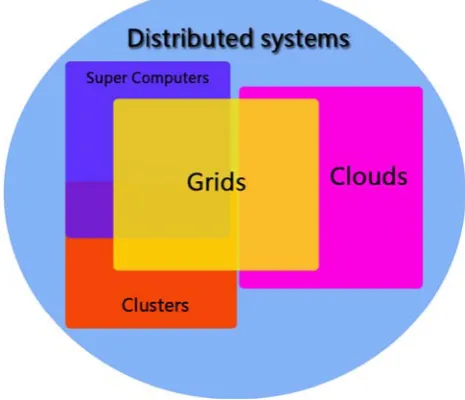
Cloud computing technology came into existence in the continued development of grid systems. Thus, in some systems, the Grid technology is also used. But despite these problems, grid computing and cloud computing have many differences. But the common point of these two technologies is virtualization capabilities in its implementation. Grid computing is used in many cloud computing implementations. In addition, many Grid networks can be seen as examples of cloud computing. But the grid is not necessarily related to cloud computing. There are clouds in the hardware and software infrastructure which do not use grid networks. Grades are based on the virtualization as well as clouds. But efforts are done to take place virtualization on the grid. The context of cloud computing is virtualization of software and hardware but most of grid computing is to virtualize resources and data [3, 4]. Many grids models use calculating model with the team planning. It looks very different with cloud computing models [24, 25]. Despite the resources dedicated specifically to the cloud is dominated by the queuing system available to all users. This allows delay-sensitive applications, provides for the implementation of the Clouds. However, to ensure adequate quality of service to end users is dedicated. This is probably one of the main challenges for cloud computing is the increasing number of users and cloud scale [26, 27]. Another challenge is that virtualization puts potential problem for the control of resource monitoring in front of the clouds. Although many Grids such as Tera Grid [28] put restrictions on the type of sensor or long service leave the user to start, but do not directly control the clouds, like Grids. Because there are different trust model of Grids in which users identify themselves through trades can have access to the resources of different Grid sites. Grid resources, such as what is seen in the clouds are highly abstract and figurative. In a cloud, various levels of services provided to the end user and the end user is only exposed to a predefined API. Lower levels of resources for the user are ambiguous [28, 29]. While many scholars and writers acknowledged similarity of cloud computing and Grid, There are other ideas, they are more focused on the problem of the cloud computing, Grid computing has evolved. Fester represented connection between the cloud and the grid and Grid and cloud computing not only overlap, but really, the grid emerged the cloud and Grid computing is infrastructure of cloud computing and it relies on it [4]. Figure 3 represents the overlap of cloud computing systems and Grid cluster.
Figure 3. The overlap of cloud computing systems, Grid cluster and cloud computing
Based on Figure 3 supercomputers and cluster computing based on the more traditional minded focus on applications of non-service. As can be seen in all of these areas grid computing overlaps with others and cloud computing spectrum includes service-oriented applications.
IV. VIRTUALIZATION
summed up in the dynamic forms. 3) Providing resources to improve the accountability, monitoring and maintenance that are automatically available to share and reuse resources [34, 35] there are wide variety of hardware virtualization, such as virtualization, application virtualization and storage virtualization [30]. From the perspective of a private cloud, virtualization hardware will be more applicable. Hardware virtualization is a way of simulating multiple physical servers into one physical server help [34]. Simply, outsourcing means unlimited cloud-based management and According to the customer demand it is present. The definition of a public cloud, private cloud point may be true, but we should reflect a bit on it. Private cloud, as the name suggests, is part of so-called private data center [36]. One of the benefits of virtualization technology is green technology. Since the computers of the cloud data system use virtual data center it makes their environment less warm. Therefore they are known as Green technologies [34].
V. HOWTOREDUCETHEOVERALLCOST
WITHTHEUSEOFVIRTUALIZATIONIN
CLOUDCOMPUTING
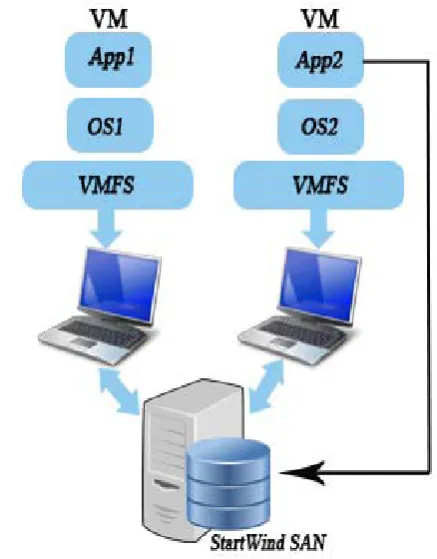
[image:4.595.337.556.102.382.2]One of the biggest problems faced by IT managers is that the number of single-purpose server hardware is more than enough .The main reason for the increasing number of such hardware are incompatible applications which are running on separate servers [7, 34]. Apparently, increasing the number of servers is not a big problem, but over time big amount of secretly cost should be paid to raise unlimited servers. Hardware costs contain failure to utilize all the power of server hardware of computers, and software problems such as inability of paying attention to software problems of different servers in different short time distances, used electricity of servers, cooling equipment of data center, the place of keeping servers, and the most important one talented experts who have the duty of managing systems containing both hardware and software convinced managers accept the integration of servers as an accepted principle [35].The most reliable method for server consolidation is using virtualization technology. Virtualization allows multiple virtual machines to run on any physical hardware. Each virtual machine can have its own operating system and run it [37, 38, and 39]. The use of virtualization can be on one server at a time, multiple operating systems (even mutually exclusive). Each operating system executing an application [37]. Figure 4 shows the operating system using virtualization can be placed on a server.
Figure 4. Different operating systems are on a server
In Figure 5, using virtualization for server consolidation is shown.
Figure 5. Installing multiple operating systems on a single server using virtualization
[image:4.595.57.292.585.778.2]VI. CONCLUSION
Reduce costs in today's world of cloud computing in many respects is quite useful. This is why researchers are always looking for one of these techniques in reducing costs. In this paper Grid computing and its application in virtualization of cloud computing is discussed and compared with the Grid. Also in this article we have talked about the relationship between virtualization and cloud computing comparing to other models and we observed how server consolidates using virtualization technology, we see this technology has contributed in any way to reduce cost when compared to other methods. It is the most controversial and very efficient in security issues as one of the most important issues in cloud computing.
VII. REFRENCES
[1] K, Sachdeva, Cloud Computing: Security Risk Analysis
and Recommendations, Master Thesis, University of Texas, Austin, 2011.
[2] S. Subashini, V. Kavitha, A survey on security issues in service delivery models of cloud computing, Elsevier, Network and Computer Applications, Vol. 34, p.1-11, 2010.
[3] Indu Gandotra, Pawanesh Abrol, Pooja Gupta, Rohit
Uppa, Sandeep Singh, "Cloud Computing Over Cluster, Grid Computing: a Comparative Analysis", Journal of Grid and Distributed Computing, Volume 1, Issue 1, pp-01-04,2011.
[4] Ian Foster, Yong Zhao, Ioan Raicu, Shiyong Lu, "Cloud Computing and Grid Computing 360-Degree Compared",
IEEE,
[5] J.R. Winkler, Securing the Cloud: Cloud Computer
Security Techniques and Tactics, Technical EditorBill Meine, Elsevier Publishing, 2011.
[6] H. Takabi, J.B.D. Joshi, G.Ahn, “Security and Privacy
Challenges in Cloud Computing Environments”, IEEE
Security Privacy Magazine, Vol. 8, IEEE Computer Society, pp.24-31, 2010.
[7] K .Vasantha Kokilam, Samson Dinakaran, "Data Storage Virtualization in Cloud Computing", International Journal of Advanced Research In Technology(IJART), Vol. 1, Issue 1, pp. 16-21, 2011.
[8] C. Lin, S. Lu, Z. Lai, A. Chebotko, X. Fei, J. Hua, and F.
Fotouhi, “Service-Oriented Architecture for VIEW: a Visual Scientific Workflow Management System”, IEEE International Conference on Services Computing (SCC), pp.335-342, 2008.
[9] Vaquero Luis M., Rodero-Merino Luis, Caceres Juan, Lindner Maik,”A Break in the Clouds: Towards a Cloud Definition”, ACM SIGCOMM Computer Communication Review, Vol.39, Num.1, pp. 50-55, January 2009.
[10] Aaron Weiss, "Computing in the clouds", netWorker - Cloud computing: PC functions move onto the web, Volume 11, Issue 4, pp. 16-25, December 2007.
[11] S. Qaisar, K.F. Khawaja,”Cloud Computing:
Network/Security Threats and Countermeasures”,
Interdisciplinary journal of contemporary research in business, Vol.3, No. 9, pp. 1323-1329, 2012.
[12] R. Choubey, R. Dubey, J. Bhattacharjee, “A Survey on
Cloud Computing Security, Challenges and Threats”,
International Journal on Computer Science and Engineering (IJCSE), Vol. 3 No. 3, pp. 1227-1231, March 2011.
[13] William Voorsluys, James Broberg, and Rajkumar Buyya, Buyya, J. Broberg, A.Goscinski (eds), ISBN-13: 978-0470887998, Wiley Press, New York, USA, February 2011.
[14] P. Mell, T. Grance, "The NIST Definition of Cloud Computing", National Institute of Standards and Technology, Information Technology Laboratory, Technical Report Version 15, 2009.
[15] L. Youseff, M. Butrico, and D. Da Silva, Toward a unified ontology of cloud computing, in Proceedings of the 2008 Grid Computing Environments Workshop,2008, pp. 1_10.
[16] S. O.Kuyoro, F. Ibikunle, and O. Awodele, “Cloud Computing Security Issues and Challenges”, International Journal of Computer Networks (IJCN), Vol. 3, pp. 247-255, Issue (5), 2011.
[17] S. Ramasami, P. Umamaheswari, “Survey on Data Security Issues and Data Security Models in Cloud
Computing”, International Journal of Engineering and
Innovative Technology (IJEIT), Vol. 1, ISSN: 2277-3754, March 2012.
[18] F. Sabahi, "Security of Virtualization Level in Cloud Computing," in Proc. 4th Intl. Conf. on Computer Science and Information Technology, Chengdu, China, pp. 197-201, 2011.
[19] Wang Anjing, Iyer Mohan, Dutta Rudra, Rouskas George,Baldine Ilia, Carolina State University, December 2012.
[20] Paolo Costa, Matteo Migliavacca, Peter Pietzuch, Alexander L. Wolf, "NaaS: Network-as-a-Service in the Cloud", The 2nd USENIX Workshop on Hot Topics in Management of Internet, Cloud, and Enterprise Networks and Services (Hot-ICE '12), co-located with USENIX NSDI'12, San Jose, CA, US, pp. 1-6, April 2012.
[21]
Cascais, Portugal, 2011.
[22] Priyank Sharma, Sandip Vaniya, Dipal Vashi, "Communication as a Service based Cloud Computing", IJCA Proceedings on International Conference on Emerging Technology Trends (ICETT), pp. 14-17, 2011, Published by Foundation of Computer Science, New York, USA.
[23] Lamia Youseff, Maria Butrico, Dilma Da Silva, "Towards a Unified Ontology of Cloud Computing" , Grid Computing Environments Workshop (GCE08), held in conjunction with SC08 (November, 2008), pp. 1-10.
[24] Vaquero Luis M., Rodero-Merino Luis, Caceres Juan, Lindner Maik, "A Break in the Clouds: Towards a Cloud
Definition", ACM SIGCOMM Computer Communication Review, Vol.39, No.1, pp. 50-55, January 2009.
[25] J. Broberg, S. Venugopal, R. Buyya, "Market-oriented Grid and utility computing: The state-of-the-art and future directions", Journal of Grid Computing, vol. 3,no. 6, pp. 255_276, 2008.
[26] Pooja Rani, "Middleware and Toolkits in Grid Computing", International Journal of Computer Applications(IJCA), vol. 65, No. 21, pp. 13-18, March 2013.
[28] C. Catlett, "The philosophy of TeraGrid: Building an open, extensible, distributed TeraScale facility" , in Proceedings of 2nd IEEE/ACM International Symposium on Cluster Computing and the Grid, Berlin, Germany, 2002, p. 8.
[29] L Ramaparvathi, R Maruthi, "Grid Enabled Environment for Image Processing Applications: A Review", International Journal of Computer Applications, vlo. 65, No. 19, pp. 18-24, March 2013.
[30] Sina Manavi, Sadra Mohammadalian, Nur Izura Udzir, Azizol Abdullah, "Secure Model for Virtualization Layer in Cloud Infrastructure", International Journal of Cyber-Security and Digital Forensics (IJCSDF), Vol. 1, No. 1, pp. 32-40, 2012.
[31] F. Azmandian, M. Moffie, and M. Alshawabkeh, “Virtual machine monitor-based lightweight intrusion detection”, ACM SIGOPS, vol. 45, no. 2, pp. 38-53, Jul. 2011.
[32] F. Sabahi, "Secure Virtualization for Cloud Environment Using Hypervisor-based Technology", International Journal of Machine Learning and Computing vol. 2, no. 1, pp. 39-45 , 2012.
[33] F. Sabahi, "Security of Virtualization Level in Cloud Computing," in Proc. 4th Intl. Conf. on Computer Science and Information Technology, Chengdu, China, pp. 197-201, 2011.
[34] Tejas P.Bhatt, Pinal.J.Patel, " Survey On Virtualization With Xen Hypervisor", International Journal of Engineering Research & Technology (IJERT), Vol. 1, Issue 8, pp. 1-8, 2012.
[35] Ashish Maheta, Chirag Patel, "Virtualization through Xen Hypervisor", International Journal of Engineering Research and Applications (IJERA), Vol. 2, Issue 2, pp.1456-1459, 2012.
[36] Qin Liu, Guojun Wang , Jie Wu, "Efficient Sharing of Secure Cloud Storage Services", IEEE, 10th International Conference on
[37] B. Loganayagi and S. Sujatha, “Enhanced Cloud Security by Combining Virtualization and Policy Monitoring Techniques,” Procedia Engineering, vol. 30, no. 2011, pp. 654–661, Jan. 2012.
[38] G. Nejger, D. Rodgers, A.L. Santoni, F.C.M. Martins, A.V. Anderson, S.M. Bennett, A. Kagi, F.H. Leung, L. Smith, " Intel virtualization technology", IEEE Computer, Journals & Magazines, Intel Corp, USA, Vol. 38, No. 5, pp. 48-56, 2005.
[39] A. Singh, M. Korupolu, D. Mohapatra, "Server-storage virtualization: Integration and load balancing in data centers", in Proceedings of the 2008 ACM/IEEE Conference on Supercomputing, San Jose, CA, USA , 2008, pp. 1-12.
[40] Flavio Lombardi, Roberto Di Pietro, "Secure virtualization for cloud computing", Elsevier , Journal of Network and Computer Applications, Vol 34, Issue 4, pp. 1113-1122, 2010.
[41] Sean Marston, Zhi Li, Subhajyoti Bandyopadhyay, Juheng Zhang, Anand Ghalsasi, "Cloud computing — The business perspective", Elsevier ,