Distinctive Image Feature Techniques from
Scale Invariant Key Points
Sanjivanikache1, Sapana Chikundre1, Varsha Salve1, Pallavi Patil2
B. E Students, Department of Computer Engineering, Genba Sopanrao Moze College of Engineering, Balewadi, Pune,
Savitribai Phule Pune University Pune India.1
Assistant Professor, Department of Computer Engineering, Genba Sopanrao Moze College of Engineering, Balewadi,
Pune, Savitribai Phule Pune University Pune India2
ABSTRACT: In the compacted video is transmitted over a correspondence arrange and examined by a server. The
server incorporates key point identification, descriptor figuring, and highlights coordinating. Video pressure has negative impact on picture highlight coordinating execution. The negative effect of pressure can be limited by utilizing the key focuses removed from the uncompressed video to ascertain descriptors from the compacted video. The proposed framework gives these key focuses to the server as side data and to separate just the descriptors from the compacted video. In the first place, we present four diverse casing sorts for key guide encoding toward address distinctive sorts of changes in video content. These edge sorts speak to another scene, a similar scene, a gradually evolving scene, or a quickly moving scene, and are controlled by contrasting components between progressive video outlines. Intra skip and entomb methods of encoding the key focuses for various edge sorts. For instance, key focuses for new scenes are encoded utilizing the Intra mode and key focuses for unaltered scenes are skipped. Thus, the bitrate of the side data identified with key point encoding is essentially lessened. At long last, show combine insightful coordinating and picture recovery tests led to assess the execution of the proposed approach utilizing the Stanford portable increased reality dataset and 720p organization recordings. The outcomes demonstrate that the proposed approach offers essentially enhanced component coordinating and picture recovery execution at a given bitrates.
KEYWORDS: Coding, H.265/HEVC, key points, matching, prediction, retrieval, SIFT.
I. INTRODUCTION
II. RELATED WORK
Paper Name Author Name Proposed System This paper we refer to
“Rate-accuracy
optimization of
binary descriptors”
Alessandra
Redondi, Luca
Baroffio, Joao
Ascensoy, MatteoCesana, Marco Tagliasacchi
There are two contributions. First, design an entropy coding scheme that seeks the internal ordering of the descriptor that minimizes the number of bits necessary to represent it.
Second, we compare different
selectionstrategies that can be adopted
to identify which pair-wise
comparisons to use when building the descriptor.
An entropy
coding scheme that operates on binary descriptors so as to minimize the number of bits necessary to represent them and
methods to select only those descriptor elements which maximize
the discriminative power.
“Hybrid coding of visual content and
local image
features”
Luca Baroffio,
MatteoCesana, Alessandro
Redondi, Marco
Tagliasacchi, Stefano Tubaro
In Hybrid-Analyze-Then-Compress, an
effective paradigm tailored to
distributed visual analysis tasks. Such model exploits a joint pixel- and local
feature-level coding
architecture,leading to significant
bitrate savings.
Improving the coding
efficiency of both the
keypoint location and the
descriptor enhancement
layer modules and at
extending the approach to different classes of local features.
“Keypoint
encoding and
transmission for
improved feature
extraction from
compressed images” JianshuChao Eckehard Steinbach LexingXiey
The encoded keypoints are signaled as side information with the compressed
image. The proposed approach
significantly improves the matching performance. The decoded images can
be watched or stored, another
advantage of our featurepreserving image compression approach is that the orientationsand scales can be used forgeometric verification.
In many mobile visual
analysis scenarios,
compressed images are
transmitted over a
communication network for
analysis at a server.
Processing at the server includes some form of
feature extraction and
matching. Image
compression has been
shown to adverse effect on
feature matching
performance.
“Coding binary
local features
extracted from
video sequences”
Luca Baroffio,
Joao Ascenso,
MatteoCesana, Alessandro
Redondi, Marco
Tagliasacchi
A coding architecture specifically designed for binary local features extracted from video content. We exploit both spatial and temporal redundancy by means of intra-frame and inter-frame coding modes,
showing that significant coding gains
The problem of coding
visual features extracted
from still images and, only very recently, the problem
of coding real-valued
features (e.g., SIFT, SURF)
can be attained for a target
level of accuracy of the visual analysis task.
sequences.
“brisk:Binary
robust invariant
scalable keypoints”
Stefan Leutenegger,
Margarita Chli
and Roland Y. Siegwart
Autonomous
Systems Lab,
ETH Z¨urich
A method for keypoint detection,
description and matching. A
comprehensive evaluation on
benchmark datasets reveals BRISK’s adaptive, high quality performance as in state-of-the-art algorithms, albeit at a
dramatically lower computational
cost(an order of magnitude faster than SURF in cases). The key to speed lies in the application of a novel scale-space FAST-based detector in combination with the assembly of a bit-string descriptor from intensity comparisons retrieved
by dedicated sampling of each keypoint neighborhood.
The classic Computer
Vision problem of
detecting,describing and
matching image keypoints for cases withoutsufficient a priori knowledge on the scene and cameraposes.
II. EXISTING SYSTEM APPROACH
The feature keypoints as side information to the server, and extract only the feature descriptors from the compressed images. Efficiently encode the locations, scales, and orientations of keypoints extracted from the original image. Selecting relevant yet fragile keypoints as side information for the image, thus further reducing the data volume. Evaluate the performance of our approach using the Stanford mobile augmented reality dataset. Results show that the feature matching performance is significantly improved for images at low bitrate.
Disadvantages:
1. In mobile visual analysis scenarios, compressed images are transmitted over a communication network for
analysis at a server.
2. The server includes some form of feature extraction and matching. Image compression has been shown to
have an adverse effect on feature matching performance.
III. PROPOSED SYSTEM APPROACH
This present pairwise matching and image retrieval experiments conducted to evaluate the performance of the proposed approach using the Stanford mobile augmented reality dataset and 720p format videos. The results show that the proposed approach offers significantly improved feature matching and image retrieval performance at a given bitrate.
Advantages:
1. Encode the original SIFT key points from a video and transmit them along with the compressed video to the server. 2. Pairwise matching and image retrieval are performed.
IV. SYSTEM ARCHITECTURE
Fig No 01 System Architecture
CONTRIBUTION
In key point encoding and transmission when the scene is moving quickly to reduce the number of D- or U-frames.The number of key points that must be encoded is significantly reduced.Content based image retrieval systems; performance typically improves with an increasing number of preserved features.Key point encoding can be applied like “Analyze-Then-Compress” paradigm that is, visual features are extracted from the acquired content, encoded at remote nodes, and finally transmitted to a central controller that performs visual analysis. This is in contrast with the traditional approach, in which visual content is acquired at a node, compressed and then sent to a central unit for further
processing, according to the “Compress-Then-Analyze” (CTA) paradigm.
V. EXPERIMENTAL RESULTS
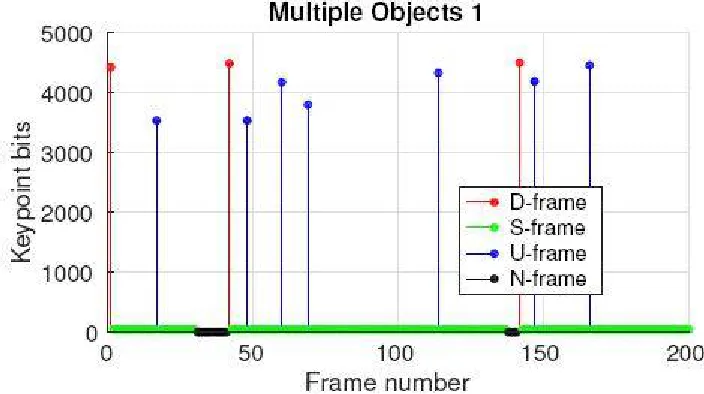
Fig. No 02. Number of key point bits used for each frame
The original video frames. It should be noted that the key pointdetection, feature extraction and matching, and key point encoding are based on the uncompressed video frames. Thus, we can run this process in parallel with the video compression as shown in Fig to speed up in practice. Here, we add the encoded key points as side information to videos compressed with different QP values. The pairwise matching and retrieval performances are compared with the performance of standard H.265/HEVC encoded videos.
Fig No 03 Frame number Object 1
Each Multiple Objects video has 200 frames and contains three different objects of interest. The first two Multiple Objects videos are used in our retrieval experiments. Excluding the fast spatial matching component, we use a previously proposed image retrieval system [26]. We use the MIRFLICKR-25000 [27] database and the 23 reference images from the Stanford MARdataset as the training dataset. Similar to [12], we extract up to 300 SIFT descriptors for each image in the database and train one million visual words (VW) from these descriptors. For test frames, we extract 200 SIFT features and feed themto the retrieval engine. After obtaining a shortlist of candidate matched images from the retrieval system, we run RANSAC for the top 100 images in the shortlist to reorder the retrieved images for improved precision. We run the retrieval for each frame of the Multiple Objects videos. As mentioned in the previous study [3], this is redundant because the retrieval results for consecutive frames are closely related. However, the goal of this experiment is to examine the performance of different approaches in a scenario wherein an object of interest is leaving or entering the scene. Note that in this experiment, the threshold is set to 80% (Section III-C), the N-frames are used, and Ns are set to 4 for these video sequences. We encode the videos using H.265/HEVC. Note that we only use a QP value of 46. Three approaches are compared, i.e., features extracted from the uncompressed video frames, features extracted from the Compressed video frames, and features extracted using the encoded key points.
VI. CONCLUSION
While image compression methods have an adverse effect on feature matching performance, the situation can be significantly improved by using the original SIFT key points. We propose a novel approach for feature-preserving image compression, where the encoded key points are signaled as side information with the compressed image. Our results show that the proposed approach significantly improves the matching performance. Besides the merit that the decoded images can be watched or stored, another advantage of our feature preserving image compression approach is that the orientations and scales can be used for geometric verification. In our future work, we plan to apply the idea to videos using key point prediction and differential key point coding.
REFERENCES
[1] A. Redondi, L. Baroffio, J. Ascenso, M. Cesana, and M. Tagliasacchi, “Rate-accuracy optimization of binary descriptors,” in Proc. IEEE Int.Conf. Image Process., Sep. 2013, pp. 2910–2914.
[2] L. Baroffio, M. Cesana, A. Redondi, M. Tagliasacchi, and S. Tubaro,“Hybrid coding of visual content and local image features,” CoRR,2015 [Online]. Available: http://arxiv.org/abs/1502.07828
[3] J. Chao, E. Steinbach, and L. Xie, “Keypoint encoding and transmission for improved feature extraction from compressed images,” in Proc. IEEE Int. Conf. Multimedia Expo, Jun.–Jul. 2015, pp. 1–6.
[4] A. Redondi, L. Baroffio, M. Cesana, and M. Tagliasacchi, “Compress-then-analyze vs. analyze-then-compress: Two paradigms forimage analysis in visual sensor networks,” in Proc. IEEE Int. WorkshopMultimedia Signal Process., Sep. 2013, pp. 278–282.
[5] L. Baroffio, J. Ascenso, M. Cesana, A. Redondi, and M. Tagliasacchi, “Coding binary local features extracted from video sequences,” in Proc. IEEE Int. Conf. on Image Process., Oct. 2014, pp. 2794–2798.
[6] S. Leutenegger, M. Chli, and R. Y. Siegwart, “BRISK: Binary robust invariant scalable keypoints,” in Proc. Int. Conf. Comput. Vis., Nov. 2011, pp. 2548– 2555.
[7] L. Baroffio, J. Ascenso, M. Cesana, A. Redondi, and M. Tagliasacchi, “Coding binary local features extracted from video sequences,” in IEEEInternational Conference on Image Processing, Oct. 2014, pp. 2794–2798.
[8] S. Leutenegger, M. Chli, and R. Y. Siegwart, “BRISK: Binary Robust Invariant Scalable Keypoints,” in Proc. Int. Conf. Computer Vision(ICCV), Barcelona, Spain, Nov. 2011.
[9] http://mpeg.chiariglione.org/standards/mpeg-7/compact-descriptorsvisual-search.
[10] M. Makar, C.-L. Chang, D. Chen, S. Tsai, and B. Girod, “Compression of image patches for local feature extraction,” in Proc. IEEE Int. Conf. Acoustics, Speech, and Signal Processing, Taipei, Taiwan, Apr. 2009, pp. 821–824.
[11] M. Makar, H. Lakshman, V. Chandrasekhar, and B. Girod, “Gradient preserving quantization,” in Proc. IEEE Int. Conf. Image Processing, Orlando, Florida, USA, Sep.-Oct. 2012.
[12] M. Makar, S. S. Tsai, V. Chandrasekhar, D. Chen, and B. Girod, “Interframe Coding of Canonical patches for Low Bit-rate Mobile Augmented Reality.”Int. J. Semantic Computing, vol. 7, no. 1, pp. 5–24, 2013.
[13] L. Duan, X. Liu, J. Chen, T. Huang, and W. Gao, “Optimizing JPEG quantization table for low bit rate mobile visual search,” in Proc. Visual Communications and Image Processing, San Diego, CA, USA, Nov.
2012, pp. 1–6.
[14] J. Chao, H. Chen, and E. Steinbach, “On the design of a novel JPEG quantization table for improved feature detection performance,” in IEEE International Conference on Image Processing, Melbourne, Australia,
Sep. 2013.