Defining and Measuring Policy Coverage in Testing
Access Control Policies
Evan Martin, Tao Xie, Ting Yu
Department of Computer Science
North Carolina State University
Raleigh NC USA 27695
{
eemartin,xie,yu
}
@csc.ncsu.edu
Abstract
To facilitate managing access control in a system, se-curity officers increasingly write access control policies in specification languages such as XACML, and use a ded-icated software component called Policy Decision Point (PDP). To increase confidence on written policies, certain types of policy testing (often in an ad hoc way) are usually conducted, which probe PDP with some typical requests and check PDP’s responses against expected ones.
This paper develops a first step toward systematic pol-icy testing by defining and measuring polpol-icy coverage when testing policies. We have developed a coverage-measurement tool to measure policy coverage given a set of XACML policies and a set of requests. We have developed a tool for request generation, which randomly generates re-quests for a given set of policies, and a tool for request reduction, which greedily selects a nearly minimal set of requests for achieving the same coverage as the originally generated requests. To evaluate coverage-based request re-duction and its effect on fault detection, we have conducted an experiment with mutation testing on a set of real policies. Our experimental results show that the coverage-based test reduction can substantially reduce the size of generated re-quests and incur only relatively low loss on fault detection. We also conduct a study on the policy coverage achieved by manually generated requests.
1
Introduction
Access control is one of the most fundamental and widely used security mechanisms. It controls which princi-pals (users, processes, etc.) have access to which resources in a system. To better manage access control, systems of-ten explicitly specify access control policies using policy languages such as XACML [1] and Ponder [8]. When-ever a principal requests access to a resource, that request
is passed to a software component called Policy Decision Point (PDP). PDP evaluates the request against access con-trol policies, and grants or denies the request accordingly.
The specification of access control policies is often a challenging problem. It is common that a system’s secu-rity is compromised due to the misconfiguration of access control policies instead of the failure of cryptographic prim-itives or protocols. This problem becomes increasingly se-vere as software systems become more and more complex, and are deployed to manage a large amount of sensitive information and resources that are organized into sophis-ticated structures.
Formal verification is an important means to ensuring the correct specification of access control policies. Recently, several tools have been developed to verify XACML ac-cess control policies against user-specified properties [10, 13,24]. However, it is often beyond the capabilities of these tools to verify complex access control policies in large-scale information systems. Further, user-specified properties are often not available [10].
Like in software development, errors in access control policies may also be discovered through testing. In fact, once access control policies are specified, they are often tested with some access requests so that security officers may check the PDP’s responses against expected ones [5]. However, current policy testing practice tends to be ad hoc. Although there exist various coverage criteria [25] for software programs, there are no criteria or good heuristics to guide systematic generation of high-quality policy test suites. With an ad hoc policy testing, it is questionable that high confidence could be gained on the correctness of ac-cess control policies.
poli-cies. We have developed a coverage-measurement tool to measure the coverage of XACML policies achieved by a set of access requests. We have also developed a request-generation tool that randomly generates a policy test suites for a given set of policies.
Though the randomly generated test suites can achieve high policy coverage, and are effective in detecting a vari-ety of policy specification errors, it may potentially include a huge number of requests, which makes it difficult to effi-ciently inspect and verify the correctness of responses from the PDP. To mitigate this problem, we further propose a re-quest reduction technique to significantly reduce the size of a test suite while maintaining its policy coverage.
Previous experiments [20] showed that test reduction based on program code coverage can severely compromise the fault-detection capabilities of the original test suite. To evaluate the impact of the proposed request reduction tech-nique on the quality of policy testing, we conduct an ex-periment on a set of real policies with mutation testing [9], which is a specific form of fault injection that consists of creating faulty versions of a policy by making small syn-tactic changes. In the experiment, we compare the fault-detection capabilities of the reduced set and original set of requests. Our experimental results show that our coverage-based request reduction technique can substantially reduce the size of generated requests but incur only relatively low loss in fault detection capabilities. We also conduct a study by measuring the policy coverage of an XACML confor-mance test suite and requests for a conference reviewing system’s policy. Our results show that the measurement of policy coverage can effectively identify uncovered parts of policies. Such results can be used to guide the development of further test cases, significantly improving the quality of policy testing.
The rest of the paper is organized as follows. Section 2 discusses related work and background information. Sec-tion 3 proposes the concept of policy testing and policy cov-erage based on a general access control model. In Section 4, we instantiate the concept of policy coverage in the con-text of XACML, a widely used and standardized meta pol-icy language for expressing domain-specific access control requirements. We also presents the design of a coverage measurement tool. Sections 5 and 6 describe the request-generation tool and our request reduction technique, respec-tively. Section 7 presents a set of initial mutation operators developed for policies. Section 8 presents the experiment conducted to assess request reduction and its effect on fault detection capabilities. Section 9 illustrates the study of mea-suring the policy coverage achieved by manually generated requests. Section 10 concludes the paper with future direc-tions.
2
Related Work and Background
Several tools have been developed to verify properties for XACML policies [1]. Hughes and Bultan translated XACML policies to the Alloy language [14] and check their properties using the Alloy Analyzer. Fisler et al. [10] de-veloped a tool called Margrave that uses multi-terminal bi-nary decision diagrams [7] to verify user-specified proper-ties and perform change-impact analysis. Zhang et al [24] developed a model-checking algorithm and tool support to evaluate access control policies written in RW languages, which can be converted to XACML [23]. These exist-ing approaches assume that policies are specified usexist-ing a simplified version of XACML. It is challenging to gener-alize these verification approaches to support full-feature XACML policies with complex conditions. In addition, most of these approaches require users to specify a set of properties to be verified; however, policy properties of-ten do not exist in practice. The systematic policy test-ing approach proposed in this paper works on full-feature XACML policies without requiring properties, comple-menting the existing policy verification approaches.
A test adequacy or coverage criterion provides a stopping rule for testing and a measurement of a test suite’s qual-ity [25]. A test coverage criterion can be used to guide test selection. A coverage criterion typically specifies testing re-quirements based on whether all the identified features in a program or specification have been fully exercised. Iden-tified features in a program can be statements, branches, paths, or definition-use paths. Identified features in a speci-fication can be choices for categories [3,4] or conditions [6] in specifications.
The importance of test coverage criterion in fault detec-tion can be shown through a fault propagadetec-tion model such as the PIE (Propagation, Infection, and Execution) model [22]. For example, in order to expose a bug in a statement in a program, a test needs to at least cover the buggy statement. Note that the coverage of a buggy statement is not a suf-ficient condition to expose the buggy behavior in program outputs; additionally the execution of the buggy statement needs to produce a wrong data state and the wrong data state needs to have an effect on program outputs.
database-driven applications based on dataflow information that is associated with entities in a database. Different from these existing coverage measurement approaches for gram-mars, SQL queries, or database entities, our new approach defines and measures coverage information for policies.
3
Access Control Policies and Policy
Cover-age
Many access control policy languages have been pro-posed for different application domains. Policies in these languages are usually composed of a set of rules which specify under what conditions a subject is allowed or de-nied access to certain objects in a system. To discuss policy coverage criteria in general, we model access requests and policies in this paper as follows.
LetS,OandAdenote respectively the set of all the sub-jects, objects and actions in an access control system. Each subject, object, or action is associated with a set of attributes that may be used for access control decisions. For example, a subject’s attributes may include a user’s role, rank and se-curity clearance. An object’s attributes may include a file’s type, a document’s security class, and a printer’s location.
An access requestq is a tuple(s, o, a), where s ∈ S,
o∈ Oanda∈ A. A request(s, o, a)means that subjects
requests to take actionaon objecto.
An access control policy P is a se-quence of rules, each of which is of the form (Conds, Condo, Conda, decision, Condg). Conds,
Condo andConda are constraints over the attributes of a
subject, object and action respectively. Condgis a general
constraint which may potentially be over all the attributes of subjects, objects, actions and other properties of a system (e.g., the current time and the load of a system). A decision is either deny or permit. Given a request (s, o, a), if Conds(s), Condo(o), Conda(a) and Condg
are all evaluated to be true, then the request is either permitted or denied, according todecisionin the rule.
One may wonder that since Condg can be a general
constraint over the attributes of subjects, objects, actions as well as other properties of a system, why we still need
Conds,Condo andConda in a rule? The reason is that,
though conceptually those conditions can be merged with the general conditionCondg, by separating them, it makes
it easy to quickly locate relevant rules to a request. For ex-ample, given a request (s, o, a), if one of Conds,Condo
andCondais evaluated to be false, then we do not need to
further evaluateCondgthat sometimes may be much more
complex than the former three. Such a form of access con-trol rules is commonly supported in access concon-trol policy languages. If a request satisfiesConds,CondoandConda
of a rule, then we say the rule is applicable to the request. A policy may have multiple rules that are applicable to a request. These rules may in fact offer conflicting decisions.
The final decision regarding the request depends on applica-tion specific conflict resoluapplica-tion funcapplica-tions. Commonly used conflict resolution functions include denial overriding per-mission (where a request is denied if it is denied by at least one rule), permission overriding denial (where a request is permitted if it is permitted by at least one rule) and first ap-plicable (where the final decision is the same as that of the first applicable rule in a sequence of rules whose condition
Condg is evaluated true). We useP DP (Policy Decision
Point) to denote the component of a system where final de-cisions are made according to the decision of each rule and a specific confliction resolution function. Conceptually, given a policyPand a requestq, a PDP returns the access control decision ofq.
Since we are interested in capturing potential errors in policy specifications, we assume that PDP is correctly im-plemented in the rest of the paper. In practice, generic PDP implementations are often available which has been scruti-nized by the public.
We next start our discussion on policy testing based on the above model. The basic idea of policy testing is very simple. Like software testing, given a policy, we would like to generate a set of requests, and check whether the access control decisions on these requests are as expected. Any unexpected decision indicates potential errors in the speci-fication of the policy.
Clearly, if no requests are evaluated against a rule during testing, then potential errors in that rule will not be discov-ered. Thus, it is important to generate requests so that a large portion of rules are involved in the evaluation of at least one of the requests. In other words, we are interested in requests that cause a rule’s conditions to be evaluated to be true.
Definition 1 Given a requestqand a rulemin a policyP, we sayqcoversmifmis applicable toq. Given a set of requestsQ, the rule coverage ofPbyQis the ratio between the number of rules covered by at least one request inQand the total number of rules inP.
Intuitively, the higher the rule coverage of a set of re-quest, the better chance specification errors may be discov-ered. Like software testing, it is often infeasible to have ex-hausted policy testing when the space of possible requests is large. Therefore, policy specification errors may still exist even after testing with requests that cover all the rules.
To improve the quality of policy testing, it helps to fur-ther examine potential errors in the specification of condi-tions in each rule, which can also be tested by requests.
Definition 2 Given a request q and a rule m(Conds, Condo, Conda, decision, Condg), we say
Condg is positively (negatively) covered by q if m is
covered by q and Condg is evaluated to be true (false).
Q is the ratio between the numbers of general conditions positively or negatively covered by at least one request in Qand two times of the total number of rules inP.
The intuition behinds the above definition is as follows. An error in the condition of a rule may have two types of im-pacts on a request. SupposeCond′
gis the condition when an
error is introduced to the original conditionCondg. Given
a request q,Cond′
g(q)may be evaluated to be true while
Condg(q)is false, or vice versa. That is why we concern
with both positive and negative coverage of a condition in the above definition.
4
Policy Testing in XACML
In this section, we focus our discussion of policy test-ing on XACML (eXtensible Access Control Markup Lan-guage). XACML is a language specification standard de-signed by OASIS. It can be used to express domain-specific access control policy languages as well as access request languages. Besides offering a large set of built-in func-tions, data types and combining logic, XACML also pro-vides standard extension interfaces for defining application specific features. Since it was proposed, XACML has re-ceived much attention from both the academia and the in-dustry. Many domain specific access control languages have been developed using XACML [17, 19]. Open source XACML implementations are also be provided for dif-ferent platforms (e.g., Sun’s XACML implementation and XACML.NET). Therefore, XACML provides an ideal plat-form for the development of policy testing techniques so that they can be easily applied to multiple domains and ap-plications. In this section, we first give a brief introduction of XACML, and then discuss the policy coverage criteria for XACML.
4.1
XACML
The basic concepts of access control in XACML include policies, rules, targets and conditions. A single access con-trol policy is represented by a policy element, which in-cludes a target element and one or more rule elements. A target element contains a set of constraints on the subject (e.g., the subject’s role is equal to faculty), resources (e.g., the resource name is grades), and actions (e.g., the action name is assign)1.
A target specifies to what kinds of requests a policy can be applied. If a request cannot satisfy the constraints in the target, then the whole policy element can be skipped with-out further examining its rules.
We next describe how a policy is applied to a request in details. A policy element contains a sequence of rule ele-ments. Each rule also has its own target, which is used to
1Conditions of “AnySubject”, “AnyResource”, and “AnyAction” can
be satisfied by any subject, resource, or action, respectively.
1<Policy PolicyId="demo" RuleCombinationAlgId="first-applicable"> 2 <Target>
3 <Subjects> <AnySubjects/> </Subjects> 4 <Resources>
5 <Resource>
6 <ResourceMatch MatchId="equal">
7 <AttributeValue>demo:5</AttributeValue>
8 <ResourceAttributeDesignator AttributeId="objectid"/> 9 </ResourceMatch>
10 </Resource> 11 </Resources>
12 <Actions> <AnyAction/></Actions> 13 </Target>
14 <Rule RuleId="1" Effect="Deny">
15 <Target> <Subjects><AnySubject/></Subjects> 16 <Resources> <AnyResource/> </Resources> 17 <Actions>
18 <Action>
19 <ActionMatch MatchId="equal">
20 <AttributeValue>Dissemination</AttributeValue> 21 <ActionAttributeDesignator AttributeId="actionid"/> 22 </ActionMatch>
23 </Action> 24 </Actions> 25 </Target>
26 <Condition FunctionId="not">
27 <Apply FunctionId="at-least-one-member-of">
28 <SubjectAttributeDesignator AttributeId="loginid"/> 29 <Apply FunctionId="string-bag">
30 <AttributeValue>testuser1</AttributeValue> 31 <AttributeValue>testuser2</AttributeValue> 32 <AttributeValue>fedoraAdmin</AttributeValue> 33 </Apply>
34 </Apply> 35 </Condition> 36 </Rule>
37 <Rule RuleId="2" Effect="Permit"/> 38</policy>
Figure 1. An example XACML policy
determine whether the rule is applicable to a request. If a rule is applicable, a condition (a boolean function) associ-ated with the rule is evaluassoci-ated. If the condition is evaluassoci-ated to be true, the rule’s effect (PermitorDeny) is returned as a decision; otherwise,NotApplicableis returned as a de-cision. If an error occurs when a request is applied against policies or their rules,Indeterminateis returned as a de-cision.
More than one rule in a policy may be applicable to a given request. To resolve conflicting decisions from differ-ent rules, a rule combining algorithm can be specified to combine multiple rule decisions into a single decision. For example, a deny overrides algorithm determines to return
Denyif any rule evaluation returnsDeny or no rule is ap-plicable. A first applicable algorithm determines to return what the evaluation of the first applicable rule returns.
In general, an XACML policy specification may also in-clude multiple policies, which are inin-cluded with a container element called PolicySet. When a request can also be ap-plied to multiple policies, a policy combining algorithm can also be specified in a similar way.
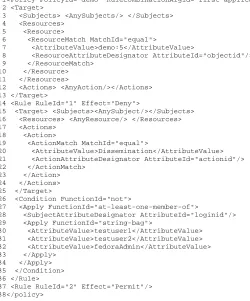
Figure 1 shows an example XACML policy, which is re-vised and simplified from a sample Fedora2 policy (to be
used in our experiment described in Section 8). This pol-icy has one polpol-icy element which in turn contains two rules. The rule composition function is “first-applicable”, whose meaning has been explained before. Line 2-13 defines the target of the policy, which indicates that this policy only ap-plies to those access requests of an object “demo:5”. The target of rule 1 (line 15-25) further narrows the scope of applicable requests to those asking to perform “Dissemina-tion” action on object “demo:5”. Its condition (line 26-35) indicates that if the subject’s “loginId” is “testuser1”, “tes-tuser2”, or “fedoraAdmin”, then the request should be de-nied. Otherwise, according to rule 2 (line 37) and the rule composition function of the policy (line 1), a request ap-plicable to the policy should be permitted.
4.2
Policy Coverage in XACML
In XACML languages, we can see there are three major entities: policies, rules for each policy, and a condition for each rule. We define policy coverage as follows:
• Policy hit percentage. A policy is hit by a request if the policy is applicable to the request; in other words, all the conditions in the policy’s target are satisfied by the request. Policy hit percentage is the number of hit policies divided by the number of total policies.
• Rule hit percentage. A rule for a policy is hit by a request if the rule is also applicable to the request; in other words, the policy is applicable to the request and all the conditions in the the rule’s target are satisfied by the request. Rule hit percentage is the number of hit rules divided by the number of total rules.
• Condition hit percentage. The evaluation of the condi-tion for a rule has two outcomes: true and false, which are called as the true condition and false condition, re-spectively. A true condition for a rule is hit by a request if the rule is applicable to the request and the condition is evaluated to be true. A false condition for a rule is hit by a request if the rule is applicable to the request and the condition is evaluated to be false. Condition hit percentage is the number of hit true conditions and hit false conditions divided by twice of the number of total conditions.
Note that a policy has at least one rule but a rule can have no condition, indicating an implicit conditiontrue, which is always satisfied when the rule is applicable. Therefore, when there are no conditions defined within the policies un-der consiun-deration, the condition hit percentage is always the same as the rule hit percentage. Normally a policy tester shall be able to generate requests to achieve 100% for all three types of policy coverage. In other words, all the to-be-covered entities defined in the policy coverage are fea-sible to cover in principle; otherwise, those infeafea-sible parts
of policy specifications could be removed like dead code in programs.
To automate the measurement of policy coverage, we have developed a measurement tool based on Sun’s open source XACML implementation [2], written in Java. Based on Sun’s XACML implementation, we first built a Policy Decision Point (PDP), which receives an access request and returns an access decision. We then developed several pub-lic methods in a Java class for collecting runtime coverage and insert some call sites to these methods in several places in the code of Sun’s XACML implementation. When PDP loads given policies, we insert a method call to collect all the policies, rules, and conditions in the given policies. Every time PDP determines that all the conditions in a policy’s tar-get are satisfied, we insert a method call to collect policy hit information. Every time PDP determines that all the condi-tions in a rule’s target are satisfied, we insert a method call to collect rule hit information. Every time PDP determines that a condition for a rule is evaluated to be true or false, we insert a method call to collect condition hit information.
After PDP returns the decision, we output the coverage information into a text file, whose name is determined by the names of given policies; if a text file with the same name exists, the coverage information in it is updated by incorpo-rating the new coverage information. Therefore, when PDP receives several requests separately against the same set of policies, the aggregated coverage information achieved by them is collected. Besides the basic coverage information, we also output the details of covered entities and their cov-ering requests as well as the details of uncovered entities. The extra information can help developers or external tools in generating or selecting requests for achieving higher pol-icy coverage.
5
Request Generation
To generate requests automatically for achieving policy coverage, we have developed a request-generation tool for inspecting the policy under test and constructing a request factory that provides requests on demand. There are vari-ous algorithms that can be devised to generate requests. At present we have implemented two simple factories called
theAllComboReqFactoryand theRandomReqFactory.
The former attempts to generate requests for all possible combinations of attribute id-value pairs found in the policy while the latter randomly selects requests from the set of all combinations. This is achieved by representing a particu-lar request as a vector of bits. The length of this vector is equal to the number of different attribute values found in the policy targets, rule targets, and rule conditions of the policy under test. Each attribute value appears in the request if its corresponding bit in the vector is1, otherwise the value is not present.
integer ifrom 0 to2n where nis the number of attribute
values found in the policy. To construct a request from the integeriwe first convertito binary and use thenleast sig-nificant bits as the vector of bits that indicate the presence or absence of the possible attribute values. This approach guarantees that all possible combinations of the available attribute values are generated. However this is a simplis-tic approach and not realissimplis-tic for larger policies since the number of possible requests increases exponentially with the number of possible attribute values. In addition to this shortcoming, there are instances in which the set of attribute values is not finite, such as cases with integer data types and greater than or less than condition functions. Such instances make the use of theAllComboReqFactoryimpractical or even impossible.
The generation of random requests is done in a similar fashion. First, the policy is inspected and the n possible attribute values are determined. Each request is generated by setting each bit in the vector to 0 or 1 with probabil-ity 0.5. The number of randomly generated requests can be configured by the user and the configured number can be considerably smaller than the total number of combina-tions. To help achieve adequate coverage with a small set of random requests, we further modified this algorithm to ensure that each bit was set to 1 and0 at least once. We accomplish this by explicitly setting theithbit to1for the
firstngenerated requests wherei= 1,2, ...n. Similarly, for the nextnrequests, we explicitly set the(i−n)thbit to0.
This approach guarantees that each attribute value is present and absent at least once as long as the number of randomly generated requests is greater than2n.
6
Request Reduction
The request reduction problem can be stated similar to the test minimization problem for program testing [11]:
Given: request set QS, a set of requirementsr1,r2, ...,rn
that must be satisfied to provide the desired test coverage of the policies, and subsets of QS,Q1,Q2,...,Qn, one
associ-ated with each of theris such that any one of the requestqj
belonging toQican be used to testri.
Problem: Find a representative set of requests from QS that satisfies all ofris.
In the problem statement, the ris can represent policy
coverage requirements, such as covering a certain policy, a certain rule, and a certain condition. In a representative set of requests that satisfies all of theris, at least one request
satisfies eachri. We call a representative set is minimal if
removing any request from the set causes the set not to be a representative set. Given a request setQS, there can be several minimal representative sets QS′ ⊆ QS. Among
the minimal representative request sets, we could find a
re-quest set that has the smallest possible number of rere-quests. Finding such request tests reduces to optimization problems called “minimum set cover” and “minimum exact cover”, respectively; these problems are known to be NP complete, and in practice approximation algorithms are used [15].
In our implementation of coverage-based request reduc-tion, we use a greedy algorithm for selecting requests as they are generated by the random request factory if and only if the generated request increases any of the coverage met-rics described in Section 4. More specifically, we iteratively generate a random request, add it to the large set. We then evaluate that request against the policy in order to both com-pute the response and measure the coverage. If the coverage increases due to the evaluation of the request, then that re-quest is added to the reduced rere-quest set.
We note that this greedy algorithm may not produce a minimal representative set. In practice, it does, however, often produce a representative set whose size is near the size of a minimal representative set. We call our reduced set as a nearly minimal representative set.
7
Mutation Testing
In order to investigate the effect of request reduction on fault detection capabilities, we can inject faults into the original policy thereby creating faulty policies. Since fault detection is the central focus of any testing process, it provides an external measure of the effectiveness of that process. We aim to demonstrate that reduced request sets based on coverage can detect a large percentage of the faults detected by the original request set. We use mutation test-ing [9] as a mechanism to compare request sets in terms of fault detection. In mutation testing, the policy under test is mutated to introduce an error and a request set is evalu-ated against the mutant policy. If the request set produces any response that differs from the corresponding response produced by the original policy, then the mutant is killed.
There are many studies concerned with the types and ef-fectiveness of mutating general purpose programming lan-guages [12, 18], however many of these do not directly ap-ply to mutating policies. We describe the types of mutation operators employed in our experiments in Table 1.
8
Experiment on Request Reduction and Its
Effect on Fault Detection
The objective of the experiment is to examine whether the reduced request set will be as effective at fault detection as the original request set. Similar to the goals of Hennessy et al. [12] for grammar-based software, we wish to investi-gate the following hypotheses:
Table 1. The types of mutation operator applied to the policies.
ID Description
REff Invert the RuleEffectby changingPermittoDenyorDenytoPermit.
PTargT Ensure the policy is always applied to all requests by replacing tags within the<Target>tag with<Any*/>. PTargF Ensure the policy is never applied to any requests by removing tags within the<Target>.
RTargT Ensure the rule is always applied to all requests by replacing tags within the<Target>tag with<Any*/>. RTargF Ensure the rule is never applied to any requests by removing tags within the<Target>.
CondT Ensure the condition always evaluates to True by removing the condition entirely.
CondF Ensure the condition always evaluates toFalseby manipulating the condition value or the condition function. POrder Try all combinations of policy orderings. This mutant is only meaningful if there is more than one policy and
the policy combining algorithm is order sensitive.
ROrder Try all combinations of rule orderings. This mutant is only meaningful if there is more than one rule and the rule combining algorithm is order sensitive.
while maintaining equivalent policy, rule, and condition coverage.
Hypothesis 2 Reducing a request set based on coverage will not proportionately decrease its fault detection capa-bility.
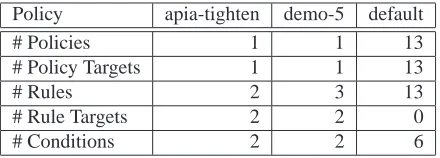
In order to investigate our hypotheses, we need to mea-sure the reduction in request-set size, the coverage metrics, and the reduction in fault detection capability. We measure each of these against three XACML policies used by Fe-dora3, an open source software that gives organizations a flexible service-oriented architecture for managing and de-livering digital content. Fedora leverages Sun’s XACML implementation [2] to provide fine-grained access control to the digital content it manages. The Fedora repository of default and example XACML policies proved a useful re-source for realistic test subjects. The subjects selected for this experiment are apia-tighten, demo-5, and the default set of policies shipped with Fedora. The basic metrics of each policy include the number of policies, policy targets, rules, rule targets, and conditions found in each of the three sub-jects. These metrics are summarized in Table 2. The first policy, apia-tighten, is just one of a set of policies used to tighten the access control of the Fedora system. The overall intent of the policy is datastream hiding, meaning that raw datastreams must not be accessible to anyone except very privileged users. The demo-5 policy is an example policy used to show how access control can be enforced on particu-lar objects. The default policy is actually a set of 13 policies that approximate the access control of an earlier version of Fedora.
We first randomly generate requests for each policy as outlined in Section 5 and greedily select a smaller set of requests with equivalent coverage as outlined in Section 6. If we define the size of the entire request set as rand the size of the reduced request set asr′ then we can define the
3http://www.fedora.info
Table 2. Basic policy metrics of the experi-mental subjects.
Policy apia-tighten demo-5 default
# Policies 1 1 13
# Policy Targets 1 1 13
# Rules 2 3 13
# Rule Targets 2 2 0
# Conditions 2 2 6
reduction in request-set size,SizeReduction, as follows:
SizeReduction= 1−r′
r
Table 3 shows the size of the generated request set, the size of the reduced request set, the coverage obtained by each request set, and the reduction in request-set size achieved by the greedy selection algorithm. The results in Table 3 show that we can achieve more than 98% size reduc-tion for the three Fedora policies. The results suggests that we can indeed greatly reduce the request set size of large randomly generated request sets while maintaining equiva-lent policy, rule, and condition coverage.
The second objective of the experiment is to investigate if the reduced request set can still effectively detect faults in policies compared to the full set. We perform the exper-iment illustrated in Figure 2. The basic approach is to ex-ploit mutation testing as a mechanism to compare the fault detection capability of various request sets. As discussed in Section 7, we create several mutant policies using the muta-tion operators listed in Table 1 for each of the experimental subjects. The quantity and type of mutation operator used for each policy is summarized in Table 4.
Table 3. Coverage metrics and reduction in request-set size achieved for each policy.
Policy apia-tighten demo-5 default Coverage Metrics
Policy Hit % 100% 100% 100%
Rule Hit % 100% 100% 100%
Condition Hit % 100% 100% 91.67%
Request Reduction
# Requests 200 200 1000
# Reduced Requests 4 3 10
Size Reduction 98% 98.5% 99%
R equest S et
R educed R equest S et
P olicy
R esp
M utant P olicy 1
M utant P olicy N
.
.
.
.
R esp 1
R esp N Correct R esponses
D iffer? M u
tant1 Responses
M utantN Responses
Figure 2. Overview of fault detection experi-ment.
Table 4. Type of mutation operator and quan-tity of mutant policies created for each policy.
Policy apia-tighten demo-5 default
Mutation Operator Id
REff 2 3 13
PTargT 1 1 13
PTargF 1 1 13
RTargT 2 2 0
RTargF 2 2 0
CondT 2 2 6
CondF 2 2 6
POrder 0 0 0
ROrder 1 5
Total Mutants 13 18 51
differs from the response for the request evaluated against the mutant policy, then the mutant is said to be killed. We define the CapabilityReduction as a metric that quanti-fies the relative fault detection capability of the reduced set compared to its original set. If we define the total number of mutants detected by the original set as mand the total number of mutants detected by the reduced set asm′, then
we compute the reduction in fault detection as:
CapabilityReduction= 1−m
′
m
Table 5 summarizes the results of our experiments on the reduction of fault detection. The results suggest that, on av-erage, a 98.5% reduction in request-set size only results in a 18.97% reduction in fault detection capability. In many cases we suspect the reduction in fault detection capability is acceptable considering the large reduction in request-set size. These results suggest that request sets requiring man-ual inspection can be greatly reduced with relatively low loss to fault detection capability.
Table 5. Reduction in fault detection.
Policy apia-tighten demo-5 default
# Mutants 13 18 51
Kill %
Original Set 76.92% 94.44% 80.39% Reduced Set 69.23% 77.78% 56.86% Capability Reduction 10% 17.65% 29.27%
One possible explanation as to why the reduced set suf-fers from a reduction in fault detection capability is greedy selection of requests for addition to the reduced set. Since requests can carry multiple attribute values for the same at-tribute ids, it is possible that two requests with the identical coverage can produce different responses by operating on the same conditions in different ways. There may be more optimal, albeit likely more complex, algorithms for choos-ing requests.
We consider these results promising yet further experi-mentation with larger, more complex policies and a more comprehensive suite of mutation operators is necessary to further validate the findings. We will investigate if there are any specific types of mutation operators that result in mu-tants that are least likely to be killed by the reduced set.
9
Empirical Study of Manually Generated
Requests’ Policy Coverage
Table 6. Policy coverage of the XACML con-formance test suite
type 100% 50% non-0% 0% total
all cond rule/cond rule/cond
policies 24 172 24 14 234
Permit 31 144 6 181
Deny 6 6
NotApp 13 28 6 10 57
Indet 1 2 6 4 13
The XACML conformance test suite includes 337 dis-tinct policies4, 374 requests, their expected responses from
the application of the policies. Among these 337 distinct policies, we show the results of 234 policies in this sec-tion because for the requests of the remaining 103 policies, Sun’s XACML implementation [2] responded different de-cisions than the ones specified in their expected responses. Applying the requests on these 103 policies failed to con-form with expected responses because Sun’s XACML im-plementation does not support some optional features of XACML specifications.
The conference paper review system’s policy specified by Zhang et al. [23] has 11 requests and 15 rules, which have 10 conditions. These 10 conditions involve the exe-cution of SQL statements that access an external database. Because it is not trivial to adapt Sun’s XACML implemen-tation to support this, we simply remove these 10 condi-tions as well as some attributes that are not parsed by Sun’s XACML implementation, in order to allow us to focus on the the measurement of rule hit percentage.
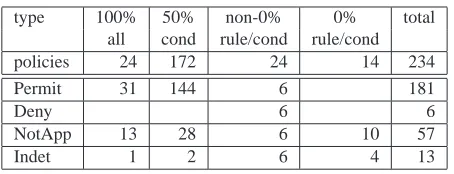
After we fed 374 requests in the XACML conformance test suite to the coverage-measurement tool, we summarize the reported statistics of policy coverage in Table 6. Note that all policies in the conformance test suite are hit by the requests, achieving 100% policy hit percentage. Column 1 shows the type of data and Columns 2-5 show the data for different types of coverage. Row 2 shows the number of policies. Rows 3-6 show the number of requests whose re-turned decisions arePermit,Deny,NotApplicable, and
Indeterminate, respectively. When a data entry has a
zero value, we do not show the zero value but leave the en-try empty.
Column 2 shows the data for policies whose policy, rule, and condition hit percentages reach 100%. These poli-cies have achieved the optimal policy coverage. Column 3 shows the data for policies whose policy and rule hit per-centages reach 100% but condition hit percentage reaches 50%. These policies achieve almost-optimal policy cover-age because sometimes it is not very essential to cause a
4In the XACML conformance test suite, there are 374 policies, each of
which receives a single request. We have reduced those policies with the same policy content into a single policy, which can then receive multiple requests.
condition of a rule to be evaluated to be false. Column 4 shows the data for policies whose rule or condition hit per-centage is less than 100% but not equal to 0% (but we do not include the cases shown in Column 3 here). The coverage of these policies needs to be improved. Column 5 shows the data for policies whose rule or condition hit percentage is equal to 0%. These policies are especially in need for im-provement. The last column shows the sum of all the data in Columns 2-5.
From the results shown in Table 6, we observed that a majority of policies fell into the category of Column 3, where policy and rule hit percentages reach 100% but con-dition hit percentage reaches 50%. Many polices in the XACML conformance test suite contain single rules each of which has a condition. Often each of these policies re-ceives only one request, which basically cover the policy’s rule and the rule’s true condition.
We took a close look at the details of 14 policies in Column 5. Two of them had 100% for rule hit coverage but 0% for condition hit percentage. Their coverage re-sults were against our expectation because if their condi-tions were applicable, we expected at either true or false condition would be hit. We inspected their requests and found that a subjects’s age was specified twice and their conditions access the the subject’s age. When evaluating the conditions, PDP encountered an error and returned a de-cision ofIndeterminate; therefore, neither true or false condition is hit.
Note that the XACML conformance test suite was not specifically constructed to achieve high coverage of poli-cies but the measurement results still give us some insights of the common coverage distribution, reflecting policy por-tions that are commonly hit by manually created requests.
After we fed to coverage-measurement tool 11 requests for the conference paper review system’s policy [23], 73% rule hit percentage was achieved: 4 out of 15 rules were not hit. These four uncovered rules included the case of per-mitting a PC chair to read papers and no request matched this case. Interestingly one of these uncovered four rules was the last rule, which has the effect of Deny and this rule’s target can be matched by any request. This rule is often used for thepermit-overrides rule combination algorithm [1]. Given the measurement results of coverage-measurement tool, we could construct new requests without much difficulty to cover these uncovered rules in the policy of the conference paper review system as well as those un-covered rules or conditions in many policies of the XACML conformance test suite.
10
Conclusion
test-ing and policy coverage based on a general access control model. We further defined three levels of specific policy coverage for XACML policies: policy hit percentage, rule hit percentage, and condition hit percentage. To support systematic policy testing based on policy coverage automat-ically, we have developed a coverage-measurement tool, a request-generation tool, and a request-reduction tool. By using mutation testing, we have conducted an experiment that assesses the coverage-based request reduction and its effect on fault-detection capabilities. The experimental re-sults showed that the coverage-based request reduction sub-stantially reduce the size of the request set but incur only relatively low loss of fault-detection capabilities. We also conducted a study on the policy coverage achieved by man-ually generated requests for policies in a conformance test suite for XACML specifications [5] and a conference re-viewing system [23]. Our results showed that our measure-ment results can pinpoint uncovered areas of policies and guide the development of new requests to achieve higher policy coverage.
In future work, we plan to develop a comprehensive suite of techniques and tools for systematic policy testing. In par-ticular, we plan to extend our policy coverage to consider cases that reflect the interactions of different rules or differ-ent policies, which are not focused by our existing policy coverage. We also plan to conduct experiments on a larger scope of policies.
References
[1] OASIS eXtensible Access Control Markup Language (XACML). http://www.oasis-open.org/committees/xacml/, 2005.
[2] Sun’s XACML implementation.
http://sunxacml.sourceforge.net/, 2005.
[3] N. Amla and P. Ammann. Using Z specifications in cate-gory partition testing. In Proc. 7th Annual Conference on
Computer Assurance, pages 3–10, June 1992.
[4] P. Ammann and J. Offutt. Using formal methods to de-rive test frames in category-partition testing. In Proc. 9th
Annual Conference on Computer Assurance, pages 69–80,
June 1994.
[5] A. Anderson. XACML 1.1 committee
speci-fication conformance tests. http://www.oasis-open.org/committees/xacml/ConformanceTests/, 2002. [6] J. Chang and D. J. Richardson. Structural
specification-based testing: automated support and experimental evalu-ation. In Proc. 7th ESEC/FSE, pages 285–302, 1999. [7] E. Clarke, M. Fujita, P. McGeer, J. Yang, and X. Zhao.
Multi-terminal binary decision diagrams: An efficient data structure for matrix representation. In Proc. International
Workshop on Logic Synthesis, 1993.
[8] N. Damianou, N. Dulay, E. Lupu, and M. Sloman. The ponder policy specification language. In Proc. International
Workshop on Policies for Distributed Systems and Networks,
pages 18–38, 2001.
[9] R. A. DeMillo, R. J. Lipton, and F. G. Sayward. Hints on test data selection: Help for the practicing programmer. IEEE
Computer, 11(4):34–41, April 1978.
[10] K. Fisler, S. Krishnamurthi, L. A. Meyerovich, and M. C. Tschantz. Verification and change-impact analysis of access-control policies. In Proc. 27th International
Confer-ence on Software Engineering, pages 196–205, 2005.
[11] M. J. Harrold, R. Gupta, and M. L. Soffa. A methodology for controlling the size of a test suite. ACM Trans. Softw.
Eng. Methodol., 2(3):270–285, 1993.
[12] M. Hennessy and J. F. Power. An analysis of rule cov-erage as a criterion in generating minimal test suites for grammar-based software. In Proc. 20th IEEE/ACM
Inter-national Conference on Automated Software Engineering,
November 2005.
[13] G. Hughes and T. Bultan. Automated verification of access control policies. Technical Report 2004-22, Department of Computer Science, University of California, Santa Barbara, 2004.
[14] D. Jackson, I. Shlyakhter, and M. Sridharan. A micromod-ularity mechanism. In Proc. 8th ESEC/FSE, pages 62–73, 2001.
[15] D. S. Johnson. Approximation algorithms for combinatorial problems. J. Comput. System Sci., 9:256–278, 1974. [16] G. M. Kapfhammer and M. L. Soffa. A family of test
ad-equacy criteria for database-driven applications. In Proc.
9th European Software Engineering Conference held jointly with 11th ACM SIGSOFT International Symposium on Foundations of Software Engineering, pages 98–107, 2003.
[17] M. Lorch, D. Kafura, and S. Shah. An xacml-based pol-icy management and authorization service for globus re-sources. In International Workshop on Grid Computing
(GRID), pages 208–212, Phoenix, AZ, Nov. 2003.
[18] Y.-S. Ma, Y.-R. Kwon, and J. Offutt. Inter-class mutation operators for Java. In Proc. International Symposium on
Software Reliability Engineering, pages 352–363, 2002.
[19] T. Moses, A. Anderson, S. Proctor, and S. Godik. XACML Profile for Web-Services (WSPL). OASIS Working Draft, Sept. 2003.
[20] G. Rothermel, M. J. Harrold, J. Ostrin, and C. Hong. An empirical study of the effects of minimization on the fault detection capabilities of test suites. In Proc. International
Conference on Software Maintenance, pages 34–43, 1998.
[21] M. J. Suarez-Cabal and J. Tuya. Using an sql coverage mea-surement for testing database applications. In Proc. ACM
SIGSOFT International Symposium on Foundations of Soft-ware Engineering, pages 253–262, 2004.
[22] J. M. Voas. PIE: A dynamic failure-based technique.
IEEE Transactions on Software Engineering, 18(8):717–
727, 1992.
[23] N. Zhang, M. Ryan, and D. P. Guelev. Synthesising ver-ified access control systems in XACML. In Proc. 2004
ACM workshop on Formal Methods in Security Engineer-ing, pages 56–65, 2004.
[24] N. Zhang, M. Ryan, and D. P. Guelev. Evaluating access control policies through model checking. In Proc. 8th
In-ternational Conference on Information Security, pages 446–
460, September 2005.