SIVASUBRAMANIAN, DHIVYA. Automated Access Control Policy Testing Through Code Generation. (Under the direction of Ting Yu.)
Any multiuser system has to enforce access control for protecting its resources from unau-thorized access or damage. One way for specifying access control is in a separate policy specifica-tion language. An access control system maintains a repository of policies, receives access requests, consults the policy and returns a response specifying whether the request was permitted or denied. However, it is challenging to specify a correct access control policy and so, it is common for the se-curity of a system to be compromised because of the incorrect specification of these policies. There are many ways in which a policy can be checked for correctness like, formal verification, analysis and testing. In this thesis, a systematic and automatic tool for policy testing is provided. Testing a policy involves formulating requests that represent test cases for the policy, evaluating the policy with those test cases (requests) and comparing the responses obtained with actual expected results.
In our approach to policy testing, we generate access control policy programs correspond-ing to a policy. Dynamic analysis testcorrespond-ing techniques are those which execute a program for different inputs to test the expected behavior. We use concolic testing which generates test inputs (requests) by dynamically analyzing the policy program and solving constraints to identify distinct feasible execution paths. We choose to illustrate our above technique using the most generic access control specification language, Extensible Access Control Markup Language (XACML). However, our ap-proach to policy testing can in general be applied for testing other rule-based systems using other languages.
by
DHIVYA SIVASUBRAMANIAN
A thesis submitted to the Graduate Faculty of North Carolina State University
in partial fulfillment of the requirements for the Degree of
Master of Science
COMPUTER SCIENCE
Raleigh, North Carolina
2007
APPROVED BY:
_________________________ _________________________ Dr. Peng Ning Dr. Tao Xie
________________________________ Dr. Ting Yu
Chair of Advisory Committee
DEDICATION
BIOGRAPHY
ACKNOWLEDGEMENTS
First and foremost, I would like to thank my family, my parents and sister for their love and support for everything.
I would like to thank my adviser, Dr.Ting Yu for his guidance and support for my research work. His careful and critical comments greatly improved this thesis work. I would also like to thank Dr.Tao Xie for his invaluable advice, guidance and also for agreeing to serve on my thesis advisory committee. I also thank Dr.Peng Ning for kindly agreeing to serve on my thesis advisory committee.
I would like to acknowledge Evan Martin for his help in starting this project and also for the useful discussions.
Table of Contents
List of Tables vii
List of Figures viii
List of Listings ix
1 Introduction 1
1.1 Contributions of this thesis . . . 3
1.2 Organization of this thesis . . . 4
2 Access Control Policies and Enforcement 5 2.1 BackGround . . . 5
2.2 Security Policy . . . 6
2.2.1 Policy Specification Languages . . . 6
2.2.2 XACML . . . 7
3 Policy Testing Framework 13 3.1 Policy Model . . . 14
3.2 Request Generation Process . . . 17
3.2.1 Generating XACML Policy Programs . . . 17
3.2.2 Dynamic Policy Program Analysis . . . 24
3.2.3 Request Reduction . . . 27
4 Evaluation 28 4.1 Coverage Criteria . . . 28
4.2 Policy Coverage Criteria . . . 29
4.3 Target Driven Request Generation(Targen) . . . 30
4.4 Comparison of Request Generation Techniques . . . 30
4.5 Mutation Testing for Fault Detection . . . 32
4.5.1 Fault Detection Capability Comparison . . . 35
4.6 Policy Path Coverage . . . 37
5 Related Work 41
5.1 Policies, Models and Mechanisms . . . 41
5.2 Access control models . . . 42
5.3 Policy Specification Langauges . . . 44
5.3.1 Ponder Policy Specification Language . . . 44
5.3.2 The Platform for Privacy Preferences(P3P) . . . 46
5.3.3 Enterprise Privacy Authorization Language(EPAL) . . . 46
5.4 Policy Testing Techniques . . . 48
5.5 Formal Policy Analysis . . . 48
6 Conclusions and Future Work 50
Bibliography 52
Appendix 55
List of Tables
4.1 Policies used in the evaluation. . . 31
4.2 Policy Set mutation operators . . . 32
4.3 Policy mutation operators . . . 33
4.4 Rule mutation operators . . . 33
List of Figures
2.1 Functional Components of an Access Control System . . . 6
2.2 Components of XACML Policy . . . 9
2.3 An example XACML policy . . . 11
2.4 XACML policy target for a university’s policy . . . 12
2.5 XACML Request . . . 12
2.6 XACML Response . . . 12
3.1 Policy Testing Framework . . . 14
3.2 Control Flow Graph . . . 15
3.3 Request Generation Process . . . 17
3.4 Request Generation from Program . . . 25
4.1 Policy Element Coverage . . . 29
4.2 Target Driven Request Generation . . . 30
4.3 jCute Vs Targen . . . 34
4.4 Mutation Operators . . . 35
4.5 Example : Original Policy . . . 39
4.6 Combined Mutation Kill Percentage . . . 40
4.7 Comparison of Number of Requests . . . 40
5.1 Ponder Authorization policy syntax . . . 45
5.2 Ponder Authorization policy example . . . 45
5.3 EPAL policy example . . . 47
List of Listings
3.1 Faculty Policy code . . . 16
3.2 Policy code for example . . . 18
3.3 Process each Policy Element . . . 21
3.4 Process PolicyORPolicySetTarget Element . . . 22
3.5 Process Policy Element . . . 22
3.6 Permit Overides Combining Algorithm . . . 22
3.7 One Rule . . . 23
Chapter 1
Introduction
Any multiuser system has to enforce access control for protecting its resources from unau-thorized access or damage. Access control is one of the fundamental mechanisms for information system security and it is widely used in operating systems, databases, networks, etc. All these sys-tems support different applications with multiple users and every activity performed by a user or a process must be checked to see if it is authorized. An access control system determines what principals can access what resources and when.
Access control is traditionally enforced by directly hard coding into a system. However, this is tedious and becomes difficult for a large system. Also, this makes it hard to accommodate changes of security requirements in a system. Recently, access control systems increasingly separate policy from mechanisms. That is, an access control policy is explicitly specified using certain policy languages. And a system dynamically consults the policy to determine whether an access request should be granted. The advantage of this is that by separating policy from mechanism makes it easier to specify the protection requirements to be enforced on the system independent of the underlying implementation details. Also, when the security requirements on the system change later on, it is possible to easily change the policy without affecting the underlying mechanism implementing it.
transportable and also inter operable across various access control systems.
The use of separate policy specification language provides a systematic way for express-ing, managing and maintaining access control policies. However, this does not by itself ensure the correctness of the specified policies. As explained below, there can be anomalies and inconsistencies in a specified policy and the security of a system is only as good as the policy.
As an example, consider the case of firewall policies. Firewalls are one mechanism for securing network resources. It is common for mis configured firewall policies to be causing prob-lems. In examining 37 firewalls in production enterprise networks in 2004, Wool found that all the firewalls were mis configured and vulnerable [29]. In addition, the study states, “The protection that firewalls provide is only as good as the policy they are configured to implement. Analysis of real configuration data shows that corporate firewalls are often enforcing rule sets that violate well established security guidelines”. The wide and continued spread of worms such as Blaster and Sap-phire, demonstrated that many firewalls were mis configured, because “well-configured firewalls could have easily blocked them” [29]. There can be many anomalies and inconsistencies in the policy which make the network resources vulnerable to security attacks. Also, firewall rules are developed over a period of time. New rules are periodically added as more resources with new con-straints are added to the network. It is difficult to check for conflicts or overlaps of new rules with existing rules. Similar problem exists in access control policies of enterprises and other systems. An enterprises’s security policy is also revised over time as new security requirements are added. Therefore, it is critical to specify access control policies correctly, which however is a challenging problem.
There are various ways in which the quality of the policy can be assured like, formal verification, analysis and testing. Formal verification techniques can verify if a policy satisfies a particular security property [9, 31]. However, a formal representation of the policy is not scalable and properties about a policy do not exist in practice. Analysis of policies can include semantic analysis like performing a change impact analysis between two policies [6]. Testing is one practical way for checking the correctness of a policy specification. Semantic analysis techniques can be used complementary to testing.
the policy. However, these requests are not exhaustive and all the features of the policy may not be tested. Also, it is tedious to manually formulate requests for large policies. So, there is a need for a systematic and automatic method for policy testing.
There are two existing policy testing techniques. Martin, Xie, and Yu [15] have developed a random test generation tool for XACML policies. The tests (requests) are generated as a set of all combination of attributes found in the policy. The tool represents this attribute as a bit vector and an attribute appears in the request only if the corresponding bit in the vector is set to 1. The number of requests to be generated can be user specified. To achieve adequate coverage, even in a small request set, they modify the random bit setting algorithm to ensure each bit is set at least once. This method, though simple to implement is not ensure that a policy is thoroughly tested. Martin and Xie [14] have developed the target driven test generation tool for testing XACML policies. This tool considers the policy as a hierarchical tree with the rules as the leaves. The conditions along branch in the tree leading to a rule is solved to generate the requests. This method, though outperforms the random test generation technique in terms of policy coverage and fault detection, it considers only each rule at a time and the effect of the policy as a whole is not considered.
In our approach to policy testing, we generate policy programs corresponding to a policy. The large amount of existing software testing techniques can be applied to this policy program for policy testing. The process of software testing is often called dynamic analysis because it requires that the software be executed for different inputs and the corresponding outputs be observed. This is in contrast to static analysis techniques like model checking which do not require the execution of the software. We use dynamic analysis techniques in our approach to policy testing. We use XACML as the policy language, but our techniques can be easily extended to other rule-based systems using different languages.
1.1
Contributions of this thesis
The following are the contributions made by this thesis,
1. The thesis proposes an automated method that uses software testing techniques for testing access control policies. The use of software testing techniques for ensuring the correctness of access control policies is novel.
code can be executed and software testing techniques like path coverage analysis can be used on it for policy testing. This idea of automatically generating policy programs is novel.
3. We have conducted extensive experiments to evaluate the effectiveness of our approach, and found that our method achieves 100% policy structural coverage. The mutation testing results show that our technique tests different properties of the policy than existing techniques.
4. Based on our technique, we define a stronger coverage criteria for testing access control polices. This can be used for assessing requests generated by other techniques also.
1.2
Organization of this thesis
Chapter 2
Access Control Policies and Enforcement
2.1
BackGround
In this chapter, we give an overview of the various components that make up an access control system and an introduction to policy specification languages. The figure 2.1 shows the various functional components of any system protecting its resources by enforcing access control. The user makes a request to the entity protecting the resources in the system, the Policy Enforcement Point(PEP). The PEP forms the appropriate access control request in a format applicable to the Policy based on the attributes of the requester, the action sought, the resource requested and the environment and gives it to the Policy Decision Point(PDP). The PDP looks up the policy that applies to the request and returns a response to the PEP. The PEP then returns the corresponding decision to the requester. The advantage of using this abstract model is that any application can use this system.
vulner-Policy Enforcement Point
Policy Decision Point
User
Resource Access
Request
Access Decision
Request Response
Access Granted
Access Control Policies
Figure 2.1: Functional Components of an Access Control System
abilities, one of the most basic requirement is to ensure that the security policy is specified correctly. In this thesis, we focus on the problem of ensuring that the access control polices are specified correctly. A policy is considered to be correctly specified when it satisfies all the properties of the system. An example of a property is that a particular subject should not access certain resources. These properties can be explicitly and formally expressed and formal analysis techniques like resolution theorem proving can be used to prove if a property holds in a policy. However, such properties of a policy do not exist in practice and it is difficult to infer such properties in a large system. Also, the formal analysis techniques are not scalable. A practical way for ensuring the correctness of the policy is to test the policy against a set of requests and check if the responses obtained are as expected. This is the policy testing approach which is followed in this work.
2.2
Security Policy
The security policy in an access control system provides a systematic way for specifying the strategy and practices for ensuring the security, integrity and availability of resources in an information system. In this section, we will give a brief overview of policy specification languages and describe XACML which we will be using for illustrating our approach to testing.
2.2.1 Policy Specification Languages
can be either generic or specific to applications. Generic policy specification languages are designed for enforcing access control in broad domains like distributed policy management [3], protecting the privacy of enterprises [18] , etc. Jajodia et al [10] propose a logical language for a model that allows the specification of different access control policies. They have also proposed a Flexible Authorization Manager (FAM) [11] that can enforce multiple access control policies within a single system. Besides generic policy languages, researchers have also designed models and languages for specific applications like, a model for information access control in a clinical information system [1], an access control model for work flow management [2], security policies for distributed system services [19], an access control language for web services [25],etc.
Our technique for policy testing is general and can be used for testing access control policies specified in other rule-based systems. In this thesis we present our approach in the context of one of the generic specification language XACML.
2.2.2 XACML
XACML provides a standardized way of expressing authorization polices and a standard format for expressing queries over these policies.
We have chosen to illustrate our approach to policy testing using XACML because it a general purpose specification language with various advantages for enforcing access control like,
• It is an open source standard ratified by the Organization for the Advancement of Structured Information Standards (OASIS). Because it is a standard, the various features of XACML has been examined by experts and so the specification is stable. Also, it is expected to be used widely in the industry because of its ratification.
• XACML is specified in XML format which is used for e-business applications for Electronic Data Interchange (EDI) in business-to-business and business-to-consumer transactions. Be-cause of this, these applications can be easily configured to exchange or share XACML poli-cies for enforcing access control.
• It is a portable standard. Since the specifications is in XML format, it can be used across applications.
• Conceptually it follows the PDP and PEP model which makes it applicable to many applica-tion environments.
• It supports distributed policies. The security policy of an enterprise may be enforced at dif-ferent points and there is a need for specifying distributed policies.
XACML follows the abstract model as shown in figure 2.1 for policy enforcement defined by the Internet Engineering Task Force(IETF) [30] [28].
The specification defines the PEP (Policy Evaluation Point) and PDP (Policy Decision Point) as any other access control implementation. The request is given to a PEP which processes it and converts it to an XACML request format and gives it to the PDP. The PDP has access to the policies and it gets the request and determines if it has to give access to the policy or not. The PDP and PEP implementation is dependent on the application. They may be in the same application or be as separate entities on different applications or be available as a service over a network.
XACML Constructs
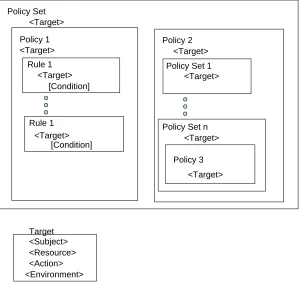
All XACML polices contain either a Policy or Policy Set as the basic element. A Policy is composed of a set of Rules. A set of policies or policy sets are combined to form a Policy Set. Figure 2.2 shows these main components and the hierarchical relation between Policy Sets, Policies, Rules and Conditions in XACML. When there are multiple rules in the policy and multiple policies / policy sets in a policy set, it is possible that a single access request can be applied to multiple rules to return conflicting access decisions. The way these conflicts must be resolved is dependent on the specific application’s policy. However, XACML specifies some standard rule and policy combining algorithms for this. They are,
First Applicable : Among the set of rules (policies), this returns the effect of the rule (policy) that
first evaluated to true. Here, the ordering of the rules is important.
Permit Overrides and Deny Overrides : In the set of rules (policies) in a policy (policy set), if
Policy Set <Target>
Policy 1 <Target>
Policy 2 <Target> Rule 1
<Target>
Policy Set 1 <Target>
Policy Set n <Target>
Policy 3
<Target> [Condition]
Rule 1 <Target>
[Condition]
Target
<Environment> <Resource> <Action> <Subject>
evaluating to true. If such a rule exists, a permit decision is returned, if not a deny decisions is returned if none of the permit rules are applicable. Hence, here permit rules are given precedence. Similarly the deny overrides rule (policy) combining algorithm is defined.
Only One Applicable : This combining algorithm is defined for combining policies in a policy set.
If no policy is applicable or more than one policy is applicable, the result is defined as not applicable and in determinant. If only one policy in the policy set is applicable for a request then the result of the policy is returned.
The permit overrides and deny overrides combining algorithms can be specified to be ordered requiring that the rules be evaluated in the order in which they are specified. In addition to the above, user-defined combining algorithms can also be added.
A Rule is the most elementary unit of a Policy [16]. A rule is made of the elements, Target, Effect and the optional Condition element. A Target defines a set of Subject, Resource and Actions elements for which the rule is intended to apply. The Effect specifies the access decision as permit or deny that is returned on the successful evaluation of the rule. The Condition element can include complex functions that further refine the applicability of the rule. The policy itself can have a target specifying the applicability of the policy. In this case, this target can be thought of as an index into the policy. The index can be the common criteria that has to be satisfied for the set of rules in the policy to be applicable. When there are a number of policies each with a number of rules, the index of each policy helps to speed up the evaluation of a decision request by first checking the applicable policy targets and then evaluating the rules in those policies. A policy set may be used for semantically grouping policies/ policy sets. For example, grouping those policies defining authorization for a particular object/subject, etc. A policy set also includes a target element which again be used as an index for checking the applicability before evaluation of all the constituent elements.
1<Policy PolicyId="univ" RuleCombinationAlgId="permit-overrides"> 2 <Target>
3 <Subjects> <AnySubjects/> </Subjects>
4 <Resources><Resource> <AnyResource/> </Resource></Resources>
5 <Actions> <AnyAction/> </Actions>
6 </Target>
7 <Rule RuleId="1" Effect="Permit">
8 <Target>
9 <Subjects><Subject> Faculty </Subject></Subjects>
10 <Resources> Grades </Resources>
11 <Actions><Action> Assign </Action>
12 <Action> View </Action></Actions>
13 </Target></Rule>
14 <Rule RuleId="2" Effect="Deny">
15 <Target>
16 <Subjects><Subject> Student </Subject></Subjects>
17 <Resources>Grades </Resources>
18 <Actions><Action> Assign </Action></Actions>
19 </Target>
20 </Rule>
21 <Rule RuleId="3" Effect="Permit">
22 <Target>
23 <Subjects><Subject> Student </Subject></Subjects>
24 <Resources> Grades </Resources>
25 <Actions><Action> View </Action></Actions>
26 </Target>
27 </Rule>
28 <!-- A final, "fall-through" rule that always Denies --> 29 <Rule RuleId="FinalRule" Effect="Deny"/>
30</policy>
Figure 2.3: An example XACML policy
logical functions, numeric conversions, set functions, bag functions, etc and the values returned can be compared to arrive at an access decision.
An Example Policy
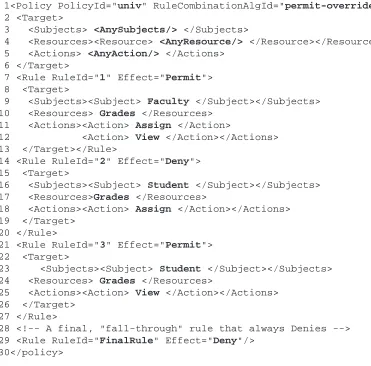
In this section, we describe an example XACML policy in a university. Figure 2.3 shows a simplified form of this policy with the major XACML componenets. This policy describes the way in which the access to the grade resource is controlled in a university. The policy has an empty target, which means that by default the set of rules in the policy are applicable for any request. The target of the policy in general is used as an index for the rules. In the above example, the target could have been used to restrict the policy to be specific to a university as shown in figure 2.4.
com-<Target>
<Subjects> <Subject> NC State University User </Subject> </Subjects> <Resources> <Resource> NC State University Academic Records
</Resource> </Resources>
<Actions> <AnyAction/> </Actions> </Target>
Figure 2.4: XACML policy target for a university’s policy
<Request>
<Subjects> Student </Subjects>
<Resources><Resource>Grades</Resource></Resources> <Actions> View </Actions>
</Request>
Figure 2.5: XACML Request
bined based on the permit overrides rule combining algorithm. This means that set of rules are combined giving precedence to rules with an effect of permit.
XACML Request and Response context
The XACML Request and Response context specifies the standard format with which a request and response from the system is got. The figures 2.5 and 2.6 shows a simplified form of an XACML Request and Response.
The request enables a set of subjects, resource and action elements to be specified. In this example, the student requests access to view the grade resource.
The response is returned on evaluating the request against the set of rules in the policy. In this example, a decision is returned on matching the attribute values in the request with the attribute values in the rule 3 in the policy.
<Response> <Result>
<Decision>Permit</Decision> </Result>
</Response>
Chapter 3
Policy Testing Framework
In this chapter, we describe the general framework followed for policy testing. We also describe our technique for policy testing and show how it fits into this framework.
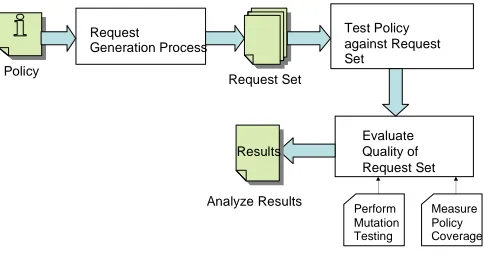
Figure 3.1 shows the general framework for testing a policy specification. The input to the framework is the access control policy that is to be tested. In the request generation phase, this policy is converted to a format suitable for testing. The output is results about the quality of the request set generated. The various phases are, request generation, testing policy against these requests and evaluating the quality of request set. These components are described in detail below,
Request Generation Process: Here, a policy is taken as input and the optimal number of requests needed for testing the policy is generated. This phase corresponds to test input selection in general software testing. As in test selection, some form of heuristics must be used to restrict the test cases generated.
Test Policy against Request: In this phase, we evaluate the generated request set against the policy to collect statistics of the generated test cases, which are later used to evaluate the quality of the test suite.
Compare and Evaluate Quality of Request Set: Here two techniques are used for evaluation. We find the policy structural coverage and the mutant kill ratio of the requests generated by our approach. We compare and analyze these results with existing request generation techniques.
14
Request Generation Process Policy
Request Set
Test Policy against Request Set
Evaluate Quality of Request Set
Measure Policy Coverage Perform
Mutation Testing
Results
Analyze Results
Figure 3.1: Policy Testing Framework
3.1
Policy Model
In this section, we describe how we model an XACML policy for generating requests. The overall idea of our approach is to consider the ordering and relationship between rules in the policy when generating requests. Consider an XACML policy shown in figure 2.3 for access to a grade book in a university. Here, the resource to be protected is Grades. The roles in the system are Faculty and Student. The various actions that the roles can perform on the resource are View and Assign.
The example 2.3 shows a single policy with the following rules,
1. Faculty can Assign and View Grades
2. Students cannot Assign Grades
3. Students can View Grades
4. All other requests will be denied
An XACML request to access the Grade resource will contain the subject/s that is the role/s making the request, the resource/s being requested for and the action/s requested on it.
The problem of policy testing is to find all possible requests that a policy can receive and check if the response is as expected. A request is a subset of the set of attributes representing the subject, resource, action and environment elements of the policy. So, all possible combinations of the sum of attribute sets will give all possible requests that a policy can receive. In general the number of possible requests that a policy can receive is 2n
where n is the number of attributes. In other words, the request to a policy is a bit vector of length n and 2n
If ( faculty==true)
If ( Grades== true)
If ( Assign==true or View ==true ) Permit If (Student==true) If (Grades==true) If (Assign==true) If( Student==true)
If (View ==true)
Deny Permit T T T F F T T T F F F Deny F F T T F
Figure 3.2: Control Flow Graph
tested is25
= 32. This technique though exhaustive, is inefficient and the number of test cases grows exponentially with the increase in number of attributes. Also, in XACML, the attributes correspond to roles, resources and actions sought, and the number of attributes directly map to the size of the application. According to a case study of the role based access control system of a bank [22] , the number of roles in an organization is 2-3% of the user population. So, generating test cases based on all combinations of attributes in a policy is not scalable.
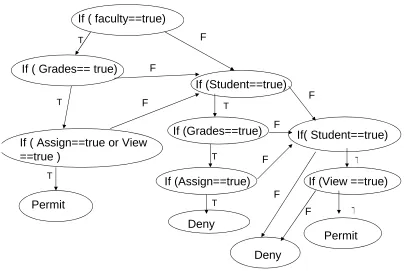
control-flow-graph of a program is a directed control-flow-graph showing all the execution paths in the program. The nodes represent the blocks of code without any branches and the edges represent jumps in the control flow. Figure 3.2 shows the control flow graph of the program corresponding to the example policy. Control flow graph of a program is used in many static analysis tools and compiler optimizations.
Listing 3.1: Faculty Policy code
1 i f ( r o l e == F a c u l t y )
2 i f ( r e s o u r c e == G r a d e s )
3 i f ( a c t i o n == A s s i g n o r View )
4 r e t u r n P e r m i t
5
6 i f ( r o l e == S t u d e n t )
7 i f ( r e s o u r c e == G r a d e s )
8 i f ( a c t i o n == A s s i g n )
9 r e t u r n Deny
10
11 i f ( r o l e == S t u d e n t ) 12 i f ( r e s o u r c e == G r a d e s )
13 i f ( a c t i o n == View )
14 r e t u r n P e r m i t
15
16 r e t u r n Deny / / d e f a u l t r e t u r n v a l u e
A coverage metric specifies when to stop a testing process. For testing a program, one structural coverage metric that is commonly used is path coverage. In path coverage, the criteria to stop testing is when each path in the program is traversed at least once. The problem with this approach is that the number of paths even for a simple program can be large. For example, if the input to a program is an integer, then the number of paths that the program can take is infinite. In our case, the program is a series of conditional statements. The output of each conditional statement is a true or a false outcome. So, for the above example, there are 9 conditions in the program and the number of paths is29
= 512. In general, for a policy, if there arenrules (with subject,resource and action elements) in a policy program, the number of paths is2n∗3
Preprocess policy, renaming attribute values if necessary
Generate code corresponding to every policy element
Perform program path coverage analysis and generate optimal test cases
Generate XACML requests from test cases XACML policy source Requests for testing the policy
Convert policy to program
Generate test cases from policy program
Figure 3.3: Request Generation Process
test cases is to use concolic testing (combination of concrete and symbolic executions) [23] to detect distinct paths as explained in the subsequent sections. This is done by solving the constraints which correspond to conditions represented by each rule.
3.2
Request Generation Process
The various components of the request generation process are code generation, test case generation and request formulation. This is shown in figure 3.3. The input to this step is the policy which is to be tested, the output will be a set of test cases that can be used to test the different paths in the policy. Also, an intermediate product is the policy program which can be used for other purposes like semantic code analysis as explained in chapter 6.
3.2.1 Generating XACML Policy Programs
As a practical example, we consider the modified form of the policy that is used by meta access management system and fedora for controlling access to objects and data streams. The XACML policy is given in the appendix in figure A.1. The policy has one policy set with four rules in the policy. The order in which the rules are to be combined is using deny overrides rule combining algorithm. The four rules are,
The target of the policy is the condition checking if the access requested is for this mod-fedora object.
1. Deny any access if client ip address is not 127.0.0.1. This policy essentially checks if the environment attribute client ip address is 127.0.0.1. If yes it grants access and proceeds to evaluate the next rule. If no it returns a deny decision.
2. Deny any access to objects or data streams, which are either inactive or deleted, unless subject has administrator role This rule first checks if the requested resource is inactive or deleted. If true then it checks if the subject accessing the resource is the administrator and it gives access.
3. Permit access to inactive data streams if the user role is special user.
4. Deny access to POLICY data stream unless subject has administrator role. Similarly, here also only if the subject is an administrator, it is given access to the resource.
The generated code corresponding to the above policy is,
Listing 3.2: Policy code for example
1 p u b l i c c l a s s m o d f e d o r a{
2 p u b l i c s t a t i c S t r i n g E v a l u a t e P o l i c y ( b o o l e a n [ ] p R e q u e s t A r r a y ){ 3 b o o l e a n 1 2 7 0 0 1 , a d m i n i s t r a t o r , s p e c i a l u s e r , I n a c t i v e o b j e c t , 4 D e l e t e d o b j e c t , I n a c t i v e d a t a s t r e a m , D e l e t e d d a t a s t r e a m ,
5 u r n f e d o r a n a m e s f e d o r a ; 6
7 1 2 7 0 0 1 = p R e q u e s t A r r a y [ 0 ] ; 8 a d m i n i s t r a t o r = p R e q u e s t A r r a y [ 1 ] ; 9 s p e c i a l u s e r = p R e q u e s t A r r a y [ 2 ] ; 10 p o l i c y = p R e q u e s t A r r a y [ 3 ] ;
13 I n a c t i v e d a t a s t r e a m = p R e q u e s t A r r a y [ 6 ] ; 14 D e l e t e d d a t a s t r e a m = p R e q u e s t A r r a y [ 7 ] ; 15 u r n f e d o r a n a m e s f e d o r a = p R e q u e s t A r r a y [ 8 ] ; 16
17 i f ( ( ( u r n f e d o r a n a m e s f e d o r a == t r u e ) ) ){ / / P o l i c y T a r g e t
18 A s s e r t ( f a l s e ) ;
19 i f ( ! ( 1 2 7 0 0 1 == t r u e ) ){ / / r u l e 1
20 A s s e r t ( f a l s e ) ; 21
22 }
23 } 24
25 i f ( ( ( I n a c t i v e o b j e c t == t r u e ) ){
26 A s s e r t ( f a l s e ) ;
27 i f ( ! ( a d m i n i s t r a t o r == t r u e ) ){ / / r u l e 2
28 A s s e r t ( f a l s e ) ;
29 }
30 }
31 i f ( ( D e l e t e d o b j e c t == t r u e ) ){ 32 A s s e r t ( f a l s e ) ;
33 i f ( ! ( a d m i n i s t r a t o r == t r u e ) ){ / / r u l e 2
34 A s s e r t ( f a l s e ) ;
35 }
36 }
37 i f ( ( I n a c t i v e d a t a s t r e a m == t r u e ) ){ 38 A s s e r t ( f a l s e ) ;
39 i f ( ! ( a d m i n i s t r a t o r == t r u e ) ){ / / r u l e 2
40 A s s e r t ( f a l s e ) ;
41 }
42 }
43 i f ( ( D e l e t e d d a t a s t r e a m == t r u e ) ){ 44 A s s e r t ( f a l s e ) ;
45 i f ( ! ( a d m i n i s t r a t o r == t r u e ) ){ / / r u l e 2
46 A s s e r t ( f a l s e ) ;
47 }
50 i f ( p o l i c y == t r u e ){ / / r u l e 4 − r e o r d e r e d 51 A s s e r t ( f a l s e ) ;
52 i f ( ! ( a d m i n i s t r a t o r == t r u e ) ){
53 A s s e r t ( f a l s e ) ;
54
55 }
56 }
57
58 i f ( s p e c i a l u s e r == t r u e ){ / / r u l e 3 − r e o r d e r e d 59 A s s e r t ( f a l s e ) ;
60 i f ( I n a c t i v e d a t a s t r e a m == t r u e ){
61 A s s e r t ( f a l s e ) ; 62
63 }
64 }
65 r e t u r n "Not Applicable"; / / d e f a u l t r u l e
66 }
The program shows that the attributes in the policy are converted to boolean variables in the program. The input to the program is the boolean array pRequestArray. The presence and absence of the attributes in the policy can be controlled by setting the index in this input array.
Assertions are a software engineering technique that can be used to systematically prove the correctness of a program [7]. Java provides this feature by means of the assert statement which takes a boolean expression and can assert true or false. The jCute testing tool, looks for these assertion violations in a program. So, to generate test cases for testing the policy program, we add assert statements after every rule or to have more specific inputs, add assert statements after every condition check in the rule. This can be seen in example listing 3.2. Adding these assertions drives the program execution through these paths. As an optimization to get more optimal requests from jCute, the conditional statements in the program with OR’s can be split up into separate if statements. This is shown in the example where the rule 2 is split into four conditional statements.
Converting permit overrides and deny overrides combining algorithms
an effect of deny. Similarly, the deny overrides algorithm can be converted to its first applicable format.
The reason for doing this is that, when exploring the various paths in the program, the use of the permit overrides and deny overrides algorithms may miss certain paths, while this re-ordering makes it simple to cover these paths in the program. In the above example in listing 3.2, the rule with an effect of permit is re-ordered to be after all the rules with an effect of deny.
Algorithm for translating an XACML policy to a program
In this section we describe an algorithm for converting a policy to program. Given an XACML policy, the following describes the step by step procedure for converting it to program.
Step 1: Pre-process attribute values: Do a static analysis of the policy - parse the policy, collect attributes, remove duplicate attribute values and process the attribute values making them suitable for use as a variable name in a program.
Step 2: Maintain mapping between code and policy - write the attribute values to a file in a format that will preserve the meaning of the attributes like subjects, resource and action.
Step 3: Generate code corresponding to each policy element. The policy set target, policy target, rule target and rule conditions are read in order and converted to corresponding condition equivalents preserving the ordering between the rules.
Step 4:Add the default cases, and the test driver code needed for generating the various test cases.
The algorithm is as follows,
Listing 3.3: Process each Policy Element
1 p r o c e s s P o l i c y E l e m e n t ( Node aNode ){
2 i f ( aNode == P o l i c y T a r g e t E l e m e n t )
3 P o l i c y O R P o l i c y S e t T a r g e t ( aNode )
4 i f ( aNode == P o l i c y E l e m e n t )
5 O n e P o l i c y ( aNode )
6 i f ( aNode == P o l i c y S e t E l e m e n t ){
7 f o r e v e r y c h i l d n o d e o f P o l i c y S e t
8 i f ( c h i l d N o d e O f P o l i c y S e t == P o l i c y S e t T a r g e t )
10 i f ( c h i l d N o d e O f P o l i c y S e t == P o l i c y ) 11 O n e P o l i c y ( c h i l d N o d e O f P o l i c y S e t )
12 i f ( c h i l d N o d e O f P o l i c y S e t == P o l i c y S e t E l e m e n t )
13 p r o c e s s P o l i c y E l e m e n t ( c h i l d N o d e O f P o l i c y S e t ) 14 }
15 }
Listing 3.4: Process PolicyORPolicySetTarget Element
1 P o l i c y O R P o l i c y S e t T a r g e t ( Node aNode ){ 2
3 s u b j e c t = aNode . g e t S u b j e c t E l e m e n t O f T a r g e t ( ) 4 p r i n t C o d e C o r r e s p o n d i n g T o S u b j e c t ( s u b j e c t ) 5
6 r e s o u r c e = aNode . g e t R e s o u r c e E l e m e n t O f T a r g e t ( ) 7 p r i n t C o d e C o r r e s p o n d i n g T o R e s o u r c e ( r e s o u r c e ) 8
9 a c t i o n = aNode . g e t A c t i o n E l e m e n t O f T a r g e t ( ) 10 p r i n t C o d e C o r r e s p o n d i n g T o A c t i o n ( a c t i o n ) 11 }
Listing 3.5: Process Policy Element
1 O n e P o l i c y ( Node aNode ){
2 T a r g e t = aNode . g e t T a r g e t O f P o l i c y ( ) 3 P o l i c y O R P o l i c y S e t T a r g e t ( T a r g e t ) 4
5 i f ( aNode . P o l i c y R u l e C o m b i n i n g A l g o r i t h m == P e r m i t O v e r i d e s ) 6 P e r m i t O v e r i d e s C o m b i n i n g A l g o r i t h m ( aNode )
7
8 i f ( aNode . P o l i c y R u l e C o m b i n i n g A l g o r i t h m == D e n y O v e r i d e s ) 9 D e n y O v e r i d e s C o m b i n i n g A l g o r i t h m ( aNode )
10
11 i f ( aNode . P o l i c y R u l e C o m b i n i n g A l g o r i t h m == F i r s t A p p l i c a b l e ) 12 F i r s t A p p l i c a b l e C o m b i n i n g A l g o r i t h m ( aNode )
Listing 3.6: Permit Overides Combining Algorithm
1 P e r m i t O v e r i d e s C o m b i n i n g A l g o r i t h m ( Node aNode ){ 2 Queue R ul eQ ueue ;
3 f o r e v e r y r u l e i n p o l i c y
4 R u l e = aNode . g e t R u l e S e t ( )
5 i f ( R u l e . E f f e c t == Deny ) {
6 R ul eQ ueue . add ( R u l e )
7 c o n t i n u e
8 }
9 OneRule ( R u l e )
10 f o r e v e r y r u l e i n Queue
11 OneRule ( R u l e )
12 }
Listing 3.7: One Rule
1 OneRule ( R u l e a R u l e ){
2 T a r g e t = a R u l e . g e t T a r g e t ( ) 3 O n e T a r g e t ( T a r g e t )
4 i f ( ( C o n d i t i o n = R u l e . g e t C o n d i t i o n ( ) ) ! = n u l l ) 5 O n e C o n d i t i o n ( C o n d i t i o n )
6
7 C l a s s a F u n c t i o n{ 8 S t r i n g n a m e o f f u n c t i o n 9 L i n k e d L i s t p a r a m e t e r s L i s t 10 }
11
12 Queue C o n d i t i o n Q u e u e
13 O n e C o n d i t i o n ( C o n d i t i o n a C o n d i t i o n ){ 14 a F u n c t i o n o n e F u n c t i o n
15 f o r e a c h c h i l d o f c o n d i t i o n
16 o n e F u n c t i o n . name = c o n d i t i o n C h i l d . name 17 i f ( c o n d i t i o n C h i l d == a n A t t r i b u e V a l u e )
18 Func . p a r a m e t e r s L i s t . add ( c o n d i t i o n C h i l d . a n A t t r i b u t e V a l u e ) 19 i f ( c o n d i t i o n C h i l d == a C o n d i t i o n ){
22 }
23 f o r e a c h f u n c t i o n i n C o n d i t i o n Q u e u e
24 w r i t e C o r r e s p o n d i n g F u n c t i o n T o F i l e ( ) 25 }
Listing 3.3 shows the overall algorithm for processing each policy element. The function processP olicyElementtakes each element of the policy as input. It starts from the top most policy element. For each of the elements, the type of the element is determined as Policy Set or Policy Set Target or Policy Target or Policy and the corresponding sub-procedure is called. The procedure recurses in the case if there is a policy set inside a policy set.
Listing 3.4 shows how the target of the policy and policy set is being handled. The target is made of the subject, resource and action elements. Each of these elements correspond to a condition to be checked. So the code corresponding to this is generated.
Listing 3.5 shows how the various rules in the policy are combined using the three differ-ent combining algorithms, permit overrides, deny overrides and first applicable.
Listing 3.6 shows how the permit overrides algorithm is handled. Permit Overrides algo-rithm keeps evaluating the rules until a permit decision is returned. A policy with permit overrides combining algorithm can be converted to first applicable by re-ordering the rules based on their effect. The rules which have an effect of permit are put before rules which have an effect of deny so that the semantics of the ordering remain the same. In the algorithm, there is a queue to which any rule with a deny effect is encountered is added when first traversing the policy. If the effect of the rule is permit then the code corresponding to the rule is printed out. If the effect of the rule. After the end of the policy is reached, the permit rules are printed.
Listing 3.7 shows how each rule is converted to a code. Each rule is made up a target which is handled by the function in Listing 3.4. The rule can have a condition and this has to be converted into another conditional statement. A condition can have different parameters depending on the function defined. They are specified in the list.
3.2.2 Dynamic Policy Program Analysis
The purpose of converting the XACML policy to a program is to take advantage of the large amount of software testing techniques available. So, testing a policy reduces to the problem of unit testing the policy program.
!!
"#$"%&'( ))
*&'(
))"#$"%+, )) *+,
-" !! . *"#/ -" !! 0.*10
"#$"%+,
23!!
4567789:
False False False False False True False False True True False False False False False False False True True False False False False False False False False False False False False False False False False False urnFedora delDS inactiveDS delObj policy inactiveObj splUsr admin 127_0_0_1
Figure 3.4: Request Generation from Program
without executing it but performing activities like inspection, symbolic execution and verification. Dynamic techniques test a software by generating various test inputs for executing the software and checking the results obtained. Our approach to policy testing follows the dynamic testing approach. There are many methods of dynamic program testing each depending on the specific application. In this thesis, we use concolic testing [23] for policy testing.
Concolic testing is a systematic and scalable method for program testing. The goal in con-colic testing is to generate data inputs that would exercise all feasible execution paths of a sequential program [23]. The essential idea is to use concrete values as well as symbolic values as inputs for a program and execute the program both concretely and symbolically. A concrete value is a specific value for an input variable in a program. A symbolic value is a symbolic name for an input variable in a program. The execution path followed by a program on using a concrete input value is called concrete execution. In symbolic execution, an input variable is assigned a symbolic name and the program’s execution path is followed. The result of this execution will be an equation in terms of input variables, which if satisfied, will lead the execution on the symbolically executed path. In the example program in listing 3.8, the input variable isxand it can be assigned the symbolic name xasx = x. On reaching the second statement, y has the symbolic valuey =x∗x. Now, for the if statement on line 3 to take the true branch, the inequalityx∗x > 12 must hold. Similarly, the inequality to hold in line 4 is(x∗x) + 2>14.
Listing 3.8: Symbolic Execution
2 y = x ˆ 2 3 i f ( y > 1 2 )
4 A s s e r t ( f a l s e ) / / an e r r o r
The symbolic execution followed by the concolic testing algorithm is the same as the one defined above except that the algorithm takes the path that the concrete execution takes. At each branch point, during this execution, constraints over the symbolic values are collected. This is called symbolic constraint [23]. So, at the end of the execution, the algorithm will have a sequence of symbolic constraints corresponding to each branch point in the program. The conjunction of these constraints is called the path constraint [23]. It is to be noted that,“ all input values that satisfy a given path constraint will explore the same execution path” [23].
The concolic testing algorithm repeatedly generates inputs to traverse distinct execution paths using a depth first search strategy. The algorithm starts of with a randomly generated input. This input is used to first execute the program (concrete testing), simultaneously during this exe-cution, the path followed by the program is modeled as symbolic constraints (symbolic execution). These constraints will be used for generating the subsequent inputs. Among the symbolic con-straints collected, a constraint is picked and negated to generate the next path constraint. This way, inputs for all distinct execution paths can be found and hence redundant test cases can be avoided.
We use the tool jCUTE [24], a concolic unit testing engine for testing the policy programs. This tool logs the inputs that led to the feasible execution paths. These inputs form the optimal, non-redundant test cases for testing the program. We chose the path analysis based concolic testing for policy testing because, we believe that the test cases generated by this method could capture the type of errors more commonly done in a policy specification for the following reasons. The rules are a series of conditional statements and concolic testing easily solves each of the constraints. The addition of new rules to a policy does not change the previous rule and so new test cases can be added to the existing test cases.
urnFedora==true is the negated constraint. This generates the next input to the program. This way, each of the constraints are negated to drive the execution along distinct paths.
3.2.3 Request Reduction
Chapter 4
Evaluation
In this chapter, the requests generated by our approach to request generation are evalu-ated. To perform the evaluation, the two measures, policy coverage and mutation testing are used. The policy coverage measures the adequacy of the requests generated and uses the existing struc-tural policy coverage criteria. The other measure, mutation testing determines the fault detection capability of the request set and for this existing policy mutation testing tools are used. We present results of the experiments and analyse the results.
4.1
Coverage Criteria
Testing by itself can only show the presence of bugs and cannot prove that a particular property always holds. So, it is difficult to specify when a testing process is complete. It is necessary to define a test criterion before testing any software. A test criterion defines a stopping condition for the testing process. It enables identification of an adequate test. The test adequacy criteria is dependent on the nature of the application being tested. Some specific features and properties of the application may need to be tested more and so, accordingly the criteria has to be defined. Testing involves generating a set of inputs for checking the different executions of a program. Definitions of the basic components in any testing process are,
Test Case An input using which the program has to be tested. In policy testing, a request is the
input to the policy that is to be tested.
Test Set The set of all test cases that are tested against the program under test. In policy testing, the
Policy hit percentage
Rule hit percentage
Condition hit percentage
Figure 4.1: Policy Element Coverage
test criterion. The set of requests/test cases are usually redundant and could syntactically and semantically be the same. So, usually test case reduction techniques are used for removing these redundant cases.
There is a lot of research on the definition of test criteria and adequacy for programs [32]. The test criterion to be satisfied for a program is usually specified in the form of amount of coverage of the code. There are many coverage criteria like statement coverage, branch coverage, path coverage and mutation adequacy.
4.2
Policy Coverage Criteria
Policy <Target>
Rule1 <Target>
Rule 1 <Condition>
Rule 2 <Target>
Rule 2 <Condition>
Rule 3 <Target>
Rule 3 <Condition>
Figure 4.2: Target Driven Request Generation
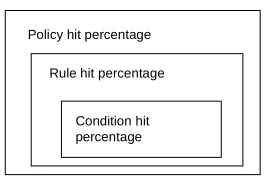
total conditions. A condition hit requires that the request be applicable to the policy and the rule. The figure 4.1 shows the above coverage criteria and the hierarchical relation between the various elements and its effect on the overall coverage.
We call the above coverage criteria as policy element coverage. The method that we have used in our testing framework converts the policy to program and uses the path coverage with concolic testing for limiting the number of paths. In our initial evaluation, we measure whether the requests generated by policy program path coverage achieve complete policy element coverage.
4.3
Target Driven Request Generation(Targen)
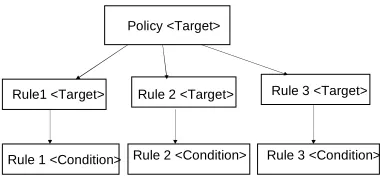
This is another method for policy request generation [13]. This method considers the policy as a hierarchical tree with each rule representing a leaf in the tree. The figure 4.2 shows this representation. Here, a request/test case is generated by solving constraints in the path of each rule from the root of the tree. The constraints in the path of a rule from the root of the tree has the target of the policy and the target of the rule to be solved. So, a request following this path is applicable to the policy and rule. Combinations of the attribute values in this path represent requests. Targen considers a modified form of combinatorial coverage that reduces the invalid requests generated from all possible combinations of the attribute values along this path. This request generation technique looks at each rule in the policy individually. It is possible that when all the rules in the policy are considered, some of the requests generated can be redundant. These redundant requests can be removed by measuring their coverage as explained in the next section.
4.4
Comparison of Request Generation Techniques
Table 4.1: Policies used in the evaluation.
policy # set # policy # rule # cond
codeA 5 2 2 0
codeB 11 5 5 0
codeC 8 4 4 0
codeD 11 5 5 0
default-2 1 13 13 12
demo-11 0 1 3 4
demo-26 0 1 2 2
demo-5 0 1 3 4
mod-fedora 1 12 12 10
simple-policy 1 2 2 0
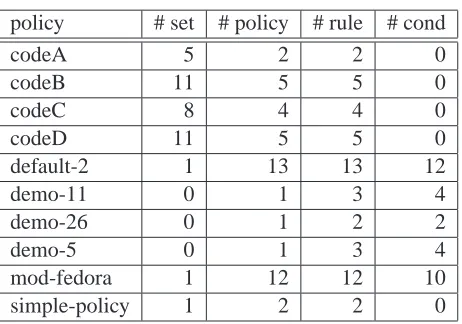
of requests. In our experiments, we have used 10 XACML policies from [15]. These range from simple to complex policies. The table 4.1 shows the statistics of the policy composition. The first column gives the name of the policy, the second column gives number of policy sets in the policy, the third column gives the number of polices, the fourth column gives the number of rules in the policy and the fifth column gives the number of conditions in the policy.
The table 4.5 shows the coverage comparing the targen method and our approach using jCUTE. Column 1 gives the names of the policies. Columns 2, 3 and 4 give the policy, rule and condition coverage when using the targen approach. Columns 6,7 and 8 give the policy, rule and condition coverage when using the jcute based approach. The results show that each of the requests generated by our approach have 100% policy, rule and condition coverage. The targen method achieves 100% policy and rule coverage in the policy element coverage criteria. The condition coverage achieved is not 100% because the currently available targen tool does not implement con-ditions. Another difference to be noted is that the number of requests generated using the targen approach consists of some redundant cases - requests which do not cause any increase in the cover-age. When using targen requests, a greedy reduction has to be performed to consider only requests which cause an increase in coverage. This is an extra overhead because first the request has to be generated and then the generated request has to be reduced. In our approach, however, the request generation process itself ensures that no request generated covers the same policy element as the previous request. This is because, in our approach only the constraints along the path to the rule are solved. Performing a greedy reduction of the requests generated by our approach showed that there was 0% reduction in the requests generated. This shows that our requests are optimal since they achieve 100% policy element coverage and no reduction is needed based on this measure.
Table 4.2: Policy Set mutation operators
ID Description
PSTT Policy Set Target True PSTF Policy Set Target False
CPC Change Policy Combining Algorithm
achieve almost 100% policy element coverage. But however, our approach to request generation considers the different paths in the policy program and seems like a semantically efficient measure than the targen approach. To check this, we use another test adequacy measure, mutation testing to compare the fault detection capability of both the request generation techniques. This technique is explained in the next section.
4.5
Mutation Testing for Fault Detection
We also use mutation testing to determine the quality of the requests generated. Mutation testing is used for testing programs by introducing small faults in the original program and gener-ating programs that are close to the original program. Specifically, this technique takes advantage of the coupling effect [4]. In programming, the coupling effect can be defined on the basis of the empirical observation that complex errors occur due to the combination of simple errors. So, if we can introduce simple errors into a program by means of simple changes by using operators and if these errors can be detected by a test case, then we can be assured that this test case can also be used to detect complex errors which occur as a combination of these simple errors.
In other words, mutation testing measures the sensitivity of the test case to simple errors, which could be used as an indication of its sensitivity to complex errors. To use this technique for access control policies, it is necessary to identify simple errors in the context of an XACML policy. For example a simple error a user makes when writing an XACML policy is to write a policy with a set of rules but write a target which is not applicable to any valid request. Here the policy will not be applicable to any request. This can be emulated by creating a mutant policy with a target value that will always evaluate to false. Another mutant policy could be one with the target always being applicable, this will ensure that all the requests evaluate are applicable to the policy and the rules in the policy will be evaluated. Based on this idea, Martin and Xie [13] have developed set of mutation operators for an XACML access control policy.
muta-Table 4.3: Policy mutation operators
ID Description
PTT Policy Target True PTF Policy Target False
CRC Change Rule Combining Algorithm
Table 4.4: Rule mutation operators
ID Description
RTT Rule Target True RTF Rule Target False RCT Rule Condition True RCF Rule Condition False CRE Change Rule Effect
tion operation is performed. They can be classified as,
Policy Set Mutation Operators: These represent the mutation operations that can be done at the policy set level. The various mutation operators defined for this is shown in table 4.2. They are, policy set target true mutant in which the policy set target is removed so that it is always true, policy set target false mutant in which the target value is changed such that it is always evaluated to false and change in policy combining algorithm mutant in which mutants are created for each policy combining algorithm like permit overrides, deny overrides and first applicable.
Policy Mutation Operators: These represent the mutation operations that can be done at the policy level. The various mutation operators defined for this is shown in table 4.3. They are policy target true, policy target false and change in rule combining algorithm. These are similar to the policy set operators except that the granularity is at the level of policy rather than policy set.
Table 4.5: Policy coverage and fault detection when using targen and the jcute technique.
targen jcute
policy pol % rule % con % mut kill% pol % rule % con % mut kill%
codeA 100 100 n/a 36.36 100 100 n/a 41.8
codeB 100 100 n/a 37.7 100 100 n/a 38.58
codeC 100 100 n/a 38.58 100 100 n/a 38.54
codeD 100 100 n/a 37.79 100 100 n/a 37.79
default-2 100 100 100 50 100 100 100 31.6
demo-11 100 100 75 77.78 100 100 100 88.88
demo-26 100 100 50 78.57 100 100 100 78.57
demo-5 100 100 75 78.95 100 100 100 89.47
mod-fedora 100 100 100 56.67 100 100 100 44.16
simple-policy 100 100 n/a 44.44 100 100 n/a 55.5
jCute Vs Targen Mutation Testing
0 10 20 30 40 50 60 70 80 90 100 code A code B code C code D defa ult-2 dem o-11 dem o-26 dem o-5 mod -fedo ra sim pl e-polic y Policies M u ta n t K il l % Jcute Requests Targen Requests
Figure 4.3: jCute Vs Targen
The number of mutants created for each policy element is dependent on the size of the policy. For example, the number of policy set mutants with a target of a true is equal to the number of policy set target elements within a policy. Some of mutants may also be equivalent and this is dependent on the specific policy.
Fault Detection by Mutation Operators 0 20 40 60 80 100 120 code A code B code C code D defa ult-2 dem o-11 dem o-26 dem o-5 mod -fedo ra Sim pl e-polic y Policies M u ta ti o n K il l P e rc e n ta g e Rule Operators Policy Operators Policy Set Operators
Figure 4.4: Mutation Operators
4.5.1 Fault Detection Capability Comparison
We compare the fault detection capability of our method and the target-driven request generation method. The set of requests generated by both the methods are evaluated against the original policy and the mutant policies. If the results are different, the mutant is said to have been killed. If the result remains the same, the mutant lives. The column 5 in table 4.5 shows the mutation kill percentage of the requests from targen and the column 9 shows the mutation kill percentage using our approach. The figure 4.3 shows the graph representation of the comparison. The fault detection capability of jCute based optimal requests performs better or as good as targen in most of the cases. However, in two of the cases targen performs better than jcute. The following shows an example of a case where a mutant is killed by targen but not killed by jcute.
The original policy set has the following two policies among a set of policies,
Policy 2 :Deny access to POLICY resource unless the subject has administrator role.
Policy 8 :If subject has administrator role, access decision is Permit. (This broad rule may be
limited by specific rules in the beginning.)
Among the set of requests generated by targen, a request with just the attribute POLICY is generated. This will give an effect of deny in the original policy, being applicable to Policy 2 and an effect of permit in the mutant policy again being applicable to Policy 2.
Among the Jcute requests, the request being applicable to Policy 2 has the attributes POL-ICY and administrator. For this request, the result in both original and mutant policy is permit (being applicable to Policy 8 in both cases). So the mutant is reported as not killed. Here a request with only POLICY attribute is not generated.
It has to be noted that jCute generates an optimal set of requests that achieve the maximum path or branch coverage. So, even if a request with only POLICY attribute is generated, it may not be chosen as an optimal request because another request with both POLICY and administrator attributes achieves more coverage. Similarly for other cases also some requests with attribute values covering multiple paths may be reported by jCute as an optimal request causing some mutants to be missed when doing mutation testing.
We analyzed the effect of each type of mutation operators on the fault detection capability in the jcute case. The figure 4.4 shows the graph with the mutation kill percentage for each of the operators. The higher the fault detection percentage value, the better because it means more mutants are killed. It is observed that the rule operators have better fault detection than policy and policy set operators for almost all the policies.
It is to be noted that some of the mutants cannot be killed because they could be equivalent mutants [17]. An equivalent mutant is one which is semantically equivalent to the original policy. An example of an equivalent policy mutant is a mutant create by changing the policy set combining algorithm from first applicable to permit overrides when there is only one policy in the policy set. In this case, both the mutant and the original policy are semantically the same. In general, it is difficult to automatically detect equivalent mutants and is often done manually [17]. The mutation testing tool that we use does not detect and remove equivalent mutants.
For the policies default-2 and mod-fedora for which the mutant kill percentage of jcute is lesser than targen, we measure the combined mutant kill%. To evaluate if the same mutants are killed in both the cases, we combine the set of requests generated from both the approaches and measure the mutant kill %. The combined mutation kill % is higher than the individual total mutant kill %. This show that the mutants killed by jcute are different than that killed by jcute. The graph is shown figure 4.6.
of rules in the policy while the number of requests generated by jcute is those set of requests that achieve optimal path coverage in the policy program.
Using only the existing policy coverage criteria, the requests generated by both targen and jcute methods have the good structural coverage. The targen set of requests, though they achieve 100% coverage most of the time, they look at each rule in the policy locally, while a path coverage based set of requests will look at all the rules in the policy when formulating the set of requests. The difference between the two request generation techniques can be better observed by introducing a new policy coverage measure called the policy path coverage.
4.6
Policy Path Coverage
‘A test adequacy criteria is a predicate that defines what properties of a program must be exercised to constitute a through test’ [32]. To define the test adequacy criteria for the policy, the property of the policy has to be analyzed. The property that we are considering here is the path coverage of the various requests. We define the policy path coverage measure based on the execution path coverage of the policy program.
For a program, the path coverage criteria requires that all the execution paths from the program’s entry to its exit are executed during testing [32]. The corresponding policy path coverage can be similarly defined as,
policy path coverage : The policy path coverage criteria requires that all the valid policy evaluation
paths covering the first rule to the last rule in the policy must be covered at least once.
Examples of valid policy paths are, the outermost path in a policy which evaluates the default case in the policy. The innermost path in a policy is the one for which only the last rule in the policy is true. This means all the previous rules evaluate to false.
The target-driven requests are not expected to achieve complete policy path coverage. An analysis of the way these requests are generated gives an indication of this. In their method, each rule is treated separately and they use a modified form of combinatorial coverage in which combinations of requests with subject, resource and action attributes in every rule are formulated. Among these large number of generated requests, those causing an increase in the policy structural criteria are chosen as the final set of requests. These requests do not consider the interaction between the rules in the policy. So these requests may not achieve complete policy path coverage.