A Study on General Ambient Intelligent
Architecture and its Applications
Blessy Thomas, Ashika A
Student, Dept. of ISE, New Horizon College of Engineering, Bangalore, India
Student, Dept. of ISE, New Horizon College of Engineering, Bangalore, India
ABSTRACT: This paper describes the general ambient architecture and the applications where the ambient
intelligence can be used. Ambient is our immediate environment. Ambient intelligence is giving intelligence to the surrounding environment and making it sensitive to us. This AmI can be applied in the various field like in the field of education, transport etc. it involves various technologies. It involves the sensing, reasoning and acting. The ISrAmI has developed the architecture of the AmI that involves four different layers. The first module data, information layer where it captures the data from the environment. The second is the storage layer where the data is stored. In the third the reasoning layer it compares and process the data based on the stored data. Stores the data if required. The fourth layer is the decision layer it compares the stored data and based on it performs the action. Based on the ISrAmI architecture we develop the architecture it checks whether the agent is authenticated once if it is authenticated then based on the if else condition stored it performs the action. Here it allows the agents to have access on the object based on its capacity.
KEYWORDS: Ambient intelligence; Ubiquitous computing; Sensors; Middleware
I. INTRODUCTION
The enhancement in the field of technology has led to the development of new devices. Also it has a transformation of how it connects the people in the society with that of the computers. Initially there was huge devices know these huge devices are been embedded in the electronic devices. Like in our daily day to day usable things like washing machines etc. here the device are being embedded. The systems are being designed in such a way that the non-specialist also will be able to handle it. By using some of the protocols such as Bluetooth and zigbee were introduced and this lead to the removal of physical connection. This kind of technical improvement is being extended in the area called Ambient Intelligence (AMI). The ambient intelligence idea is not new but known we are implementing it. In the early days in the movie due to friction the doors used to open due to the presence of the people. These features were been considered for the technology that were available at that time and they were aimed as target for the industry and AMI was developed. Know a days in all the homes or the workplaces, malls the sensors are placed these are considered as “Smart” at that time. The idea of the ambient intelligence is to enrich the environment with the new technology. AmI is the combination of artificial intelligence and the different technologies. Sensors act as a main device for the AmI it is used to capture the information of the world. AmI also involves the other devices like ultrasonic devices cameras and microphones. This AmI are inserted into the environment that can receive the information from the sensing devices or the other devices and this information is sent to the user and they perform exact reasoning process with the environment. The AmI also have technologies that support them like the sensors actuators communications and ubiquitous computing.
II. GENERAL AMBIENT ARCHITECTURE
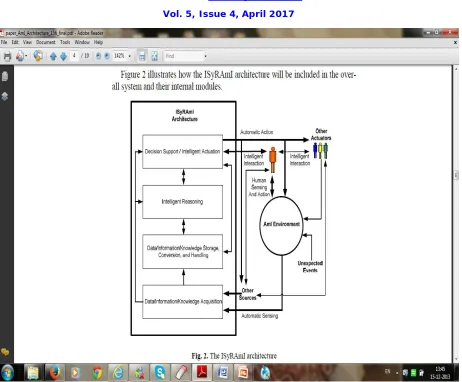
Figure 1: General architecture for AmI
There are four different modules in this architecture includes data/information/knowledge acquisition, storage, intelligent reasoning, decision support.
The first module is data acquisition which accepts input from the environment. The different sources of the data is plane data which is not processed from the sensors, intelligent individual senses the environment through sensors and perform in the environment through actuators, speech recognition where the words which are spoken are translated into text, computer vision which deals with acquiring images,identifies human gestures to control equipment and human facial expressions to recognize the emotional mood. The input can also come from other sources like experts, web, friends etc. The main functionality of this module is, it takes input and joins the data. This module does not check whether input data is correct or not, complete or not, vague or not. ISyRAmI architecture accepts different inputs from different sources. Consider the example of tourism. If a person has to visit a new place the weather input is considered as an important data. This weather report can come from many different sources like, it can come from sensors directly such as 27 c, can come from web, media reports or from a friend of the tourist who lives in the same city such as it’s very hot in spite of the weather being cool in the early morning.
it can be used by the reasoning component. This module also joins the data obtained from different sources to produce the items so that it will be validate the conditions in the expert system rules. Considering the above example the inputs got regarding the weather such as when the thermometer indicates 27 degree Celsius and there is no rain and through the web, weather prediction indicates elevated level of temperatures and chances of rain, and companion says its moderate temperature and it is raining.
The third module is intelligent reasoning which is based on the information obtained from the second module the conclusion is obtained which will be sent to the next module. The conclusion is obtained by using the expect system. It is a system which draws the conclusion by using IF-THEN rules. This layer performs high level reasoning processes with the inclusion of planning, knowledge discovery systems (process of developing new knowledge from the synthesis of prior knowledge).
The fourth module is the decision support which deals with taking actions on the environment either directly or indirectly. Some tasks will be assigned to the user and some will be assigned to the AmI system. If tasks are assigned to the humans then decision support system plays the role. The system will present a list of proposed actions, explain them to the user and the user should finalize the actions. If the system gives the solution which the user does not like then the system is not considered as an intelligent system. AmI system should be able to learn from user observation. Using this architecture many new AmI environments are developed. This research is restricted to only understanding the general architecture of the AmI system.
III. APPLICATIONS OF AMI
1 Hospitals
Applications of AMI can be used in hospitals. In most cases, the patients have to be taken care of after surgery. In this case, AmI can be of help. It can be used to ensure the safety of the patients after surgery.
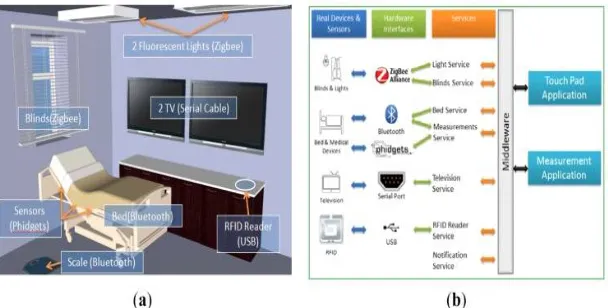
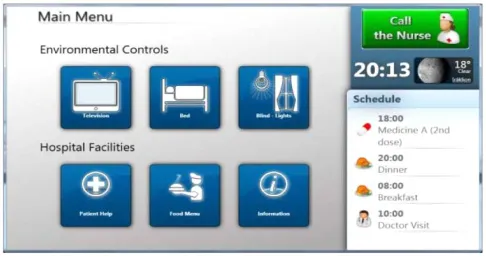
AmI can be used to improve the technologies in the hospitals. It has been improved so much that, hospitals can now be connected to smart homes. This ensures that the safety, security and independence of the individuals are maintained. In the below example, we have a smart room wherein there is a bed, two television sets and a cabinet to store things required by the patient. The main users of this room are doctor, nurse and the patient. If in case, the patient has a medical condition where he cannot move or get up, he will be given an application that works on touch sensors. The patient will be able to control the lights, television sets etc using this application. He will also be in contact with the nurse as well the doctor using this application. There will be an application installed in the room that will alert and remind the patient to take medicines, food etc at the scheduled time. Ambient environment room and system architecture is shown in figure 2.
Figure 2: (a) Ambient environment room, (b) System architecture
1. The TV will be moved closer to the patient to see the selected channel and the other rear TV will give a detailed description about the patient, like blood pressure , sugar level , pulse rate., heart rate ,ECG etc.
2. If the patient is sleeping, it follows the same method; and also in some similar scenario’s the earlier patient records can be obtained in the form of patient logs. This technology is also helpful if the doctors want to know the patient’s condition.
(Cook, Augusto & Jakkula, 2009: 277–298).
Figure 3: Hardware components in the environment
The hardware components that are used in the ambient environment are shown in the figure 3.
Near to the bed system is fitted in the wooden cabinet. All the various equipments and the sensors are attached to this system. The television, lights, BP check-up machines and Oxymeter are connected to this computer and will make the measurements accordingly. The angle or the height of the hospital bed can be changed and it works based on the controls given through bluetooth. (http://www.ncbi.nlm.nih.gov/pmc/articles/PMC3478791/, March 23, 2016).
2 Education
In order to improve the learning experience, AmI is used in classrooms. It can be used to keep track of student's test score and their attendance. An interactive whiteboard is used in classrooms, in which notes can be written using a digital pen. To recognize motion and speech, video and microphones can be used. All these features enable the children to respond well to natural interfaces.The teacher’s activities, the audio and video are recorded. The URL's of the websites visited by the teacher is also stored. This can be used for the future purposes and also maintains the safety and security of all the individuals present in the classroom.The students are given a smartphone or a tablet that is compatible with the software that the teacher uses. Students can write notes while watching the videos. These notes are converted to html at the end of the session.
3 Transportation
As human beings spend a lot of time in travelling, it is important to make it convenient. AmI systems are provided in various transport systems like bus, cars and trains which monitors the system's performance .Image processing,GPS can be used in public transport to make it efficient. An example will be using AmI systems provide assistance to drivers so that damages can be avoided. Route planners are provided to the drivers by Microsoft.
(Cook, Augusto & Jakkula, 2009: 277–298).
IV. CONCLUSION
REFERENCES
1. Ashwini, K., Akshya., and Sivaranjini., “A Study on the Contributing Technologies of Ambient Intelligence”, International Journal of
Innovative Research in Computer and Communication Engineering, 4(8), 14967-14970, DOI: 10.15680/IJIRCCE.2016. 0408068, 2016.
2. Ashwini, K., Sivaranjini., and Akshya., “A Study on General Ambient Architecture”, International Journal of Innovative Research in Computer
and Communication Engineering, 4(10), 17153-17156, DOI: 10.15680/IJIRCCE.2016. 0410008, 2016.
3. Ashwini, K., “Development Of Cognitive Architecture By Using Ambient And Swarm Intelligence In Society Of Agents Metaphor”, PhD
Thesis, 2016.
4. Ashwini, K., and Vijayakumar., M. V., “Development Of Swarm And Ambient Cognitive Architecture (SACA) By Using Society Of Agents”,
International Journal of Advanced Studies in Computer Science and Engineering, 4(9), ISSN: 2278 7917, 2015.
5. Ashwini, K., Ganashree, R., and Vijayakumar, M. V., “Survey On Ambient Intelligence”, International Journal of Computer Technology and
Applications, 6(3), pg. 440-447, ISSN:2229-6093, 2015.
6. Paz-Lopez, A., Varela, G., Monroy, J., Vazquez-Rodriguez, S., and Duro, R. J., “HI3 Project: General Purpose Ambient Intelligence
Architecture” , 3rd Workshop on Artificial Intelligence Techniques for ambient Intelligence, July 2008.
7. Carlos Ramos, “An Architecture for Ambient Intelligent Environments”, 3rd Symposium of Ubiquitous Computing and Ambient Intelligence,
Volume 51, pp 30-38, 2008.
8. Yannis Georgalis1, Dimitris Grammenos1, and Constantine Stephanidis , “Middleware for Ambient Intelligence Environments: Reviewing
Requirements and Communication Technologies Universal Access in Human-Computer Interaction”, Intelligent and Ubiquitous Interaction Environments, Vol.5615, pp 168-177.
9. Hoon Ko, and Carlos Ramos, "A Survey of Context Classification for Intelligent Systems Research for Ambient Intelligence", Complex Intelligent and Software Intensive Systems (CISIS) 2010 International Conference on, pp. 746-751, 2010.
10. Varela, G., Paz-Lopez, A., Becerra, J. A., Vazquez-Rodriguez, S., and Duro, R. J., “Towards Mobility in Ambient Intelligence: Component Migration and Adaptation Strategies in the HI3 Architecture”, 5th International Symposium on Ubiquitous Computing and Ambient Intelligence (UCAmI 2011), December 2011.
11. Varela, G., Paz-Lopez, A., Becerra, J. A., Vazquez-Rodriguez, S., and Duro, R. J., “Hi3 project: Design and implementation of the lower level
layers”, Proceedings of the 2007 IEEE International Conference on Virtual Environments, Human-Computer Interfaces,and Measurement Systems, 2007.
12. Gervasio Varela , Alejandro Paz-Lopez, José A. Becerra, and Richard J. Duro , “Autonomous Evaluation of Interaction Resource
Adequateness for Ambient Intelligence Scenarios, Ubiquitous Computing and Ambient Intelligence”. Sensing, Processing, and Using Environmental Information, Volume 9454, pp 174-186, December 2015.
13. Vetrivel, S., and Pandikumar, S., “Sensor Based Smart Learning Environment using Ambient Intelligence”, Journal of nanoscience and