ISSN(Online) : 2320-9801
ISSN (Print) : 2320-9798
I
nternational
J
ournal of
I
nnovative
R
esearch in
C
omputer
and
C
ommunication
E
ngineering
(An ISO 3297: 2007 Certified Organization)
Vol. 4, Issue 4, April 2016
Implementation of 4-Tap Sequential and
Parallel Micro-programmed Based Digital
FIR Filter Architecture using VHDL
Tamli Dhanraj Sawarkar, Prof. Lokesh Chawle, Prof. N.G. Narole
M. Tech Student, Dept. of Electronics Engineering, RGCER, Nagpur, Maharashtra, India
Associate Professor, Dept. of Electronics Engineering, RGCER, Nagpur, Maharashtra, India
Associate Professor, Dept. of Electronics Engineering, RGCER, Nagpur, Maharashtra, India
ABSTRACT: The digital Finite Impulse Response (FIR) is widely used in many Digital Signal Processing (DSP) Systems, ranging from wireless communication to image and video processing. Basically, the digital FIR filter is consist of multiplier, adder delay element. In the realization of FIR filter, multiplier is an essential and complex building block. Several techniques have been reported in the open literature to implement digital FIR filter using Field Programmable Gate Array (FPGA).In this paper, the implementation of 4-tap sequential and parallel micro-programmed based digital FIR filter using VHDL is presented using 16 bit Wallace tree multiplier and Vedic multiplier. Performance evaluation is done based on the implementation results obtained through FPGA synthesis tools. Results clearly indicate that sequential filter achieves better performance in terms of speed and resource utilization as compared to parallel filter. Also Vedic multiplier is faster than Wallace multiplier. The coding is done in VHDL (Very High Speed Integrated Circuit Hardware Descriptive Language) and synthesized using Xilinx ISE version 13.4i.
KEYWORDS: Wallace Tree Multiplier, Vedic Multiplier, VHDL, FIR, FPGA.
I. INTRODUCTION
Digital signal processing (DSP) is one of the core technology used in communication system such as wireless sensor network (WSN) and Internet of Thing (IoT), requires fast processing of large amount of digital information. The digital filter is one of the most widely used building block of many digital signal processing (DSP) system. They are most commonly used in signal, image and video processing application. Digital filters are an important class of linear time invariant (LTI) system designed for filtering out undesirable parts from the signal, spectral shaping, motion estimation, noise reduction and channel equalization among many other applications. Digital filters are divided into two types, Finite Impulse Response (FIR) filter and Infinite Impulse Response (IIR) filter. The FIR filters are preferred over IIR filter for the operation in DSP includes filtering, convolution and inner product due to its linear phase response and inherent stability.
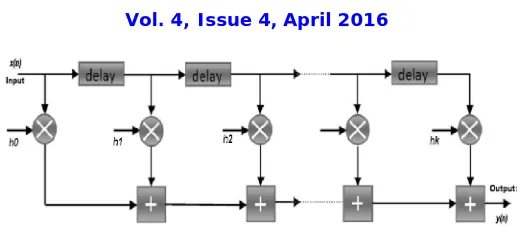
Adders, multipliers and delay elements are the key block used in the implementation of digital FIR filter. These blocks are arranged and interconnected in different ways based on the architecture of FIR filter. Basically, FIR filter performs a linear convolution on a window of N data samples which can be mathematically expressed as follows:
( ) = ( ). ( − )
Fig. 1: Direct form FIR filter architecture
Direct form FIR filter are also known as tapped delay line or traversal filters. N-tap FIR filter consist of N delay elements, N multipliers, N-1 adders or accumulators. The impulse response of FIR filter can be directly inferred from the tap coefficient ℎ . This paper presents the implementation of micro-programmed digital FIR filter using Wallace tree multiplier and Vedic multiplier. The performance of micro-programmed digital FIR filter is evaluated and compared using both Wallace tree and Vedic multiplier.
This paper is organized as follows; Section II describes proposed micro-programmed FIR filter. Section III describes Wallace tree multiplier. Section IV describes Vedic multiplier. Section V describes the implementation results and finally section VI describes the conclusion.
II. RELATED WORK
In [1], the author designs 64-tap linear phase filter operating at 1.4 MHz with 60dB attenuation at 0.28fs, 12dB attenuation at 0.25fs based on explicit multiplier and concluded that pipelined multiplier provides best trade-off between speed and resource requirement. In [2], the author implements digital-serial 5-tap FIR filter on a Xilinx XC4010 FPGA and concluded that digital-serial design with digit-size of 2 bit have about 17% smaller area-time product than those of bit-serial implementations. In [3], the author, introduces the design and simulation of FIR filter which is mainly based on FPGA, Quartus II ,Matlab and concluded that the use of these software significantly shortens the R& D period and it is able to greatly improve the speed of the filter by use of the pipelining structure. In [4], the author proposes a new hardware efficient reconfigurable FIR filter architecture based on binary signed sub-coefficient method and concluded that the FPGA synthesis results of the designed two filters based on 3-bit and 4-bit partitioning have been shown 33% and 27% reduction in the resource usage with respect to two state of art architecture. In [5], the author presents implementation of low power and low area digital Finite Impulse Response (FIR) filter The proposed FIR filter have been synthesized and implemented using Xilinx ISE V7.1 and Virtex IV FPGA. The author concluded that the minimum power achieved is 56mw in fir filter based on shift/add multiplier in 100MHz with bit input and 8-bit coefficient.
III.MICRO-PROGRAMMEDFIRFILTER
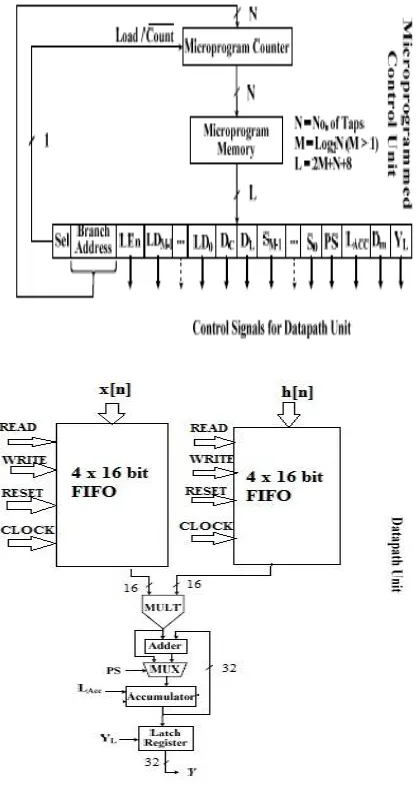
The micro-programmed FIR filter consists of data-path and micro-program control unit. The most important part of program control unit is its flexibility to modify the program in ROM based control memory. The micro-program controller consists of two main parts.
1. Addressing microinstruction kept in control memory. 2. Hold and generate microinstruction for data-path.
In this paper, two different architecture of digital FIR filter using micro-programmed controller is presented:
A. Sequential Architecture of Micro-programmed FIR Filter
ISSN(Online) : 2320-9801
ISSN (Print) : 2320-9798
I
nternational
J
ournal of
I
nnovative
R
esearch in
C
omputer
and
C
ommunication
E
ngineering
(An ISO 3297: 2007 Certified Organization)
Vol. 4, Issue 4, April 2016
multiplier and an adder, a two input multiplexer to control the flow of data from multiplier or accumulator, one 32 bit accumulator and 32 bit register to latch the output data.
Fig. 2: Architecture of 4-tap sequential micro-programmed FIR filter
B. Parallel Architecture of Micro-programmed FIR Filter
The parallel architecture utilizes multiple adders and multipliers based on the size of it. In this paper, the 4-tap FIR filter is designed is consists of the following sub-modules:
Four 16-bit data register One 2-to-4 decoder
Four 16-bit coefficient register Four 16-bit multipliers Three 32-bit adders
Fig. 3: Architecture of 4-tap parallel micro-programmed FIR filter
IV.WALLACETREEMULTIPLIER
A Wallace tree multiplier is an efficient methodology, easily hardware implementable that multiplies two integers, proposed by an Australian Computer Scientist Chris Wallace. Using this method, a three step process is used to multiply two integer numbers. The first step is to multiply each bit of one of the arguments, by each bit of other, yielding result. The second step is to reduce the number of partial products to two by the layers of full adders and half adders. The third step is to group the wires in two numbers and add them with conventional adder. In this paper, two different architecture of Wallace tree multiplier are presented. First is designed using half adder and full adder, while second one uses the carry look ahead adder.
A. Wallace Tree Multiplier using Half adder and Full Adder
ISSN(Online) : 2320-9801
ISSN (Print) : 2320-9798
I
nternational
J
ournal of
I
nnovative
R
esearch in
C
omputer
and
C
ommunication
E
ngineering
(An ISO 3297: 2007 Certified Organization)
Vol. 4, Issue 4, April 2016
Wallace tree method is used to reduce the number of adder by minimizing the number of half adder in any multiplier. As shown in fig. above the first partial product is the least significant bit (LSB) in the output of multiplier result. Then moving towards the next column of partial product if there are any adders from the previous product, the full adder is used otherwise half adder is used. Fig. 4 shows how algorithm is implemented.
A. Wallace Tree Multiplier using Carry Look Ahead Adder (CLA)
Fig. 5: 16 Bit Wallace Tree Multiplier using Carry Look Ahead (CLA) Adder
The Fig. 5 shows the implementation of 16 Bit Wallace tree multiplier using carry look ahead adder. The two 16-bit inputs are x15x14...x2x1x0 and y15y14...y2y1y0. Firstly, multiply each one input to all other 16 inputs and we get the AND operation results. Then arrange these results as shown in Fig. 5(in triangular form). Now, addition of these AND operation results is performed using CLA. The output of this adder is the final output of multiplier which is denoted as P31P30...P2P1P0.
V. VEDICMULTIPLIER
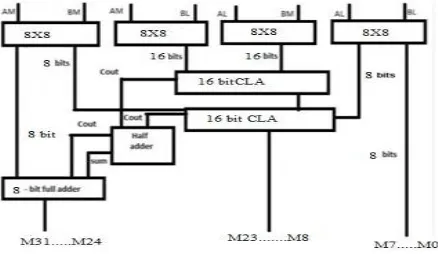
Vedic mathematics is an ancient form of mathematics which was developed in India by Sri Bharti Krishna Tirthaji between 1911 and 1918. Vedic mathematics is based on 16 sutras or algorithm. The Urdhava Tiryakbhagyam Sutra (Vertically and Crosswise Algorithm) is one of them used for multiplication. The Urdhava Tiryakbhagyam Sutra is used for efficient digital multiplication. The multiplier based on this algorithm has the advantage that as the number of bits increases, gate delay and area increases very slowly as compared to other conventional multiplier. The proposed Vedic multiplier is designed using Urdhava Tiryakbhagyam Sutra (Vertically and Crosswise Algorithm).In this algorithm, the partial product and their sum are calculated in parallel and because of this the multiplier is independent of clock frequency of the processor. The proposed 16 bit Vedic multiplier design is shown in fig. 6 as given below:
The Fig.6 consist of four 8 bit Vedic multiplier, two 16 bit carry look ahead adder (CLA), one 8 bit carry look ahead adder (CLA) and one half adder for designing of 16-bit Vedic multiplier.
VI.RESULT
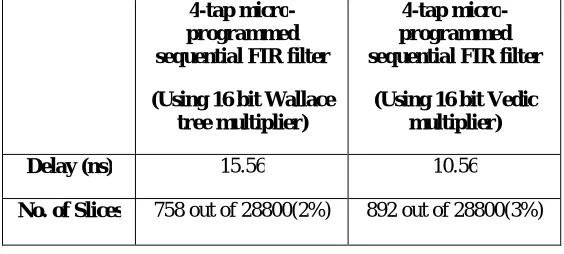
The proposed 4-tap micro-programmed sequential and parallel FIR filter is implemented using VHDL. The synthesis is done using Xilinx Synthesis Tool (XST) available with Xilinx ISE 13.4i simulator. Table I and Table II given below indicates the total path delay occur while designing these micro-programmed FIR filters.
Table I: Comparison of Synthesis Result of Proposed 4-tap micro-programmed sequential FIR filter using 16 bit Wallace Tree and Vedic Multiplier
4-tap micro-programmed sequential FIR filter
(Using 16 bit Wallace tree multiplier)
4-tap micro-programmed sequential FIR filter
(Using 16 bit Vedic multiplier)
Delay (ns) 15.56 10.56
No. of Slices 758 out of 28800(2%) 892 out of 28800(3%)
Table II: Comparison of Synthesis Result of Proposed 4-tap micro-programmed parallel FIR filter using 16 bit Wallace Tree and Vedic Multiplier
4-tap micro-programmed parallel
FIR filter
(Using 16 bit Wallace tree multiplier)
4-tap micro-programmed parallel
FIR filter
(Using 16 bit Vedic multiplier)
Delay (ns) 19.51 14.28
No. of Slices 2687 out of 28800(9%) 3309 out of 28800(11%)
The Table I and II shows that the utilization of 4-tap micro-programmed sequential FIR filter is less (which are 2% and 3%) than the utilization of 4-tap micro-programmed parallel FIR filter ( which are 9% and 11%). The path delay of 4-tap micro-programmed sequential FIR filter using 16- bit Wallace tree multiplier and 16- bit Vedic multiplier is 15.56ns and 10.56ns. The path delay of 4-tap micro-programmed parallel FIR filter using 16- bit Wallace tree multiplier and 16- bit Vedic multiplier is 19.51ns and 14.28ns.
ISSN(Online) : 2320-9801
ISSN (Print) : 2320-9798
I
nternational
J
ournal of
I
nnovative
R
esearch in
C
omputer
and
C
ommunication
E
ngineering
(An ISO 3297: 2007 Certified Organization)
Vol. 4, Issue 4, April 2016
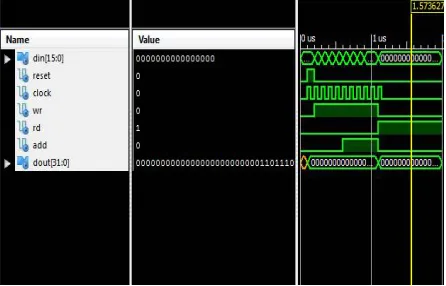
Fig. 7: Simulation Result of 4-tap micro-programmed sequential FIR filter using 16- bit Wallace tree multiplier
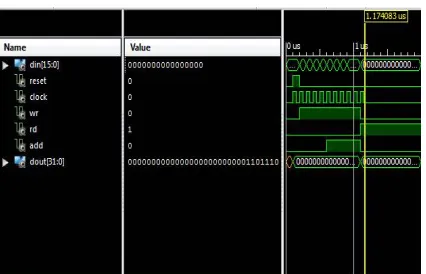
Fig. 8: Simulation Result of 4-tap micro-programmed sequential FIR filter using 16- bit Vedic multiplier
Fig. 10: Simulation Result of 4-tap micro-programmed parallel FIR filter using 16- bit Vedic multiplier
VII. CONCLUSION
In this paper, the 4-tap micro-programmed sequential and parallel FIR filter using 16- bit Wallace tree multiplier and 16- bit Vedic multiplier is implemented. The comparison of synthesis result shows that the path delay of the 4-tap micro-programmed sequential and parallel FIR filter using 16- bit Vedic multiplier is less than that of the path delay of the 4-tap micro-programmed sequential and parallel FIR filter using 16- bit Wallace tree multiplier. Results clearly indicate that sequential filter achieves better performance in terms of speed and resource utilization as compared to parallel filter.
REFERENCES
1. P. Kollig , B. M. Al-Hashim i, K. M. Abbott‘FPGA Implementation of High Performance FIR Filter’ 1997 IEEE International Symposium on
Circuits and Systems, Hong Kong, 0-7803-3583-X/97 $10.00 01997 IEEE.
2. Hanho Lee, Gerald E. Sobelman ’FPGA Based FIR Filter Using Digital Serial Arithmetic’ University of Minnesota, Minneapolis, MN 55455,
U.S.A 1063-0988/97/$10.000 1997 IEEE.
3. Lin Jieshan , Huang Shizhen ‘An Design of the 16-Order FIR Digital Filter Based On FPGA’ The 1st International Conference on Information Science and Engineering (ICISE2009) 978-0-7695-3887-7/09/$26.00 ©2009 IEEE.
4. Asgar Abbaszadeh , Khosrov D. Sadeghipour ’A New Hardware Efficient Reconfigurable FIR Filter Architecture Suitable For FPGA Application’ 978-1-4577-0274-7/11/$26.00©2011 IEEE.
5. Bahram Rashidi , FarshadMirzaei, MajidPourormazd ’Low Power FPGA Implementation of Digital FIR Filter Based on Low Power Multiplexer Base Shift/Add Multiplier’ International Journal of Computer Theory and Engineering, Vol. 5, No. 2, April 2013 DOI: 10.7763/IJCTE.2013.V5.707. 6. B. Mamatha, V. V. S. V. S. Ramachandram ‘Design and Implementation of 120-Order FIR filter Based on FPGA’International Journal of Engineering Sciences & Emerging Technologies, August 2012. ISSN:2231 – 6604 Volume 3, Issue 1, pp: 90-97 ©IJESET.
7. Mrs. Pooja, S. Puri, Mr.U. A. Patil ’High Speed Vedic Multiplier in FIR Filter on FPGA’IOSR Journal of VLSI and Signal Processing (IOSR-JVSP) Volume 4, Issue 3, Ver. II (May-Jun. 2014), PP 48-53 e-ISSN: 2319 – 4200, p-ISSN No. : 2319 – 4197.
8. Vijender Saini, Balwinder Singh, Rekha Devi ’Area Optimization of FIR Filter and its Implementation on FPGA’ International Journal of Recent Trends in Engineering, Vol 1, No. 4, May 2009.
9. M. Gnanasekaran, M. Manikandan ’Low Delay-High Compact FIR Filter Using Reduced Wallace Tree Multiplier’ 2nd International Conference
on Current Trends in Engineering and Technology, ICCTET’14 © IEEE 2014 IEEE Conference Number – 33344 July 8, 2014, Coimbatore, India.
10. Sarita Chouhan, Yogesh Kumar ‘Low Power Designing of FIR Filters’ International Journal of Advanced Technology & Engineering Research
(IJATER) ISSN NO: 2250-3536 VOLUME 2, ISSUE 2, MAY 2012.
BIOGRAPHY