International Journal of Recent Trends in Engineering, Vol 1, No. 3, May 2009
Structured Genetic Algorithm Technique for
Unit Commitment Problem
Abstract _ This paper presents and identifies alternative strategies with the advantages of Genetic Algorithm for solving the Thermal Unit Commitment (UC) problem. A Parallel Structure has been developed to handle the infeasibility problem in a structured and improved Genetic Algorithm (GA) which provides an effective search and therefore greater economy. In addition, this proposed method lead us to obtain better performance by using both computational methods and classification of unit characteristics. Typical constraints such as system power balance, minimum up and down times, start up and shut-down ramps have been considered. A number of effective parameters related to UC problem have been identified. This method is developed and tested by using C# program. Tests have been performed on 10 and 20 units systems over a scheduling period of 24 hours. The final results are compared with those obtained genetic schemes in other same research.
Index Terms _ Genetic Algorithm, Parallel Structure, Power Systems, Unit Commitment.
I. INTRODUCTION
The Unit Commitment (UC) problems are well known in the power industry and have the potential to save millions of dollars per year in fuel and related costs. It is an area of production scheduling that relates to the determination of the ON/OFF status of the generating units during each interval of the scheduling period, to meet system load and reserve requirements and minimum cost, which are subjected to the variety of equipment, system and environmental constraints.
The UC problem is a complex decision-making process and it is difficult to develop any rigorous mathematical optimization methods capable of solving the entire for any real-size system. Also, multiple constraints should be imposed which must not be violated while finding the optimal or near-optimal commitment schedule.
A true solution for UC problem can only be obtained by exhaustive enumeration, which is very time consuming. So attempts are being continuously made to solve this problem by reliable iterative and heuristic methods. A number of such methods has been developed so far [1]-[8]. Several investigations have also been carried out to solve UC problem with Genetic Algorithm (GA) [10]-[22].
In this study, an improved and optimized GA based on Parallel Structure is identified which make the search space smaller and hence the search quicker. In fact, Parallel Structure tries to quantify the amount of infeasibility by classification of unit characteristics (measuring the fitness). Other than by using both standard and convenient new genetic operators in solving this problem, a much improved results and thus a greater economy is achieved. The proposed approach applied on 10 and 20 units systems. The results are compared with those of the three previously developed genetic schemes in the same conditions [l4],[19],[20].
II. PROBLEM FORMULATION
The objective of the Unit Commitment problem is the minimization of the total production costs over the scheduling period. The total costs consist of:
i. Fuel costs, ii. Start-Up costs, iii. Shut-Down costs.
In addition, some constraints which must be satisfied during the optimization process are:
i. System power balance ii. System reserve requirement iii. Unit initial conditions
iv. Unit maximum/minimum MW limit v. Unit minimum up and down times vi. Unit status restrictions (must run, must not
run, unavailable, fixed MW)
vii. Unit start up and shut down ramp limits.
Kaveh Abookazemi*, Mohd Wazir Mustafa, Hussein Ahmad
Department of Electrical Engineering, University Technology of Malaysia, Johor, Malaysia [email protected] , [email protected], [email protected]
International Journal of Recent Trends in Engineering, Vol 1, No. 3, May 2009 III. GENETIC ALGORITHM
The GA is a stochastic search or optimization procedure based on the mechanics of natural selection and natural genetics. Many non-linear, large-scale combinatorial optimization problems in power systems have been re-solved by using this genetic computing scheme. The GA requires only a binary representation of the decision variables to perform the genetic operations, i.e., selection, crossover, and mutation.
A. Genetic Algorithm Construction
A Genetic Algorithm consists of a string representation of the point in the search space, a fitness function to evaluate the search points, a set of genetic operators for generating new search points, and a stochastic assignment to control the genetic operators. The construction of a Genetic Algorithm for UC problem can be separated into four distinct and yet related tasks: [18]
i. Choice of the representation of the string; ii. The genetic operators selection;
iii. Fitness function determination;
iv. Determination of the probabilities controlling the genetic operators.
B. Important Imposed Operators of Genetic Algorithm
The standard operators of Genetic Algorithm and also some new and effective genetic operators (which are highlighted with Italic fonts) which improve the new populations and applied in proposed method, are listed below:
1) Selection: The purpose of parent selection in genetic algorithms is to give more reproductive chances to those population members which have the most fitness. In fact, this parameter is used to choose parents for the next generation. Stochastic uniform selection was used.
2) Cross-over: Crossover is a random process of recombination of strings. Based on the probability of crossover, partial exchange of characters between two strings is performed. The crossover process is included; select two mating parents, select a crossover point and exchange the chromosomes between two strings. With the crossover operation, genetic algorithms are able to acquire more information with the generated individuals. The genetic search space is thus extended and more complete.
3) Mutation: Mutation is the occasional random alteration of the bits in the string. With the binary representation, this simply means flipping the state of a bit from 1 to 0 or vice versa.
4) Intelligent Mutation: For obtaining lower cost in
case of determination of commitment schedule, commitment of some cheaper units should be given priority over commitment more expensive units. To achieve lower cost, intelligent mutation is introduced and applied only to the best solution. In fact, if over committed, it is decommitted otherwise it is committed.
5) Elitism: This operator preserves the best
solutions found by maintaining a group of them in the next generation. This operator is necessary to prove the convergence to the optimum through a Markov chain analysis. In fact, elitism as a powerful genetic parameter is considered to avoid losing the best individual in each generation.
IV. PARALLEL STRUCTURE OF GENETIC ALGORITHM
To solve an optimization UC problem by using Genetic Algorithm, it is required to determine how to encode a solution and how to measure its fitness. The problem now amounts to measuring the fitness of some genotypes which correspond to ‘infeasible’ solutions. Parallel Structure has been proposed in this study to consider the infeasibility problem by using improved and structured Genetic Algorithm model which tries to quantify and classify the amount of infeasibility and therefore provides better performance of system.
A. The Properties of Parallel Structure
The importance of this Parallel Structure is that introduces a solution which corresponds to an optimum UC schedule of the original system. In fact, multiple situations can be accessed in parallel. The properties of the Parallel Structure are described below:
i. All the units of the original system have same cost functions and limitations in the new system. These are termed as original units.
ii. The new system is provided with an additional unit which is free from all the constraints.
International Journal of Recent Trends in Engineering, Vol 1, No. 3, May 2009 iv. Some other constraints such as; minimum
up-time and minimum down-time are assumed as conditional factors in the new system.
v. All other properties of the original system and the new system are same.
B. Objective Function
In this study, the Economic Status is Objective Function, which is defined as the determination of suitable allocation of generation among the operating units in order to minimize the production cost of supplying energy for the already committed units. Furthermore, Based on Economic Status function, the programming and achieving the results are done in this paper.
The economic status (ES) of a feasible overall schedule at time period j (interval), is given by; [19]
Where;
= Total generation (fuel) cost related to jth interval,
= Total start up cost related to jth interval, = Total shut down cost related to jth interval, = Total number of intervals.
was determined through standard Lambda iteration technique, whereas
was determined by selecting cold start or hot start properly. Because of the better economy achievement is concerned, the inverse of this economic status was surveyed as the fitness of the corresponding solution.
V. IMPLEMENTATION OF PROPOSED GENETIC MODEL
The implementation of the developed and proposed GA determines the optimal (or near optimal) commitment schedule for a given period. The current GA chart is improved and used in representing step by step structured way which is followed to overcome some constraints in UC problem.
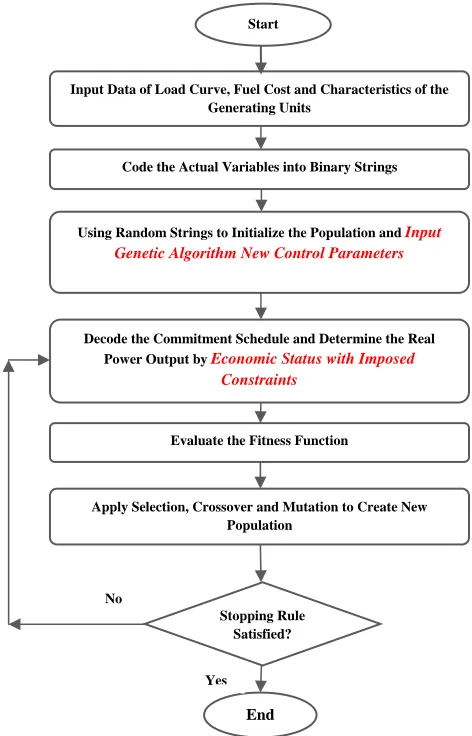
The implemented GA consists of input data, binary strings coding, initializing of the population, decoding the commitment schedule by using Economic Status, evaluation of fitness function and application of Selection-Crossover-Mutation of the UC schedules. The optimized Flowchart of the algorithm is given in Fig. 1.
Fig. 1. Improved and Optimized Flow chart of the Unit Commitment problem solved by the Genetic Algorithm
As shown in Fig. 1, some parts of optimizations in GA structure such as; input new GA parameters for system control, decoding the Commitment schedule and determination of output real power by using Economic Status with imposed constraints are implemented and executed in the new system.
VI. SIMULATIONS AND RESULTS
The proposed system is executed and evaluated on a case study. The algorithm has been tested on 10 and 20 units systems. In this case a total scheduling period of 24 hours has been
Input Data of Load Curve, Fuel Cost and Characteristics of the Generating Units
Start
Code the Actual Variables into Binary Strings
Using Random Strings to Initialize the Population and Input Genetic Algorithm New Control Parameters
Decode the Commitment Schedule and Determine the Real Power Output by Economic Status with Imposed
Constraints
Evaluate the Fitness Function
Apply Selection, Crossover and Mutation to Create New Population
End Stopping Rule
Satisfied?
International Journal of Recent Trends in Engineering, Vol 1, No. 3, May 2009 considered. The properties of the 10 units system
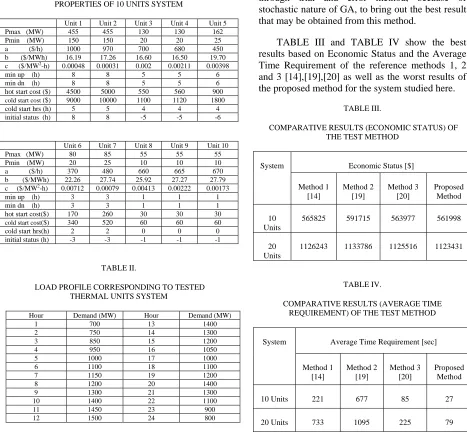
are presented in TABLE I whereas the corresponding load profile is presented in TABLE II [14]. For the 20 units problem the initial 10 units system are duplicated and demand load data are multiplied by 2.
TABLE I.
PROPERTIES OF 10 UNITS SYSTEM
Unit 1 Unit 2 Unit 3 Unit 4 Unit 5
Pmax (MW) 455 455 130 130 162
Pmin (MW) 150 150 20 20 25
a ($/h) 1000 970 700 680 450
b ($/MWh) 16.19 17.26 16.60 16.50 19.70
c ($/MW2-h) 0.00048 0.00031 0.002 0.00211 0.00398
min up (h) 8 8 5 5 6
min dn (h) 8 8 5 5 6
hot start cost ($) 4500 5000 550 560 900
cold start cost ($) 9000 10000 1100 1120 1800
cold start hrs (h) 5 5 4 4 4
initial status (h) 8 8 -5 -5 -6
Unit 6 Unit 7 Unit 8 Unit 9 Unit 10
Pmax (MW) 80 85 55 55 55
Pmin (MW) 20 25 10 10 10
a ($/h) 370 480 660 665 670
b ($/MWh) 22.26 27.74 25.92 27.27 27.79
c ($/MW2-h) 0.00712 0.00079 0.00413 0.00222 0.00173
min up (h) 3 3 1 1 1
min dn (h) 3 3 1 1 1
hot start cost($) 170 260 30 30 30
cold start cost($) 340 520 60 60 60
cold start hrs(h) 2 2 0 0 0
initial status (h) -3 -3 -1 -1 -1
TABLE II.
LOAD PROFILE CORRESPONDING TO TESTED THERMAL UNITS SYSTEM
Hour Demand (MW) Hour Demand (MW)
1 700 13 1400
2 750 14 1300
3 850 15 1200
4 950 16 1050
5 1000 17 1000
6 1100 18 1100
7 1150 19 1200
8 1200 20 1400
9 1300 21 1300
10 1400 22 1100 11 1450 23 900 12 1500 24 800
In TABLE I, “initial status” indicates how long the unit has been committed/decommitted. If positive, it indicates the number of hours the unit has been committed. If negative, it indicates the number of hours the unit has been decommitted. The final generation increases with the number of units.
Based on improved Genetic Algorithm, C# program has been developed for the proposed method. For programming in first step, it is assumed that i = 1,2,3,… 10 units and j =1,2,3,… 24 hours. In second step, it is assumed that i =
1,2,3,… 20 units and j =1,2,3,… 24 hours. The program has been run on PC with INTEL DUO CORE CPU 1.8 GHz and 2 GB RAM.
Initial population and the probability values have been adjusted to settings for runs of a test method for a particular problem set. For the test method probability values have been adjusted through trial and error method, because of stochastic nature of GA, to bring out the best result that may be obtained from this method.
TABLE III and TABLE IV show the best results based on Economic Status and the Average Time Requirement of the reference methods 1, 2 and 3 [14],[19],[20] as well as the worst results of the proposed method for the system studied here.
TABLE III.
COMPARATIVE RESULTS (ECONOMIC STATUS) OF THE TEST METHOD
System Economic Status [$] Method 1
[14]
Method 2 [19]
Method 3 [20]
Proposed Method 10
Units
565825 591715 563977 561998 20
Units
1126243 1133786 1125516 1123431
TABLE IV.
COMPARATIVE RESULTS (AVERAGE TIME REQUIREMENT) OF THE TEST METHOD System Average Time Requirement [sec]
Method 1 [14]
Method 2 [19]
Method 3 [20]
Proposed Method 10 Units 221 677 85 27 20 Units 733 1095 225 79
VII. CONCLUSION
International Journal of Recent Trends in Engineering, Vol 1, No. 3, May 2009 optimized Genetic Algorithm Flowchart (by using
important imposed genetic operators) as programming guideline.
It is proved the better performance of optimized GA which is improved and tested in this project. This is exactly what has been attempted in this study. In fact, the proposed method is provided much-improved results i.e. greater economy as a major conclusion and much faster operation as another result of this study. The suitable performance of this method is achieved and evaluated which can lead other researches in this field for obtaining better results in future.
ACKNOWLEDGEMENT
The authors acknowledge and appreciate the University Technology of Malaysia for providing suitable conditions and facilities for this project.
REFERENCES
[1] A. J. Wood and B.F. Wollenberg, “Power Generation Operation and Control”, John Willey, New York, 1984. [2] Gerald B. Sheble and George N. Fahd, “Unit Commitment Literature Synopsis’’, IEEE Transactions on Power Systems, Vol. 9, No. 1, pp 128-135, February 1994.
[3] S. Virmani, C. Adrian, K Imhof, S. Mukbejee, “Implementation of a Lagrangian Relaxation Based Unit Commitment Problem”, IEEE Transactions on Power Systems, Vol. 4, No. 4, pp 1373-1380, October 1989.
[4] Fulin Zhuang and F.D. Galiana, “Towards a More Rigorous and Practical Unit Commitment by Lagrangian Relaxation”, IEEE Transactions on Power System, vol. 3, No. 2, pp 763-772, May 1988.
[5] Arthur I. Cohen, S.H. Wan, “A Method for Solving the Fuel Constrained Unit Commitment problem’’, IEEE Transactions on Power Systems, Vol. PWRS 2, No.2, pp 608-614, August 1987. [6] Z. Ouyang, S.M. Sahidehpour, “A Multi Stage Intelligent System for Unit Commitment”, IEEE Transactions on Power Systems, Vol. 7, No. I, pp 639- 645, May 1992.
[7] Shih-Yih Lai , Ross Baldick, ‘‘Unit Commitment with Ramp Multiplier”, IEEE Transactions on Power Systems .Vol. 14, No. 1, pp 58-64, February 1999.
[8] Carlos Murillo-Sanchez, Robert J. Thomas, “Thermal Unit Commitment Including Optimum AC Power Flow Constraints”. PSERC 97-12, Published in the Proceedings of Hawaii International Conference on System Sciences, Kona, Hawaii, January 6-9, 1997.
[9] Roy Billinton, Mahmud Fotuhi- Firuzabad, Saleh Aboreshai, “Unit Commitment Health Analysis For Interconnected Systems”, IEEE Transactions on Power Systems, Vol. 12,No.3,pp 1i94-1201, August 1997.
[10] David E. Goldberg, “Genetic Algorithm in Search, Optimization and Machine Learning” Pearson Education Asia, 1999.
[11] D. Dasgupta and D.R. McGregor, “Thermal Unit Commitment using Genetic Algorithms” IEE Proc. Gener. Transm. Distrib., Vol. / 4 / , No. 5, September 1994.
[12] Hong-Tzer Yang, Pai-Chum Yang and Ching-Lien Huang, “Optimization of Unit Commitment Using Parallel Structures of Genetic Algorithm” IEEE, 1995.
[13] Hong-Tzer Yang,Pai-Chum Yang and Ching-Lien Huang, “Applications of the Genetic Algorithm to the Unit Commitment Problem in Power Generation Industry”, 1995 IEEE, Department of Electrical Engineering National Cheng-Kung University, Taiwan , 1995.
[14] S.A Kazarlis, A.G. Bakirtzis, V. Petridis, “A Genetic Algorithm solution to the Unit Commitment problem”, IEEE Transactions on Power Systems, Vol.11, No.1, pp 83-92, February 1996.
[15] Tim T. Marifeld , Gerald B. Sheble , “ Genetic Based Unit Commitment Algorithm”, IEEE Transactions on Power System, Vol. 11, No. 3, pp 1359-1370, August 1996.
[16] Ta- Peng Tsao, Gwo- Ching Liao, Shi- Hsien Chen, “Hybrid Genetic Algorithm/Fuzzy system Approach to Short-Term Thermal Generating Unit Commitment”, Presented at The Fifth International Power Engineering Conference( IPEC 200l), 17-19May 2001, Singapore.
[17] Shyh-Jier Huang and Ching-Lien Huang, “Application of Genetic-Based Neural Networks to Thermal Unit Commitment”, IEEE Transactions on Power Systems, Vol. 12, No. 2, May 1997.
[18] X. Ma, A.A. El-Keib, R.E. Smith, H. Ma, “A Genetic Algorithm based approach to Thermal Unit Commitment of Electric Power Systems”, 0378-7796,'95/$09.50 © 1995 Elsevier Science S.A.