Conversion of Data along with Entire
Structure of Referential Tables between
ORACLE to MS-Excel
Chalorme Roy Mukhopadhyay1, Prof. Dr Pranam Paul2
Final Year Student of MCA, Narula Institute of Technology, Agarpara, Westbengal, India1
HOD, Department of Computer Application, Narula Institute of Technology, Agarpara, Westbengal, India2
ABSTRACT: To begin this project, I will try to Migrate table from Oracle platform to MS Excel platform for the initial process of the project. My goal is to keep the main structure of the table in intact format, means I will get the original database structure with its original data and as well as its primary key too (if there is any primary key present in table) after data migration process is over. This whole process is called as data migration between two different databases in my project. And in my project I will get the tables in MS Excel Platform as it was in the Oracle Platform.
KEYWORDS: Databases, Migrate, Table, Goal, Oracle, MS Excel, Sheets, Intact, Conversion.
I. INTRODUCTION
Here, I will work and find out how data will be migrated from Oracle to MS Excel platform keeping the entire structure of the database intact.
As my work progressed, I found out how the details of the table structure can be fetched from Oracle, which means Oracle itself is allowing copying its table’s structure. If I was unable to collect these data about the structure through SQL, then I had to think about how to break the security of the DBA part of the Oracle in an ethical manner.
II. RELATED WORKS
•Discussion of Actual Work:
Here, I am discussing about my actual work to convert the database from Oracle to MS Excel. Section [1] discusses the establishing the connection. While section [2] gives the idea about the data conversion from database to an excel file. And [3] is an entire example of the conversion process.
1. Establishing the connection between database and excel file:
I have implemented my concept of migrating data from Oracle to MS Excel in Visual Basic (6.0) to develop the software which will be able to convert the database from Oracle to MS Excel.
All necessary actions required for connecting the Oracle database and MS Excel through Visual Basic was done.
The SQL commands were written in VB properly so that they could be fired in proper database and the output were kept in record sets. Here, at first, SQL commands were fired through VB, the output were temporarily stored in record sets provided by VB. From the record set, each record were taken tuple wise and they were stored one by one in MS Excel keeping the format of each fields intact.
2. Required information about Oracle database and implementation in MS Excel: 2.1 Creation of table structure in MS Excel as Sheet:
To get the actual structure of a table in Oracle I use “desc <table name>” command. But as I was working with VB and using SQL so I had to find the equivalent command of “desc” in SQL. I can get the structure from the table in oracle named “all_tab_columns”. All required fields were taken from “all_tab_columns” using the proper SQL command.
Here, the tables are created as individual sheets in MS-Excel with the same name and same data and other information along with the constraints of the selected table for migration process have been also kept into the that particular sheet.
The required fields to be fetched from “all_tab_columns” table were the column name, data type, data length, constraint name, and constraint (CON). This information was later used to define or create the main structure of the table in MS Excel.
Fig. 2.1
The output of “desc” equivalent SQL command for a particular table having 2 foreign keys- B, C
2.2 Getting information from table user_constraint:
In the following fig 2.2 constraint name, constraint type and r_constraint name from user_constraint table are shown:
Fig. 2.2
Output of SQL command with constraint name and their type
2.3 Finding the primary key in the table:
Primary key is the important part of any table, as it can uniquely identify any tuple from other tuples. It cannot be null. It also has vital role at the time of inserting any data tuple wise in a table. So, to fetch the information about primary key of any table and store it in a variable is very important. This will be used during the creation of the sheet in MS Excel of a particular file. So, I had to use the SQL command to find the primary key in the table.
The following fig 2.3 shows the primary key present in a particular table. It provides the information about column name, constraint name, r_constraint name and constraint (CON).
Fig. 2.3
Information about Primary key
In the above figure 2.3 column_name is the field which is the primary key of that table and “P” in the column of “CON” means the corresponding field is primary key.
This command is also capable of finding the composite key (when more than one field together uniquely identifies the tuple, it is called composite key).
2.4 Finding the foreign key between the tables:
It is also very important to find the foreign key or reference key between tables. I know, by foreign key tables are inter related to each other. And the field which is used as reference key in tables must have same data type and structure. If foreign key or its structure is altered, omitted or replaced, then the entire table structure is changed and it is not able to migrate the actual table, in fact it will show an error message. So it is very important to find the foreign keys, store in corresponding cells in the MS Excel sheet, name of which is similar to the table in ORACLE, keeping the entire table structure intact.
The following fig. 2.4 shows the reference keys present in the database:
Fig. 2.4
Foreign keys present in the tables
In the above fig. 2.4 the foreign key are denoted to corresponding field name and it also gives the information about the field which is referenced to it.
Similar structure is created while creating the table structure in the MS Excel and hence the main structure is kept intact
2.5 Parent- child relation between tables:
It is also important to find which table is related to each other and which one is created first. It is known that many tables could be related to each other. The table which is created first is called the parent table, while the later created table is called child table. Let it would be divided into the creation of table in levels in Oracle database. At the time of creating the sheets in MS EXCEL, the sheets which signify the tables of first level in Oracle must be created before the second level and so on. In similar words, every sheets which is referred as child table can only be created, if and only if all the sheets in MS EXCEL, referring the parent tables of that child table in ORACLE are defined first.
The following fig. 2.5 shows parent tables of a particular table selected.
Fig. 2.5
Parent table of a particular table
This structure is maintained while creating the database in SQL Server.
2.6 Selecting the table to be migrated:
After login in with the user name and password in the database of Oracle, I have to select the table which will be migrated to the MS Excel. So, I have to show all the tables available under that user, so that the user can select the table. This list of tables is shown by the data grid in my software, user will select the table and the table will be migrated to the MS Excel platform keeping its main structure, relation with other table and data types of every field intact.
Fig. 2.6
Tables available under a particular user
2.7 Selecting the proper location to save the converted EXCEL file:After proceeding all of the above steps, user need
to choose the location to save the Excel file (having extension “.xls”) in a particular folder or have to create a new folder in which user wants to copy the entire table with its information, data and structures and as well as its referenced tables too. After this, the migration process will be started and can view the current progress status of the conversion process that which table is migrating currently, and after the completion of the conversion process the completion message will be generated to inform that migration process is completed successfully or not.
III. SIMULATION RESULTS
3. Example:
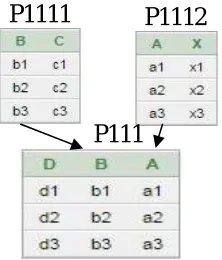
To illustrate my work let me consider the following example given in fig. 3.A Here, a table named P111 has two parent tables – P1111 and P1112.
I want to migrate this P111 table from Oracle to MS Excel. As it have two parent tables,
So parent tables must be migrated first. Only after the migration of all parent tables with the data, then only the child table will be created and data will be inserted, i.e. migration will be completed.
Fig. 3.A - Structure of database in ORACLE to be migrated in MS-EXCEL
P1111
P1112
Here, in Fig.3.A we can see in ORACLE, that Table P111 have 2 foreign keys named B (connects with Table P1111) and A (connects with Table P1112) which makes Table P1111 and Table P1112 as the parent tables of Table.
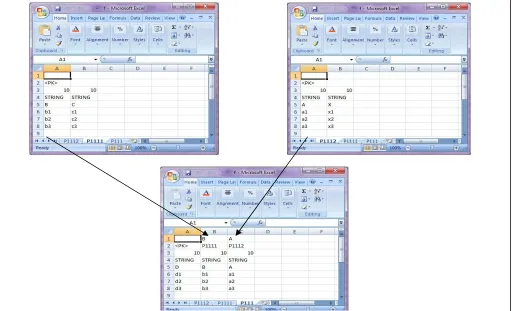
Fig.3.B -Structure of database in MS-Excel after migration from ORACLE
Here, in Fig. 3.B we can see in MS-Excel, that Table P111 converted as a excel sheet named P111 which have the information about the table such as, P111 have one Primary key named D which is represented by “<PK>” on cell no. (2, A) and also have 2 foreign keys named B [represented in cell no. (1, B)] Which connects with Table P1111 [represented in cell no. (2, B)] and A[represented in cell no. (1, C)] Which connects with Table P1112 [represented in cell no. (2, C)], so which makes Table P1111 and Table P1112 as the parent tables of Table P111.
Above figures signifies that from ORACLE P111 table is copied with its all data and keeping the information about the structure and Table P1111, Table P1112 are also copied in MS Excel as they are referenced table of P111.
Now, if P1111 table is to be migrated from ORACLE to MS Excel. Here is the step by step explanation how these tables are migrated from Oracle to MS Excel.
3.1 Finding the foreign key in child table:
As I select the child table and convert it, at first, it searches for the foreign key. Here child key have two foreign keys. Fig. 3.1 shows the information about the foreign keys fetched by the SQL command.
Fig 3.1
Foreign keys of child table
3.2 Creation of structure of foreign key:
As it moves to P1111 table, which is foreign key of P111 table, it again searches for foreign key of P1111 table. Fig. 3.2 shows it has no result.
Fig 3.2
No foreign key of P1111
3.3 Creation of structure and data insertion P1111 table:
As P1111 have no foreign key so it starts to construct the structure of P1111 table. Then its primary keys are to be found and collecting the tuples one by one and insert it into the corresponding excel sheet in to the corresponding cell starting from 6th row of that excel sheet.
3.4 Creation of structure and data insertion P1112 table:
The above process is done recursion ally meaning as 3.3 creates and inserts data in table P1111, then the structure of P1112 is created, primary key is implemented and data are inserted.
3.5 Creation of structure of P111 table and data insertion:
As all the tables of P111 table now has been created, so it comes back to P111 table, then creates it structure and inserts all the data. And finally all tables are migrated from Oracle to MS Excel.
IV. CONCLUSION AND FUTURE WORK
As my initial goal was to migrating tables from one database to another different database the software developed by me is successful of migrating tables between ORACLE to MS Excel. Though it has some limitations but I look forward to work out and develop more accurate software.
Above said limitation of my project can be rectified. I will work out about this limitation in future and hopefully will overcome this limitation.
Apart from this, as I am able to migrating tables from Oracle to MS Excel, now I will concentrate on extending my project so that it will be able to migrating the table in some other way, i.e. from some other database to some other database.
Not only that, I wish to carry forward my work and developing the software which will be able to migrating tables between all major databases which follow the CODD’s rule (Oracle, SQL Server, My SQL).
REFERENCES
[1] Kevin Loney and George Koch, Oracle 9i, The Complete Reference, sixteenth reprint, 2005, Oracle Press. [2] Silberschatz, Korth and Sudarshan, Database System Concepts, fourth edition, McGraw-Hill International Edition.
[3] Ivan Bayross, SQL, PL/SQL: The Programming Language Of Oracle, 4th Revised Edition.
[4] https://www.google.co.in/
[5] http://stackoverflow.com/
[6] https://www.wikipedia.org/
[7] Yahoo.com
[8] https://community.oracle.com
[9] https://oracle.com
[10] www.blocks.oracle.com
[11] Kibria Dastagir Dafadar, Chalorme Roy Mukhopadhyay, Prof. Dr Pranam Paul; “Implementation of Data Migration between Two Different Databases for discrete table”; Paper ID: V40202104; Accepted and Published in “International Journal of Innovative Research in Computer and Communication Engineering (IJIRCCE)”; ISSN No: 2320-9801 (Online), 2320-9798 (Print); Vol. 4, Issue: 1; Feb 2016; pp 2144 – 2147.
[12] Chalorme Roy Mukhopadhyay,Kibria Dastagir Dafadar, Prof. Dr Pranam Paul; “Implementation of Data Migration between Two Different Databases for inter connected tables”; Paper ID: V40202106; Accepted for Publication in “International Journal of Innovative Research in Computer and Communication Engineering (IJIRCCE)”; ISSN No: 2320-9801 (Online), 2320-9798 (Print) ); Vol. 4, Issue: 1; Feb 2016; pp 2148 – 2154. [13]Chalorme Roy Mukhopadhyay, Prof. Dr Pranam Paul; “Conversion of Entire Structure of Database from SQL SERVER to MS Access”; Paper ID: V40505138; Accepted for Publication in “International Journal of Innovative Research in Computer and Communication Engineering (IJIRCCE)”; ISSN No: 2320-9801 (Online), 2320-9798 (Print); Vol 4, Issue: 5; May 2016; pp 9179 - 9185
[15] Chalorme Roy Mukhopadhyay, Prof. Dr Pranam Paul; “Implementation of Data Migration between SQL Server to ORACLE”; Paper ID: V40505138B; Accepted for Publication in “International Journal of Innovative Research in Computer and Communication Engineering (IJIRCCE)”; ISSN No: 2320-9801 (Online), 2320-9798 (Print); Vol 4, Issue: 5; May 2016; pp 9186 - 9192
BIOGRAPHY
Chalorme Roy Mukhopadhyay, Final Year Student of MCA at Narula Institute of Technology, Agarpara, Westbengal, India. She completed her BCA degree from George College (Kolkata), under the West Bengal University of Technology. Achievements:
1. Got 431st Rank on NEST(Nationwide Education And Scholarship Test) Aptitude Test 2013,
2. Scored among the top 24 %( 76 percentile) on NIIT 8th National IT Aptitude Test 2012.
3. Five papers accepted and published in an International Journal.
Prof. Dr Pranam Paul, Assistant Professor and Departmental Head, CA Department, Narula Institute of Technology (NIT), Agarpara had completed MCA in 2005. Then my carrier had been started as an academician from MCKV Institute of Technology, Liluah. Parallely, at the same time, I continued my research work. At October, 2006, National Institute of Technology (NIT), Durgapur had agreed to enroll my name as a registered Ph.D. scholar. Then I had joined Bengal College of Engineering and Technology, Durgapur. After that Dr. B. C. Roy Engineering College hired me in the MCA department at 2007. At the age of 30, I had got Ph.D. from National Institute of Technology, Durgapur, WestBengal. I had submitted my Ph.D. thesis only within 2 Years and 5 Months. After completing the Ph.D., I had joined Narula Institute of Technology in Computer Application Department. Parallely I continue my research work. For that, I have 39 International Journal Publications among 54 accepted papers in different areas. I am also reviewer of International Journal of Network Security (IJNS), Taiwan and International Journal of Computer Science Issue (IJCSI); Republic of Mauritius.
Achievement:
1. Accepted my name for publication in “Who’s Who Science and Engineering, 2011 – 2012” published by “Marquis Who’s Who”, USA on 31st Dec 2010
2. Selected my name as “Top 100 Engineers’ 2011”, by “International Biographical Centre”, Cambridge, England 3. Selected my name as “Outstanding 2000 Intellectuals of the 21st Century, 2012”, by “International Biographical