A Semantic Based Approach for Abstractive
Multi-Document Text Summarization
Dipti Bartakke 1, Dr S D Sawarkar2, Archana Gulati 3
P.G. Student, Department of Computer Engineering, Datta Meghe College of Engineering, Airoli, Mumbai, India1 Principal, Datta Meghe College of Engineering, Airoli, Mumbai, India2
Associate Professor, Department of Computer Engineering, Datta Meghe College of Engineering, Airoli, Mumbai, India3
ABSTRACT: One of the important Natural Language Processing applications is Text Summarization, which helps users to manage the vast amount of information available, by condensing documents content and extracting the most relevant facts or topics included. Text summarization is the process of extracting salient information from the source text and to present that information to the user in the form of summary. It is very difficult for human beings to manually summarize large documents of text. Text summarization approaches fall in two broad categories: extractive and abstractive. Extractive summarization produces summaries by choosing a subset of the sentences in the original document(s). This contrasts with abstractive summarization, where the information in the text is rephrased. In this paper, a novel approach is presented to create an abstractive summary for a multi-document using a rich semantic graph reducing technique. The approach summaries the input documents by creating a rich semantic graph for the original documents, reducing the generated graph, and then generating the abstractive summary from the reduced graph.
KEYWORDS: Text Summarization; Abstractive Summary; Semantic Representation; Rich Semantic Graph; Semantic Graph.
I. INTRODUCTION
Text summarization is the technique, where a computer summarizes a text. A text is entered into the computer and a summarized text is returned, which is a non-redundant extract from the original text. The intention of text summarization is to express the content of a document in a condensed form that meets the needs of the user. For more information that can realistically be digested is available on the World-Wide Web and in other electronic forms. News information, biographical information is so vast that it is not possible to read everything, hence it requires condensed information.
Text Summarization has become a very popular Natural Language Processing (NLP) task in recent years. Due to the vast amount of information, especially since the growth of the Internet, automatic summarization has been developed and improved in order to help users manage all the information available these days. The data on World Wide Web is growing at an exponential pace. Nowadays, people use the internet to find information through information retrieval (IR) tools such as Google, Yahoo, Bing and so on. However, with the growth of valid information on the internet, information abstraction or summary of the retrieved results has become necessary for users. In the current era of information overload, text summarization has become an important and timely tool for user to quickly understand the large volume of information. The goal of text summarization is to condense the documents into a shorter version and preserve important contents. This reduces user’s time for finding the key information in the document.
Features: A summary can be defined as a text that is produced from one or more texts, that contain a significant portion of the information in the original text(s), and that is no longer than half of the original text(s). Summarization systems can be characterised according to many features. There are three classes of context factors that influence summaries: input, purpose and output factors.
document (single-document summarization) or multiple ones (multi-document summarization). Regarding the output, a summary may be an extract (i.e. when a selection of “significant” sentences of a document is performed), abstract, when the summary can serve as a substitute to the original document or even a headline (or title). It is also possible to distinguish between generic summaries and user-focused summaries. The first type of summaries can serve as surrogate of the original text as they may try to represent all relevant features of a source text. The user-focused summaries rely on a specification of a user information need. Concerning also the style of the output, abroad distinction is normally made between two types of summaries. Indicative summaries are used to indicate what topics are addressed in the source text. As a result, they can give a brief idea of what the original text is about. The other types, the informative summaries, are intended to cover the topics in the source text.
Text summarization approaches can be broadly divided into two groups: extractive summarization and abstractive summarization. Extractive summarization extracts salient sentences or phrases from the source documents and groups them to produce a summary without changing the source text. Usually, sentences are in the same order as in the original document text. However, abstractive summarization consists of understanding the source text by using linguistic method to interpret and examine the text. The abstractive summarization aims to produce a generalized summary, conveying in information in a concise way, and usually requires advanced language generation and compression techniques. Summarization started with single document summarization which produces summary of one document. As research done, due to large amount of information on web, multi document summarization came into existence. Multi document summarization produces summaries from many source documents on the same topic or same event.
Abstractive methods need a deeper analysis of the text. These methods have the ability to generate new sentences, which improves the focus of a summary, reduce its redundancy and keeps a good compression rate. Generally, a summary should be much shorter than the source text. This characteristic is defined by the compression rate, which measures the ratio of length of summary to the length of original text.
II.RELATED WORK
[23] proposed an approach; -gram sub-sequences of transitions per term in the discourse role matrix then constitute the more fine grained evidence used in our model to distinguish coherence from incoherence. Gangemi [24] have presented some preliminary results of OntoWordNet, a large scale project aiming at the “ontologization” of WordNet. We presented a twostep methodology: during the first, automatic phase, natural language word sense glosses in WordNet are parsed, generating a first, approximate definition of WN concepts (originally called synsets). In this definition, generic associations (A-links) are established between a concept and the concepts that co-occur in its gloss. In a second phase, the foundational top ontology DOLCE (in the DOLCE-Lite+ version), including few hundred formally defined concepts and conceptual relations, is used to interpret A-links in terms of axiomatised conceptual relations. This is a partly automatic technique that involves generating solutions on the basis of the available axioms, and then creating a specialized partition of the axioms (the set ∏ d + and its specializations) in order to capture more domain-specific phenomena.
III.PROPOSED SYSTEM
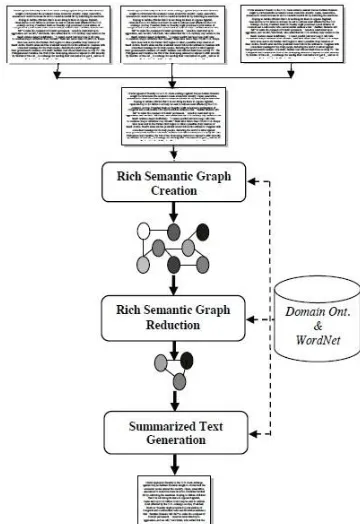
The aim of the project is to use the multiple documents in order to create abstractive summarization. At first, semantic graph is generated for every sentence in the documents by preprocessing each sentence. Thereafter, the generated graph is reduced to more reduced graph to generate abstractive summary. Heuristic rules have been used to generate abstractive summary. The goal of the system is to condense the documents into a shorter version and preserve important contents.
Figure 1: The Proposed System
The Rich Semantic Graph Creation Phase
:
The main objective of the Rich Semantic Graph Creation Phase is to represent the input documents semantically using Rich Semantic Graph (RSG). Unlike traditional semantic graph, the Rich Semantic Graph is able to capture the meaning of words, sentences, and paragraphs. The Rich Semantic Graph Creation phase is as shown in figure 2.
creating the final Rich Semantic Graph. It is composed of three modules: Preprocessing, Rich Semantic Sub-graphs Generation, and Rich Semantic Graph Generation modules.
1) The Preprocessing Module: Preprocessing module is responsible to accept the input text, and converts it to preprocessed sentences. It consists of four main processes: named entity recognition, morphological and syntactic analysis, cross-reference resolution, and pronominal resolution processes.
The named entity recognition process locates atomic elements into predefined categories such as person names, organizations, etc.
In morphological analysis, each word is divided into morphemes and figures out its grammatical categories, the syntactic analysis parses the whole sentence to describe each word syntactic function and build the parse tree, and typed dependencies expresses syntactic knowledge in terms of direct relationships between words.
Co-reference and pronominal resolution reference resolution processes identify co-reference named entities and resolve pronominal references in the whole input text.
Co-reference is defined as the identification of surface terms (words within the document) that refer to the same entity.
Figure 2: The Rich Semantic Graph Creation Phase
2) The Rich Semantic Sub-graphs Generation Module: The Rich Semantic Sub-graphs Generation module is responsible to transform each preprocessed sentence to a set of ranked rich semantic subgraphs. The main objective of the Rich Semantic Sub-graphs Generation module is to generate multiple rich semantic sub-graphs for each input preprocessed sentence. This module includes three processes: Word Senses Instantiation, Concepts Validation, and Semantic Sentences Ranking processes.
Word Senses Instantiation process: For each input preprocessed sentence, this process instantiates a set of word concepts for both noun and verb senses based on the domain ontology.
Concept Validation Process: In this process, for each preprocessed sentence, the sentence concepts instantiated are interconnected and validated to generate multiple rich semantic sub-graphs.
weight of each concept (word sense). The weight of the word concept is derived according to its usage popularity (Wordnet usage popularity).
3) The Rich Semantic Graph Generation module: Finally, the Rich Semantic Graph Generation module is responsible to generate the final rich semantic graphs of the whole input document from the highest-ranked rich semantic sub-graphs of the document sentences. The semantic sub-graphs of the input document will be merged to form the final rich semantic graph.
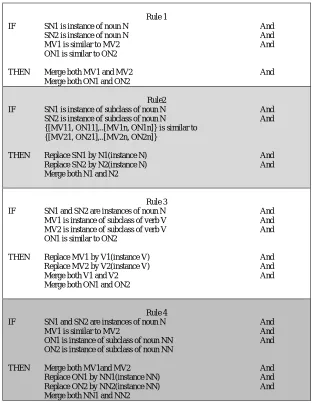
The Rich Semantic Graph Reduction Phase: This phase aims to reduce the generated rich semantic graph of the original document to more reduced graph. In this phase, a set of heuristic rules are applied on the generated rich semantic graph to reduce it by merging, deleting, or consolidating the graph nodes.
Rule 1
IF SN1 is instance of noun N And
SN2 is instance of noun N And
MV1 is similar to MV2 And
ON1 is similar to ON2
THEN Merge both MV1 and MV2 And
Merge both ON1 and ON2
Rule2
IF SN1 is instance of subclass of noun N And
SN2 is instance of subclass of noun N And
{[MV11, ON11],..[MV1n, ON1n]} is similar to {[MV21, ON21],..[MV2n, ON2n]}
THEN Replace SN1 by N1(instance N) And
Replace SN2 by N2(instance N) And
Merge both N1 and N2
Rule 3
IF SN1 and SN2 are instances of noun N And
MV1 is instance of subclass of verb V And
MV2 is instance of subclass of verb V And
ON1 is similar to ON2
THEN Replace MV1 by V1(instance V) And Replace MV2 by V2(instance V) And Merge both V1 and V2 And Merge both ON1 and ON2
Rule 4
IF SN1 and SN2 are instances of noun N And
MV1 is similar to MV2 And
ON1 is instance of subclass of noun NN And
ON2 is instance of subclass of noun NN
THEN Merge both MV1and MV2 And
Replace ON1 by NN1(instance NN) And
Replace ON2 by NN2(instance NN) And
Merge both NN1 and NN2
Figure 3: Herustic Rules
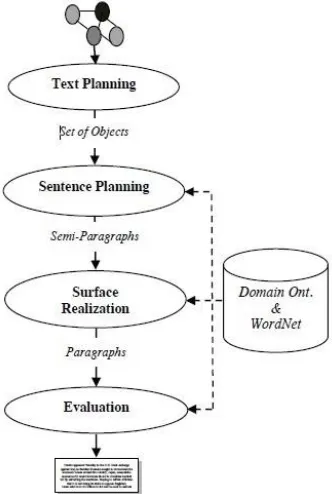
Realization, and the Evaluation modules. These modules are performed by processes arranged as a pipeline, so the output of each process is the input of the next one as shown in figure 4.
1) The Text Planning module: It aims to select the appropriate content material to be expressed in the final text. This phase includes one process called “Content Determination”, which decides what information should be included in the generated text.
2) The Sentence Planning module: It specifies the sentence boundaries, and generates and orders an intermediate paragraphs. The main objective of this phase is to improve the fluency or understandability of the text. The sentence planning consists of four main processes:
Lexicalization Process: In this process, for each verb/noun object, its synonyms are selected by accessing the WordNet ontology to generate the target content.
Figure 4: Text Generation Phase
Discourse Structuring Process: The main aim of this process is to build a structure that contains the selected object synonyms in the form of pseudo-sentences
Aggregation Process:The main aim of this process is to decide how pseudo-sentences should be combined into semi-paragraphs.
Referring Expression Process: This process identifies and replaces the intended referent by its appropriate pronoun. 3) The Surface Realization module: This phase aims to transform the enhanced semi-paragraphs into paragraphs by
correcting them grammatically (inflect words for tense, etc.) and adding the required punctuation (capitalization adding semicolon, etc). The Surface Realization module: This phase aims to transform the enhanced semi-paragraphs into paragraphs by correcting them grammatically (inflect words for tense, etc.) and adding the required punctuation (capitalization adding semicolon, etc).
4) The Evaluation module: The main objective of this phase is to evaluate and then rank the paragraphs according to two factors: coherence between paragraph sentences, and the most frequently used paragraph word synonyms.
V.SYSTEMGUI
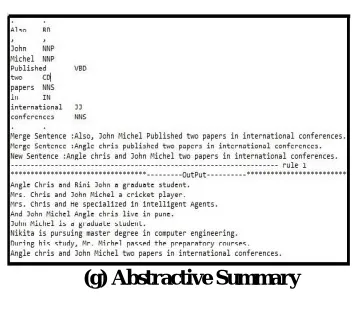
The Graphical User Interface (GUI) is designed to produce abstractive summary by using Semantic approach. The GUI is as illustrated in Figure (a). Figure (b) below shows files selection process, where the different documents are given as an input to the system. Figure (c) reads the selected files and will display on the screen. Figure (d) shows sentence wise graph with named entity recognizer and POS tagging. Figure (e) shows merging of sentences after heuristic rules are applied to the multiple documents. Figure (f) shows merging of sentences after heuristic rules are applied to the multiple documents. Figure (g) shows the summary of multiple documents
(a) System GUI (b) File Selection
(c) File Reading (d) Sentence Wise Graphs
(g) Abstractive Summary
VI.PERFORMANCEANALYSIS
Our system provides evaluation by comparing the human generated summary with the system generated summary. The evaluation through precision and recall for the summary produced is shown in figure 6.
Original Documents: File 1:
Angle Chris is a graduate student. Mrs. Chris is a cricket player.
Mrs. Chris is specialized in Machine learing field. Angle chris is live in pune.
Rini John is a graduate student completed engineering in computer science. Albert is good in bating.
During his study, Mr. Michel passed the preparatory courses. Human Generated Summary:
File 1:
Chris and Rini are graduate student. He is a cricket player who live in Pune
And he is specialized in Machine learing field.
Mr. Michel passed the preparatory courses, during his study. System Generated Summary:
File 1:
Angle Chris and Rini John a graduate student. Mrs. Chris is a cricket player.
Mrs. Chris is specialized in Machine learing field. Angle chris is live in pune.
Albert is good in bating.
Figure 6: Comparision of human generated summary with system generated summary
Precision &Recall
Precision
The precision of the summary can be defined as the measurement of the retrieved relevant sentences to the query of the total retrieved sentences. Precision measures the accuracy of the summary.
Precision=A/B Where,
B = the total retrieved sentence.
Recall
The recall of the summary can be defined as the measurement of the retrieved relevant sentences to the total database sentences.
Recall=A/C Where,
A = No of relevant retrieved sentences and
C = Total number of relevant sentences in the database.
On an average precision obtain for the summary generated by the system is 70 %.
VI.CONCLUSION AND FUTURE WORK
Information condensation is needed. Extractive summary leads usually for sentence extraction rather the summarization. So the need is to generate summary that captures the important text and relates the sentences semantically. The work is applicable in open domain. Abstractive summarization will serve as a tool for generating summary which is semantically correct and produced fewer amounts of sentences in summary. Extractive summarization leads to sentence extraction based on statistical methods which are not useful always. In this paper, a model is proposed to create an abstractive summary for multiple documents using a semantic graph reducing approach. The approach summaries the source documents by creating a semantic graph called Rich Semantic Graph for the original documents, reducing the generated semantic graph to more abstracted graph, and generating the abstractive summary from the reduced graph. It reduces the original document to almost fifty percent. The average precision for the above results is obtained as 70%. In the future work, we are going to develop a model for multilingual multi-document summarization. We can also try to summaries the multilingual multi- multi-documents in the form of video, or in the form of audio.
REFERENCES
1. Ibrahim F. Moawad, Mostafa Aref," Semantic Graph Reduction Approach for Abstractive Text Summarization" 2012 IEEE
2. D. Das, A. Martins, "A Survey on automatic text summarization", Unpublished, Literature survey for Language and Statistics II, Carnegie Mellon University, 2007.
3. D. Radev, E. Hovy, K. McKeown, "Introduction to the Special Issue on Summarization", Computational Linguistics, Vol. 28, No. 4, pp. 399-408, 2002.
4. A. Khan, N. Salim, “A Review on Abstractive Summarization Methods”, in JATIT, Vol. 59 No. 1, Jan 2005. 5. S. Ismail, I. Moawad, M. Aref, “Arabic Text Representation using Rich Semantic Graph”.
6. I. Fathy, D. Fadl, M. Aref, “Rich Semantic Representation Based Approach for Text Generation”, The 8th International conference on Informatics and systems (INFOS2012), Egypt, 2012.
7. K. Svore, L. Vanderwende, C. Burges, "Enhancing single-document summarization by combining RankNet and third-party sources", In Proceedings of the EMNLP-CoNLL, pp. 448-457, 2007.
8. D. Evans, K. McKeown, J. Klavans, "Similarity-based Multilingual Multi-Document Summarization", Technical Report CUCS-014-05,Department of Computer Science, Columbia University, Apr 2005.
9. J. Leskovec, M. Grobelnik, N. Milic-Frayling, "Learning Sub-structures of Document Semantic Graphs for Document Summarization", inKDD2004 Workshop on Link Analysis, 2004.
10. Stanford Parser, http://nlp.stanford.edu:8080/parser/index.jsp, June 15, 2012.
11. J. Leskovec, M. Grobelnik, N. Milic-Frayling, "Extracting Summary Sentences Based on the Document Semantic Graph", Microsoft Research, 2005.
12. D. Rusu, B. Fortuna, M. Grobelnik, D. Mladenić, "Semantic Graphs Derived From Triplets With Application In Document Summarization", International journal of Computing and Informatics, Vol.33, No.3, 2009.
13. B Fellbaum, "WordNet: An Electronic Lexical Database", MIT Press, 1998.
14. R. Prasad, N. Dinesh, A. Lee, E. Miltsakaki, L. Robaldo, A. Joshi, B. Webber, "The Penn Discourse Treebank 2.0", Proceedings of the 6th International Conference on Language Resources and Evaluation (LREC 2008), Morocco.
15. https://www.ling.upenn.edu/courses/Fall_2003/ling001/penn_treebank_pos.html.
16. http://nlp.stanford.edu/software/CRFNER.html.
17. J. Leskovec, M. Grobelnik, N. Milic-Frayling, "Learning Semantic Graph Mapping for Document Summarization", 2000.
18. Saeedeh Gholamrezazadeh, Mohsen Amini Salehi, Bahareh Gholamzadeh, "A Comprehensive Survey on Text Summarization Systems" 2009 In proceeding of: Computer Science and its Applications, 2nd International Conference.
20. Silber G.H., Kathleen F. McCoy, "Efficiently Computed Lexical Chains as an Intermediate Representation for Automatic Text Summarization," Computational Linguistics 28(4): 487-496, 2002.
21. Barzilay, R., Elhadad, M, "Using Lexical Chains for Text Summarization," in Proc. ACL/EACL’97 Workshop on Intelligent Scalable Text summarization, Madrid, Spain,1997, pp.10–17.
22. A.Stergos, K. Vangelis, S. Panagiotis, "Summarization from medical documents: a survey", Artificial intelligence in medicine, Vol. 33, No. 2, pp. 157-77, 2005.
23. Z. Lin, H. Ng, M. Kan, "Automatically Evaluating Text Coherence Using Discourse Relations", In Proceedings of the 49th Annual Meeting of the Association for Computational Linguistics: Human Language Technologies (ACL-HLT 2011), Portland, Oregon, USA, 2011.
24. A. Gangemi, R. Navigli, P. Velardi, "The OntoWordNet Project: Extension and Axiomatization of Conceptual Relations in WordNet", In Proc. of International Conference on Ontologies, Databases and Applications of Semantics (ODBASE 2003), Catania, Italy, pp. 820–838, 2003.
BIOGRAPHY
Dipti Abhishek Bartakke is a student in the Computer Department, Datta Meghe College of Engineering, Mumbai University. My research interests are Image Processing, Natural Language Processing, Data Mining, etc.