To Study IT Implementation in Private and
Public Bank
Dr. Minakshi D. Bhosale
Associate Professor, Faculty of MCA, YSPM's Yashoda Technical Campus, Satara, India
ABSTRACT: IT refers to processing, storing and transferring information. It uses computers, electronic devices such as telephones, mobile phones, fax machines etc. and telecommunication network. IT has defied all geographical boundaries. The banking today is redefined and re-engineered with the use of IT and it is sure that the future of banking will offer more sophisticated services to customers with the continuous product and process innovations. Banks are taking an effort to make a client's banking experience more helpful, effective, at low transaction cost, very quick and compelling. The above research paper enlightens the IT implementation in private and public banks in Satara district and also provide comparative study between private and public bank.
KEYWORDS: Private bank, Public bank, IT (Information Technology), configuration.
I. INTRODUCTION
In advancement of the banking industry, Satara region is not lingering behind the improvement. In the improvement of banking in the Satara area, some historic progressions might be performing. The age-old foundation of cash banks, which were the conspicuous wellspring of credit to an expensive segment of the individuals, particularly the farming populace is fast losing ground and no doubt reinstated by the up to date, sorted out banking framework
(Kumbhar, V. M. (25-Mar-2013). On the date 20thAugust 1907, the first bank Satara Swedish Commercial Bank was
created as a Joint Stock Bank. The development of banks in Satara area is its establishment only. The main objective of the above study is to know the IT implementation in Satara district private and public banks.
In order to accomplish the objectives of the study, the data are collected from primary and secondary sources the empirical findings will be analysed against the frame of reference and based on the collected data from interviews and questionnaires. Collected data can be represented or analysed with the help of elementary statistical tools
II. PRIVATE AND PUBLIC BANKS IN SATARA DISTRICT
Data collected from 17 private bank branches and 57 public bank branches for the analysis. Samples details are described below.
Table 2.1 Demographic profile of selected samples for study.
Sr. No Name of bank type Population Sample units
1 Private banks 46 17
2 Public banks 181 57
Total 227 74
(Source: - Secondary data)
Table 2.2 Demographic profile of private banks
Sr No. Private bank names Population Sample units
1 ICICI Bank 20 7
2 HDFC Bank 12 2
3 Axis Bank 5 1
4 Catholic Syrian Bank 1 1
5 Karnataka Bank 1 1
6 Federal bank 2 1
7 ING Vysya Bank 2 1
8 Ratnakar bank 1 1
9 Indusind bank Ltd. 1 1
10 Yes bank 1 1
Total 46 17
(Source: - Secondary data)
The table 2.2 shows the private bank branches in the Satara district. Out of 46 private bank branches researchers selected 17 bank branches for the study. In which ICICI bank has the maximum number of branches in Satara from which researcher has taken 7 branches for the study, on the other hand HDFC bank has 12 branches from which researcher has selected 2 branches, same way going ahead, researcher has chosen 1 branch of Axis bank, Catholic Syrian bank, Karnataka bank, Federal bank, ING Vysya bank, Ratnakar bank, Indusind bank Ltd., Yes bank for this research study.
Table 2.3 Demographic profile of public banks
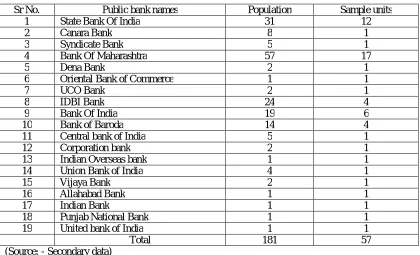
Sr No. Public bank names Population Sample units
1 State Bank Of India 31 12
2 Canara Bank 8 1
3 Syndicate Bank 5 1
4 Bank Of Maharashtra 57 17
5 Dena Bank 2 1
6 Oriental Bank of Commerce 1 1
7 UCO Bank 2 1
8 IDBI Bank 24 4
9 Bank Of India 19 6
10 Bank of Baroda 14 4
11 Central bank of India 5 1
12 Corporation bank 2 1
13 Indian Overseas bank 1 1
14 Union Bank of India 4 1
15 Vijaya Bank 2 1
16 Allahabad Bank 1 1
17 Indian Bank 1 1
18 Punjab National Bank 1 1
19 United bank of India 1 1
Total 181 57
(Source: - Secondary data)
Baroda is having 14 branches among them researcher has selected 4 branches. Remaining all other mentioned here by researcher selected one branch of each Canara bank, Syndicate bank, Central bank of India, Corporation bank, Indian overseas bank, Union bank of India, Vijaya bank, Allahabad bank, Indian bank, Punjab National bank, United bank of India for the study.
IV. IT IMPLEMENTATION STATUS OF PRIVATE AS WELL AS PUBLIC BANKS IN SATARA DISTRICT.
To know the IT implementation in Satara district banks researcher studied computer configuration, network facilities, Intent banking service provided by bank, Training provided to the employees etc. These are as follows.
Table 3.1 Status of computer configuration used in private and public banks.
Type Of PC
Private bank Public bank
Number of Computers Number of Computers
10 20 30 Any
other
10 20 30 Any
other Dual Core 14 (82.35%) 1
(5.88%) . .
32 (56.14%)
8
(14.04%) 9 (15.78%) -
PIV 1 (5.88%) 1
(5.88%) - -
5 (8.77%)
8 (14.04%)
4
(7.02%) -
PIII
- 1
(5.88%) - -
2
(3.51%) - - -
Celeron
- - - - 2
(3.51%) -
Any
other - -
1
(5.88%) -
6
(10.53%) 1 (1.75%)
2
(3.51%) -
(Source:-Primary data)
Table 3.1 reflects the computer configuration used in private and public banks. In private banks, 82.35% dual core computers are used where a number of the computer are near about 10, whereas in public bank it is 56.14%. The number of PIV computers used in private banks is 5.88% where a number of the computer is near about 20 whereas in public bank it is 14.04% of the same numbers of computers in PIV range. Use of PIII is reduced and it is 5.88% in the range of 20 computers for private banks, on the other side in a public bank number of computers are near about 10 uses PIII configuration are 3.51%. So the analysis shows that private bank is using an updated computer configuration in their banks compared to public banks.
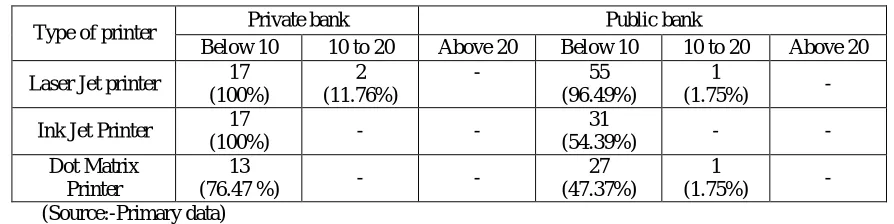
Table 3.2 Type of printers used in private and public banks.
Type of printer Private bank Public bank
Below 10 10 to 20 Above 20 Below 10 10 to 20 Above 20
Laser Jet printer 17
(100%)
2 (11.76%)
- 55
(96.49%)
1
(1.75%) -
Ink Jet Printer 17
(100%) - -
31
(54.39%) - -
Dot Matrix Printer
13
(76.47 %) - -
27 (47.37%)
1
(1.75%) -
(Source:-Primary data)
private bank below the number 10 and its use is again 100%. Whereas in a public bank for the same criterion, with 54.39%. For Dot Matrix Printer in private bank below the number 10 and its use is 76.47% and a public bank, it is 47.37%. This analysis again reflects that private banks are using higher numbers of Laser Jet and Ink Jet printers in comparison with public banks.
Table 3.3 Type of Storage media used in private and public banks.
Type of bank
Storage media used
Pen drive Magnetic
tape
Mirroring &
Duplexing server Data Warehouse CD/ DVD
Private bank 15(88.24%) 5 (29.41%) 13(76.47%) 15(88.24%) 5(29.41%)
Public bank 24(42.11%) 10 (17.54%) 15(26.32 %) 45(78.95%) 5(8.77%)
(Source:-Primary data)
Table 3.3 represents the use of Storage media for securing data for future use in selected banks for this research. In private bank use of pen drive is 88.23%, but in public bank it is 42.11%. Use of magnetic tape in private banks is 29.41%, whereas in public bank it is 17.54%. For Mirroring and Duplexing server private banks are using its 76.47% and public bank usage is 26.32%. About Data Warehouse private bank usage is 88.24% and in public bank it is 78.95%. For Compact Disk (CD) and Digital Video/Versatile Disk (DVD) use in a private bank is 29.41%, whereas public bank usage is 8.77%. This analysis reflects that again a private bank uses Storage media facility in high percentage as compare with public banks.
Table 3.4 Other type of computer peripherals used in private and public banks.
Type of bank Other Peripherals used
Scanner MICR UPS system
Private bank 17(100%) 16(94.12%) 17(100%)
Public bank 57(100%) 35(61.40%) 57(100%)
(Source:-Primary data)
Table 3.4 represents computer peripherals used in private and public banks. Use of the scanner is 100% in both private and public banks; use of MICR (Magnetic Ink Character Recognition is a technology used in banking to facilitate the processing of cheques) is 94.12% in private bank and 61.40% in public banks, whereas use of the Uninterruptable Power Supply (UPS) system in private as well as public banks is 100%. So the analysis indicates that both types of banks have the similar type of computer peripheral utilization.
Table 3.5 Type of network structure used in private and public banks.
Type of bank Type of network structure used
Client server Peer-to-Peer Network Distributed Network
Private bank 14 (82.35%) 1(5.88) 2(11.76%)
Public bank 47(82.46%) 3(5.26%) 7(12.28%)
(Source:-Primary data)
Table 3.6 Type of network topology used in private and public banks.
Type of bank Network topology used
Bus Ring Star Tree Mesh
Private bank 14(82.35%) - 2(11.76%) 1(5.88%) -
Public bank 36(63.16%) 2(3.51%) 12(21.05%) 5(8.77%) 2(3.51%)
(Source:-Primary data)
Table 3.6 describes about network topology used in private and public bank. Topology is nothing but a schematic description of the arrangement of a network. It provides maximum possible reliability to assure proper receipt of all traffic. Route the traffic across the least-cost path within the network between the sending and receiving DTEs (Data Terminal Equipment) (Black, U. (1993)). Mostly bank used Bus, Ring, Star, Tree, Mesh topology as per requirement in a bank branch. Most of the banks used Bus topology (In this network arrangement, all of the various devices in the network are connected to a single cable or line. It is also called as horizontal topology and this arrangement is quite
popular in local area network) 1 in their branches. The usage of bus topology percentage in private banks is 82.35% and
63.16% in public banks.
Table 3.7 Type of network component used in private and public banks.
Type of bank
Network Components used Network
interface card
Repeater Hub Bridge Switch Router Gateway
Private bank
5 (29.41%)
3 (17.65%)
12 (70.59%)
4 (23.53%)
12 (70.59%)
13 (76.47%)
3 (17.65%)
Public bank
32 (56.14%)
18 (31.58%)
42 (73.68%)
10 (17.54%)
40 (70.18%)
37 (64.91%)
19 (33.33%) (Source:-Primary data)
Table 3.7 shows the network components used in private and public banks in which router (Small physical device is used to join multiple network together that forwards data packets between computer network) use is 76.47% in private banks, but in public bank it is 64.91%. Hub (Hardware device is used to network multiple computers together) network use is 70.59% in private banks whereas in public banks its use is 73.68%. In private banks usage of switch (It works similar to a hub, but is extra superior to hub and less competent than routers) is 70.59% comparatively in public bank it is 70.18%.
Table 3.8 Development of Internet banking software in private and public banks.
Type of bank Internet banking software development
In-house Outsourcing Readymade packages
Private bank 1(5.88) 14(82.35%) 2(11.76%)
Public bank 3(5.26%) 47(82.46%) 7(12.28%)
(Source:-Primary data)
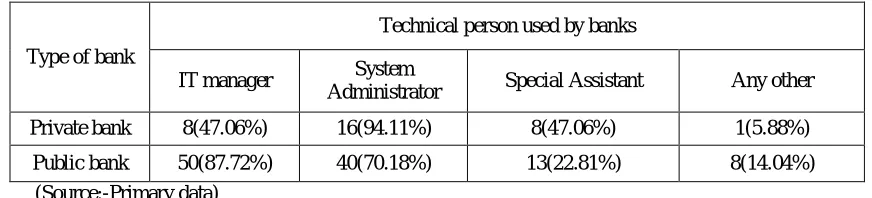
Table 3.9 Technical person used to handle Internet banking software in both banks.
Type of bank
Technical person used by banks
IT manager System
Administrator Special Assistant Any other
Private bank 8(47.06%) 16(94.11%) 8(47.06%) 1(5.88%)
Public bank 50(87.72%) 40(70.18%) 13(22.81%) 8(14.04%)
(Source:-Primary data)
Table 3.9 shows that a technical person was available in bank to handle Internet banking software in selected bank branches. Banking sector adopts new technology regularly. For smooth functioning of Internet banking, banks require to train the personnel with advanced technology regularly. Hence bank appoints technical personnel with adequate technology knowledge. During the analysis researcher find both the bank concentrates on technical personnel. In a private bank number of system administrator are 94.11%, whereas in the public banking sector, it is 70.18%, IT managers in private banks are about 47.06% where as in public bank this number increases to 87.72%. With this few banks also appoint special assistant and technical personnel with percentage 47.06% and 5.88% in private bank branches. In public bank branches this percentage is 22.81% and 14.04% respectively. So the table signifies that intake of technical people is in good amount for both the banks.
Table 3.10 Training is provided to employees regarding IT trends, security and Internet banking awareness program for private and public banks.
Bank Internet banking technology
awareness System security and audit Recent trends in IT
Annually Occasionally Annually Occasionally Annually Occasionall
y Private
bank 9(52.94%) 8(47.06%) 9(52.94%) 8(47.06%) 8(47.06%) 9(52.94%)
Public bank
23(40.35%
) 34(59.65%) 23(40.35%) 34(59.65%) 21(36.84%) 36(63.16%)
(Source:-Primary data)
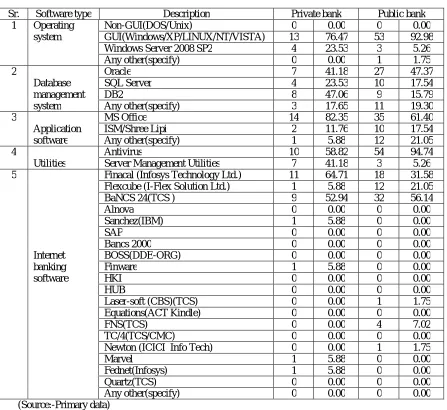
Table 3.11 To study software used in private as well as public banks.
Sr. Software type Description Private bank Public bank
1 Operating
system
Non-GUI(DOS/Unix) 0 0.00 0 0.00
GUI(Windows/XP/LINUX/NT/VISTA) 13 76.47 53 92.98
Windows Server 2008 SP2 4 23.53 3 5.26
Any other(specify) 0 0.00 1 1.75
2
Database management system
Oracle 7 41.18 27 47.37
SQL Server 4 23.53 10 17.54
DB2 8 47.06 9 15.79
Any other(specify) 3 17.65 11 19.30
3
Application software
MS Office 14 82.35 35 61.40
ISM/Shree Lipi 2 11.76 10 17.54
Any other(specify) 1 5.88 12 21.05
4
Utilities
Antivirus 10 58.82 54 94.74
Server Management Utilities 7 41.18 3 5.26
5
Internet banking software
Finacal (Infosys Technology Ltd.) 11 64.71 18 31.58
Flexcube (I-Flex Solution Ltd.) 1 5.88 12 21.05
BaNCS 24(TCS ) 9 52.94 32 56.14
Alnova 0 0.00 0 0.00
Sanchez(IBM) 1 5.88 0 0.00
SAP 0 0.00 0 0.00
Bancs 2000 0 0.00 0 0.00
BOSS(DDE-ORG) 0 0.00 0 0.00
Finware 1 5.88 0 0.00
HKI 0 0.00 0 0.00
HUB 0 0.00 0 0.00
Laser-soft (CBS)(TCS) 0 0.00 1 1.75
Equations(ACT Kindle) 0 0.00 0 0.00
FNS(TCS) 0 0.00 4 7.02
TC/4(TCS/CMC) 0 0.00 0 0.00
Newton (ICICI Info Tech) 0 0.00 1 1.75
Marvel 1 5.88 0 0.00
Fednet(Infosys) 1 5.88 0 0.00
Quartz(TCS) 0 0.00 0 0.00
Any other(specify) 0 0.00 0 0.00
(Source:-Primary data)
V. CONCLUSION
In recent years, IT implementation in banking will not only be appropriate approach of banking, but will be the ideal approach of banking. One of the primary objectives of this research was to know the status of IT implementation in private and public banks of Satara district. The Indian banking industry quickly adopts the technology development and provides automated banking services to the bank customer. According to available information it is realized that hundred percent of private sector banks and public sector banks provide adequate IT implementation, automated services to their client in Satara district. The bank had adequate hardware and software status for managing banking technology.
REFERENCES
1. Black, U., Asoke K. Ghosh "Computer Networks Protocols, Standards, and Interface", Prentice-Hall of IndiaPrivate limited, 1993.
2. Kumbhar, V. M., “An empirical study on alternative banking and Its impact on Customers Satisfaction: a case study of Public and Private Sector Banks in Satara City”, Shivaji University, Department of Economics, (25-Mar-2013).
3. Muneer Abbad, J. M.,” The Development of E-Banking in Developing Countries in the Middle East. Journal of Finance, Accounting and
Management, Vol. 3 (2), pp107-122,2012.
4. https://www.google.co.in
5. https://www.wikipedia.org
6. https://www.timesjobs.com.
7. www. slideshare.net.
BIOGRAPHY