Design and Analysis the Performance of Grid
Connected Three Phase Inverter
D.Satheesh Kumar1, R.Ganesamoorthy2
Assistant Professor, Department of ECE, Panimalar Engineering College, Poonamallee, Chennai, India1, 2
ABSTRACT: Recent days Inverters are play vital role in electrical field, when it is used in a many number of power applications. Normally the function of an inverter is to converts DC form of power into the form AC power; these are classified into two types: Voltage Source Inverters (VSI) and Current Source Inverter (CSI). This paper will talk about the designing of voltage source Inverter and monitoring the various parameters like THD, quality factor, power factor, efficiency and etc.,. There are many applications that require an inverter with three-phase power in industries like an ac-motor drive and uninterruptible power supplies. Most probably they are using three phase AC supplies but during the power failure environment inverter with alternative source like solar is act as a most feasible alternative for AC source. A capacitive full bridge circuit is used to provide instant current under nonlinear load conditions and thereby reducing the harmonics. A new proportional plus integral (PI) controller for inverter control is proposed to eliminate the dc current component, and steady state error under heavy load applications. The experimental result derived by using the MATLAB/SIMULINK software.
KEYWORDS: Power Factor, Converters, Inverter, PI Controller, Ripple Factor, Arduino2560 controller, Pulse Width Modulation (PWM), Total Harmonic Distortion (THD), Maximum Power Point Tracking(MPPT).
I.INTRODUCTION
Within the last decade, there have been major advancements in the field of power electronics. Power electronics have moved along with these developments with such things as digital signal processors are used to control the power systems. An Inverter is basically a converter that converts DC-AC power. Inverter circuits can be very complex so the objective of this paper is to present some of the inner workings of inverters without getting lost in some of the fine details. A voltage source inverter (VSI) is one that takes in a fixed voltage from a device, such as a dc power supply, and its converts to a variable-frequency AC supply. Voltage-source inverters are divided into three general categories: Pulse-width Modulated (PWM) Inverters, Square-wave Inverters, and Single-phase Inverters with Voltage Cancellation. Pulse-width modulation inverters take in a constant dc voltage. Diode-rectifiers are used to rectify the line voltage, and the inverter must control the magnitude and the frequency of the ac output voltages.
II.CLASSIFICATION OF POWER ELECTRONIC DEVICES
DEVICE HISTORY:
The earliest switches used to oscillate were mechanical vibrators. Essentially oscillating mechanical relays, these devices were not very efficient or reliable. It was not until the 1960s when semi-conductors were being discovered and the transistor started to make an appearance. Now the Silicon Controlled Rectifier was made that worked as electronic latching relays. Next the Darlington transistors were used. These last two devices did prove to be both reliable and somewhat efficient but still had disadvantages. When the Metal Oxide Semi-conducting Field Effect Transistor (MOSFET) came out, it solved a lot of problems. These devices can handle high currents and have a low resistance. They are easy to connect in a circuit and work well in parallel connections allowing for more current. Some inverters now use the newer IGBTs which are newer, high power, and low less switching transistors.
POWER DIODES:
These devices function identically to any other standard diode except that they are able to handle much more current. There are three main types of power diodes: general-purpose, high-speed (fast-recovery), and Schottky. Typical ranges for these devices are around 3000 V and 3500 A for general-purpose diodes and 3000 V and 1000 A for high-speed devices. High speed devices can switch on the order of a microsecond whereas a schottky diode is much fast and is in the nanosecond range. The schottky diodes, however, are limited to around 100 V and 300 A. The forward voltage drop over power diodes is usually negligible compared to the voltages that they are in. But the voltage drop is similar to normal diodes and is between 0.5 V and 1.2 V. [1]
THYRISTORS:
These devices are similar to power diodes except that they have an additional gate terminal that controls the time when the device begins conducting. Provided that the anode voltage is greater than the cathode voltage, a small gate current will allow the device to conduct. The forward voltage drop of a thyristor is between 0.5 V and 2 V. Once conduction is initiated the gate current has no further control. In order to stop conduction the device must be in reverse-biased; the anode voltage is less than the cathode voltage. These devices are rated up to 6000 V and 3500 A.
The turn-off time of these devices is the time it takes for the device current to go back to zero after putting the device in reverse-bias. The fastest turn-off times are around 10 microseconds. To achieve these turn-off time devices with lower power ratings must be used. Thyristor are further classified into the following groups: force-commutated and line-commutated thyristor, gate turn-off thyristor (GTOs), reverse-conducting thyristor (RCTs), static induction thyristor (SITs), gate-assisted turn-off thyristor (GATTs), light-activated silicon controlled rectifiers (LASCRs), and MOS controlled thyristor (MCTs). These devices are all basically a modification of the standard thyristor.
The inverter is basically two thyristor connected back to back to allow control both forwards and backwards. A TRIAC is basically a bidirectional thyristor. The gate turn-off thyristor (GTO), can be turned on by applying a short positive pulse to the gate, like a thyristor, and can also be turned off by applying a short negative pulse. GTOs are very convenient in that they do not need to have other circuits to control in order to be turned off. [1]
III.SWICHING OPERATION OF INVERTER
BASIC CONCEPTS OF INVERTER:
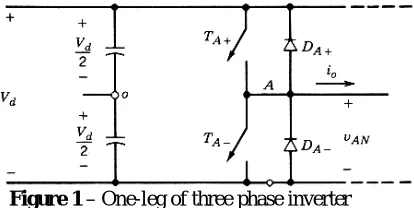
Figure 1 – One-leg of three phase inverter
must power the car, however, when the car is breaking it could be reversed, and used to generate power. The idea is that the motor has kinetic energy, since it would have already been spinning, it can then be slowed down and used as a generator. When this happens power would flow from the AC side to the DC side. This can then be dissipated through a resistor or fed back into the power grid to be used. In order to feed power back into the grid the converter that connects the drive to the utility grid must be a two-quadrant converter with reversible DC current. It must be able to operate as a rectifier when it is driving the motor and as an inverter when the motor is being used as a generator. [2]
IV.CLASSIFICATION OF INVERTER
PULSE-WIDTH MODULATED (PWM) INVERTER:
Inverters that use PWM switching techniques have a DC input voltage that is usually constant in magnitude. The inverters job is to take this input voltage and output ac where the magnitude and frequency can be controlled. There are many different ways that pulse-width modulation can be implemented to shape the output to be AC power. A common technique called sinusoidal-PWM will be explained. In order to output a sinusoidal waveform at a specific frequency a sinusoidal control signal at the specific frequency is compared with a triangular waveform (See Figure 2). The inverter then uses the frequency of the triangle wave as the switching frequency. This is usually kept constant.
The triangle waveform, vtri is at switching frequency fs; this frequency controls the speed at witch the inverter
switches are turned off and on. The control signal, vcontrol is used to modulate the switch duty ratio and has a
frequency f1. This is the fundamental frequency of the inverter voltage output. Since the output of the inverter is
affected by the switching frequency it will contain harmonics at the switching frequency. The duty cycle of the one of the inverter switches is called the amplitude modulation ratio, ma. [3]
EQUATION 1
m a V control
V tri where, Vcontrol is the peak amplitude of the control signal
ma - amplitude modulation ratio
EQUATION 2
m f f s
f 1 Where, mf - frequency-modulation ratio
EQUATION 3
vcontrol vtri Ta_pos is on, vA Vd
2
vcontrol vtri Ta_neg is on, vA Vd
2
In figure3 the switches Ta+ and Ta- are controlled based on the comparison of vcontrol and vtri (See equation 3).
The two switches are never off at the same time which results in the output voltage fluctuating between +/- Vd/2.
frequency and frequency-modulation ratio, mf, is usually considered to be better higher than lower. This is due to the
fact that it is easier to filter out the harmonics at higher frequencies. The major drawback with is switching losses in the inverter switches increase proportionally with the switching frequency fs. In many inverter applications the
switching frequency is taken to be either less than 6 kHz or greater than 20 kHz, which is out of the audible range. If for some reason the best switching frequency turns out to be between these two it is often outweighed with the advantages of having it over 20 kHz. Take for example an inverter that is going to operate around 60 Hz; the frequency-modulation ratio mf would likely be 9 or less. The relationship between the triangular-waveform signal and
the control voltage signal is determined by how big mf is. When mf is small it is thought of as synchronous PWM. The
value of mf should be an integer so that it stays proportional to the desired inverter frequency. When the control signal is not synchronous, sub harmonics will occur. This is usually not desired in most inverter applications. Take for example if the inverter output frequency was going to be 60 Hz and mf = 15, then the triangle-wave frequency should
be exactly 15 * 60 = 900 Hz. When mf is large (> 21) the amplitudes of sub harmonics due to asynchronous between
the triangular wave and the control signal are small. Therefore as long as mf is large the triangle-wave does not need to be proportional to the desired inverter frequency. This is called asynchronous PWM. [3]
PUSH-PULL INVERTERS:
Figure5 shows a push-pull inverter, it requires a Center-taped transformer. If we assume the output current flows continuously then the switch T1 is on and T2 is off. Now, T1 will conduct for a positive value of io, and D1 would
conduct for a negative value of io. This means that the direction of io does not matter then, the output voltage is simply
vo=Vd/n. In this equation n is the number of turns on the transformer between the primary-half and the secondary
winding. The other state of the inverter is when T2 is on and T1 is off, the output voltage is now the same as before except it is negative. A push-pull inverter can be operated in either the pulse width modulation switching scheme or the square-wave switching scheme. The outputs are the same as before shown in figure 5.
EQUATION 4
Vo maVdn ma
where <= to 1.0
Vd
n Vo
4
Vd n
where ma > 1.0
EQUATION 5
VT 2 Vd
IT io
The above equations 4 and 5 show the push-pull inverter, from figure 5, output voltage thyristor voltage and current of the inverter. One of the main advantages of the push-pull inverter is that it is more efficient for low-voltage input sources, such as a battery. The reason for this is that the voltage drop across more than one switch in series would result in a significant reduction in energy efficiency. Also, the control drives for the two switches have a common ground. It is hard to avoid the dc saturation of the transformer in a push-pull inverter. The output current from the secondary current of the transformer is slowly varying current at the fundamental output frequency. This is usually assumed to be a constant during a switching interval. When the transistors are switched the current shifts from one half to the other half of the primary winding.
THREE PHASE INVERTERS:
Many applications that require an inverter use three-phase power. Two main examples are an ac-motor drive and uninterruptible power supplies. One option for a “three-phase” inverter is to use three separate single phase inverters but vary their output by 120 degrees. This setup would require lots of hardware including 12 switches for the three inverters used.
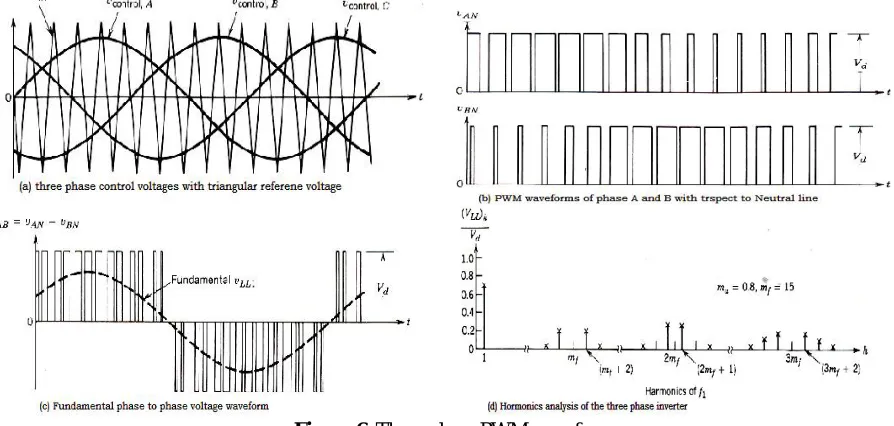
It is much more common to use a setup shown in Figure 6. This setup consists of three legs, one for each phase. Each leg is basically setup in the same way as the one-leg inverter described above. In three phase inverters pulse-width modulations is used in the same way as it is before except that it much be used with each of the three phases. When generating power to three different phases one must make sure that each phase is equal, meaning that it is balanced. To ensure this the same triangle voltage waveform is compared with three sinusoidal control voltages that are 120 degrees out of phase.
Figure 6. Three-phase PWM waveforms
The Harmonics in the output are only of concern in the line-to-line voltages. The harmonics in the output of any one of the legs are identical to the harmonics in Va. Only the odd harmonics exist as sidebands, centered on mf and
its multiples, provided, mf is odd. Only considering the harmonic of mf, the phase difference will be equivalent to zero if mf is odd and a multiple of 3. As a consequence, the harmonic at mf is suppressed in the line-to-line voltage vab.
The same argument applies in the suppression of harmonics at the odd multiples of mf, if mf is chosen to be an odd multiple of 3.
The three phase switch-mode inverter shown in figure 7. Therefore, some of the dominant harmonics in the One-leg inverter can be eliminated from the line-to-line voltage of a three-phase inverter. PWM considerations are summarized below: For low values of mf, to eliminate the even harmonics, a synchronized PWM should be used and mf
should be an odd integer. Moreover, mf should be a multiple of 3 to cancel out the most dominant harmonics in the line-line voltage. Moreover, the slopes of Vcontrol and Vtri should be of the opposite polarity at the coincident zero
crossings. During over modulation (ma > 1.0), regardless of the value of mf, the conditions pertinent to a small mf
should be observed. [1]
V.POWER QUALITY ANALYSIS
Power quality was a critical part of power system analysis. Power quality refers to the Total Harmonic Distortion (THD) as well as the presence of transients. To determine how inverters impact power quality, special monitoring equipment called the BMI Dual Node was used to measure the power quality on a sample system. The system used for measurement was a 20-KW photovoltaic array. It is a grid tied 3-phase system that uses two 10-KW inverters.
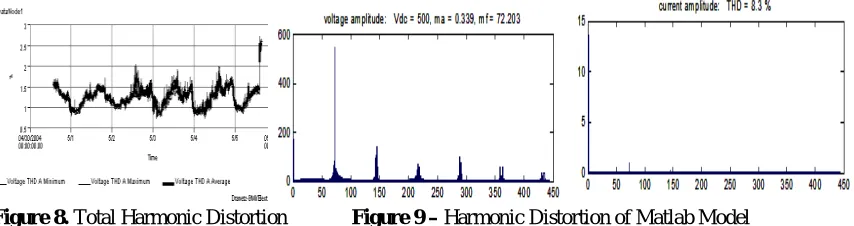
It was assumed that the operating state of the inverters is typical for the selected three day window in which it was observed. This was a reasonable assumption since variations in the system over time will be minimal. Another assumption which was made was that the inverters would not be producing power during the night. This was a reasonable assumption, since the photovoltaic modules are by definition energized by the presence of sunlight. The THD analysis graph is shown in figure 8.when we can see that during the daylight hours, harmonic distortion of the system did not go over 2.1 %, it should be noted that up to 5% THD is acceptable for IEEE power requirements. When the THD valves with respect to the time it can be varied, the varied THD values are between the 0.5 to 2.6% that indicates the red dots.
Analysis
The single phase voltage was measured for this test, since the current could not be attained without actually interrupting the building power supply. The voltage measurements were taken from a breaker located adjacent to the photovoltaic system electrical panel interconnection points. The following is a graph of what was observed during standard operation. The peaks were during the day when the photovoltaic system was active, and the valleys were during the night when the photovoltaic system was not operational.
The mat lab model of THD analysis graph is shown in figure 9. From this graph we can see that during the daylight hours, harmonic distortion of the system did not go over 2.1 %, it should be noted that up to 5% THD is acceptable for IEEE power requirements (this is currently up for revision, with potential that it will be raised to 9%). The spike near the end of this plot is due to the monitoring device being removed from the power circuit. This means that the photovoltaic system did not detrimentally impact the power quality of the Interpretive Centre over the observed time period. Continued monitoring of the building will be necessary to verify these results and validate the assumption that there will be little variation over time. It was also important to note that the power quality in terms of transients will not be adversely affected by the disconnection of transformers during non production hours (over night). This was because the inverters are not producing at the time of disconnection and they are not under load. In discussing this issue with power systems that the automated shutdown of the transformers during the night was a terrific idea and would not introduce any big transients or harmonics due to the size of the transformers relative to the grid size.
VI.SIMULATION RESULTS
Theoretical Analysis - MathCAD
These values can then be inserted into a model in matlab that calculates the harmonics.
mf = 72.2030; ma = 0.3390; vdc = 500; fo = 60;
nmax = 443.2180; r = 10; l = 0.0200; fc =4.3322e+003
w = 376.9911; I1rms =9.5901; power_total =926.0635;
Figure 8. Total Harmonic Distortion Figure 9 – Harmonic Distortion of Matlab Model
The inverter model here was done in simulink model is shown in figure10. It is a three-phase inverter that uses pulse-width modulation. The “three-phase” inverter is to use three separate single phase inverters but vary their output by 120 degrees deviations. This setup would require lots of hardware including 12 switches are used in the three phase inverters.
Figure10 Matlab / Simulink Model of Inverter
The following are graphs of the current for each phase .The figure 11 shown the respective output waveforms of the inverter on each phase. From the fig.11 when each output line voltages waveform are 120° phase shifted.
Figure11 three phase inverter output waveform Table 1. Ratings of inverter module Parameter Ratings
Inverter
Voltage Input 600 VDC Power Rating 2500 Watts Voltage Output 208/480 3-Phase
Photo-Voltaic module
Voltage Input 600 VDC Power Rating 10000 Watts Voltage Output 208/480 3-Phase
DC-DC converter
Voltage Input 48 VDC
VII.INVERTER SYSTEM DESIGN AND IMPLEMENTATION
The inverters were required to be grid connected and to provide some means of monitoring the production of the photovoltaic system in both kW-hr and peak kW for instrumentation purposes. The inverters were the part of the photovoltaic system that converted the electrical DC voltage from the photovoltaic modules, to AC voltage for use in the building and rest of the campus grid. The Balance of System components included AC/DC disconnects fuses, combiner boxes, and transformers. Since these were specific to the inverter which was selected, these are derivatives of the inverter selection. The inverters were required to be connected to the power system of the Interpretive Centre, and to provide power to offset the building load. The inverters and their isolation transformers must be installed on the outside of the building, to minimize the cooling load of the building. The electrical power must be brought into the building in 3-Phase 208 VAR configuration. These inverters must be directly connected to the building electrical distribution panel. All photovoltaic components must be grounded continuously and terminated to the building ground at the electrical distribution panel. These options contained the primary inverters that are used for grid-tied photovoltaic systems. It was for this reason that they were investigated. Historically photovoltaic systems have been utilized mainly in standalone applications; as a result there were many more inverters available for small scale off-grid applications.
VIII.CONCLUSION
In conclusion it can be stated, that the on-site source of power represented by the photovoltaic system will not detrimentally impact the building power quality. This was important since the building has a laboratory located in it, along with a number of computer workstations which could be adversely affected by significant voltage fluctuations. Inverters by their nature are going to produce harmonics that are not wanted. This must be considered when designing an inverter. A good inverter, as need above, that can be tied into a grid and used without producing unwanted transients and harmonics. Inverters are a practical device and are a useful piece of equipment for many different applications. Anyone who wants to run a laptop or other electronic device within a car or RV an inverter is required. Inverter types can be categorized by output waveform, switch type, switching technology and frequency. In order to go from a constant DC voltage to an AC the input DC voltage is put through an oscillating circuit which creates the output AC. The output of the inverter can be a square wave, or a sine wave.
REFERENCES
[1] N. M.Abdel-Rahimand J. E. Quaicoe, “Analysis and design of a multiple feedback loop control strategy for single-phase voltage-source UPS inverters,” IEEE Trans. Power Electron., vol. 11, no.4, pp. 532–541, Jul. 1996.
[2]Li wang and Ying-Hao Lin, “Dynamic Stability analysis of a photovoltaic array connected to a Large utility Grid”, IEEE 2000.
[3].K. S. Low, “A digital control technique for a single-phase PWM inverter,” IEEE Trans. Ind. Electron., vol. 45, no. 4, pp. 672–674, Aug.1998 [4]. R. I. Bojoi, L. R. Limongi, D. Roiu, and A.Tenconi, “Enhanced power quality control strategy for single-phase inverters in distributed generation systems,” IEEE Trans. Power Electron., vol. 26, no.3, pp. 798–806, Mar. 2011.
[5]. Nariain G. Hingorani, Laszlo Gyugyi. “Understanding Facts Concepts and Technology of Flexible AC Transmission Systems”. IEEE Press, Piscataway, NJ. 1995.
[6]. Ned Mohan, Tore M. Undeland, William P. Robbins “Power Electronics: Converters, Applications, and Design”. John Wiley & Sons, Inc., 1989.
[7]. Power Electronics by M.H.Rashid.
[8]. Power Electronics by Dr.P.S.Bimbhra, Kanna publishers, 4th Edition, 2010.