University of Windsor University of Windsor
Scholarship at UWindsor
Scholarship at UWindsor
Electronic Theses and Dissertations Theses, Dissertations, and Major Papers
10-19-2015
THREE DIMENSIONAL REAL-TIME GEOGRAPHICAL ROUTING
THREE DIMENSIONAL REAL-TIME GEOGRAPHICAL ROUTING
PROTOCOLS FOR WIRELESS SENSOR NETWORKS
PROTOCOLS FOR WIRELESS SENSOR NETWORKS
Sarab F. Majed Al Rubeaai
University of Windsor
Follow this and additional works at: https://scholar.uwindsor.ca/etd
Recommended Citation Recommended Citation
Al Rubeaai, Sarab F. Majed, "THREE DIMENSIONAL REAL-TIME GEOGRAPHICAL ROUTING PROTOCOLS FOR WIRELESS SENSOR NETWORKS" (2015). Electronic Theses and Dissertations. 5444.
https://scholar.uwindsor.ca/etd/5444
THREE DIMENSIONAL REAL-TIME GEOGRAPHICAL ROUTING
PROTOCOLS FOR WIRELESS SENSOR NETWORKS
by
Sarab Fadhel Majed Al Rubeaai
A Dissertation
Submitted to the Faculty of Graduate Studies
through the Department of Electrical and Computer Engineering
in Partial Fulfillment of the Requirements for
the Degree of Doctor of Philosophy at the
University of Windsor
Windsor, Ontario, Canada
2015
Three Dimensional Real-Time Geographical Routing Protocols For Wireless Sensor
Networks
by
Sarab Fadhel Majed Al Rubeaai
APPROVED BY:
Dr. Hongwei Zhang
Wayne State University
Dr. Boubakeur Boufama
School of Computer Science
Dr. Huapeng Wu
Department of Electrical and Computer Engineering
Dr. Esam Abdel-Raheem
Department of Electrical and Computer Engineering
Dr. Kemal E. Tepe, Advisor
Department of Electrical and Computer Engineering
DECLARATION OF CO-AUTHORSHIP / PREVIOUS
PUBLICATION
I. Co-Authorship Declaration
I hereby declare that this dissertation incorporates some materials part of which
are results of joint researches. The investigations and evaluations done
through-out this dissertation used some technologies that were developed in the WiCIP
research laboratory. The investigations were supported by collaborative help
from my colleagues in WiCIP LAB in the form of advice, critiques, and
men-toring. This dissertation also incorporates the outcome of joint research
under-taken in collaboration with Mehmmood A. Abd and Brajendra K. Singh, under
the supervision of Professor Dr. Kemal E. Tepe. In all cases, the main ideas,
primary contributions, experimental designs, data analysis and interpretation,
were performed by the author, and the contribution of co-authors was primarily
through the provision of suggestions, comments, critiques, verification and other
supports. I am aware of the University of Windsor Senate Policy on
Author-ship and I certify that I have properly acknowledged the contribution of other
researchers to my dissertation, and have obtained written permission from each
II. Declaration of Previous Publication
This dissertation includes three original papers that have been previously
pub-lished/submitted for publication in peer reviewed journals, as follows:
Dissertation chapter Publication title/full citation Status
Part of Chapter 3 and 5 Sarab F. Al Rubeaai, Brajendra K.
Singh, Mehmmood A. Abd, Kemal E.
Tepe, ”Adaptive Packet Forwarding
Re-gion Based Three Dimensional Real-Time
Geographical Routing Protocol (3DRTGP)
for Wireless Sensor Networks,
Proceed-ing of IEEE Wireless Communication and
Network Conference (WCNC), Istanbul,
Turkey, 2014.,
Published
Part of Chapter 4 Sarab F. Majed Rubeaai, Brajendra K.
Singh, Mehmmood A. Abd, Tepe, Kemal
E., ”Region based three dimensional
real-time routing protocol for wireless sensor
networks”, Proceeding of IEEE Sensors,
vol., no., pp.1,4, 3-6 Nov. 2013.
Published
Part of Chapter 3 and 5 Sarab F. Al Rubeaai, Mehmmood A.
Abd, Brajendra K. Singh, Kemal E. Tepe,
”3D Real-Time Routing Protocol with
Tunable Parameters for Wireless Sensor
Networks.”, IEEE Sensors journal.
Submitted
I certify that I have obtained a written permission from the copyright owner(s) to
include the above published material(s) in my dissertation. I certify that the above
University of Windsor.
I declare that, to the best of my knowledge, my dissertation does not infringe
upon anyone’s copyright nor violate any proprietary rights and that any ideas,
tech-niques, quotations, or any other material from the work of other people included in
my dissertation, published or otherwise, are fully acknowledged in accordance with
the standard referencing practices. Furthermore, to the extent that I have included
copyrighted material that surpasses the bounds of fair dealing within the meaning of
the Canada Copyright Act, I certify that I have obtained a written permission from
the copyright owner(s) to include such material(s) in my dissertation. I declare that
this is a true copy of my dissertation, including any final revisions, as approved by
my dissertation committee and the Graduate Studies office, and that this dissertation
ABSTRACT
One of the most important concerns in the operation of Wireless Sensor Network
(WSN) is the real-time data delivery. This dissertation addresses the problem of
real-time data delivery and void node problem in three dimensional WSN, which has
a significant impact on the network performance. In order to provide an accurate
route calculation for reliable data delivery the third coordinate of the location sensor
nodes is considered in this dissertation. Additionally, two different heuristic solutions
for void node problem in three dimensional space have been provided to elevate the
effect of long route and spares regions on assurance of real-time data delivery.
In order to provide a wide applicable soft real-time routing protocol two
decentral-ized geographical routings are proposed: Three Dimensional Real-Time Geographical
Routing Protocol (3DRTGP) and Energy-Aware Real-Time Routing Protocol for
Wireless Sensor Networks (EART). 3DRTGP and EART are designed to fit with
WSNs that are deployed in 3D space. Both protocols benefit from utilizing the third
coordinate of nodes’ locations to achieve less packet end to end (E2E) delay and
packet miss ratio.In 3DRTGP, void node problem in 3D space was solved based on
adaptive packet forwarding (PFR) region. 3D-VNP solution solely was done locally
and without any messaging overhead. In EART, 3D-VNP was solved based on an
A network tunning parameters guide is presented to make the proposed protocols
applicable and fit with a large number of networks in terms of network deployment
and size. The effect of location errors on the network performance is also investigated.
The protocols are evaluated analytically and experimentally under realistic simulation
environment and the results show that combining real-time and solving 3D-VNP
solution can enhance WSN performance. Moreover, considering nodes’ energy in
EART cooperated in extending the network lifetime. The results demonstrate that
3DRTGP enhanced the packet E2E delay by 40% to 90% and decreased the packet
miss ratio by 5% to 60% in comparison with other competing geographical routing
protocols (GRPs). The results also showed that EART extended the network lifetime
DEDICATION
to my
MOTHER, FATHER, and CHILDREN
ACKNOWLEDGEMENTS
I would like to thank my advisor Dr. Kemal E. Tepe for introducing me to the research
area of wireless sensor networks, for his help and support during all phases of this
dissertation and mainly for the many fruitful discussions, which always inspired and
motivated me. I appreciate the time and effort he dedicated to me and my work
despite he has many other students who also need his support. He became a good
friend and I hope this relationship will last after the end of this study period too.
I had many helpful and interesting discussions with all the other research groups at
WiCiP LAB and their advice and enlightening discussions have helped me greatly,
too. However, I am the mostly grateful for my husband Mehmmood A. Abd, for
supporting me at all times and always encouraging to never give up, even through
TABLE OF CONTENTS
Page
Declaration of Co-Authorship / Previous Publication . . . iii
Abstract . . . vi
Dedication . . . viii
Acknowledgements . . . ix
List of Tables . . . xiv
List of Figures . . . xv
List of Abbreviations . . . xvii
1 INTRODUCTION . . . 1
1.1 Introduction . . . 1
1.1.1 Applications of wireless sensor networks (WSNs) . . . 2
1.1.2 Challenges in Wireless Sensor Network (WSNs) . . . 3
1.2 Problem Statement . . . 6
1.3 Contributions . . . 8
1.4 Research Methodology . . . 10
1.5 Dissertation Organization . . . 11
2 BACKGROUND AND LITERATURE REVIEW . . . 12
2.2 Wireless Sensor Network Routing Metrics . . . 13
2.3 Routing Protocol Categorizes . . . 14
2.3.1 Geographical routing protocol: . . . 14
2.3.2 Topological routing protocol: . . . 15
2.4 Void Node Problem . . . 16
2.5 Real-time Routing Protocols . . . 16
2.5.1 Hard real-time routing protocols . . . 16
2.5.2 Soft real-time routing protocols . . . 17
2.6 Energy Aware Real-time Protocols . . . 17
2.7 Related Work . . . 18
2.7.1 Review of Real-Time Protocols . . . 18
2.7.2 Review of Energy Aware Real-Time Protocols . . . 19
2.8 Summary . . . 21
3 THREE DIMENSIONAL REAL-TIME GEOGRAPHICAL ROUT-ING PROTOCOL (3DRTGP) . . . 22
3.1 Introduction . . . 22
3.2 3DRTGP PROTOCOL DESIGN . . . 24
3.2.1 Location Management . . . 29
3.2.2 Forwarding probabilistic mechanism . . . 30
3.2.3 VNP Handling . . . 32
3.2.4 Flooding Reduction . . . 36
3.3 RESULTS AND DISCUSSION . . . 36
3.3.1 E2E packet delay performance . . . 37
3.3.2 E2E packet delay with traffic load . . . 39
3.3.3 Packet miss ratio with traffic load . . . 40
3.3.4 Energy per packet with traffic load . . . 42
4 ENERGY-AWARE REAL-TIME ROUTING PROTOCOL FOR
WIRELESS SENSOR NETWORKS . . . 43
4.1 Introduction . . . 43
4.2 PROTOCOL DESIGN . . . 45
4.2.1 Spherical forwarding wedge mechanism . . . 46
4.2.2 Forwarding probabilistic mechanism . . . 47
4.2.3 Void node problem detection and solution . . . 49
4.3 RESULTS AND DISCUSSION . . . 50
4.3.1 Average energy consumption per packet . . . 51
4.3.2 Network lifetime . . . 52
4.3.3 Packet miss ratio performance . . . 54
4.3.4 Packet E2E delay performance . . . 55
4.4 Conclusion . . . 56
5 PROTOCOL EVALUATION AND ANALYSIS . . . 57
5.1 Introduction . . . 57
5.2 Tuning deadlines and network density . . . 58
5.2.1 Tuning deadlines with miss ratio . . . 58
5.2.2 Tuning network density with miss ratio . . . 59
5.3 Analysis of PFR size effect . . . 61
5.3.1 Effects of PFR on E2E delay . . . 61
5.3.2 Effects of PFR on miss ratio . . . 63
5.4 Effect of VNP on 3DRTGP performance . . . 64
5.5 Three dimensional routing necessity . . . 66
5.5.1 Discarding third coordinate impact on miss ratio . . . 69
5.5.2 Discarding third coordinate impact on E2E delay . . . 70
5.5.3 Terrain dimensions effect on network performance . . . 71
5.6 Summary . . . 71
6.1 Contributions . . . 73
6.2 Future Work . . . 74
References . . . 75
Appendix A . . . 86
LIST OF TABLES
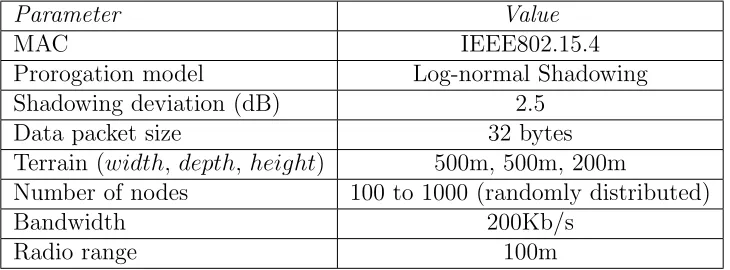
3.1 SIMULATION PARAMETERS . . . 37
LIST OF FIGURES
3.1 Functional diagram of 3DRTGP. . . 24
3.2 3DRTGP process flowchart: Receiver node operation. . . 27
3.3 3DRTGP process flowchart: Sender node operation. . . 28
3.4 PFR with and without nodes. . . 33
3.5 Probability of VNP: analytical and experimental calculated based on 3.1. . . 34
3.6 Illustration of VNP in 2D. . . 35
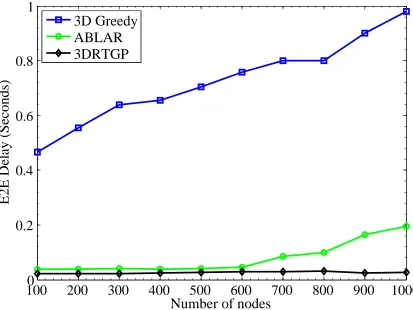
3.7 E2E packet delay versus number of nodes. . . 38
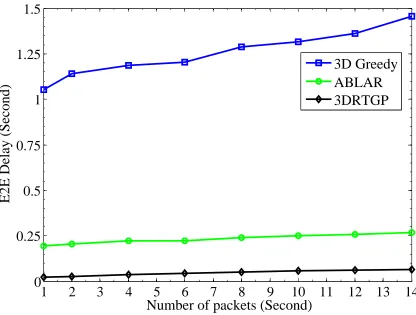
3.8 E2E packet delay versus traffic load. . . 39
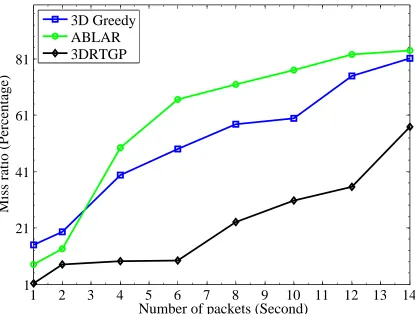
3.9 Packet miss ratio versus traffic load. . . 40
3.10 Energy consumption per packet versus traffic load. . . 41
4.1 2D projection of SFW,α, and, φ. . . 45
4.2 3D shaded SFW with VNP. . . 49
4.3 2D projection of VNP solution in 3D WSNs. . . 50
4.4 Energy consumption per packet versus packet generation rates. . . 52
4.5 The effect of traffic load on the network lifetime. . . 53
4.7 The effect of traffic load on E2E delay. . . 55
5.1 Tuning: Packet miss ratio versus packet deadlines. . . 59
5.2 Tuning: Packet miss ratio versus deadlines with different densities. . . 60
5.3 Tuning: Effect of PFR on packet E2E delay . . . 61
5.4 Tuning: Effect of PFR on packet miss ratio. . . 62
5.5 Tuning: Normalized void region size versus E2E delay . . . 63
5.6 Tuning: Normalized void region size versus β. . . 64
5.7 2D-RGRP forwarding mechanism. . . 67
5.8 3D-RGRP forwarding mechanism. . . 68
5.9 Packet miss ratio in 3D-RGRP versus 2D-RGRP protocols. . . 69
5.10 Packet E2E delay in 3D-RGRP versus 2D-RGRP protocols. . . 70
LIST OF ABBREVIATIONS
2D Two dimensions. 3D Three dimensions.
2D−RGRP Two dimensional region based geographical routing protocol. 3D−RGRP Three dimensional region based geographical routing protocol.
S Sender sensor node.
β Initial angle of conical forwarding region.
η Number of sensor nodes in wireless sensor network (WSN).
ηs Number of a sensor node in spherical transmission range.
ηs Number of neighboring nodes in a node’s transmission range.
γ Forwarding probability parameter.
λs Number of the sensor nodes in the spherical transmission range
of any node.
k−SD→k Euclidean vector norm of −→SD. k−SN→k Euclidean vector norm of −→SN. k−SO→k Euclidean vector norm of −→SO. −→
SA Vector from sender S to the node A
−→
SD Vector from sender node S to the destination node D. −→
SN Vector from sender node node S to any node N. −→
SO Vector from sender nodeS to the polar of the transmission range
O.
φ Angle of packet forwarding wedge.
τav Average velocity in node’s neighborhood.
τh the time required in each hop.
´
τh Estimated required time in every hop.
τpr Processing time of the packet in the forwarding node.
τreq Required time for a packet to reach the destination.
τp Packet propagation time.
τq Queuing delay in a node.
τt Required time to transmit a packet.
θ Angle between any two vectors.
τi
s The hop delay for ith packet.
D Destination sensor node.
(Dx, Dy, Dz) Location coordinates of destination sensor node D.
Eav Average energy in node’s neighboring nodes in Joules.
Erx Receiving energy cost in Joule.
Etx Transmission energy cost in Joule.
E0 Initial energy of a node in Joules.
En Energy in potential forwarding node in Joules.
Es Expected energy in the node’s neighborhood in Joules.
h Expected number of hops.
N Sensor node N.
(Nx, Ny, Nz) Location coordinates of a node n.
O Polar point of a node’s transmission sphere.
Pτ Delay metric of forwarding probability.
PE Energy metric of forwarding probability.
p Forwarding probability.
q Forwarding probability in EART.
r Spherical radius of transmission range. (Sx, Sy, Sz) Location coordinates of a sender node S.
V Volume of the deployment terrain.
VP F R Volume of the packet forwarding region (PFR).
Vs Volume of spherical transmission region around the sender node.
2D-VNP Void node problem in two dimensional space.
3DRTGP Three dimensional real-time geographical routing protocol.
3D-VNP Void node problem in three dimensional space.
GPS Global positioning system.
GRP Geographical routing protocol.
J Joule.
m Meter.
MANET Mobile ad hoc networks.
PFN Potential forwarding node.
PFR Packet forwarding region.
QoS Quality of service.
RTT Round trip time.
SFW Spherical forwarding wedge (SWF).
SFW Spherical forwarding wedge.
VNP Void node problem.
WSN Wireless sensor network. (−SN→•−SD)→ Dot product of −SN and→ −SD.→
τw Time duration before retransmissions.
CHAPTER
1INTRODUCTION
1.1
Introduction
The impressive development of micro-sensor technology has enabled small and smart
devices to provide new application opportunities with low power and low cost
hard-ware. These smart devices are called sensor nodes which are equipped with different
kinds of sensing, processing, storage, power source and wireless communication units.
Many physical phenomena can be observed and monitored by deploying a large
num-ber of sensor nodes. These sensors can network wirelessely and collect data
coopera-tively about a physical environment and then route it to the base station (BS). BS is
a more powerful node that has more processing, storage capacity, power source and
acts as a gateway between sensor network and a special computer server. This group
of connected sensor nodes is called wireless sensor network (WSN).
WSNs can be employed by many applications which require hundreds or even
thousands of sensor nodes in remote and inaccessible areas. Current and future
ap-plications of WSNs entail real-time data gathering and delivery such as in smart grid
monitoring, disaster control and operation, military applications, object tracking,
environment monitoring, health care, home automation, industrial monitoring and
Routing data from the nodes to BS, in WSNs, is a challenging task due to
infrastructure-less communications and frequent topology changes. The main
weak-nesses of the WSNs are the limitations associated with storage capacity, bandwidth,
communication range and power resources. This chapter discusses examples of some
of WSN applications, challenges in WSNs, problem statement, and contributions of
this dissertation.
1.1.1
Applications of wireless sensor networks (WSNs)
WSNs applications can vary from simple surveillance to very sophisticated
applica-tions. Some examples of sensor network applications are:
1. Ocean monitoring applications: These applications are mainly utilized to
col-lect oceanographic data and monitor the creatures that live in the sea [1,2]. These
types of applications enable scientists to take urgent action to deal with disasters
such as the eruption of pollution as well as protect and study the habitats of sea
animals.
2. Industrial process monitoring and control applications: These applications
need to make an accurate and instant decision. Therefore each sensor node must
have the ability of sensing and evaluating the usefulness of acquired information
and send it to the control units. Then the control units take an action accordingly
for operation and management. The primary properties of these applications are
the high sensitivity of gathered data and unpredictable event occurrences which
correlate with time and place. Sensing and monitoring nuclear reactors [3],
traf-fic control [4], disaster relief applications [5], intrusion detection applications [6]
and mining [7] are some examples of such time sensitive industrial monitoring
3. Health monitoring applications: Monitoring patients with serious diseases
such as heart disease, Parkinson’s disease, and patient rehabilitating from strokes
or heart attacks entail constant monitoring and urgent care. Therefore, these types
of applications must be designed to alert nurses and doctors to provide in time
care. The artificial retina [8], and Parkinson’s disease [9] are two examples of WSN
applications can be used in the health care system.
4. Smart grid applications: Smart grid applications provide reliable, effective,
robust, and safe energy services by integrating communication and information
technologies together. Hence, WSNs are utilized by many utility companies in
their wireless and automatic control system to collect information about energy
usage, which enable engineering staffs to understand the changes in demand and to
act accordingly. Additionally, the engineering staffs use the collected information
to rapidly isolate faults, restore power, maintain stability in power delivery and
many other functions [10–12].
A brief discussion of WSN challenges will be presented in the following subsections.
1.1.2
Challenges in Wireless Sensor Network (WSNs)
WSN consists of very small sensor nodes with limited resources. These limited
re-sources raise new challenges to design routing protocols for WSNs which differ from
other regular routing protocols designed for other wireless communication systems.
Some of these challenges are:
1. Energy restriction: Because operating wireless sensors depends on limited power
resources such as batteries and capacitors, these have direct impact on the network
lifetime. Therefore, balancing energy consumption is an important challenge and
must be considered in designing a reliable routing protocol to extend the network
2. Node deployment: The deployment of sensor nodes is a fundamental issue that
must be considered in order to achieve the required objective of the network. A
proper node deployment can reduce the complexity of problems in WSNs, such as
routing calculation and extending the lifetime of the sensor nodes [14]. Therefore,
one important issue, in network deployment, is considering the third coordinate of
sensor locations. Which can significantly enhance the routing accuracy and reduce
the redundant transmission by limiting the participated node in forwarding [15–18].
3. Mobility: Usually wireless sensors are non stationary and the changes in their
locations lead to frequent update in network topology. The frequent changes could
cause problems such as route failure, high packet collision rate, and increased
energy consumption. This change dramatically affects on the network performance
and shorten its lifetime. Hence, network mobility must be considered in the routing
protocol design [19, 20].
4. Scalability: Because a WSN consists of hundreds or even thousands of sensor
nodes, the number of messages that must be routed to BS is very large. For this
reason, any routing protocol must be designed to adapt to any changes in density
and size of the network. Geographical routing is one of best options to design
decentralized algorithms, which can satisfy the scalability requirements [15, 21].
5. Fault tolerance: WSNs are inherently subject to failure because of their low cost
components and limitation of their energy supplies. That is why, a failure of one
or set of sensor nodes should not affect the functionality or performance of the
network. For this reason, a network must accommodate any failure and set a new
reliable route to BS. In such case, sensor nodes must have the ability to find other
routes with better resources and available energy [22, 23].
6. Quality of services (QoS): WSNs require various levels of quality of services
resources such as processing ability, memory, bandwidth, and power resources in
each sensor node, QoS is a challenging task in WSNs [24]. For example, smart
gird application entails minimum E2E delay to ensure fast responses from the
cor-responding authority. In contrast, ocean monitoring applications require accurate
data and better energy usage to reduce the cost of maintenance and prolong the
network lifetime [25–28].
7. Security: In wireless communication, routing traffic in the network make its
subject to the security threats. For instance, shared wireless medium is vulnerable
to the denial of service attacks. For this reason, WSNs requires special security
solutions that work with their wireless communication and limited resources [29,
30].
8. Real-time data delivery: Delivering data in real-time has become essential for
wireless sensor networks (WSNs) due to emerging time sensitive applications such
as in smart grid, industrial control and process automation [28, 31–33].The
ad-vances in WSNs have led to a rapid development in time sensitive applications
such as in smart grid [13], industrial control and process automation [34].
There-fore, designing a routing protocol that can satisfy the requirements of real-time
operation is an important task.
The main objective of this dissertation is to design a real-time geographical routing
protocols for WSNs deployed in three dimensional space. This dissertation provides
real-time routing protocol to enhance the real-time data delivery. This objective
is achieved by employing a decentralized, scalable and soft real-time geographical
routing protocol (GRP) called 3DRTGRP and energy aware 3D geographical routing
called (EART). Both routing protocols are designed to fit with networks that are
1.2
Problem Statement
This dissertation provides solution to the problems related with three dimensional
(3D) geographical routing protocols (GRPs) to achieve soft real-time routing
proto-cols. These problems are discussed hereunder:
Problem 1. Real-time requirement: Real-time applications require the packets to
be delivered in real-time with maximal reliability and minimal overhead. Thus,
it is important to design a 3D soft real-time geographical routing protocol that
can satisfy the time sensitive requirements.
Problem 2. 3D network deployment: In real-life applications of WSNs, sensor nodes
are deployed in a three dimensional (3D) space such as applications in ocean
monitoring [16], forest fire sensing [24], mining [7] and unmanned aerial vehicle
(UAV) networks [17]. However, the majority of GRPs consider two-dimensional
(2D) coordinate system. Even if two dimensional GRPs can function in
net-work deployed in 3D space, they do not utilize full potential of the netnet-work.
For instance, in a dense network, there will be more packet forwarding than
necessary, which causes packet collisions, congestions and premature energy
depletions. Therefore, it is important to utilize three dimensional location
in-formation, in GRPs, for accurate operation, enhancing real-time data delivery,
and increasing network lifetime.
Problem 3. Void node problem in 3D WSNs: Another problem that is associated
with GRPs is the void node problem (VNP), where there is no forwarding node
in the direction of the destination that can serve as a forwarder. This problem
has been effectively solved in 2D GRPs using planar or face routing techniques,
however, these techniques cannot be effectively applied to 3D GRPs. Therefore,
routing protocols and avoiding the void region require further investigation in
Problem 4. Redundant transmission problem in GRPs: GRPs usually depend on
one of the following techniques to forward the traffic from source/relay nodes
to the destination:
I. Region based forwarding (RBF): In this technique, a geographical routing
relies on forwarding a packet to a set of nodes that is located in the same
region. This causes more packet forwarding than necessary, which leads
to packet collisions, congestions and missed deadlines, eventually causing
the protocols to not meet the real-time requirements. For this reason,
GRPs must have the ability to detect the congested region and dynamically
change the forwarding region to avoid packet loss.
II. Greedy forwarding technique (GFT): In this technique packets are
for-warded from source to destination along the shortest straight path between
source and destination nodes. The nodes that are located on this path will
be overused and depleted of their energy which causes traffic congestion
and generates VNP. Both congestion and VNP lead to delay in packet
delivery and most of them miss their required deadlines. For this reason,
it is important to make a routing protocol with the property of congestion
detection to avoid packet delay and VNP generation.
Problem 5. Node’s energy: Discarding the energy of the nodes in the forwarding
decision may result in selecting nodes with low available energy which causes
a rapid network partitioning. Therefore, an energy aware property must be
integrated in the forwarding decision to enhance the protocol’s reliability and
efficiency.
In this dissertation, the proposed protocols are designed on the basis of GRPs
because the low network overhead. Because they do not rely on pre route
discovery and do not require route maintenance. Additionally, GRPs can be
accelerates the routing decision. These positive characteristics of GRPs make
them promising candidates for designing soft real-time routing protocols for 3D
WSNs.
In this dissertation, two novel distributed soft real-time GRPs are proposed:
A. Three dimensional real-time geographical routing protocol (3DRTGP): This
protocol is designed to achieve real-time data delivery in WSN deployed in
3D space.
B. Energy aware three dimensional real-time geographical routing protocol
(EART): This protocol is an enhanced version of 3DRTGP designed to
achieve soft real-time data delivery with energy aware property in WSN
deployed in 3D space.
The protocols operations were verified through a set of extensive simulation
experiments and analytical evaluations which confirmed their validity.
1.3
Contributions
The main contributions of this dissertation are stated hereunder:
1. A novel soft real-time geographical routing is proposed and evaluated
ana-lytically and through vigorous simulation, which is called:Three dimensional
real-time geographical routing protocol (3DRTGP). This protocol was
de-signed to decrease redundant transmission based on reducing the number
of forwarding nodes in a conical forwarding region. This conical forwarding
region was chosen based on the network density. Then, one forwarding node
will be selected based on its queuing, processing delay and expected
other competing GRPs in term of packet end-to-end (E2E) delay and packet
delivery ratio.
2. 3DRTGP was extended to energy aware real-time geographical routing
proto-col which is called (EART). EART considers the energy of node in forwarding
decision to provide more reliable data delivery and increase network lifetime.
The network lifetime, packet delivery ratio, and average energy consumption
per packet were further improved by incorporating node energy in
forward-ing metric. The results showed that 3DRTGP has successfully met the soft
real-time requirements.
3. Both 3DRTGP and EART protocols heuristically solved VNP in 3D
de-ployments (3D-VNP) without explicit or implicit exchange of neighboring
information. This solution significantly reduces the network overhead, which
in turn enable the protocols to meet the real-time requirement. 3D-VNP
solution was extensively and successfully evaluated through a set of
exper-iments under different network conditions and deployments, which clearly
showed that 3D-VNP was completely solved. It is demonstrated that the
3DRTGP resolved VNP given that there is no network partitioning.
4. Tuning techniques for 3DRTGP is provided to make the protocol meet the
delay and the miss ratio requirements of applications. For example, a low
miss ratio requirement of an application can be met by adjusting network
density. Functionality of the proposed tuning technique was verified through
extensive simulation studies and network performance was evaluated against
the competing protocols.
In summary, the routing protocol frameworks designed in this dissertation not
only support the WSNs real-time quality of services requirements, but also
reduce energy consumption in sensor nodes and provide high reliability (delivery
1.4
Research Methodology
The problems that are discussed in 1.2 are deeply investigated and solved
throughout this dissertation. In this dissertation, WSNs conditions,
deploy-ment and routing protocols that are commonly used in WSNs were studied and
it is found that designing a decentralized routing protocol can enhance the
real-time data delivery and extend the network lifereal-time. Moreover, investigating
the network deployment in real-life shows that discarding third coordinates of
sensor locations has significant impact on the protocol performance in terms of
data delivery, energy consumption and packet miss ratio. The heuristic solution
for 3D-VNP was proven through extensive experiments. This heuristic solution
allows the proposed protocol to have a reliable operation in the event of having
void regions.
The objectives of the research have achieved throughout the following steps:
Step I. In this phase, the effect of discarding third coordinates of sensor nodes
on the routing performance have been investigated. 3DRTGP algorithm
is implemented and tested in OMNeT++, and its reliability was proven.
Step II. In this phase, the protocol in Step I was enhanced by solving VNP in
3D network deployment. The new version of this enhanced protocol was
investigated in OMNeT++ to prove its reliability.
Step III. In this phase, 3DRTGP was evaluated based on analytical analysis
and compared with other two state-of-art three dimensional geographical
routing protocols: ABLAR [36] and 3D-Greedy. This routing protocol was
designed to adapt with WSNs deployed in 3D space and is applicable to
any network topology with different network conditions.
Step IV. In this step, 3DRTGP was further enhanced and the energy in sensor
pro-tocol is called: Energy aware three dimensional real-time routing propro-tocol
(EART). EART’s reliability and efficiency was investigated in OMNeT++
and evaluated by comparing the network lifetime and the packet delivery
ratio against 3DRTGP.
1.5
Dissertation Organization
A background and literature review is given in Chapter 2. Chapter 3 identifies
the solution for data propagation protocol and presents the results of three
di-mensional real time geographical routing protocol for wireless sensor network
(3DRTGP). Chapter 4 describes the design of Energy aware three dimensional
real-time routing protocol (EART). The evaluation details of the proposed
pro-tocols are presented in Chapter 5. In Chapter 6, the conclusions of the proposed
research in this dissertation is summarized and some recommendations for
CHAPTER
2BACKGROUND AND LITERATURE REVIEW
2.1
Introduction
The primary objective of routing protocols is to discover available routes from
any given sensor node to the destination through multi-hops or single hops
and to make routing decisions. The task of routing establishment is the main
responsibility of the network layer in the hierarchy of the communication
pro-tocol stack. WSNs usually are infrastructureless and are comprised of a large
number of sensors which produce a very large amount of data. Hence, a
multi-hop routing approach is necessary for a WSN to permit channel utilization in
various regions of the network and overcome the effects of long distance
commu-nication [37]. Moreover, wireless sensors are usually deployed randomly, which
makes the network topology unpredictable. Therefore, sensor nodes must have
the ability to coordinate and learn their location as well as neighboring node
locations. Additionally, routing protocols must be designed with the properties
that adapt to topological changes and fits with the limited resources of WSN.
In WSNs, the collected data about a phenomena must be delivered at the right
real-time data delivery properties is important. Routing reliability has a significant
influence on packet E2E delay, packet delivery ratio, energy consumption per
packet and network lifetime. This chapter presents the WSN routing
proto-cols metrics, routing protocol categories, void node problem (VNP), real-time
routing protocols, and related work.
2.2
Wireless Sensor Network Routing Metrics
The efficiency of WSNs routing protocols is usually measured using a set of
evaluation metrics. These metrics are used to ensure that the evaluated protocol
can efficiently cope with the limited resources of sensor nodes. This section
presents an overview of some metrics related to this study:
A. End-to-End Delay: E2E delay is the total delay for each packet from the
source to reach the destination. The concept of E2E delay metric is to
eval-uate the protocol efficiency in term of meeting the real-time requirements.
The primary goal of this metric is to evaluate the performance of routing
protocol under time restriction requirements [36, 38].
B. Packet miss ratio: Packet miss ratio is defined as the ratio between the
number of packets that do not meet their deadlines to the total number
of transmitted packets [39, 40]. This metric is mainly used to evaluate the
network performance and protocols reliability in time sensitive applications.
C. Average energy consumption per packet: The term energy
consump-tion per packet refers to the total energy consumed in each sensor node
for each packet successfully delivered to the destination node [35, 41]. For
better energy usage in WSN the average consumption per packet must be
minimized. This metric is essential in the assessment of protocol efficiency
D. Network lifetime: Network lifetime metric is an essential metric in
evalu-ating the reliability of the protocol in terms of energy usage in the network
and extending its lifetime. It is defined as the time of the network before
any sensor node runs out of energy or becomes inoperative [42, 43].
2.3
Routing Protocol Categorizes
In literature, a large number of routing protocols have been proposed to solve
multi-hop routing problem [44]. Some of the most common routing protocols
in-clude: geographical routing protocols (GRPs) and topological routing protocols
(TRPs).
2.3.1
Geographical routing protocol:
GRPs rely on the location information to propagate the data from a given
sensor node to the BS or sink. GRPs have gained popularity in WSNs because
of their low overhead, low operation complexity, and smaller E2E delay than
TRPs. GRPs do not require route maintenance and discovery schemes like
TRPs; therefore they can handle dynamic changes in the network much better
than TRPs. The main weakness of GRPs is their dependence on the location
information. However, this deficiency can be resolved using location services
such as Global Positioning Systems (GPS), radio ranging [45, 46], and other
localization techniques [18, 47]. In general, GRPs can be classified into two
dimensional GRPs (2D-GRPs) and three dimensional GRPs (3D-GRPs):
A. Two dimensional geographical routing: In 2D-GRPs, the sensor nodes
are assumed to be deployed on flat surface. That means the third coordinate
projected on a surface [44, 48]. This assumption is justified for applications
where sensor nodes are deployed on ground or where the hight of the network
is smaller than the transmission range of sensors [14, 15].
B. Three dimensional geographical routing: In real-life applications of
WSNs, sensor nodes are deployed in a three dimensional (3D) space such as,
application in ocean monitoring [16, 49], forest fire sensing [24], mining [7]
and unmanned aerial vehicle (UAV) networks [17,50]. For such applications,
GRPs must utilize three dimensional location information for accurate
oper-ation. Even if two dimensional GRPs can function in 3D space, they do not
utilize the full potential of the network. For instance, in a dense network,
there will be more packet forwarding than necessary, which causes packet
collisions, congestions and premature energy depletions. Experimental
re-sults presented in [51–53] demonstrate that excluding the third dimension
from GRPs can significantly reduce reliability of the protocols.
2.3.2
Topological routing protocol:
TRPs count on routing table construction in every sensor node. Routing table
contains all possible routes from any given node to the BS. Constructing such
routing tables entail a large amount of exchanging beaconing messages, which
incur WSN more energy and time delay. Exchanging messages dramatically
affects the network performance and causes congestion and collision. For this
reason, topological routings are not scalable to the frequent changes in network.
For this reason, topological routing approach can not be acceptable solution for
2.4
Void Node Problem
Void node problem (VNP) occurs where there is no forwarding node in the
direction of the destination. VNP can be observed due to reasons such as sparse
network, node failure or region congestion [15, 54]. VNP has a significant effect
on decreasing packet delivery ratio. This is either because packets are dropped
or take long detour and miss their deadlines before they reach to the destination.
This problem has been effectively solved in 2D GRPs by using planar techniques
or facing routing algorithms, however, these techniques cannot be applied to an
network that is deployed in 3D space. Routing paths and avoiding the void
region need further investigation in 3D space [55] and VNP is still an open
problem. In this dissertation, a heuristic solution for 3D-VNP will be provided
in the next chapters.
2.5
Real-time Routing Protocols
There are large number of real-time applications [12, 34, 56] that entail data
packets to be delivered within limited time with minimal overhead and high
reliability. There are two classes of real-time routings: hard real-time and soft
real-time routing protocols.
2.5.1
Hard real-time routing protocols
In this class of real-time routing approach, the arrival of the packets after their
deadlines are considered failure of the routing protocol [57] and such packets
are discarded. The objective of hard real-time protocols is to ensure that all
packets meet their deadlines. Nuclear systems [3] and seismic applications [58]
2.5.2
Soft real-time routing protocols
In this class of real-time routing, the deadlines of the packets are probabilistic
and the delay of the packet is tolerable [32, 33]. The main goal of these
proto-cols is to optimize some application specific criteria. For example, maximizing
the packet delivery ratio, maximizing the number of packets that meet their
deadlines and average energy consumption per packet. In this dissertation, soft
real time routing protocols are considered.
It should be noted that energy efficiency must not be ignored while considering
the real-time support [27, 37].
2.6
Energy Aware Real-time Protocols
Since sensor nodes are usually equipped with limited power supply such as a
battery they pose a big challenge for network designers in vicious environments
like a battlefield, where it is infeasible to replace or recharge their power supplies
frequently. Furthermore, when the energy of a sensor drains, the sensor will
become inoperative and will not be able to function properly, which will have
a major effect on the network performance. Main objective of energy aware
routing protocols is to deliver data packets within their E2E deadlines, while
optimizing the energy usage in the network [31, 59–61]. Ignoring the energy in
sensor usually leads to over utilization of some sensors which can cause VNP [62].
Thus, a routing protocol should consider the nodes with better available energy
and low delay to provide timely and reliable data delivery, and extend the
network lifetime. In this dissertation, EART is designed based on combining
2.7
Related Work
The research work in this dissertation is related to the real-time data delivery
in 3D-WSNs and 3D-VNP. The related work throughout this dissertation
fo-cuses on real-time algorithms and energy aware real-time algorithms with VNP
solution.
2.7.1
Review of Real-Time Protocols
Real-time routing in WSNs is gaining popularity because a large numbers of
applications are demanding time critical information for monitoring and
con-trol. GRPs with their inherent properties offer low control overhead and
opera-tion complexity which can help in lowering delay compared to their topological
routing counterparts [14, 20, 49, 63]. The real-time GRPs proposed in the
liter-ature, such as [20, 39], neglect the third dimension. Neglecting third dimension
reduces the protocol accuracy in estimating delay because 3D network
deploy-ment projection into 2D coordinate systems eliminates alternative routes and
increases the number of participating nodes in packet forwarding [51–53]. There
are many scenarios where application demands 3D operation and the third
di-mension must be utilized. Some applications include UAV networks [64] and
underwater acoustic communications [53, 65]. In addition to that, some
avail-able real-time GRPs depend on neighborhood information exchange to estimate
the number of important parameters such as distance to the destination [38],
end-to-end (E2E) delay [19], link quality and energy availability [39].
Incorpo-rating these parameters in protocols increase the control overhead in the form
of acknowledgment and beacon messages [63]. Protocols proposed in [38, 61]
use the information exchange to identify which particular node is going to be
then the reliability and real-time operation of the protocols are compromised.
Selecting a PFR instead of one forwarding node in 3DRTGP and coupling this
with VNP solution make the proposed protocol reliable while maintaining
for-warding efficiency. In [66], reliability of the SPEED protocol [38] is improved
by exploiting the multi-path routing. Although the multi-path routing offers
better reliability, it increases the interference and collision.
ABLAR [36] is one of the prominent 3D GRPs that uses restricted flooding
mechanism in which packets are forwarded to a specific region that consists of
the source and destination nodes. In ABLAR, formation of these regions does
not depend on network density. Thus, the number of nodes participating in
forwarding increases the risk of collisions, which decrease reliability. Another
option to provide routing for 3D deployed WSN is the 3D Greedy routing
pro-posed in [36]. However, both ABLAR and 3D Greedy do not provide a solution
for the 3D VNP problem. Although there are solutions for 2D VNP such as face
routing and planar graph, they are not applicable for 3D VNP [67]. 3DRTGP is
designed to provide a real-time and reliable operation in 3D WSNs. Real-time
operation is achieved by eliminating control messaging by using adaptive PFR
mechanism and selecting nodes in this PFR which are more capable to meet
the delay deadlines. Reliability is provided by solving 3D VNP heuristically.
2.7.2
Review of Energy Aware Real-Time Protocols
The diversity of time sensitive applications of WSN motivated many researchers
to design routing protocols with real-time properties [38, 66]. However, the
energy in nodes was discarded in these protocols, which has dramatic impact
on the protocols reliability in term of preserving energy and timely reporting
events. This is because, nodes with low energy can not transmit and generate
power aware routing algorithms such as using sleeping mode scheduling [68],
transmission power adjustment [69], and multi path routing techniques [21, 70].
Nevertheless, in all of these techniques the necessity of timely reporting events
was ignored.
On the other hand, real-time routing approach with power aware property
for-wards a packet toward the destination over a set of predefined routes are
pre-sented in [25,43]. These approaches having high network overhead and consider
the global energy of the route in their forwarding metrics. Hence, global route
energy metric usually fails to satisfy the real-time delivery because it ignores
the energy in the individual nodes and node with low energy can not deliver
the packets within their deadlines [21].
GRPs have been considered to design real-time and power aware routing
proto-cols due to their low network overhead. For example, a real-time routing
pro-tocol with load distribution (RTLD) was proposed in [39] and real-time power
aware greedy based approach was proposed in [28]. In fact, both of approaches
in [39] and [28] depend on periodical exchange of neighbor information and are
designed based on the assumption that WSN is deployed in 2D space. Assuming
that WSNs always deployed in 2D space is not valid assumption because in
real-life they are deployed in 3D terrain. Therefore, using 2D routing protocol in 3D
WSN results in route error calculation. This route mis calculation can degrades
the network performance. The studies in [51–53, 71] showed that discarding
third coordinate of sensor nodes has significant impact of routing performance
in terms of data delivery and energy consumption. Moreover, discarding the
solution of VNP in real-time routing increases the routing length and more
packets will miss their deadlines. Therefore, in order to solve VNP some
re-searchers tried to used 2D VNP solution for 3D VNP for example, greedy face
face greedy solution discards the third coordinate of sensor nodes and it does
not provide accurate solution to 3D-VNP. In this dissertation, two different
heuristic solutions are presented to solve VNP in 3D WSN.
2.8
Summary
This chapter discusses Wireless sensor network routing metrics, routing protocol
categories, Void node problem, real-time routing protocols,Energy Aware
Real-time Protocols, and related work. It is shown that designing a soft real-Real-time
routing protocol based on geographical routing approach can provide a better
data delivery than routing protocol based on topological approach. An overview
of real-time routing protocols were provided. Related work of real-time routing
protocols and power aware real-time protocols with void node problem solution
CHAPTER
3THREE DIMENSIONAL REAL-TIME GEOGRAPHICAL
ROUTING PROTOCOL (3DRTGP)
3.1
Introduction
Delivering data in real-time has become essential for wireless sensor networks
(WSNs) due to emerging time sensitive applications such as in smart grid,
indus-trial control and process automation. Geographical routing protocols (GRPs)
are promising candidates in fulfilling such real-time requirements because they
can handle dynamic changes in the network far better than topological routing
protocols, which in turn enable GRPs to maintain the delay deadlines
effec-tively [15,44]. Another significant advantage of GRPs is lower network overhead
as compared to topological routing protocols since GRPs do not require route
discovery and maintenance procedures. The main weakness of GRPs seems
to be their dependence on accurate location determination. However, this
defi-ciency can be resolved using location services such as Global Positioning Systems
(GPS), radio ranging, and other localization techniques [18, 45, 73, 74].
In real-life WSN applications, sensor nodes are deployed in three-dimensional
coor-dinate system. This exclusion of the third dimension from routing interferes
with the effectiveness of GRPs, which has prompted 3D GRP proposals [52,71].
However, existing 3D GRPs are not designed to support real-time data transfer
and do not provide a viable solution to the 3D void node problem (VNP) [15].
This problem has significant impact on the network performance, VNP occurs
when the packet arrives at a node that does not have any neighbor that can
forward the packet to the destination [32].
The contribution of this chapter is twofold. Firstly, the 3D real-time
geograph-ical routing protocol (3DRTGP) is proposed for 3D deployed WSNs, which
provides a soft real-time capability. The real-time operation is achieved by the
protocol using an adaptive conical packet forwarding region (PFR) and selecting
fast forwarding nodes in the PFR. The PFR limits the number of forwarding
nodes in the direction of the destination, which reduces channel contention and
congestion caused by unnecessary forwarding. Adjusting the forwarding
proba-bility of the nodes based on their queue length improves the delay experienced
by packets and allows the protocol to provide delay guarantees. Secondly, an
effective heuristic solution for the VNP in 3D WSNs is provided. This solution
allows the proposed protocol to have a reliable operation in the event of having
void regions.
Functionality of the proposed protocol was demonstrated by extensive
simu-lation studies and network performance was evaluated against the competing
protocols. Based on evaluations, the proposed protocol is a viable and reliable
option for 3D geographical routing in WSNs for a number of time critical
ap-plications. With these contributions, the proposed protocol can be employed
in WSNs, which are taking a large role in a number of important applications
related to smart grid [75], Internet of things [76], machine to machine
Flooding reduction
Location management
VNP handling
If (τreq>deadline)
Forwarding management
Packet packet.id
Angle β
Forward Extended Angle β
Drop Drop
packet.id: Packet sequence number, τreq: required time , p: Probability, RAND : Random number [0,1]
Forward again
Overhearing Packet
Drop If (p>RAND)
Forwarding probability Delay Estimation
Figure 3.1. Functional diagram of 3DRTGP.
protocol description in Section 3.2. Results and discussion are presented in
Section 3.3, and the summarization of this chapter is given in Section 3.4.
3.2
3DRTGP PROTOCOL DESIGN
In the design of this protocol, it is assumed that a WSN consists ofη number of
uniformly randomly distributed homogeneous nodes. These nodes are
station-ary and are deployed in a 3D volume of V. It is assumed that the transmission
range is r and is radiating spherically. 3DRTGP, being a GRP, assumes that
every node knows its own location, and the source nodes know the location of
their destination node. In most WSN deployments, the destination (or base
station) node is located in a predefined position and this location information
can be preprogrammed to all sensors.
One of the objectives of the proposed protocol is to form an adaptive optimal
conical PFR. Forming this PFR captures the essence of using the third
dimen-sion. With an optimum PFR, the number of forwarding nodes will be reduced
and ultimately helps the protocol to meet delay deadlines.
The other objective of this protocol is to solve 3D-VNP, which is a common
problem in GRPs. Providing a heuristic solution to 3D-VNP significantly
en-hances the reliability of the proposed protocol. Another important feature of
3DRTGP is that nodes do not rely on neighbors’ information, which
signifi-cantly decreases the protocol control overhead. All functions of a receiver and
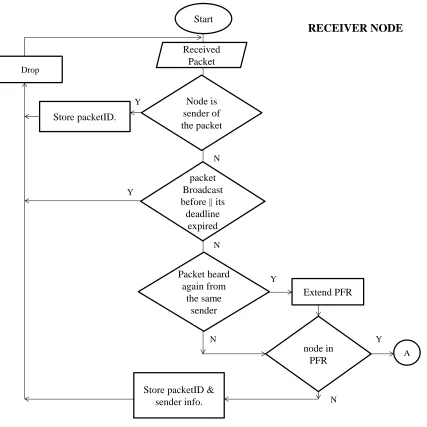
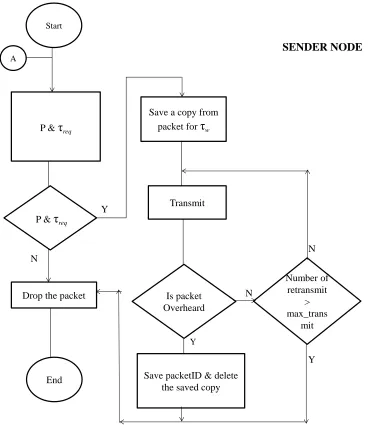
sender node are described in the flowchart given in Fig. 3.2 and Fig. 3.3.
Based on the receiver flowchart in Fig. 3.2, when a node receives a packet, it
checks if this packet was transmitted by itself before. If the packet was
trans-mitted before or its deadline has expired, the node drops the packet. Otherwise
the node progresses on the flowchart and checks if it is in the PFR. If the node
is in the PFR, then it becomes a potential sender. If the previously overheard
packet was received again, the node extends the PFR and checks if it is in the
newly extended PFR and if it can be a potential sender. When a node becomes
a potential sender, it follows the sender’s flowchart of the protocol as given in
Fig. 3.3. The first process in the sender node is to calculate if the node can
meet the delay requirements of the packet. If the node meets this requirement,
it forwards the packet; otherwise it drops it. Fig. 3.1 illustrates the functional
diagram of 3DRTGP and these functions are given as follows:
A. Location management.
B. Forwarding management.
C. VNP handling.
D. Flooding reduction.
The forwarding management function decides if the node forwards the packet
or not according to its forwarding matrices. The location management function
responsible for identifying if the node experiences a void region and activates
the VNP handling algorithm to divert the traffic to an alternative PFR. VNP
can be also experienced if the nodes in the PFR are congested and cannot meet
the packet deadline. For this reason, VNP handling is important in selecting
alternative routes to meet the delay deadlines necessary for real-time operation.
The flooding reduction function identifies if the received packet has already been
broadcast or not. Descriptions of these functions are provided in the following
Start
Received Packet
packet Broadcast before || its
deadline expired
Packet heard again from
the same sender
Extend PFR
node in
PFR A
Store packetID & sender info.
Drop
Y
N
N
N
Store packetID.
Node is sender of the packet
Y Y
Y
N
RECEIVER NODE
Start
P & τreq
Drop the packet
End
Save a copy from packet for τw
Transmit
Is packet Overheard
Save packetID & delete the saved copy
Number of retransmit
> max_trans
mit N
Y
N
Y
Y N
A
P & τreq
SENDER NODE
3.2.1
Location Management
The function of location management is to identify a PFR where the packet can
be forwarded. Nodes that are located inside the PFR are considered as potential
forwarding nodes. In order to mimic the behavior of a unicast transmission, the
PFR should be as small as possible and should ideally contain one forwarding
node. On the other hand, the PFR should be large enough to have at least
one forwarding node to ensure successful forwarding. The location management
function receives packets that have never been broadcasted before and checks the
node’s location, (Nx, Ny, Nz), with respect to the sender’s location (Sx, Sy, Sz)
and the destination’s location (Dx, Dy, Dz). In order to identify if a node is
located in the PFR, it calculates the angle, θ, between two vectors and uses
this angle as a measurement criteria to determine if the node is in the PFR or
not. These two vectors are: a) the vector from the sender to the destination, −→
SD andb) the vector from the sender to the node itself, −SN. Where→ −SD is given→
by, (Sx−Dx, Sy−Dy, Sz−Dz) and −→
SN is given by (Sx−Nx, Sy−Ny, Sz−Nz).
The sender’s location is provided by the packet and the destination location is
preprogrammed to all nodes. Then, the angle,θ, is computed as follows,
θ = cos−1[ −→ SN•−SD→
k−SN→k · k−SD→k], (3.1)
where k−SN→k and kSD−→k are Euclidean vector norms and (−SN→•−SD) is the dot→
product of −SN and→ −SD. In a potential forwarding node,→ θ must satisfy the
following inequality,
θ ≤ β
where β is the conical forwarding angle. The angle, β, of a PFR is inversely
proportional to the network density ρ= Vη. In order to ensure that there is one
node in the PFR, an intuitive initial value ofβ is 360
ηs degrees, where ηs is given by ρ×Vs, with Vs being the volume of spherical transmission region around
the sender with radius r. All nodes are preprogrammed with this initial value
of β at the time of deployment. If the node experiences a VNP after sending
the packet, it retransmits the packet. This retransmission indicates that the
PFR does not contain a forwarding node, which signals a void region. Then
the nodes outside the initial PFR, receiving this retransmission increase their
β adaptively and evaluate if they can be forwarders for this packet. The VNP
handling subsection will provide more details about this process.
3.2.2
Forwarding probabilistic mechanism
The forwarding probabilistic mechanism consists of two components: delay
es-timation and forwarding probability. Delay eses-timation ensures that the packets
meet their delivery deadlines. Forwarding probability increases the chance of
forwarding the packet by less congested nodes.
3.2.2.1 Delay Estimation
The node estimates the packet’s latency to reach the destination if it is
par-ticipating in forwarding. This estimated latency,τreq, depends on the expected
number of hops, h, between the forwarding node, N, and the destination node,
D, as well as the time required in each hop,τh. The expected number of hops,
h, is given by k −→
SDk
r . The total time that is required in each hop, τh, for packet
transmission can be calculated as (τp+τpr +τq +τt) , where τp is the packet
forwarding node, τt is the time required to transmit the packet from the
for-warding node, andτq is the queuing delay in the forwarding node. Here,τp can
be ignored for RF signals. Thus, the estimated required time in a hop without
the queuing delay, ´τh , can be expressed as (τp+τpr+τt). Hence, theτreq for a
data packet to reach the destination node from the forwarding nodeN is given
by,
τreq = (τp+τpr+τt) + (h×τ´h). (3.3)
The first term, (τp+τpr+τt), represents the estimated packet delay in the
for-warding node at the time of the decision. The second term, (h×τ´h), represents
the estimated packet delay in the next h hops towards the destination.
Ignor-ing the queuIgnor-ing delay of later hops offers a lower bound for the delay. If τreq
in (3.3) is less than the available time margin provided in the packet deadline,
the node becomes a potential forwarding node. Hence, the packet has a better
chance to be delivered on time. However, the protocol must choose the best
forwarding candidate, thus the forwarding probability of nodes are utilized to
select the best forwarding node in the PFR. This node selection is explained in
the following subsection. If all the nodes in the PFR of a sender do not transmit
the packet, then the sender will realize that the nodes in the PFR either cannot
meet the delivery deadline or the PFR experiences a VNP. Both scenarios are
dealt in a manner similar to the VNP handling subsection.
3.2.2.2 Forwarding Management
If a node located in the PFR finds that it can deliver the packet within the packet
delivery deadline, then it becomes a potential forwarder. However, if there is
more than one forwarder in a PFR, the protocol should identify which potential
also be made based on forwarding probability. Forwarding probability reflects
the the queuing delay of the potential forwarders. This probability depends on
the average of one hop delay, τav, of m previously transmitted packets. The
average delay is calculated by a sender and provided to the next forwarding
nodes with the packet. The sender measures the one hop delay as the time
between transmission and overhearing. Hence the average delay is given by,
τav =
Pm i=1τ
i s
m , (3.4)
where τsi is the hop delay for ith packet measured by the sender. Then the
forwarding probability, p, in possible forwarding nodes is given by,
p=
1− (τpr+τq+τt)
τav if (τpr+τq+τt)< τav, 0 otherwise.
(3.5)
Hence, based on (3.5) a higher queuing delay will result in a lower probability
of packet forwarding. Nodes make their forwarding decision based on p. If
no nodes transmit the packet, the sender retransmits the packet, which alerts
nodes outside of the previous PFR to participate in the next round by increasing
their β. The adjustment of β is done locally and is explained in the following
subsection.
3.2.3
VNP Handling
VNP is defined by a packet that reaches a node that has no next hop neighbor
which can serve as a forwarding node. VNP can occur when a network is sparse
or there are no nodes available because of battery depletion, or as in our case,
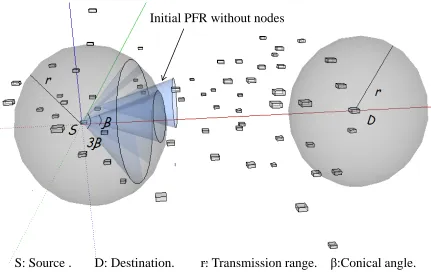
the nodes cannot deliver the packet within their deadlines. The probability of
1
Initial PFR without nodes
S: Source . D: Destination. r: Transmission range.
β
:Conical angle.
Figure 3.4. PFR with and without nodes.
raises the packet miss ratio, particularly for real-time applications. In general,
VNP does not occur if there is at least one node in the PFR. The probability
of having no node in the PFR is denoted by q, for a given β, is as follows,
q= VP F R
Vs
, (3.6)
where VP F R is the volume of the PFR, which is given by [(23)×π×r3 ×[1−
(1
2) cos(β)×sin
2(β)]], V
s is the spherical transmission volume of a sender whose
radius of transmission range is r and ηs is the average number of nodes in Vs.
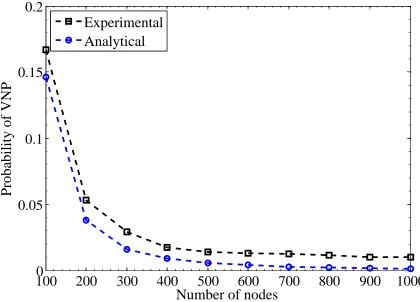
Fig. 3.5 shows the probability of having a void node, q in (3.6) and the
prob-ability of experiencing VNP in the simulation scenarios with different network
deployments. These results provide significant information about how often
impor-100
0
200
300
400
500
600
700
800
900
1000
0.05
0.1
0.15
0.2
Number of nodes
Probability of VNP
Experimental
Analytical
Figure 3.5. Probability of VNP: analytical and experimental calculated based on 3.1.
tant in 3DRTGP to provide reliable data delivery. The VNP handling function
is triggered when a sender does not overhear the transmitted packet within a
predefined waiting time, τw. The packet may not be forwarded because of the
following two cases: a) the PFR does not have any node or b) nodes in the
PFR are congested and cannot meet the delivery criteria. If there is a VNP, the
sender has to rebroadcast the same packet. This time, the nodes that overhear
this rebroadcast will double their β and check whether they are now located
inside the newly formed PFR. This process will enable a new set of nodes in
this wider PFR to participate in packet forwarding. Such PFR adaptation is
done locally at each node and β is set to this new value at the nodes
through-out the operation. If there is still no forwarding after this rebroadcast, then
D S
PFR
2PFR
1β
2
β
PFR
33
β
East
West
n
1Figure 3.6. Illustration of VNP in 2D.
receiving nodes will extend their PFR to be even wider. This adaptive process
continues until the packet is forwarded successfully by a forwarding node and
resolves VNP as long as there is no network partitioning around the sender
in the network. If β becomes large enough to contain the previous hop sender,
then the previous hop sender assumes responsibility for the packet transmission.
Fig. 3.6 illustrate the process of VNP handling in 2D.
The possible maximum number of retransmissions of a packet by a node, Q,
can be given by,
Q=dlog(360)−log(β)
log(2) e, (3.7)