2012. Vol.3, Special Issue, 903-907
Published Online October 2012 in SciRes (http://www.SciRP.org/journal/ce) http://dx.doi.org/10.4236/ce.2012.326136
Classroom Assessment Techniques: An Assessment and
Student Evaluation Method
Dawn-Marie Walker
University of Nottingham, Nottingham, UK Email: [email protected]Received August 9th, 2012; revised September 10th, 2012; accepted September 24th, 2012
Some of the challenges that face Higher Education are how to ensure that assessment is meaningful and that feedback is prompt in order to promote learning. Another issue is how to provide lecturers with feed-back regarding their efficacy, in a timely and non-judgmental manner. This paper proposes that Class-room Assessment Techniques (Angelo and Cross, 1993), maybe a good way of answering both of those issues. They are quick and easy tasks set within the lecture, which tests the students’ knowledge, provid-ing an immediate opportunity for further elaboration if needed by the lecturer, therefore providprovid-ing imme-diate feedback to the students. It also ensures that the lecturer has delivered the most salient messages, therefore also providing feedback to the lecturer.
Keywords: Assessment; Student Evaluation; Feedback; Classroom Assessment Techniques
Introduction
Appropriate assessment in Higher Education (HE) is a topic which has been debated and researched over the years, as not only is assessment respected as a necessary method of quanti-fying students, but it is also required by clients themselves, both students and employers. One of the major problems with assessment is how to make it meaningful, and in a manner which promotes deep learning to develop independent and self motivated thinkers, whilst also fulfilling the assessment criteria. This is often achieved by providing thorough feedback in a timely manner after the assessment, which in large classes can be difficult to the lecturer. Another area of much debate in HE is how to evaluate what is taught. Student evaluation of teach-ing and modules is prone to criticism; therefore many sugges-tions of evaluation methods to improve accuracy have been put forward. The present paper aims to draw on previous theories about: 1) assessment, i.e. summative or formative; 2) feedback; and 3) student evaluated teaching, to propose an assessment method, which also combines an evaluation method.
Approaches to Learning
The deep approach to learning which is what HE strives to achieve, involves the critical analysis of new ideas, with the student relating their own previous knowledge to the new knowledge, theoretical ideas, and evidence. This in turn leads to understanding and long-term retention of concepts so that they can be used for problem solving in unfamiliar contexts. The surface approach to learning is the unquestioning acceptance and memorization of information as isolated and unlinked facts which lead to rote learning for examinations, most of which are promptly forgotten about following the exam (Marton & Saljo, 1976; Biggs, 1987; Biggs, 1993; Ramsden, 1992), i.e. “brain dump”. Deep learning is driven by challenging, open-ended problems with lecturers acting as facilitators in an interactive classroom. An interactive classroom promotes deep approaches
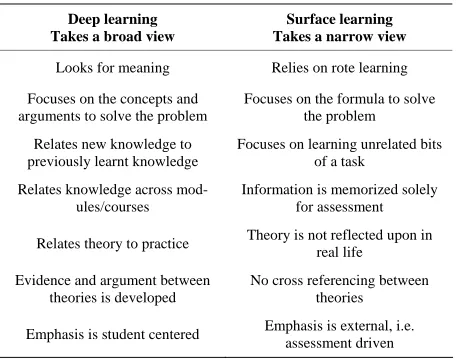
to learning and contributes towards positive student motivation by allowing students to be in charge of their learning environ-ment (Markett et al., 2006). A key strength of classroom inter-action is that it provides scaffolding which allows the student to develop content into context, therefore developing cognitive structures (Moore, 1989). Therefore to promote deep learning, there has to be dialogue and an interactive classroom, and also great care needs to be given when choosing assessment tech-niques to prevent surface learning(Table 1 compares and con-trasts these two approaches to learning).
Assessment
Assessment can provide a framework for sharing educational objectives with students and for mapping their progress. For these reasons there is strong support for assessment to be part of the learning process (Dochy & McDowell, 1997). In general, assessment is divided into two concepts: formative and summa-tive. Formative assessment is intended to assist student learning via deep learning approaches. Summative assessment on the other hand, e.g. assessments involving short questions, multiple choice or unseen exams, checks the level of learning at the end of a course/module and often takes the form of an exam or piece of course work which is graded. Exams lend themselves to rote learning, or surface approaches by encouraging students to concentrate on performance goals (passing the test) rather than learning goals (understanding the subject) (Dweck, 1999). This leads some to argue that summative assessment in itself can control, and arbitrarily classify students whilst impairing the student’s own sense of self and leads to a limitation of their educational development (Barnett, 2007). Therefore it is argued that formative assessment should be an integral part of teaching and learning in HE and that it should be systematically embed-ded in curriculum practices (Juwah et al., 2004).
Table 1.
Compare and contrast deep learning with surface learning (based on Ramsden, 1992).
Deep learning Takes a broad view
Surface learning Takes a narrow view
Looks for meaning Relies on rote learning
Focuses on the concepts and arguments to solve the problem
Focuses on the formula to solve the problem
Relates new knowledge to previously learnt knowledge
Focuses on learning unrelated bits of a task
Relates knowledge across mod-ules/courses
Information is memorized solely for assessment
Relates theory to practice Theory is not reflected upon in real life
Evidence and argument between theories is developed
No cross referencing between theories
Emphasis is student centered Emphasis is external, i.e. assessment driven
quired of them to gain a top mark and enables them to gain feedback, via reflection on their own work when compared with the criteria, and so will encourage deep learning (Norton et al., 2001). Feedback is an extremely important part of learning and the assessment process. For any assessment to be useful to the student in their personal development there needs to be a timely feedback loop that will encourage the student to learn from the process, to reflect on their work and to assimilate the knowl-edge for future practice. When assessment (often formative) encompasses a feedback loop, it results in positive benefits on learning and achievement across all content areas; knowledge, skills and levels of education (Black & William, 1998).
Feedback
Feedback is information about how the student’s present state (of learning and performance) relates to the desired goals and standards (Nicol & Macfarlane-Dick, 2006) and systematic reviews show that effective feedback leads to learning gains (Black & William, 1998). Lecturer feedback serves as an au-thoritative external reference point against which students can evaluate, and self-correct their progress and their own internal goals (Juwah et al., 2004). Hence the main aim of feedback is in developing self regulated students, which requires them to internalize personal goals against which their performance can be compared and assessed by themselves (Nicol & Macfarlane- Dick, 2006). However providing meaningful feedback in a timely manner can be difficult. Although there has been ex-panding numbers of students attending HE, the actual resource allocated per student in the largest classes may be much less than ten years ago (Gibbs, 2006). The work load of lecturers is often calculated by “class contact hour” which ignores class size, therefore assessment loads are sometimes ignored (Gibbs, 2006). These time constraints, together with modularization of degrees, often without any increase in staffing, can increase the utilization of summative assessment (Gibbs, 2006) and there-fore leads to a decrease in timely and relevant feedback which would have enhanced learning.
It is also important that the feedback is in a loop and is part of a dialogue which encourages engagement. Dialogue between the lecturer and student will help develop the student’s
under-standing of expectations and standards, to correct misunder-standings and to get an immediate response to difficulties (Freeman & Lewis, 1998). It can also inform the lecturers as to whether they are teaching appropriately and whether it is at the right level, therefore providing an immediate opportunity for realignment of their teaching. A common method of closing the loop and providing feedback to the lecturer is “Student Evalu-ated Teaching (SET)”.
Student Evaluated Teaching
The need for greater accountability and improvement in the quality of teaching has become a major issue in HE in recent years (Coaldrake & Stedman, 1998; Ballantyne et al., 2000). Therefore SET has become an integral part of HE’s approach to maintaining teaching standards via a summative method: to gain data for administrative purposes, to provide information to students and to meet government guidelines; and a formative purpose: giving diagnostic feedback to lecturers about their teaching effectiveness (Marsh, 1987). SET is often the only measure of teaching effectiveness (Perry, 1997), so it is of pa-ramount importance that the students give meaningful input. Literature however, suggests that SET is currently not fulfilling all its objectives as there doesn’t appear to be a consensus as to what “effective teaching” includes (Shelvin et al., 2000). For example, Lowman and Mathie (1993) identifies lecturers’ ef-fectiveness, as comprising 1 intellectual excitement; and 2 in-terpersonal rapport; whilst Swartz et al. (1990) view it as com-posing: a) clear instructional presentation; and b) good man-agement of student behavior. However in reality it’s probably all of these items compounded with others such as encouraging students to have self worth (Covington, 1997), etc. Other prob-lems with this system relates to the validity of the student evaluations as it is human nature to be subjective in voting, for example Shelvin et al. (2000) found that student evaluation frequently measures other factors such as 63% of the variance of the “lecturer effectiveness” score being accounted for by charisma.
Therefore HE establishments are wrong if they quantify teaching effectiveness on SET, or see students as customers, and shape their educational provision to meet their wishes or evaluations, as students objectives centre around getting the highest grades with the least amount of effort, or time (Chad-wick & Ward, 1987). Therefore good lecturers who use tech-niques to promote deep approaches to learning, which are by their nature, often harder work and more difficult tasks than surface approaches, may be looked upon less favorably than a teacher who “spoon feeds” information to the students (Platt, 1993).
to fulfill government requirements, although they maintain that teaching needs to be evaluated significantly more than the staff. So it appears that students value this process, but become disil-lusioned by the lack of feedback/impact, and not giving enough time to complete the form thoughtfully.
Classroom Assessment Techniques
The use of Classroom Assessment Techniques (CATs) is one way of resolving all of these problems. CATs offer an egalitar-ian and productive method of student evaluation, gives the op-portunity for immediate formative feedback to both students and staff, and is also a formative assessment, therefore pro-motes deep learning techniques, and thus enhancing knowledge and motivation. CATs were first presented and described in detail in a book by Angelo and Cross in 1993. CATs are quick and simple activities which are designed to give both the lec-turer and the students’ useful, immediate feedback. They also assess the teaching-learning process rather than other con-founding issues such as the charisma of the lecturer, or how easy the course is. They are defined as “small-scale assessments conducted continually in college classrooms by discipline- based teachers to determine what students are learning in that class”, (Cross & Steadman, 1996: p. 8).
CATs are sometimes called test-feedback cycles, and imple-mentation of them allows teachers and students to share, on a regular basis, their conceptions about both the goals and proc-esses of learning (Stefani & Nicol, 1997) thereby opening up dialogue opportunities. They are usually not graded to enable the student to interact with the feedback, rather than become obsessed with the grade. However some authors argue that even making CATs count for 1% of the final grade will encourage
students to take them seriously (Enerson et al., 2007). CATs rely on self-assessment, thus promoting the internal resources necessary for lifelong learning, and autonomy which enhances the learning process. In an evaluation of CATs use forty-five out of forty-six faculties in a university setting reported that there were no negative experiences associated with their use of CATs (Catlin & Kalina, 1993), although there is still some de-bate regarding their efficacy as Cottell & Harwood (1998) found no difference in grades, participation, or perceptions of learning between students who used CATs and those who didn’t.
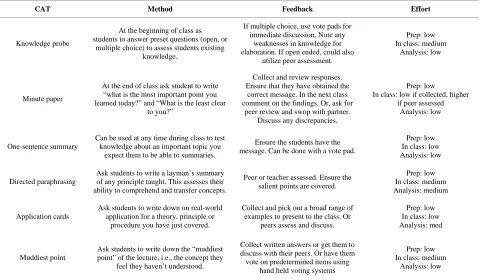
[image:3.595.59.542.452.732.2]There are various types of CATs one can adopt (Table 2) al-though perhaps the most commonly used one is the “one-min- ute paper,” where students are asked to write down answers to questions such as, “What was the most important thing you learned during this class?” or “What questions do you still have on this topic?” This type of technique enables the lecturer to discover how the students are processing and synthesizing the presented material as well as which points need to be reiterated or elaborated on before progressing. Therefore this method assesses student knowledge and also offers the lecturer imme-diate feedback regarding whether the students have grasped the most salient pieces of information from the lecture giving an opportunity to recap on any misunderstood items. Although, arguably, some CATs could be regarded as summative in nature, such as the minute paper, because of the immediate feedback and dialogue ensuing, they therefore become formative. CATs differ from tests and other forms of student assessment in that it provides timely opportunity for course improvement, with the goal of understanding the students’ learning and therefore im-proving teacher effectiveness. Another benefit of this system is
Table 2.
Examples of CATs (adapted from a table on the National Teaching and Learning Forum, 2008).
CAT Method Feedback Effort
Knowledge probe
At the beginning of class as students to answer preset questions (open, or
multiple choice) to assess students existing knowledge.
If multiple choice, use vote pads for immediate discussion. Note any
weaknesses in knowledge for elaboration. If open ended, could also
utilize peer assessment.
Prep: low In class: medium
Analysis: low
Minute paper
At the end of class ask student to write “what is the most important point you learned today?” and “What is the least clear
to you?”
Collect and review responses. Ensure that they have obtained the
correct message. In the next class comment on the findings. Or, ask for
peer review and swop with partner. Discuss any discrepancies.
Prep: low In class: low if collected, higher
if peer assessed Analysis: low
One-sentence summary
Can be used at any time during class to test knowledge about an important topic you
expect them to be able to summaries.
Ensure the students have the message. Can be done with a vote pad.
Prep: low In class: low Analysis: low
Directed paraphrasing
Ask students to write a layman’s summary of any principle taught. This assesses their ability to comprehend and transfer concepts.
Peer or teacher assessed. Ensure the salient points are covered.
Prep: low In class: medium Analysis: medium
Application cards
Ask students to write down on real-world application for a theory, principle or
procedure you have just covered.
Collect and pick out a broad range of examples to present to the class. Or
peers assess and discuss.
Prep: low In class: low Analysis: med
Muddiest point
Ask students to write down the “muddiest point” of the lecture, i.e., the concept they
feel they haven’t understood.
Collect written answers or get them to discuss with their peers. Or have them vote on predetermined items using
hand held voting systems
Prep: low In class: medium
Analysis: low
that there is very little time investment when compared to more traditional assessment such as essays or exams, especially when one bears in mind the time taken to provide feedback.
This method also fosters open dyadic communication and good rapport. CATs can be used within any size of classroom, large lectures or small seminars, and can personalize learning and lend themselves to peer led teaching/feedback. They have also been used in e-learning/distance formats (Henderson, 2001) and so are extremely versatile. They are well suited to the ad-vent of the Interactive Voting Systems that many universities have adopted. These are systems that can be built into Power-Point presentations and which use individual voting pads. The lecturer can then build a CAT into their presentation, ask the students to vote with their key pad and the system will then calculate the results immediately, presenting them on the screen for the lecturer and students to analyze. Mobile phones and SMS technology have also been shown to work when used in this manner (Markett et al., 2006). Using media in this way can enhance the learning experience as it is interactive therefore promoting deep learning. For example, Laurillard (1996) claims that by changing the media used in class, the student activity is changed and hence improves the learning situation i.e. “peda-gogical re-engineering” (enhancing learning by changing the balance or combination of the components used) (Collis, 1996).
Case Study
In the author’s own teaching, she has used CATs with great effect. In a module consisting of approximately 10 lectures, she built in around 5 CATs. The students were not told which lec-tures the CATs would appear in prior. This ensured that atten-tion was maintained throughout the module. She used a CAT when there was an important theory/fact for the students to understand due to the ensuing lectures/work developing on from it. As she wanted to make the use of CATs fun, she de-cided not to mark them, but rather got students to debate around the topics with students next to them. Dependent upon when the author needed feedback about her teaching, and which impor-tant theory the students needed to grasp, informed which CAT was used, and also where in the lecture. She found that using voting systems built into the PowerPoint presentation engaged the students and gave immediate feedback about whether they were correct or not. She also found that students discussing CATs in small groups, such as the one-sentence summary pro-moted deep learning. The students would then write down the agreed answer on a card anonymously which were then col-lected so that the author would get feedback regarding the ef-fectiveness of her teaching.
With virtual learning environments (VLE) become more in-tegrated into HE teaching, the author has also used CATs within the VLE used at the University of Nottingham. Along-side putting the PowerPoint slides and associated handouts up online, she has found success with an online survey replicating the knowledge probe CAT which asks one or two questions. It appears that the students value the engagement that using CATs offer, as the SET scores for her modules are always high and the pass rate of assessments are also high. The author also val-ues the timely feedback on her teaching, so she can detect any problems early and give her opportunity to approach the theory in another manner, encourage peer teaching and learning, and identify key items of literature for them.
Another area she is currently exploring is working with small
groups of students, so that they can design a suitable CAT for their target lecture. This involves meeting with the students shortly after their target lecture to discuss what they believe were the salient points and how they might assess the student’s grasp of them. Working in their small groups they then design the CAT they feel would be the most appropriate (or design a new one), and carry it out at the start of the next lecture. They then collect the data back from the students and review it in their groups and report back to the author with any deficits in the learning identified. If any deficits are observed, some ideas from them about how these could be remedied such as re-sources which they could be referred to for further reading, typed up study notes, etc. are required from them. These re-sources are then given back to the class by the students, and feedback obtained e.g. whether other students knew of any further useful resources which were omitted, etc. To ensure com-mitment, the author has allocated 5% to this task. This task not only promotes deep learning (to both “teachers” and “students”), but also encourages team work and hones their teaching/public speaking ability. For the author, it also ensures some student designed teaching, from which she can also learn. Although it seems to have worked out well, it does take some organization, such as getting students to form groups, and staggering them throughout the module. However the feedback from all students was positive so far.
Conclusion
CATs encourage the view that teaching and learning is a formative process that evolves over time. By being able to react swiftly to student answers, they provide the opportunity for immediate feedback to the lecturer which can be promptly acted upon, therefore giving the chance to the teacher to close the feedback loop. It encourages self-assessment by the student and reflection amongst both the lecturers and students. How-ever care must be taken in choosing the appropriate CAT and also allowing enough time in class to ensure that they are worthwhile. It may also be a good idea to give the CATs a nominal grade of 5% or 10% to ensure that the students value them.
Tips for successful use of CATs (Angelo & Cross, 1993):
Don’t ask for feedback on things you can’t or won’t change;
Don’t collect more feedback than you can analyze and re-spond to by the next lecture;
Before you use a CAT, ask yourself: How might responses to this question(s) help me and my students improve? If you can’t answer that question, don’t do the assessment;
Don’t use too many different CAT techniques in one se-mester. Student responses are more useful when the stu-dents are comfortable with a particular technique and un-derstand it (Martin, 2011).
REFERENCES
Angelo, T. A. (1991). Classroom research: Early lessons from success. San Francisco, CA: Jossey-Bass.
Angelo, T. A., & Cross, K. P. (1993). Classroom assessment techniques—A handbook for college-teachers. San Francisco, CA: Jossey-Bass Pub-lishers.
25, 211-236.
Barnett, R. (2007). Assessment in Higher Education. In D. Boud, & N. Falchicov (Eds.), Re-thinking assessment in higher education: Learn- ing for the longer term (pp. 29-40). London: Routledge Taylor and Francis.
Biggs, J. (1987). Student Approaches to Learning and Studying. Haw-thorn, VIC: Australian Council for Educational Research.
Biggs, J. (1993). What do inventories of students’ learning process really measure? A theoretical review and clarification. British Jour-nal of EducatioJour-nal Psychology, 83, 3-19.
doi:10.1111/j.2044-8279.1993.tb01038.x
Black, P., & William, D. (1998). Assessment and classroom learning. Assessment in Education, 5, 7-74. doi:10.1080/0969595980050102 Catlin, A., & Kalina, M. (1993). What Is the Effect of the Cross/Angelo
Model of Classroom Assessment on Student Outcome? A Study of the Classroom Assessment Project at Eight California Community Col-leges. Sacramento, CA: California Community College Chancellor’s Office.
Chadwick, K., & Ward, J. (1987). Determinants of consumer satisfac-tion with educasatisfac-tion: Implicasatisfac-tions for college & university adminis-trators. College and University, 2, 236-246.
Coaldrake, O. P., & Stedman, L. (1998). On the brink: Australia’s universities confronting their future. St. Lucia, QLD: University of Queensland Press.
Collis, B. (1996). Tele-learning in a Digital World: The future of dis-tance learning. London: International Thomson Computer Press. Covington, M. V. (1997). A motivational analysis of academic life in
college. In R. P. Perry, & J. C. Smart (Eds.), Effective teaching in higher education: Research and practice (pp. 61-100). New York: Agathon Press.
Cross, P., & Steadman, M. (1996). Classroom Research: Implementing the scholarship of teaching. San Francisco, CA: Jossey-Bass. Dochy, F., & McDowell, L. (1997). Assessment as a tool for learning.
Studies in Educational Evaluation, 23, 279-298. doi:10.1016/S0191-491X(97)86211-6
Dweck, C. (1999). Self-Theories: their role in motivation, personality and development. Philadelphia, PA: Psychology Press.
Enerson, D. N., Plank, K. M., & Johnson, R. N. (2007). An introduction to classroom assessment techniques. University Park, PA: Penn State. Freeman, R., & Lewis, R. (1998). Planning and implementing
assess-ment. London: Kogan Page.
Gibbs, G. (2006). Why assessment is changing. In C. Bryan, & K. Clegg (Eds.), Innovative assessment in higher education (pp. 11-22). Abingdon: Routledge.
Henderson, T. (2001). Classroom assessment techniques in asynchro-nous learning networks. The Technology Source. URL (last checked 12 October 2012).
http://ts.mivu.org/default.asp?show=article&id=1034
Juwah, C., Macfarlane-Dick, D., Matthew, B., Nicol, D., Ross, D., & Smith, B. (2004). Enhancing student learning through effective for-mative feedback. The Higher Education Academy. URL (last checked 12 October 2012).
http://www.heacademy.ac.uk/assets/documents/resources/database/id 353_senlef_guide.pdf
Laurillard, D. (1996). How should UK higher education make best use
of new technology? Glasgow: Association for Learning Technology. Lowman, J., & Mathie, V. A. (1993). What should graduate teaching
assistants know about teaching? Teaching of Psychology, 20, 84-88. doi:10.1207/s15328023top2002_4
Markett, C., Sanchez, I. A., Weber, S., & Tangney, B. (2006). Using short message service to encourage interactivity in the classroom. Computers & Education, 46, 280-293.
doi:10.1016/j.compedu.2005.11.014
Marsh, H. W. (1987). Students’ evaluation of university teaching: Re-search findings, methodological issues and directions for future re-search. International Journal of Educational Research, 11, 253-388. doi:10.1016/0883-0355(87)90001-2
Martin, M. B. (2011). Classroom assessment techniques designed for technology. URL (last checked 29 August 2012).
http://online-course-design.pbworks.com/f/Classroom+Assessment+ Techniques+Designed+Technology.pdf
Marton, F., & Saljo, R. (1976). On qualitative differences in learning-1: Outcome and process. British Journal of Education Psychology, 46, 4-11. doi:10.1111/j.2044-8279.1976.tb02980.x
Moore, M. G. (1989). Editorial: Three types of interaction. The Ameri-can Journal of Distance Education, 3, 1-6.
doi:10.1080/08923648909526659
National Teaching and Learning Forum (1998). Classroom assessment techniques (2nd ed.). New York: Jossey-Bass.
www.ntlf.com/html/lib/bib/assess.htm
Nicol, D. J., & Macfarlane-Dick, D. (2006). Formative assessment and self-regulated learning: A model and seven principles of good feed-back practice. Studies in Higher Education, 31, 199-218.
doi:10.1080/03075070600572090
Norton, L. S., Tilley, A. J., Newstead, S. E., & Franklyn-Stokes, A. (2001). The pressures of assessment in undergraduate courses and their effect on student behaviors. Assessment & Evaluation in Higher Education, 26, 269-284. doi:10.1080/02602930120052422
Perry, R. P. (1997). Teaching effectively: Which students? What methods? In R. P. Perry, & J. C. Smart (Eds.), Effective teaching in higher education: Research and practice (pp. 154-170). New York: Agathon Press.
Platt, M. (1993). What student evaluations teach. Perspectives in Po-litical Science, 22, 29-40. doi:10.1080/10457097.1993.9944516 Ramsden, P. (1992). Learning to teach in higher education. London:
Routledge. doi:10.4324/9780203413937
Shelvin, M., Banyard, P., Davies, M., & Griffiths, M. (2000). The va-lidity of student evaluation of teaching in higher education: Love me, love my lectures? Assessment and Evaluation in Higher Education, 25, 397-405. doi:10.1080/713611436
Stefani, L., & Nicol, D. (1997). From teacher to facilitator of collabora-tive enquiry. In S. Armstrong, G. Thompson, & S. W. Brown (Eds.), Facing up to radical changes in universities and colleges (pp. 131- 140). London: Kogan Page.