IOT Based Hydroponic System
Chavan Akshay A1, Pawar Abhijeet S1, Wagh Pratik V1, Prof. Lalita Wani2
B.E. Student, Dept. E&TC Engineering, Bharati Vidyapeeth Lavale, Pune, India1
Professor, Dept. E&TC Engineering, Bharati Vidyapeeth Lavale, Pune, India2
ABSTRACT: Hydroponics is a technique in which we grow the plant without using the soil. In This technique we ensure that plant gets all nutrients from the water solution. There are many types of hydroponics system. The Ebb & Flow is one of the hydroponics technique types. In this technique that grows the plant by supplying the nutrient direct to the root of the plant until the plants harvested. By using this technique, the plant roots will be always deeped into the water contains nutrient and oxygen. However, this technique manually controls the purity of water, which can effect to growing of plant. In this the purity level in water solution will be automatically maintained by microcontroller and measured by turbidity sensor. Lastly, this research also focuses on the ability of the system can adjust the purity in water solution for Ebb & Flow system. The water solution from the Ebb & Flow system container is transferred to the main tank to measure the purity level by turbidity sensor and make changes if needed and then transfer back to the system container to continue growing the plant. There are six stages in methodology for this project, which are details of study, hardware identification, software identification, hardware and software interfacing, analysis and troubleshooting, data and result collection.
KEYWORDS: Hydroponics, Sensors, IoT, Soil-less Cultivation, Microcontroller, Wi-Fi Module.
I. INTRODUCTION
The purpose of this project was to design, install, and maintain hydroponic containing different types of varieties. The development and learning of how to properly grow hydroponic greens is important for future project ventures. Once growing quality on a smaller scale is achieved expansion can be easier. Designing and testing smaller systems will also allow you to test different techniques and decide which works the best. There have been large shifts toward locally grown fresh and healthy produce. Hydroponic systems can accomplish this by allowing crop production in urban environments not available for conventional farming. Hydroponic grow located in urban environments can help with maximization of crops per acre. Instead of expanding horizontally increasing the acreage of a farm a hydroponic can expand upwards and maximize the use of urban land. Included in this project will be the steps taken to design, construct, and grow varieties in the hydroponic, the challenges I faced during the grow cycle, results, cost analysis, and recommendations for future designs and growth cycles.
II. LITERATURE SURVEY
History of Hydroponics:-
Hydroponics is the method of growing plants using with the water and the essential Nutrients
required without soil. This form of growing has been Shown from the hanging gardens of Babylon, the floating gardens of the Aztecs of Mexico, and in older Chinese cultures (Resh,1995). In 1929 William Gericke of the University of California Berkley began promoting the growing of plants in a soil less medium and coined the term hydroponics.
Necessity of Hydroponics:-
of hydroponic growing techniques because it does not require soil. Along with the many uses for hydroponic on earth we can even begin seeing the Usefulness of hydroponic in future space travel. NASA has already begun experimentation and research with hydroponic because we have yet to find soil suitable for supporting life in space (Turner). Soil would also be a heavy and unnecessary item to bring to space. Hydroponics would allow us to grow plants in spaceships and uninhabitable land for long missions through space as well as providing a good source of food for space travel. The plants would also supply oxygen and remove carbon dioxide from the astronaut’s environments.
Types of Crops:-
1. Lettuce:-(Lactuca sativa)
Lettuce is an annual plant of the daisy family, Asteraceae. It is most often grown as a leaf vegetable, but sometimes for its stem and seeds. Lettuce is most often used for salads, although it is also seen in other kinds of food, such as soups, sandwiches and wraps; it can also be grilled. One variety, the woju , or asparagus lettuce (celtuce), is grown for its stems, which are eaten either raw or cooked. In addition to its main use as a leafy green, it has also gathered religious and medicinal significance over centuries of human consumption. Europe and North America originally dominated the market for lettuce, but by the late 20th century the consumption of lettuce had spread throughout the world. World production of lettuce and chicory for calendar year 2013 was 24.9 million tonnes, over half of which came from China.
2. Fenugreek:-
Fenugreek (Trigonella foenum-graecum) is an annual plant in the family Fabaceae, with leaves consisting of three small obovate to oblong leaflets. It is cultivated worldwide as a semiarid crop, and its seeds are a common ingredient in dishes from South Asia. Fenugreek is believed to have been brought into cultivation in the Near East. While Zohary and Hopf are uncertain which wild strain of the genus Trigonella gave rise to domesticated fenugreek, charred fenugreek seeds have been recovered from Tell Halal, Iraq, (carbon dated to 4000 BC) and Bronze Age levels of Lachish and desiccated seeds from the tomb of Tutankhamen. Cato the Elder lists fenugreek with clover and vetch as crops grown to feed cattle. In one first-century A.D. recipe, the Romans flavored wine with fenugreek.[4] In the 1st century AD, in Galilee, it was grown as a food staple, as Josephus mentions it in his book, the Wars of the Jews.
3. Spinach:-
Spinach (Spinacia oleracea) is an edible flowering plant in the family Amaranthaceae native to central and western Asia. Its leaves are eaten as a vegetable. It is an annual plant (rarely biennial) growing to 30 cm (12 in) tall. Spinach may survive over winter in temperate regions. The leaves are alternate, simple, ovate to triangular, and very variable in size from about 2–30 cm (1–12 in) long and 1–15 cm (0.4–5.9 in) broad, with larger leaves at the base of the plant and small leaves higher on the flowering stem. The flowers are inconspicuous, yellow-green, 3–4 mm (0.1–0.2 in) in diameter, maturing into a small, hard, dry, lumpy fruit cluster 5–10 mm (0.2–0.4 in) across containing several seeds.
III. IMPLEMENTATION
1. Block Diagram --The basic block diagram of the IoT based Hydroponic system is shown in the figure.
Mainly this block diagram consists of the following essential blocks. 2. Power Supply.
3. Water Temperature and Level Sensor. 4. Microcontroller.
5. Light Sensor.
Figure 1:- Block Diagram of IoT Based Hydroponics System
1. Working –
Figure 2:- Ebb & Flow System
Nutrient solution is delivered to the crop roots in the substrate and then it flooded over into the tank. The process is automatic as the pump turn ON and turn OFF function is automatic with the help of timer. When the timer is on the pump starts delivering nutrient solution with the help of water to the roots. When it is off the solution gets into the tank by drain outlet. After all the solution is gone into the tank the process is repeated. The flooding is done a few times a day that depends on the culture and the substrate type. The disadvantage is hidden in the energy shortage and the pump breakdown.
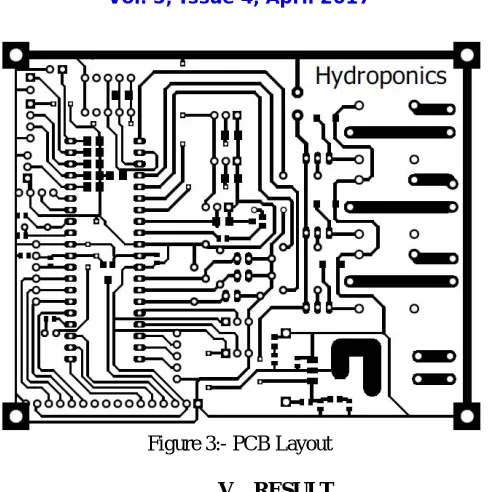
IV. PCB LAYOUT
Figure 3:- PCB Layout
V. RESULT
When the water is flooded into tank of our system and get drain from the another side in between the temperature and humidity sensor check the temperature and humidity of the room and provides it to the owner alongside it keeps watch on timer of the water pump cycles and gives periodic report of all sensors. Owner obtains the information of all above parameters with the help of Wi-Fi module. The output Fig. is given below.
fresh vegetables and fruits in household gardens or in small discarded containers. By means of hydroponics, a regular and abundant supply of fresh greens vegetables, fruits can be produced in poor production areas and clean areas can be made productive at relatively low cost.
VII. ACKNOWLEDGEMENT
Behind every Endeavour, there are people who make it happen. The making of this project is the result of many invisible hands helping in every way and express our deepest gratitude to all of them. We would like to express our gratitude to the principle Dr.S.M.Shendokar, Head of Department Electronics & Telecommunication, Prof.A.B.Wani, without whom the success of this project would have been highly impossible. First and foremost, we would like to express our profound sense of gratitude and we are indebted to our guide Prof.L.K.Wani, Department of Electronics and Telecommunication Engineering in carrying out this project. We also wish to express our sincere thanks to all faculty members and Non teaching staff Of Department, Electronics and Telecommunication Engineering, Bharati Vidyapeeth’s College Of Engineering, Lavale Pune, for his invaluable guidance.
REFERANCES
1. International Journal of Advanced Research in Electrical, Electronics and Instrumentation Engineering (An ISO 3297: 2007 Certified Organization) Vol. 4, Issue 8, August 2015.
2. Bio Resource and Agricultural Engineering Bio Resource and Agricultural Engineering Department California Polytechnic State University San Luis Obispo 2014.
3. https://en.wikipedia.org/wiki/Lettuce#Description 4. https://en.wikipedia.org/wiki/Fenugreek 5. https://en.wikipedia.org/wiki/Spinach 6. www.soillessgardening-india.com
BIOGRAPHY
Chavan Akshay A, Pawar Abhijeet S, Wagh Pratik V, all are students of Bharati Vidyapeeth College of
Engineering lavale, Pune. Studing in last year of E&TC Engineering.
Prof. Lalita Wani is a Professor of Dept. E&TC Engineering, Bharati Vidyapeeth Lavale, Pune, Savitribai Phule Pune