Faster Private Set Intersection based on OT Extension
(Full Version)
∗Benny Pinkas
Bar-Ilan University, Israel
[email protected]
Thomas Schneider
TU Darmstadt, Germany
[email protected]
Michael Zohner
TU Darmstadt, Germany
[email protected]
July 28, 2014
Abstract
Private set intersection (PSI) allows two parties to com-pute the intersection of their sets without revealing any information about items that are not in the intersection. It is one of the best studied applications of secure com-putation and many PSI protocols have been proposed. However, the variety of existing PSI protocols makes it difficult to identify the solution that performs best in a re-spective scenario, especially since they were not all im-plemented and compared in the same setting.
In this work, we give an overview on existing PSI pro-tocols that are secure against semi-honest adversaries. We take advantage of the most recent efficiency improve-ments in OT extension to propose significant optimiza-tions to previous PSI protocols and to suggest a new PSI protocol whose runtime is superior to that of existing pro-tocols. We compare the performance of the protocols both theoretically and experimentally, by implementing all protocols on the same platform, and give recommen-dations on which protocol to use in a particular setting.
1
Introduction
Private set intersection (PSI) allows two partiesP1andP2
holding setsX andY, respectively, to identify the inter-section X∩Y without revealing any information about elements that are not in the intersection. The basic PSI functionality can be used in applications where two par-ties want to perform JOIN operations over database ta-bles that they must keep private, e.g., private lists of preferences, properties, or personal records of clients or
∗Please cite the conference version of this work published at
USENIX Security’14 [53].
patients. PSI is used for privacy-preserving computa-tion of funccomputa-tionalities such as relacomputa-tionship path discov-ery in social networks [41], botnet detection [45], test-ing of fully-sequenced human genomes [3], proximity testing [48], or cheater detection in online games [11]. Another use case is measurement of the performance of web ad campaigns, by comparing purchases by users who were shown a specific ad to purchases of users who were not shown the ad. This is essentially a variant of PSI where the input of the web advertising party is the identities of the users who were shown the ad, and the input of the merchant, or of an agency that operates on its behalf, is the identities of the buyers. It was published that Facebook and Datalogix, a consumer data collection company, perform this type of measurements.1 (The ar-ticle indicates that they seem to be using the insecure hash-based solution described in§1.1, but instead they can use a properly secure PSI protocol while still being reasonably efficient.)
PSI has been a very active research field, and there have been many suggestions for PSI protocols. The large number of proposed protocols makes it non-trivial to perform comprehensive cross-evaluations. This is fur-ther complicated by the fact that many protocol designs have not been implemented and evaluated, were analyzed under different assumptions and observations, and were often optimized w.r.t. overall runtime while neglecting other relevant factors such as communication.
In this paper, we give an overview on existing effi-cient PSI protocols, optimize the recently proposed PSI protocols of [30] and [19], based on garbled circuits and
1
Bloom filters, respectively, and describe a new PSI pro-tocol based on recent results in the area of efficient OT extensions [1, 38]. We compare both the theoretical and empirical performance of all protocols on the same plat-form and conclude with remarks on the protocols and their suitability for different scenarios.
1.1
Classification of PSI Protocols
A naive solution When confronted with the PSI prob-lem, most novices come up with a solution where both parties apply a cryptographic hash function to their in-puts and then compare the resulting hashes. Although this protocol is very efficient, it is insecure if the input domain is not large or does not have high entropy, since one party could easily run a brute force attack that applies the hash function to all items that are likely to be in the input set and compare the results to the received hashes. (When inputs to PSI have a high entropy, a protocol that compares hashes of the inputs can be used [46].)
PSI is one of the best studied problems in secure computation. Since its introduction, several techniques have been used to realize PSI protocols. While the first PSI protocols were special-purpose solutions based on public-key primitives, other solutions were based on circuit-based generic techniques of secure computation, that are mostly based on symmetric cryptography. A recent development are PSI protocols that are based on oblivious transfer (OT) alone, and combine the efficiency of symmetric cryptographic primitives with special pur-pose optimizations. Finally, we describe PSI protocols that utilize a third party to achieve even better efficiency.
Public-Key-Based PSI A PSI protocol based on the Diffie-Hellmann (DH) key agreement scheme was pre-sented in [32] (related ideas were prepre-sented earlier in [40]). This protocol is based on the commutative prop-erties of the DH function and was used for private prefer-ence matching, which allows two parties to verify if their preferences match to some degree.
Freedman et al. [24] introduced PSI protocols se-cure against semi-honest and malicious adversaries in the standard model (rather than in the random oracle model assumed in the DH-based protocol). This protocol was based on polynomial interpolation, and was extended in [22], which presents protocols with simulation-based security against malicious adversaries, and evaluates the practical efficiency of the proposed hashing schemes. We discuss the proposed hashing schemes in§6. A similar approach that uses oblivious pseudo-random functions to perform PSI was presented in [23]. A protocol that uses polynomial interpolation and differentiation for finding intersections between multi-sets was presented in [37].
Another PSI protocol that uses public-key cryptogra-phy (more specifically, blind-RSA operations) and scales linearly in the number of elements was presented in [16] and efficiently implemented and benchmarked in [17].
A PSI protocol based on additively homomorphic en-cryption was described in [12], but is excluded from this evaluation since it scales quadratically in the number of elements and is hence slower than related solutions.
Circuit-Based PSI Generic secure computation proto-cols have been subject to huge efficiency improvements in the last decade. They allow the secure evaluation of arbitrary functions, expressed as Arithmetic or Boolean circuits. Several Boolean circuits for PSI were proposed in [30] and evaluated using the Yao’s garbled circuits framework of [31]. The authors showed that their Java implementation scales very well with increasing secu-rity parameter and outperforms the blind-RSA protocol of [16] for larger security parameter.2 We reflect on and present new optimizations for circuit-based PSI in§3.
OT-Based PSI A recent PSI protocol of [19] uses Bloom filters [10] and OT extension [33] to obtain very efficient PSI protocols with security against semi-honest and malicious adversaries. We describe this protocol and our optimization using random OT extension [1] in§4.
Third Party-Based PSI Several PSI protocols have been proposed that utilize additional parties, e.g., [4]. In [28], a trusted hardware token is used to evaluate an oblivious pseudo-random function. This approach was extended to multiple untrusted hardware tokens in [20]. Several efficient server-aided protocol for PSI were pre-sented and benchmarked in [35]. For their PSI protocol with a semi-honest server, the authors report a runtime of 1.7 s for server-aided PSI on one million elements us-ing 20 threads between cloud instances in the US east - and west coast and 10 MB of communicated data. In comparison, our fastest PSI protocol without a server re-quires 4.9 s for 218elements using four threads and sends 78 MB (cf. Tab. 1 and Tab. 8). Note that this comparison is sketchy and is only meant to demonstrate that using a third party can increase performance. In our work we focus on PSI protocols without a third party.
1.2
Our Contributions
We describe in detail the PSI protocols based on generic secure computation and on Bloom filters, and suggest
2Subsequent work of [17] claimed that the blind-RSA protocol
how to improve their performance using carefully ana-lyzed features of OT extension. We then introduce a new OT-based PSI protocol, and perform a detailed experi-mental comparison of all the PSI protocols that we de-scribed. In the following, we detail our contributions.
Optimizations of Existing Protocols We improve the circuit- and Bloom-filter-based PSI protocols using re-cent optimizations for OT extension [1]. In particular, in§3 we evaluate the circuit-based solution of [30] on a secure evaluation of the GMW protocol, and utilize fea-tures of random OT (cf. §2.2) to optimize the perfor-mance of multiplexer gates (which form about two thirds of the circuit). In§4.3 we redesign the Bloom filter-based protocol of [19] to benefit from using random OT and to support multi-core environments.
A Novel OT-Based PSI Protocol We present a new PSI protocol that is directly based on OT (§5) and di-rectly benefits from recent improvements in efficient OT extensions [1, 38]. The basic version of the protocol can efficiently compare one element with many elements, but for PSI onn elements it requiresO(n2logn)
com-munication. In §6 we use carefully analyzed hashing techniques in order to achieveO(nlogn)communication. The resulting protocol has very low computation com-plexity since it mostly requires symmetric key operations and has even less communication than some public-key-based PSI protocols.
A Detailed Comparison of PSI Protocols We imple-ment the most promising candidate PSI protocols us-ing state-of-the-art cryptographic techniques and com-pare their performance on the same platform. As far as we know, this is the first time that such a wide compar-ison has been made, since previous comparcompar-isons were either theoretical, compared implementations on differ-ent platforms or programming languages, or used imple-mentations without state-of-the-art optimizations. Our implementations and experiments are described in detail in§7. Certain experimental results were unexpected. We give a partial summary of our results in Tab. 1: the values in parenthesis give the overhead of the original protocols and highlight the gains achieved by our optimizations.
PSI Protocol DH Circuit [30] Bloom Filter OT
ECC optimized GMW§3.2 optimized§4.3 §5+§6 [32] (original GMW [1]) (original [19])
Runtime (s) 416 762 (1,304) 68 (154) 14
Comm. (MB) 24 14,040 (23,400) 740 (1,393) 78
Table 1: Runtime and transferred data for private set in-tersection protocols on sets with 21832-bit elements and 128-bit security with a single thread over Gigabit LAN.
We highlight here the conclusions of our results:
• The Diffie-Hellman-based protocol [32], which was the first PSI protocol, is actually the most efficient w.r.t. communication (when implemented using elliptic-curve crypto). Therefore it is suitable for settings with distant parties which have strong com-putation capabilities but limited connectivity.
• Generic circuit-based protocols [30] are less effi-cient than the newer, OT-based constructions, but they are more flexible and can easily be adapted for computing variants of the set intersection function-ality (e.g., computing whether the size of the inter-section exceeds some threshold). Our experiments also support the claim of [30] that circuit-based PSI protocols are faster than the blind-RSA-based PSI protocol of [16] for larger security parameters and given sufficient bandwidth.
• While for larger security parameter previously pro-posed circuit- and OT-based protocols can be faster than the public-key-based protocols on a Gigabit LAN, the DH-based protocol of [32] outperforms
allof them in an Internet network setting. Our new OT-based protocol (§5+§6) is the only protocol that maintains its performance advantage in this setting and even outperforms public-key-based PSI proto-cols for a mobile network setting.
2
Preliminaries
We give our notation and security definitions in§2.1and review recent relevant work on oblivious transfer in§2.2.
2.1
Notation and Security Definitions
We denote the parties asP1andP2, and their respective
input sets asX andY with|X|=n1and|Y|=n2. When
the two input sets are of equal size, we usen=n1=n2.
We refer to elements fromX asxand elements fromY
as yand each element has bit-lengthσ (cf. §A for the relation betweennandσ).
We writeb[i]for thei-th element of a listb, denote the bitwise-AND between two bit stringsa andb of equal length asa∧band the bitwise-XOR asa⊕b.
We refer to a correlation resistant one-way function as CRF, to a pseudo-random generator as PRG, and to a pseudo-random permutation as PRP.
We write N1
-OTm
` formparallel 1-out-of-Noblivious
transfers on`-bit strings, and write OTm` for 21
-OTm`.
asρ, the statistical security parameter asλ, and use the recommended key sizes of the NIST guideline [50], sum-marized in Tab. 2. We denote the bit size of elliptic curve points with ϕ, i.e., ϕ =284 for Koblitz curve K-283 when using point compression.
Security SYM(κ) FFCandIFC(ρ) ECC(ϕ) Hash 80-bit 80 1,024 K-163 SHA-1 128-bit 128 3,072 K-283 SHA-256
Table 2: NIST recommended key sizes for symmetric cryptography (SYM), finite field cryptography (FFC), integer factorization cryptography (IFC), elliptic curve cryptography (ECC) and hash functions.
Adversary definition The secure computation litera-ture considers two types of adversaries with different strengths: Asemi-honest adversarytries to learn as much information as possible from a given protocol execution but is not able to deviate from the protocol steps. The semi-honest adversary model is appropriate for scenarios where software attestation is enforced or where an un-trusted third party is able obtain the transcript of the pro-tocol after its execution, either by stealing it or by legally enforcing its disclosure. The stronger,malicious adver-saryextends the semi-honest adversary by being able to deviate arbitrarily from the protocol steps.
Most protocols for private set intersection, as well as this work, focus on solutions that are secure against semi-honest adversaries. PSI protocols for the mali-cious setting exist, but they are considerably less ef-ficient than protocols for the semi-honest setting (see, e.g., [15, 18, 22, 24, 29, 34]).
The random oracle model As most previous works on efficient PSI, we use the random oracle model to achieve more efficient implementations [9]. We provide details and argue about the use of random oracles in§B.
2.2
Oblivious Transfer
Oblivious transfer (OT) is a major building block for secure computation. When executing minvocations of 1-out-of-2 OT on `-bit strings (denoted 21
-OTm `), the
sender S holds m message pairs (xi0,x1i) with xi0,xi1 ∈ {0,1}`, while the receiverRholds anm-bit choice vector
b. At the end of the protocol,Rreceivesxib[i]but learns
nothing aboutxi
1−b[i], andSlearns nothing aboutb. Many
OT protocols have been proposed, most notably (for the semi-honest model) the Naor-Pinkas OT [47], which uses public-key operations and has amortized complexity of 3mpublic-key operations when performingmOTs.
OT extension [7, 33] reduces the number of expen-sive public-key operations for OTm` to that of only OTκ
κ,
and computes the rest of the protocol using more efficient symmetric cryptographic operations which are orders of magnitude faster. The security parameterκis essentially independent of the number of OTsm, and can be as small as 80 or 128. Thereby, the computational complexity for performing OT is reduced to such an extent, that the net-work bandwidth becomes the main bottleneck [1, 21].
Recently, the efficiency of OT extension protocols has gained a lot of attention. In [38], an efficient
1-out-of-NOT extension protocol was shown, that has sub-linear communication inκ for short messages. Another
proto-col improvement is outlined in [1, 38], which decreases the communication fromR toS by half. Additionally, several works [1, 49] improve the efficiency of OT by us-ing an OT variant, calledrandom OT. In random OT,
(xi0,xi1)are chosen uniformly and randomly within the OT and are output toS, thereby removing the final mes-sage fromStoR. Random OT is useful for many appli-cations, and we show how it can reduce the overhead of PSI. We elaborate on these OT extension protocols in§C.
3
Circuit-Based PSI
Unlike special purpose private set intersection protocols, the protocols that we describe in this section are based on agenericsecure computation protocol that can be used for computing arbitrary functionalities. State-of-the-art for computing the PSI functionality is the sort-compare-shuffle (SCS) circuit of [30], which has sizeO(nlogn)
(cf. §D.1 for details.) We discuss these protocols by reflecting on the generic secure computation protocol of Goldreich-Micali-Wigderson (GMW) [26] (§3.1), and outlining major optimizations for evaluating the SCS cir-cuit for PSI using GMW (§3.2) .
The usage of generic protocols holds the advantage that the functionality of the protocol can easily be ex-tended, without having to change the protocol or the security of the resulting protocol. For example, it is straightforward to change the protocol to compute the size of the intersection, or a function that outputs 1 iff the intersection is greater than some threshold, or com-pute a summation of values (e.g., revenues) associated with the items that are in the intersection. Computing these variants using other PSI protocols is non-trivial.
3.1
The GMW Protocol
The GMW protocol represents the function to be computed as a Boolean circuit and uses an XOR-based secret-sharing and OT to evaluate the circuit. A cir-cuit with input bitufromP1andvfromP2is evaluated
as follows. First, P1 andP2secret-share their input bit u=u1⊕u2 andv=v1⊕v2 andPi obtains the shares
labeled withi. The parties then evaluate the Boolean cir-cuit gate-by-gate, as detailed next. To evaluate an XOR gate with input wiresu andvand output wirew,P1
lo-cally computesw1=u1⊕v1whileP2locally computes w2=u2⊕v2.
Evaluating AND gates using multiplication triples
An AND gate with input wireuandvand output wirew
requires an interaction between both parties using a mul-tiplication triple [6]. A multiplication triple is a set of sharesα1,α2,β1,β2,γ1,γ2∈ {0,1}with(α1⊕α2)∧ (β1⊕β2) =γ1⊕γ2. Given a multiplication triple, to
eval-uate an AND gate implementing u AND v, the parties computedi=αi⊕uiandei=βi⊕vi, exchangedi,ei,
re-constructd=d1⊕d2ande=e1⊕e2, and compute the
shares of the gate output wire asw1= (d∧e)⊕(d∧β1)⊕ (e∧α1)⊕γ1andw2= (d∧β2)⊕(e∧α2)⊕γ2. These
are all extremely efficient operations and therefore the efficiency of the evaluation depends on the efficiency of generating multiplication triples.
As described in [1], multiplication triples can be gen-erated using two random OTs on one-bit strings as fol-lows: both parties chooseαi∈R{0,1}and run two
ran-dom OTs, where in the first OTP1acts as sender andP2
as receiver with choice bitα2, and in the second OTP2
acts as sender andP1as receiver with choice bitα1. From
each OT, the sender obtains(xi0,xi1)and setsβi=xi0⊕xi1
and the receiver obtains xiα
i. To compute valid γ0,γ1
values for the triple, note that(α1⊕α2)∧(β1⊕β2) = (α1∧β1)⊕(α1∧β2)⊕(α2∧β1)⊕(α2∧β2) =γ0⊕γ1. Pi locally computesαi∧βi. Valuesα1∧β2andα2∧β1
are computed using the output of the random OT as
α1∧β2 =x2α1 ⊕x
2
0 and α2∧β1 =x1α2⊕x
1
0. 3
Fi-nally,P1setsγ1= (α1∧β1)⊕x10⊕x2a1 andP2setsγ2=
(α2∧β2)⊕x20⊕x1α2. These computations can be done in
a preprocessing step before the input is known, are inde-pendent of circuit’s structure, and highly parallelizable.
3.2
Optimized Circuit-Based PSI
We describe in this section an optimization which greatly reduces the overhead of circuit based PSI for GMW (as is detailed in Tab. 5 in§7, the reduction in the runtime
3To verify the correctness of the equations, note that we can rewrite
α1∧β2=α1∧(x02⊕x21) = (α1∧(x02⊕x21)⊕x20)⊕x20=x2α1⊕x 2 0and
α2∧β1asx1α2⊕x 1
0, analogously.
for inputs of size 218is about 40%). The optimization is based on a protocol proposed in [43].
As outlined in§D.1, the size of the SCS circuit is dom-inated by the multiplexer gates. In each multiplexer op-eration withσ-bit inputsxandyand a choice bits, we computez[j] =s∧(x[j]⊕y[j])⊕x[j]for each 1≤j≤σ
usingσ AND gates in total. The evaluation of this
mul-tiplexer circuit in the GMW protocol requires random OT2σ
1 , namely 2σ random OTs of single-bit inputs. We
observe that the same wire sis input to multiple AND gates which allows for the following optimization.
Consider an input wire uthat is the input to multiple AND gates of the formw[1] = (uANDv[1]), . . . ,w[σ] =
(uANDv[σ]). Similar to the evaluation of a single AND
gate described in§3.1, these gates can be evaluated using a multiplication triple generalized to vectors, which we call avector multiplication triple.
A vector multiplication triple has the following form:
α1,α2∈ {0,1}; β1,β2,γ1,γ2∈ {0,1}σ, where Pi holds
the shares labeled withithat satisfy the condition(α1⊕
α2)∧(β1[j]⊕β2[j]) =γ1[j]⊕γ2[j]. To evaluate the
AND gates, both parties compute di = αi⊕ui and
ei[j] =βi[j]⊕vi[j], exchangedi,ei[j], setd =d1⊕d2, e[j] =e1[j]⊕e2[j], andwi[j] = (d∧e[j])⊕(d∧βi[j])⊕
(e[j]∧αi)⊕γi[j]. The vector multiplication triple can
be pre-computed analogously to the regular multiplica-tion triples described in §3.1, but using random OT2σ, namely only two random OTs applied toσ-bit strings:
The parties each choose α1,α2∈R {0,1} and perform
a random OT1σ withP1 acting as sender andP2 acting
as receiver with choice bit α2, and a second random
OT1σ withP2 acting as sender andP1 acting as receiver
with choice bitα1. From these random OTs,Pi obtains βi∈ {0,1}σ =xi0⊕xi1 and, analogously to the regular
multiplication triple generation, a validγi∈ {0,1}σ.
Efficiency Overall, evaluating σ AND gates with a vector multiplication triple requires to send 2σ+2 bits (instead of 4σbits withσregular multiplication triples). Generating a vector multiplication triple requires 2 ran-dom OTs onσ-bit strings (instead of 2σ random OTs
withσ regular multiplication triples); as the
communi-cation of random OT is independent of the input length, this improves communication by factorσ.
In the SCS circuit we have 2nlog2n+n+1 multiplex-ers, each of which can be evaluated using a single vector multiplication triple. This reduces the number of random OTs from 2σ(2nlog2n+n+1)to 2(2nlog2n+n+1).
Further applications of vector multiplication triples
computing a multiplication between twoσ-bit numbers
x and y using the school method multiplication cir-cuit [55], each bit xi is multiplied with every bit of y: ∀1≤i≤σ∀1≤j≤σ(xi∧yj). Here, using vector
multiplica-tion triples allows to reduce the total number of random OTs by a factor two, from 4σ2−2σ OTs to 2σ2.
4
Bloom Filter-Based PSI
The recent PSI protocol of [19] uses Bloom Filters (BF) and OT to compute set intersection. We summarize Bloom filters in§4.1 and the PSI protocol of [19] in§4.2. We then present a redesigned optimized version of the protocol in§4.3. This optimization reduces the runtime for inputs of size 218by 55%−60% (cf. §7, Tab. 5).
4.1
The Bloom Filter
A BF that represents a set ofnelements consists of an
m-bit stringFandkindependent uniform hash functions
h1, ...,hk withhi:{0,1}∗7→[1,m], for 1≤i≤k.
Ini-tially, all bits inF are set to zero. An element x is in-serted into the BF by setting F[hi(x)] =1 for alli. To
query if the BF contains an itemy, one checks all bits
F[hi(y)]. If there is at least one jsuch thatBF[hj(y)] =0, then yis not in the BF. If, on the other hand, all bits
BF[hi(y)]are set to one, then yis in the BF except for
a false positive probability ε. An upper bound on ε
can be computed asε=pk(1+O(kp
q
lnm−klnp
m )), where
p=1−(1−1
m)kn. The authors of [19] propose to choose
the number of hash functions ask=1/εand the size of the BF asm=kn/ln 2≈1.44kn. In their experiments, they setε=2−κ, resulting ink=κ and a filter of size
m≈1.44κn.4
The intersection between two BFsFX andFY,
repre-senting setsX andY, respectively, can be computed as
F(X∧Y)=FX∧FY. However, as described in [19],F(X∧Y)
has more bits set to one than a BFF(X∩Y) that was
gen-erated from the intersection X∩Y. For example, as-sume that there are two setsX={x}andY ={y}with
x6=y. If there existi,jsuch thathi(x) =hj(y), we have
F(X∧Y)[hi(x)] =1. However, the intersectionX∩Y =∅,
results in F(X∩Y)[hi(x)] =0. Thus, learningF(X∧Y)
re-veals more information about the set of the other party than is revealed by only obtaining the result, so a differ-ent approach is needed, as described next.
4In our application it is insufficient to setεto be equal to the sta-tisticalsecurity parameter, since in the PSI protocol one of the parties might mount a brute force attack where it attempts to find items that are mapped to “1” locations in the Bloom filter. The parameters must ensure that the success probability of this attack is negligible.
4.2
Garbled Bloom Filter-Based PSI
To avoid unintentional information leakage when using Bloom filters for PSI, the authors of [19] introduced a variant of the BF, called Garbled Bloom Filter (GBF). Like a BF, a GBF G usesκ hash functions h1, ...,hκ,
but instead of single bits, it holds shares of length`at each positionG[i], for 1≤i≤m. These shares are cho-sen uniformly at random, subject to the constraint that for every elementxcontained in the filterGit holds that
Lκ
j=1G[hj(x)] =x.
To represent a set X using a GBF G, all positions ofGare initially marked as unoccupied. Each element
x∈X is then inserted as follows. First, the insertion algorithm tries to find a hash functiont ∈[1...κ] such thatG[ht(x)]is unoccupied (the probability of not
find-ing such a function is equal to the probability of a false positive in the BF, which is negligible due to the choice of parameters). All other unoccupied positionsG[hj(x)]
are set to random`-bit shares. Finally, G[ht(x)] is set toG[ht(x)] =x⊕ Lκ
j=1,j6=tG[hj(x)]
to obtain a valid sharing ofx. We emphasize that because existing shares need to be re-used, the generation of the GBF cannot be fully parallelized. (We describe below in §4.3 how the protocol can be modified to enable a parallel execution.)
In the semi-honest secure PSI protocol of [19],P1
gen-erates a m-bit GBFGX from its setX andP2 generates
a m-bit BFFY from its setY. P1 andP2 then perform
OTm
`, where for thei-th OTP1acts as a sender with input (0,GX[i])andP2acts as a receiver with choice bitFY[i].
Thereby, P2 obtains an intersection GBF G(X∧Y), for
whichG(X∧Y)[i] =0 ifFY[i] =0 andG(X∧Y)[i] =GX[i]if
FY[i] =1.P2can check whether an elementyis in the
in-tersection by checking whetherLk
i=1G(X∧Y)[hi(y)]
? =y. (Note that P2 cannot perform this check for any value
which is not in its input set, since the probability that it learns all GBF locations associated with that value is equal to the probability of a false positive, which is neg-ligible due to the choice of parameters.) The bit-length of the shares in the GBF can be set to`=λ.
4.3
Random GBF-Based PSI
We introduce a further optimization of the GBF-based PSI protocol of [19], which we call therandom Garbled Bloom Filter protocol. The core idea is to have parties collaboratively generate arandomGBF. This is in con-trast to the original protocol where the GBF had to be of a specific structure (i.e., have the XOR of the entries ofx∈X bex). The modified protocol can be based on random OT extension (in fact, on a version of the proto-col which is even more efficient than the original random OT extension). For each position in the filter, each party learns a random value if the corresponding bit in its BF is 1.P1then sends toP2the XOR of the GBF values
cor-responding to each of its inputs, andP2compares these
values to the XOR of the GBF values of its own inputs. We denote the primitive that enables this solution an oblivious pseudo-random generator (OPRG), which takes as inputs bitsb1,b2 from each party, respectively, generates a random strings, and outputs toPt sifbt=1
and nothing otherwise, fort∈ {0,1}. Additionally, we require that the parties remain oblivious to whether the other party obtained s. A protocol for computing this functionality is obtained by modifying the existing ran-dom OT extension protocol of [1] as follows.
Recall that in random OT extension, S has no input in thei-th OT and outputs two values (xi
0,xi1)as xi0= H(qi),xi1=H(qi⊕s), whileRinputs a choice bit vector
b and outputs xib[i]=H(ti)(cf. §2.2 and§C). The new
functionality is obtained by havingSignore thexi0output that it receives, and ignore also thexi1output ifb1=0. Similarly,Rignores its output ifb2=0. The random OT extension protocol thus becomes more efficient, since the parties can ignore parts of the computation.
Our resulting Bloom filter-based protocol works as follows. First,P1andP2each generate a BF,FX andFY
respectively. They evaluate the OPRG with P1 being
the sender and P2 being the receiver, using the bits of FX and FY as inputs, to obtain random GBFs GX and
GY with entries in {0,1}`. For each element xj in its
setX,P1then computesmP1[j] =
Lκ
i=1GX[hi(xj)], with
1≤ j≤n1. Finally,P1 sends allmP1 values in random
order toP2, which identifies whether an elementyin its
set is in the intersection by checking whether a j exists such thatmP1[j] =
Lκ
i=1GY[hi(y)].
Correctness For each item in the intersection,P2gets
fromP1 the same XOR value that it computed from its
own GBF, and therefore identifies that the item is in the intersection. For any item which is not in the in-tersection, it holds with overwhelming probability that the XOR value computed byP2is independent of then1
values received fromP1. The probability of a false
posi-tive identification for that value is thereforen1·2−`. The
probability of a false positive identification for any of the values isn1n2·2−`. To achieve correctness with
proba-bility 1-2−λ, we therefore set`=λ+log
2n1+log2n2.
Security The security of each party can be easily proved using a simulation argument.P2’s security is
ob-vious, since the only information thatP1learns are the
random outputs of the random OT protocol, which are independent ofP2’s input and can be easily simulated
byP1. P1’s security is apparent from observing that the
information thatP2receives fromP1is composed of
• The XOR values thatP2computed for each item in
the intersection.
• The XOR values thatP1computed for itsn1− |X∩ Y|items that are not in the intersection. These val-ues are independent ofP2’s BF unless one of these
items is a false-positive identification in the filter, which happens with negligible probabilityε.
Therefore, the information received fromP1can be easily
simulated byP2given its legitimate output, i.e.,X∩Y.
Efficiency As shown in Tab. 3, our resulting random GBF-based PSI protocol has less computation and com-munication complexity than the original GBF protocol in [19] (even with the optimizations described in §4.2 that are based on the OT extension protocol of [1]). In terms of communication, in our new protocol,P1has to
send then1`-bit vectormP1 andP2has to sendmκ bits
in the random OTs. (This is compared to 2mλ bits and
2mκbits sent in the original protocol. Later in our exper-iments in§7 we show that the communication is reduced by a factor between 1.9 and 3, cf. Tab. 6.)
The computation complexity of our protocol is HW(FX)hash function evaluations for P1and HW(FY)
hash function evaluations forP2, where HW(·)denotes
the Hamming weight. When the number of hash func-tionskand the size of the BFmare chosen optimally, we can approximate the average Hamming weight in a BF using the probability that a single bit is set to 1, which is 1−(1−(m1))kn≈1
2. Thus, HW(F)≈
m
2.
A main advantage of our protocol is that it allows to parallelizealloperations: BFs can be generated in paral-lel (bits in the BF are changed only from 0 to 1) and, most importantly, the random GBF can also be constructed in parallel, in contrast to the original GBF-based protocol.
5
Private Set Intersection via OT
Optimization Party #Bits Sent #calls to H
Original GBF-based PSI [19] P1 2mλ 2m
P2 2mκ m
[19] with OT of [1] P1 mλ m
P2 mκ m/2
Random GBF-based PSI (§4.3) P1 n1` m/2
P2 mκ m/2
Table 3: Communication and computation complexities for Bloom-filter-based PSI of [19] and our optimiza-tion. (λ: statistical security parameter, κ: symmetric security parameter, ni: number of elements of partyPi,
m≈1.44κmax(n1,n2),`=λ+log2n1+log2n2).
efficient 1-out-of-NOT of [38]. This PSI protocol scales very efficiently with an increasing set size.
We first describe the protocol for a private equality test (PEQT) between two elements xandy(§5.1) and then describe how to efficiently extend it for comparingyto a setX ={x1, ...,xn}(§5.2). The resulting protocol can
then be simply extended to perform PSI between setsX
andY by applying the parallel comparison protocol for each elementy∈Y (§5.3). The overhead of the protocol can be greatly improved using hashing (§6).
5.1
The Basic PEQT Protocol
In the most basic private equality test (PEQT) protocol,
P1andP2check whether theirσ-bit elementsxandyare equal by engaging in random 21 OTσ
`, where P2 uses
the bits ofyas its choice vector. From each random OT,
P1 obtains two uniformly distributed and random `-bit
strings (si
0,si1), and P2 obtains siy[i]. P1 then computes mP1 =
Lσ
i=1six[i] (the XOR of the strings corresponding
to the binary representation ofx) and sends it toP2. P2
compares this value tomP2=
Lσ
i=1siy[i]and decides that
x=yiffmP1=mP2.
The basic private equality test can be improved by us-ing a base-N representation of the inputs and a N1
OT in the protocol. Specifically, letN=2η.P
1andP2check
whether theirσ-bit elementsxandyare equal by
repre-senting them usingt=σ/η letters from an alphabet of
sizeN, and then engaging in random N1-OTt`.
For this,P2cuts itsσ-bit elementyintot blocksy[i]
of bitlengthη each: y=y[1]||. . .||y[t]; similarly, P1
in-terpretsx=x[1]||. . .||x[t]. In thei-th random N1-OT,P2
inputsy[i]as choice bits and P1obtains N random and
uniformly distributed`-bit strings (si0, ...,siN−1); P2
ob-tainssi
y[i].P1sendsmP1 =
Lt
i=1six[i]toP2who compares
it tomP2=
Lt
i=1siy[i]and decides thatx=yiffmP1=mP2.
Correctness Ifx=ythen the choices that both parties make for their sums are equal, i.e., mP1 =
Lt
i=1six[i]= Lt
i=1siy[i]=mP2, andP2successfully identifies equality.
Ifx6=ythen the probability thatmP1 =mP2 is 2 −`. To
see that this is true, assume w.l.o.g. that the inputs dif-fer in their last sub-string, i.e.,x[t]6=y[t]. Equality only holds if the last element received byP2, namelysty[t], is
equal toLt
i=1six[i]⊕ Lt−1
i=1siy[i]. The value ofs t
y[t]is
inde-pendent of the other values, and therefore this equality happens with probability 2−`and thus we can set`to be equal to the statistical security parameterλ.
Security P2’s security is obvious, since the only
infor-mation thatP1learns are the random values chosen in the
random OT, which are independent ofP2’s input.
As forP1’s security, note thatP2’s view in the protocol
consists of itstoutputs in the random N1
-OT protocols, and of the valuemP1sent byP1. Ifx=ythenmP1is equal
to the XOR of the firsttvalues. Otherwise, allt+1 val-ues are uniformly distributed. In both cases, the view of
P2can be easily simulated given the output of the
pro-tocol (i.e., knowledge whetherx=y). The protocol is therefore secure according to the common security defi-nitions of secure computation [25].
Efficiency Since in thei-th random OTP1needs only
the output si
x[i], it suffices to evaluate one hash function
per random OT. When using the random 21-OT exten-sion protocol5of [1] and`=λ, the parties perform ran-dom OTσ
λ, send σ κ+λ bits, and do σ hash function
evaluations each. In comparison, when using the random
N
1
-OT extension protocol of [38], the parties perform onlyσ/ηOTs and send 2κbits per OT (cf.§C.3); in
to-tal, they have to send 2σ κ/η+λ bits and doσ/η hash
function evaluations each. The analysis in §C.3 shows that settingη=8 results in optimal performance for our
PSI protocols.
5.2
Private Set Inclusion Protocol
In a private set inclusion protocol, P1 and P2 check
whether yequals any of the values inX ={x1, ...,xn1}.
The set inclusion protocol is similar to the basic PEQT protocol, but in order to perform multiple comparisons in parallel, the OTs are computed over longer strings, essentially transferring (in parallel) a random string for each element in the setX.
In more detail, both parties run a random N1
-OTt n1`,
whereP2uses the bits ofyas choice bits. Each received
string is of lengthn1`bits. That is, in thei-th random OT, P1 obtains N random strings (si0, ...,sN−i 1)∈ {0,1}n1`,
5Note that for
andP2 obtains one random string siy[i]. The strings are
parsed as a list ofn1 sub-strings of length `bits each.
We refer to the j-th sub-string in these lists assiw[j], for 1≤ j≤n1and 0≤w<N. Using these sub-strings,P1
andP2can then compute the XOR of the strings corre-sponding to their respective inputs, compare the results and decide on equality, as was described in the basic PEQT protocol in §5.1. In more detail, P1 computes mP1[j] =
Lt
i=1sixj[i][j]and sends then1`-bit stringmP1 to
P2.P2decides whetherymatches any of the elements in X by computingmP2 =
Lt
i=1siy[i] and checking whether
a jexists withmP1[j] =mP2.
Correctness and security follow from the properties of the protocol of§5.1. However, now we require that the valuemP2andallthen1valuesmP1[j]are distinct, which
happens with probability n12−`. Thus, to achieve
cor-rectness with probability 1-2−λ, we must increase the
bit-length of the OTs to `=λ+log2n1. Also, note
thatP2learns the positionjat which the match is found,
which can be avoided by randomly permuting the inputs.
Efficiency The set inclusion protocol that comparesy
to many values has the same number of random OTs as the basic comparison protocol comparingyto a sin-glevalue, but it requires the transferred strings to be of lengthn1(λ+log2(n1))bits instead ofλbits. Note,
how-ever, that since we use random OTs there is no need to send these strings in the OT protocol. Instead, all strings corresponding to the same value of the same input bit can be generated from a single seed using a pseudo-random generator. Therefore, the amount of data transferred in the OTs is the same as for the single comparison PEQT protocol.
The only additional data that is sent is the n1(λ+
log2n1)-bit string mP1, which P1 sends to P2. Hence,
the total amount of communication is 2σ κ/η+n1(λ+
log2n1)bits.
In addition, the PRG which is used to generate the out-put string from the OT must be evaluated multiple times to generate then1(λ+log2n1)bits. Therefore, the set inclusion protocol, which comparesyton1elements, is less efficient than a single run of the PEQT protocol, but is definitely more efficient thann1invocations of the
PEQT protocol.
5.3
The OT-Based PSI Protocol
To obtain the final PSI protocol that computesX∩Y,P2
simply invokes the private set inclusion protocol of§5.2 for eachy∈Y. Correctness and security follow from the properties of the private set inclusion protocol.
Efficiency Overall, to compute the intersection be-tween setsX andY of σ-bit elements, the protocol re-quiresn2σ/η random N1
-OTs of n1(λ+log2n1)
bit-strings and additionallyn1n2(λ+log2n1)bits to be sent.
Using the random N1-OT of [38], the total amount of communication is 2n2σ κ/η+n1n2(λ+log2n1)bits. For largen1andn2, this amount of communication grows too large for an efficient solution. In order to cope with large sets, one can use a hashing scheme, as shown in§6.
6
Hashing Schemes and PSI
Several private set intersection protocols are based on running many invocations of pairwise private equality tests (PEQT). These protocols include [12, 24, 30] or our set inclusion protocol in§5. A straightforward imple-mentation of these protocols requiresn2invocations of PEQT for sets of sizen, and therefore does not scale well. In [22, 24] it was proposed to use hashing schemes to re-duce the number of comparisons that have to be com-puted. The idea is to have each party use a publicly known random hashing scheme to map its input elements to a set of bins. If an input element is in the intersection, both parties map it to the same bin. Therefore, the pro-tocol can check for intersections only between items that were mapped to the same bin by both parties.
Naively, ifnitems are mapped tonbins then the av-erage number of items in a bin isO(1), checking for an intersection in a bin takesO(1)work, and the total over-head isO(n). However, privacy requires that the par-ties hide from each other how many of their inputs were mapped to each bin.6 As a result, we must calculate in advance the number of items that will be mapped to the
most populatedbin (w.h.p.), and then set all bins to be of that size. (This can be done by storing dummy items in bins which are not fully occupied.) This change hides the bin sizes but also increases the overhead of the protocol, since the number of comparisons per bin now depends on the size of the most populated bin rather than on the actual number of items in the bin. However, while the parties need to pretend externally that all their items are real, they do not need to apply all their internal compu-tations to their dummy items (since they know that these items are not in the intersection). A careful implementa-tion of this observaimplementa-tion, which takes into account timing attacks, can further optimize the computation complexity of the underlying protocols.
The work of [22, 24] gave asymptotic values for the bin sizes that are used with this technique, and of the
6Otherwise, and since the hash function is public, some information
is leaked about the input. For example, if no items ofP1were mapped
to the first bin by the hash functionh, thenP2learns thatP1 has no
resulting overhead. They left the task of setting ap-propriate parameters for the hashing schemes to future work. We revisit the hashing schemes that were outlined in [22,24], namely, simple hashing, balanced allocations, and Cuckoo hashing (§6.1). We evaluate the performance when using hashing schemes for PSI (§6.2), and describe an analysis of the involved parameters (§6.3). We con-clude that Cuckoo hashing yields the best performance (for parameters which we find to be most reasonable).
6.1
Hashing Schemes
Simple Hashing In the simplest hashing scheme the hash table consists of b binsB1...Bb. Hashing is done
by mapping each input elementeto a binBh(e) using a
hash functionh:{0,1}σ 7→[1,b]that was chosen
uni-formly at random and independently of the input ele-ments. An element is always added to the bin to which it is mapped, regardless of whether other elements are al-ready stored in that bin. Estimating the maximum num-ber of elements that are mapped to any bin, denoted
maxb, is a non-trivial problem and has been subject to
ex-tensive research [27, 42, 54]. When hashingmelements tob=mbins, [27] showed thatmaxb=ln lnlnmm(1+o(1))
w.h.p. In this case, there is a difference between the ex-pected and the maximum number of elements mapped to a bin, which are 1 andO(ln lnlnmm), respectively. When decreasing the number of bins to a value b satisfying
c·blnb=mfor some constantc, it was shown in [54] that
maxb= (dc−1+α)lnb, wheredcis the largest solution
to f(x) =1+x(lnc−lnx+1)−c=0, andα is a pa-rameter for adjusting the conservativeness of the approx-imation, and should be set to be slightly larger than 1. In this case the expected and maximum number of elements mapped to a bin are of the same orderO(lnb)≈O(lnm). This is preferable for our purposes, since even though privacy requires that we set each bin to be as large as the most populated bin, this size is of the same order as the expected size of a bin when no privacy is needed.
Balanced Allocations The balanced allocations hash-ing scheme [2] uses two uniformly random hash func-tionsh1,h2:{0,1}σ7→[1,m]. An elementeis mapped
by checking which of the two binsBh1(e) andBh2(e) is
less occupied, and mapping the element to that bin. A lookup for an elementq is then performed by checking both bins,Bh1(q)andBh2(q), and comparing the elements
in these bins toq. The advantage of this scheme, shown in [2], is that when hashingmelements intob=mbins,
maxbis only ln lnln 2m(1+o(1)), i.e., exponentially smaller than in simple hashing.
Cuckoo Hashing Similar to balanced allocations hash-ing, Cuckoo hashing [51] uses two hash functionsh1,h2:
{0,1}σ 7→[1,b] to map m elements to b=2(1+ε)m
bins. The scheme avoids collisions by relocating el-ements when a collision is found using the following procedure: An elementeis inserted into a binBh1(e).
Any prior contentso ofBh1(e) are evicted to a new bin
Bhi(o), usinghito determine the new bin location, where
hi(o)6=h1(e)for i∈ {1,2}. The procedure is repeated
until no more evictions are necessary, or until a thresh-old number of relocations been performed. In the latter case, the last element is put in a special stashs. It was shown that for a stash of sizes≤lnm, insertion ofm el-ements fails with probabilitym−s [36]. A lookup in this scheme is very efficient as it only compareseto the two items inBh1(e)andBh2(e)and to thesitems in the stash. In exchange for the improved lookup overhead, the size of the hash table is increased to about 2mbins.
6.2
Evaluation of Hashing-Based PSI
We evaluate the asymptotic overhead of applying the OT-based PSI protocol that was introduced in§5.3 while us-ing any of the hashus-ing scheme that we described. Also note that P1 can save communication since instead of
sending all masks for each bin (including masks for both dummy and real values), it can send only the masks of its real values (in permuted order, so thatP2 does not
know which value was in each bin). P2can then simply
check every mask received fromP1against every
com-puted mask. However, in this case the bit-length`of the masks has to be increased to`0=λ+log2n1+log2n2,
sinceP2has to perform a total ofn1n2comparisons and
the overall error probability must be at most 2−λ. In the
following, we address the mask length for checking one item against a set ofn1 items as `1=λ+log2n1 and the mask length for checking a set ofn2items againstn1
items as`2=λ+log2n1+log2n2.
PSI based on simple hashing A protocol based on simple hashing allocates the n inputs of P2 to b bins,
such thatn=O(blnb)andbis approximatelyO(n/lnn). Each bin is padded with dummy items to contain the maximum number of items that is expected in a bin, which is O(lnb) =O(lnn). For each bin, the parties need to compute the intersection between sets ofO(lnn)
items. Each item can be represented using O(ln lnn)
bits.7 The protocol requires O(lnnln lnn) random OTs for each bin. The total number of OTs is therefore
O(nln lnn). The length of the values transferred in the OTs (the masks) is`2lnnbits.
7This holds since the items in a bin can be hashed to a shorter
PSI based on balanced allocations A major problem occurs when using balanced allocations hashing for PSI: every item can be mapped to one of two bins, and there-fore it is unclear with which ofP1’s bin shouldP2
com-pare its own input elementse. Furthermore, the protocol must hide from each party the choice of bins made by the other party to storee, since that choice depends on other input elements and might reveal information about them. The solution to this is to use balanced allocations byP2
alone, whereasP1maps each of its input elements totwo
bins using simple hashing with both hash functions h1
andh2. When usingb=n bins,P2hasO(ln lnn)items
in each bin, whereasP1hasO(lnn/ln lnn)items in every
bin (actually, it has twice as many items as with simple hashing, since it maps each item twice). The items can be represented using strings ofO(ln lnn)bits. The pro-tocol continues as before. P2learns the output, but since P1 does not use balanced allocations,P1does not learn P2’s choices in that hashing scheme. The number of OTs
is linear in the number of items stored byP2multiplied
by the representation length, e.g.,O(n·(ln lnn)2)OTs on
`2lnn/ln lnnbit strings. This overhead is larger than that
of the simple hashing-based scheme.
PSI based on Cuckoo hashing Designing PSI based on Cuckoo hashing encounters the same privacy problem as when using balanced allocations hashing, and there-fore the same solution is used. P2uses Cuckoo hashing
whereasP1maps each of its elements using simple hash-ing with each of the two hash functions. P2maps a
sin-gle item to each of the 2nbins, whereasP1’s bins contain O(lnn)items. In addition,P2has a stash ofs≤lnn
el-ements. Each of these elements must be compared with each ofP1’snelements. An item in a bin can again be
represented usingO(ln lnn)bits, whereas an item in the stash can be represented usingO(lnn)bits. Furthermore, when checking items in the stash, we check one item againstn1, allowing us to reduce the bit-size of the masks
in the OTs to`1instead of`2. The protocol therefore per-forms O(nln lnn) OTs on inputs of length O(`2ln lnn)
bits (for the items in the bins), and in additionO((lnn)2)
OTs of inputs of lengthO(`1lnn)bits (for the items in
the stash, which are each compared to all items ofP1’s
input). Overall, the protocol has the same asymptotic overhead as the protocol that uses simple hashing.
6.3
Maximum Bin Size and Overhead
When using hashing schemes for private set intersection, the number of bins b and the corresponding maximum bin sizemaxbmust be set to values that balance efficiency
and security. Ifmaxbis chosen too small, the probability
of a party failing to perform the mapping, denotedPfail,
increases. As a result, the output might be inaccurate
Parameter Total # OTs Comm. [bits] Comm. [MB]
P1toP2 total,n=218
No hashing nt n2`
1 458,880 / 458,784
Simple Hashing 3.7nt n`2 476 / 121
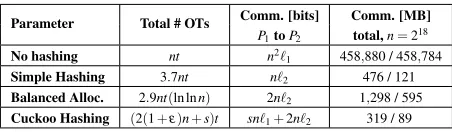
Balanced Alloc. 2.9nt(ln lnn) 2n`2 1,298 / 595 Cuckoo Hashing (2(1+ε)n+s)t sn`1+2n`2 319 / 89
Table 4: Number of OTs and communication for the different hashing-based protocols. The total communi-cation given in the last column is calculated for `1=
λ+log2n,`2=λ+2 log2n,κ=128,λ=40,ε=0.2, s=4. The first value in this column is fort=σ=32
2 1
-OTs per element and the second value is fort=32/8
N
1
-OTs,N=28. It is composed of the total number of OTs in the 2ndcolumn times the communication per OT plus the communication fromP1toP2in the 3rdcolumn.
(since not all items can be mapped to bins), or one of the parties needs to request a new hash function (a request that leaks information about the input set of that party). On the other hand, the number of performed comparisons increases withbandmaxb. An asymptotic analysis of the
maximum bin size was presented in [22, 24], but leaves the exact choice ofbandmaxband the resultingPfailto
further work. In the following, we analyze the complex-ity of the hashing schemes when used in combination with our set inclusion protocol, described in§5. To com-pare the performance of the hashing schemes on a unified base, we depict in Tab. 4 the overall communication, di-vided into the number of OTs (where we runt OTs per element) and the number of bits sent fromP1toP2.
In§E we detail the analysis of setting the optimal pa-rameters for usage of the different hashing schemes in our PSI protocol, and of the resulting number of OTs and communication overhead. The results are depicted in Tab. 4 and show that Cuckoo hashing has the lowest communication. In addition, this scheme has a stronger guarantee on the upper bound ofPfail, since we achieve
rehash probability ofn−s. We therefore use this scheme in our implementation and experiments.
A note on approximations When using a hashing scheme with fixed bin sizes it is possible that the number of items mapped to a certain bin, say byP1, is larger than
the capacity of the bin. (This event happens with prob-ability Pfail.) In such a case it is possible forP1to ask
to use a new hash function. This request reveals some information about P1’s input. Another option is forP1
to ignore the missed item, and therefore essentially com-pute an approximation to the intersection. This choice, too, might reveal information aboutP1’s input, albeit in
proto-col, the occurrence of a false positive might leak infor-mation. The best solution to this issue is to make sure that the probability of these events happening is negligi-ble, so that it is almost certain that these events will not occur in practice. This is the approach that we take in our comparisons. (Another approach would be to allow the computation of an approximation of the original in-tersection function, while analyzing the privacy leakage effects of this computation, and deciding whether to tol-erate them. The result might be a more liberal choice of parameters which will result in a more efficient imple-mentation of the original protocol.)
7
Experimental Evaluation
In the following we experimentally evaluate the PSI pro-tocols described before. We describe our benchmarking environment in§7.1 and then detail the comparison be-tween the protocols in§7.2. Tab. 5 compares the single-threaded runtimes of all protocols over Gigabit LAN, Tab. 6 compares the communication complexities, and Tab. 7 compares the single-threaded runtimes on differ-ent networks. In the tables we highlight the protocol with lowest runtime and communication for each type.
7.1
Benchmarking Environment
We ran our experiments on two Intel Core2Quad desk-top PCs (withoutAES-NI extension) with 4 GB RAM, connected via Gigabit LAN. In each experiment,P1and P2held the same number of input elements nand were
not allowed to perform any pre-computation. We set
n as in [19], i.e., n∈ {210,212,214,216,218}, but omit-ted n=220, since many implementations exceeded the available main memory. We use σ =32 as the bit length of the elements.8 We use a statistical security
parameterλ =40 and a symmetric security parameter κ∈ {80,128}(other security parameters are chosen
ac-cording to Tab. 2). For our set-inclusion protocol we set
η=8, i.e., use 1-out-of-28OT extensions (cf.§C.3).
In our tables, the asymptotic performance is given for the party with the majority of the workload, and are divided to public-key operations (asym) and symmetric cryptographic operations (sym).
Implementations The implementation of the blind-RSA-based [16] and garbled Bloom-Filter [19] proto-cols were taken from the authors, but we used a hash-table to compute the last step in the blind-RSA proto-col that finds the intersection (the original implemen-tation used pairwise comparisons with quadratic
run-8For protocols whose complexity depends on
σ, elements from a large domain can be hashed to short representations as described in§A.
time overhead). We implemented a state-of-the-art Yao’s garbled circuits protocol (using garbled-row-reduction, point-and-permute, free-XOR, and pipelining, cf [31]) by building on the C++ implementation of [13] and using the fixed-key garbling scheme of [8]9. For Yao’s garbled circuits protocol, we evaluated a size-optimized version of the sort-compare-shuffle circuit (comparison circuits of size and depth σ) while for GMW we evaluated a
depth-optimized version (comparison circuits of size 3σ
and depth log2σ) forσ-bit input values [55].
We implemented FFC (finite field cryptography) and IFC (integer factorization cryptography) using the GMP library (v. 5.1.2), ECC using the Miracl library (v. 5.6.1), symmetric cryptographic primitives using OpenSSL (v. 1.0.1e), and used the OT extension implementation of [1] which requires about 3 symmetric cryptographic opera-tions per OT for the asymptotic performance analysis.
We argue that we provide a fair comparison, since all protocols are implemented in the same programming lan-guage (C/C++), run on the same hardware, and use the same underlying libraries for cryptographic operations.
For each protocol we measured the time from starting the program until the client outputs the intersecting ele-ments. All runtimes are averaged over 10 executions.
7.2
Performance Comparison
We divide the performance comparison into three cate-gories, depending on whether the protocol is based on public-key operations, circuits, or OT. Afterwards, we provide experiments for different networks and give a comparison between the best protocols in each category.
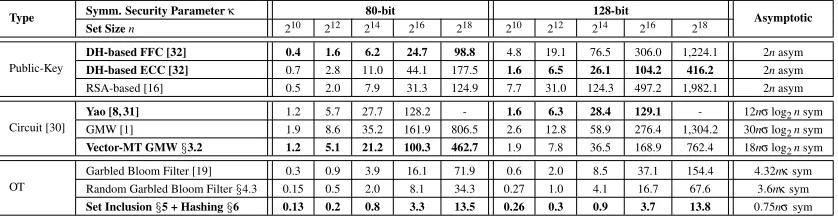
Public-Key-Based PSI For the public-key-based PSI protocols, we observe that the DH-based protocol of [32] outperforms the RSA-based protocol of [16] when using finite field cryptography (FFC). Similarly to [1], we also obtain the somewhat surprising result that for 80-bit se-curity elliptic curve cryptography (ECC) using the Mir-acl library is slower than FFC using the GMP library. For larger security parameters, however, ECC becomes more efficient and outperforms FFC by a factor of 3 for 128-bit security for the DH-based protocol. (The reason for this phenomenon might be better implementation optimiza-tions in the GMP library.) The advantage of the ECC-based protocol is its communication complexity, which is lowest among all PSI protocols, cf. Tab. 6. We note that a major advantage of these protocols is their simplicity, which makes them comparably easy to implement.
9The security of the fixed-key garbling scheme is somewhat
Type Symm. Security Parameterκ 80-bit 128-bit Asymptotic Set Sizen 210 212 214 216 218 210 212 214 216 218
Public-Key
DH-based FFC [32] 0.4 1.6 6.2 24.7 98.8 4.8 19.1 76.5 306.0 1,224.1 2nasym
DH-based ECC [32] 0.7 2.8 11.0 44.1 177.5 1.6 6.5 26.1 104.2 416.2 2nasym
RSA-based [16] 0.5 2.0 7.9 31.3 124.9 7.7 31.0 124.3 497.2 1,982.1 2nasym
Circuit [30]
Yao [8, 31] 1.2 5.7 27.7 128.2 - 1.6 6.3 28.4 129.1 - 12nσlog2nsym GMW [1] 1.9 8.6 35.2 161.9 806.5 2.6 12.8 58.9 276.4 1,304.2 30nσlog2nsym Vector-MT GMW§3.2 1.2 5.1 21.2 100.3 462.7 1.9 7.8 36.5 168.9 762.4 18nσlog2nsym
OT
Garbled Bloom Filter [19] 0.3 0.9 3.9 16.1 71.9 0.6 2.0 8.5 37.1 154.4 4.32nκsym Random Garbled Bloom Filter§4.3 0.15 0.5 2.0 8.1 34.3 0.27 1.0 4.1 16.7 67.6 3.6nκsym
Set Inclusion§5 + Hashing§6 0.13 0.2 0.8 3.3 13.5 0.26 0.3 0.9 3.7 13.8 0.75nσsym
Table 5: Runtimes in seconds for PSI protocols with one thread over Gigabit LAN (σ=32: bit size of set elements,
asym: public-key operations, sym: symmetric cryptographic operations).
Type Symm. Security Parameterκ 80-bit 128-bit Asymptotic Set Sizen 210 212 214 216 218 210 212 214 216 218
Public-Key
DH-based FFC [32] 0.4 1.5 6.0 24.0 96.0 1.1 4.5 18.0 72.0 288.0 3nρ
DH-based ECC [32] 0.1 0.2 1.0 3.8 15.0 0.1 0.4 1.5 6.0 24.0 3nϕ
RSA-based [16] 0.3 1.1 4.3 17.3 69.0 0.8 3.1 12.5 50.0 200.0 2nρ+2nκ
Circuit [30]
Yao [8, 31] 28.1 135.0 630.0 2,880.0 12,960.0 45.0 216.0 1,008.0 4,608.0 20,736.0 9nκ σlog2n GMW [1] 31.3 150.0 700.0 3,200.0 14,400.0 50.0 240.0 1,120.0 5,120.0 23,040.0 10nκ σlog2n
Vector-MT GMW§3.2 18.8 90.0 420.0 1,920.0 8,640.0 30.0 144.0 672.0 3,072.0 13,824.0 6nκ σlog2n
OT
Garbled Bloom Filter [19] 3.4 13.5 54.0 216.0 864.0 7.6 30.2 121.0 483.8 1,935.4 2.88nκ(κ+λ) Random GBF§4.3 1.1 4.5 18.1 72.6 290.4 2.9 11.6 46.2 184.9 739.7 1.44nκ2+n(λ+2 log2n) Set Inclusion§5 + Hashing§6 0.2 0.8 3.3 13.4 54.3 0.3 1.2 4.8 19.4 78.3 0.5nκ σ+6n(λ+2 log2n)
Table 6: Communication complexity in MB for PSI protocols. (σ=32: bit size of set elements, security parameters κ,λ,ρ,ϕas defined in§2.1). Numbers are computed from the asymptotic complexity given in the last column.
Circuit-Based PSI Here we tested Yao- and GMW-based implementations, as well as an implementation of our optimized vector multiplication-triple-based GMW protocol (§3.2). Following is a summary of the results:
• Both the computation complexity and the communi-cation complexity of the circuit-based PSI protocols are the highest among all protocols that we tested.
• The basic GMW protocol has the highest overall runtime and communication complexity.
• Our vector multiplication triple optimization re-duces the runtime and communication of GMW by approximately 40%. For security parameter
κ=80, this implementation is slightly faster than Yao’s protocol, but it is slightly slower for κ =
128. Communication-wise, the vector multiplica-tion triple GMW is more efficient than Yao’s proto-col.
• The runtime of Yao’s protocol hardly increases with the security parameter, since we use AES-128 for both versions. Note, however, that our implemen-tation of Yao’s protocol exceeded the main memory when processing 218elements.
• Our Yao implementation does not use the AES-NI hardware support. Using AES-NI is likely to im-prove the runtime of the Yao implementation.
We give a more detailed performance comparison for GMW and Yao’s protocol in Appendix§D.2.
OT-Based PSI The random garbled Bloom filter pro-tocol of§4.3 improves the original garbled Bloom filter protocol of [19] by more than a factor of two in runtime and by factor of 2-3 in communication.
We also implemented our protocol of §5, where we used Cuckoo hashing with parametersε=0.2 ands=4, cf.§6. This protocol had the best runtime, and was about 5 times faster than the random garbled Bloom filter pro-tocol forκ=128. In terms of communication, our set
inclusion protocol uses less than 20% of the communi-cation of the random garbled Bloom filter protocol for
κ=80 and less than 10% communication forκ=128.
The main difference between the set inclusion protocol and the random garbled Bloom filter protocol is the de-pendency of the performance on the symmetric security parameterκ. In the random garbled Bloom filter proto-col, the number of OTs is independent of the bit-lengthσ
but scales linearly withκ. On the other hand, the number of OTs for the set inclusion protocol is independent ofκ
Type Network Gigabit LAN 802.11g WiFi Intra-country WAN Inter-country WAN HSDPA (Bandwidth (Mbit/s) / Latency (ms)) (1,000 / 0.2) (54 / 0.2) (25 / 10) (10 / 50) (3.6 / 500)
Public-Key DH-based ECC [32] 104.2 104.8 107.6 111.8 115.9
Circuit [30] Yao [8, 31] 129.1 779.5 1,735.5 4,631.8 11,658.6
Vector-MT GMW§3.2 168.9 (11.3) 370.5 (18.1) 770.4 (27.5) 1,936.5 (67.2) 5,310.9 (170.2)
OT Random Garbled Bloom Filter§4.3 16.6 37.2 70.8 164.9 445.0
Set Inclusion§5 + Hashing§6 3.7 5.0 8.8 22.8 77.5
Table 7: Runtimes in seconds for PSI protocols with one thread in different network scenarios forn=216elements,
σ=32: bit size of elements, andκ=128-bit security (cf. Tab. 2); online time for Vector-MT GMW in ().
Experiments for Different Networks For each pro-tocol type (public-key-based, circuit-based, and OT-based), we benchmark the best performing PSI protocol in different network scenarios: Gigabit LAN, 802.11g WiFi, intra-country WAN, inter-country WAN, and mo-bile Internet (HSDPA) and depict our results in Tab. 7. We characterize each network scenario by its bandwidth and latency. By latency we mean one-way latency, i.e., the time from source to sink, and we used the same band-width for up- and downlink. We simulated these network types using the Linux commandtcand ran the protocols onn=216elements forκ=128 and with one thread.
The only protocol that is nearly unaffected by the change in network environment and for which the net-work has not become the bottleneck is the DH-based ECC protocol. In this protocol computation is the bottle-neck which can be improved by using multiple threads.
For the other protocols we observe how the main bot-tleneck transitions from computation to communication:
For Yao’s protocol this transition happens very early, already when changing from Gigabit LAN to WiFi (fac-tor 6 in runtime).10 Our vector-MT GMW protocol and our random garbled Bloom filter protocol suffer less drastically from the decreased bandwidth (factor 2.3 in runtime). However, from the WiFi connection on, the performance of all three protocol decreases approxi-mately linear in the bandwidth. Note that, although our vector-MT GMW protocol has only 66% of the commu-nication complexity of Yao’s protocol, it is more than two times faster in slower networks. This can be explained by the direction of the communication. In Yao’s protocol, the large garbled circuit is sent in one direction, whereas the communication in GMW can be evenly distributed in both directions s.t. it uses both up- and downlink.
For our set inclusion protocol, the network satura-tion happens when using intra-country WAN. From this point on, the performance also decreases linearly with the bandwidth. Still, this protocol is the fastest of all protocols in all network settings.
10The performance advantage of using fixed-key AES garbling
in-stead of SHA-1/SHA-256 already diminished in the WiFi setting.
Experiments with Multiple Threads Tab. 8 shows the runtimes with four threads. Of special interest is the last column, which shows the ratio between the runtimes with four threads and a single thread forn=218elements
and security parameterκ=128. The DH-based protocol,
which is very simple and easily parallelizable, achieves almost the optimal speedup of 4x as computation is the performance bottleneck. The GMW protocol achieves only a speedup of about 2x, possibly due to the gate-by-gate evaluation of the circuit resulting in multiple rounds of communication as the bottleneck. The OT-based pro-tocols achieve a very good speedup of about 3x.
Comparison From the results we observe that OT-based protocols have the lowest runtime on a fast net-work. The public-key-based protocols require costly public-key operations, which scale very poorly with in-creasing security parameter, but need less communica-tion than the OT- or based protocols. The circuit-based protocols have a smaller runtime than the public-key-based protocols using FFC or RSA forκ=128, but by far the highest communication complexity.
Our set inclusion protocol achieves both the most ef-ficient runtime and a very low communication overhead. Compared to the second fastest protocol, namely our op-timized random garbled Bloom-filter protocol, the set in-clusion protocol is at least 5 times faster and uses 10 times less communication (for 128 bit security). More-over, this protocol has the second best communication overhead, requiring only 3 times the communication of the DH-ECC-based protocol of [32], but running faster in all network environments that we tested.
We stress that the choice of the preferable PSI protocol depends on the application scenario. For instance,
• If communication is the bottleneck and computation is vast, then the DH-based PSI protocol using ECC is the most favorable. That protocol is also the sim-plest protocol to implement.
![Table 3: Communication and computation complexitiesfor Bloom-filter-based PSI of [19] and our optimiza-tion](https://thumb-us.123doks.com/thumbv2/123dok_us/7914309.1314091/8.612.77.291.70.151/table-communication-computation-complexitiesfor-bloom-lter-based-optimiza.webp)