Available Online atwww.ijcsmc.com
International Journal of Computer Science and Mobile Computing
A Monthly Journal of Computer Science and Information Technology
ISSN 2320–088X
IMPACT FACTOR: 6.199
IJCSMC, Vol. 8, Issue. 4, April 2019, pg.103 – 107
Video Analysis with Image
Recognition in TensorFlow
Avijeet Jha
1; Ashish Jha
2; Amarjeet Kushwaha
3; Deepak Aeloor
4¹Department of Computer Engineering, St. John College of Engineering and Management, India
²Department of Computer Engineering, St. John College of Engineering and Management, India
³Department of Computer Engineering, St. John College of Engineering and Management, India
4
Department of Computer Engineering, St. John College of Engineering and Management, India
1
[email protected]; 2 [email protected]; 3 [email protected]; 4 [email protected]
Abstract— Video analytics, loosely defined as autonomous understanding of events occurring in a scene. The use of deceptive techniques in user-generated video portals is ubiquitous. Unscrupulous up loaders deliberately mislabel video descriptors aiming at increasing their views and subsequently their ad revenue. This problem, usually referred to as "click-bait," may severely undermine user experience. In this work, we study the click-bait problem on YouTube by collecting metadata for 206k videos. To address it, we devise a deep learning model based on variation auto-encoders that supports the diverse modalities of data that videos include. Every click earns them display advertisement revenue. Social media users who are tricked into clicking may experience a sense of disappointment or agitation, and social media operators have been observing growing amounts of click bait on their platforms. As largest video-sharing platform on the web, YouTube, too, suffers from click bait. Thus, it is susceptible to recommending misleading videos to users. Keywords— Video analysis, Clickbait, Sentiment analysis, Machine Learning, Transfer Learning
I. INTRODUCTION
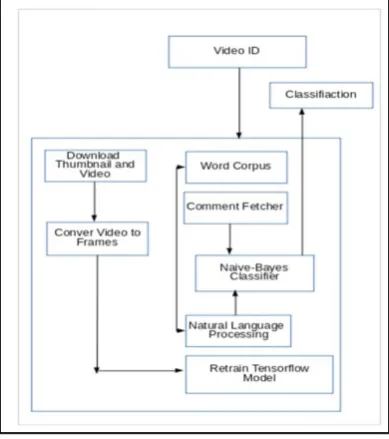
the spam problem is not as prevalent as a few years ago due to the deployment of systems that diminish it. Furthermore, users have an increased awareness of typical spam content (e.g., emails, etc.) and they can effortlessly discern it. However, this is not the case for click-bait, which usually contains hidden false or ambiguous information that users or systems might not be able to perceive. Comments that were found in click-bait videos. The users frustration is apparent (we omit users’ names for ethical reasons).There are basically two models for obtaining the final result in our system (I) Using thumbnail of the video and matching [8] it with the video frames divide on per second rate of the video length and (ii) sentiment analysis on the comments of the video extracted from the video URL [9].We propose a deep generative model that allows for combining data from as diverse modalities as video headline text, thumbnail image and tags text, as well as various numerical statistics, including statistics from comments. Most importantly, the proposed model allows for successfully ad- dressing the problem of learning from limited labelled samples and numerous unlabelled ones (semi-supervised learning). This is achieved by postulating a deep variation auto-encoder that employs a finite mixture model as its encoder. In this context, mixture component assignment is regulated via an appropriate gating network; this also constitutes the eventually obtained classification mechanism of our deep learning system. We provide a large-scale analysis on YouTube; we show that, with respect to the collected data, its recommendation engine does not consider how misleading a recommended video is. Hence, it is susceptible to recommending click-bait videos to its users.
II. LITERATURE REVIEW
2.1. Impression Network for Video Object Detection
The paper [1] is inspired by how human utilize impression to recognize objects from blurry frames, they propose Impression Network that embodies a natural and efficient feature aggregation mechanism. These methods treat single image recognition pipeline as two stages: 1. the image is passed through a general feature network; 2. the result is then generated by a task-specific sub-network This enables successful detection on low-quality frames, but the aggregation cost can be huge thus further slows down the framework. In this work, we combine the advantages of both tracks.
2.2. An 10Sent: A Stable Sentiment Analysis Method Based on the Combination of Off-The-Shelf Approaches
The authors of paper [2] propose to combine several very popular and effective state-of-the-practice sentiment analysis methods, by means of an unsupervised bootstrapped strategy for polarity classification. Their main goals is to reduce the large variability (lack of stability) of the unsupervised methods across different domains (datasets). The experimental results demonstrate that their combined method (aka, 10SENT) improves the effectiveness of the classification task, but more importantly, it solves a key problem in the field.
2.3. Should I use TensorFlow
The paper [3] is based on evaluation of TensorFlow and its potential to replace pure Python implementations in Machine Learning The rapidly growing field of Machine Learning has been gaining more and more attention, both in academia and in businesses that have realized the added value. By utilizing TensorFlow, one can thus overall describe a model more expressively, with less effort and with less potential errors.
2.4.
Sentiment Analysis of Review Datasets using Naïve Bayes’ and K-NN ClassifierThis paper [4] mainly describes Bayesian network classifiers are a popular supervised classification paradigm. A well-known Bayesian network classifier is the Naïve Bayes’ classifier is a probabilistic classifier based on the Bayes’ theorem, considering Naïve (Strong) independence assumption. It was introduced under a different name into the text retrieval community and remains a popular(baseline) method for text categorizing, the problem of judging documents as belonging to one category or the other with word frequencies as the feature.
III. METHODOLOGY
by researchers working at YouTube, we would be left with no choice but to crawl YouTube ourselves. Below, we briefly review the construction and original purpose of the YouTube 8M dataset, describe our efforts to augment the dataset with the meta data necessary for clickbait detection (rendering the dataset also useful for tackling other research questions), and give a brief overview of the corpus statistics. Altogether, the resulting corpus compiles (if available) the meta data, comments, thumbnails, and subtitles ("captions") of 6,192,353 videos in a unified format, which we make available to other researchers on request.2 Table 1 gives an overview of the corpus.
Category
Table 1 reports the categories we find on the videos. In total, we find 15 categories but we only show the top five in terms of count for brevity. We observe that most clickbait’s exist in the Entertainment and Comedy categories, whereas non-click baits are prevalent in the Sports category. This indicates that, within this dataset, YouTubers employ clickbait techniques on videos for entertainment.
Headline
YouTubers normally employ deceptive techniques on the headline like the use of exaggerating phrases. To verify that this applies to our ground truth dataset, we perform stemming to the words that are found in clickbait and non-clickbait headlines. Fig. 2 (a) depicts the ratio of the top 20 stems that are found in our ground truth clickbait videos (i.e., 95% of the videos that contain the stem “sexy” are clickbait). In essence, we observe that magnetizing stems like “sexy” and “hot” are frequently used in clickbait videos, whereas their use in non-clickbait’s is low. The same applies to words used for exaggeration, like “viral” and “epic”.
Thumbnail
To study the thumbnails, we make use of Imagga [19], which offers descriptive tags for an image. We perform tagging of all the thumbnails in our ground truth dataset. Fig. 2(b) demonstrates the ratio of the top 10 Imagga tags that are found in the manually reviewed ground truth. We observe that clickbait videos typically use sexually-appealing thumbnails in their videos in order to attract viewers. For instance, 81% of the videos’ thumbnail of which contains the “pretty” tag are clickbait’s.
Tags
Tags are words that are defined by YouTubers before publishing and can dictate whether a video will emerge on users’ search queries. We notice that clickbait’s use specific words on tags, whereas non-clickbait’s do not. Fig. 2 (c) depicts the ratio of the top 20 stems that are found in clickbait’s. We observe that many clickbait videos use tags like “try not to laugh”, “viral”, “hot” and “impossible”; phrases that are usually used for exaggeration.
Statistics
Fig. 2 (d) shows the normalized score of the video statistics for both classes of videos. Interestingly, clickbait’s and non-clickbait’s videos have similar views; suggesting that viewers are not able to easily discern clickbait videos, hence clicking on them. Also, non-clickbait videos have more likes and less dislikes than clickbait’s. This is reasonable as many users feel frustrated after watching clickbait’s.
Video ID
This is unique video id which is given by user.
Comment Fetcher
This is used to fetch comments of the given video for sentiment analysis.
Word Corpus
It is document of huge wordlist containing positive and negative words to train the model.
Retrain TensorFlow Model
This is used to retrain the TensorFlow model using frames from video.
Natural Language Processing
This is used to perform many Natural Language Processing operation like tokenizing, vectorization and lemmatization.
Image recognition
The TensorFlow model is used to recognize the thumbnail against the video. The accuracy of prediction will be more if thumbnail is part of video. If thumbnail is not in video, then content and thumbnail are different.
IV.RESULTS
Fig 2 & Table 1
Analysis of the manually reviewed ground truth dataset. Normalized mean scores for: (a) stems from headline text; (b) tags derived from thumbnails; (c) stems from tags that were defined by uploaders; (d) video statistics; and (e) comments that contain words for flagging suspicious videos. Table 1 shows the top five categories (and their respective percentages) in our ground truth dataset.
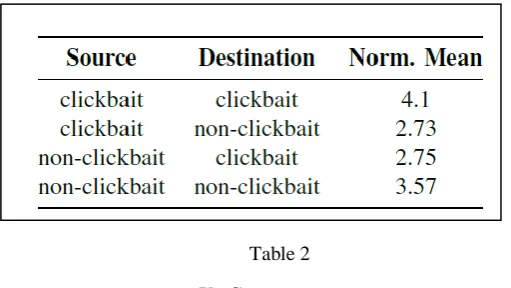
Table 2
Table 2
V. CONCLUSION
VI. ACKNOWLEDGEMENT
We thank our guide, Mr. Deepak Aeloor who has extended all valuable guidance and help through various stages for the development of the project. Her Valuable suggestions were of immense help throughout the project work.
We convey our sincere regards to our respected principal Dr. G.V. Mulgund and Head of Department Dr. G.A. Walikar for their valuable support.
R
EFERENCES
[1] Piperjaffray. Survey, 2016. http://archive.is/AA34y.
[2] G. Stringhini, M. Egele, A. Zarras, T. Holz, C. Kruegel, and G. Vigna. B@bel: Leveraging Email Delivery for Spam Mitigation. In USENIX Security, 2012. U. Yabas, H. Cankaya, T. Ince. 2012. “Customer churn prediction for telecom services.” 2012 IEEE 36th
Annual computer software and application conference, Nov.2012.
[3] G. Stringhini, T. Holz, B. Stone-Gross, C. Kruegel, and G. Vigna. BOTMAGNIFIER: Locating Spambots on the Internet. In USENIX Security, 2011.
[4] G. Stringhini, C. Kruegel, and G. Vigna. Detecting spammers on social networks. In CSA, 2010.
[5] H. Gao, Y. Chen, K. Lee, D. Palsetia, et al. Towards Online Spam Filtering in Social Networks. In NDSS, 2012.
[6] N. Jindal and B. Liu. Review spam detection. In WWW, 2007.
[7] S. Zannettou, S. Chatzis, K.Papadamou. The Good, the Bad and the Bait: Detecting and Characterizing Clickbait on YouTube, 2018. [Online] [Accessed:Nov 15,2018]
[8] C. Hetang,H. Qin,S. Liu,J. Yan . Impression Network for Video Object Detection, 2017.
[9] P. Melo, M. Gonçalves, F. Benevenuto.10Sent: A Stable Sentiment Analysis Method Based on the Combination of Off-The-Shelf Approaches, 2018.