Efficient Quantum-Immune Keyless Signatures with Identity
Ahto Buldas1,2, Risto Laanoja1,2, and Ahto Truu1 1
Guardtime AS, Tammsaare tee 60, 11316 Tallinn, [email protected]
2 Tallinn University of Technology, Ehitajate tee 5, 12618 Tallinn, Estonia.
Abstract. We show how to extend hash-tree based data signatures to server-assisted personal digital signature schemes. The new signature scheme does not use trapdoor functions and is based solely on cryptographic hash functions and is thereby, considering the current state of knowledge, resistant to quantum computational attacks. In the new scheme, we combine hash-tree data signature (time-stamping) solutions with hash sequence authentication mechanisms. We show how to implement such a scheme in practice.
1 Introduction
Electronic signatures use secret keys to protect the integrity of data. Keys can be compromised because of technical failures, human factor, or both threats in combination. In the creation process of electronic signatures, some types of secrets (keys, passwords, etc.) seem unavoidable, because secrets are necessary for authenticating the signer. Even if one uses biometric authentication, there must be a secure channel between the biometric reader and the signature creation device, and even if the signature creation device is physically (and securely) connected to biometric reader, the signature itself must be protected against modification (the integrity of signatures) and traditional solutions use public-key cryptography for that. This means that the validity of signatures depend on assumptions that some private keys are secure. For example, the keys of Public Key Infrastruc-ture (PKI) service providers like the OCSP responders are used to sign the validity statements of public-key certificates. Thereby, signatures created with secret keys look more like testimonies than independent (irrefutable) proofs of facts and it is hard to achieve certainty beyond reasonable doubt. Large service providers are often even interested in denying the fact that their keys might have been abused.
Instant revocation has been a serious problem for traditional PKI signatures. On one hand, revocation is necessary to protect the signer if the signature key becomes insecure. On the other hand, the possibility of revocation makes the signature verification procedure much more complex, because it must be proven that the key was not revoked at the time of creating the signature. This means that many additional confirmations (such as OCSP responses, timestamps, etc.) must be added to the signature together with public-key certificates. Note that if instant revocation is possible, a signature key might be revoked right after signing, which means that electronic signature solutions must be very precise in determining the chronological order of the signing and the revocation events. For some types of documents, such a determination must be possible decades after these documents have been signed.
– Signatures are compact in size and independently verifiable, their verifiability does not require any communication with third parties.
– Instant revocation of signature creation keys is possible and does not involve certificate revoca-tion list management.
– Integrity of signatures does not depend on the secrecy of keys, i.e. signatures stay verifiable after their creation so that no secrecy assumptions (i.e. that some keys are secret during the verification) are needed.
– Trusted third parties are unable to forge clients’ signatures, i.e. the signatures can be used for
non-repudiation.
– Signatures are immune to quantum computational attacks, which means that we must avoid of using traditional digital signature schemes like RSA.
To achieve these goals, we use server-based signatures where all signatures are created with assis-tance ofsignature servers—third parties that on clients’ requests create signatures in the name of clients. Instead of using traditional digital signature schemes that might be vulnerable to quantum attacks, we use the so-called hashing and publishing mechanism, where the server creates a Merkle hash tree [21] from the requests it receives and publishes the root hash of the tree as a trust anchor. The server authenticates the clients and adds their identities to the hash tree. Everyone who has an authentic copy of the published root hash and certain hash values in the tree can verify the signature. As hash functions are keyless, the integrity of such signatures does not depend on any secrets.
As in such a scheme, servers are able to create signatures in the name of their clients, the non-repudiation feature is not achieved. For still having the non-repudiation property, we have to include a proof of authentication to a signature, which can only be created in the presence of the client, i.e. servers are unable to forge clients’ signatures. One example of a proof of authentication is an RSA signature of the client but we have to avoid using RSA because of the goals of this paper—we have to avoid modular arithmetic based one-way functions because they are vulnerable to quantum attacks. Note also that one cannot usemessage authentication codes (MACs) for non-repudiation because the server and the client have copies of the same key and the server is able to create signatures in the name of its clients.
For that reason, we use a solution where clients are authenticated via one-time passwords that are generated by applying a one-way hash function iteratively to a secret random seed. Such an authentication technique was first proposed by Lamport [19]. The idea of using iterated hashing for non-repudiation was first proposed in [22] but their scheme is not suitable for creating independently verifiable compact signatures.
2 Preliminaries
2.1 Traditional Signature Solutions
In a traditional signature system, each user has a private keyd, and a public keyewhich is made available to all potential verifiers. To sign a message m, the signer applies a signature function σ =S(d, m). To verify a digital signature, one has to use a verification functionV(e, m, σ) which returns 1 if and only if the signature is correct.
For reliable distribution of public keys, a trustedCertification Authority (CA) is used. The CA also have a private key which is used to sign public key certificates—statements that bind public keys to identities of users. The certificate is mostly added to the signature for reliable verification of the key-identity relationship.
It is also foreseen that users may revoke their keys (certificates) in case the keys are suspected of being compromised. Hence, one also needstime stamps in order to prove that the signature was created before the key was revoked. Therefore, the PKI signature schemes also need a trustedTime Stamping Authority (TSA). Time-stamping is a mechanism to prove that certain data was created at (or before) certain time. In the context of signatures it helps to determine whether the key was valid (not revoked) at the time of creating the signature. In PKI, time-stamping service is provided by trusted third parties who just sign the hash of the data (sent by a client) together with current time-reading.
Actually, one needs even more trusted parties in the PKI-based signature solutions. Usually there are also the so-called On-line Certificate Status Protocol (OCSP) responders, whose duty is to confirm the validity of public key certificates. The OCSP-responders also use private keys to sign the validity statements. Also the OCSP responses must be reliably dated.
Due to the complicated structure of trusted third parties that are necessary in the traditional signature solutions, the structure of a signature is very complicated. It consists of the signature, the certificate, the time stamp of a signature, the OCSP-response, etc. Still, in spite of its complexity, the pki signatures do not provide a complete solution to the fundamental question of what happens if the keys of the trusted third parties become compromised. We need another layer of timestamps, OCSP-responses, etc. that are signed by higher-level trusted third parties, and so on. So, we have a chicken and egg problem. Moreover, there are some more fundamental threats for traditional digital signatures like the fast developing field of quantum computations.
2.2 Quantum Computing
Traditional electronic signatures use trapdoor one-way functions such as RSA and they will be insecure for thequantum age.
2.3 Hash-Tree Digital Signature Schemes
Hash functions seem to stay secure and there exist signatures schemes that are entirely based on hash functions. The first such scheme was proposed in 1979 by Lamport [18]. The Lamport signature scheme is very inefficient because of signature size (a few hundred hash values) and the public key size (two hash values for every signed bit). In 1980, Merkle [21] proposes of using hash-trees in order to efficiently publish a large public key. Though the Lamport signature scheme and its more efficient modification by Merkle are secure against known quantum attacks, they still have a fundamental weakness related to secret keys—the secrecy of keys is a necessary assumption not only for the security of signing but also for the security of verification. If the key is compromised, all signatures become unreliable. So, the revocation problem still remains.
2.4 Data Signatures using Merkle Trees
Data signature is a mechanism to protect the integrity of data, i.e. to prevent unauthorized mod-ification of data. The so-called hashing and publishing mechanism is used for that purpose. Data is hashed by using public and standard cryptographic one-way hash functions. The hash is pub-lished in widely witnessed ways (in newspapers etc.) Many hashes are pubpub-lished together by using
Fig. 1.Merkle hash tree.
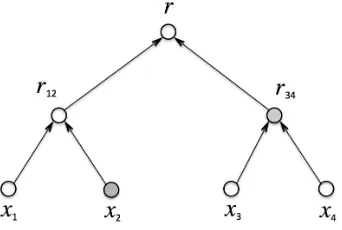
a Merkle hash tree [21] (Fig. 1). The leaves (x1, . . . , x4 in Fig. 1) of the tree are paired and hashed
recursively to compute the root hash r of the tree which is published. A data signature (of a data record) is a proof that the data record took part of creating a global hash tree (for certain time unit). The proof is a slice of the global tree (a hash chain) that consists of the data that is abso-lutely necessary to re-compute the root of the global hash tree. For example, the time stamp forx1
in Fig. 1 consists ofx2 (for re-computing r12) and r34 (for recomputing r from r12). Time stamps
are compact, because in case ofN leaves, their size is justO(logN).
2.5 Hash Calendar
Hash calendar [4] is a special kind of hash tree. At any given moment, the tree contains a leaf node for each second since 1970-01-01 00:00:00 UTC. The leaves are numbered left to right starting from zero and new leaves are always (every second) added to the right (Fig. 2). The internal nodes of the tree can only be computed if the corresponding predecessor nodes have been computed. For example at time 6 by UTC, we have three subtrees computed (Fig. 2, left): one for the leaves 0-3, one for 4-5 and a singleton tree for 6. To compute the published hash value at time 6 (in case this was the publishing time), a temporary hash valuex=h(x45, x6), where x45 is the root of the tree with
leaves 4,5, and x6 is the 6th leaf, and finally the published hash R is computed as R =h(x03, x),
wherex03is the root hash of the tree with leaves 0,1,2,3. In this example, the calendar hash chain
Fig. 2.Hash calendar at time 6 by UTC (left), publishing computations (the middle tree), and the calendar hash chain for the 5th UTC second.
for the 5th leaf is depicted in Fig. 2 right. It hash a right link as the first link with sibling hash 4, a right link structure with sibling hash 6 as the second link, and right link structure with sibling x03 as the third and final link.
Since the calendar tree is built in a deterministic manner, the shape of the tree for any moment can be reconstructed knowing just the number of leaf nodes in the tree at that moment, which is one more than the number of seconds from 1970-01-01 00:00:00 UTC to that moment. Therefore, given the time when the calendar tree was created and a hash chain extracted from it, the UTC time value that corresponds to the leaf node is uniquely determined.
Hash Calendar in action.A publicly available hash calendar can be used as an audit mechanism
in order to prevent malicious behavior of the server. Real world’s publishing mechanisms are usually not efficient enough to publish every hash in the calendar immediately after creation. So during the time period between creating a calendar hash and publishing it the server may try to reorder the calendar hash values. To prevent that happening, the server should reply promptly after creating a new calendar has so that the reply contains a unique representation on the whole previous calendar. For example, when creating x6 (Fig. 2), the server has to reply with the two root hash values: the
root of the subtree with leavesx0, x1, x2, x3 and the subtree with the leavesx4, x5. If the server still
tries to reorder the calendar hash values, then it has to reply inconsistently to the clients, which will be detected sooner or later.
2.6 Signatures with Identity and Keyless Signatures’ Infrastructure (KSI)
signed data. In this case of course signers need to be authenticated by the service and (at least to current knowledge) some sort of secrets for authentication would be necessary. Still, even if keys or passwords are used for authentication, the integrity and reliability of the signatures does not depend on the secrecy of any keys. During the creation of a personal keyless signature, the signer
Fig. 3.Identities in a keyless signature.
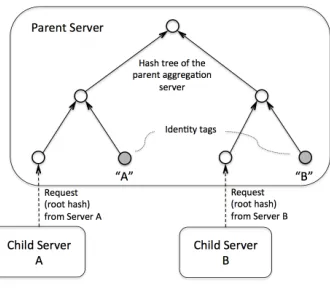
isauthenticated by the service and signer’s identity is added to the global hash tree (together with the signed hash value).
Note that for scalability reasons a hierarchy of aggregation servers, the so-called Keyless Sig-natures’ Infrastructure, KSI [4], is needed to create the global hash tree. Such an infrastructure consists of a hierarchy of aggregation servers that, in co-operation, create the per-round global hash trees. First layer aggregation servers, so-called gateways, are responsible of collecting requests directly from clients, and every aggregation server receives requests from a set of lower level servers, hashes them together into a hash tree, and sends the root hash value of the tree as a request to higher-level servers. The server then waits for the response from a higher-level server and by com-bining the received response with suitable hash chains from its own hash tree responds to lower-level servers.
Parent servers also check the identity of child servers and add their identities into the hash trees together with the corresponding requests (Fig. 3). Having a keyless signature, it can be checked which servers in the global KSI actually created the signature.
2.7 Server-Based Signatures and Trust Issues
Many different forms of server-based signatures exist. For example, Lamport signatures [18] are server based, and also the so-calledon-line/off-line signatures first proposed in 1989 by Even, Goldreich and Micali [12] in order to speed up the signature creation procedure, which is usually much more time consuming than verification. The so-calledserver-Supported Signatures (SSS) pro-posed in 1996 by Asokan, Tsudik and Waidner [1] delegate the use of time-consuming operations of asymmetric cryptography from clients (ordinary users) to a server. Clients use hash chain authen-tication [19] to send their messages to a signature server in an authenticated way and the server then creates a digital signature by using an ordinary public-key digital signature scheme. In SSS, signature servers are not assumed to be Trusted Third Parties (TTPs) because the transcript of the hash chain authentication phase can be used as evidence. In SSS, servers cannot create signatures in the name of their clients. The so-calledDelegate Servers (DS)proposed in 2002 by Perrin, Burns, Moreh and Olkin [22] reduce the problems and costs related to individual private keys. In their solution, clients (ordinary users) delegate their private cryptographic operations to a Delegation Server (DS). Users authenticate to DS and request to sign messages on their behalf by using the server’s own private key. The main motivation behind DS was that private keys are difficult for ordinary users to use and easy for attackers to abuse. Private keys are not memorable like passwords or derivable from persons like biometrics, and cannot be entered from keyboards like passwords. Private keys are mostly stored as files in computers or on smart-cards, that may be stolen.
Trust Issue. The main drawback in server-based signature solutions is that the server must be
completely trusted. Still, it is somewhat unclear whether such a server-based signature system is less trustworthy than the traditional PKI based signature solutions, where the signature keys are held by end-users. In [8], “average persons” creating electronic signatures are compared to illiterate persons signing paper documents in the presence of a notary public. Indeed, the electronic devices for creating electronic signatures are far more complicated than pens used to sign paper documents. Having full control over the electronic signature technology is out of question for most users. Therefore, blind trust is inevitable in the electronic signature systems and it does not make much difference whether to trust your personal computer or a signature server. Considering the limited knowledge average persons have about elementary security procedures, server-based solutions are even preferable to the traditional ones.
2.8 Verifiable Client Authentication and Non-Repudiation
It is desirable to have a “trace of authentication” inside the signature that is verifiable and cannot be forged by the server (or anyone else). We also want the signatures dated totbe unforgeable at any later timet0 > t no matter if the secret authentication key is secure at t0 or not.
Otherwise, the non-repudiation function of the signature is not covered. Clients may not accept the situation that signature servers are capable of signing in their names and must therefore be blindly trusted.
As we also want the signatures to be quantum-immune, we cannot use ordinary digital signature mechanisms (like RSA, DSA, etc.) as the traces of authentication. One way of avoiding quantum threats is using one-time hash-chain type password schemes.
One-Time Hash-Password Schemes The main idea behind iterated hash chain authentication
the number of possible authentication sessions (i.e. the number of one-time passwords)
z`← {0,1}n
zi←h(zi+1) fori∈ {`−1, `−2, . . . ,0}
The last element z0 = h(z1) in the chain is the so-called public key, which is published and also
given to the server.
Now, the client will usez1in the first authentication session. Server does not knowz1 before the
client uses it, but as it knows z0 (the public key) it is possible to verify the password by checking
the relationz0=h(z1). After the first session, the server already knowsz1 and hence it is possible
for the server to check z2 after it is used by the client (by the relationshipz1 =h(z2)), etc.
Time-Dedicated Passwords The indices i may also be related with time, i.e. zi is assumed to
be published by the client not before time t0 +i, where t0 is a certain initial time that is also
published together with the public keyz0. If now for example a messagemand azi is timestamped
together, this may be considered as a signature ofm. The signature is correct only if the date of the timestamp is not later thant0+i. The signature cannot be forged because all published passwords
z1, . . . , zi are useless for creating signatures after t0 +i, because the time stamps obtained later
will not be suitable for later-created signatures (at least if the time-stamps were not intentionally back-dated by the time-stamping authority).
This idea in the context of authentication was first used in the so-called TESLA protocol [23]. However, as it was described by the authors of TESLA, the scheme is not quite suitable for digital signatures, because of inefficiency of off-line verification. TESLA was designed to authenticate parties who are constantly communicating with each other. This is not the case in the use of digital signatures and if one wants to convert TESLA to autonomous digital signatures, their size isO(`).
Efficient Hash Sequence Traversal Considering possible security problems in clients’
comput-ers, the password sequence could be maintained by a dedicated cryptographic hardware device that generates the random seed, computes the chain and then consequtively reveals the preimages. Naive solutions would either require O(`) amount of memory (if the whole hash chain is pre-computed and stored in the device) orO(`) time (if only the seed is stored ) to compute the next preimage. In was shown by Jakobsson et al [17, 11] that O(log`) memory andO(log`) time (per one pre-image) is sufficient.
3 New Keyless Signature Scheme
We show that if we use Keyless Signatures combined with Merkle hash tree type structures instead of hash chains in an authentication procedure analogous to hash chain authentication, then we can produce compact and independently verifiable signatures, which are quantum immune (at least against the known quantum attacks) and the integrity of which does not depend on the secrecy of keys.
3.1 Compactness of Signatures
In our solution, together with a one-time password zi, we also add a hash chain to the signature,
place in the hash tree. To verify the proof, one only needs O(logN) steps instead of O(N) that would be needed if we use the standard TESLA authentication scheme.
Fig. 4.Key hash-chain with Merkle tree (left) and a secure version of it (right).
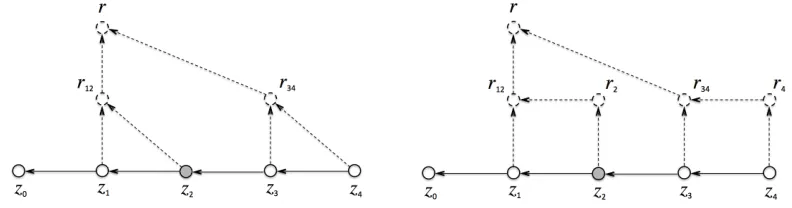
Note however that such a hash tree must have a special form and shape to prevent premature disclosure of one-way passwords. if we just add a Merkle tree structure to the key hash chain like shown in Fig. 4 (left) then the hash chain for z1 contains z2 and hence z2 would be prematurely
disclosed. Thereby, we use a new type of tree structure (Fig. 4), where the keysz2, z4, . . . with even
indices are replaced respectively with hash valuesr2=h(z2) =z1,r4 =h(z4) =z3, etc.
3.2 Public Key Certificates
A client generates the random seed zN and a key-hash chain z1, z2, . . . , zN by using the recursive
relationzi−1 =h(zi) (for all i= 1. . . N). Every hash value is a one-time password for a particular
second of time. Client also computes the key hash-tree (Fig. 4) and its root hashr. Client’s public key consists ofz0 =h(z1) and r.
A public key certificate for client consists of the following data:
– Identity ID of Client. – The public key (z0, r).
– Validity time t0 after which the certificate becomes valid, i.e.z1 is intended to sign documents
at time t0+ 1, z2 is for signing att0+ 2, etc.
– Identity and connection parameters of a keyless signature servers that are authorized to serve the client.
The certificate is sent to the signature server and is also published in a way that is not controlled by the signature server, i.e. the server cannot create or change clients’ certificates.
To revoke the certificate, it is sufficient to send the server a revocation note that contains zN
with the corresponding hash chain sufficient to recompute r from zN.
3.3 Signing a Document
To sign a document M at timet > t0 (where t=t0+i), the Client:
– Sends x together with client’s identity ID as a request to the signature server.
– The server checks if the certificate of the client has not been revoked and if not, creates a hash-tree time stamp St for the pair (x,ID), and sendsSt back to the client.
The signature forM ishID, i, zi, ci, Sti, where ci is the hash chain which proves thatzi is the i-th
element of the key hash chain.
3.4 Verifying a Signature
To verify a signature hID, i, zi, ci, Sti with a certificate hID, z0, r, t0,IDsi the following checks are
made:
– Identities in the certificate and in the signature coincide. – The key zi and the hash chainci lead to the root hash valuer.
– Extract timet from the timestamp St.
– t=t0+i, i.e. if a proper hash key was used.
– Extract server’s identity from Stand check whether it coincides with IDs, i.e. if the server was
authorized by the client to create the keyless signature.
3.5 Security
The security of the signature scheme relies on the fact that ifzi is used right beforet0+i(whenzi
expires), then it is impossible to abusezi. Ifzi is used too early (sufficiently long beforet0+i), then
zi can be abused by anyone who has the signature with zi. So, for the security of the scheme, it is
viable that the signer verifies the signature before disclosing it to other parties. This guarantees, due to the condition t=t0+ithatzi is safe to disclose.
3.6 How to Achieve t=t0+i ?
Signatures are considered valid only ift=t0+i, wheretis the time indicated by the data signature
St(time stamp) obtained from the service. In practical implementations, the value oftdepends on
the service delay. Hence,t may vary but the values t0 and i are fixed befor sending the signature
request to the server. Therefore, the equalityt=t0+inot necessarily holds.
The service can be organized so that the delay is predictable an is no more that a few seconds. Hence, the client may send several requests in parallel using i, i+ 1, i+ 2, . . . , i+∆, where ∆is the maximum accepted service delay. Hence, there is always i0 ∈ [0, . . . , ∆] for which t =t0 +i0.
The client keeps the signature with such i0 and deletes the rest.
4 Personal Signature Device
For better protecting the keyszi, it might be reasonable to hold them in a hardware device that may
resemble a memory stick that is connected to the computer with a USB connector. The hardware device has the following properties.
– It has an independent clock that cannot be externally adjusted, because that would be a security hole.
– It enables to use zi on client’s request but not earlier than t0 +i(1−δ)−∆, where δ is the
As the ordinary quartz clocks may drift a few seconds per day, the yearly drift can be about 10 minutes. More precise clocks are too expensive or impossible to include into the personal signature device and therefore, the clock drift must be taken into account.
It is reasonable to consider two different types of personal signature devices: the light version and the strong version.
4.1 Signature Device: Light Version
The light version of the signature device, given as input an index i and a password p, checks if t0 > t0 +i(1−δ)−∆ and releases zi and ci, if the inequality holds. Here, t0 means the internal
clock-reading of the signature device.
The service we need for the light version of the signature device is the ordinary keyless signature service used only for time-stamping the requests, i.e. the timet in the time stampSt must be the
standard UTC time. There is no need for the service to authenticate the client so we only need a pure data signature.
The downside of this solution is that malware in the client’s computer may steal zi and abuse
it to forge client signatures. As there are no restrictions on the number of signatures that may be created, the number of potential forgeries is unlimited. Note also that as zi is revealed to client’s
computer, malware is able to abuse it even after the personal signature device is disconnected from the computer.
4.2 Signature Device: Strong Version
In order to make the system more secure, we assume that the device and the server have a shared secret key K which is unknown to client and to anybody else. To sign a message M, the client hashes first the messagem=h(M) and sends the hashmand an indexito the device as a request. The device computes the request x = h(m, zi) and outputs x. After that, (x, ID) is sent to the
server who proceeds as described above. Together with St, the server also sends to the client the
Message Authentication Code (MAC)µ=MACK(t) whereK is the secret key. The client computer
then sends MACµas a request into the personal signature device.
The device reveals zi and ci only if it has receivedMACK(t) withtthat satisfies t0+i < t, i.e.
afterzihas already expired. This guarantees, assuming that the service knows the correct time and
there are no co-operating malware both in the server and in the client’s computer, that the keyszi
are never exposed before they expire, even if the client does not verify hir/her own signatures before disclosing them to third parties. So, the signatures can only be created if the personal signature device is connected to the computer.
Note that the check t0 > t0+i(1−δ)−∆ can be omitted, because x does not reveal useful
information aboutzi. This means that the signature device does not need an clock and a separate
power supply. This means that the signature device is inexpensive and costs a few dollars.
5 Hash Calendar Traversal
(called pebbles) used as shortcuts for consecutive pre-image computation. By suitably placing the pebbles, the preimage computation time can be reduced fromO(`) to O(log`).
While in the original algorithm of Jakobsson a pebble consists of one hash value, we modify this algorithm by adding to each pebble a hash chain (consisting of O(log`) hash values) to the global root hash. As there are O(log`) pebbles, the memory requirement in the new algorithm is O(log2`).
While moving a pebble to left, we also have to create a new hash chain for the moved pebble. We show that that this can be done withO(log`) hash computations. Hence, each traversing step takes O(log2`) hash steps. Note that our algorithm works for hash trees of any shape. It is very likely that for hash trees of special shape, there exist somewhat better algorithms.
5.1 Graph-Theoretical Background
Definition 1 (Proper Subtree). By a proper subtree P of a binary tree T we mean a subset of
the vertices of T such that there exists r ∈ P (the root of P) such that P is the smallest set of vertices for which (1) r ∈P; (2) if v∈P and vL, vR are the left- and the right children of v, then
vL, vR∈P.
Definition 2 (Orderd Tree).By an ordered treeT we mean a tree the leaves of which are ordered
so that for any vertexw, ifwL andwR are the left- and the right siblings of v respectively, and TL
and TR are the proper subtrees with roots wL and wR, respectively, then vL < vR for any leaves
vL∈TL and vR∈TR.
Definition 3 (Left- and Right Subtrees). For any leaf v of an ordered tree T, by the right
subtreeRv of v we mean the maximum proper subtree with v as the first leaf. By the left subtreeLv
of v we mean the maximum proper subtree of T that has v as the last leaf.
Definition 4 (Chain). By a chain from a vertex v to vertex r in a tree T we mean the set of all
sibling vertices in the unique path fromv tor (if such a path exists).
Lemma 1. Ifv is a leaf of an ordered tree andv0 is its left neighbor, then the rootsr0 andr of Lv
and Rv respectively then there is a vertex w for which r0 and r are the left- and the right children,
respectively.
Proof. There is a vertexw that is the common “grandparent” ofr0 and r respectively. LetwL and
wR be the left and the right children of w, respectively. If wL 6= r0 orwR 6= r, then there would
exist leaves between v0 and v, which is impossible. ut
Definition 5 (Cuts). By the right cut [left cut] of a leaf v of an (ordered) tree T we mean
respectively the set of all right[left] siblings in the chain from v to the root of T.
Note that the right cut ofv always contains a chain fromvtoRv and the left cut contains a chain
from v toLv.
Lemma 2 (Left Move of a Pebble). Let v be a leaf of an ordered tree T and v0 be its left
neighbor. Let C be the right cut of v and r be the root of Rv. Then the set C∪ {r} contains the
Proof. Letr0 be the root of Lv0 and r be the root ofRv. By Lemma 1, there is a vertexwwith left childr0 and right childr (i.e.r0 andr are siblings). Asv0 is the last leaf ofLv0, the hash chain from v0 tor0 consists only of left siblings. In w, the hash chains fromv0 and v (to the root of T) meet and will further be the same. As r is the first right sibling in the hash chain from v0 to the root of T, and all other right siblings are already inC, we conclude, thatC∪ {r}contains the right cut of
v0. ut
Lemma 3 (Right Move of a Pebble). Let v be a leaf of an ordered tree T and v0 be its left
neighbor. Let C0 be the left cut of v0 and r0 be the root of Lv0. Then the set C0∪ {r0} contains the
left cut of v.
Proof. Dual of Lemma 2. ut
Corollary 1 (Moving Lead Pebble to Right). Let v be a leaf of an ordered tree T and v0 be
its left neighbor. Let C0 be the left cut of v0 and C be the right cut of v. Let r0 be the root of Lv0.
Then the set S =C0∪C∪ {r0} contains a chain from v to the root of T.
Proof. AsS contains (as subsets) both the right cutC and the left cut ofv (by Lemma 3), thenS
also contains the chain fromv to the root of T. ut
5.2 Traversal Algorithm
The new traversal algorithm extends the hash sequence traversal algorithms [17, 11] in the following way:
– We add the tree structure to hash (password) sequence.
– We add a new pebble, the so-calledlead pebble that points to the hash value v0 in the sequence that was previously released. The lead pebble contains the left cut Cv−0 ofv0.
– We extend every ordinary pebble at vwith the right cut Cv+of v. Every time the pebble moves to the left, its right cut is also updated (by Lemma 2).
– For releasing the next hash value (and the corresponding hash chain), the first pebble v (with Cv+) has to be moved to the position next to the lead pebble v0 (with Cv−0), after which (by Corollary 1) the hash chain from v to the root hash is derived and released together with v. The lead pebble is moved to v.
Otherwise, the algorithm works like an ordinary hash sequence traversal algorithm. If we use the Jakobsson’s algorithm for placing the pebbles, then we have O(log`) pebbles. In each step, we have to move some of these pebbles to the left by a constant number of steps. Hence, as in the new algorithm we also have to disclose the hash chains, each pebble contains O(log`) hash steps and hence, the computational cost of every step is measured by O(log2`). For example, if we issue certificates per one year with SHA-256 and we have a hash value per each second, the size of memory we need is about 20 K bytes.
References
1. Asokan, N., Tsudik, G., Waidner, M.: Server-supported signatures. J. Computer Security (1996) 5: 131–143. 2. Bernstein, D.J.: Cost analysis of hash collisions : will quantum computers make SHARCS obsolete?. In:
3. Brassard, G., Høyer, P., Tapp, A.: Quantum cryptanalysis of hash and claw-free functions. In: Lucchesi, C.L., Moura, A.V., (Eds.), LATIN’98: LNCS 1380, pp. 163–169 (1998)
4. Buldas, A., Kroonmaa, A., Laanoja, R.: Keyless signatures infrastructure: How to build global distributed hash-trees. In: H. Riis Nielson and D. Gollmann (Eds.): NordSec 2013, LNCS 8208, pp. 313–320 (2013)
5. Buldas, A., Laur, S.: Knowledge-binding commitments with applications in time-stamping. In: PKC 2007, LNCS 4450, pp. 150–165 (2007)
6. Buldas, A., Laanoja, R.: Security proofs for hash tree time-stamping using hash functions with small output size. In: Boyd, C., Simpson, L. (eds.): ACISP 2013. LNCS 7959, pp. 235–250 (2013)
7. Buldas, A., Niitsoo, M.: Optimally tight security proofs for hash-then-publish time-stamping. In: ACISP 2010. LNCS 6168, pp. 318–335 (2010)
8. Buldas, A., Saarepera, M.: Electronic signature system with small number of private keys. In: 2nd Annual PKI Research Workshop, pp.96–108. NIST Gaithersburg MD, USA. April 28–29 (2003)
9. Buldas, A., Saarepera, M.: On provably secure time-stamping schemes. In: ASIACRYPT 2004, LNCS 3329, pp. 500–514 (2004)
10. Catalano, D., Di Raimondo, M., Fiore, D., Gennaro, R.: Off-line/on-line signatures; theoretical aspects and experimental results. In Cramer, R. (Ed.) PKC 2008, LNCS 4939, pp. 101–120. Springer Heidelberg (2008) 11. Coppersmith, D., Jakobsson, M.: Almost optimal hash sequence traversal. In: Blaze, M. (ed.): FC 2002, LNCS
2357, pp. 102–119 (2003)
12. Even, S., Goldreich, O., Micali, S.: On-line/off-line digital signatures. J. Cryptology (1996) 9: 35–67.
13. Feynman, R.P.: Simulating physics with computers. International Journal of Theoretical Physics 21 (6): 467–488 (1982)
14. Grover L.K.: A fast quantum mechanical algorithm for database search, Proceedings, 28th Annual ACM Sym-posium on the Theory of Computing, p. 212 (1996)
15. Grover L.K.: From Schr¨odinger’s equation to quantum search algorithm. American Journal of Physics 69(7): 769–777 (2001)
16. Haber, S., Stornetta, W.-S.: How to time-stamp a digital document. Journal of Cryptology 3(2), 99–111 (1991) 17. Jakobsson, M.: Fractal hash sequence representation and traversal. In Proceedings of the 2002 IEEE International
Symposium on Information Theory (ISIT 2002), pp. 437–444 (2002)
18. Lamport, L.: Constructing digital signatures from a one way function. Comp. Sci. Laboratory. SRI International (1979)
19. Lamport, L.: Password authentication with insecure communication. Comm. ACM (1981) 24(11): 770–772. 20. Manin, Yu. I.: Vychislimoe i nevychislimoe (Computable and Noncomputable) (in Russian). Sov.Radio. pp. 13–15
(1980)
21. Merkle, R.C.: Protocols for public-key cryptosystems. In: Proceedings of the 1980 IEEE Symposium on Security and Privacy, pp. 122–134 (1980)
22. Perrin, T., Bruns, L., Moreh, J., Olkin, T.: Delegated cryptography, online trusted parties, and PKI. In 1st Annual PKI Research Workshop—Proceedings, pp. 97–116 (2002)
23. Perring, A., Canetti, R., Tygar, J.D., Song, S.: The TESLA broadcast authentication protocol. In CryptoBytes, 5:2, pp. 2–13 (2002)