© 2014, IJCSMC All Rights Reserved 291 Available Online atwww.ijcsmc.com
International Journal of Computer Science and Mobile Computing
A Monthly Journal of Computer Science and Information Technology
ISSN 2320–088X
IJCSMC, Vol. 3, Issue. 3, March 2014, pg.291 – 296
RESEARCH ARTICLE
Clustering with Efficient Web Usage Mining
MS. RASIKA KALBENDE
1, MR. AMIT SAHU
21
M.E Pursing (CSE), G.H.Raisoni College of Engineering, Amravati, India
2
Associate Professor (CSE) G.H.Raisoni College of Engineering, Amravati, India
1
[email protected], mobile: 9665698704
2
[email protected], mobile: 9403626043
ABSTSTRACT
Web usage mining attempts to discover useful knowledge from the secondary data obtained from the interactions of the users with the Web. Web usage mining has become very critical for effective Web site management, creating adaptive Web sites, business and support services, personalization; network traffic flow analysis etc., Web site under study is part of a nonprofit organization that does not sell any products. It was crucial to understand who the users were, what they looked at, and how their interests changed with time. To achieve this, one of the promising approaches is web usage mining, which mines web logs for user models and recommendations. Web usage mining algorithms have been widely utilized for modeling user web navigation behavior. In this study we advance a model for mining of user’s navigation pattern.
The proposal of our work proceeds in the direction of building a robust web usage knowledge discovery system, which extracts the web user profiles at the web server, application server and core application level. The proposal optimizes the usage mining framework with fuzzy C means clustering algorithm (to discover web data clusters) and compare with Expected Maximization cluster system to analyze the Web site visitor trends. The evolutionary clustering algorithm is proposed to optimally segregate similar user interests. The clustered data is then used to analyze the trends using inference system. By linking the Web logs with cookies and forms, it is further possible to analyze the visitor behavior and profiles which could help an e-commerce site to address several business questions. Experimentation conducted with CFuzzy means and Expected Maximization clusters in Syskill Webert data set from UCI, shows that EM shows 5% to 8% better performance than CFuzzy means in terms of cluster number.
KEYWORDS: Clustering, algorithm; Fuzzy clustering algorithm, web content mining, pattern discovery, pattern analysis.
I. Introduction
© 2014, IJCSMC All Rights Reserved 292
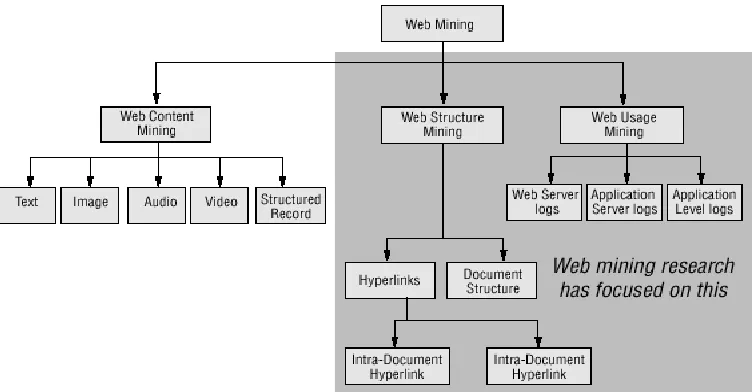
extracting useful information from the contents of web documents. Content data is the collection of facts a web page is designed to contain. It may consist of text, images, audio, video, or structured records such as lists and tables. Application of text mining to web content has been the most widely researched. Issues addressed in text mining include topic discovery and tracking, extracting association patterns, clustering of web documents and classification of web pages.
Research activities on this topic have drawn heavily on techniques developed in other disciplines such as Information Retrieval (IR) and Natural Language Processing (NLP). While there exists a significant body of work in extracting knowledge from images in the fields of image processing and computer vision, the application of these techniques to web content mining has been limited. The structure of a typical web graph consists of web pages as nodes, and hyper-links as edges connecting related pages. Web structure mining is the process of discovering structure information from the web. This can be further divided into two kinds based on the kind of structure information used.
A hyperlink is a structural unit that connects a location in a web page to a different location, either within the same web page or on a different web page. A hyperlink that connects to a different part of the same page is called an intra-document hyperlink, and a hyperlink that connects two different pages is called an inter-document hyperlink. In addition, the content within a Web page can also be organized in a tree-structured format, based on the various HTML and XML tags within the page. Mining efforts here have focused on automatically extracting document object model (DOM) structures out of documents
Web usage mining is the application of data mining techniques to discover interesting usage patterns from web usage data, in order to understand and better serve the needs of web-based applications. Usage data captures the identity or origin of web users along with their browsing behavior at a web site. Web usage mining itself can be classified further depending on the kind of usage data considered i.e. web server data, application server data and application level data.
In Web Server Data, user logs are collected by the web server and typically include IP address, page reference and access time. In Application Server Data, commercial application servers such as Web logic, Story Server, have significant features to enable E-commerce applications to be built on top of them with little effort. A key feature is the ability to track various kinds of business events and log them in application server logs. In Application Level Data, new kinds of events can be defined in an application, and logging can be turned on for them, generating histories of these events. It must be noted, however, that many end applications require a combination of one or more of the techniques applied in the above the categories.
© 2014, IJCSMC All Rights Reserved 293
II. Literature Review
The WWW continues to grow at an amazing rate as an information gateway and as a medium for conducting business. Web mining is the extraction of interesting and useful knowledge and implicit information from artifacts or activity related to the WWW [4], [6]. Based on several research studies we can broadly classify Web mining into three domains content , structure and usage mining [8], [9]. This work is concerned with Web usage mining. Web servers record and accumulate data about user interactions whenever requests for resources are received. Analyzing the Web access logs can help understand the user behavior and the web structure. From the business and applications point of view, knowledge obtained from the Web usage patterns could be directly applied to efficiently manage activities related to e business, e-services, e-education and so on [10]. Accurate Web usage information could help to attract new customers, retain current customers, improve cross marketing/sales, effectiveness of promotional campaigns, track leaving customers and find the most effective logical structure for their Web space [3]. User profiles could be built by combining users' navigation paths with other data features, such as page viewing time, hyper- link structure, and page content . What makes the discovered knowledge interesting had been addressed by several works [11] and . Results previously known are very often considered as not interesting. So the key concept to make the discovered knowledge interesting will be its novelty or unexpected appearance.
Whenever a visitor accesses the server, it leaves the IP, authenticated user ID, time/date, request mode, status, bytes, referrer, agent and so on. The available data fields are specified by the HTTP protocol. There are several commercial software that could provide Web usage statistics[1]. These stats could be useful for Web administrators to get a sense of the actual load on the server. However, the statistical data available from the normal Web log data files or even the information provided by Web trackers could only provide the information explicitly because of the nature and limitations of the methodology itself. Generally, one could say that the analysis relies on three general sets of information given a current focus of attention past usage patterns, degree of shared content and inter-memory associative link structures. After browsing through some of the features of the best trackers available it is easy to conclude that rather than generating statistical data and texts they really do not help to find much meaningful information.
For small web servers, the usage statistics provided by conventional Web site trackers may be adequate to analyze the usage pattern and trends. However as the size and complexity of the data increases, the statistics provided by existing Web log file analysis tools may prove inadequate and more intelligent knowledge mining techniques will be necessary[2], [3]. In the case of Web mining, data could be collected at the server level, client level, proxy level or some consolidated data. These data could differ in terms of content and the way it is collected etc. The usage data collected at different sources represent the navigation patterns of different segments of the overall Web traffic, ranging from single user, single site browsing behavior to user, multi-site access patterns. Web server log does not accurately contain sufficient information for inferring the behavior at the client side as they relate to the pages served by the Web server.
Previous work presented approaches for discovering and tracking evolving user profiles. It also describes how the discovered user profiles can be enriched with explicit information need that is inferred from search queries extracted from Web log data. Profiles are also enriched with other domain-specific information facets that give a panoramic view of the discovered mass usage modes. An objective validation strategy is also used to assess the quality of the mined profiles, in particular their adaptability in the face of evolving user behavior. However the previous work concentrated only on user profiling at the application level data but not associating it to the web server. The user profile maintained by the web server enriches the user’s session of authenticity at different spatial entities. The previous work used conventional web log profile analyzers weakened at the linkage of web user profiling to its server.
A. Cluster based Web Usage Knowledge Discovery Framework
© 2014, IJCSMC All Rights Reserved 294
proposed to optimally segregate similar user interests. Proposed approach is compared with hierarchical patterns (to discover patterns) and several function approximation techniques.
The Miner hybrid framework optimizes a fuzzy clustering algorithm using an evolutionary algorithm. The raw data from the log files are cleaned and pre-processed and a fuzzy C means algorithm is used to identify the number of clusters. The developed clusters of data are fed to a fuzzy inference system to analyze the trend patterns. The if-then rule structures are learned using an iterative learning procedure by an evolutionary algorithm and the rule parameters are fine-tuned using a back propagation algorithm. The optimization of clustering algorithm progresses at a faster time scale in an environment decided by the inference method and the problem environment.
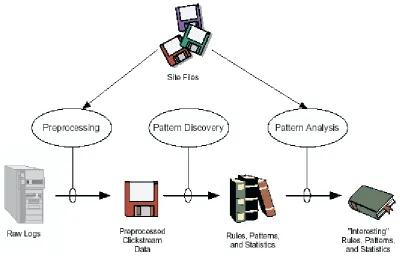
Figure 2: High Level Web Usage Mining Process
1) Fuzzy Clustering Algorithm:
Usually a number of cluster centers are randomly initialized and the FCM algorithm provides an iterative approach to approximate the minimum of the objective function starting from a given position and leads to any of its local minima. No guarantee ensures that FCM converges to an optimum solution (can be trapped by local extrema in the process of optimizing the clustering criterion). The performance is very sensitive to initialization of the cluster centers. An evolutionary algorithm is used to decide the optimal number of clusters and their cluster centers. The algorithm is initialized by constraining the initial values to be within the space defined by the vectors to be clustered. In the Miner approach, the fuzzy clustering algorithm is optimized jointly with the trend analysis algorithm (fuzzy inference system) in a single global search.
2) Expectation Maximization:
Expectation maximization (EM) is used for clustering in the context of mixture models. This method estimates missing parameters of probabilistic models. Generally, this is an optimization approach, which had given some initial approximation of the cluster parameters, iteratively performs two steps, i.e., the expectation step computes the values expected for the cluster probabilities, and second, the maximization step computes the distribution parameters and their likelihood given the data. It iterates until the parameters being optimized reach a fix point or until the log-likelihood function, which measures the quality of clustering, reaches its maximum. To simplify the discussion we first briefly describe the EM algorithm.
© 2014, IJCSMC All Rights Reserved 295
achieved. The finite mixtures model assumes all attributes to be independent random variables. A mixture is a set of N probability distributions where each distribution represents a cluster. An individual instance is assigned a probability that it would have a certain set of attribute values given it was a member of a specific cluster. In the simplest case N=2, the probability distributes are assumed to be normal and data instances consist of a single real-valued attribute. Using the scenario, the job of the algorithm is to determine the value of five parameters are the mean and standard deviation for cluster 1, the mean and standard deviation for cluster 2 and the sampling probability P for cluster 1 (the probability for cluster 2 is 1-P) Algorithm Procedure
a. Guess initial values for the five parameters.
b. Use the probability density function for a normal distribution to compute the cluster probability for each instance. In the case of a single independent variable with mean μ and standard deviation ó, the formula is: In the two-cluster case, we will have the two probability distribution formulas each having differing mean and standard deviation values.
c. Use the probability scores to re-estimate the five parameters. d. Return to Step b.
The algorithm terminates when a formula that measures cluster quality no longer shows significant increases. One measure of cluster quality is the likelihood that the data came from the dataset determined by the clustering. The likelihood computation is simply the multiplication of the sum of the probabilities for each of the instances.
Result and Discussion on Clusters effect on web usage patterns
EM algorithm is used in statistics for finding maximum likelihood estimates of parameters in probabilistic models, where the model depends on unobserved latent variables. The process of the algorithm repeats until likelihood is stable. The experiment was accomplished by maximum 114 iterations. It is complex to define the number of clusters in the initial cluster formation. In our experiment, we tried several times to tune the cluster size with other parameters to get higher true positive rate of clustering. Finally cluster the user’s navigation patterns into 20 groups. Meanwhile, that the EM algorithm will get a local optimization after 26 iterations.
Conclusion
The web usage mining framework presented in this work evaluates the performance of expectation-maximization (EM) and Fuzzy means cluster algorithms. The proposed Miner framework is an initial effort to patch up some of the weaknesses of the conventional web log file analyzers. The experimental results of EM represent that by decreasing the number of clusters, the log likelihood converges toward lower values and probability of the largest cluster will be decreased while the number of the clusters increases in each web usage pattern. The experimentation on the K-means clustering is also conducted. The results indicate the EM approach can improve accuracy of clustering to 11 more. By linking the Web logs with cookies and forms, it is further possible to analyze the visitor behavior and profiles which could help an e-commerce site to address several business questions. The further scope can be made in the direction of applying some classification methods for request. This can be used in web usage mining-based prediction systems.
References
[1]Knowledge and Data Engineering, IEEE Transactions on Feb. 2008 [1] A Web Usage Mining Framework for Mining Evolving User Profiles in Dynamic Web Sites, “ Nasraoui, O. Soliman, M. Saka, E. Badia, A. Germain,
R.”,
[2] Abraham, A (2001). Neuro-fuzzy systems: State-of-the- art modeling techniques, connectionist models of neurons, learning processes, and artificial intelligence. In Lecture Notes in Computer Science 2084, J Mira and A Prieto (eds.), Germany, Spain: Springer-Verlag, pp. 269-276.
[3] Bocca, M Jarke and C Zaniolo Analog Website Tracker (2003). (http://www.analog.cx/) [3 October 2003].
[4] Chakrabarti, S (2003). Mining the Web: Discovering Knowledge from Hypertext Data. Morgan Kaufmann Publishers.
[5] Chang, G, MJ Healey, JAM McHugh and JTL Wang (2001) Web Mining, Mining the World Wide Web Chapter 7, pp. 93-104. Kluwer Academic Publishers
© 2014, IJCSMC All Rights Reserved 296
[7] Chi, EH, A Rosien and J Heer (2002). LumberJack: Intelligent discovery and analysis of web user traffic composition. In Proc. of ACM-SIGKDD Workshop on Web Mining for Usage Patterns and User Pro_les. Canada: ACM Press.
[8] Cho, YH, JK Kim and SH Kim (2003). A personalized recommender system based on web usage mining and decision tree induction, Expert Systems with Applications, 23(3), 329 - 342.
[9] Coenen, F, G Swinnen, K Vanhoof and G Wets (2000). A framework for self-adaptive websites: Tactical versus strategic changes. In Proc. of the Workshop on Web mining for E-commerce: Challenges and Opportunities (KDD'00), pp. 75-80.
[10] Hay, B, G Wets and K Vanhoof (2003) Segmentation of visiting patterns on web sites using a sequence alignment method, Journal of Retailing and Consumer Services, 10(3), pp. 145-153