EFFICIENT WEB SERVICES
DISCOVERY AND COMPOSITION
YANAN HAO
DOCTOR OF PHILOSOPHY
2009
DECLARATION
I, Yanan Hao, declare that the PhD thesis entitled Efficient Web Services Discovery
and Composition is no more than 100,000 words in length including quotes and
exclusive of tables, figures, appendices, bibliography, references and footnotes. This thesis contains no material that has been submitted previously, in whole or in part, for the award of any other academic degree or diploma. Except where otherwise indicated, this thesis is my own work.
PUBLICATIONS
1. Yanan Hao, Yanchun Zhang, “A Two-phase Rule Generation and Optimization
Approach for Wrapper Generation”. Proceedings of the 17th Australasian Database Conference (ADC’06), pp.39-48. Hobart, Tasmania, Australia, January 16-19 2006.
2. Yanan Hao, Yanchun Zhang, “Web Services Discovery Based on Schema
Matching”. Proceedings of 23rd Australasian Computer Science Conference (ACSC’07), pp. 107-113. Ballarat, Australia, 29 Jan - 2 Feb, 2007.
3. Yanan Hao, Yanchun Zhang and Jinli Cao, “WSXplorer: Searching for
Desired Web Services”, Proceedings of the 19th International Conference on
Advanced Information Systems Engineering (CAiSE'07), pp.173-187.
Trondheim, Norway, 11-15 June 2007.
4. Hongcan Yan, Dianchuan Jin, Lihong Li, Baoxiang Liu and Yanan Hao, "Feature Matrix Extraction and Classification of XML Pages", Proceedings of APWeb 2008 International Workshops, pp.210-219. Shenyang, China, April 26-28, 2008.
5. Yanan Hao, Jinli Cao and Yanchun Zhang, “Efficient IR-Style Search over
Web Services”, Proceedings of the 21st International Conference on Advanced Information Systems Engineering (CAiSE'09), pp.305-319. Amsterdam, The Netherlands, 8-12 June 2009.
6. Yanan Hao, Yanchun Zhang, “Efficient IR-Style Search over Web Services”.
Submitted to Future Generation Computer Systems.
7. Yanan Hao, Yanchun Zhang, “A Relaxation-Based QoS Model and
ACKNOWLEDGMENTS
First and foremost, I would like to express my deep gratitude to my supervisor, Professor Yanchun Zhang, for his exceptional support, encouragement, patience during all stages of this dissertation. This dissertation would not have been possible without his invaluable advice and guidance. I feel so lucky to have Prof. Zhang as my supervisor. I owe a special debt to him forever.
I also want to thank my co-supervisor, A/Prof. Yuan Miao for his constant help, discussion, and many constructive suggestions throughout my doctoral study. I have had the great pleasure to work with my colleagues in Centre for Applied Informatics Research (CAI) at Victoria University. I would like to thank them for their valuable suggestions and discussions during the process. I thoroughly enjoyed their fruitful collaboration, and I gained invaluable skills by working with them.
I am grateful to the School of Engineering and Science for supplying very good research environment, and the staff members who offered countless help, particularly, Ponnusamy Rajendran, Danh Ho, Mark Mojic, the School Postgraduate Coordinator Dr. Gitesh Raikundalia, Janet Grady, A/Prof. Xun Yi, Dr. Bai-ling Zhang, Dr. Fuchun Huang, Professor Pietro Cerone, A/Prof. Hao Shi, and the Scholarship Coordinator of Office for Postgraduate Research, Ms. Lesley Birth.
Special thanks go to Dr. Jinli Cao for her trust, support and recommendation. I appreciate her help forever.
ABSTRACT
As an emerging cross discipline area for distributed computing,Service-Oriented
Comput-ing(SOC) paradigm promises to bridge the gap between Business Services and IT Services,
enable technology to help people perform business processes more efficiently and
effec-tively, and enable businesses and organizations to collaborate globally through standard
services. With the rapid development and popularity of Internet and e-commerce,
busi-ness organizations are investigating ways to expose their current software components into
web services so as to make use of distributed service computing resources. Business
orga-nizations are also investigating ways on how to incorporate services running on different
platforms and hosted by service providers outside of their boundaries into more complex,
orchestrated services.
This conceptually new approach brings multiple issues to researchers. As the number
of web services and SOC applications increases, there is a growing need for mechanisms
for discovering services efficiently. Effective mechanisms for web services discovery and
ranking are critical for organizations to take advantage of the tremendous opportunities
offered by web services, to engage in business collaborations and service compositions, to
identify potential service partners, and to understand service competitors and increase the
competitive edge of their service offerings.
only according to their functional requirements but also to their transactional properties
and QoS characteristics defined using a quality model. On one hand, in service-oriented
environments multiple web services may provide similar functionality, but may offer
dif-ferent non-functional properties (e.g., price). When selecting existing web services from
web service communities to generate composite services, the number of composed services
may be very large. Therefore, it is a challenge on how to select appropriate web services
to satisfy users’ global QoS requirements based on a set of given QoS preferences. On
the other hand, as web services operate in a highly dynamic distributed environment and
interact with each other, the possibility of unexpected behavior is high. The unexpected
be-havior from an individual service may bring negative impact on all the component services
in the composition, even lead to failure of the running of the composite service. Thus we
need a mechanism that provides transactional support to service composition to ensure the
overall consistent and reliable execution of business processes.
In this thesis, we investigate the problem of efficient web services discovery and
com-position in service oriented environments. Firstly, we present an efficient IR-Style
mech-anism for discovering and ranking web services automatically, given a textual description
of desired services. We introduce the notion ofpreference degree for a web service, and
suggestrelevance and importance as two desired properties for measuring its preference
degree. Also, various algorithms are given to obtain service relevance and importance. The
catches not only structures, but even better semantic information of schemas defined in web
services. Moreover, we develop an approach to identify associations between web-service
operations based on service operations matching. This approach uses the concept of
at-tribute closureto obtain sets of operations. Each set is composed of associated web-service
operations. Experimental results show the proposed IR-style search strategy is efficient and
practical.
Secondly, we propose a novel QoS model for performing flexible service selection in
web service composition with QoS constraints. The key idea of the model is to relax users’
QoS constraints and try to find the most possible services satisfying users’ QoS
require-ments. Based on the proposed QoS framework, we develop various algorithms for making
service selection on individual and composite services. We also introduce a top-k ranking
strategy to reflect users’ personalized requirements. We evaluate the performance of the
model in terms of time and space cost.
Finally, we propose a strategy to verify at design time whether a service composition
can be implemented by a set of selected web services according to the transactional
re-quirements specified by a user. We define transactional properties for component web
ser-vices and analyze the dependencies among them. Next, based on theAutomata theory, we
model the transactional behavior of both component web services and composite services
as transition systems, and use Accepted Termination States (ATS) to describe the correct
execution of composite services. Then, by analyzing themessage exchangesbetween
com-ponent services of a composite service we present a novel algorithm to verify all possible
SPIN, an automata-based model checker to carry out automated verification of temporal
TABLE OF CONTENTS
Page
List of Figures . . . iv
List of Tables . . . vi
Chapter 1: Introduction . . . 1
1.1 Business Process and Web Service . . . 2
1.2 Problem Statement . . . 4
1.2.1 Efficient web services discovery . . . 7
1.2.2 Dynamic web service selection with QoS constraints . . . 9
1.2.3 Ensure reliable execution of composite services . . . 10
1.3 Solution Overview . . . 11
1.3.1 Efficient IR-Style Search over Web Services . . . 11
1.3.2 A Relaxation-Based QoS Model and Computation Framework for Service Selection . . . 12
1.3.3 Verification of Transactional Requirements in Web Service Com-position . . . 13
1.4 Thesis Structure . . . 14
Chapter 2: Background and Fundamentals . . . 17
2.1 Specification and Modeling of Web Services . . . 17
2.1.1 XML, XML schema and DOM . . . 19
2.1.2 WSDL . . . 21
2.1.3 UDDI . . . 23
2.1.4 SOAP . . . 24
2.2 Web Service Composition . . . 25
2.2.1 Introduction . . . 25
2.3.1 tModel . . . 36
2.3.2 Clustering Algorithms for Web Services Discovery . . . 36
2.4 Relaxation Technique for QoS-driven Service Selection . . . 42
2.4.1 Introduction to Skyline . . . 42
2.4.2 Algorithms of Skyline Computation . . . 44
2.5 Modeling and Verification of Web Service Composition . . . 46
2.5.1 Models . . . 46
2.5.2 Tools . . . 50
Chapter 3: Efficient IR-Style Search over Web Services . . . 52
3.1 Introduction . . . 52
3.2 Related Work . . . 56
3.3 Desired Properties for Service Rank . . . 58
3.4 Service Relevance . . . 59
3.5 Service Importance . . . 60
3.5.1 Web-service Operation Modeling . . . 61
3.5.2 Connectivity of Web Service Operations . . . 62
3.5.3 Importance of Web Service Operations . . . 64
3.6 Algorithm for Ranking Web Services . . . 64
3.6.1 Computing Connectivity Using Schema Tree Matching . . . 65
3.6.2 TheCompImpAlgorithm . . . 75
3.6.3 Combining Service Relevance with Importance . . . 75
3.7 Finding Associated Web-service Operations . . . 77
3.7.1 Web-service operations matching . . . 77
3.7.2 Clustering Web-service Operations . . . 77
3.7.3 Identifying Associations . . . 79
3.8 Experiments and Evaluations . . . 81
3.9 Conclusions . . . 87
Chapter 4: A Relaxation-Based QoS Model and Computation Framework for Service Selection . . . 88
4.1 Introduction . . . 88
4.2 QoS Computing Model . . . 91
4.2.1 Computing Model for Individual Services . . . 91
4.2.2 Computing Model for Composite Services . . . 96
4.3 Algorithms for Answering a User’s QoS Query . . . 103
4.3.1 Algorithms for QoS Query on Individual Services . . . 104
4.3.2 Algorithms for QoS Query on Composite Services . . . 108
4.4 Personalized Service Selection . . . 112
4.4.1 Selecting fully satisfying services . . . 112
4.4.2 Top-kAnswers on out-of-range services . . . 113
4.5 Experiments . . . 114
4.6 Related Works . . . 116
4.7 Conclusions . . . 118
Chapter 5: Verification of Transactional Requirements in Web Service Compo-sition . . . 120
5.1 Introduction . . . 120
5.2 Preliminaries . . . 122
5.2.1 Transactional Properties of Services . . . 123
5.2.2 Transactional Composite Services . . . 125
5.3 Modeling . . . 125
5.4 Verification with Transition Systems . . . 128
5.4.1 Objective and Overview . . . 128
5.4.2 Verification Algorithm . . . 129
5.5 Verification with SPIN . . . 129
5.6 Related works . . . 132
5.7 Conclusions . . . 134
Chapter 6: Conclusions . . . 135
6.1 Contributions . . . 135
6.2 Future Research Issues . . . 138
Bibliography . . . 140
Figure Number Page
1.1 An example of BPM service pattern. . . 3
1.2 Web service architecture in enterprises. . . 5
1.3 B2B integration via web services. . . 5
1.4 Structure of the thesis. . . 15
2.1 Web service roles and interactions through standardized protocols. . . 18
2.2 An example of XML file . . . 20
2.3 An example of XML schema . . . 20
2.4 XML DOM tree structure . . . 21
2.5 Loan ApproverWSDL . . . 23
2.6 Four core constructions/types of UDDI . . . 25
2.7 A travel reservation scenario . . . 27
2.8 Theloan approvalprocess . . . 33
2.9 Role of a Web Service Level Agreement. . . 34
2.10 Skyline of hotels . . . 43
2.11 Example of a Petri Net . . . 47
3.1 Sample web-service operations . . . 54
3.2 XML schema tree ofOrdertype . . . 54
3.3 An example of tree mapping . . . 66
3.4 XML Schema tree transformation . . . 71
3.5 Matching web service operations . . . 78
3.6 System Architecture . . . 83
3.7 Service Index Structure . . . 83
3.8 Time cost of building index and searching . . . 84
3.9 Precision and recall of IRWService . . . 86
3.10 Performance of identifying associated operations . . . 86
4.1 Workflow patterns . . . 97
4.2 Composite service example . . . 99
4.3 Running time comparisons on individual and composite services . . . 115
5.1 Service states describing their transactional properties . . . 124
5.2 Transition of asellerservice . . . 127
5.3 A composite service defined with AND-split and AND-join patterns. . . 129
5.4 Translate BPEL to FSP . . . 131
Table Number Page
4.1 Sample web services. Each web service provides the same postcode infor-mation. . . 90 4.2 Normalization of QoS values of services in Table 4.1 . . . 94 4.3 Example of Composite Service . . . 101
1
Chapter 1
INTRODUCTION
The Internet is one of the most important inventions in the world. It has already made
a profound impact on the way people work, live and communicate. Thanks to its basic
fea-tures such as widespread usability and access, individuals and organizations can easily than
ever publish and share information, interact with each other. The Internet has also redefined
how businesses operate. Realizing that the Internet has become a large market and has the
advantage of low-cost and high efficiency, more and more companies today are engaging
in business through the Internet, also known as e-commerce. With the increasing number
of e-commerce between companies, there is a strong demand for automating business
acti-vates in e-commerce applications and making them run efficiently, effectively and reliably.
Web service technology provides a solution for these challenges. Our research is motivated
by the need to facilitate the discovery and composition of web services effectively.
This chapter is organized as follows. We first retrospect some backgrounds of business
process, SOC, SOA and web service technology in Section 1.1. In Section 1.2, we give
an outline of the research issues on web services discovery and composition in
service-oriented environments. Section 1.3 summarizes our solutions and Section 1.4 presents the
1.1 Business Process and Web Service
Business Processes play an important role in modern information systems. A business
process is a collection of related, structured activities that produce a service or product that
meets the needs of a client. Roughly speaking, the concept of process can be regarded as
tasks, production and outputs. Business processes are critical to any organization as they
generate revenue and often represent a significant proportion of costs. Business process
management (BPM) attempts to continuously improve processes. It could be described as
a “process optimization process” focusing on aligning organizations with the wants and
needs of clients, which aims to promote business effectiveness and efficiency while striving
for innovation, flexibility and integration with technology [2]. BPM is now widely accepted
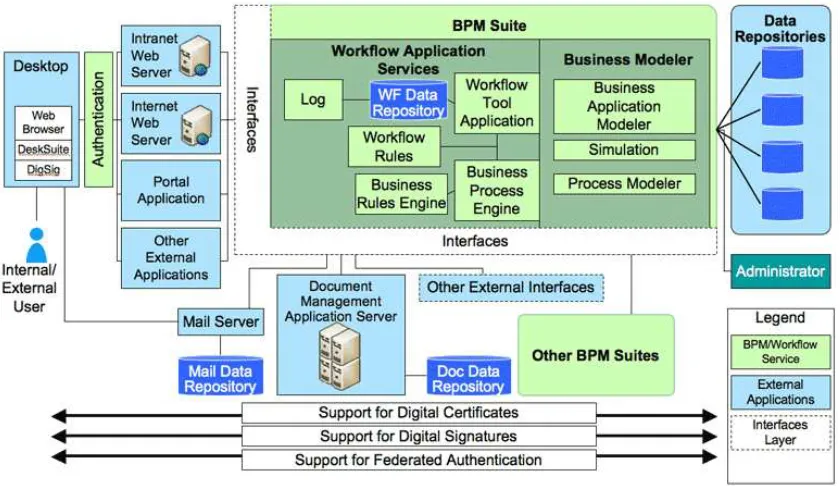
as a design paradigm for organizational and IT-driven redesign initiatives. Figure 1.1 gives
an example of business process management (BPM) service pattern [21]. As can be seen,
through the orchestration of activities between people and system, BPM tools can manage
business processes effectively.
Increasingly, business processes are seen from the viewpoint of how well they
con-tribute to the efficient and coordinated delivery of services. Identification of inefficient
processes may lead to the planned improvement of those processes, or, in some cases, to
the decision to scrap the processes and outsource them to another organization [13]. With
the development of global economics, now business organizations operate their business
process in a globalized way. Business-to-Business (B2B) integration has become more
important than ever before in today’s IT markets. As the Internet proliferates and the
e-commerce activities explode, the B2B integration is driven by the automation of business
3
Figure 1.1: An example of BPM service pattern.
cost of developing, maintaining and integrating enterprises applications.
As an emerging cross discipline area for distributed computing,Service-Oriented
Com-puting (SOC) paradigm promises to bridge the gap between business services and IT
ser-vices, enable technology to help people perform business processes more efficiently and
effectively, and enable businesses and organizations to collaborate globally through
stan-dard services. The scope of services oriented computing covers the whole lifecycle of web
services research that includes business modulization, services modeling, services creation,
services realization, services annotation, services deployment, services discovery, services
composition, services delivery, service-to-service collaboration, services monitoring,
ser-vices optimization, as well as serser-vices management. Also, a lot of technical aspects are
technology areService-Oriented Architecture(SOA) andWeb service[6].
The Service-Oriented Architecture (SOA) provides the foundations for organizations
to identify and choose external services they would like to use, and also offer their own
services to other organizations or businesses. In other words, SOA supports web services
- the provision of business processes to interested parties via the Web. Web services are
the fundamental building blocks of SOA. Web services are loosely coupled, autonomous,
platform-independent, and reusable software components that semantically encapsulate
discrete functionality and are distributed and programmatically accessible over standard
Internet protocols [4]. They can be described, published, discovered, orchestrated and
programmed using standard protocols for collaborating applications distributed within and
across organizational boundaries. Web services provide the basis for the development and
execution of business processes that are distributed over the network and available via
stan-dard interfaces and protocols - they therefore enable the creation of dynamic virtual
enter-prises. Due to standard interfaces, web services have evolved as a dominant technology for
integrating business processes and applications across organization boundaries on the Web
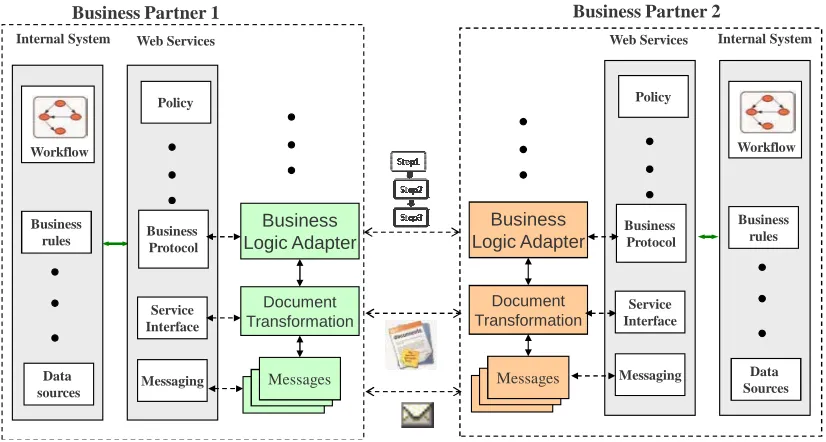
[13]. Figure 1.2 and Figure 1.3 [92] give an intuitive impression on how enterprises use
web services as an application distribution and integration tool, and how the B2B business
is viable through web services.
This conceptually new approach brings multiple issues to researchers. In the next two
sections, we outline the research issues in this thesis and summarize our contributions.
1.2 Problem Statement
A Web Service is a set of related functionalities that can be loosely coupled with other
5 Legacy Application Interaction Logs SAP R/3
Resource (Data) Layer
Web Service Web Service Web Service Web Service Web Service Web Service Web Service Web Service Business Services Customer & Order Service Invoice & Payment Service Shipping Service Component Services
Service Layer
Business Process Layer
Figure 1.2: Web service architecture in enterprises.
Workflow Business rules Data sources Internal System Workflow Business rules Data Sources Internal System
Business Partner 1 Business Partner 2
Messages Document Transformation Business Logic Adapter Service Interface Policy Business Protocol Web Services Messaging Web Services Service Interface Policy Business Protocol Messaging Messages Document Transformation Business Logic Adapter
of Internet and e-commerce, business organizations are investigating ways to expose their
current software components into web services so as to make use of distributed service
computing resources. They are also investigating ways on how to incorporate services
run-ning on different platforms and hosted by service providers outside of their boundaries into
more complex, orchestrated services. As the number of web services available on the Web
and SOC applications increases, there is a growing need for mechanisms for discovering
and composing services efficiently. Actually, how to discover appropriate web services
and compose them has become an ever more important problem for organizations to take
advantage of the tremendous opportunities offered by web services, to engage in business
collaborations and service compositions, to identify potential service partners, and to
un-derstand service competitors and increase the competitive edge of their service offerings.
Apart from functional specification required by users during service discovery, some
non-functional requirements such asQuality of Service(QoS) and transactional properties
are also major concerns, because users need to select and compose web services not only
according to their functional requirements but also to their transactional properties and QoS
characteristics defined using a quality model. When users search and compose web services
to deploy business processes, there are three major issues that need to be tackled, which are
listed below.
• Efficient web services discovery
• Dynamic web service selection with QoS constraints
7
1.2.1 Efficient web services discovery
The problem of web services discovery has become a hot research topic in service-oriented
computing area. Currently, theUniversal Description, Discovery, and Integration(UDDI)
[114] registries are the dominating scheme for web services discovery. The UDDI
specifi-cation provides a strategy to build an open framework for describing services, discovering
businesses, and integrating business services across the Internet. UDDI serves as a
repos-itory for businesses to publish their web services specifications, which are defined clearly
and described in a standard service description language - the Web Service Description
Language (WSDL) [36]. However, the UDDI-based web services discovery faces three
hurdles:
Firstly, in order to implement the inter-operations between distributed business
ser-vices, users usually search the UDDI repositories for desired services publicly available on
the Internet. The current UDDI repositories only enable users to retrieve services based on
keywords [84][70]. However, service registries in UDDI are classified manually into
dif-ferent categories according to their commercial objectives described by WSDL [36] rather
than the functions provided by them [44]. This category-based approach is quite informal
and relies extensively on the shared common understanding of publishers and consumers.
It does not provide any support for selecting competing alternative services that could
po-tentially be reused. As a result, simple keyword-based service discovery method usually
returns many useless retrieval results, which makes the task of finding relevant or desired
services within the search results time-consuming and difficult, and thus can not satisfy
common users. The task becomes even more challenging as the number of web services
be helpful and significant if there is a ranking mechanism that can consider users’ specific
requirements and output desired web services within the top results. Furthermore, UDDI
can not enable users to efficiently discover web services based on certain requirements,
which can be either functional (the purpose of the service), and non-functional (constraints
on various properties such as Quality of Service, transactional characteristics, etc) [27].
Therefore, the current UDDI repositories cannot meet the needs of the business processes in
efficiency and requirement. The thesis aims to facilitate the discovery of web services based
on user requirements in service-oriented environments by proposing novel approaches and
tools.
Secondly, since many web services are created from existing applications and may not
contain enough semantic annotations or sufficient text documentation, simple
keyword-based queries may lead to low precision and recall ratio. Also, a good searching strategy
should not check the full semantic compliance between service specifications and user
re-quests, but return ranked lists of potentially useful services that are closest to the requests.
In this thesis, we achieve this goal by integrating both syntactic and semantic matching into
the web services discovery process.
Finally, in web service composition, based on the request information, a web services
discovery broker often generates composite services by combine a group of structural
indi-vidual services according to some business patterns. Then the discovered composite service
can be invoked to concrete the underlying business process. However, the current UDDI
model only enables the discovery of simple services. It does not provide a mechanism
as-sisting users in selecting relevant services and composing with them. In other words, the
implementation of automatically discovering or dynamically composing services is missing
9
1.2.2 Dynamic web service selection with QoS constraints
In service-oriented environments, multiple web services may provide similar
functional-ity, but may offer different non-functional properties (e.g., different prices, different
re-sponse time, etc). Web services with similar functionality are typically grouped together
in a single community. The members of a community are differentiated according to their
non-functional properties. In the selection of a web service, the quality of service (e.g.,
execution duration and execution price, etc.) is a key factor for users, so it is important
to consider both functional and non-functional properties in order to satisfy the constraints
or requirements of users. To support dynamic composition of services, web services that
satisfy users’ functional requirements need to be located from a large number of service
providers based on their quality of service. Therefore, when selecting existing web
ser-vices from web service communities to generate composite serser-vices, the number of
com-posed services may be very large and it is a challenge on how to select appropriate web
services that are able to satisfy users’ global QoS requirements based on a set of given user
QoS preferences.
Furthermore, in addition to satisfying user QoS requirements by obtaining optimized
service selection, users’ personalized preferences need to be considered. Depending on
their context, different users may have different preferences about the services they need.
For instance, a user may say an expensive serviceais better than a cheap serviceb, because
althoughais more expensive thanband exceeds the user’s financial requirement a bit, it has
much better reliability, which is crucial to her because of her strict reliability requirement.
Similarly, another user running out of money prefers a cheaper service, while a cautious
not in QoS depends on the user’s context and preference. It is essential to model the users’
personalized preferences and requests.
1.2.3 Ensure reliable execution of composite services
The composition of web services provided by different organizations provides an efficient
way to build complex application logics. However, as web services operate in a highly
dy-namic distributed environment and interact with each other, the possibility of unexpected
behavior is high. For example, the invocation of a service may fail because of temporary
unavailability of the service. The unexpected behavior from an individual service may bring
negative impact on all the component services in the composition, even lead to failure of
the running of the composite service. We need a mechanism that not only allows selecting
a set of component web services satisfying a user’s QoS criteria, but also provides
trans-actional support to business integration via composing individual web services to ensure
the overall consistent and reliable execution of business processes. A main problem that
remains is, given a user’s transactional requirements, how to select individual services and
verify their transactional properties to ensure a correct composition and a reliable execution
of a composite service.
Although there exist several transaction web service standards, they only provide
lim-ited support without giving much thought to the transactional features [80]. We need to
investigate further the transactional properties of component services, as well as the
work-flow patterns which are often used as basis to compose services and which also determine
the transactional behavior of composite services. In addition, we need an efficient
verifi-cation mechanism to determine whether a given composite service has valid transactional
11
1.3 Solution Overview
In this thesis, we present a web service composition framework for efficient web services
discovery and composition in service oriented environments. Various experiments have
been carried out to demonstrate the efficiency and effectiveness of the methods proposed
to support the framework. The contributions of the thesis are composed of three aspects,
which are listed below:
• Efficient IR-style search over web services.
• A relaxation-based QoS model and computation framework for service selection.
• Verification of transactional requirements in web service composition.
1.3.1 Efficient IR-Style Search over Web Services
We propose a novel IR-Style mechanism for discovering and ranking web services
auto-matically, given a textual description of desired services. The features of our approach are
summarized as follows:
• We propose algorithms for supporting web service operations matching. The key part of our algorithms is a schema tree matching algorithm, which employs a new
cost model to compute tree edit distances. Our new schema tree matching algorithm
can not only catch structures, but also the semantic information of schemas.
• Based on service operations matching, we use the agglomeration algorithm to cluster similar web service operations. Also, an approach to identify associations between
closureto obtain sets of operations. Each set is composed of associated web service
operations.
• We introduce the notion of preference degreefor web services and then we define service relevance andservice importance respectively as two desired properties for
measuring the preference degree.
• We design novel algorithms for computing the relevance and importance degree of services. Our algorithms take into account both textual and structural information of
web services.
• We defineservice connectivity, a novel metric to evaluate the importance of services.
• We do various experiments to search for desired web services. Initial results show the proposed IR-style search strategy is efficient and practical.
1.3.2 A Relaxation-Based QoS Model and Computation Framework for Service Selection
In this part, we solve the problem of how to aggregate and leverage individual services’ QoS
information to derive the optimal QoS of composite services, given user QoS constraints.
In particular, the main contributions of this work are listed as follows:
• We propose a novel personalized QoS model for performing flexible and adaptable service selection. The key idea of the model is to use skyline technique to relax
users’ QoS constraints and try to find the most possible services which meet users’
requirements. The problem of QoS computation and policing is converted into the
13
• Based on the proposed QoS framework, we develop various algorithms for making service selection on individual and composite services, respectively. We also
intro-duce a top-kranking strategy to reflect a user’s personalized requirements.
• We present the experimental results of a thorough evaluation. Experimental evalua-tion shows the proposed QoS model is efficient and practical.
1.3.3 Verification of Transactional Requirements in Web Service Composition
We propose a novel verification method to support transactional composition of web
ser-vices. Service selection passing the verification can ensure a correct composition and a
reliable execution of a composite service according to user transactional requirements. In
particular, the contributions of this work can be summarized as below:
• We define a transactional model for composite web services. The model is based on the transactional properties of component web services contributing to the composite
service, and the dependencies between component services, which are defined by
the workflow patterns that specify how services are combined together and how the
behavior of a service interacts with other services.
• We model web services as automata. Based on automata theory, we model both com-ponent web services and composite services as transition systems, and useAccepted
Termination Statesto describe the transactional properties of composite services. A
verification algorithm is developed to carry out automated verification of Accepted
• In addition, for the cause of efficiency we use Temporal Logic to describe the transac-tional properties of a composite service, and then we employ theSPINmodel checker
to carry out automated verification of temporal logic properties on the composite
ser-vice.
1.4 Thesis Structure
The reminder of this thesis is organized as follows. In Chapter 2, we introduce some basic
concepts and definitions used in the thesis and survey some technologies that are related
to web services discovery and composition in service-oriented environments. Chapter 3
presents a novel IR-style web services discovery scheme. In Chapter 4, we give a
person-alized QoS-driven service selection technique in dynamic service environments. In chapter
5, we focus on the verification of service selection for satisfying user transactional
require-ments of composite services. Finally, in Chapter 6, we conclude the thesis and outline some
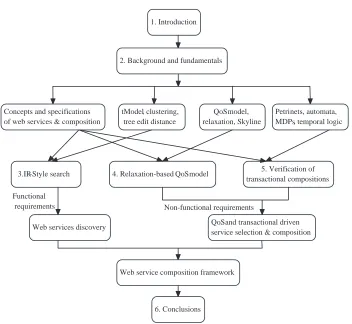
future work. Figure 1.4 illustrates the structure of the thesis chapters.
Chapter 2 starts from introducing the current web service specification and the
state-of-the-art in service computing. Afterwards, the methodology for modeling web service
match is illustrated. The next section of the chapter discusses the skyline technique in
spacial database and shows this idea can be applied into our personalized QoS-driven web
services discovery model. Then we review some classic model checking methods and
tools, including temporal logic, TLA logic, SPIN, CPN etc. Last, we give a brief summary
to conclude the chapter.
Chapter 3 firstly reviews research on web services discovery. Secondly, it introduces
the conception of preference degree for service ranking. Thirdly, it presents models and
15
1. Introduction
3.IR-Style search
Petri nets, automata, MDPs, temporal logic QoS model,
relaxation, Skyline tModel, clustering,
tree edit distance
2. Background and fundamentals
Concepts and specifications of web services & composition
4. Relaxation-based QoS model 5. Verification of transactional compositions
Web services discovery QoS and transactional driven service selection & composition
6. Conclusions Functional
requirements Non-functional requirements
Web service composition framework
Figure 1.4: Structure of the thesis.
ranking web services are provided, followed by a thorough experimental evaluation. The
last section gives concluding remarks.
Chapter 4 first gives a motivating example for personalized QoS-driven service
discov-ery. Secondly, it introduces the computing model for individual services and composite
services, and describes the corresponding QoS query algorithms on the two models,
re-spectively. Then we present the personalized service selection strategy using a relaxation
approach and its justification. Afterwards, we provide examples and experiments to
ser-vices discovery and selection. Finally, the chapter is concluded with a short summary of its
contribution.
Chapter 5 first introduces the main points in our verification strategy. Then we
ex-plain the transactional properties of web services and how they determine the transactional
properties of the composite service they belong to. Next, we model both component web
services and composite services as transition systems, and useAccepted Termination States
to describe the transactional properties of composite services. A verification algorithm is
developed to carry out automated verification of Accepted Termination States on composite
services. Afterwards, we present the formal expression of user transactional requirements
using temporal logic. We illustrate how our formal expression can be verified by the classic
model checking toolSPIN so as to assist designers to compose valid composite services.
Finally, we discuss some related work, followed by some concluding remarks.
Finally, in Chapter 6, we give the concluding remarks of the thesis and point out some
17
Chapter 2
BACKGROUND AND FUNDAMENTALS
This chapter presents basic concepts and techniques for better understanding the
algo-rithms and methods developed in this thesis. We first introduce various web service
speci-fications and models, including WSDL, UDDI, SOAP, XML schema and BPEL. Then we
introduce the concept, models and research issues of web service composition. After that,
we spend more space on query and matching techniques for web services discovery such as
TF/IDF, clustering, tree edit distance, as they are very important foundations of our research
topic. Afterwards, we give some basics about Skyline and its computing algorithms, which
are used in our relaxation technique for QoS-driven service selection. Finally, we review
some formal representation and verification concepts, models and tools, including temporal
logic, automata, SPIN, etc, which are the basis of our verification scheme for transactional
composite web services. All the contents given here provides a foundation for further study
of web services discovery and composition, and will be the frame of references throughout
the remainder of the thesis.
2.1 Specification and Modeling of Web Services
Web service [48, 136] have become the preferred technology for realizing the SOC
(Service-oriented Computing) paradigms. A web service is a set of related application functions that
can be programmatically published, located, and invoked across the Web. Web services
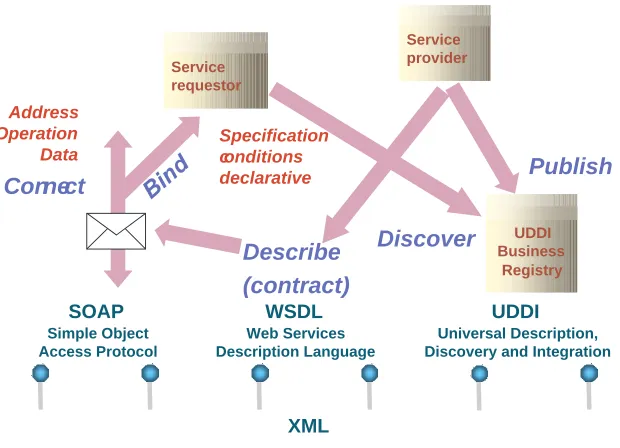
SOAP Simple Object Access Protocol WSDL Web Services Description Language UDDI Universal Description, Discovery and Integration
UDDI Business Registry Address Operation Data Specification conditions declarative Connect Discover Publish Describe (contract) XML Service provider Service requestor
Figure 2.1: Web service roles and interactions through standardized protocols.
business process interactions. Typical web services, for example, are currency conversion
service, stock quotes/stock charting service, credit card verification/payment processing
service, integrated travel planning service, etc.
The main conceptual characteristics and properties of web services are: self-contained,
self-describingandmodular[48]. Firstly, web services are self-contained software
compo-nents, that is, no additional software is required on the client side. Client users can easily
start with programming languages support such as XML and HTTP. An existing application
can be invoked without writing a single line of code. Secondly, those software components
are self-describing. The client and server only need to recognize the format and content
of request and response messages. The definition of the message format is included in the
message. Finally, web services are modular, reusable software components, that is, they
sim-19
ple web services can be aggregated to form more complex web services by using workflow
techniques through the BPEL language.
A group of standards have been established to manage web service lifecycles and
service-client communication. These standardized protocols play key roles in web
ser-vices, including: Extensible markup Language (XML), Universal Description, Discovery
and Integration (UDDI), Web Services Description Language (WSDL), and Simple Object
Access Protocol (SOAP). Figure 2.1 [136] presents the web service roles and interactions
through these protocols. The protocols mentioned here are described in the following
sec-tions.
2.1.1 XML, XML schema and DOM
EXtensible Markup Language(XML) [131][123] is a subset of the Standard Generalized
Markup Language (SGML), the standard for creating markup documents. XML is
classi-fied as an extensible language, because XML tags are not predefined and users can define
their own tags. XML is self-descriptive and it is designed to carry data, not to display data.
Via XML we can define the content of a document separately from its formatting, which
makes it easy to reuse that content in other applications or other presentation environments.
Most importantly, XML provides a basic syntax that can be used to share information
be-tween different kinds of computers, different applications, and different organizations
with-out needing to pass through many layers of conversion [116][54]. Therefore, XML is ideal
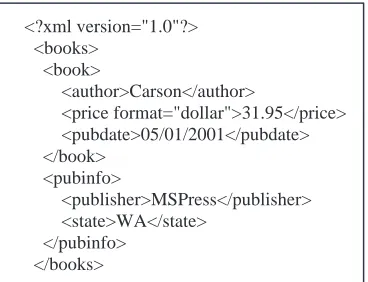
for use on the Internet. Figure 2.2 is a sample document taken from [88] showing how data
can be represented in XML format.
The XML Schema [111][122] language is also referred to asXML Schema Definition
<?xml version="1.0"?> <books>
<book>
<author>Carson</author>
<price format="dollar">31.95</price> <pubdate>05/01/2001</pubdate> </book>
<pubinfo>
<publisher>MSPress</publisher> <state>WA</state>
</pubinfo> </books>
Figure 2.2: An example of XML file
<xs:element name="book" maxOccurs="unbounded"> <xs:complexType>
<xs:sequence>
<xs:element name="author" type="xs:string"/> <xs:element name="price" type="xs:decimal"/> <xs:element name="pubdate" type="xs:date"/> </xs:sequence>
</xs:complexType> </xs:element>
Figure 2.3: An example of XML schema
in terms of constraints on the structure and content of documents of that type, above and
beyond the basic syntactical constraints imposed by XML itself. An XML schema provides
a view of the document type at a relatively high level of abstraction [110]. Figure 2.3 is a
segment of the XML schema file describing the XML file in Figure 2.2.
The XML DOM [86][124] defines the objects and properties of all XML elements, and
the methods (interface) to access them. It provides a standard way to get, change, add, or
delete XML elements. In XML DOM, an XML document is presented as a tree structure,
21
Figure 2.4: XML DOM tree structure
when the sample XML data [88] is read into the DOM tree structure.
Each circle represents a node in this XML DOM tree structure. Each node is called an
XmlNode object, which is the basic object in the DOM tree.
2.1.2 WSDL
The Web Services Description Language (WSDL) [132] is an XML-based language that
provides a model for describing web services. A WSDL document describes how to invoke
a service and provides information on the data being exchanged, the sequence of messages
for an operation, protocol bindings and location of a service.
More specifically, a WSDL document definesservices as collections of network
end-points, orports. In WSDL, the abstract definition of endpoints and messages is separated
from concrete implementation. Messagesandport typesprovide abstract definitions of the
data being exchanged and the operations performed by a service. The concrete protocol
binding. By associating a network address with a reusablebinding, a port can be defined.
A collection of ports make up a service. To sum up, the elements defined in a WSDL
document are listed as follows [48][132]:
• Types - the structure of the data contained in messages, often defined by XML schema specification.
• Message- an abstract definition of the data being transferred.
• Operation - an abstract description of an action a service can perform. Operation defines which message is the input and which message is the output.
• Port Type- a collection of all operations exposed by the web.
• Binding- a specific protocol, data format or structure for an abstract message, oper-ation or endpoint.
• Port- a single endpoint defined by specifying a single network address for a binding endpoint.
• Service- a group of related ports or endpoints.
WSDL documents provide an efficient way for web developers to expose their
applica-tions as services accessible on the Internet. Once published through UDDI, WSDL
docu-ments can be found by other applications and bound with them to execute other complicated
business processes.
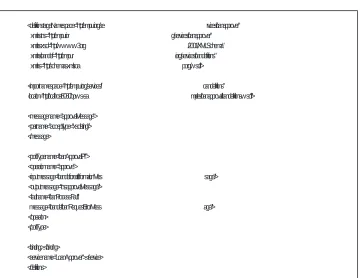
As an example, we use the classic Loan Approver[76] web service to show the
23
<definitions targetNamespace="http://tempuri.org/se rvices/loanapprover" xmlns:tns="http://tempuri.or g/services/loanapprover" xmlns:xsd="http://www.w3.org /2001/XMLSchema" xmlns:loandef="http://tempur i.org/services/loandefinitions" xmlns="http://schemas.xmlsoa p.org/wsdl/">
<import namespace="http://tempuri.org/services/l oandefinitions" location="http://localhost:8080/bpws-sa mples/loanapproval/loandefinitions.wsdl"/>
<message name="approvalMessage"> <part name="accept" type="xsd:string"/> </message>
<portType name="loanApprovalPT"> <operation name="approve">
<input message="loandef:creditInformationMes sage"/> <output message="tns:approvalMessage"/>
<fault name="loanProcessFault"
message="loandef:loanRequestErrorMess age"/> </operation>
</portType>
<binding ...> ... </binding>
<service name="LoanApprover">....</service> </definitions>
Figure 2.5:Loan ApproverWSDL
approve, to process a loan request. approve takes as input the information about the
cus-tomer, and outputs an approval message. The WSDL file defining theLoan Approver web
service is shown in Figure 2.5.
2.1.3 UDDI
Universal Description, Discovery, and Integration (UDDI) is an XML-based protocol which
provides a universally recognized directory model for publishing and discovering web
ser-vices. UDDI provides a foundation for developers and administrators to readily share
in-formation about internal web services across the enterprises and public web services across
distributed registry of businesses and their service descriptions implemented in a common
XML format. Business registration is the main part of UDDI. A UDDI business registration
consists of three components: white pages, yellow pages and green page. White pages
in-clude business name, contact information, and a text description of the business’s services.
Yellow pages include industrial categorizations based on standard taxonomies. Green pages
are composed of technical information and references to specifications for services exposed
by the business.
The data structure within UDDI is comprised of four constructions: a businessEntity
structure, abusinessServicestructure, a bindingTemplatestructure and atModelstructure.
The relationship between these four core structures [94] is shown in Figure 2.6. The
busi-nessEntity represents a web Service provider; the businessService is a group of services
that may reside in a single businessEntity; the bindingTemplate gives technical information
needed to bind and interact with the target web service; whereas tModels is used to
repre-sent interfaces. Classification information and namespace can be added into the interface
to make UDDI search easier by tModels, which is playing an important role in UDDI.
2.1.4 SOAP
Simple Object Access Protocol(SOAP) is a simple XML-based protocol enabling
applica-tions to exchange of information in a decentralized, distributed environment over HTTP.
To put it simply, SOAP is a protocol for accessing a web service. A SOAP message is a
transmission of information from a sender to a receiver. In SOAP protocol, each message
is composed of three parts: (1) an envelope that defines a framework for describing what is
in a message and how to process it; (2) a set of encoding rules for expressing instances of
25
Figure 2.6: Four core constructions/types of UDDI
and responses [48][23].
SOAP aims “to help developers build web services and link heterogeneous components
over the Internet. It provides an open, extensible way for applications to communicate using
XML-based messages over the Web, regardless of what operating system, object model or
language particular applications may use. SOAP facilitates universal communication by
defining a simple, extensible message format in standard XML and thereby providing a way
to send that XML message over HTTP” [104].
2.2 Web Service Composition
2.2.1 Introduction
Business Processes play an important role in modern information systems. A business
process is the scheduling of a set of activities that collaborated with each other for achieving
organization or across several. Workflow technology aims for “automation of a business
process, in whole or part, during which documents, information or tasks are passed from
one participant to another for actions according to a set of procedural rules” [45].
With the rapid development of distributed computing and the Internet, web service
composition technology emerges as a new approach for efficient automation of business
processes based on Service-Oriented Architecture (SOA). SOA provides a standardized
platform for organizations to expose and access the functionality of their applications as
services, to communicate and manage services, and to combine exposed functionalities of
simple applications, possibly offered by different companies, into complex, orchestrated
business processes. Composite web services are often created from simple, basic and loose
coupling services. To get an intuitive understanding of web service composition, let us
present an example in the following.
Consider a travel reservation scenario [112] [10] illustrated in Figure 2.7, where a
travel agent offers customers to book complete travel packages, including air tickets, hotels,
car rental and excursions. The travel agency cooperates with external specialized service
providers (airlines, hotel chains, etc) that offer web services to query their offerings and
perform reservations. Also, Credit card companies provide services for the travel agency
to guarantee payments made by consumers. Because of the loosely coupled-nature of web
services, the credit card companies and the service providers can offer their services broadly
to satisfy their customers. Therefore, the travel agent is able to have access to more services,
offering more options to its customers. In this situation, once receiving the customer request
the travel agent will choose the required hotel and flight booking for it. Then the agent will
request specialized services, which work independently of each other and try to book the
27
Figure 2.7: A travel reservation scenario
confirmation from the customer. After getting the confirmation, the travel agent contacts
the bank service that the user chose to finish payment. We assume that all the services are
using common concepts (e.g. flight, economy class, room, etc), which can be described by
a travel industry ontology.
2.2.2 Issues of Web Service Composition
Composite services are the automation of business processes. Since composite services
op-erate in an open, different and dynamic environment, we need better tools and methods to
assist designers/developers to form process from services, to enable flexible and effective
enactment of processes and to improve the running performance of the processes
Specifically, a web service composition method should consider a group of principles and
issues [85][51][115][143], including Service Description, Service Discovery,
Conversa-tion Modeling,Execution monitoring,Exception Handling and Recovery, andTransactions
Management.
• Service Description. Web service composition requires each service provider in-volving in the composition to describe the properties of their explicitly in a
descrip-tive file, for example, using WSDL. The properties include functional properties,
where the functionalities, input and output of a service are stated; and non-functional
properties, including QoS (quality of service), transaction, conversation,
dependabil-ity, securdependabil-ity, etc. Any tools and languages need to support description of both
func-tional and non-funcfunc-tional properties of a web service.
• Service Discovery. A web services discovery mechanism is needed to support find-ing candidate web services usfind-ing matchfind-ing algorithms that compares “service
re-quests” with “service advertisements”. Matching strategies can be based on
key-words, the types of inputs/outputs, or semantic information, and so on in WSDL
files.
• Conversation Modeling. A conversation [40] is the global sequence of messages exchanged among the components of a composite service. Conversation modeling
provides a formal method for specifying and analyzing the interactions among the
services participating in a composite web service. It facilitates service discovery and
dynamic binding, service composition validation, service composition framework
29
• Execution monitoring. In practice, there are two different approaches to monitor the execution of composite services: Centralized and distributed. Centralized mode
is similar to the traditional client-service scheme. A central controller schedules
the execution of component services. Whereas in distributed mode, participating
web services share their execution context. The component services coordinate with
each other to execute the data and control flow, so as to guarantee a correct ordered
execution of the services.
• Transactions Management. In order to guarantee the interactions among services, it is important to add a transaction management policy into the composite service
exe-cution environments. Typical transaction management protocols are WS-Transaction
standard, proposed by IBM and WS-TXM suggested by Sun. WS-Transaction builds
upon WS-Coordination framework, based on which the protocols for centralised and
peer-to-peer transactions are defined. WS-TXM is designed to ensure that a
compos-ite application always either reaches successful completion or transits to predictable,
known state if one or more of the individual web services fail in the composite
appli-cation.
• Exception Handling and Recovery. There should be an exceptional module that monitors the exceptions web services throw. If a failure occurs at some point in
the execution of a process instance, some recovery actions need to be done, such as
2.2.3 Web Service Composition Standards
WSCL
TheWeb Service Conversation Language (WSCL) [18] was submitted to W3C by HP and
was published as Technical Notes. WSCL defines the overall input and output message
sequences for one web service using a finite state automaton FSA over the alphabet of
mes-sage types. It specifies the XML documents being exchanged, and the allowed sequencing
of these document exchanges. WSCL conversation definitions are themselves XML
doc-uments, and can therefore be interpreted by web services infrastructures and development
tools. WSCL may be used in conjunction with other service description languages like
WSDL, e.g., to provide protocol binding information for abstract interfaces and to specify
the abstract interfaces a concrete service is supporting.
WSCI
The Web Service Choreography Interface (WSCI) 1.0 [15] specification was submitted
to W3C by BEA Systems, BPMI.org, Commerce One, Fujitsu Limited, Intalio, IONA,
Oracle Corporation, SAP AG, SeeBeyond Technology Corporation, and Sun Microsystems.
It is an XML-based interface description language that describes the flow of messages
exchanged by a web service participating in choreographed interactions with other services.
WSCI describes the dynamic interface of the web service participating in a given
mes-sage exchange by means of reusing the operations defined for a static interface. WSCI
works in conjunction with the Web Service Description Language (WSDL), the basis for
the W3C Web Services Description Working Group; it can, also, work with another service
31
WSCI describes the observable behavior of a web service. This is expressed in terms of
temporal and logical dependencies among the exchanged messages, featuring sequencing
rules, correlation, exception handling, and transactions. WSCI also describes the
collec-tive message exchange among interacting web services, thus providing a global,
message-oriented view of the interactions.
BPEL4WS
Developed by BEA, IBM, Microsoft, SAP, and Siebel, BPEL4WS (Business Process
Ex-ecution Language for Web Services) [1] is an XML-based language to specify business
processes and business interaction protocols. BPEL4WS is process-oriented. It defines a
business process as coordinated sets of web service interactions, in which a given task is
achieved by a subset of services. BPEL4WS merges the concepts of XLANG [22](Web
Services for Business Process Design) and WSFL [19] (Web Services Flow Language) as a
standard for web services flow specification, enabling the creation of compositions of web
services.
BPEL4WS supports the modeling of executable and abstract processes. An executable
business process models the actual behavior of a participant in a business interaction. An
abstract process is a partially specified process that is not intended to be executed.
Typically, a BPEL business process invokes the involved web services to fulfil user
requirement. A BPEL process consists of steps; each step is called an “activity”. BPEL
supports both primitive and structured activities. Primitive activities are used for common
tasks, including
• <receive> - Waiting for the client to invoke the business process by sending a mes-sage.
• <reply> - Generating a response for synchronous operations.
• <assign> - Manipulating data variables.
• <throw> - Indicating faults and exceptions.
• <wait> - Waiting for some time.
• <terminate> - Terminating the entire process.
These primitive activities can be combined to form complex activities. BPEL supports
several structure activities to combine primitive activities. Typical structure activities are
• <sequence> - for definition of a set of activities that will be invoked in an ordered sequence.
• <flow> - for defining a set of activities that will be invoked in parallel.
• <switch> - for implementing branches.
• <while> - for defining loops.
• <pick> - for selecting one of several alternative paths
Each BPEL process will also define partner links, using<partnerLink> , and declare
33
<process name="loanApprovalProcess"
targetNamespace="http://acme.com/simple loanprocessing" xmlns="http://schemas.xmlsoap.org/ws/20 02/07/business-process/" xmlns:lns="http://loans.org/wsdl/loan-a pproval"
xmlns:loandef="http://tempuri.org/servi ces/loandefinitions" xmlns:apns="http://tempuri.org/services /loanapprover"> <partners>
<partner name="customer"
serviceLinkType="lns:loanApproveLi nkType" myRole="approver"/>
<partner name="approver"
serviceLinkType="lns:loanApprovalL inkType" partnerRole="approver"/>
</partners> <containers>
<container name="request" messageType="loandef :CreditInformationMessage"/> <container name="approvalInfo" messageType="a pns:approvalMessage"/> </containers>
<invoke name="invokeapprover" partner="approver" portType="apns:loanApprovalPT" operation="approve" inputContainer="request" outputContainer="approvalInfo"> </invoke>
<reply name="reply" partner="customer" portTyp e="apns:loanApprovalPT" operation="approve" container="appro valInfo">
</reply> </sequence> </process>
Service Instrumentation
Service Using Application
Service Invocation Measurement
& Management
Service Consumer Service Provider
Metrics
Instrumentation
Metrics Measurement & Management
WSLA
Service Description
e.g. WSDL
Figure 2.9: Role of a Web Service Level Agreement.
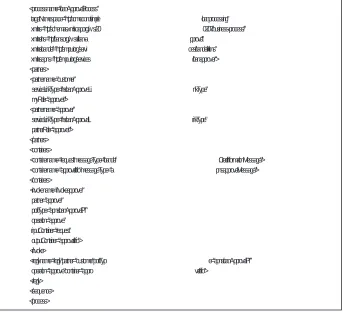
In order to demonstrate how a business process can be created by BPEL4WS, we
de-scribe a simple example taken from [76], which shows a loan approval process. In this
example, a customer sends a request for a loan, then the financial institution’s web
ser-vice is invoked, and finally replies to the customer. The running flow of the loan approval
process is shown in Figure 2.8.
WSLA
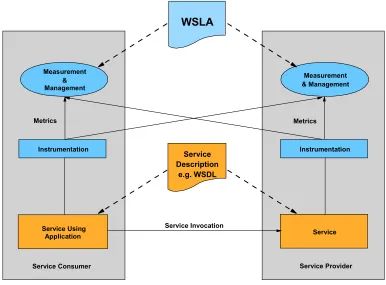
TheWeb Service Level Agreement language(WSLA) [16], presented by IBM, is a
frame-work for specifying and monitoring Service Level Agreements (SLA) for web services. A
35
perform a service according to agreed guarantees for IT-level and business process-level
service quality parameters such as response time and throughput, and measures to be taken
in case of deviation and failure to meet the asserted service guarantees, for example, a
notification of the service customer. The assertions of the service provider are based on a
detailed definition of the service parameters including how basic metrics are to be measured
in systems and how they are aggregated into composite metrics for web service
composi-tion. In addition, a WSLA expresses which party monitors the service, third parties that
contribute to the measurement of metrics, supervision of guarantees or even the
manage-ment of deviations of service guarantees. Interactions among the parties supervising the
WSLA are also defined. WSLA can be used by both service provider and service customer
to configure their respective systems to provide and supervise their service. See Figure 2.9
[16] for the role of a web service level agreement in web service environments.
As far as web service composition is concerned, its Quality of Service (QoS) issue
can be solved by the WSLA language. With WSLA, we can specify the QoS property,
requirement and agreement.
2.3 Query and Matching Techniques for Web Services Discovery
In the previous sections, we introduced various web service specifications and models,
including WSDL, UDDI, SOAP, XML schema and BPEL. We also introduced the models
and research issues of web service composition. In this section, we will focus on important
related techniques and backgrounds for web services discovery. In the first part of this
section, we illustrate tModel, which serves as an important tool to facilitate discovery of
web services. Then we present some classic clustering algorithms, which lay basis for our
that, we illustrate the tree edit distance algorithm, which is mainly used to calculate the
similarity degree of two web service messages represented as tree structures.
2.3.1 tModel
We have known that UDDI can be seen as an online “yellow book”, where service providers
register their web services, and service consumers try to find the desired service
descrip-tions from this online registry. tModel is an important tool to facilitate businesses to
dis-cover desired web services through UDDI [5][120]. A tModel is a single interface of the
web service that we are going to develop and register, i.e. a technical specification and a
data structure representing a service type (a generic representation of a registered service)
in the UDDI registry. Each tModel consists of a name, a service description, and a
Univer-sal Unique Identifier (UUID). Via tModel, service providers can register their web services
according to a predefined list of service types, and the tModel organizes the service type’s
information and makes it accessible in the registry database. Therefore, businesses can
search the registry’s service types list to find service providers in a much easier way.
2.3.2 Clustering Algorithms for Web Services Discovery
The Web Service Description Language (WSDL) specification provides a standard way for
describing web services in natural language. A WSDL file shows the relevant information
about a web service, such as service name, service operations and service description. Our
web services discovery methods are based on unsupervised clustering for web services.
They mainly focus on the textual features of WSDL files and depend on analyzing the
frequency of terms to make service matching. Furthermore, by schema matching, which