Available Online atwww.ijcsmc.com
International Journal of Computer Science and Mobile Computing
A Monthly Journal of Computer Science and Information Technology
ISSN 2320–088X
IJCSMC, Vol. 4, Issue. 4, April 2015, pg.229 – 233
RESEARCH ARTICLE
Effective Bandwidth Utilization in
Multimedia Video Streaming
Dushyanth GM
Computer Networks and Engineering, New Horizon College of Engineering, Bangalore, India
Miss. Tinu
Asst. Professor, Computer Networks and Engineering, New Horizon College of Engineering, Bangalore, India
Abstract— Multimedia video streaming is becoming one of the popular technologies in this modern world. Videos are streamed in internet in various formats and resolutions for example mp4, avi, mpeg, HD, UHD. The higher resolution video utilizes more bandwidth and similarly low resolution videos utilize relatively less bandwidth to stream video over internet. So the videos need to be buffered such that streaming is continuous and non-disruptive hence the videos should be buffered accordingly for effective utilization of the data and bandwidth. This paper describes how efficiently the videos can be streamed with minimum waste of data in high speed bandwidth internet.
Keywords— Threshold; ISP:Internet Service Provider; FUP:Fair Usage Policy; buffer
I. INTRODUCTION
We all know that Internet has been revolutionized the modern world where the internet is been provided with a very high speed bandwidth with fiber optics as a backbone and high speed mobile data with 3G,4G and wi-max technologies. ISP (Internet service providers) are providing the bandwidth to their end-users in different tariff plans that include Unlimited and FUP (fair usage policies) plans. Unlimited data usage is the tariff plan where the user can download and upload data unlimitedly or ISP would provide limited data at full speed and post to the limited data the speed in brought down to the lower bandwidth. But in FUP plans the data is been provided limitedly that is, if subscriber subscribes to plans where the data limit is 10GB/month and post data usage would be charged according to the ISP tariff plans.
II. CASE STUDY
A. Scenario 1
Consider a user who is watching a video of length 1000sec and video size of 50MB at 24MBps and since the bandwidth is high the video would buffer around 25sec and if user feels the video what he is watching is not appropriate and if the video playtime/current time is at 20th sec then the video data after 20th sec would drown into wastage.
B. Scenario 2
Suppose if the user is watching the video and if the video is completely buffered and consider there is a sudden power hit where the system has no power backup then then user would waste the data after the playtime at the time of power hit.
C. Scenario 3
Consider a user who is watching a movie online would have buffered the video completely. Suppose at the middle of the movie if he gets engaged with some other business where he forcibly wants to end the movie then he would be still wasting the data after the video current time.
III. PROPOSED METHOD
This paper proposes how effectively the data can be utilized during video streaming in high speed internets based on buffer restriction time based threshold value.
Consider a user who is streaming a video on 24MBps broadband connection on FUP tariff plan of video size 50 MB and video length of 1000sec. Here let us consider a threshold value as 100sec so now when the user starts to buffer the video, the video would get buffered till 100sec only. There after the buffering would be with respect to the playtime or current time that is, if the current time is at 0th sec then the video would get buffered till 100th sec similarly if video current time is at 5th sec then the video would get buffered till 105th sec and if the video current time is at 10th sec then the buffering will be at 110th sec and so on. Thus by restricting buffer using threshold value the data can be utilized effectively and efficiently in high speed internet since video only buffers till the threshold value. Even if the user wants to close the video then the data would get wasted till the threshold value only unlike the traditional video streaming the data would get wasted completely.
A. Abbreviations and Acronyms
ISP: Internet service provider.
An Internet Service provider is an Organization that provides services for accessing, using, or participating in the internet.
FUP: Fair Usage Policy
Under Fair usage policy, data transfer limits of the plans are not changed. The data transfer limits remain as it is. (e.g. an unlimited plan will continue as an unlimited plan). Post consuming a certain amount of GB/MB on the plan you have, the speeds will be rationalized.
B. Comaprative Study
The theoretical study proves that this paper results in an effective utilization of bandwidth in high speed internets by avoiding unnecessary data wastage.
1) Equations
a)Video Size (VS)
Video Size: video size is the number of bits/bytes that is comprised in video and is given as
VS = (TB*VL)/8 in KB.
VS = Video Size in KBps. TB = Total Bitrate in KBps. VL = Video length in sec.
b)Optimal Internet data tranfer Rate
TransferRate=Bandwidth/8 in KBps
c)Time taken to download Video file (T)
T=VS/TransferRate in sec
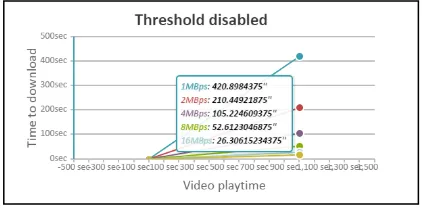
The above graph shows the time taken to download 52MB of data in different bandwidths
2) Video Streaming with Threshold disabled
In traditional video streaming if the videos are streamed over a high speed internet the video would get downloaded completely. If the user closes the video window then the data would get wasted completely till it has buffered. In the below comparative study if the total video playtime is 1000sec and video size 52MB. If the video is fully buffered and if the user closes the video at 500th sec still remaining 500 sec data would get wasted so there would be 0MB data saved
Fig. 1. Graph showing with Threshold value disabled
Table 1
Data saved 0 MB
Time taken to download 52MB (threshold disabled)
Speed/Kbps Time/sec
1 420
2 210
4 105
8 52
16 26
3) Video streaming with enabled
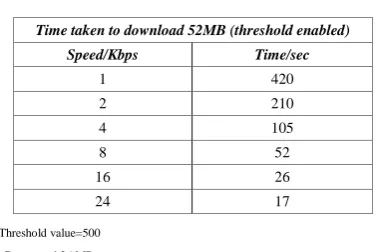
In the proposed system since the video streaming is enabled with the threshold value. Hence the video would get buffered till the threshold value only. Suppose if the user closes the video streaming window at 0th sec after some time and if the user current time is at 0th sec the video would get buffered till 500th sec since the video would get buffered till 500th sec hence the data from 500th sec to 1000th sec could be saved. So if my video size if around 52 MB then the user could save 26MB of the data.
Fig. 2. Graph showing with Threshold value enabled in the blue region
Table 2
Threshold value=500 Data saved 26 MB
IV. CONCLUSION
The proposed system ensures that there is an effective bandwidth utilization during Multimedia video streaming and helps the end user with unnecessary data wastage. Since the propose system is based on time based buffer restriction there is no degradation in video quality because no bits are reduced in the video. The proposed system is highly effective in High speed internet bandwidths and also fights against the fair usage policies resulting a cost effective video streaming in terms of data.
Though the proposed system is highly effective for high-speed internet bandwidth users, the low bandwidth users suffers with continuous video streaming since the threshold value stops the buffer at specified threshold value. Usually low bandwidth users buffers the complete video and then the video is played to achieve non-disruptive video streaming however providing a toggle button to enable and disable the threshold value could overcome this come.
Time taken to download 52MB (threshold enabled)
Speed/Kbps Time/sec
1 420
2 210
4 105
8 52
16 26
REFERENCES
[1] Effective Bandwidth Utilization in For Multimedia Over Low Bandwidth links Dinil Mon Divakaran, Hema A. Murthy and Timothy A. Gonsalv.
[2] http://forum.videohelp.com/threads/299571-How-to-calculate-size-of-video-file-after-encoding
[3] Calculate TCP throughput http://bradhedlund.com/2008/12/19/how-to-calculate-tcp-throughput-for-long-distance-links/ [4] Media streaming over Internet https://tech.ebu.ch/docs/techreview/trev_292-kozamernik.pdf
[5] Streaming video over the Internet: approaches and directions http://www.slideshare.net/Ronny72/streaming-video-over-the-internet-approaches-and-directions-4759277