A QUANTITATIVE ANALYSIS ON THE
CORRELATION BETWEEN INDUSTRIAL
EXPERIENCE AND STRESS LEVEL CHANGES IN
BANKING INDUSTRY
Gopika G.
Lecturer, Amrita Vishwa Vidyapeetham,
Amrita School of Arts and Sciences, Kochi (India)
ABSTRACT
Nowadays the corporate sector is thriving at a high speed that the working class has to work for lingering hours to
maintain the standard of living and achieve their basic needs. So is the condition in the hospitals, colleges, BPO’s
and lots of other places. Despite having the modern technological innovations, people have a feeling of over loaded
with work and stressed out. The banking sector is of no exemption. An attempt has been made through this research
paper to know the experience level of employees and the relative effect of experience on stress level changes. It is
found that maximum number of employees in banks is under stress. Majority of the employees try to find solution to
relieve them from stress. Also the measures are also suggested in the paper to overcome stress that affects their
physical and mental health.
Key Words: Banking Sector, Workplace Stress, Innovation, Experience
I INTRODUCTION
1.1 In the present dynamic environment, workplace stress is becoming a major issue and a matter of concern for the employees and the organizations. With the advent of industrialisation and privatization, pressure in the urban areas,
quantitative growth in population and various problems in day to day life are some of the reasons for increase in
stress. Stress is a condition of strain that has a direct bearing on emotions, thought process and physical conditions
of a person. Steers indicate that, “Occupational stress has become an important topic for study of organizational behavior for several reasons.” 1. Stress has harmful psychological and physiological effects on employees, 2. Stress
is a major cause of employee turnover and absenteeism, 3. Stress experienced by one employee can affect the safety
of other employees, 4. By controlling dysfunctional stress, individual and organization can be managed more
effectively.
During the past decade, the banking sector had under gone rapid and striking changes like policy changes due
banking sector are experiencing a high level of stress. The advent of technological revolution in all walks of life
coupled with LPG policies has drastically changed traditional and conventional patterns in all sectors. The banking
sector is of no exemption. The shift in the work culture compelled the banking sector to reform and adjusts to have a
competitive edge to cope with multinationals led environment. The implications of the above said transformations
have affected the social, economical and psychological domains of the bank employees and their relations. Evidence
from existing literature states that more than 60% of the bank employees have one or other problem directly or
indirectly related to these drastic changes. All the factors discussed above are prospective attributes to cause
occupational stress and related disorders among the employees which can be possibly reduced through proper
training and induction programme. Although a lot of studies have been conducted on the psychosocial side of the
new policy regime in many sectors, there are only few studies, as far as the banking sector is concerned, while the
same sector has been drastically influenced by the new policies.
In the juncture, this study is undertaken to address specific problems of bank employees related to occupational
stress. This throw light in to the pathogenesis of various problems related to occupational stress among bank
employees.
1.2 Rationale
The employees are the most important assets of the organization. Organizational role stress influences behaviour of
the people working in an organization and thereby affects performance, satisfaction and attitude of the people. This
study will help to understand the level of stress among the workers derived from insufficient and outdated training
methods. The purpose of this paper is an attempt to investigate and to compare the correlation between the industrial
experience and stress level changes experienced by the employees of the banks.
1.3 Objectives of the study
1.3.1 Primary Objective
The primary aim for the study is to analyze the level of stress among the bank employees
1.3.2 Secondary Objective
To assess the effect of stress in work caused due to lack of experience
To study the different types of stresses undergone by the employees
To identify the stressors for employees and which stressors contribute most towards stress.
To suggest ways and means of coping with various types of stresses.1.4 Scope of the study
United States National Institute of Occupational Safety and Health has defined workplace stress as “The harmful
physical and emotional responses that occur when the requirements of the job do not match the capabilities,
by pressures at home and at work. Stress at work can be a real problem to the organization as well as for its workers.
Good management and good work organization are the best forms of stress prevention. This study is helpful in
assessing the extent of stress experienced by the employees.
1.5 Methodology of the Study
1.5.1 Population
The population selected for this particular study is employees from 100 private and public sector banks in
Ernakulam.
1.5.2 Research Design
The study is explorative as well as descriptive in nature
.
1.5.3 Sample Design
The particulars of sample design,
1. TYPE OF UNIVERSE : Finite.
2. SAMPLING UNIT : Ernakulam
3. SOURCE LIST : Bank Employees
4. SIZE OF SAMPLE : 100
5. PARAMETER OF INTEREST : In estimating the number of persons being stressed in their jobs.
1.6 Tools of Data Collection
A pilot testing will be conducted initially by administering the questionnaire on around 10 numbers of respondents.
Interviews will be conducted with the employees for gathering information on their perception about their
organization and the problems which they face both directly and indirectly in the discharge of their responsibilities.
The respondents will be questioned on the issues affecting the stress levels of the employees, impact of external
pressures on their work, expectations from their roles, up to what extent they are satisfied and possible suggestions
for overcoming the adversities of stress by evaluating the individual initiatives and organizational initiatives.
Source Of Data
The study will consist of both primary and secondary data. The primary data will be collected by direct interview
through questionnaire. The secondary data was collected from research publications, standard journal and
periodicals including the government organizations and from respective records about the job related occurrence.
Research Instrument- Questionnaire Method
The instrument will be administered in the workplaces of each group. Data will be collected from the employees.
Data will be collected using a structured questionnaire, which will be distributed in the workplace to the branch
Analysis of Data
The data will be analyzed to determine any differences between the stress levels of the branch managers and their
impact on reducing stress.
1.7 Limitations of the study
There is a limitation of time.
Inherent limitations of Sampling
The response obtained from the questionnaire may suffer from personal bias which will distort the results.
The questionnaire may contain incomplete responses which will cause incorrect or misleading results.
Due to limited geographical area sample size generalization is impossible.
II LITERATURE REVIEW
Organizations are managed and staffed by people. Without people organization cannot exist. Indeed, the challenge,
the opportunity and also the frustrations of creating and managing organizations frequently stem for the mistaken
belief that people are all alike that they can be treated identically. Even within a single physical category there will
be enormous variability in psychological characteristics. Some will be screamers and others will be reserved, some
will be intelligent and others average, etc. The point is that these differences demand attention so that each person
can maximize his or her potential, so that the organizations can maximize their effectiveness, so that the society as a
whole can make the wisest use of its human resources.
2.1 Stress
Stress is a general term applied to pressures people feel in life. The presence of stress at work is almost inevitable in
many jobs. When pressure begins to build up it can cause adverse strain on one’s emotions, thought process and
physical conditions. They are easily provoked to anger and unable to relax. They may be non-co-operative although
these conditions also occur from other causes which are common symptoms of stress.
2.2 Definition
Hans Selye(1956)1 was one of the founding fathers of stress research. His view in 1956 was that “stress is not necessarily something bad – it all depends on how you take it. The stress of exhilarating, creative successful work is
beneficial, while that of failure, humiliation or infection is detrimental.” Selye believed that the biochemical effects of stress would be experienced irrespective of whether the situation was positive or negative.
2.3 Symptoms of Stress
Stress is associated with physiological symptoms, characteristic of sympathetic nervous system activity. These
stress, both the subjective (how a person feel) and the behavioral (how a person acts), although there is some overlap
in these areas.
2.4 Types of Stress
Stress is a biological term which refers to the consequences of the failure of a human or animal body to respond appropriately to emotional or physical threats to the organism, whether actual or imagined. It includes a state of
alarm and adrenaline production, short-term resistance as a coping mechanism, and exhaustion. It refers to the
inability of a human or animal body to respond. Common stress symptoms include irritability, muscular tension,
inability to concentrate and a variety of physical reactions, such as headaches and accelerated heart rate.
Two types of stress may be distinguished:-
2.4.1 Acute Stress
Acute stress is usually for short-time and may be due to work pressure, meeting deadlines, pressure or minor
accident over exertion, increased physical activity, searching something but misplaced it or similar things.
Symptoms of this type of tensions are headache, back pain, stomach problems, rapid heartbeat, muscle aches or
body pain, hypertensions, chest pains, heart diseases, etc. Acute stress is common in people who take too many
responsibilities and are over loaded or overworked, disorganized, always in hurry and never on time. These people
are generally in position of importance at their workplace and stressful lifestyle is inherent in them.
2.4.2 Chronic Stress
This type of stress is the most serious one. Chronic stress is a prolonged stress that exists for weeks, months, or even
years. This stress is due to poverty, broken or stressed families and marriages, chronic illness and successive failures
in life. People suffering from this type of stress get used to it and may even not realize that they are under chronic
stress. It is harmful to their health. Chronic stress is stress that lasts a long time or occurs frequently. Chronic stress
is potentially damaging.
2.4.3 Stress Management
Stress management is the need of the hour. However hard we try to go beyond a stress situation, life seems to find
new ways of stressing us out and plaguing us with anxiety attacks. Moreover, be it our anxiety, mind-body
exhaustion or our erring attitudes, we tend to overlook causes of stress and the conditions triggered by those. In such
unsettling moments we often forget that stressors, if not escapable, are fairly manageable and treatable.
Stress, either quick or constant, can induce risky body-mind disorders. Immediate disorders such as dizzy spells,
anxiety attacks, tension, sleeplessness, nervousness and muscle cramps can all result in chronic health problems.
They may also affect our immune, cardiovascular and nervous systems and lead individuals to habitual addictions,
which are inter-linked with stress. Like "stress reactions", "relaxation responses" and stress management techniques
are some of the body's important built-in response systems. As a relaxation response the body tries to get back
the lost carbohydrates and fats, and restore the energy level. The knotted nerves, tightened muscles and an exhausted
mind crave for looseness. Unfortunately, today, we don't get relaxing and soothing situations without asking. To be
relaxed we have to strive to create such situations.
2.4.4 Banking Industry
Banks are among the top ten high stress workplaces in India. Elucidating the causes of occupational stress is
important not only for its potential implications for stress management at banks but also for enhancing an
understanding of strategic human resource management. The massive and speedy expansion and diversification of banking has not been without its strains.
The banking industry is entering a new phase in which it will be facing increasing competition from non-banks not
only in the domestic market but in the international markets also. The operational structure of banking in India is
expected to undergo a profound change during the next decade. With the emergence of new private banks, the
private bank sector has become enriched and diversified with focus spread to the wholesale as well as retail banking.
The existing banks have wide branch network and geographic spread, whereas the new private banks have the clout
of massive capital, lean personnel component, the expertise in developing sophisticated financial products and use of
state-of-the-art technology.
III RESULTS AND DISCUSSIONS
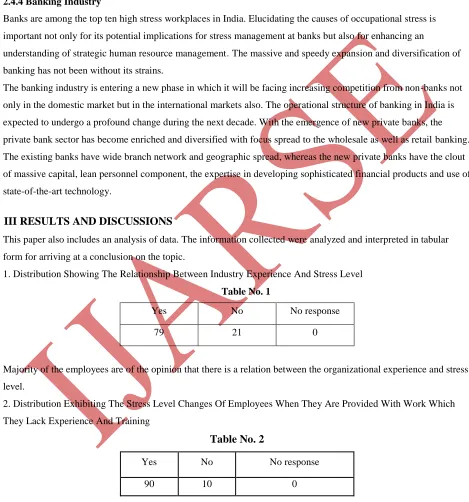
This paper also includes an analysis of data. The information collected were analyzed and interpreted in tabular
form for arriving at a conclusion on the topic.
1. Distribution Showing The Relationship Between Industry Experience And Stress Level
Table No. 1
Yes No No response
79 21 0
Majority of the employees are of the opinion that there is a relation between the organizational experience and stress
level.
2. Distribution Exhibiting The Stress Level Changes Of Employees When They Are Provided With Work Which
They Lack Experience And Training
Table No. 2
Yes No No response
90 10 0
90% respondents believe that they are not in a position to undertake the duties and responsibilities in which they
3. Distribution Showing The Opinion Of Employees Regarding The Stress Releiving Measures To Be Employed By
Management
High
Salary
Recruit
supportive staff Training Reduce Work Load
28 10 50 12
The bank employees suggested certain stress relief measures as a tool of stress management. Training
IV FINDINGS & SUGGESTIONS
4.1
Findings
1. 79% of the employees were of the opinion that with the increase in the experience level in the industry the
stress will reduce. With the increase in industrial experience, the employees get used to the major
uncertainties and are able to avoid the same.
2. 70% of the respondents responded that they would get tensed when provided with some unplanned work.
3. The employees in banks need training or experience in the job, otherwise they would get stressed out as the
job is monotonous.
4. The employees are of the view that in order to relieve the employees from stress, 28% the respondents was
of the opinion that the management will have to increase salary. 50% of the employees opted for better
training methods while the rest 12% had an opinion to reduce the work load and 10% request for a
supportive staff.
4.2 Implication of Stress
1. Physical problems and health problems like heart diseases, ulcers, arthritis, increased frequency of drinking and
smoking, cardiovascular, gastrointestinal, endocrine and other stress related disorders
2. Psychological and behavioral problems: psychological problems like change of moods, inferiority complex,
widespread resentment, reduced aspirations and self esteem, reduced motivation and job skills.
3. Organisational job dissatisfaction, behavioral problems, production turn over, increased absenteeism, increased
accidents, lower productivity.
4.3 Suggestion and Recommendations
1. The organization must introduce Employee Assistance Programmes (EAPs) and stress control workshops
accordingly to the level of employees, because there is a strong relation between the level of stress and
level of employees. EAP includes counseling employees who seek assistance on how to deal with alcohol
and drug abuse, managing personal finances, handling conflicts at the work place, dealing with marital and
other family problems, and coping with health problems.
2. Take adequate steps to redesign jobs, which are taxing to employees’ abilities and capacities.
4. Introduce more job oriented training programs, which improve employees’ skill and their confidence to
work effectively.
5. Encourage open channel of communication to deal work related stress.
6. Undertake stress audit at all levels in the organization to identify stress area improving conditions of job
and alleviating job stress.
V CONCLUSION
The productivity of the work force is the most decisive factor as far as the success of an organization is concerned.
The productivity in turn is dependant on the well being of the employees. The well-being is influenced by
occupational stress and job satisfaction. In an age of highly dynamic and competitive world, employees are exposed
to all kinds of stressors that can affect them on all realms of life.
Stress in the work place has become the black plague of the present century. Much of the stress at work is caused not
only by work overload and time pressure but also by lack of rewards and praise, and more importantly, by not
providing individuals with the autonomy to do their work as they would like. Most of the employees were not
satisfied with the grievance handling procedure of the organization which was found by the unstructured interview.
Organization must begin to manage people at work differently, treating them with respect and valuing their
contribution. If we enhance the psychological well-being and health of the employees, in the coming future the
banking industry would make more revenue as well as employee retention, because it is said that,
“A Healthy Employee is a Productive Employee”
REFERENCES
BOOKS:
1. Selye, H. (1974). “Stress without Distress.” Harper and Row Publications, U.S.A
2. Khanka, S.S.(2009). Organisational Behaviour, S.Chand,, New Delhi, 319
JOURNAL PAPERS:
1. Chowdhury, N. and Menon, S. (1997), Beating Burnout, India Today, 9 June, 86
2. Dayo, Akintayo(2012),Working environment, workers’ morale and perceived productivity in industrial
organizations in Nigeria, Education Research Journal Vol. 2(3), 87-93.
3. Dr. K. Chandrasekar (2011), "Workplace environment and its impact on organisational performance in
public sector organisations", International Journal of Enterprise Computing and Business Systems, Vol. 1,
Issue 1, January 2011.
4. Kang L.S., Sandhu R.S., (October 2011), The Indian Journal of Industrial Relations, Vol. 47, No. 2,
329-340,
5. Garg P., (Sep 2010), Case Study, Vol 3, Punjab, 52-58
6. Kathirvel N,(2009), The IUP Journal of Management Research, Vol. VIII, No. 11, 28-44