Watermarking Cryptographic Capabilities
∗Aloni Cohen† Justin Holmgren‡ Ryo Nishimaki§ Vinod Vaikuntanathan¶ Daniel Wichs‖
Abstract
A watermarking scheme for programs embeds some information called a mark into a program while preserving its functionality. No adversary can remove the mark without damaging the functionality of the program. In this work, we study the problem of watermarking various cryptographic programs such as pseudorandom function (PRF) evaluation, decryption, and signing. For example, given a PRFF, we create a marked programCe that evaluates F(·). An adversary that gets Ce cannot come up withany programC∗in which the mark is removed but which still evaluates the PRF correctly on even a small fraction of the inputs.
The work of Barak, Goldreich, Impagliazzo, Rudich, Sahai, Vadhan, and Yang (CRYPTO’01 and Journal of ACM 59(2)) shows that, assuming indistinguishability obfuscation (iO), such watermarking isimpossibleif the marked programCeevaluates the original program with perfect correctness. In this work we show that, assuming iO, such watermarking ispossibleif the marked programCeis allowed to err with even a negligible probability, which would be undetectable to the user. We also significantly extend the impossibility results to our relaxed setting.
Our watermarking schemes are public key, meaning that we use a secret marking key to embed marks in programs, and a public detection key that allows anyone to detect marks in programs. Our schemes are secure againstchosen program attackswhere the adversary is given oracle access to the marking functionality. We emphasize that our security notion of watermark non-removability considers arbitrary adversarial strategies to modify the marked program, in contrast to the prior works (Nishimaki, EUROCRYPT ’13).
∗
This work is a merged version of [NW15] and [CHV15] with additional results. This work was sponsored in part by the Defense Advanced Research Projects Agency (DARPA) and the U.S. Army Research Office under contract number W911NF-15-C-0226. This work was done in part while the first two authors were visiting the Weizmann Institute of Science, and in part while the authors were visiting the Simons Institute for the Theory of Computing, supported by the Simons Foundation and by the DIMACS/Simons Collaboration in Cryptography through NSF grant CNS-1523467.
†
MIT,[email protected]. Research supported in part by the NSF Graduate Student Fellowship. ‡
MIT,[email protected]. Research supported in part by NSF Frontier CNS-1413920. §
NTT Secure Platform Laboratories,[email protected]. This work was done in part while the author was visiting Northeastern University.
¶
MIT CSAIL,[email protected]. Research supported in part by DARPA Safeware grant, NSF grants CNS-1350619 and CNS-1414119, Alfred P. Sloan Research Fellowship, Microsoft Faculty Fellowship, the NEC Corporation, and a Steven and Renee Finn Career Development Chair from MIT.
‖
Contents
1 Introduction 1
1.1 Our Results . . . 3
2 Overview of Our Techniques 4 2.1 Simplification: Token-Based Watermarking . . . 4
2.2 A High Level Approach . . . 4
2.3 A Simple Scheme with Weak Security . . . 5
2.4 Challenges in Allowing Mark/Extract Oracles . . . 5
2.5 Toward a Fully Secure Token-Based Scheme . . . 6
2.6 Using Indistinguishability Obfuscation. . . 8
2.7 Related Work . . . 8
3 Preliminaries 9 4 Definition of Watermarking 11 5 Puncturable Encryption 12 6 Watermarking PRFs 14 6.1 Scheme Outline . . . 14
6.2 A Message-Embedding Construction . . . 15
6.3 Security Proofs . . . 15
7 Extensions and Variants of Watermarking 22 7.1 Stronger Unremovability in a Different Model . . . 22
7.2 Optimality of(12 + 1 poly(λ))-Unremovability . . . 23
7.3 Variants . . . 23
8 Watermarking Other Cryptographic Primitives 24 9 The Limits of Watermarking 26 9.1 Impossibilities for statistical correctness . . . 26
9.2 Impossibilities for weak statistical correctness . . . 29
10 Conclusions 30 A Construction and Security Proofs of Puncturable Encryption 33 A.1 Construction. . . 33
A.2 Ciphertext Pseudorandomness . . . 35
B Proof of Theorem 9.13: Waterproof PRFs 41 B.1 Preliminaries . . . 41
B.2 Construction. . . 42
B.3 Learnability . . . 43
B.4 Pseudorandomness . . . 44
1
Introduction
Digital watermarking enables us to embed some special information called amarkinto digital objects such as images, movies, music files, or programs. We often call such objects marked. There are two basic requirements for watermarking. The first is that a marked object should not be significantly different from the original object. The second is that malicious entities should not be able to remove embedded marks without somehow “destroying” the object (e.g., modify an image beyond recognition).
There are many works on watermarking perceptual objects such as images, movies, music files, etc. Most of them do not give a rigorous theoretical treatment and their constructions are heuristic and ad-hoc. (We briefly survey some of these works in Section 2.7). Barak, Goldreich, Impagliazzo, Rudich, Sahai, Vadhan and Yang [BGI+01,BGI+12], in their seminal work that laid the mathematical foundations of program obfuscation, also proposed definitions for program watermarking. Unfortunately, their results were all negative, showing that certain definitions of watermarking are impossible to achieve. The work of Hopper, Molnar and Wagner [HMW07] proposes general and rigorous definitions for watermarking schemes, and explores in depth connections between the definitions, but does not provide any actual constructions. Watermarking Programs. Our first contribution is to define the notion of public-key watermarking, building on the work of Hopper, Molnar and Wagner [HMW07] who introduced a secret-key definition. We speak of a watermarking scheme for a circuit classC = {Cλ}λ∈N where eachCλ is a set of circuits. A watermarking scheme forCconsists of proceduresMark(mk,·)andExtract(ek,·)with asecret marking key
mk and apublic extraction keyek. Given a circuitC, the marking procedureCe ← Mark(mk, C)creates
a marked circuit Ce that evaluates C. Although we will see that we cannot achieve perfect correctness,
in whichCe(x) = C(x) for all inputsx, we will be able to achievestatistical correctnesswhere we allow
a negligible error probability. The extraction procedureExtract(ek, C∗) outputs either that the circuit is markedorunmarked.
For security, we consider a game where a challenger chooses arandom circuitC ← Cλ and gives the adversary the marked circuitCe←Mark(mk, C). Intuitively, we require that the adversary cannot come up
withanycircuit that correctly evaluatesCbut does not have the mark embedded in it. This property is called
unremovability. Following [HMW07] and adapting it to the public-key setting, we require that unremovability holds againstchosen circuit attackers, namely adversaries that have oracle access toMark(mk,·).
More precisely, the adversary produces a circuitC∗ and we insist that either:
(a) Extractcorrectly detects that the circuit is marked by outputtingmarked←Extract(ek, C∗); or
(b) The circuitC∗does not even approximatelycomputeC, meaning thatC∗(x) =C(x)on at most anε fraction of the inputsx.
The parameterεis called the “approximation factor” and we can set it to some small constant or even to any
1/polyfraction. (The smaller theε, the better the security guarantee). During the attack, the adversary is also given the public extraction keyek and access to the marking oracleMark(mk,·)that he can query on arbitrary circuits of his choice (even ones that are not inCλ). At this point, it is prudent to note that the very first idea that comes to mind, namely signing the circuitCusingmk, is not a particularly good watermarking strategy as the adversary can simply strip off the signature leaving a perfectly functional circuit.
We call the above type of watermarking “messageless” to denote that it only distinguishes between marked and unmarked circuits. We also consider a stronger version called “message-embedding” watermarking where the marking procedure can be used to embed an arbitrary message into the circuit and the extraction procedure should recover the message. Similar to the above, the adversary’s goal is to force the extraction procedure to recover a different message. (We refer the reader to Section4for formal definitions).
First, we observe that in the security definition for watermarking, the challenge circuit C has to be unknown to the adversary. For, if not, the adversary has a trivial watermark removing strategy: given the marked circuitCe, simply outputCas the mark-removed circuit. SinceCis an arbitrary program, it is very
likely to be unmarked; on the other hand,C is (approximately) equivalentCe in functionality.1 Thus, it is
natural for the challenger to pickCfrom a distribution with high min-entropy (In this work, for simplicity, we consider picking circuits uniformly at random fromCλ).
Secondly, we observe that circuit families that are exactly learnable are not watermarkable. This is because the adversary can simply invokeCeas a black box and recover a description of the original circuitC
(or an equivalent version thereof) which is again very likely to be unmarked.
This naturally leads us to consider families of circuits where random circuits from the family are not exactly learnable, canonical examples of which are cryptographic programs: pseudo-random functions, signing algorithms and decryption algorithms. Jumping ahead, we remark that unlearnability is a necessary but not sufficient condition for being able to watermark a family of circuit. Indeed, we show families of pseudo-random functions that, despite being strongly unlearnable, cannot be watermarked even with approximate correctness.
That said, we regard the question of coming up with meaningful definitions and constructions of water-marking for general circuits (and even families of evasive circuits) as a challenging open question arising from this work.
Watermarking Cryptographic Programs: An Application. To further highlight the usefulness of wa-termarking cryptographic functions, we describe an application of wawa-termarking pseudorandom functions. However, we emphasize that the concept should have broader applicability beyond this example.
Consider an automobile manufacturer that wants to put electronic locks on its cars; the car contains a PRFF and can only be opened by running an identification protocol where it chooses a random inputxand the user must respond withF(x). When a car is sold to a new owner, the owner is given a software key (e.g., a smart-phone application) consisting of marked programCethat evaluates the PRFF(·)and is used to open
the car. The mark can embed some identifying information such as the owner’s name and address. Even if the software key is stolen, the thief cannot create a new piece of software that would still open the car while removing information about the original owner.
Impossibility of Watermarking? The work of Barak et al. [BGI+01,BGI+12] initiated the first theoretical study of program watermarking. They propose a game-based definition which appears significantly weaker than the definitions we consider in this work (it is in the symmetric-key setting with no marking/detection oracles given to the adversary),butrequires perfect correctness. Unfortunately, they show that this definition is unachievable assuming the existence of indistinguishability obfuscation.
The main intuition behind the negative result is to consider an attacker that takes a marked program and applies indistinguishability obfuscation (iO) to it. If the marked program implements the original program withperfect correctnessthen the result of applying iO to it should be indistinguishable from that of applying iO to the original program. Since the latter is unlikely to be marked, the same should apply to the former. Therefore, this presents a valid attack against watermarking in general.
Barak et al. note that the above attack crucially relies on the perfect (rather than merely statistical) correctness of the marked program, meaning that it correctly evaluates the original program on every input. They mention that otherwise “it seems that obfuscators would be useful in constructing watermarking schemes, because a watermark could be embedded by changing the value of the function at a random input, after which an obfuscator is used to hide this change.” This idea was not explored further in [BGI+01,BGI+12] and it is far from clear if a restricted notion of obfuscation such as iO (or even extractability 1One can attempt to get around this issue by requiring that the program output by the watermark remover should be distinct from
CandCe. However, it is also easy to defeat these definitions by asking the watermarked remover to output an indistinguishability
obfuscation or VGB) would be sufficient and what type of watermarking security can be achieved with this approach. Nevertheless, this idea serves as the starting point of our work.
1.1 Our Results
We start by giving new formal definitions of program watermarking, along the lines of what we described earlier. To avoid the [BGI+01,BGI+12] impossibility result described above, our definition allows for statistical rather than perfect correctness. That is, for every circuitC ∈ Cλand every inputx,
Pr[Ce(x)6=C(x) | Ce←Mark(mk, C)]≤negl(λ)
where the probability is over the choice of the keys and the coin tosses of theMarkalgorithm. We call this
strong approximate correctness.
This seemingly small relaxation allows us to circumvent the impossibility results and show algorithms to watermark large classes of pseudo-random functions, signature algorithms and decryption algorithms. Our main technical contribution is a method of watermarking any family of puncturable PRFs.2 Our scheme has a public-key extraction procedure and achieves security in the presence of a marking oracle. We get a messageless scheme that allows for anyε = 1/poly(λ)approximation factor and a message-embedding scheme that allows for approximation factorsε = 1/2 + 1/poly(λ). In the case of message-embedding constructions, we show that there is an inherent lower bound ofε= 1/2. Both schemes rely on (polynomially secure) indistinguishability obfuscation (iO).
Theorem 1.1 (Informal) Assuming indistinguishability obfuscation and injective one-way functions, there
is a watermarking scheme that is secure against chosen circuit attacks for any family of puncturable PRFs.
We then extend this to watermarking other cryptographic primitives such as the decryption procedure of a public-key encryption scheme, and the signing procedure of a signature scheme. To do so, we rely on recent (obfuscation-based) constructions of public-key encryption and signatures where the decryption/signing procedures are simply PRF evaluations [SW14]. (In contrast to our PRF result where we watermark any punctured PRF, here we design special watermarkable signature schemes and decryption algorithms).
Theorem 1.2 (Informal) Assuming indistinguishability obfuscation and injective one-way functions, there
are signature and decryption algorithms that can be watermarked with chosen circuit security.
Theorem1.1and1.2show that relaxing the correctness requirement to strong approximate correctness allows us to watermark any family of puncturable PRFs, and certain families of signature and decryption algorithms. A natural question is whether one can watermark arbitrary PRF, signature and decryption circuits. We show impossibility results matching our constructions by demonstrating families of PRFs, signature and decryption algorithms that cannot be watermarked. We call such schemeswaterproof.
We start by observing that learnable functions are waterproof, simply because an adversary can learn a canonical representation of the function given any program (even any oracle) that computes the function. Indeed, it is sufficient for the function family to be non black-box learnable. That is, the adversary should be able to use any program that computes the function to extract a canonical representation. Such function families were defined in the work of Barak et al. [BGI+01] and are calledunobfuscatable functions. Indeed, [BGI+01,BGI+12] show PRFs, signature and decryption algorithms that are strongly unobfuscatable – that is, an adversary can extract the canonical representation even given a program that only computes a function with strong approximate correctness. This immediately gives us waterproof PRFs, signature and decryption algorithms. (See Section9for more details.)
2Puncturable pseudo-random functions (pPRFs) [BW13a,BGI14a,KPTZ13a] are PRFs where the owner of the keyK can produce a punctured keyKxthat allows computation of the PRF on all inputsy6=x. Moreover, given the punctured key,PRFK(x)
Theorem 1.3 (Informal) Assuming the existence of one-way functions, there are waterproof PRFs and
signature and decryption algorithms, even if: (a) we only require symmetric-key watermarking; and (b) we only require unremovability against stand-alone adversaries that do not have access toMark orExtract
oracles.
We continue this line of thought and ask if we can further weaken the correctness requirement and overcome this impossibility result. Namely, we consider a weak approximate correctness requirement which states that the marked program Ce agrees with the original program C on most inputs. (In contrast to
strong approximate correctness, hereCecan always make a mistake on some fixed set of inputs). We show
that even this relaxation does not help. Our proof of this result involves constructing new types ofrobust unobfuscatable PRFs. (See SectionBfor more details).
Theorem 1.4 (Informal) Assuming the existence of one-way functions, there are waterproof PRFs even
under weak approximate correctness (and even with relaxations (a) and (b) as in Theorem1.3).
2
Overview of Our Techniques
2.1 Simplification: Token-Based Watermarking
Although our full watermarking scheme relies on indistinguishability obfuscation (iO), our main technical insights are largely unrelated to obfuscation. In order to elucidate our techniques clearly without getting entangled in details of iO, for the purposes of this introduction we consider a simplified model of watermarking that we calltoken-basedwatermarking. We treat watermarked programsCe ← Mark(mk,· · ·)as
tamper-proof hardware tokens which the adversary can only access as a black box.3 The adversary can arbitrarily compose hardware tokensCe1, . . . ,Ceqand create a new tokenC∗=C∗[Ce1, . . . ,Ceq]that has oracle access to
the tokensCeiembedded inside of it. More formally, we can think ofC∗as an oracle circuit with oracle-gates
toCe1, . . . ,Ceq. The extraction procedureExtract(ek, C∗)will also treat any such tokenC∗ as a black box.
The goal of the adversary is to create a tokenC∗which functionally approximates the challenge watermarked programCe but on which the extraction procedure fails to recover the correct embedded message. Most of
the interesting aspects of constructing watermarking schemes already come up in the token-based setting.4 However, the constructions in the token-based setting become simpler and do not rely on obfuscation. Therefore, we view it as a useful stepping stone to building intuition for our full results where the adversary gets the complete code of the watermarked programs.
2.2 A High Level Approach
At a high level, to watermark a PRFF : {0,1}n→ {0,1}m, we create a tokenCethat evaluatesF correctly
on almost all inputsx, except for some special set of “marked-points”X ⊆ {0,1}nwhich have negligible density in{0,1}n. On the marked points, the watermarked program outputs specially constructed incorrect values that allow the extraction procedure to recover the embedded message. We will ensure that marked points are indistignuishable to the adversary from random inputs. Therefore, the adversary cannot create a new tokenC∗that agrees withCeon a large fraction of random inputs (i.e., approximatesF) but disagrees
withCeon sufficiently many marked points so as to cause the extraction procedure to fail.
3Alternately, one can think of this setting as assuming thatCeis obfuscated with an “ideal obfuscation” scheme. However, since
software-only ideal obfuscation schemes don’t exist, it’s more accurate to think ofCeas a physical hardware token.
4For example, it’s immediately clear thatexactwatermarking, where the marked programCeis functionally equivalent to the
2.3 A Simple Scheme with Weak Security
We start by considering a weak notion of token-based watermarking security, where both the marking key
mk and the extraction keyek are secret and the adversary does not have access to either the marking oracle Mark(mk,·)or the extraction oracleExtract(ek,·). We also consider a messageless scheme where programs can only bemarked orunmarked. In particular, in the security game the adversary gets a single marked tokenCe ← Mark(mk, F)as a challenge, whereF :{0,1}n → {0,1}mis chosen at random from a PRF
familyF ← F (andn, mare super-logarithmic). The adversary’s goal is to come up with some new token
C∗ = C∗[Ce]that approximately evaluatesF but on which the extraction procedure fails to detect that the
program is marked: Extract(ek, C∗) =unmarked.
This can be easily achieved as follows. Choose a polynomial set of`“marked-points”X ={x1, . . . , x`} ⊆
{0,1}n
uniformly at random with corresponding random outputsy1, . . . , y` ← {0,1}m. Setmk = ek =
(x1, . . . , x`, y1, . . . y`). To mark a PRFF, the marking procedureCe ← Mark(mk, F) outputs a tokenCe
that containsx1, . . . , x`, y1, . . . , y`hard-coded and, on inputx, ifx=xifor somei∈[`]it outputsyielse it outputsF(x). The extraction procedure Extract(ek, C∗) tests if onat least one of the`marked points
xi ∈ X the program evaluates toC∗(xi) = yi. If so, it outputs that the program ismarked, and otherwise outputsunmarked.
To prove that the above scheme is secure, we notice that an adversary that gets black-box access to a tokenCe ← Mark(mk, F) for a random unknown F ← F cannot distinguish between the marked points
X = {x1, . . . , x`}and`uniformly random and independent inputs without breaking PRF security. This implies that the adversary cannot come up with a new token C∗ = C∗[Ce] such that C∗(x) = Ce(x) is
“correct” on a large fraction of inputs x ∈ {0,1}n, but C∗(xi) 6= Ce(xi) = yi for all marked points xi ∈ X, as this would imply distinguishing between random points and marked points. More precisely, by setting ` = Ω(λ/ε) where λ is the security parameter, we ensure that if the adversary creates any tokenC∗ =C∗[Ce]that agrees with the marked tokenCeon even anε-fraction of inputsx ∈ {0,1}n, then C∗(xi) =yifor at least one marked pointxi∈ X with overwhelming probability1−(1−ε)`and therefore Extract(ek, C∗) =markedas desired.
2.4 Challenges in Allowing Mark/Extract Oracles
Unfortunately, the above scheme becomes completely insecure if the adversary has access toeithera marking oracleMark(mk,·)or the extraction oracleExtract(ek,·), let alone if the extraction keyek is made public. Let us describe the attacks.
Attack using the extraction oracle. If the adversary gets the challenge marked programCe←Mark(mk, F)
as a token, he can create new tokensC0 =C0[Ce]such thatC0(x) =Ce(x)only forxsatisfyingP(x) = 1
where P is some predicate. By querying the extraction oracle Extract(ek, C0) to see if such tokens are deemed marked or unmarked, the adversary will learn whether there exists some marked point xi with
P(xi) = 1. By choosing such predicates carefully, these queries can completely reveal the marked points. 5 Attack using the marking oracle. Assume the adversary makes just one call to the marking oracle with an arbitrary known PRF functionF0∈ F and gets back a tokenCe0 ←Mark(mk, F0). In addition, the adversary
gets a challenge tokenCe←Mark(mk, F)corresponding to a random unknown PRFF ← F. The adversary
5For example, a concrete instantiation of the above attack uses predicates of the formPw(x) = 1iffx[1, . . . ,|w|] =wfor some
w∈ {0,1}∗(i.e., the first|w|bits ofxmatchw). By starting withwbeing the empty string, the adversary can iteratively add a bit to learn if there exists some marked pointxiwithPw||b(xi) = 1forb∈ {0,1}. Whenever the above occurs for exactly one choice ofb∈ {0,1}, the adversary extendsw:=w||band continues to the next iteration. If this happens for both choices ofb∈ {0,1} then the adversary branches the above process and continues down both paths forw:=w||0andw:=w||1. Since there are` marked points, this process will only branch`times and the adversary will eventually recover all of the pointsX ={x1, . . . , x`}. Once the adversary learnsX, he can create a circuitC∗[Ce]such thatC∗(x) =Ce(x)for anyx6∈ X and otherwiseC∗(x)outputs
some incorrect value (e.g., an independent pseudorandom output). The circuitC∗closely approximatesCe(on all but a negligible
can easily remove the mark by creating a new tokenC∗[Ce0,Ce]that gets oracle access toCe0andCeand does
the following: on inputx, ifCe0(x) = F0(x)then output Ce(x)else output some incorrect value (e.g., an
independent pseudorandom output). The circuitC∗ only differs fromCe on the marked pointsxi ∈ X and
therefore closely approximatesCeon all but a negligible fraction of inputs. However, the extraction procedure
will fail to detectC∗as marked.
2.5 Toward a Fully Secure Token-Based Scheme
We now outline the main ideas for how to thwart the above attacks and get a token-based watermarking scheme with a public extraction keyek and with security in the presence of a marking oracleMark(mk,·). Overview. Our first idea is to make the set of marked pointsX ⊆ {0,1}n
super-polynomial, yet still of negligible density inside of{0,1}n. This will allow us to thwart the attack using an extraction oracle and even make the extraction keyekpublic. In particular, we ensure that even given the extraction keyek, which can be used to sample random marked pointsx← X, the adversary still cannot distinguish such points from uniformly random inputs. Thwarting the marking oracle attack is more difficult. We need to ensure that the set of marked pointsXF is different for each PRFFthat we will mark so that, even if the adversary can test if a point belongs toXFi for various PRFs Fi that were queried to the marking oracle, the marked points XF for the challenge (unknown) PRFF will remain indistinguishable from uniform. However, this creates a difficulty since the extraction procedureExtract(ek,Ce)must test the marked programCeon the correct set
of marked pointsXF without knowing the functionF from whichCewas created. We solve this by ensuring
that one can find a marked point for the functionF by queryingF. In particular, the extraction procedure first queriesCe(z)on some special (pseudo-random) “find point”zand then, assumingCe(z) =F(z), uses
the outputCe(z)to sample a marked pointx← XF.
A Concrete Scheme. LetFbe a PRF family consisting of functionsF : {0,1}n→ {0,1}λ
whereλis the security parameter andnis sufficiently large. Let(Gen,Enc,Dec)be a CCA secure public-key encryption scheme withpseudorandom ciphertextshaving message space{0,1}3λ and ciphertext space{0,1}n.6 Let
G : {0,1}λ → {0,1}n
be a PRG.
Keys: We sample a key pair for the encryption scheme(pk,sk)←Gen(1λ)and define the marking/extraction keymk,ekto be the secret/public key respectively: mk =sk,ek =pk.
Marking: For a PRFF ∈ F, we define the set of “marked points” as:
XF ={x∈ {0,1}n : Dec
sk(x) = (a||b||c)∈ {0,1}3λ, F(G(a)) =b}.
To mark a PRFF the procedureCe←Mark(mk, F)creates a tokenCedefined as follows:
Hard-Coded Constants: F,sk. Input: x∈ {0,1}n
1. Try to decrypta||b||c←Decsk(x)witha, b, c∈ {0,1}λ.
2. If decryption succeeds andF(G(a)) =boutputc. //x∈ XF is a marked point 3. Otherwise outputF(x).
Extraction: The extraction procedureExtract(ek, C∗)repeats the following`times:
• Choose randoma, c← {0,1}λ and letz=G(a)andb=C∗(z). //zis a find point
If all`iterations fail, outputunmarked.
Intuitively, the construction relies on the fact that the marked programCecan recognize marked points by
using the decryption key. On the other hand the extraction procedure can find the marked points for a function
Fgiven a circuitC∗that approximatesF by queryingC∗(z)wherez=G(a)is a “find point”. If the circuit answers correctly onz so thatF(z) = C∗(z) = bthen the extraction procedure will be able to correctly sample a marked pointx←Encpk(a||b||c).
Security Analysis Overview. For the security analysis, consider an adversary that gets an extraction key
ek = pk and makes q queries to the marking oracle with arbitrary PRF functions Fi ∈ F and gets back marked tokensCei ←Mark(mk, Fi). The adversary then gets a challenge marked tokenCe←Mark(mk, F)
for a random unknown PRFF ← F. The adversary can only query the tokens as a black box.
Firstly, we claim that even given the aboveview, the adversary cannot distinguish between getting random find/mark pointsz, xand completely random valuesz0, x0:
(view, z, x)≈(view, z0, x0) :a, c← {0,1}n, z =G(a), b=F(z), x←Enc
pk(a||b||c), z0, x0 ← {0,1}n.
To show this, we can first rely on CCA security to switch x to a uniformly random x0. This is because black-box access to the marked tokens Cei can be simulated by a CCA oracle that never decryptsx (it’s unlikely thatF(z) =Fi(z)for somei, and thereforexis not a marked point for the queried functionsFiwith overwhelming probability) while the challenge programCe outputsCe(x) = cbut this is indistinguishable
fromCe(x0) =F(x0)since both outcomes look random. We then rely on PRG security to switchzto uniform.
Secondly, we claim that the above “indistinguishability” property immediately implies “unremovability”. In particular, if the adversary manages to produce a tokenC∗ thatε-approximates the challenge program
e
Cthen, for a randomz0, x0 ← {0,1}nthe probability thatC∗(z0) = Ce(z0)andC∗(x0) =Ce(x0)is at least ε2. Therefore, the same must hold (up to a negligible difference) whenx, zare a random find/marked point. This means that each iteration of the extraction procedure outputsmarkedwith probability at leastε2 and therefore the probability that none of the iterations outputsmarkedis at most(1−ε2)` which is negligible as long as`= Ω(λ/ε2).
This analysis only provideslunch-time securitywhere the adversary can query the marking oracle only prior to seeing the challenge programCe. This is because we relied on the fact that, with overwhelming
probability, none of the queried functionsFi will satisfyFi(z) =F(z)whereF is the challenge PRF. This may not hold in a stronger security model where the adversary can adaptively query the marking oracle with functionFiafter seeing the watermarked versionCe of the challenge PRFF. However, we can salvage the
same analysis and make it hold in the stronger model if we assume the PRF family satisfies an additional
injectiveproperty, meaning that whenF 6=F0 thenF(z) 6=F0(z)for all inputsz. We can construct such PRFs under natural assumptions such as DDH or LWE.
Embedding a Message. We can extend the above construction to embed a message in the marked program. We do so by ensuring that the outputs of the marked circuit on the marked points x encode information about the messagemsg, which can then be recovered by the extraction procedure. In particular, instead of simply having the marked circuit output the valuec encrypted in the marked point x, we make it output
c⊕msgwheremsgis message we wish to embed. The extraction procedure can work as above but in each iterationi = 1, . . . , `it recovers a candidate messagemsgi. We simply test if there is a message which is
recovered in a majority of the iterations. If so we output it, and otherwise we outputunmarked. A naive implementation of this approach would only work for an approximation factorε > 1/
√
2.6 Using Indistinguishability Obfuscation.
Lastly, we briefly mention our techniques for moving beyond token-based watermarking. On a high level, we can simply obfuscate the watermarked programs Ce, instead of thinking of them as hardware tokens.
However, the fact that we only have iO rather than ideal obfuscation makes this step non-trivial. Indeed, the token-based model can give false intuition since it allows us to watermarkanyPRF family but we show that in the standard model there are PRF families that cannot be watermarked. Nevertheless, it turns out that we can adapt the techniques from the token-based model to also work in the standard model using iO. The main differences are that: (1) we need the PRF familyF that we are watermarking to be apuncturablePRF family, (2) instead of a standard CCA secure encryption, we need a special type of puncturable encryption scheme where we can create a punctured secret key which doesn’t decrypt a particular ciphertext. The latter primitive may be of independent interest and we show how to construct it using iO. We use a careful sequence on hybrids to show that the above changes are sufficient to get a provably secure watermarking scheme in the standard model.
2.7 Related Work
There has been a large body of work on watermarking in the applied research community. Notable con-tributions of this line of research include the discovery of protocol attacks such as the copy attack by Kutter, Voloshynovskiy and Herrigel [KVH00] and the ambiguity attack by Adelsback, Katzenbeisser and Veith [AKV03]. However, these works do not formally define security guarantees, and have resulted in a cat-and-mouse game of designing watermarking schemes that are broken fairly immediately.
We mention that there are several other works [NSS99,YF11,Nis13] that propose concrete schemes for watermarking cryptographic functions, under several different definitions and assumptions. For example, the work of Nishimaki [Nis13] gives formal definitions and provably secure constructions for watermarking cryptographic functions (such as trapdoor functions). The main aspect that sets our work apart from these works is that they only consider restricted attacks which attempt to remove a watermark by outputting a new program which has some specific format (rather than an arbitrary program). In particular, for all of these schemes, the mark can be removed via the attack described in [BGI+01,BGI+12] where an adversary uses iO to obfuscate the marked program so as to preserve its functionality but completely change its structure.
3
Preliminaries
Notation
For any n ∈ N, we write [n]to denote the set {1, . . . , n}. For two stringsx1 andx2, x1kx2 denotes a concatenation ofx1andx2.
WhenDis a distribution, we writey ←Dto denote thatyis randomly sampled fromD. IfS is a set, then we will also writeSto denote the uniform distribution on that set.
We say that a functionf :N→Ris negligible if for all constantsc >0, there existsN ∈Nsuch that for alln > N,f(n)< n−c.
IfX ={Xλ}λ∈NandY ={Yλ}λ∈Nare two ensembles of random variables indexed byλ∈N, we say thatX andY are computationally indistinguishable if for all p.p.t. algorithmsD, there exists a negligible functionν such that for allλ,
Pr
D(xb) =b
x0 ←Xλ x1 ←Yλ b← {0,1}
≤
1
2 +ν(λ).
We writeX
c
≈ Y to denote thatX andYare computationally indistinguishable.
For two circuitsCandD, we writeC ≡DifCandDcompute exactly the same function. IfCandD agree on anεfraction of their inputs, we writeC∼=εD.
Definitions
In this section, we review basic notions and definitions used in this paper.
Obfuscation. The notion of indistinguishability obfuscation (iO) was proposed by Barak et. al. [BGI+01,
BGI+12] and the first candidate construction was proposed by Garg, Gentry, Halevi, Raykova, Sahai, and Waters [GGH+13].
Definition 3.1 (Indistinguishability Obfuscation [BGI+12,GGH+13]) An indistinguishability obfusca-tor is a p.p.t. algorithmiOsatisfying the following two conditions.
Functionality: For every security parameterλ∈Nand every circuitC, it holds with probability 1 that
iO(1λ, C)≡C
Indistinguishability: For all circuit familiesC0 ={Cλ0}andC1={Cλ1}such thatCλ0 ≡Cλ1are function-ally equivalent and|Cλ0|=|Cλ1|, it holds that
n
iO(1λ, Cλ0)o
λ
c
≈niO(1λ, Cλ1)o
λ
For simplicity, we writeiO(C)instead ofiO(1λ, C)when the security parameterλis clear from context. Pseudorandom Generators and Functions. We review pseudorandom generators and several variants of pseudorandom functions (PRFs).
Definition 3.2 (Pseudorandom Generator) A pseudorandom generator (PRG)G:{0,1}λ→ {0,1}λ+`(λ) with stretch`(λ) (`is some polynomial function) is a polynomial-time computable function that satisfies G(Uλ)
c
Definition 3.3 (Pseudorandom Functions) A pseudorandom function familyF ={Fλ}λ∈Nis a function family where each functionF ∈ Fλmaps a domainDto a rangeRand satisfies the following condition. For all PPT adversaryAandF ← Fλ, it holds
Pr[A
F(·)= 1]−Pr[AR(·)= 1]
≤negl(λ)
whereF(·) :D → Ris a deterministic function andRis chosen uniformly at random from the set of all functions with the same domain/range.
In this paper, we basically setD:={0,1}n(λ)andR:={0,1}m(λ)for a pair of polynomial-time computable functionsn(·)andm(·).
The notion of puncturable pseudorandom function (pPRF) was proposed by Sahai and Waters [SW14].
Definition 3.4 (Puncturable Pseudorandom Functions) A puncturable pseudorandom function (pPRF) familyFis a function family with a “puncturing” algorithmPuncturewhere each functionF ∈ Fλmaps a domain{0,1}n(·)to a range{0,1}m(·)that satisfies the following two conditions.
Functionality preserving under puncturing: For all polynomial size setS ⊆ {0,1}n(λ)
and for allx ∈ {0,1}n(λ)\S
, it holds that
Pr[F(x) =F{S}(x)|F ← Fλ, F{S}:=Puncture(F, S)] = 1.
Pseudorandom at punctured points: For all polynomial size set S = {x1, . . . , xk(λ)} ⊆ {0,1}n(λ) it holds that for all PPT adversaryA,
µ(λ) :=Pr[A(F{S},{F(xi)}i∈[k]) = 1]−Pr[A(F{S}, Um(λ)·|S|) = 1]
≤negl(λ)
whereF ← Fλ,F{S}:=Puncture(F, S)andU`denotes the uniform distribution over`bits.
Theorem 3.5 ( [GGM86,BW13b,BGI14b,KPTZ13b]) If one-way functions exist, then for all efficiently
computablen(·)andm(·), there exists a pPRF family whose input is ann(·)bit string and output is anm()
bit string.
Definition 3.6 (Injective pPRF) If a pPRF familyF ={Fλ}λsatisfies the following, we call it an injective prefix pPRF family. For allF ∈ Fλandx, x0∈D, ifx6=x0, thenF(x)6=F(x0).
Sahai and Waters showed that we can convert any pPRF into a statistically injective pPRF [SW14]. Here, "statistically" means with probability1−negl(λ)over the random choice ofF ← Fλ,F(·)is injective.
Definition 3.7 (Injective Bit-Commitment) An injective bit-commitment function is a p.p.t. algorithm Comwhich takes as input a security parameterλand a bitb∈ {0,1}, and outputs a commitmentc, satisfying the following properties.
Computationally Hiding:
n
Com(1λ,0)
o
λ ≈ n
Com(1λ,1)
o
λ
Perfectly Binding: For everyλ, it holds that
Pr
c0 =c1
c0 ←Com(1λ,0)
c1 ←Com(1λ,1)
Injective: For every security parameterλ, there is a bound`rand on the number of random bits used by Comsuch thatCom(1λ,·;·)is an injective function on{0,1} × {0,1}`rand.
Definition 3.8 (Universal One-Way Hash Function) A universal one-way hash function (UOWHF) family H={Hλ}λ∈Nis a function family where each functionH∈ Hλmaps a domainDto a rangeRand satisfies the following condition. For all PPT adversaryA:= (A1,A2), it holds
Pr
x6=x∗∧H(x) =H(x∗)
(x, s)← A1(1λ),
H← Hλ,
x∗ ← A2(1λ, H, x, s)
≤negl(λ).
Theorem 3.9 ( [Rom90]) If one-way functions exist, then UOWHFs exists.
Hoeffding’s Inequality We will use the following well-known bound. If X1, . . . , XN are independent Bernoulli variables with parameterp, then
Pr
" X
i
Xi≥(p+ε)·N #
≤e−2ε2N
In particular, ifN > ελ2, then this probability is exponentially small inλ.
4
Definition of Watermarking
We begin by defining the notion of program watermarking. Our definition is similar to the game-based definition of Barak et al. [BGI+12, Definition 8.4] (It is called occasional watermarking) with the main difference that: (1) we allow “statistical” rather than perfect correctness, (2) the challenge circuit to be marked is chosen uniformly at random from the circuit family (for example, in the case of PRFs, this corresponds to marking a random PRF key), (3) we strengthen the definition to the public-key extraction setting and give the attacker access to the marking oracle.
Definition 4.1 (Watermarking Syntax) A message-embedding watermarking scheme for a circuit class {Cλ}λ∈N and a message space M = {Mλ} consists of three probabilistic polynomial-time algorithms
(Gen,Mark,Extract).
Key Generation: Gen(1λ) takes as input the security parameter and outputs a pair of keys(xk,mk), respectively called the extraction key and mark key.
Mark: Mark(mk, C,msg)takes as input a mark key, an arbitrary circuitC(not necessarily inCλ) and a messagemsg∈ Mλand outputs a marked circuitCe.
.
Extract: msg0 ←Extract(xk, C0)takes as input an extraction key and an arbitrary circuitC0, and outputs msg0 ←Extract(xk, C0)wheremsg0∈ M ∪ {unmarked}.
We are now ready to define the required correctness and security properties of a watermarking scheme.
Definition 4.2 (Watermarking Security) A watermarking scheme(Gen,Mark,Extract)for circuit family {Cλ}λ∈Nand with message spaceM={Mλ}is required to satisfy the following properties.
Statistical Correctness: There is a negligible function ν(λ) such that for any circuit C ∈ Cλ, any messagemsg∈ Mλand any inputxin the domain ofC, it holds that
Pr
e
C(x) =C(x)
(xk,mk)←Gen(1λ)
e
C←Mark(mk, C,msg)
Extraction Correctness: For everyC∈ Cλ,msg∈ Mλand(xk,mk)←Gen(1λ):
Pr[msg0 6=msg msg0 ←Extract(xk,Mark(mk, C,msg)) ]≤negl(λ).
Meaningfulness: For every circuitC(not necessarily inCλ), it holds that
Pr
(xk,mk)←Gen(1λ)[Extract(xk, C)6=unmarked]≤negl(λ).
ε-Unremovability: For every PPTAwe have
Pr[ExpnrmvA (λ, ε) = 1]≤negl(λ)
whereεis a parameter of the scheme called theapproximation factorandExpnrmvA (λ, ε)is the game defined next.
We say a watermarking scheme isε-secure if it satsifies these properties.
Definition 4.3 (ε-Unremovability Security Game) The gameExpnrmvA (λ, ε)is defined as follows.
1. The challenger generates(xk,mk)←Gen(1λ)and givesxk to the adversaryA.
2. The adversary has oracle access to the mark oracleMO. IfMOis queried a circuitCi(not necessarily inCλ) and messagemsgi, then it answers withMark(mk, Ci,msgi).
3. At some point, the adversary makes a query to the challenge oracleCO. IfCOis queried with a message msg∈ Mλ, it samples a circuitC ← Cλuniformly at random and answersCe ←Mark(mk, C ,msg).
4. Again,Aqueries many pairs of a circuit and a message toMO.
5. Finally, the adversary outputs a circuitC∗. If it holds thatC∗ ∼=εCandExtract(xk, C∗)6=msgthen the experiment outputs1, otherwise0.7
Our main construction achieves what we call “lunch-time security”, in which step 4 of the above game is omitted. This and other variations are discussed in Section7.
5
Puncturable Encryption
One of our main abstractions is apuncturable encryptionsystem. This is a public-key encryption system in which the decryption key can be punctured on a set of ciphertexts. We will rely on a strong ciphertext pseu-dorandomness property which holds even given access to a punctured decryption key. We will additionally require that valid ciphertexts aresparse, and that a decryption key punctured at two ciphertexts{c0, c1}is functionally equivalent to the non-punctured decryption key, except possibly on{c0, c1}.
In this section we define the puncturable encryption abstraction that we use in Section6. We instantiate this definition in SectionA.1and prove its security SectionA.2.
Definition 5.1 (Puncturable Encryption Syntax) Syntactically, a puncturable encryption schemePEfor a message spaceM={0,1}`is a triple of probabilistic algorithms(Gen,Puncture,Enc)and a deterministic algorithmDec. The space of ciphertexts will be{0,1}nwheren= poly(`, λ). For clarity and simplicity, we will restrict our exposition to the case whenλ=`.
Key Generation: (pk,sk)←Gen(1λ)
takes the security parameter in unary, and outputs an encryption keypkand a decryption keysk.
Puncturing: sk{c0, c1} ←Puncture(sk, c0, c1)takes a decryption keysk, and a set{c0, c1} ⊂ {0,1}n.8 Punctureoutputs a “punctured” decryption keysk{c0, c1}.
Encryption: c ← Enc(pk, m) takes an encryption keypk and a messagem ∈ {0,1}`, and outputs a ciphertextcin{0,1}n.
Decryption: mor⊥ ←Dec(sk, c)takes a possibly punctured decryption keyskand a stringc∈ {0,1}n. It outputs a messagemor the special symbol⊥.
Definition 5.2 (Puncturable Encryption Security) A puncturable encryption schemePE= (Gen,Puncture, Enc,Dec)with message spaceMis required to satisfy the following properties.
Correctness: We require that for all messagesm,
Pr
Dec(sk, c) =m
(pk,sk)←Gen(1λ), c←Enc(pk, m)
= 1.
Punctured Correctness: We also require the same to hold for keys which are punctured. For all possible keys(pk,sk)←Gen(1λ), all stringsc0, c1∈ {0,1}n, all punctured keyssk0←Puncture(sk, c0, c1), and all potential ciphertextsc∈ {0,1}n\ {c0, c1}:
Dec(sk, c) =Dec(sk0, c).
Ciphertext Pseudorandomness: We require that in the following game, all PPT adversaries A have negligible advantage.
Game 5.3 (Ciphertext Pseudorandomness) .
1. Asends a messagem∗to the challenger. 2. The challenger does the following:
• Samples(pk,sk)←Gen(1λ)
• Computes encryptionc∗ ←Enc(pk, m∗).
• Samplesr∗← {0,1}n.
• Generates the punctured keysk0←Puncture(sk,{c∗, r∗})
• Samplesb← {0,1}and sends the following toA:
(c∗, r∗,pk,sk0) ifb= 0 (r∗, c∗,pk,sk0) ifb= 1
3. The adversary outputsb0and wins ifb=b0.
Sparseness: We also require that most strings are not valid ciphertexts:
PrhDec(sk, c)6=⊥
(pk,sk)←Gen(1
λ), c← {0,1}ni≤negl(λ).
One of our contributions is the following theorem.
Theorem 5.4 A puncturable encryption system can be constructed using indistinguishability obfuscation
and injective one-way functions.
6
Watermarking PRFs
In this section, we construct schemes for watermarking any puncturable PRF family. One is secure against lunch-time attacks and the other is fully secure. Both of them are in the public-key extraction setting. As we explain in Section2.3, the simple scheme is not secure in these settings (the attacker has access to the marking or extraction oracles).
For all of the schemes, let C be some puncturable PRF (pPRF) family where, forC ← Cλ we have
C(·) :Dλ →Rλ withDλ ={0,1}n(λ), andRλ ={0,1}m(λ)for somen(λ), m(λ) = Ω(λ). We often drop
λfromDλ andRλ. We construct a watermarking scheme forPRF evaluationofC. We identify the PRF evaluation circuits computing the functionC(·) and assume (without loss of generality) that the marking procedure just takesCas an input.
Theorem 6.1 Assuming the existence of injective one-way functions, and an indistinguishability obfuscator
for all circuits, for allε(λ) = 12 + 1/poly(λ), all message spaces M = {0,1}w (for w = poly(λ)), all integer functionsn(λ) = Ω(λ)andm(λ) = Ω(λ)there exists a watermarking scheme with message space
Mwhich isε-secure against lunch-time attacks for every pPRF ensemble{Cλ}λ∈Nsuch that functionsCin Cλ map{0,1}n(λ)→ {0,1}m(λ).
If we assume pPRF family C = {Cλ}λ∈N satisfies a "nice" property, that is, the injective property in Definition7.1, then we can show the full security in Definition4.3 where the adversary has access to the mark oracle even after the challenge program is given. See Section7.1for the details.
Construction: Public-Key Extraction and Security against Lunch-Time Attacks. We now construct a watermarking scheme with public-key extraction and with security against lunch-time attacks in the presence of a marking oracle (see Definition4.3). We have already explained the challenges in constructing such a scheme in Section2.4. We start with the scheme outline.
6.1 Scheme Outline
Assume we want to mark a PRF familyC with domainD = {0,1}nand rangeR= {0,1}m, where both
nandmare sufficiently large. In this overview, suppose for simplicity that the space of marks is{0,1}m. Our construction relies on a puncturable encryption scheme PE with ciphertext space C = {0,1}n and message spaceM= {0,1}`for sufficiently large `. We follow the watermarking framework described in the introduction, in which a marked program is changed on a small set of “marked points”, determined by a set of “find points” which arenotchanged.
Roughly speaking, a marked point in our scheme is a valid ciphertext ofPE. A valid ciphertext when marking a programCis defined as any encryption of any plaintextakbkcsuch thatb=H(C(G(a))). On such inputs, the marked program’s output is changed toG0(c)⊕msgwhereG0is a publicly known pseudorandom generator andmsgis the desired mark. Note that there are super-polynomially many marked-points, but yet they are only a negligible fraction of the total domain.
Given the above marking scheme, there is a natural procedure to extract the mark msg. We first pick random valuesa, c ← {0,1}`/3 and compute the corresponding find-pointα := G(a). Then we compute
b := H(C0(α)) and use this to find the corresponding marked-point x ← PE.Enc(pk, akbkc). Finally, we compute y = C0(x) and record msg0 := y⊕G0(c) as a candidate for the embedded message. If
C0 = Mark(C), correctness is obvious. The bulk of our work is making extraction work for arbitrary efficiently computableC0 ≈εMark(C).
In order to guarantee that the correct message is extracted with high probability , we amplify our procedure in two steps. First, we fixakband sample multiple independentc’s, extract as above, and take the majority result. We then repeat this process with independently sampleda’s, and again taking the majority result. Compared to earlier versions of this work [CHV15,NW15], this “majority of majorities” approach allows us to attain optimal thresholds for unremovability (any 12 +
6.2 A Message-Embedding Construction
In this section, we formally construct our main message-embedding watermarking scheme. We show it satisfies unremovability in the public-key extraction setting and in the presence of a marking oracle. We obtain a scheme in which unremovability holds for any approximation factorε(λ) = 12 + 1/poly(λ). Setup. Our goal is to construct a watermarking scheme for a pPRF family C with domain {0,1}n
and range{0,1}m. For any positive integerw, letM={0,1}w·mdenote the message space. We will think of messagesmsg ∈ Mas consisting of w/mchunks in{0,1}m, so we will writemsg =msg1k · · · kmsgw.
LetPE be a puncturable encryption scheme with ciphertext lengthnand plaintext length`+ logw. Let G : {0,1}`/3 → {0,1}n
andG0 : {0,1}`/3 → {0,1}m be PRGs, and letH : {0,1}m → {0,1}`/3 be a UOWHF.
Construction. For any approximation factorε(λ) = 12+ρ(λ)whereρ(λ)is some inverse polynomial, we setQ=Q(λ) =λ/ρ(λ)2 andR=R(λ) =λ/ρ(λ)2and define our construction as follows.
Gen(1λ):
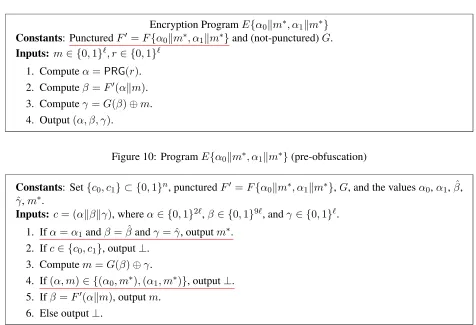
Sample a key pair(pk,sk)←PE.Gen(1λ). Output(xk,mk)wherexk =pkandmk =sk. Mark(mk, C,msg): Outputs the iO-obfuscation of circuitM constructed fromCin Fig.1, i.e.,iO(M).
Constants: PEdecryption keysk, pPRFF, circuitC, and messagemsg=msg1k. . .kmsgw
Inputs: x∈ {0,1}n
1. Try to parseakbkcki←PE.Dec(sk, x), where|a|=|b|=|c|=`/3andi∈[w]. 2. Ifakbkcki6=⊥andH(C(G(a))) =b, outputG0(c)⊕msgi.
3. Otherwise, outputC(x).
Figure 1: The programM, which is a modification ofC(pre-obfuscated program)
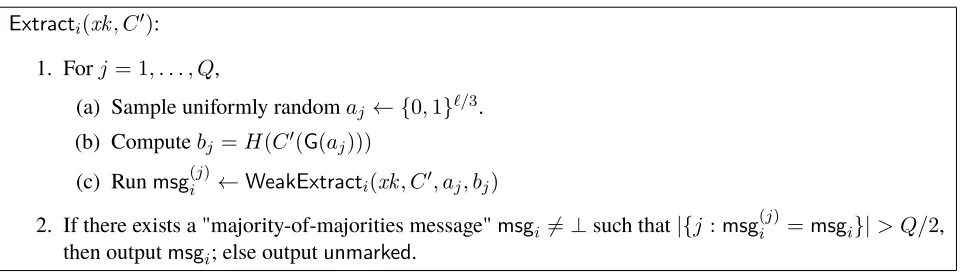
Extract(xk, C0): For eachi∈[w], letmsgi =Extracti(xk, C0), whereExtractiis defined in Fig.2. Extracti
makes use of a subroutineWeakExtracti, which is defined in Fig.3. Outputmsg1k. . .kmsgw.
Extracti(xk, C0):
1. Forj = 1, . . . , Q,
(a) Sample uniformly randomaj ← {0,1}`/3. (b) Computebj =H(C0(G(aj)))
(c) Runmsg(ij) ←WeakExtracti(xk, C
0, a
j, bj)
2. If there exists a "majority-of-majorities message"msgi 6=⊥such that|{j :msg (j)
i =msgi}|> Q/2,
then outputmsgi; else outputunmarked.
Figure 2: The sub-routine algorithmExtracti(xk, C0)
It is easy to check that this construction satisfies statistical and extraction correctness, and meaningfulness. Proposition 6.2 The above construction satisfies Theorem6.1.
6.3 Security Proofs
WeakExtracti(xk, C0, a, b):
1. Fork= 1, . . . , R,
(a) Sampleck← {0,1}`/3andxk←PE.Enc(pk, akbkckki). (b) Computemsg(ik)=G0(ck)⊕C0(xk).
2. Define the “majority message” msgi such that |{k :msg (k)
i = msgi}|> R/2if such amsgi exists;
otherwise, definemsgi=⊥.
Figure 3: The sub-routine algorithmWeakExtracti(xk, C0, a, b)
Overview. Recall that in our scheme, there are two sparse sets of points: “find points”, which are unchanged between a marked and unmarked program, and “mark points”, which are changed. To extract from a circuit
C0, one repeatedly performs the following 4 steps, which we will refer to asweak extraction:
1. Sample a find pointx, and queriesC(x)
2. Use the resulting value to sample many mark pointsx1, . . . , xk, wherek=λ/ρ2
3. For eachxi, queryC(xi)to compute a guessmsgi
4. If somemsgioccurs more thank/2times, return it. Otherwise, return⊥.
If this procedure returns some messagemsgmany times (more than half), thenmsgis the extracted value. Weak extraction can fail ifC(x)has been changed by the remover, or if most ofC(x1), . . . , C(xk)have been changed. The first happens with probability at most1−ε, by the pseudorandomness of find points. The second happens with negligible probability by a Chernoff bound. By repeating this process with many find points, the error probability is reduced to negligible.
Proof ofε-unremovability. First, we define two security experiments to state a useful lemma that is used to prove Proposition6.2. These two experiments are similar to the unremovability security game, but the goal of the adversary is now to distinguish a mark-point of a marked program from a uniformly random string of the same length, while first given access to a marking oracle and also given the corresponding find point.
For any PPT adversaryD, we define the following two experiments,ExpDREAL(λ, i)andExpDRAND(λ).
ExpDREAL(λ, i):
1. (xk,mk)←Gen(1λ)
2. (s,msg)← DMark(mk,·,·)(xk) 3. C← CandCe←Mark(mk, C,msg)
4. a← {0,1}`/3,b=H(Ce(G(a)))
5. c← {0,1}`/3
6. xREAL ←PE.Enc(pk, akbkcki)
7. Finally, outputD(s,C, a, xe REAL)
ExpDRAND(λ):
1. (xk,mk)←Gen(1λ)
4. a← {0,1}`/3 5. xRAND← {0,1}n
6. Finally, outputD(s,C, a, xe RAND)
Lemma 6.3 Under the same conditions as in Theorem6.1, for all PPT distinguishersDand for alli∈[w],
it holds that
Pr[ExpDREAL(λ, i) = 1]−Pr[ExpDRAND(λ) = 1]
<negl(λ)
We also define a “many-message” version of these two experiments: ExpDREALR(λ, i):
1. (xk,mk)←Gen(1λ)
2. (s,msg)← DMark(mk,·,·)(xk) 3. C← CandCe←Mark(mk, C,msg)
4. a← {0,1}`/3,b=H(Ce(G(a))).
5. c← {0,1}`/3 6. Forj= 1, . . . , R:
samplexREAL,j←PE.Enc(pk, akbkcki)
7. Finally, outputD(s,C, a,e xREAL), wherexREAL = (xREAL,1, . . . , xREAL,R).
ExpDRANDR(λ):
1. (xk,mk)←Gen(1λ)
2. (s,msg)← DMark(mk,·,·)(xk) 3. C← CandCe←Mark(mk, C,msg)
4. a← {0,1}`/3 5. Forj= 1, . . . , R:
samplexRAND,j ← {0,1}n
6. Finally, outputD(s,C, a,e xRAND), wherexRAND= (xRAND,1, . . . , xRAND,R).
Corollary 6.4 For all p.p.t. Dand for alli∈[w], it holds that
Pr[ExpD
REALR(λ, i) = 1]−Pr[Exp
D
RANDR(λ) = 1]
<negl(λ)
Proof. This follows from a simple hybrid argument. 2
Before proving Lemma6.3, we first show that it would imply Proposition6.2.
Proof of Proposition6.2. We show that for everyiand every p.p.t. adversary(A1,A2),
Pr
Extracti(xk, C∗)6=msg(i)∧C∗∼=εCe
(xk,mk)←Gen(1λ)
(msg, s)← A1Mark(mk,·,·)(1λ,xk,mk) C ← C
e
C ←Mark(mk, C,msg)
C∗ ← A2(s,Ce)
≤negl(λ)
Extracti(C∗) 6= msg(i) with non-negligible probability. For convenience of notation, let ∆ denote the point-wise xor ofCeandC∗. That is, let∆(x) =C∗(x)⊕Ce(x). Recall thatε(λ) = 12 +ρ(λ). Because
Extracti takes the majority answer after running WeakExtracti many (λ/ρ(λ)2) times, it must be (by a Chernoff bound) that for any suchC∗,
pC∗ := Pr
h
WeakExtracti(C∗)6=msg(i) i
≥ 1
2−ρ(λ) + 1 poly(λ)
for some polynomialpoly. SinceWeakExtracti only accessesC∗ in a black-box way, and since we know thatWeakExtracti(Ce) =msg(i)with high probability, it must be the case thatC∗differs fromCeat some of
the points queried byWeakExtracti. FurthermoreWeakExtractiis robust against differences at mark points (since it suffices forC∗to agree withCeat a majority of the queried mark points). Thus we have (by a union
bound) that
pC∗≤Pr
a [∆(G(a))6= 0] + a←{Pr0,1}`/2 xk←PE.Enc(akbki)
|{k: ∆(xk)6= 0∧k∈[R]}|> R
2
+negl(λ)
The first term corresponds to the probability ofAchanging the find point queried byWeakExtracti, and the second corresponds to the probability ofAchanging many mark points. The third term is the probability thatWeakExtracti(Ce)6=msgi.
For the first term, we note that by the pseudorandomness ofG(a), it must hold that for all polynomials
poly, there is a negligibleneglsuch that
Pr
C∗ ∼=εCe∧Pr
a [∆(G(a))6= 0]≥1−ε(λ) +
1 poly(λ)
≤negl(λ).
Indeed, otherwise we can break the security ofGby runningA, and empirically testing whether the∆output byA2exhibits a poly(1 λ) advantage in distinguishingG(a)points from random points. If it does, we evaluate
∆on our challenge to try to distinguish; otherwise we guess randomly.
For the other term, Corollary 6.4 states that the xi’s are jointly indistinguishable from i.i.d. random
xi’s sampled from{0,1}m, even thoughA1has oracle access toMark(mk,·,·). Combined with a Chernoff bound, which states that
Pr
C∗ ∼=εCe∧ Pr x1,...,xR←{0,1}n
|{xk: ∆(xk)6= 0}|> R
2
≥ 1
poly(λ)
= 0,
this implies that for every polynomialpoly,
Pr
C
∗∼
=εCe∧ Pr
a←{0,1}`/2 x1,...,xR←PE.Enc(akbki)
|{xk: ∆(xk)6= 0}|> R
2
≥ 1
poly(λ)
≤negl(λ).
Combining these four inequalities yields a contradiction.
2
Now we turn to proving Lemma6.3.
Proof of Lemma6.3. We define a sequence of hybrid experiments to prove this lemma. We call all variables thatDsees in the experimentExpa view ofDand denote it byview(Exp).
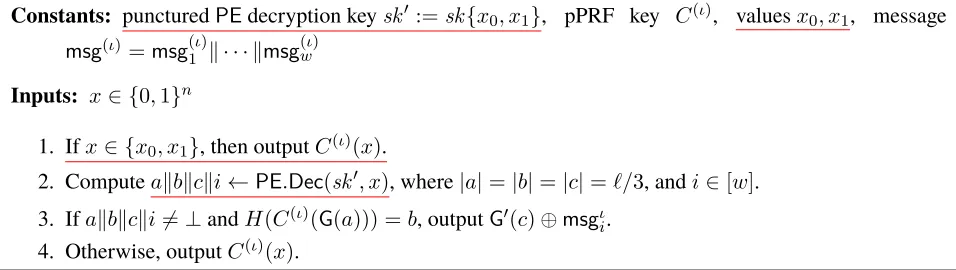
Constants: puncturedPEdecryption keysk0 :=sk{x0, x1}, pPRF key C(ι), valuesx0, x1, message msg(ι)=msg(ι)
1 k · · · kmsg (ι) w
Inputs: x∈ {0,1}n
1. Ifx∈ {x0, x1}, then outputC(ι)(x).
2. Computeakbkcki←PE.Dec(sk0, x), where|a|=|b|=|c|=`/3, andi∈[w]. 3. Ifakbkcki6=⊥andH(C(ι)(G(a))) =b, outputG0(c)⊕msgιi.
4. Otherwise, outputC(ι)(x).
Figure 4: ProgramM(ι){x0, x1}inHyb1
Hyb1: In this hybrid experiment, we change the marking oracle. For the adversary’s queries(C(1),msg(1)), . . . ,
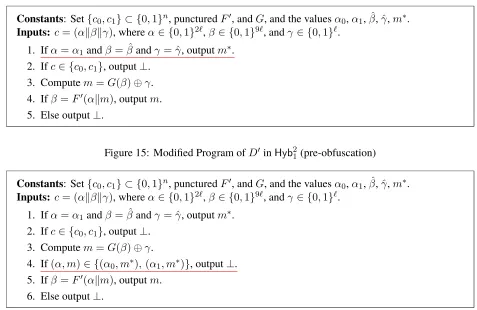
(C(q),msg(q)), instead of generating marked programCe(ι)←iO(M(ι)), we setCe(ι)←iO(M(ι){x0, x1}) whereM(ι){x0, x1}is defined in Figure4, having hard-codedC(ι),sk0 ←PE.Puncture(sk, x0, x1),
x0 :=xREAL,x1 ← {0,1}n, andmsg(ι).
Hyb2: In this hybrid experiment, we change the marked challenge program Ce. We use the punctured
decryption keysk0 and hard-code the output values corresponding tox0 andx1 asy0 = G0(c) and
y1 ← {0,1}m respectively. That is, we set Ce ← iO(M{x0, x1}) where M{x0, x1} is defined in
Figure5.
Constants: puncturedPEdecryption keysk0 :=sk{x0, x1}, pPRF key F, pPRF key C, valuesx0, x1,y0, y1, messagemsg=msg1k · · · kmsgw
Inputs: x∈ {0,1}n
1. Ifx=xσ forσ ∈ {0,1}, then outputyσ.
2. Computeakbkcki←PE.Dec(sk0, x), where|a|=|b|=|c|=`/3andi∈[w]. 3. Ifakbkcki6=⊥andH(C(G(a))) =b, outputG0(c)⊕msgi.
4. Otherwise, outputC(x).
Figure 5: ProgramM{x0, x1}inHyb2
Hyb3 In this experiment,x0is changed to be uniformly sampled from{0,1}n.
Hyb4 In this experiment,y0is changed to be uniformly sampled from{0,1}m
ExpRANDD : The only changes from Hyb3 are that the challenge program Ce and marked keys Ce(ι) for all ι∈[q]are changed back to the original programs but the valuesx0 remain random.
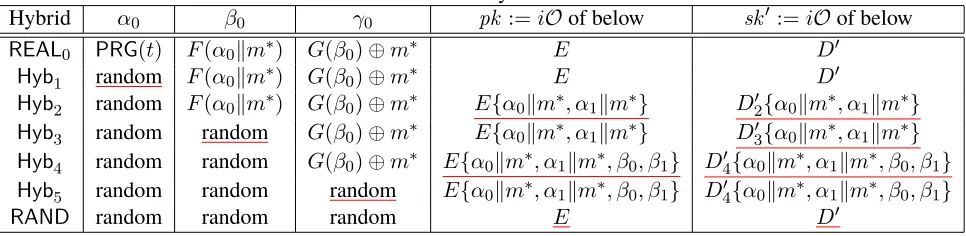
We describe an overview of the main hybrid experiments in Table1.
Lemma 6.5 IfF is a pPRF family,His a UOWHF,PEsatisfies the punctured correctness and sparseness,
andiOis a secure indistinguishability obfuscator, thenview(Hyb0)≈c view(Hyb1).
Table 1: An overview of hybrid experiment
Hybrid experiment Challenge: iO(·) Answers ofMO: iO(·) x0 x1 ExpDREAL M M(ι) xREAL none
Hyb1 M M(ι){x0, x1} xREAL random Hyb2 M{x0, x1} M(ι){x0, x1} xREAL random Hyb3 M{x0, x1} M(ι){x0, x1} xRAND random ExpDRAND M M(ι) xRAND none
Claim: InHybι0, the probability thatH(C(ι+1)(G(a))) =bis negligible, whereb:=H(Ce(G(a))).
Proof. If for some p.p.t. D, this event happens with non-negligible probability, we show how to invertH at a random input with nearly the same non-negligible probability, thus contradicting the one-wayness ofH.
We use the fact thatC(G(a)), and thereforeCe(G(a)), is pseudorandom, because up until this point
in the game, the only informationDhas aboutC comes from the marking oracle hard-codingx0 = Enc(akbkc)in its answers. So ifbis replaced by a random challengeH(r),C(ι+1)(G(a))must still be a pre-image ofbwith non-negligible probability.
2
Claim: view(Hybι0)≈c view(Hybι0+1)for allι∈[q].
Proof. The only difference betweenHybι0andHybι0+1is the(ι+ 1)-th answer by the mark oracle. We show that the mark oracle’s answers are functionally equivalent in the two games, so indistinguishability follows from the security ofiO.
There are only two possible inputs on whichM(ι+1) may differ in Hyb0ι andHybι0+1: namely, x0 andx1 due to the punctured correctness at non-punctured points of PE. We show that (with high probability) they respectively mapped toC(ι+1)(x0)andC(ι+1)(x1)without our changes, just as they do with our changes.
It holds that PE.Dec(sk, x1) = ⊥ with high probability since x1 is uniformly random and PE satisfies sparseness. Thus, M(ι+1)(x1) = C(ι+1)(x1) in Hybι0. This is also true inHybι0+1 since
M(ι+1){x0, x1}(x1)goes to the punctured-points branch.
On the other hand, x0 decrypts as akbkcki, but by our previous claim, it cannot be the case that
H(C(ι+1)(G(a))) =b. Thus,M(ι+1)(x0) =C(ι+1)(x0)inHybι0.
2
We completed the proof of the lemma by the two claims. 2 Lemma 6.6 IfC is a pPRF,PEsatisfies the punctured correctness, andiOis a secure indistinguishability
obfuscator, thenview(Hyb1)≈c view(Hyb2).
Proof of Lemma6.6. We define auxiliary hybrid experiments as follows.
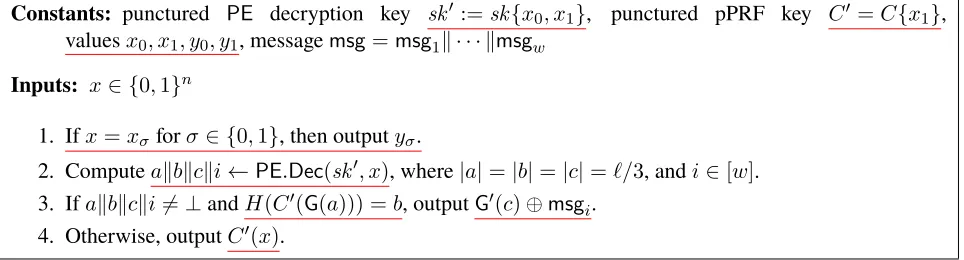
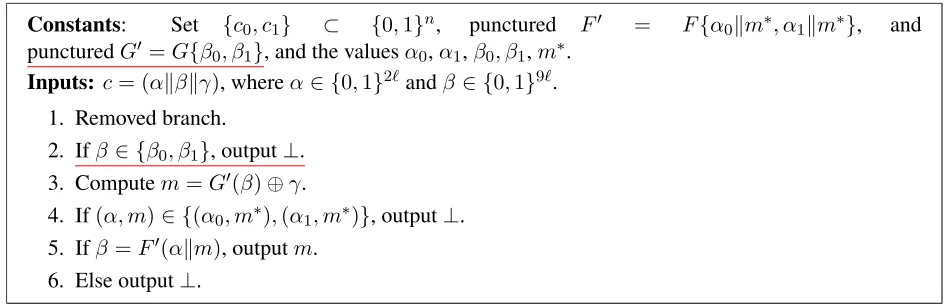
Hyb11: Instead of choosing challenge programCe ← iO(M)where the programM is described in Figure 1, we now use punctured keyssk0 andC{x1}and setCe ← iO(M1{x0, x1})whereM1{x0, x1}is
Constants: punctured PE decryption key sk0:=sk{x0, x1}, punctured pPRF key C0 =C{x1}, valuesx0, x1, y0, y1, messagemsg=msg1k · · · kmsgw
Inputs: x∈ {0,1}n
1. Ifx=xσ forσ ∈ {0,1}, then outputyσ.
2. Computeakbkcki←PE.Dec(sk0, x), where|a|=|b|=|c|=`/3, andi∈[w]. 3. Ifakbkcki6=⊥andH(C0(G(a))) =b, outputG0(c)⊕msgi.
4. Otherwise, outputC0(x).
Figure 6: ProgramM1{x0, x1}inHyb11
Hyb21 : We choose uniformly randomy1← {0,1}mand hard-code it in the programM{x0, x1}.
Claim: view(Hyb1)≈c view(Hyb11)
Proof. ProgramM1{x0, x1} is functionally equivalent to Program M in Hyb1, because we just hard-coded the values fory0 andy1 which would be output anyways. Also, replacingC byC{x1} does not change functionality because, by line 1,Cis never evaluated atx1.Thus, the claim holds due
to the security ofiO. 2
Claim: view(Hyb11)≈c view(Hyb21)
Proof. This follows from the pseudorandomness ofC{x1}atx1. 2
Claim: view(Hyb21)≈c view(Hyb2)
Proof. InHyb2,Cis un-punctured in the challenge programiO(M{x0, x1}), butM{x0, x1}is still functionally equivalent to the program inHyb21 due to line 1. Therefore, the claim holds due to the
security ofiO. 2
The proof of the lemma follows from these three claims. 2
Lemma 6.7 IfPEsatisfies ciphertext randomness, thenview(Hyb2)≈c view(Hyb3).
Proof of Lemma6.7. This reduces to the ciphertext randomness property ofPE. If some p.p.t. distinguisher DdistinguishesHyb2 fromHyb3, we construct a p.p.t. Awith non-negligible advantage in the ciphertext pseudorandomness game.
First,Achoosesa← {0,1}`/3,c← {0,1}`/3,C ← Cλ, and a UOWHFH, computesb:=H(C(G(a))), and sendsm0 := akbkckiand uniformly randomm1 ← {0,1}`+|w| as a challenge. Then, the challenger of PE returns (cσ, c1−σ,pk,sk0) where σ ∈ {0,1}, c0 ← PE.Enc(pk, m0), c1 ← {0,1}n, and sk0 = PE.Puncture(sk, m0, m1).
Now,Acan perfectly simulateHyb2andHyb3toD, usingcσasx0. Ifσ= 0, thenAperfectly simulates Hyb2. Ifσ = 1, thenAperfectly simulatesHyb3. Thus,Acan break the ciphertext pseudo-randomness by
outputting whateverDoutputs. 2