planets have been the subject of direct study. Hundreds of other “candidate” planets de-tected by the Kepler spacecraft await confirmation of their existence. Planets are thus common phenomena around stars, and the prospects seem good in the next few years for establishing statistics on the occurrence of Earth-sized planets. Extension of the most successful technique of Doppler spectroscopy in sensitivity to detect Earth-mass planets around Sun-like stars will be limited by the noise generated by the stellar photospheres themselves. The James Webb Space Telescope will have the capability to measure at-mospheric abundances of certain gases and of liquid water on extrasolar planets, includ-ing “superEarths” within a factor of two of the radius of the Earth. The ultimate goal of measuring the atmospheric composition of an Earth-sized planet orbiting at 1 AU around a star like the Sun remains a daunting challenge that is perhaps twenty years in the future.
1 Introduction
The prediction that planets would be common, first on philosophical then on scientific grounds, has been confirmed with the discovery (at the time of writing) of some 492 planets orbiting stars other than the Sun [1]. In very crude terms, at least one of every ten stars like the Sun has one or more planets, and with the latest Kepler data most of these will have sizes within a factor of a few that of the Earth. [2]. The first extrasolar planet, or exoplanet, residing in the liquid water “habitable zone” has been found [3]. There is every expectation that the number of known planets will grow, and with that the number of systems that resemble their own. In this brief chapter I summarize the prospects for such an outcome given the current and anticipated programs for search and characterization of exoplanets.
2 Current planetary statistics
2.1 Masses: radial velocity and microlensing candidates
Roughly 90% of all exoplanet discoveries are made through the radial velocity (also called doppler spectroscopic) technique. This technique is most effectively done from the ground, and requires very high precisions [4] in measurement of Doppler shifted spectral lines from the photosphere of a star orbiting around the common center-of-mass (barycentric motion) with its planet or planetary system (multiple planets); these precisions are discussed later. The quantity derived from the measurements is not the mass but rather the mass times the sine of the inclination of the normal to the plane of the
ae-mail:[email protected]
This is an Open Access article distributed under the terms of the Creative Commons Attribution-Noncommercial License 3.0, which permits unrestricted use, distribution, and reproduction in any noncommercial medium, provided the original work is properly cited.
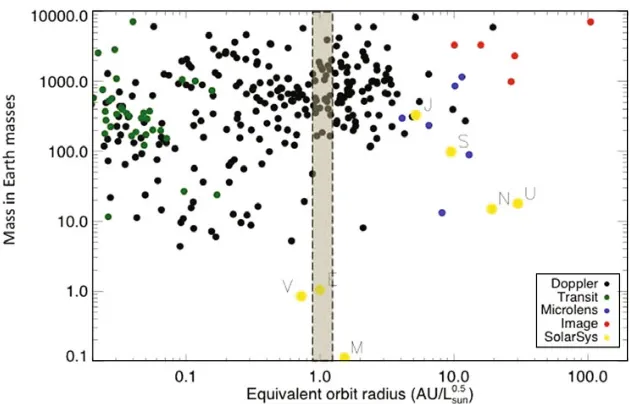
Fig. 1. For the more than 300 extrasolar planets discovered as of early 2009, mass normalized to that of the Earth
versus semi-major axis of the planet’s orbit is plotted. The planets are colored according to the detection technique; the vast majority by radial velocity surveys. Planets in our solar system are colored yellow. By normalizing the planetary orbits’ semi-major axis by the square root of the stellar luminosity, the so-called “habitable zone” where liquid water is stable on a planetary surface (shown conservatively as a narrow box around 1 AU) is situated at a common point on the x-axis. Modified (with habitable zone added) from an original figure by B. Macintosh in [9].
planet’s orbit relative to the line of sight to the observer (Earth). In a minority of cases (one to a few percent) the planet is observed to transit in front of the parent star and so the planetary orbit plane is aligned with the line of sight; hence the sensed quantity is indeed the planet’s physical mass. By as-suming the orbital planes of planetary systems are oriented randomly on the sky, the argument can be made that 90% of the planetary masses detected through Doppler spectroscopy are within a factor of two of the physical mass [5]. From this point onward we do not explicitly mention the mass ambiguity any further, but the reader should recall it in the discussions that follow.
Figure 1 shows the distribution of mass and semimajor axis for exoplanets detected through early 2009; the majority of which were detected by radial velocity (a graph showing all known exo-planets would have a similarly uniform distribution). The lack of preference for semi-major axis among radial velocity candidates suggests that there is either no preferred region in semimajor axis space for exoplanets, or that processes during and after formation act to redistribute planetary orbits widely in semi-major axis space. The wide range of orbital eccentricities of exoplanets suggests dynamical interactions are important in the histories of most planetary systems, although the percentage of nearly circular orbits may be underrepresented in the known sample [6]. The weak increase in mass with semimajor axis is an artifact of the declining sensitivity of the radial velocity technique with dis-tance, (more distant planets produce slower barycentric motion of the star). The sparsity of planets beyond several AU is due to the dependence of sensitivity on distance, and to the finite duration of surveys (planets in progressively more distant orbits require more time over which to see a single orbital period). Although astrometry complements radial velocity by detecting the positional shift in the plane of the sky of the stellar barycentric motion, and hence has increased sensitivity with planet-star separation, astrometry from the ground has no confirmed detection of an extrasolar planet.
planet will transit its star as seen from Earth is highest for the planets closest to the parent star, but as a rule of thumb is∼1% [10]. The rotation of the star itself provides additional information from the transit, because the light of a rotating star is blue- and red-shifted symmetrically from the approaching and receding limbs. The movement of a planet across the limb alternately suppresses these two limbs, producing an anomalous Doppler shift called the Rossiter-McLaughlin effect. From this comes both confirmation of the existence of a transiting planet (as opposed to a starspot fixed to the stellar disk), and some indication of the displacement from fully edge-on of the orbit as seen from the Earth [11].
For nearly circular orbits transiting planets also undergo eclipses (sometimes called secondary transits), in which they pass behind their parent star. Because the face of the planet is illuminated by the star in the portion of the orbital phase just before and after eclipse, the eclipse also produces a decrease in the total light of the system, though not by as much as the primary transit event itself. However, eclipses are a means of obtaining spectra of the planet’s atmosphere or even surface, because the measured spectrum of the star with the planet in eclipse may be subtracted from the measured spec-trum of the system just before the planet goes into eclipse or just after it exits. A specspec-trum may also be obtained from the primary transit because the apparent size of the planet as an occulting disk will depend on the wavelength if the planet has a substantial, optically thick, atmosphere. (An airless planet will not exhibit such a change in radius). In this way, it has been possible to diagnose interesting diff er-ences in bulk density and atmospheric compositions of a few exoplanets, e.g. [12]. It may be possible with the 6.5 meter James Webb Space Telescope, to be launched in 2015, to take spectra of planets just two or three times the size of the Earth orbiting cool M-dwarfs, thereby providing the chance for spectra of potentially habitable planets within the decade.
The number of exoplanets discovered by transit far exceeds 1% of the total number of exoplanets because transiting surveys probe more deeply into the galaxy than do radial velocity surveys. Indeed, the launch of two satellites designed to detect planets by transit, Corot and Kepler, have led to system-atic surveys of nearby portions of the galactic disk. At the time of writing of this article, initial release of Kepler data provides hundreds of candidate exoplanets discovered by transits alone, all of which need confirmation. The striking point about the list of candidates is the bias toward lower sizes; that is, planet candidates down to twice the size of the Earth (the limit analyzed in the current data set) are the most common [13]. If most of these are confirmed it implies that one of every ten stars like the Sun (the stellar type most represented in the survey) have planets within a factor of a few the size of the Earth. The bias of transits toward planets in close orbits means, however, that the region around 1 AU from a typical Sun-like star will not be completely sampled; a complementary survey that is biased toward larger orbits is required, and can come from microlensing.
3 Microlensing approaches for completing the statistics
of Earth-sized planets
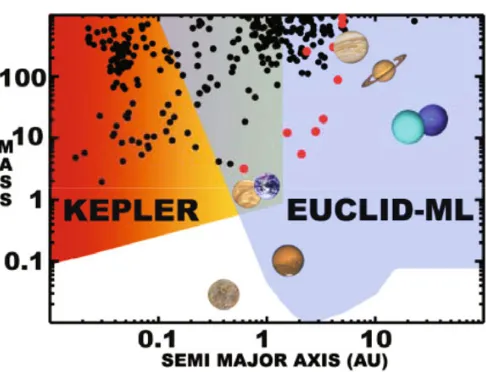
Fig. 2. Sensitivity fields for planets detected by space-based transit (Kepler) and microlensing (possible Euclid
space mission), plotted as mass in Earth masses versus semimajor axis in astronomical units. Known planets shown, with microlensing planets in red and solar system planets depicted as images [14].
distances between the Earth and the galactic bulge [7]. As Fig. 2 shows, the combination of transit and microlensing surveys provides a fortuitous coverage of the equivalent around other stars of the entire inner solar system and intermediate region almost out to Jupiter. However, the survey must be done from space because it is too easy for a single ground-based telescope to miss a secondary (planetary) event thanks to weather and the rotation of the Earth; even a network of ground-based telescopes is less efficient than a spaceborne observatory [15] and would cover only a small range of semi-major axes. Two possible space-based microlensing survey opportunities will present themselves. One, a mission proposed for the European Space Agency called Euclid, has as its primary science goal constraints on dark energy, but could do a reasonably complete survey down to Mars masses and out beyond 0.5 AU planet-star separation [14]. A mission proposed by the recent U.S. Decadal Survey of Astronomy and Astrophysics [16], called WFIRST, would devote more time to a microlensing survey and hence produce a more reliable result for smaller masses and a broader range of semimajor axes.
4 Astrometry from space versus radial velocity from the ground
4.1 Astrometric Capabilities
Astrometry measures the positions of stars in the sky and hence the transverse periodic motion of a star possessing planets. Regardless of the angle of the system in the sky relative to the observer, astrometry sees the full amplitude of the stellar barycentric wobble induced by a planet, and hence determines the planetary mass unambiguously. A solar-mass star 10 parsecs from us with an Earth at 1 AU has a 0.3µ-arcsec (microarcsecond) semi-amplitude in the astrometric wobble. The corresponding radial velocity signature, which is independent of the distance of the star from the observer, is 0.09 m/s. Ground-based astrometric programs are achieving 50–100µ-arcsec precision today, with prospects for a factor of two improvement; the Gaia mission to be launched in 2012 should achieve 10µ-arcsec precision from space [17]. It is generally considered that the astrometric technique is best done from space, in contrast to radial velocity which is done from the ground but benefits from large amounts of telescope time on large-aperture telescopes.
cisions of 15 m/s in sensing the barycentric wobble of the host star. At the time 3 m/s was regarded as a reasonable limit to which radial velocity could eventually operate based both on then-possible instrumental capabilities and the projected ability to deal with the noise contributed by the stellar photospheres. Today programs are operating with precisions as good as 0.5 m/s on 4-meter-class tele-scopes, but more routinely at 1 m/s [19].
There are several sources of noise that contribute at comparable levels to limit the precision of state-of-the-art radial velocity, including those intrinsic to the instrumentation and measurement process, and those associated with the star itself. The ESPRESSO project that is currently being implemented at the VLT, using one of the 8.2-meter telescopes, is designed to achieve a precision and long-term stability better than 0.1 m/s [19]. At this level of precision, detection of Earth-sized planets around Sun-like stars is possible were the stars themselves sufficiently quiet. It is the stellar noise that is of greatest concern for achieving precisions two orders of magnitude better than was possible in 1995.
Stellar noise itself may be divided into several sources, all of which in principle may be partially overcome by characterizing the time spectrum of the noise source and, where possible, integrating for sufficiently long time periods. Noise associated with acoustic modes can be reduced to below 0.2 m/s through integrations of 15 minutes. Granulation–essentially photospheric convection–requires measurements spanning hours [19] such as starspots cause “jitter” in the astrometric signal which is harder to remove because of the lack of predictability; for the Sun this may limit planet detection with radial velocity to 0.25 m/s at a signal-to-noise of 3 or 4 [20]. By moving toward the red end of the visible spectrum, where starspots have less contrast, the error may be reduced (D. Fischer, pers. comm, 2009), but eventually the photon noise will increase. Quieter stars will have fewer, or no, spots, but finding a sufficiently quiet cohort of Sun-like stars in the Sun’s neighborhood may be difficult. Looking for planets in Earth-like orbits around Sun-like stars, however, means looking at astrometric signals which span months, and so for stellar rotation rates like that of the Sun it may be possible to reduce further the jitter from stellar magnetic activity simply by looking for planets with orbital periods much longer than the starspot periodicity.
The various noise sources may be added quadratically. radial velocity observers in Europe and the United States, canvassed by email and in person, seem to agree that the best plausible near-term case, for a highly efficient 8-meter telescopic system working continuously over many months to canvass the quietest Sun-like stars for planets with orbital periods of months to years, is a radial velocity precision in the 0.1–0.3 m/s range. Given the nature of the noise sources, it seems difficult to imagine going beyond this with the facilities conceivable over the coming decade. Even so, getting into the 0.1–0.3 m/s range for radial velocity is an ambitious agenda.
4.3 Required accuracies from astrometry applied to radial velocity
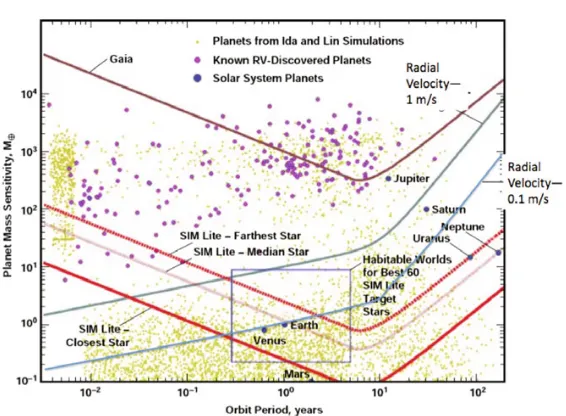
Fig. 3. Sensitivity of astrometric and radial velocity detection programs to planet mass versus orbit period for
solar mass stars. The background green dots are a theoretical simulation of planet formation not germane to the discussion in this white paper. Radial velocity limits for 1 and 0.1 m/s are compared to SIMLite and Gaia limits. For radial velocity sin i is assumed equal to unity. Modified from [21].
limits are for a set of 60 FGK stars; the range of distances translates into a range of planet mass de-tectabilities. The radial velocity curves are, in contrast, for a solar-mass star and (in an ideal sense which neglects the decreasing stellar brightness with distance) independent of distance, and hence cannot be compared precisely to the astrometric sensitivity. The original 1 m/s radial velocity limit, which represents the current best accuracy, has been supplemented in the present report with a curve for 0.1 m/s – the best-case limit for radial velocity in the decade covered by the Astro2010 Strategy. Should the limit on optical radial velocity be 0.2–0.3 m/s instead, which might be more plausible on all but the quietest G-dwarfs [20] detection of strictly Earth-mass planets would require surveying lower mass stars (K- or even M-dwarfs).
A precision of 0.1 m/s provides the potential for just barely detecting an Earth-mass planet pro-vided that the orbit of the planet around its parent star is aligned with the vector between the orbit plane of the planet around the star, and the Earth. That is, sin i must be close to unity. For 90% of a random distribution of orbit planes in the sky, m sin i will be within a factor of two of the physical mass, so this would seem to be a reasonable compromise: being able to detect planets between one and two times the mass of the Earth. However, one does not actually know by this statistical argument whether the mass is one Earth mass, two Earth masses, or anything in between.
The factor of two ambiguity (with a 10% probability that the uncertainty could be larger) inherent in radial velocity makes it very difficult to use the mass with an eventual radius determination to derive useful constraints on the internal composition and structure of rocky planets. For example, Saturn’s Mercury-sized moon Titan has a density of 1.9 g/cm3while that of Mars is 3.9 g/cm3; Titan is a world
composed of 40% water ice [22] while Mars is essentially all rock with a small amount of metal. There would be no way to diagnose the difference between the two with a factor of two ambiguity in the mass determination, and yet their evolution and geology is quite different thanks to the profound difference in composition.
. /
around at least 50–100 Sun-like stars, which is mainly contingent on overcoming the stellar noise sources to which radial velocity is intrinsically much more sensitive than astrometry. This in turn requires that (a) technology development in radial velocity instrumentation continue, (b) a sufficiently quiet cohort of G-dwarfs is found by ongoing surveys and (c) an 8-meter class telescope facility dedi-cated to radial velocity surveys becomes a high priority recommendation of the Astro2010 committee. Should (b) not be met, moving to lower-mass K and early M stars would be required to increase the planet signal, though the intrinsic faintness of such stars will negatively impact the precision, and the relevance of such a search to the original goal of finding Earths around stars like the Sun justifiably could be questioned.
Astrometry is intrinsically better than radial velocity for determine absolute masses, though accuracies better than 20–30% seem unlikely. Even if a space-based astrometry mission were flown, follow-up observations with radial velocity to resolve ambiguities associated with multiple planets in a given system will likely be required. In summary, substituting space-based astrometry with radial ve-locity represents a strategy with a high degree of risk, but offsetting the risk is the fact that the program is conducted from the ground rather than from space. Such a program is described here.
4.4 Limitations on radial velocity
To implement a ground-based program of high-precision radial-velocity on nearby stars, with the goal of finding targets near one Earth mass for eventual study by a proposed (but not approved) direct detection Terrestrial Planet Finder (TPF) mission, one would require an intensive survey of the nearest
∼100 F, G, K stars with 0.1–0.2 m/s precision. To detect Earth-mass planets around M-dwarfs, a separate objective that would not tie to TPF as currently envisioned, it has been proposed to survey the nearest 100 such stars with near-IR doppler spectroscopy at 1 m/s precision. Near-IR doppler is less mature than optical Doppler [24], and the improvement required in terms of present-day versus required precision is greater for the near-IR than for the optical.
If ground-based M-dwarf surveys now in operation find transiting planets nearly the size of the Earth – potential targets for JWST followup – the M-dwarf high-precision radial velocity survey might be replaced by focussed efforts on those transiting planets to determine their mass, and hence density. We carry both surveys in the estimates of cost below, with the understanding that the near-IR doppler survey might have a somewhat lower priority depending on the outcome of M-dwarf transit surveys and the priority assigned to TPF relative to other programs.
The nature of the surveys require the equivalent, for the two combined, of a dedicated 8-meter telescope (table 1), and funds for technology development and construction of spectrometers.
Table 1. Estimated number of nights for ground-based telescope initiatives in exoplanet research. First row
is the current survey on Keck. Second row is based on ESPRESSO’s program at VLT (http://espresso. astro.up.pt/index.php). Third row is an IR doppler program for M-dwarfs taken from the Exo-planet Task Force report. Fourth row is based on plans proposed for the Large Binocular Telescope, also from the Exoplanet Task Force Report.
Project Targets Tel. Size Nights Instr. Status radial velocity 1–3 m/s 2000 10-m (Keck) 50/yr HIRES
radial velocity 0.2 m/s 100 8–10 meter 200/yr ESPRESSO-type IR doppler 200 8-meter 100/yr needs devel. exo-zodi survey 50–100 2×8 meter 60/yr nullers in dev.
A second survey program is required prior to moving forward with TPF: determination of the range of dust emission around nearby G-type stars (exo-zodiacal emission). Values in excess of 10 times what the solar system emits would put into question the viability of smaller scale coronagraphic sys-tems envisioned as the initial design for TPF, and hence steer designs toward larger syssys-tems, or toward interferometric approaches. Ground-based systems might be marginally capable of detecting exozodi-acal emission in the range of 10–20 times solar system values. Additional studies should be conducted to assess the feasibility of using large ground-based systems in this way.
Therefore, a reasonable program of ground-based radial velocity to detect planets close to the size of the Earth, in the solar neighborhood, would be:
• development of focussed high precision radial velocity surveys in the optical and infrared as above, these programs to be competed through the peer review process;
• dedication of the equivalent of one 8-meter class optical telescope to ground-based radial velocity for both optical and near-IR.
• ground-based surveys of stellar photospheric and chromospheric activity to improve radial velocity precision.
To calculate a rough cost of such a system, assume that the cost/night of an 8 meter telescope (∼100,000 euros) is not charged to the program itself, since these telescopes exist already. The costs are for instrumentation based on existing facilities could be∼2–8 million euros for development of two new instruments for radial velocity on two different telescope systems (one optical, one IR). Nulling systems are likely to be in the 5 million euro range. Therefore, a conservative cost for this program (in-strumentation only) would be∼7 million-20 million euros. Should the dedication of the equivalent of one 8-meter class telescope require a contribution to telescope operating cost by the program itself, the numbers could be considerably higher. Time on 8-meter class telescopes runs roughly 100,000 euros per night. It is unrealistic to assume that the full cost would be borne by the survey, and a contribution of no more than 1/3 might be assumed, corresponding to an additional 10 million euros/year.
The timescale for such surveys is somewhat open ended, in that success will depend on the overall frequency of Earth-like planets. A five year survey time is reasonable based on current surveys, and so we propose this here as a nominal duration. Assuming the instrument development cost plus the 1/3 contribution to the annual operations of the telescope leads to a 5-year total cost (rounded to the nearest 5 million euros to illustrate the uncertainty) of between 55–75 million euros. These costs should be studied more closely prior to beginning such efforts, especially the assumption that some portion of the telescope operations budget would need to be paid.
Useful comments from L. Hillenbrand, S. Tremaine, J. Toomre and M. Turner improved the paper. I am grateful to F. Berilli for sharing with me the results of his modeling of the photosphere of the Sun. This work was financed within the scope of the program ”Incentivazione alla mobilita’ di studiosi straineri e italiani residenti all’estero.”
References
15. J.Lunine et al., “Worlds Beyond: A Strategy for the Detection and Characterization of Exoplan-ets”, Astronomy and Astrophysics Advisory Committee.http://arxiv.org/abs/0808.2754 16. National Research Council, “New Worlds, New Horizons in Astronomy and Astrophysics.”
National Academy Press, Washington D.C. (2010)
17. F. Malbet et al. “Detecting and characterizing extrasolar planetary systems with astrometry: review from the Blue Dots astrometry working group”. in Pathways Toward Habitable Planets, Barcelona, Spain. (2009)
18. L.W. Ramsey et al. Publ. Astron. Soc. Pac. 120, 887 (2008)
19. M. Mayor and S. Udry, . Physica Scripta T130, doi:10.1088/0031-8949/2008/T130/014010. (2008)
20. V.V. Makarov et al. ApJ. Letters 707, L73 (2010)
21. J. Davidson, S. Edberg, R. Danner, B. Nemati and S. Unwin, eds. “SIMLite Astrometric Observa-tory”. NASA, Washington DC (2009)
22. F. Sohl, W.D. Sears, and R.D. Lorenz, Icarus 115, 278 (1995)