Mehrdad Nojoumian∗
Department of Computer and Electrical Engineering and Computer Science Florida Atlantic University
Boca Raton, Florida, USA [email protected]
Douglas R. Stinson†
David R. Cheriton School of Computer Science University of Waterloo
Waterloo, Ontario, Canada [email protected]
Abstract
Due to the rapid growth of the next generation networking and system technologies, computer net-works require new design and management. In this context, security, and more specifically, access
structures have been one of the major concerns. As such, in this article,sequential secret sharing
(SQS), as an application of dynamic threshold schemes, is introduced. In this new cryptographic primitive, different (but related) secrets with increasing thresholds are shared among a set of players who have different levels of authority. Subsequently, each subset of the players can only recover the secret in their own level. Finally, the master secret will be revealed if all the secrets in the higher levels are first recovered. We briefly review the existing threshold modification techniques. We then present our construction and compare it with other hierarchical secret sharing schemes such as dis-junctive and condis-junctive multilevel secret sharing protocols.
Keywords: Secret Sharing, Access Structure, Dynamic Scheme, Threshold Changeability.
1
Introduction
In a(t,n)-threshold secret sharing[10, 2], a dealer first divides a secret intonshares to be distributed amongn players. Subsequently, at leastt players can collaborate to recover the secret. For instance, in Shamir secret sharing [10], the dealer initially selects a random polynomial f(x)∈Zq[x]of degree t−1 such that f(0) is the secret. He then distributes shares f(i) among playersPi for 1≤i≤n. As a result, any set oft or more players can recover the secret using Lagrange interpolation whereas any set of size less thant cannot gain any information about the secret. Mainly, two adversarial settings are considered in secret sharing schemes. Passiveadversary model where the players follow protocols correctly but they may attempt to learn the secret, also known ashonest-but-curiousadversary. Active adversary model where the players may deviate from protocols while at the same time trying to learn the secret. For further technical discussions, a formal definition of anaccess structureis first provided. Definition.1:Anaccess structureΓis a set of authorized subsets of players that satisfies two conditions:
(a) if A∈Γand A⊆B⊆PwhereP is the finite set of the players, then B∈Γ, and (b) if A∈Γthen |A|>0. In a threshold access structure, authorized subsets are all sets of players A such that|A| ≥t where t is the threshold of the scheme.
In adynamic secret sharingscheme, the threshold and/or the access structure are changed frequently. The main motivation for construction of such schemes is the fact that the “sensitivity of the secret” and also the “number of players” may fluctuate due to different reasons. For instance, mutual trust may vary or the structure of the players’ organization might be changed (i.e., some parties may leave or new players may join the organization). To the best of our knowledge, the existing dynamic constructions only update the threshold/access structure without changing the secret.
Indeed, the objective of threshold changeability is to transform a(t,n)-secret sharing scheme into a
(t0,n)-secret sharing scheme whethert<t0ort0<t. Note that when the threshold is increased while the secret remains unchanged, at leastn−t+1 players must erase their old shares, otherwise, the secret can be recovered by a set of old shares. This issue has been previously stated as an inevitable assumption of proactive secret sharing [9, 4] as well as threshold changeable schemes with constant secrets [5].
To change the threshold and the secret in our level access structure, secure addition and multi-plication operations are used. Letαandβbe two secrets shared by f(x)andg(x)of degreet. If each par-ticipant locally multiplies both shares together, the resulting value is a new share onh(x) = f(x)×g(x), whereh(0) =α βis the new secret. There exist two issues with this secure multiplication operation. First of all, the degree ofh(x) is 2t instead oft. Second,h(x)is reducible as a product of two polynomials. To overcome these problems, [1] applies a degree reduction method in whichh(x) is truncated in the middle to have a degree oft, subsequently, it uses a simple procedure to randomize the coefficients of h(x)except its constant term; this protocol is later simplified in [3]. The addition operation is also done locally, however, it does not require any degree reduction or randomization.
1.1 Motivation and Contribution
We introduce a new hierarchical secret sharing protocol as a new application of dynamic threshold schemes, named sequential secret sharing SQS. In this cryptographic primitive, players with various levels of authority progressively construct a sequence of secret sharing schemes with different (but re-lated) secrets and thresholds in the absence of the dealer. In the subsequent reconstruction phase, each subset of the players can only recover the secret in their own level. As a result, the master secret will be revealed if all the secrets in the higher levels are first recovered.
In the existing hierarchical secret sharing schemes [11, 12], a single secret is shared among the players who are in different authority levels (players in the initial levels have more authority for secret recovery compared to the other parties). Moreover, the secret can be reconstructed without the contribu-tion of players from all levels, i.e., players from certain levels can recover the secret and the contribucontribu-tion of all players may not be required.
However, in our sequential secret sharing, multiple secrets are first generated using a master secret. These secrets are then shared among the players who are in various authority levels. Furthermore, in our scheme, although the players in the initial level have the required authority to recover the master secret, they cannot do that without the sequential cooperation of the players from all levels, i.e., to recover the master secret, all the secrets must be recovered sequentially. For arealization of our access structure, assume the president and vice president, ministers and senators are in three different authority levels. The president and vice president can recover the master secret (to trigger a secret action) only if they have the confirmations of ministers and senators. On the other hand, even by having those confirmations, the final decision is made by the president and vice president. This access structure cannot be modeled by the existing hierarchical schemes.
2
Threshold Modification Techniques
Before presenting our sequential secret sharing scheme, the existing threshold modification techniques are briefly reviewed. We only demonstrate these protocols in the passive adversary model. For the active adversary setting, see [7, 6].
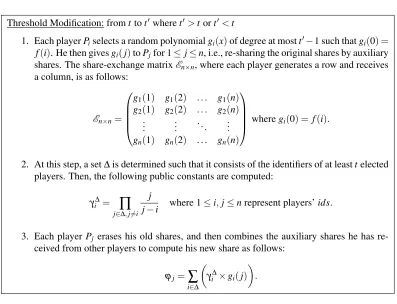
The first protocol, as shown in Figure 1, illustrates how re-sharing method(also known as 2-level sharing) can be used to decrease/increase the threshold to any arbitrary values. However, this method only works in the “passive” adversary model and it fails to increase the threshold in an active adversary setting. Note that the re-sharing technique can be implemented either by Lagrange method or by a Vandermonde matrix. Suppose the dealer randomly generates f(x)∈Zq[x]of degree at mostt−1 where f(0) =α is the secret. He then sends share f(i) toPi for 1≤i≤n. For threshold modification, each player re-shares his share using a new random polynomial of degree at mostt0−1, as shown in Figure 1.
Threshold Modification: fromttot0wheret0>tort0<t
1. Each playerPiselects a random polynomialgi(x)of degree at mostt0−1 such thatgi(0) =
f(i). He then givesgi(j)toPjfor 1≤j≤n, i.e., re-sharing the original shares by auxiliary
shares. The share-exchange matrixEn×n, where each player generates a row and receives
a column, is as follows:
En×n=
g1(1) g1(2) . . . g1(n)
g2(1) g2(2) . . . g2(n) ..
. ... . .. ...
gn(1) gn(2) . . . gn(n)
wheregi(0) =f(i).
2. At this step, a set∆is determined such that it consists of the identifiers of at leasttelected players. Then, the following public constants are computed:
γi∆=
∏
j∈∆,j6=i
j
j−i where 1≤i,j≤nrepresent players’ids.
3. Each player Pj erases his old shares, and then combines the auxiliary shares he has
re-ceived from other players to compute his new share as follows:
ϕj=
∑
i∈∆
γi∆×gi(j)
.
Figure 1: Threshold Modification by Lagrange Method in the Passive Adversary Model
Second protocol shows howpublic evaluationcan be used for threshold reduction in either “passive” or “active” adversary model. In this scheme, players collaborate to reveal an extra share on the secret sharing polynomial using theenrollment protocolof [8]. They then combine this share with their existing shares so that the threshold is decreased but the secret remains unchanged. Let f(x)∈Zq[x] be the original polynomial, see Figure 2.
Threshold Decrease: fromttot−1
1. Players select anid jsuch that j∈/P. Subsequently,tplayersPiare selected (1≤i≤t). They compute Lagrange constantsγi=∏1≤k≤t,i6=k j
−k
i−k, wherei,jandkare players’ ids.
2. EachPi multiplies his share f(i)by his Lagrange constant. He then randomly splits the
result intotportions, i.e., f(i)×γi=∂1i+∂2i+· · ·+∂tifor 1≤i≤t.
3. Players exchange ∂ki’s through pairwise channels. As a result, each player Pk holdst
values. He adds them together and revealsσk=∑ti=1∂kito everyone.
4. All the players add these values σk for 1≤k≤t together to compute the public share
f(j) =∑tk=1σk.
5. EachPicombines his private share f(i)with the public share f(j)as follows:
ˆ
f(i) =f(j)−j
f(i)−f(j)
i−j
.
6. Shares ˆf(i)are on a new polynomial ˆf(x)∈Zq[x]of degree at mostt−2 where ˆf(0) =
f(0). Therefore,t−1 players are now sufficient to recover the secret.
Figure 2: Threshold Decrease by Public Evaluation in the Passive Adversary Model
Threshold Increase: fromttot0wheret0>t
1. Players use polynomial production to generate shares of an unknown secretδ on a
poly-nomialg(x)of degreet0−2.
2. Each playerPimultiplies his shareg(i)byi. Now, eachPihas a share of 0 on the polyno-mial ˆg(x) =xg(x)of degreet0−1.
3. Each player adds his share f(i)of secretαto his shareig(i)of 0. As a result, each player has a share ofα, where the new threshold ist0>t.
Polynomial Production
1. First,tplayersPiare selected at random in order to act as independent dealers.
2. Each of thetchosen playersPishares a secret, sayδi, among all the players using a Shamir
scheme, where the degree of the secret sharing polynomial ist−1. Then, all players have
shares of every secretδi.
3. Every player adds his shares of theδi-s together. As a result, each player has a share on a
polynomialg(x)of degreet−1 with a constant termδ=∑δi.
Figure 3: Threshold Increase by Zero Addition in the Passive Adversary Model
3
Sequential Secret Sharing (SQS)
Example.1:Suppose the goal is to create a three-level sequential secret sharing scheme among a set of thirteen players. Consider the following subsets of players:
P={P1, . . . ,P13}, P1= {P1,P2,P3},
P0={
P4, . . . ,P13}, P2= {P4,P5,P6,P7},
P3= {P8,P9,P10,P11,P12,P13}.
Sharing Phase
1. The dealer first shares amaster secretα1with the players inPusing a(2,13)-threshold scheme. We denote this sharing by the following notation:
α1:P={P1, . . . ,P13}t0=2.
2. (a) The players Pi ∈P use polynomial production to create shares of an unknown secret β1 having a thresholdt1=3.
(b) They add their shares locally to obtain the shares of α2=α1+β1 which has a threshold of t1=3. All the players erase the shares ofα1.
(c) Players{P1, . . . ,P3}only keep the shares ofβ1, and players{P4, . . . ,P13}only keep the shares ofα2. Using the notation defined above, the result is denoted by:
β1:P1={P1,P2,P3}t1=3 and α2:P0={P4, . . . ,P13}t1=3.
3. (a) The players Pi∈P0 use polynomial production to create shares of an unknown secretβ2 having a thresholdt2=4.
(b) They add their shares locally to obtain the shares of α3=α2+β2 which has a threshold of t2=4. The playersPi∈P0erase the shares ofα2.
(c) Players{P4, . . . ,P7}only keep the shares of β2. Also, {P8, . . . ,P13} increase the threshold fromt2=4 tot3=6 and keep the shares ofα3. We denote this by:
β2:P2={P4, . . . ,P7}t2=4 and α3:P3={P8, . . . ,P13}t3=6.
Recovery Phase
1. In the first step, six players P3={P8, . . . ,P13} recover the secretα3. These players are in the highest level.
2. Subsequently,P2={P4, . . . ,P7}recover the secretβ2. As a result,α2is uniquely revealed since α3=α2+β2.
3. Finally,P1={P1, . . . ,P3}recover the secretβ1. As a result, the master secretα1is revealed since α2=α1+β1.
Definition.2: Sequential secret sharing is a hierarchical secret sharing scheme where a master secret α1 along with `−1 secrets α2, . . ., α` are shared among the players with monotonically increasing thresholds t0<t1<· · ·<t`. LetPbe a set of n players and assumePis composed of`disjoint levels
P=
` [ i=1
Pi,wherePi∩Pj= /0for all1≤i< j≤`and|Pi| ≥tifor all i.
Secretαk (at level k) can be then recovered only if players inRk= S`
i=kPicooperate and recover their secrets sequentially, i.e., from the highest level`down to level k, meaning that the master secretα1can be only recovered by playersP1only if the players in all levels sequentially reconstruct their secrets.
Sharing Phase
1. A dealer uses a Shamir scheme to distribute shares of an initial secretα1with threshold
t0among playersP={P1, . . . ,Pn}and then he leaves the scheme.
2. Subsequently, players repeat the following steps for 1≤i≤`−1 to construct an`-level
sequential secret sharing scheme:
(a) The players in P use polynomial production protocol, presented in Figure 3, to
generate shares of a random secretβiwith thresholdti, whereti−1<ti.
(b) They compute shares ofαi+1=αi+βimodq; the threshold ofαi+1isti. Then they erase their shares ofαi.
(c) A subset of players, sayPi⊂P where|Pi| ≥ti, only keep shares ofβiand the
rest of the players, i.e.,P−Pi, only keep shares ofαi+1.
(d) Ifi=`−1 (i.e., the last step of the protocol is being executed), they increase the threshold fromt`−1tot`. Otherwise (ifi< `−1), they setP←P\Pi.
Recovery Phase
1. Appropriate subsets of the players first collaborate to recoverα`as well asβ`−1, . . . ,β1.
Note that the players may only recover these secrets down to a specific leveli if it is
intended to do so.
2. They then solve the following system of linear congruences: αi+1≡αi+βi modqfor
i=`−1 down toi=1. (It is clear that each congruence has a unique solution forαigiven
αi+1andβi.) Therefore,α`, . . . ,α1are recovered.
Figure 4: Sequential Secret Sharing Protocol
The security proof of our proposed sequential secret sharing is pretty much similar to Shamir’s secret sharing scheme [10]. In Step-1, the dealer uses this scheme to share the master secretα1among all the players. In Step-2.a, players use the polynomial production protocol, shown in Figure 3, to generate shares of random numbersβi. In this protocol, players simply act as independent dealers and use the Shamir’s secret sharing scheme to generate these random numbers. In Step-2.b, players locally add their shares together to compute shares of the secretαi+βi. They also erase shares of the secretαi(in the first round,α1is the master secret). That way shares of the secretsαifor 1≤i≤`−1 are erased in the scheme and they cannot be recovered directly, i.e., they can only be reconstructed usingα`andβ`−1, . . . ,β1.
It is worth mentioning that the master secretα1 can be recovered correctly because secretsα`and β`−1, . . . ,β1can be sequentially reconstructed by the Lagrange interpolation method. Furthermore, as we stated earlier, each congruence equationαi+1≡αi+βi modqfori=`−1 down toi=1 has a unique solution forαigivenαi+1andβi.
4
Comparison with the Existing Hierarchical Schemes
The first hierarchical secret sharing scheme is proposed by Simmons [11] , nameddisjunctive multilevel secret sharing. Subsequently, this construction is changed intoconjunctive multilevel secret sharingby Tassa [12]. In both constructions, only a single secret is shared among the players who are in various au-thority levels whereas we generate different (but related) secrets with increasing thresholds in our access structure. We briefly illustrate these two constructions and provide an example for further clarification. Definition.3: In a hierarchical secret sharing scheme, a secret α is shared among the players with monotonically increasing thresholds t1 <t2 <· · ·<t`. Let P be a set of n players and assume P is composed of`disjoint levels:
P=
` [ i=1
Pi,wherePi∩Pj= /0for all1≤i< j≤`and|Pi| ≥tifor all i.
Indisjunctivemodel, secretαcan be recovered by a set of players A, i.e., an authorized subset, only if
|A∩(
j [ i=1
Pi)| ≥tj forat least one j where1≤ j≤`,
i.e., at least one threshold must be satisfied at level1to j. Inconjunctivemodel, secretαcan be recovered by a set of players A only if
|A∩(
j [ i=1
Pi)| ≥tjforall j where1≤ j≤`.
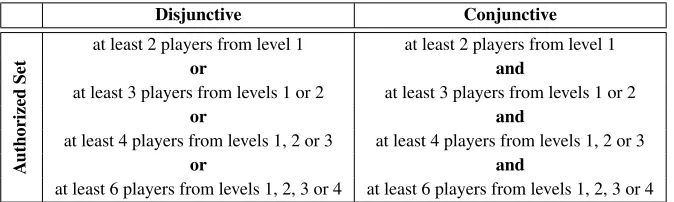
Example.2:Suppose there exist four levels witht1=2,t2=3,t3=4 andt4=6 thresholds. An authorized subsetAis shown in Table 1. It’s clear that, in both schemes, the players in the initial levels have more authority compared to the other players. For instance, two players from the first level are enough to recover the secret in the disjunctive model. Also, six players from the first level are enough to reconstruct the secret in the conjunctive model; note that six players from level 2,3 or 4 won’t be able recover the secret in this model.
Disjunctive Conjunctive
A
uthorized
Set
at least 2 players from level 1 at least 2 players from level 1
or and
at least 3 players from levels 1 or 2 at least 3 players from levels 1 or 2
or and
at least 4 players from levels 1, 2 or 3 at least 4 players from levels 1, 2 or 3
or and
at least 6 players from levels 1, 2, 3 or 4 at least 6 players from levels 1, 2, 3 or 4
As shown, in our sequential secret sharing, a master secret along with`−1 related secrets are shared among the players whereas, in disjunctive/conjunctive secret sharing, only one secret is shared. Further-more, in our scheme, although the players in the initial level have the required authority to recover the master secret, they cannot do that without the sequential cooperation of the players from all levels. On the other hand, in disjunctive/conjunctive secret sharing, cooperation of the players from all levels may not be required. As a realization of our hierarchical access structure, we could imagine the president and vice president as the setP1, ministers as the setP2, and senators as the setP3accordingly. The president and vice president can recover the master secret (to trigger a secret action) only if they have the confirmations of ministers and senators. On the other hand, even by having those confirmations, the final decision (recovering the master secretα1to trigger the intended action) is made by the president and vice president, i.e., distribution of the authority all over the hierarchical access structure. As we stated earlier, this access structure cannot be modeled by the existing hierarchical secret sharing schemes [11, 12].
5
Concluding Remarks
In this article, we proposed a new hierarchical secret sharing scheme in which multiple secrets are shared among subsets of players with different levels of authority. In this protocol, reconstruction of the master key by the highest ranked players is subject to the cooperation of the players in the lower levels. On the other hand, even by having the secrets of the lower levels, the master key can only be recovered by the highest ranked players. We believe that SQS can be utilized in various cryptographic constructions.
References
[1] M. Ben-Or, S. Goldwasser, and A. Wigderson. Completeness theorems for non-cryptographic fault-tolerant
distributed computation. In20th ACM Symposium on Theory of Computing STOC, pages 1–10, 1988.
[2] G. R. Blakley. Safeguarding cryptographic keys. InNational Computer Conference NCC, pages 313–317.
AFIPS Press, 1979.
[3] R. Gennaro, M. O. Rabin, and T. Rabin. Simplified VSS and fast-track multiparty computations with
appli-cations to threshold cryptography. In17th ACM Symp on Principles of Distributed Computing PODC, pages
101–111, 1998.
[4] A. Herzberg, S. Jarecki, H. Krawczyk, and M. Yung. Proactive secret sharing or: How to cope with perpetual
leakage. In15th Int Cryptology Conference CRYPTO, volume 963 ofLNCS, pages 339–352. Springer, 1995.
[5] K. M. Martin, J. Pieprzyk, R. Safavi-Naini, and H. Wang. Changing thresholds in the absence of secure
channels. In4th Australasian Conf. on Info Security and Privacy ACISP, volume 1587 of LNCS, pages
177–191. Springer, 1999.
[6] M. Nojoumian.Novel Secret Sharing and Commitment Schemes for Cryptographic Applications. PhD thesis,
Department of Computer Science, University of Waterloo, Canada, 2012.
[7] M. Nojoumian and D. R. Stinson. On dealer-free dynamic threshold schemes. Advances in Mathematics of
Communications, 7(1):39–56, 2013.
[8] M. Nojoumian, D. R. Stinson, and M. Grainger. Unconditionally secure social secret sharing scheme. IET
Information Security, SI on Multi-Agent and Distributed Information Security, 4(4):202–211, 2010.
[9] R. Ostrovsky and M. Yung. How to withstand mobile virus attacks. In10th ACM Symp on Principles of
Distributed Computing PODC, pages 51–59, 1991.
[10] A. Shamir. How to share a secret.Communications of the ACM, 22(11):612–613, 1979.
[11] G. J. Simmons. How to (really) share a secret. In8th Annual International Cryptology Conference CRYPTO,
volume 403 ofLNCS, pages 390–448. Springer, 1988.
[12] T. Tassa. Hierarchical threshold secret sharing. In1st Theory of Cryptography Conference TCC, volume