CENTRE FOR
ADV
ANCED
SP
A
TIAL
ANAL
YSIS
W
orking Paper Series
Paper 37
URBAN MODELING
AS
STORYTELLING:
USING
SIMULATION
MODELS AS A
NARRATIVE
Centre for Advanced Spatial Analysis University College London
1-19 Torrington Place Gower Street
London WC1E 6BT [t] +44 (0) 20 7679 1782 [f] +44 (0) 20 7813 2843 [e] [email protected]
[w] www.casa.ucl.ac.uk
http//www.casa.ucl.ac.uk/paper37.pdf Date: September 2001
ISSN: 1467-1298
© Copyright CASA, UCL.
Subhrajit Guhathakurta is an Associate Professor in the School of Planning and
Landscape Architecture at Arizona State University. His research interests include land and regional economics, housing policies, land use, and environmental planning. He was an Academic Visitor at the Centre for Advanced Spatial Analysis from August-September 2001.
School of Planning and Landscape Architecture Arizona State University
Mail Code 872005 Tempe, AZ 85287-2005 (480) 965-6343 (voice) (480) 965-9656 (fax)
ABSTRACT
Models as Stories
The renewed interest in urban land use models has been led by developments in two fundamental directions. First, new semantic structures are now being explored especially those related to self-organizing systems, neural networks, and other nonlinear dynamic systems (Batty and Longley 1994, Itami 1994, Sui 1997, 1996). Second, more sophisticated forms of representation and communication are being used such as geographic information systems, decision support systems and multimedia to make the urban models more pragmatic tools in public forums (Klosterman 1997; Shiffer 1995; Guhathakurta 1999). These advances, made in the last decade, have transformed urban modeling endeavors from a static, data-driven, unidirectional process to a simulation exercise that seeks to understand the underlying structure of stability or change in a system. However, the core of many policy-oriented urban models has remained mostly empirical and /or deterministic. In this paper I provide another semantic structure for urban models that uses elements of systems-dynamic method to construct "stories" of the past and possible futures of a region in southern Arizona. I will show that a shift in focus from prediction to "storytelling" leads us to new forms of expression that may offer a different understanding of the evolution of an urban environment.
Stories, narratives, and other "rhetorical practices" are well entrenched in the terminology of planning and policy analysis (Majone 1989; Throgmorton 1991; Forester 1993a, 1993b). The argumentative and communicative bent in planning literature have, no doubt, elevated the role of practice stories as a legitimate pedagogical and methodological tool in the discipline. While many planners may perceive this development as a clear epistemological shift away from "objective" knowledge, based on solid science, in reality, science and rhetoric have always coexisted in this profession. Echoing this view Throgmorton have suggested that "...all planning and analysis is rhetorical, and that tools such as survey research, computer modeling, and forecasting can be thought of as rhetorical tropes" (1993, p. 117). However, the literature on urban modeling has rarely acknowledged the critical function of models as a means of reconstructing and speculating on a "story". In this article I first argue that all argumentation is contextualized within a narrative that is either inferred or communicated. Next, I examine the distinctions between empirical and simulation models using the metaphors of argument and narrative. Finally, I develop a simple system-dynamic model to demonstrate how computer-based urban models can "tell a story".
Policy arguments and policy narratives
Given that various forms of narratives permeate our everyday life, it is important to separate the smaller set of policy narratives that this article addresses from the larger domain of all narratives. Policy narratives, as defined by Roe (1994, p. 3), are "those stories -- scenarios and arguments -- that are taken by one or more parties to the controversy as underwriting (that is, fixing or making steady) the assumptions for policymaking in the face of the issue's uncertainty, complexity or polarization". This definition implicitly assumes that most policy issues are "wicked problems" in the parlance of Rittel and Webber (1973). Under this scenario, a typical controversial policy problem would have few agreed upon parameters and fewer acceptable solutions. Therefore solving these problems have less to do with formal techniques of problem solving and more with the process of argumentation. The arguments produced for the purpose of policy are not judged solely by their technical merit but in significant part by their power to persuade and congeal public opinion.
Narrative expositions are not only powerful forms of rhetoric; they are essential means of interpretation and understanding. As Heidegger, Dilthey, Gadamer and several others have pointed out that all enquiries rely on “pre-understanding” and “pre-judices” since human consciousness is temporal in form. Understanding itself takes place through the medium of the enquirer's own language given that one never encounters one's data "raw" but always “mediated” through the generative power of language. If the professional vocabularies of science have to be made intelligible to us, they must be reconnected with ordinary languages through which the world is first “open” to us (Cooper 1996). This does not, however, mean, as some of Derrida's followers have suggested, that there exists nothing but language. It only suggests that the circle of understanding and interpretation (the hermeneutic circle) can only be completed through ordinary language. The purpose of the narrative is therefore to make the connections to ordinary experience through ordinary language and peel away the presuppositions so as to engage as well as to persuade.
Urban mathematical models, like all other forms of analytical tools, are embedded within a narrative. Frequently, modelers have not consciously examined and conveyed this narrative before asserting an argument based on the empirical results. This problem is especially present in the case of empirical models that privilege associations discovered through statistical tests rather than uncovering the underlying story that generates these associations. The storyline in these cases is reduced to one or more hypotheses that are tested. Also, most empirical models are unduly restricted to measured data and have neglected the far richer and more complex body of information that exists in the experience of different individuals. These experiences can be easily described heuristically although precise measures may not be known. The critical element of understanding "the story" is not necessarily the examination of associations but an analysis of interconnections. These interconnections are often too complex to comprehend without adequate methodological tools. One convenient approach for analyzing the cumulative effect of multiple interconnections is available in the literature on dynamic, and often self-organizing, systems.
A discussion of dynamic systems and embedded narratives need to be delineated carefully given the baggage associate with the label “systems theory”. The term “systems” has spawned somewhat of an industry in different versions of optimization and other modeling techniques with labels like “systems science,” “systems analysis,” “systems design,” and “general systems theory”. The last one, offered by Bertalanffy (1968) and Boulding (1985), is the well-known label for a general theory of systems. However, the perspective of systems adopted in this paper is closer to a theory of general systems as conceived by Churchman (1968, 1979) and Forrester (1969). According to this view, systems approach is a “grand” scheme that attempts to tie together all aspects of the human world. In fact, even this all-encompassing definition fails to satisfy Churchman who argues that the richness of this approach is embedded in the pursuit of “meaning” through several pathways. These pathways would weave together an understanding of history, tradition, and ethics within a foundation of logic and "reason".
While Churchman explored the political and ethical terrain of the systems approach on pragmatic grounds, Forrester used the same pragmatic foundation to develop its logical stance. Forrester found that the systems way of thinking was most suited for dealing with complexity. He argued that since complex systems defy intuitive solutions, systems dynamic investigation could provide an effective way to clarify and enhance the mental models. Even while emphasizing the usefulness of systems models, Forrester expounds at length about tapping into our collective knowledge (attained formally as well as informally) that generate the “mental models” essential for directing our goal-oriented actions. The primary purpose of the systems dynamic model in this case is to organize, clarify, and unify knowledge. In his words “a system dynamics model, if it is to be effective, must communicate with and modify the prior mental models. Only people’s beliefs, that is, their mental models, will determine action. Computer models must relate to and improve mental models if the computer models are to fill an effective role” (Forrester 1991, 19-20).
What are the kinds of narratives described by general systems models? Some aspects of narratives are fairly self-evident in systems models. For example, systems models track the progress of an evolving process over time, such as the growth, decline and regeneration of species as determined by certain external as well as internal stimuli. This structure would be similar to a narrative construction of the same phenomenon (without the poetics). System models are also particularly adept at tracing different paths depending upon the sequence of events along the time-line. The narrative equivalent of this is captured in movies such as “Sliding Doors” (Directed by Peter Howitt, UK 1998) and “Blind Chance” (Directed by Krzysztof Kieslowski, Poland 1981). These movies essentially follow two (or more) separate narratives depending upon the outcome of specific events, such as just being able to catch the train or not. The movies depict separate scenarios based on chance but in a systems model we can derive an understanding of multiple scenarios based on both chance and deliberate action. However, both narrative and system model structures allow the examination of the temporal connections between events in a manner such that a coherent and unified experience is projected.
Urban environments as dynamic complex systems
Urban environments have properties that are emerging out of micro-scale processes of individual behavior. However, Given that macro behavior in an urban environment is often derived from the interactions of many individual processes, simple aggregation of these micro-scale processes does not necessarily capture the larger patterns of macro behavior. The products of interactive development bare little resemblance to the original micro-scale patterns, and therefore require a synthetic approach to the study of the whole system. For example, markets emerge from the dynamic interactions between consumers and producers and cannot be understood by examining one component in isolation. Similarly, urban phenomena such as traffic congestion, agglomeration of activities, clustering of socioeconomic groups have to be seen in light of complex individual interactive processes (Nagel, Rassmussen, and Barrett 1996; Krugman 1996; Torrens 2000).
Dynamic models of urban areas have also been developed to examine more targeted questions. An excellent example of such a model is the Schelling’s segregation model (Schelling 1978; Krugman 1996). Schelling proposed a simple model to explore why ethnic groups tend to live in segregated neighborhoods. His approach was to construct the story of a neighborhood that was integrated and stable to begin with, but each household had mild biases against being surrounded by over 60 percent of adjacent households of a different ethnic / racial group. Schelling was able to show that small perturbations (e. g. moving few households out of the neighborhood and moving fewer others in at random) cause a tipping effect by which the neighborhood slowly becomes segregated based on the initial biases. This process would be hard to observe empirically but provides an important lesson about how individual perceptions and behavior interact to produce an (initially) unexpected macro outcome.
More recently, Krugman (1996) provided an interesting story about the formation of edge cities in the form of a systems dynamic model. He began with a proposition that seems plausible: businesses like to have other businesses nearby but dislike being around those businesses a little way away. In other words, the agglomeration effects are exhausted in a short range, beyond which the incentive to increase the separation is high. With this simple proposition, Krugman tested the dynamics of business formation in a large urban area with various initial distributions of businesses. He discovered that for many initial distributions of businesses, the dynamic simulation result was similar. In almost all cases, evenly spaced edge cities evolved. Only the number of these edge cities were somewhat determined by the initial distribution of businesses. There is no doubt that this story (like the others above) is stylized and does not correspond perfectly to the facts. Equal sized, regularly spaced business concentrations are rarely found in the real world. But just because this is not a perfect model does not diminish its usefulness. Given that the real environment is far from being undifferentiated and several other factors also determine business location (e.g. transportation access and zoning), the somewhat different perceived reality is not surprising. But the essence of the story, nevertheless, seems to ring true based on our understanding of the macro outcomes of micro behavior of business location.
sensitive to the accuracy of the information provided. In contrast, systems dynamic models attempt to observe complexity evolving from simple rules of expected behavior. These models are less sensitive to empirical information and more to the rules of behavior that guide individual actions. However, empirically based systems dynamic models do exist and have played an important function, especially in the field ecology and environmental sciences. Such models are however not prevalent in the urban literature. The next section describes how an empirically based urban model can be constructed to tell the familiar story about the tension between growth and environmental protection.
Life and death along the San Pedro River
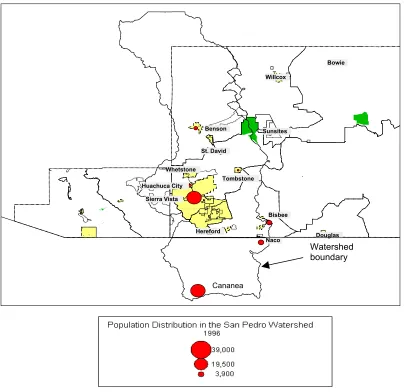
This story is set along the banks of the San Pedro River, which flows from its headwaters near Cananea, Mexico, northward approximately 140 miles until it meets the Gila River near Winkelman, Arizona. The area that drains into this river is known as the San Pedro watershed. The Arizona Department of Water Resources (ADWR) has also delineated a number of unique drainage basins located within the main San Pedro Watershed, the largest and the most critical of these being the Sierra Vista sub-watershed. This sub-watershed encompasses 1,200 square miles, more than half of which lies within Sonora, Mexico. This sub-watershed is also home to approximately 100,000 persons and includes two of the largest places in the entire watershed – Cananea, Sonora and Sierra Vista, Arizona. The location of principal population centers in the San Pedro watershed is shown in Figure 1.
The area within the Sierra Vista sub-watershed is undergoing rapid transformation of its economic base and its land uses, especially since the mid to late 1980s. The population growth in the watershed north of the border seems to be occurring at a brisk pace mostly around the Sierra Vista area. The characteristics of this growth in population are alarming since the new concentrations seem to be in the non-incorporated areas. This often leads to inefficient infrastructure growth and unregulated demands on the watershed resources. Moreover, as watersheds continue to harden, hydrologic regimes are altered producing changes in vegetation patterns and wildlife habitats. Other major environmental issues on both sides of the border include: mine and industrial waste pollution, waste transportation, the loss of farm and ranch land, visual degradation, and threats to environmentally sensitive areas (riparian corridors and wildlife habitat) and culturally significant sites (Native American).
Cananea Huachuca City
Sierra Vista Whetstone
Hereford
Naco Bisbee Tombstone
St. David Benson
Bowie
Douglas Sunsites
Willcox
Figure 1: Communities in the San Pedro Watershed
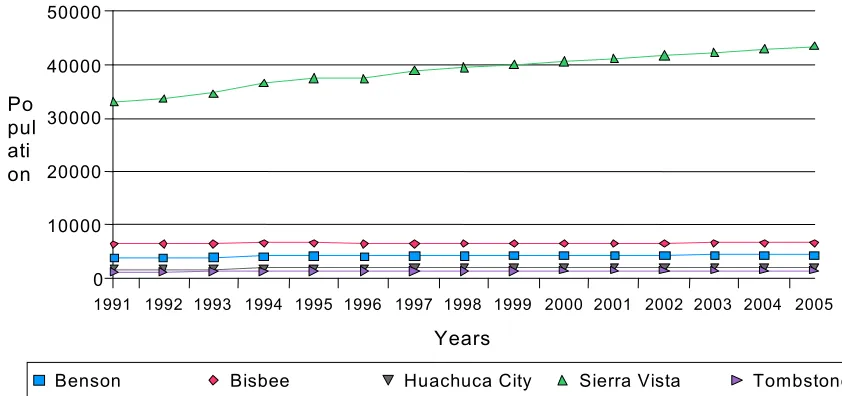
percent. In the same period, the population of communities such as Benson, Bisbee, and Tombstone actually declined. More recently, there has been a growth trend in all the communities mentioned above. This growth is led by Sierra Vista and Tombstone, with growth rates of 23.3 percent and 36.1 percent respectively during 1990-2000. Population projections conducted by Arizona Department of Economic Security suggest a continued robust growth in Sierra Vista with stable and slow growth in the other Cochise county communities in the watershed (Figure 2).
The San Pedro River and the Sierra Vista urban agglomeration is the setting for this story, which is essentially about the use and distribution of water resources. The San Pedro River is Arizona's last undammed, free-flowing river and one of the nation's hot spots for biodiversity. According to the Nature Conservancy, more than 80 species of mammals, 40 species of reptiles and amphibians, 100 species of butterflies, 20 species of bats, and 100 species of breeding birds rely on the river. Another 250 species of migratory birds are part-year residents. The river was recently named as the first of the "Last Great Places on Earth," a program of listing important global habitats by The Nature Conservancy. Along the banks of the river is a riparian ecosystem consisting of Cottonwood and Willow and several other non-native species of plants. This ecosystem is under considerable stress from several fronts. The burgeoning urban area in and around Sierra Vista is pumping out the aquifer and changing the hydrology of the region. The dwindling surface water runoffs to the river is beginning to threaten its very existence. The riparian area long the river is also impacted by development. Humans are introducing non-native species of plants that are overwhelming the fragile native Cottonwood and Willow trees.
The concern about San Pedro’s changing ecology has sparked numerous efforts to save the river and its ecosystem. A large number of organizations have formed around the issue of protecting the river including the San Pedro Partnership, the San Pedro Alliance (made up of 55 environmental organizations), and The San Pedro Foundation, among many others. The national and international organizations like the Nature Conservancy and the Sierra Club are also actively engaged in this effort. Numerous studies have been commissioned for understanding the changing hydrology and ecology of the San Pedro watershed. Not surprisingly, the studies do not agree in all details but they all suggest that water is becoming a scarce commodity, both for the river and for the inhabitants in the watershed.
1991 1992 1993 1994 1995 1996 1997 1998 1999 2000 2001 2002 2003 2004 2005
0 10000 20000 30000 40000 50000
Benson Bisbee Huachuca City Sierra Vista Tombstone
Years Po
pul ati on
the critical need to maintain water flow along the river has to be addressed more extensively. According to studies conducted by the ADWR, this water flow to the river is being hampered by excessive pumping in and around the Sierra Vista urban area. The withdrawals from the aquifer are creating a cone of depression, which in turn reduces the baseflow to the river. Besides Sierra Vista and other cities in the watershed, Fort Huachuca Military Installation is another major user of groundwater resources.
The communities in the watershed and the Fort are actively engaged in water conservation and recycling. They all require new construction to use low-water-use plumbing fixtures. The city of Sierra Vista has expanded their code to include mandatory hot water recirculating pumps. Restrictions are in place on how much turf can be planted around residences. Commercial developments are not allowed any turf areas. At least two constructed wetlands are now in operation to augment recharge of the underground aquifer. The Fort has been at the forefront of water conservation efforts. All of its component organizations implemented coordinated water conservation projects along with a conservation education program. The conservation projects included completion of a water control system to reduce tank overflow in the water system and the installation of low-flow showerheads and waterless urinals. The result of the Fort’s program was a reduction of water consumption by 12 percent during 1998-1999. Regardless, the sheer size of the demand on water made by Fort Huachuca has sparked sporadic litigation alleging adverse environmental impacts.
Perhaps the most vocal opponent of the AMA designation was John Siegal, who represents a considerable faction to the right of the political spectrum. "I'm over here because I'm concerned to convert this area to an AMA is just more intrusion by state bureaucrats," Siegal explained. "It serves the purpose not of the general public, but of a few rabid environmentalist groups. The next step will be to put meters on our wells and to charge surcharges. The whole idea is to end where we live which is what the Sierra Club is trying to do in America" (Rupkalvis 2001).
The San Pedro river and the communities in its watershed are now poised at a critical historical moment. The decisions made now will determine the direction of their story in the future. But how can we speculate on what that story will be? This process of speculation and storytelling will, perhaps, illuminate the underlying structure of relationships between water and land and its inhabitants, and how our perceptions color such relationships. It is hoped that through the development of this plot, some core values will form and critical events will take shape changing the course of history for the better. The next section describes the model that underlies the plot of this story.
The San Pedro Watershed Model
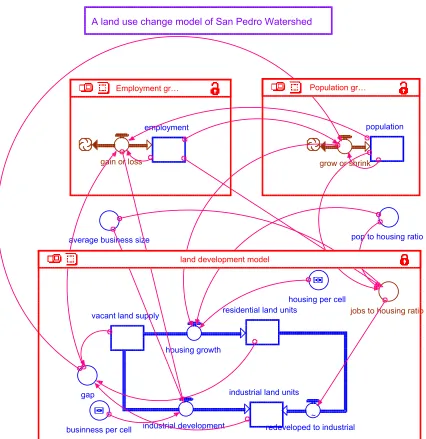
The model developed for this study is composed of three interconnected systems: The first simulates growth in population and employment; the second drives the changes in land required for residential and non-residential uses; and the third system simulates the use of water. The model has feedback loops that control population and employment growth according to land availability for each period. The objective of this component of the modeling exercise is to determine the aggregate amount of land for residential and non-residential uses that will be required for accommodating the population growth in the future. More importantly, it also shows how population and employment changes impact the underground aquifer and the river.
grow or shrink
population
gain or loss
employment
vacant land supply residential land units
housing growth
industrial development
industrial land units
~
redeveloped to industrial
jobs to housing ratio
pop to housing ratio average business size
gap
housing per cell A land use change model of San Pedro Watershed
businness per cell
Employment gr…
land development model
Population gr…
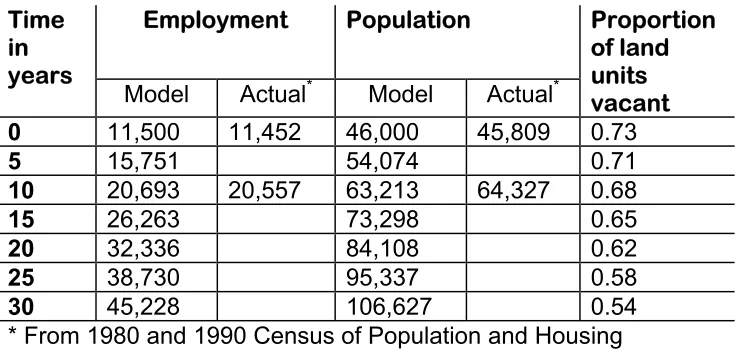
Employment Population
Time
in
years
Model Actual
*Model Actual
*Proportion
of land
units
vacant
0
11,500 11,452 46,000 45,809 0.73
5
15,751
54,074
0.71
10
20,693 20,557 63,213 64,327 0.68
15
26,263
73,298
0.65
20
32,336
84,108
0.62
25
38,730
95,337
0.58
30
45,228
106,627
0.54
* From 1980 and 1990 Census of Population and Housing
simulated with actual values of population, employment and proportion of developed land. This test simulation was performed to check how well the systems-dynamic model performs under the usual parameters. Given the minor difference between the model values and actual values, it may be concluded that the model is a fair representation of the dynamic linkages being modeled.
Once the population, employment and land unit change model was providing expected results, the other critical element of this modeling exercise – use of water – was added to the systems dynamic component of the model. This part closely followed recent hydrological studies that measured the annual recharge, aquifer levels, total pumpage, and baseflow amounts based on 1940 steady-state water budgets (Corell et al. 1996). The schematic of this model is presented in Figure 4. The flows in to the aquifer consist of mountain front recharge as a result of annual precipitation and also recharge from the constructed wetlands (surface water infiltration). The outflows are comprised of pumpage for domestic and agricultural uses, evapotranspiration, baseflows to the river, and subsurface outflow from the basin. The agricultural and domestic pumpage impose the largest demand on groundwater resources (about 11,000 acre-feet annually) followed by riparian vegetation and flows to the stream, respectively. The domestic pumpage in the model is derived from population parameters estimated in the population–economy-land use submodel and from current intensity of water use per capita. Agricultural pumpage bears a weak inverse relation to domestic pumpage given that increasing urbanization tends to convert some agricultural land to other urban uses. The model also incorporates the possibility for adding to the aquifer recharge through technological means, such as constructed wetlands. The simulation was run under various conditions of per capita water use, population growth and recharge amounts. Regardless of the speculated parameters in the water use model, almost all simulations resulted in drawing down the aquifer. Only the speed of this decline in ground water levels varied with the supplied parameters. This result is corroborated by scenarios generated by ADWR (Corell 1996). Therefore, most meaningful speculations about the plot of the story of San Pedro seem to converge towards a familiar ending.
Constructing the plot from the systems-dynamic model
aquifer storage
recharge flow
mountain front recharge per year
Graph 3 flow to agriculture
~
acreage in agriculture agricultural use
ag use per acre
domestic pumpage withdrawals from wells
watershed population
Table 3
~ Sierra Vista popua
Table 4
water use per capita
Evapotranspiration flow to pherophytes
water for pherophytes
Underflow@Fairbank underflow
annual flow net stream leakage
baseflow discharge
~
streamflow
total pumpage
percent recharge total recharge from domestic use
ltion Table 5 Water use model
land. Land was plentiful and cheap, which was one of the principle attractions drawing people and employers into this area. Even with this healthy rate of growth, only 48 percent of urban land was developed by 2010. Given this abundance of land many began to build housing at a density of 1 per acre. The planners noted that if average housing density decreases to 1 per acre, they would still be left with about 20 percent vacant urban land in 2050. Therefore physical limits of land resources did not feature in their planning decisions. Of course, transportation and energy issues necessitated a more compact development, but there were other more pressing matters that needed their attention.
Although land was plentiful, there was real and critical limits to growth in the San Pedro watershed communities were water was concerned. The aquifer was slowly but surely being depleted as the recharge in 1990 was only 78 percent of total outflows. The specter of dwindling water supply in the very near future sparked a coordinated program to recycle water and recharge the aquifer by technological means. The aggressive program of replenishing the aquifer resulted in recycling 30 percent of the domestic water, which was recharged back to the aquifer. Sadly, this effort was not nearly enough to arrest the depletion of groundwater. By 2050, there was about 0.5 million acre-feet of water less in the aquifer than there was in 1980 and the deficit continued to grow. Leakage to the river had declined to one-third of the amount in 1980, making San Pedro an intermittent stream (Figure 5). The diminishing flow of water also impacted the riparian corridor adversely. The majestic Cottonwood and Willow trees have now become a rarity. Many of the animal species that thrived in 1980 are now either extinct or endangered. The river, which once gave life to a thriving ecosystem and provided tourist dollars to the economy, is almost dead in 2050. As jobs disappeared from the tourist economy, people began to move out of the area. Those left behind now asked the state and federal governments to step in and stem the tide of decline. Some of them were the same persons, or the sons and daughters of the same people, who had initially fought hard to keep the state and federal governments out of their communities.
1:05 PM Sat, Jul 07, 2001
0.00 17.50 35.00 52.50 70.00
Years 1: 1: 1: 3: 3: 3: 4: 4: 4: 3000.00 6500.00 10000.00 5000.00 15000.00 25000.00 -1025000.00 -512500.00 0.00
1: baseflow discharge 3: withdrawals from wells 4: aquifer storage
1 1 1 1 2 2 2 2 3 3 3 3 4 4 4 4
Graph 1 (Untitled)
2: 2: 2: 0.00 1000.00 2000.00
2: flow to agriculture
6000 acre-feet annually, not much below 2000 levels. This will save the ecosystem and the economy for at least another generation. The targets discussed are achievable but unrealistic given the current attitudes toward water use and growth. It will require a substantial change in the lifestyle of the inhabitants of San Pedro watershed communities. However, it is their opportunity to write a story about saving a river that can perhaps capture the minds and hearts of other communities facing a similar fate.
Conclusion
The story of San Pedro is obviously stylized and perhaps deviates from the scientific calculations. However, the essence of this story, if not the specifics, is supported by several hydrological studies. The positive notion of science carries the baggage of data accuracy, which when unavailable tend to undermine or weaken the scientific conclusions. Also, the technical nature of presentation of scientific information can make it less meaningful to laypersons. In the case of San Pedro, which has become “one of the most data-rich areas in the world” measurement issues persist, allowing skeptics to challenge the most reasonable conclusions (City of Sierra Vista 1998). It is commonplace in modern relativism to have multiple versions of events, and stories about them, which raises suspicion to claims of the “real” or the “true” version of that event. However, the value of storytelling is not to separate the “true” from the “false” but to make sense of that reality. Given that stories are told in ordinary language, they are translatable without “fundamental damage” (Barthes 1977). Echoing a similar sentiment, White (1980) states: “We may not be able to fully comprehend specific thought patterns of another culture, but we have relatively less difficulty understanding a story coming from another culture, however exotic that culture may appear to us.” Therefore, constructing stories based on urban models would have an intuitive appeal for most people for whom the culture of modeling may be “exotic”.
References
Barthes, R. 1977. Image, Music, Text. Translated by Stephen Heath. New York, NY: Noonday
Press.
Batty M. and P. Longley. 1994. Fractal Cities. London: Academic Press.
Bertalanffy, L. 1968. General system theory: foundations, development, applications. New York: G.
Braziller.
Boulding, K. E. 1985. The world as a total system. Beverly Hills, California: Sage Publications.
Bruner, J. 1986. Actual Minds, Possible Worlds. Cambridge, MA: Harvard University Press.
Churchman, C. W. 1968. The systems approach. New York: Dell Publishing Company.
Churchman, C. W. 1979. The systems approach and its enemies. New York : Basic Books.
City of Sierra Vista. 1995. A walk along the river. An educational pamphlet published by the City
of Sierra Vista.
Cooper, D. E. 1996. Modern European Philosophy. In The Blackwell Companion to Philosophy,
eds., N. Bunnin and E. P. Tsui-James. Cambridge, MA: Blackwell Publishers.
Corell, S. W. 1996. Groundwater flow model scenarios of future groundwater and surface water
conditions:Sierra Vista Subwatershed of the Upper San Pedro Basin – Southeastern Arizona.
Supplement to Modeling Report No. 10. Phoenix, AZ: Arizona Department of Water
Resources, Hydrology Division. December.
Corell, S. W., F. Corkhill, D. Lovvik, and F. Putnam. 1996. A groundwater flow model of the Sierra
Vista Subwatershed of the Upper San Pedro Basin – Southeastern Arizona. Modeling Report
No. 10. Phoenix, AZ: Arizona Department of Water Resources, Hydrology Division.
December.
Forester, J. 1993a. Critical Theory, Public Policy, and Planning Practice: Toward a Critical
Pragmatism. Albany, NY: State University of New York Press.
Forester, J. 1993b. Learning from practice stories: The priority of practical judgment. In The
Argumentative Turn in Policy Analysis and Planning, eds. F. Fischer and J. Forester, 186-209.
Forrester, J. 1969. Urban Dynamics. Cambridge, MA: The MIT Press.
Forrester, J. 1991. System Dynamics and the Lessons of 35 Years. Available at:
http://sysdyn.mit.edu/people/jay-forrester.html (07/07/01).
Guhathakurta, S. 1999. Urban modeling and contemporary planning theory: Is there a common
ground? Journal of Planning Education and Research18: 281-292.
Itami, R. M. 1994. Simulating spatial dynamics: Cellular automata theory. Landscape and Urban
Planning30: 27-47.
Klosterman, R. E. 1997. Planning support systems: A new perspective on computer-aided planning.
Journal of Planning Education and Research17: 45-54.
Krieger, M. 1981. Advice and Planning. Philadelphia: Temple University Press.
Krugman, P. 1996. The self-organizing economy. Cambridge, MA: Blackwell Publishers.
Lee, D. B., Jr. 1973. Requiem for large-scale models. Journal of the American Institute of Planners
39: 163-178.
Majone, G. 1989. Evidence, argument, and persuasion in the policy process. New Haven: Yale
University Press.
Nagel, K., S. Rasmussen and C. L. Barrett. 1996. Network traffic as self-organized critical
phenomena. TSA-DO/SA MS-M997 and CNLS MS-B258. Los Alamos, NM: Los Alamos
National Laboratory. Available at http://transims.tsasa.lanl.gov/.
Neustadt, R. and E. May. 1986. Thinking in Time: The Uses of History for Decision Makers. New
York: Free Press.
Parry, A. and R. E. Doan. 1994. Story Re-visions. New York, NY: Guilford Publications.
Rein, M. 1976. Social Science and Public Policy. Harmondsworth, UK: Penguin Educational.
Rittel, H. W. J. and M. M. Webber 1973. Dilemmas in a general theory of planning. Policy Sciences
4: 155-169.
Roe, E. 1994. Narrative Policy Analysis: Theory and Practice. Durham, NC: Duke University
Rupkalvis, D. 2001. . Management area debate continues: State officials answer questions; sides
voice opinions. Sierra Vista Herald 04/20/01.
Schelling, T. C. 1978. Micromotives and microbehavior. New York, NY: WW Norton and
Company.
Shiffer, M. 1995. Interactive multimedia planning support: Moving from stand-alone systems to the
World Wide Web. Environment and Planning B: Planning and Design 22: 649-664.
Simon, H. 1976. Administrative Behavior: A Study of Decision Making Processes in Administrative
Organization. New York: Free Press.
Sui, D. Z. 1996. Urban forms, urban processes, and urban policies: A research agenda for the
metropolis in the 21st century. In Spatial Technologies, Geographic Information and the City.
Compiled by H. Couclelis. Santa Barbara, CA: NCGIA Technical Report 96-10: 210-213.
Sui, D. Z. 1997. Reconstructing urban reality: From GIS to electropolis. Urban Geography18:
74-89.
Throgmorton, J. A. 1991. The rhetorics of policy analysis. Policy Sciences24: 153-79.
Throgmorton, J. A. 1993. Survey research as rhetorical trope: Electric power planning arguments in
Chicago. In The Argumentative Turn in Policy Analysis and Planning, eds. F. Fischer and J.
Forester, 117-144. Durham, NC: Duke University Press.
Torrens, P. M. 2000. How cellular models of urban systems work. (1. Theory). Center for Advanced
Spatial Analysis Working Paper No. 28. Available at:
http://www.casa.ucl.ac.uk/working_papers.htm.
White, H. 1980. The value of narrativity in the representation of reality. Critical Inquiry, autumn