
Protocols
Masoumeh Safkhani1, Nasour Bagheri2, Majid Naderi1
1 Electrical Engineering Department, Iran University of Science and Technology, Tehran, Iran.
{M Safkhani,M Naderi}@iust.ac.ir
2 Electrical Engineering Department, Shahid Rajaee Teacher Training University, Tehran, Iran.
Abstract. Widespread adoption of RFID technology in all aspects of our life mainly depends on the fixing the privacy concerns of this technology’s customers. Using a tagged object should not lead to existence of the tracing possibility. This concern is a challenging issue that has motivated the researchers to propose several authentication protocols to fix the traceability problem in RFID systems and also provide other security requirements.
In this paper, we analyze the security of three authentication protocols which have recently been proposed by Morshedet al.[8]. Our security analysis clearly highlights important security pitfalls in these protocols which leads to their vulnerability against traceability. The complexity of the proposed attacks are only several runs of the protocols while the adversary’s advantages to trace the tagged object are maximal.
Keywords: RFID, Ubiquitous, Mutual Authentication, Traceability.
1
Introduction
Radio frequency identification (RFID) is a favorite technology for automated identification in various applications, e.g., libraries, supply chain management, e-passports, human implants and toll payment and we may become as dependent on that in the foreseeable future as we are dependent on e-mail or cellular phones today. The tag, the reader and the back-end server are three basic components of an RFID system:
– Tags are connected to the objects that are supposed to be identified by the reader through radio frequency signals.
– The reader can read or modify tag’s information.
– The back-end server aids the reader by an extra storage spaces and further computational capability. In addition, it is much more reliable to keep the valuable data of all tags in back-end server and transfer the necessary data of a particular tag, in case of request, to the reader which prevents the loss of all data in case of reader theft.
analysis have appeared in the literature [1–4, 6–15, 17, 18] in the past few years. Among them, recently Morshed et al.in [8] have proposed three protocols, called SUAP1, SUAP2 and SUAP3 based on an
approach which utilizes two very different but widely known approaches to design an RFID protocol, i.e. the “‘low-cost authentication protocol (LCAP)” [16] approach and the “one-way hash-based LCAP (OHLCAP)” [5] approach, and claimed that their protocols are more secure than the other schemes. However, in this work we investigate the security of the SUAP protocols and show that these protocols do not satisfy the security notation of traceability. We propose a traceability attack which works for all three variants of SUAP. The proposed attack on these protocols is highly efficient, has the success probability of almost “1” and can be performed on the cost of 16 runs of the learning phase of protocol and only one run of the on-line phase protocol.
Paper Organization: We give a brief description of SUAP protocols(i.e. SUAP 1, SUAP2 and SUAP3) in section 2. Section 3 explains the proposed traceability attack against the three variants of SUAP. Finally, in section 4 we extract some conclusions.
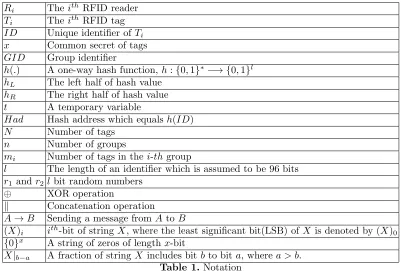
Ri Theith RFID reader
Ti Theith RFID tag
ID Unique identifier ofTi
x Common secret of tags
GID Group identifier
h(.) A one-way hash function, h:{0,1}∗−→ {0,1}l
hL The left half of hash value
hR The right half of hash value
t A temporary variable
Had Hash address which equalsh(ID)
N Number of tags
n Number of groups
mi Number of tags in thei-thgroup
l The length of an identifier which is assumed to be 96 bits
r1 andr2l bit random numbers
⊕ XOR operation
k Concatenation operation
A→B Sending a message fromAtoB
(X)i ith-bit of stringX, where the least significant bit(LSB) ofX is denoted by (X)0
{0}x A string of zeros of lengthx-bit
X|b−a A fraction of stringX includes bitb to bita, wherea > b.
Table 1.Notation
2
Protocols Description
2.1 SUAP1
1
Re quest, r
L
y, t, h
L 1
y, t, h , r
R
h 2
1 2
r
t
x
Had
h(ID)
y (r
r )
← ⊕
=
← − ⊕
Retrieves the ID from the records Computes
1 2
2
y
h(ID)
(r
r )
t
r
x
←
+ ⊕
← ⊕
Generates r2
Server
Reader
Tag
ID, x Had=h(ID), ID, x
Computes h(ID || r || r )1 2
1 2 h(ID || r || r )
If hLmatches, it authenticates the tag.
R
h If hRmatches, it authenticates
the reader.
Fig. 1.SUAP1 authentication protocol proposed by Morshedet al.[8].
1
Re quest, r
L
y, t, h
L 1
y, t, h , r
R
h 2
1 2
r
t
x
Had
h(ID)
y (r
r
GID)
← ⊕
=
← − ⊕ ⊕
Retrieves the ID from the records Computes
1 2
2
y
h(ID)
(r
r
GID)
t
r
x
←
+ ⊕ ⊕
← ⊕
Generates r2
Server
Reader
Tag
ID, x, GID Had=h(ID), ID, x, GID
Computes
1 2 h(ID || r || r || GID)
1 2 h(ID || r || r || GID)
If hLmatches, it authenticates the tag.
R
h If h
Rmatches, it authenticates the reader.
For all GIDs, looks up the address Had
1
Re quest, r
L
y, t, h
L 1
y, t, h , r
R
h 2
i 1 2
r t GID
Had h(ID) y (GID (r r ))
← ⊕
= ← ⊕ + ⊕
1 2
2
y h(ID) (GID (r r ))
t r GID
← ⊕ + ⊕
← ⊕ Generates r2
Server
Reader
Tag
ID, GID Had=h(ID), ID, GID
Computes
1 2 h(ID || r || r || GID)
1 2 h(ID || r || r || GID)
If hLmatches, it authenticates the tag.
R
h If h
Rmatches, it authenticates the reader.
For all GIDs, looks up the address Had. If Hadi=Had, it computes
Fig. 3.SUAP3 authentication protocol proposed by Morshedet al.[8].
database keeps the tag’s identifier ID, common secret numberxand hash address Had= h(ID) for each tag. SUAP1, which is depicted in Fig. 1, proceeds as below:
1. The reader generates a random numberr1 and sends it to the tag.
2. Once receipt the message, the tag generates another random number r2. Ifr1 or r2 equals 0, the protocol aborts. Otherwise, the tag does as follows:
– computesy=h(ID) + (r1⊕r2),t=r2⊕xandh(IDkr1kr2).
– sendsy,tand the left half of the computed hash value, i.e.hL, to the reader.
3. The reader then sendsy,t, hL andr1 to the back-end database. 4. On receipt the message, the back-end database does as follows:
– retrievesr2as t⊕x.
– retrieves Had, i.e.h(ID), as y−(r1⊕r2) whereHad is the address of the record containing theID.
– retrievesIDfrom the record.
– computesh(IDkr1kr2).
– compares the left half of the computed value ofh(IDkr1kr2) by the received value ofhL. If they
are the same, it authenticates the tag and sendshR to the reader wherehRis the right half of
h(IDkr1kr2).
5. The reader forwardshR to the tag.
6. Upon receiving the message, the tag compares the received hR with the computed value by itself.
In the case of equality, the tag authenticates the reader.
Morshed et al. have stated that SUAP1 is mainly suitable for an RFID system with small number
2.2 SUAP2
To overcome the problem of SUAP1, Morshed et al. have proposed SUAP2 which is suitable for large
number of tags. In this protocol they have assumed that the back-end data base divides tags to n
groups and the tag’s identifierID, secret number of a groupxand one extra variable which presents a group identifierGIDis stored in the tag side and the database side. The back-end database also keeps
Had=h(ID) as a address of the record containing the tag’sID. The steps of the SUAP2, as depicted in Fig. 2, are as follows:
1. The reader generates a random numberr1 and sends it to the tag.
2. Once receipt the message, the tag generates another random number r2. Ifr1 or r2 equals 0, the protocol aborts. Otherwise, the tag does as follows:
– computesy=h(ID) + (r1⊕r2⊕GID),t=r2⊕xandh(IDkr1kr2kGID).
– sendsy,tand the left half of the computed hash value, i.e.hL, to the reader.
3. The reader then sendsy,t, hL andr1 to the back-end database. 4. On receipt the message, the back-end database does as follows:
– retrievesr2as t⊕x.
– retrieves Had, i.e. h(ID), as y −(r1⊕r2 ⊕GID) where Had is the address of the record containingID.
– looks up the addressHad.
– retrievesIDfrom the record.
– computesh(IDkr1kr2kGID).
– compares the left half of the computed value ofh(IDkr1kr2kGID) by the received value ofhL.
If they are the same, it authenticates the tag and sendshRto the reader wherehR is the right
half ofh(IDkr1kr2kGID). 5. The reader forwardshR to the tag.
6. Upon receiving the message, the tag compares the received hR with the computed value by itself.
In the case of equality, the tag authenticates the reader.
2.3 SUAP3
For enhancing the SUAP2 efficiency, Morshedet al.have proposed SUAP3 in which the only difference
compared to SUAP2 is that SUAP3 does not use the secretx for the tag and the database. SUAP3, which is depicted in Fig. 3, proceeds as below:
1. The reader generates a random numberr1 and sends it to the tag.
2. Once receipt the message, the tag generates another random number r2. Ifr1 or r2 equals 0, the protocol aborts. Otherwise, the tag does as follows:
– computesy=h(ID)⊕(GID+ (r1⊕r2)),t=GID⊕r2 andh(IDkr1kr2kGID).
– sendsy,tand the left half of hash value, i.e. hL, to the reader.
3. The reader then sendsy,t,hL andr1to the back-end database. 4. On receipt the message, the back-end database does as follows:
– retrievesr2as t⊕GID.
– retrieves Hadi as y⊕(GID+ (r1⊕r2)), where Hadi = h(ID) is the address of the record
containing theID.
– looks up the addressHadi.
– retrievesIDfrom the record if Hadi=Hadfor any ID.
– computesh(IDkr1kr2kGID).
– compares the left half of the computed value ofh(IDkr1kr2kGID) by the received value ofhL.
If they are the same, it authenticates the tag and sendshR to the reader, wherehR is the right
half ofh(IDkr1kr2kGID). 5. The reader forwardshR to the tag.
6. Upon receiving the message, the tag compares the received hR with the computed value by itself.
Morshedet al. have claimed that the using of two random numbers in their protocols make the
trans-ferred messages unpredictable so that it is impossible to perform tracing attack by a malicious reader. However, in this section we present an efficient traceability attack against all versions of SUAP. The proposed attack is based on the following observations:
1. Assume thatA=al−1k. . .ka1ka0, r=rl−1k. . .kr1kr0 andr′ =r′l−1k. . .kr′1kr0′ are strings each of
l-bit where (e.g.)ri denotes the ith bit ofr. ForY =A+randZ=A+r′, ifri=r′i for 0≤j≤i
thenYi=Zi for 0≤j≤i and vice versa.
Hence, e.g. in SUAP1 where t =r2⊕x, if ti =t′i for 0 ≤j ≤i, where t′ =r′2⊕x, then we can conclude thatr2i=r′2i for 0≤j≤iand vice versa.
Given the above observation, to trace the target tagTiin SUAP1, SUAP2 or SUAP3, the adversary
Adoes as follows:
Phase 1(Learning) : the adversaryAcreates a tableT abincludes N rows, choosesr1= 1k{0}l−1, where {0}l−1 denotes a string of zeros of length (l−1)-bit, and supplantsN sessions with T
i as
follows, for 1≤j≤N: 1. Asendsr1 to the tag.
2. Once receipt the message, the tag generates a random numberrj2and ifrj26= 0 it does as follows:
– computesyj,tj andhj,
– sends yj,tj and the left half of the computed hash value, i.e. hj
L, to the reader which is
supplanted byA.
3. Astoresyj andtj in thejth row ofT ab.
Phase 2 (Execution) : Given T′
i the adversary A creates a table T ab′ includes N rows, chooses
r1 = 1k{0}l−1, where {0}l−1 denotes a string of zeros of length (l−1)-bit, and supplants N′ sessions withTi as follows, for 1≤f ≤N′:
1. Asendsr1 to the tag.
2. Once receipt the message, the tag generates a random number rf2 and if rf2 6= 0 it does as follows:
– computesyf, tf andhf,
– sends yf,tf and the left half of the computed hash value, i.e. hf
L, to the reader which is
supplanted byA.
3. Astoresyf andtf in thefth row ofT ab′.
Phase 3 (Decision):To decide whetherT′
i is the target tag Ti, if∃(((yj, tj) ∈T ab) ∧((yf, tf)∈
T ab′))
(tj|0−k=tf|0−k)∧(yj|0−k6=yf|0−k) then Ti 6= Ti′, , for 0 ≤ j ≤ N and 0 ≤ f ≤ N′ ;
otherwise,Ti=Ti′.
The total complexity of the given attack isNsessions in the learning phase of attack plusN′sessions
in the execution phase of attack. The adversary’s advantageAdvA to make the correct decision in the
third phase of attack can be determined as follows:
AdvA=
P r[A
Ti=Ti′ ⇒1]−P r[ATi6=Ti′ ⇒1]
To determineAdvA one can state that:
1. For any entry tj in T ab′, for 1 ≤ j ≤ N′, we denote the number of entries in T ab such that
(tj|
0−(k−1)=tf|0−(k−1))∧(tjk6=t f k) byM
j
k, for 1≤k≤l.
2. The expected value ofMkj is N
3. Following the given observation, if tj|
0−(k−1) = tf|0−(k−1) then the adversary can conclude that (rj2)|0−(k−1) = (r2f)|0−(k−1) and it expects to receive yj|0−(k−1) = yf|0−(k−1). This condition is
satisfied forTi=Ti′ with the probability of “1” and forTi6=Ti′ with the probability of “2−k”.
4. Hence, the probability of the wrong alarmP rwrong is determined as follows:
P rwrong≤ l
Y
k=1
(2−k)Mkj !N′
=
l
Y
k=1
(2−k)2kN+1
!N′
5. The adversary’s advantage to trace the target tag successfully is as follows:
AdvA=
P r[A
Ti=Ti′ ⇒1]−P r[ATi6=Ti′ ⇒1] ≥1−
l
Y
k=1
(2−k)2kN+1
!N′
Following the given procedure the adversary’s advantage to distinguish the given tag from the target tag is non-negligible. As an example, forN = 16 (which can be considered as the off-line phase of the attack) and N′ = 1 (which can be considered as the on-line phase of the attack) and doing some
numerical calculation we haveAdvA≥1−2−14. Hence, even for the on-line complexity of only one run
of the protocol, the success probability of the given attack is almost “1”. For N =N′ = 16 we have
AdvA ≥ 1−(2−14)16 = 1−2−224 which is almost “1”. An interesting point of this attack is that it
works for SUAP1, SUAP2 and SUAP3 and even the adversary does not require to know which protocol the target tag uses.
4
Conclusions
In this paper we have shown that recently proposed RFID authentication protocols by Morshed et al.fails to provide adequate security against traceability attacks. In this paper we presented an attack
which can trace the tag whenever it uses either of the suggested protocols by Morshedet al., i.e. SUAP1,
SUAP2 and SUAP3.
References
1. Y.-Y. Chen, M.-L. Tsai, and J.-K. Jan. The design of rfid access control protocol using the strategy of indefinite-index and challenge -response. computer communication, 34(3):250–256, 2011.
2. H.-Y. Chien. SASI: A New Ultralightweight RFID Authentication Protocol Providing Strong Authentication and Strong Integrity. IEEE Transactions on Dependable and Secure Computing, 4(4):337–340, December 2007.
3. J.-S. Cho, S.-S. Yeo, and S. K. Kim. Securing against brute-force attack: A hash-based rfid mutual authen-tication protocol using a secret value. Computer Communications, 34(3):391–397, 2011.
4. D. N. Duc and K. Kim. Defending rfid authentication protocols against dos attacks. Computer Communi-cations, 34(3):384–390, 2011.
5. EY Choi and SM Lee and DH Lee. Efficient RFID authentication protocol for ubiquitous computing environment. InEmbed. Ubiquit. Comput., volume 3832, pages 945–954, 2005.
6. H.Y.Chien. Secure access control schemes for rfid systems with anonymity. In Proceedings of the 7th International Conference on Mobile Data Management (MDM 2006), page 96, 20O6.
7. Y. Luo, Q. Chai, G. Gong, and X. Lai. A lightweight stream cipher WG-7 for RFID encryption and authentication. InGLOBECOM, pages 1–6. IEEE, 2010.
Mutual Authentication Protocol for Low cost RFID tags. InRFIDSec, 2006.
10. P. Peris-Lopez, J. C. H. Castro, J. M. Est´evez-Tapiador, and A. Ribagorda. Advances in Ultralightweight Cryptography for Low-Cost RFID Tags: Gossamer Protocol. InWISA, pages 56–68, 2008.
11. P. Peris-Lopez, J. C. Hernandez-Castro, J. M. Estevez-Tapiador, and A. Ribagorda. EMAP: An Efficient Mutual Authentication Protocol for Low-Cost RFID Tags. InOTM Federated Conferences and Workshop: IS Workshop – IS’06, volume 4277 of Lecture Notes in Computer Science, pages 352–361, Montpellier, France, November 2006. Springer-Verlag.
12. M. Safkhani, N. Bagheri, and M. Naderi. Vulnerabilities in a new RFID access control protocol. In6th International Conference on Internet Technology and Secured Transactions (ICITST 2011), Abu Dhabi, UAE, Dec. 2011.
13. M. Safkhani, N. Bagheri, M. Naderi, Y. Luo, and Q. Chai. Tag Impersonation Attack on Two RFID Mutual Authentication Protocols. InFARES, 2011.
14. M. Safkhani, N. Bagheri, M. Naderi, and S. Sandhya. Security analysis of LMAP++, an RFID authentica-tion protocol. In6th International Conference on Internet Technology and Secured Transactions (ICITST 2011), Abu Dhabi, UAE, Dec. 2011.
15. M. Safkhani, N. Bagheri, S. Sandhya, and M. Naderi. On the security of mutual authentication protocols for rfid systems : the case of weiet al.’s protocol. InDPM 2011, LNC, volume 7122 ofLNCS, 2011. 16. SM Lee and YJ Hwang and DH Lee and JI Lim. DEfficient authentication for low-cost RFID systems. In
in ICCSA05, LNCS, volume 3480, pages 619–629, (Springer-Verlag, 2005.
17. S.Weis, S.Sarma, R.Rivest, and D. Engels. Security and privacy aspects of low-cost radio frequency iden-tification systems. In1st International Conference on Wierless Communications, Networking and mobile computing 2007(WiCom 2007), pages 2078–2080, 2007.
![Fig. 1. SUAP1 authentication protocol proposed by Morshed et al. [8].](https://thumb-us.123doks.com/thumbv2/123dok_us/7889382.1309161/3.595.28.565.411.647/fig-suap-authentication-protocol-proposed-morshed-et-al.webp)
![Fig. 3. SUAP3 authentication protocol proposed by Morshed et al. [8].](https://thumb-us.123doks.com/thumbv2/123dok_us/7889382.1309161/4.595.27.569.100.339/fig-suap-authentication-protocol-proposed-morshed-et-al.webp)
