' - - - _ ..
_
.._--....,.
PRELI~JiINARV
SUL:-<' IV]EMORV STUDY REPORT
;
- - - - -
.~'"~-'" . .".---.--.. , •..--
....-COMPUTER SCIENCES CORPORATION
At Los Angeles International Airport
,650 North Sepulveda Boulevard
EI segundo, California 90245
PRELIMINARY· BULK MEMORY STUDY REPQRT
c
-1-INTRODUCTION
In order to satisfy customer requirements for both rapid response and
thorough analysis, the Bulk Memory Study was separated into two phases, each
of which is to culminate in the submission to IBM of a study report containing the
results of CSC's investigation: first, a brief, preliminary analysis of the benefits
to be derived from the availability of a high-speed, bulk memory device (to be
sub-mitted on March 25, 1964); and, second, a more detailed analysis of specific topics,
. which could be dealt with only in general terms in the preliminary report (to be
delivered on April 8,1964).
This document contains the results of the first phase of that study: a report
on CSC's preliminary investigation into the use of a large, bulk memory on a
high-speed, digital computer, and consists of a brief analysis of four topics:
1. The ways bulk memory could be used in conjunction with an on-line
satellite Input/Output computer;
2. How the CSC-proposed programming system would benefit from the
availability of bulk memory;
3. The type of applications bulk memory would benefit; and
4. Computer operating recommendations.
For the follow-on study, specific applications will be investigated; these
appli-cations will be selected from among those covered in this initial report. For each
application studied there will be: a short description of the problem; a description
of the techniques now used for solution; a discussion of the use of bulk memory; and
a comparative timing study. For the timing study, representative cases will be
chosen, and a reasonably detailed study will be made on the differences between bulk
memory and drum. Basic assumptions and timing cases will be chosen which will
result in the maximum completeness and accuracy achievable within the time-limits
c
-2-RESTRICTIONS
The following restrictions were employed to reduce the problem to a
solvable size.
1. . Costs or relative costs were not considered.
2. Bulk memory and drum were considered to contain the same number
of words.
3. The computer would have either bulk ·memory or drum, not both.
4. Bulk memory would be ~sed for semi-permanent storage.
APPLICA TIONS ANALYSIS
In general, the availability of bulk memory .will tend to show an improvement
in the processing of those types of problems that oper~te on large volumes of data.
(>
Since data~transfer rates from the various Input/Output devices are gene.rally fairly high, the limiting time factor in obtaining data from the Input/Output or auxiliarymemory device .is the time required to gain access to any single piece of data.
Obvi-ously, data-access times would be shorter for bulk memory than for drum or disk
storage.
On the other hand, if the problem is of the type that operates upon data already
stored in the proper sequence,and the calculations are lengthy, the process can be
"compute-bound"; effective buffering could allow it to be run just as efficiently using
drum, disk or tape as it could be run using bulk memory. (Of course, it is easier to
obtain optimum buffering in theory than it is in fact.) :
The general areas of linear programming and dynamic programming, and the
solution of partial differential equations and linear systems (simulated equations and
Eigenvalue problems) are the areas most vulnerable to improvement as a result of
using bulk memory. All these p:t;'oblems require the manipulation of large matl'iccsj
C
if sufficient primary storage is' not available, these matrices must be partition?d andI' 1IIIr, ,... ':1 ', .. '''' ~.'!r',,~\n"'~~~"f':n
c
£~
saved on tape, drums, or disk. This not only requires additional Input/Output time;
it also requires considerably greater programming effort to carry out the necessary
computations on the partitioned matrices. Hydrodynamics or neutron diffusion
problems, for example, magnify such difficulties, since solutions of these problems
are frequently performed in more than one dimension.
Several general conclusions can be drawn concerning the usefulness of bulk
memory, in solving specific types of problems; these will be followed by a list of
specific applications which definitely would benefit from the availability of bulk
memory:
1. Bulk memory will always mean faster solutions for.problems that
operate on a large file, and require:
. a. Many random accesses to the file for small increments of
data; or
b.
Which use a file that is already correctly sequenced forprocessing, but which require so little calculation ·that processing is "Input/Output bound".
2. Bulk memory will improve the speed of those programs which require
re-sequencing of a file for continued processing.
3. Bulk memory should be considered where the ability to achieve optimum
buffering is marginal.
4. Bulk memory will not give a significant improvement for problems
using large files, where the files are initially in correct sequence, and
the calculation is so lengthy that the problem becomes "compute-bound".
The following general types of applications will benefit from bulk memory. These
followed by an asterisk (*) will be covered in more detail in the follow-on report.
1. Linear Programming*
2. Matrix Arithmetic*
3. Sorting*
c
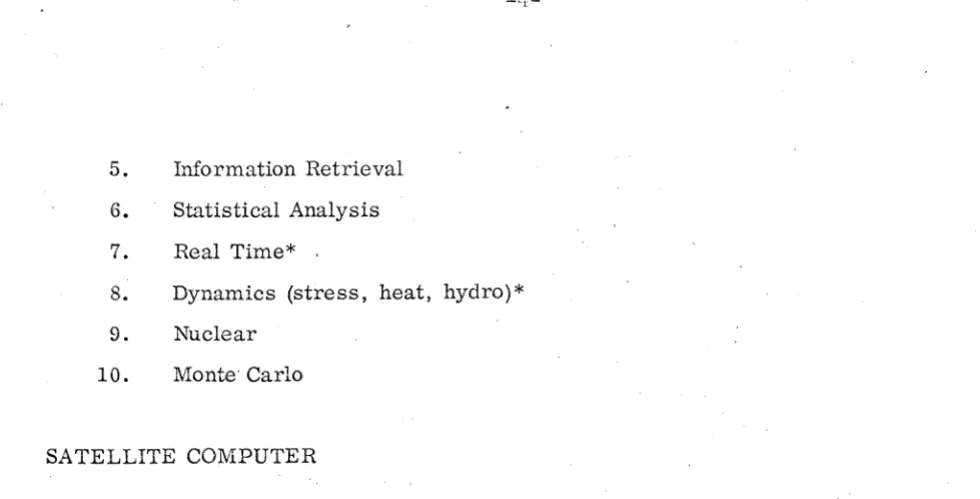
-4-5. Information Retrieval
6. Statistical Analysis
7. Real Time*
8. Dynamics (stress, heat, hydro)*
9. Nuclear
10. Monte' Carlo
SATELLITE COMPUTER
The use of bulk memory as the working storage of a satellite Input/Output device
or computer offers many advantages. This section discusses a possible configuration,
techniques of use; and possible areas of application.
Figure 1 is a block diagram of a proposed bulk memory-oriented satellite system.
The satellite device works directly into the bulk memory, and has access to all channels
and Input/Output devices .. Input/Output facilities can be removed from the main Central
Processing Unit, and Input/Output operations, including trap processing, made a
func-tion of the satellite. A Simplified channel-adapter could be associated with card
equip-ment, printers, and inquiry station devices (assuming that separate paths between each
device and the bulk memory multiplexer can be established); the satellite device could
therefore be responsible for most Input/Output processes, including buffering,
conver-sion, translation', blocking, deblocking, and most of the necessary editing. The main
Central Processing UnIt thus would be free to operate as a full-time problem solver,
with only bulk memory, or other appropriate Input/Output devices, as its responsibility.
The proposed system has definite advantages for use in multi-programming:
1. The satellite system can handle all remote inquiries for inform~tion
stored on disk.
2. It can also retain information necessary for later processing, and
[image:6.613.44.534.23.272.2].
'c
, ; ) ,
-3. For use in remote-console solution of engineering problems, the
satellite system can receive the problem input; assemble the data
with the program; stack the problems; and at a convenient time,
transmit them to the main computer for solution. The satellite can
then perform the task of following-through with the return of the
output to the proper remote console.
4. For use with low-speed character equipment, assembly-disassembly
can be avoided by receiving or transmitting one character per word,
leaving formatting to the satellite system.
A real-time problem, using a satellite system similar to th,e one described
..
(
:(
. \ Drum
" - - - '
Satellite
Multiplexer
Bulk Core
Channel
I
AdaP.ters and Cont.Units
-G-,J
Main CPU
Multiplexer
High Speed Core
Card I/O
!
I
I
L ' _ _ _ _ _ _ _ _ ~I
Printer
I
L-c;;J
FIGURE 1
[image:8.618.16.606.29.754.2](:
--7-PROGRAMMING SYSTEMS
The primary advantage that bulk memory offers over drum storage, for
use by programming systems, lies in its ability to buffer in blocks of data smaller
than 960 words. There are'many functions in the proposed 7095 Executive System,
Loader, Assembler and Compiler that require files much shorter than the drumsT
. 960 word buffer. Some of these files, and their estimated sizes are:
1. Unit assignment directory (100-200 words); VIO) fCt
1+
d(; \"1Jln...
2. Accounting information (5-20 words); 1
3. Control dictionary (25-200 words); and
4. Library calls (20-300 words).
The follow-on report will contain a more thorough analysis of the value of
bulk memory to programming systems.
MACHINE RECOMMENDA 'nONS
The following are a list of recommendations for hardware configuration, and
for instructions for the use of bulk memory:
1. The bulk memory should be capable of being used both as an
Input/Out-put device, and as a word-addressed storage device.
2. Channel transmission for bulk memory should not interfere with
Input/Output channel operations; they should, of course, be
bi-dtrectional; and, in order to obtain maximum advantage when used
for matrix operations, the Channel or Block Transfer operations
should allow incrementing of the access or storage locations by a
value other than one--thus permitting transmission of an entire
column (from a matrix stored row-wise) by means of a single.
c .... ··
/3. Indirect addressing is recommended as the means of r·eferencing
bulk memory directly, since it will provide uniform and unrestricted
utilization. (Reference through index registers, though more flexible,
would require larger index registers and, consequently,. modification
of many 7095 instructions.)
4. A flexible memory-lockout facility should be provided for the bulk