Dynamic Searchable Encryption in Very-Large Databases: Data
Structures and Implementation
David Cash
1, Joseph Jaeger
1, Stanislaw Jarecki
2, Charanjit Jutla
3, Hugo Krawczyk
3,
Marcel-C˘
at˘
alin Ro¸su
3, and Michael Steiner
31Rutgers University 2University of California Irvine
3IBM Research
October 17, 2014
Abstract
We design and implement dynamic symmetric searchable encryption schemes that efficiently and privately search server-held encrypted databases with tens of billions of record-keyword pairs. Our basic theoretical construction supports single-keyword searches and offers asymptotically optimal server index size, fully parallel searching, and minimal leakage. Our implementation effort brought to the fore several factors ignored by earlier coarse-grained theoretical performance analyses, including low-level space utilization, I/O parallelism and goodput. We accordingly introduce several optimizations to our theoretically optimal construction that model the prototype’s characteristics designed to overcome these factors. All of our schemes and optimizations are proven secure and the information leaked to the untrusted server is precisely quantified. We evaluate the performance of our prototype using two very large datasets: a synthesized census database with 100 million records and hundreds of keywords per record and a multi-million webpage collection that includes Wikipedia as a subset. Moreover, we report on an implementation that uses the dynamic SSE schemes developed here as the basis for supporting recent SSE advances, including complex search queries (e.g., Boolean queries) and richer operational settings (e.g., query delegation), in the above terabyte-scale databases.
1
Introduction
pseudorandom position, and the only known way to avoid this while maintaining privacyinvolves padding the server index to a prohibitively large size.
Contributions. We give the first SSE implementation that can encrypt and search on datasets with tens of billions of record/keyword pairs. To design our scheme, we start with a new, simple, theoretical SSE construction that uses a generic dictionary structure to already achieve an asymptotic improvement over prior SSE schemes, giving optimal leakage, server size, search computation, and parallelism in search. This starting point can be seen as a generalization and simplification of the more ad-hoc techniques of [4]. We show how to make the schemedynamic, meaning that the data can be changed after encryption: Our scheme can easily support additions to the data, as well as deletions via revocation lists.
Because the scheme uses a generic dictionary that itself has no security properties, it allows for several extensions and modifications with only small changes to the security proofs. In particular, our implemen-tation effort showed that disk I/O utilization remained a bottleneck which prevented scaling; so we extend our basic construction to improve locality and throughput. These extensions preserve privacy with slightly different leakages that we analyze with formal security proofs. Below we describe the techniques behind results in more detail, starting with the new theoretical scheme that we extend later, and then compare our results to prior work.
Basic construction. Our scheme is very simple (see Figure5): It associates with each record/keyword pair a pseudorandom label, and then for each pair stores the encrypted record identifier with that label in a generic dictionary data structure. We derive the labels so that the client, on input a keyword to query, can compute a keyword-specific short key allowing the server to search by first recomputing the labels, then retrieving the encrypted identifiers from the dictionary, and finally decrypting the matching encrypted record identifiers. The only information leaked to the server by the encrypted index (other than the indexes of records matching a query) is the number of items in the dictionary, i.e. the number of record/keyword pairs in the data. This scheme is easy to implement correctly (and with parallel searching) because we make no security demands on the dictionary thus allowing instantiations as applications demand.
Extensions for external storage. To compute the results of a keyword search withr matches, our basic scheme requires r retrievals from the dictionary for pseudorandom labels. Assuming O(1) cost of a dictionary retrieval, this is asymptotically optimal. However, in implementations this may still be slow when the dictionary is stored in external memory (i.e., a block device like a HDD), because each random-looking retrieval will generate a disk read. This is in contrast to a plaintext system which could store all of the matches in a single contiguous area of memory.
In view of this reality we extend our scheme to use external storage more carefully while maintaining privacy. We first show how to securely “pack” related results together via a padding strategy to reduce the number of dictionary retrievals.
We found that even this modification was too slow for the datasets we targeted, and in particular we noticed that real data-sets exhibit extreme variability in the number of matches for a keyword: There were typically many keywords matching very few documents, then some keywords matching a significant fraction of the entire database. Our padding strategy becomes unsatisfactory because the (many) keywords matching only a few results create a lot of padding, and the searches that return a large number of results still trigger a large number of dictionary retrievals.
To address this we introduce further modifications that replace dictionary reads with array reads when processing large numbers of results. These modifications result in a slightly different, but intuitively accept-able (and perhaps even better) leakage profile that we discuss below.
Scheme Security Ind Leak Dyn.? Dyn Leak Index Size Search Time/Comm Dyn. Comm
CGKO’06-1 [8] NonAd m, N No — O(N+m) O(r), O(1) —
CGKO’06-2 [8] Ad M n No — O(M n) O(r), O(r) —
CK’10 [6] Ad m, n, M No — O(M n) O(r), O(r) —
LSDHJ’10 [22] Ad m, n Yes no proof O(mn) O(m), O(1) O(|Wid|)
KO’12 [18] Ad(UC) n, M No — O(M n) O(r), O(1) —
KPR’12 [16] Adro m, N Yes EP(W
id) O(N+m) O(r), O(1) O(|Wid|)
KP’13 [15] Adro m, n Yes minimal O(mn) O((rlogn)/p), O(1) O(|Wid|+mlogn)
Basic (Πbashere) NonAd,Adro N No — O(N) O(r/p), O(1) —
Basic Adp (Πro
bashere) Ad N No — O(N) O(r/p), O(r) —
Basic Dyn (Πdynbas,Πdynbas,rohere) NonAd,Adro N Yes minimal O(N) O((r+d
w)/p), O(1) O(|Wid|+mlogn)
Figure 1: Comparison of some SSE schemes. Many leakages can be replaced by upper bounds and some search times assume interaction when the original paper was non-interactive. Legend: In security, “Ad” means adaptive security, Adro means adaptive security in the random oracle model, and NonAd means non-adaptive security. Ind Leakage is leakage from encrypted database only. Search comm. is the size of the message sent from client (O(r) from the server is inherent.) ro means random oracle model, n = # documents, N = Pw|DB(w)|, m = |W|, M = maxw|DB(w)|, r = |DB(w)| for the query w, p = # processors, |Wid| = # keyword changes in an update,
EP(Wid) = structural equality pattern of changed keywords (see discussion at the end of Section4),dw= the number
of times the searched-for keyword has been added/deleted.
Other applications. Recent constructions of SSE supporting more complex queries [4] and multi-client settings [14] use SSE as a black-box. Thus our data structures and associated operations (including support for dynamic databases) are readily available to support terabyte-scale databases in these much richer/complex encrypted-search settings (see end of Section2).
Implementation. Our implementation remains efficient on two orders of magnitude larger datasets than the most scalable previous work [4], resulting in the first implementation of SSE on terabyte-scale databases containing tens of billions of indexed record/keyword pairs. We report on our prototype design and experi-mental results in Section5.
Comparison to prior work. In Figure1we compare our basic theoretical scheme to prior work. The basic scheme Πbasgeneralizes and greatly simplifies an approach implicit in [4], which complicated the analysis by demanding security properties of the underlying data structures.
For a database with N record/keyword pairs, our basic scheme Πbas produces an encrypted index of optimal sizeO(N), leaks only the sizeN and the matching record id’s, and processes a search withrresults in optimal O(r) time, assuming O(1)-cost for dictionary retrievals. Searching is trivial to parallelize with any number of processors.
Most prior schemes leak additional information, like the number of unique keywords, the size of the largest number of matches for a keyword, and so on. Some of these works also pad their encrypted indexes to be (worst-case) quadratic in their input size, which is totally impractical for large datasets. A notable issue with most prior work was a difficulty with parallelism: Other than [4], parallel searching was only achieved by two works that needed quadratic padding. Works like [8] required walking through an encrypted linked list and were not parallelizable at all. See the “Ind Leak”, “Index Size”, and “Search Time” columns in Figure1.
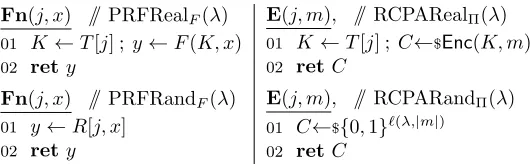
Fn(j, x) // PRFRealF(λ) 01 K←T[j] ; y←F(K, x) 02 rety
Fn(j, x) // PRFRandF(λ) 01 y←R[j, x]
02 rety
E(j, m), // RCPARealΠ(λ) 01 K←T[j] ; C←$Enc(K, m) 02 retC
E(j, m), // RCPARandΠ(λ) 01 C←${0,1}ℓ(λ,|m|)
02 retC
Figure 2: Oracles for games PRFRealF,PRFRandF,RCPARealΠ,and RCPARandΠ.
More on related work. The notion of SSE we consider has its origins in work by Song, Wagner, and Perrig [20]. Several schemes since have improved upon the security and efficiency offered by the original schemes. The most similar to our construction is that of Chase and Kamara [6], and Cash et al [4]. Chase and Kamara also uses a dictionary, but in a different way and with an impractical level of padding for large datasets. Cash et al implements a scheme similar to our basic construction, but do not address updates nor, as we show in Section5.5, does their approach achieve the same level of practical scalability.
There is also a related line of work on searchable public-key encryption starting with [3], all of which do not scale due to linear-time searching. The version of SSE we deal with inherently leaks the identifiers of documents that match a query, as well as when a query is repeated. It is possible to hide even this information using private information retrieval [7] or oblivious RAM [11]. Several recent improvements to oblivious RAM move it further towards practicality [12,21], but it is far from clear that they are competitive with SSE schemes at scale as one must implement the plaintext searching as an abstract RAM program and then run this program underneath the ORAM scheme without leaking information, say, via timing.
Organization. Preliminary definitions are given in Section2. Our non-dynamic (i.e., static) SSE construc-tions are given in Section 3, and the dynamic extensions are given in Section 4. Finally we report on our implementation in Section5.
2
Definitions and Tools
The security parameter is denoted λ. We will use the standard notions of variable-input-length PRFs and symmetric encryption schemes (c.f. [17]). For these primitives we make the simplifying assumption that their keys are always in{0,1}λ, and that key generation for the encryption scheme picks a random key. By efficient we mean probabilistic poly-time inλ. We write negl(λ) for a negligible function inλ. Some of our constructions will be analyzed in the random oracle model [1], with the random oracle denotedH.
Games. We formalize some of our security notions using code-based games [2]. A game Gis defined by a collection of oracle procedures. A game is executed with an adversary (i.e., a randomized polynomial time algorithm) A. Running a game with adversary A means running A with access to the prescribed set of oracles, possibly with some restrictions on its access (for instance, if there is anInitoracle, we will always restrict the adversary to querying it once and before any other query). WhenAhalts andGruns theFinal
procedure with the output A, and the output of the game is the output of Final, denote as GA. When
Finalis omitted, we mean that it forwards its input as output (i.e., the adversary’s output is the output of the game). WhenGis a game we use the shorthandP r[G] for the probability thatGoutputs 1.
In defining games we adopt the following notation: Boolean flags are initialized false. When T is a dictionary,T[j] denotes the data item associated withj, if there is one. When we writex←T[j] we mean that xis assigned the valueT[j] if it exists, and otherwise a uniformly random value from the appropriate range is selected, stored atT[j], and assigned tox.
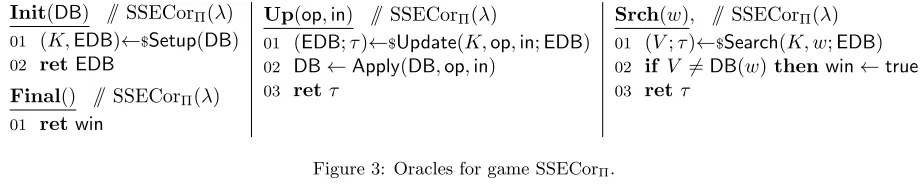
Init(DB) // SSECorΠ(λ) 01 (K,EDB)←$Setup(DB) 02 retEDB
Final() // SSECorΠ(λ) 01 retwin
Up(op,in) // SSECorΠ(λ)
01 (EDB;τ)←$Update(K,op,in;EDB) 02 DB←Apply(DB,op,in)
03 retτ
Srch(w), // SSECorΠ(λ) 01 (V;τ)←$Search(K, w;EDB) 02 if V 6=DB(w)thenwin←true 03 retτ
Figure 3: Oracles for game SSECorΠ.
PRFReal,PRFRand from Figure2. We only consider algorithmsF that on inputK ∈ {0,1}λ,x∈ {0,1}∗,
output a string in{0,1}λ. In the games the adversary chooses an index j and an input x∈ {0,1}∗ when
queryingFn. In PRFReal the key stored atT[j] is used to produce the output (being selected at random if necessary, as per our convention). In PRFRand responses are returned from entries in a dictionary, each ini-tialized to a random value as it is used. Restricting this game to only allow queries withj= 1 collapses this to the usual definition, and our version is clearly asymptotically equivalent by a standard hybrid argument.
Definition 1 An algorithm F is a variable-input-length pseudorandom function if for all efficient A, the function
AdvprfF,A(λ) = Pr[PRFRealAF(λ) = 1]−Pr[PRFRandAF(λ) = 1] is negligible.
An encryption scheme Π (symmetric key) is a pair of efficient algorithms (Enc,Dec) such that for all K ∈ {0,1}λ and m ∈ {0,1}∗, Dec(K,Enc(K, m)) = m with probability 1. We assume that Π is ℓ-length regular, meaning there exists a function ℓ such that |Enc(K, m)|=ℓ(λ,|m|) for allλ, m, where| · |denotes string length.
We will assume access to an encryption scheme that haspseudorandom ciphertexts under chosen-plaintext attack, which we callRCPA security. As with PRFs, we formalize this in a multi-key variant that simplifies our reductions. This is defined using games RCPARealΠ(λ) and RCPARandΠ(λ). In the first game, the adversary can query its E oracle with an index j and message m ∈ {0,1}∗, and the game generates a
ciphertext using a key from T[j] (generated at random as necessary) and messagem. In the second game, a fresh random string of the appropriate lengthℓ(λ, m) is always returned, where Π isℓ-regular.
Definition 2 An encryption scheme Π = (Enc,Dec)has pseudorandom ciphertexts under chosen-plaintext attackif for all efficientA, the function
AdvindΠ,A−rcpa(λ) = Pr[RCPAReal A
Π(λ) = 1]−Pr[RCPARandAΠ(λ) = 1] is negligible.
Our constructions can be proved secure assuming a type of key anonymity property, but RCPA is simpler and is anyway achieved by many efficient constructions like counter-mode.
SSE schemes. We follow the formalization of Curtmola et al. [8] with some modifications discussed below. Below when an algorithm takes a set as input, we assume that it is represented by writing its elements in lexicographic order. A database DB = (idi,Wi)d
i=1 is a d-tuple of identifier/keyword-set pairs where idi ∈ {0,1}λ andWi⊆ {0,1}∗. When the DBunder consideration is clear, we will writeW=Sd
i=1Wi. For a keywordw∈W, we writeDB(w) for{idi :w∈Wi}. We will always usem=|W|andN =P
w∈W|DB(w)| to mean the number of keywords and the total number of keyword/document matches inDB.
Setuptakes as input a databaseDB, and outputs a secret keyK along with an encrypted databaseEDB. In the search protocol the client takes as input the secret key K and a query w ∈ {0,1}∗ and the server
takes as input EDBand the server outputs a set of identifiers and the client has no output. In the Update protocol the client takes as input a keyK, an operationop∈ {add,del,edit+,edit−}, a file identifierid, and a setWid of keywords. These inputs represent the actions of adding a new file with identifier idcontaining keywordsWid, deleting the file with identifierid, or add/removing the keywords inWid from an existing file. At the end of theUpdate, the server outputs an updated encrypted database, and the client has no output.
We will write
(V;τ)←$Search(K, w;EDB)
to mean thatV andτ are sampled by running the search protocol with client inputK, w and server input EDBand lettingV be the server output andτ be the messages sent by the client. (We omit the messages sent by the server from τ since they can be calculated from τ and EDBwhen the server is deterministic.) Similarly we write
(EDB′;τ)←$Update(K,op,in;EDB)
to mean executing the update protocol with client inputsK,op,inand server input EDB, and then letting EDB′ be the server output andτ be the messages from the client.
We say that an SSE scheme is correct if the search protocol returns the (current) correct results for the keyword being searched (i.e., DB(w)), except with negligible probability. We formalize this with game SSECor(λ) in Figure3, where the adversary is additionally restricted to never add a duplicate identifier, add redundant keyword to an existing identifier, delete with currently nonexistent identifier, or delete a keyword from an identifier that does not match it. In this game we use the function Apply, which takes as input a DB, an operationop of one of the allowed values, and inputs in for that operation. It outputs an updated version ofDBwith the operation applied to it.
Definition 3 An SSE scheme Π is correctif for all efficient A AdvsseΠ,A−cor(λ) = Pr[SSECor
A
Π(λ) = 1] is a negligible function.
Discussion. For simplicity our formalization of SSE does not model the storage of the actual document payloads. The SSE literature varies on its treatment of this issue, but in all cases one can augment the schemes to store the documents with no additional leakage beyond the number and length of the payloads. Compared to others we model also modifications of documents (edit+,edit−) in addition to add and delete of complete documents (add,del) as this can lead to more efficient protocols with reduced leakage.
The correctness definition for SSE requires the server to learn the ids of the results. One could define correctness to require the client to learn the ids instead. The two approaches are essentially equivalent assuming that encrypted documents are of fixed length.
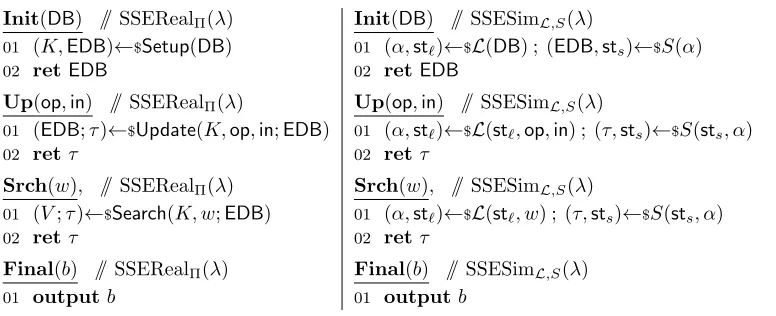
Security. Security [6,8,16] follows the real/ideal simulation paradigm and is parametrized by aleakage function L that describes what a secure protocol is allowed to leak. Formally, L is an algorithm used in the simulation game below. The definition uses two games, SSERealΠ(λ) and SSESimL,S(λ). In the first game, the adversary chooses a DB input and recievesEDB, and then can adaptively query Up and Srch, which return transcripts from theUpdate andSearchprotocols respectively (recall that here a “transcript” means client messages only as the server message are efficiently computable from them andEDB). TheFinal
oracle halts the computation and returns the bitbchosen by the adversary. In this game we place the same correctness restrictions on the adversary to prevent it from issuing invalid dynamic operations.
Definition 4 A dynamic SSE scheme Π is L-secure against adaptive attacks if for all efficient A there exists an efficientS such that
AdvsseΠ,A,S−adap(λ) = Pr[SSEReal A
Π(λ) = 1]−Pr[SSESimAL,S(λ) = 1]
Init(DB) // SSERealΠ(λ) 01 (K,EDB)←$Setup(DB) 02 retEDB
Up(op,in) // SSERealΠ(λ)
01 (EDB;τ)←$Update(K,op,in;EDB) 02 retτ
Srch(w), // SSERealΠ(λ) 01 (V;τ)←$Search(K, w;EDB) 02 retτ
Final(b) // SSERealΠ(λ) 01 outputb
Init(DB) // SSESimL,S(λ)
01 (α,stℓ)←$L(DB) ; (EDB,sts)←$S(α) 02 retEDB
Up(op,in) // SSESimL,S(λ)
01 (α,stℓ)←$L(stℓ,op,in) ; (τ,sts)←$S(sts, α) 02 retτ
Srch(w), // SSESimL,S(λ)
01 (α,stℓ)←$L(stℓ, w) ; (τ,sts)←$S(sts, α) 02 retτ
Final(b) // SSESimL,S(λ) 01 outputb
Figure 4: Oracles for games SSERealΠ(λ),SSESimL,S(λ).
We defineL-security against non-adaptive attacksin the same way, except that in both gamesAmust choose all of its queries at the start,L takes them all as input, and S uses the output of L to generate EDBand the transcripts at the same time. Formally, in the game SSENARealΠ, A gets to make a single query to
Init consisting of aDB and a list of q queries, where each query is of the form (op,in) or (srch, w), with the latter representing search queries. The game sets (K,EDB)←Setup(DB). Then it processes each query, computingτi by running eitherUpdateorSearch and then overwritingEDBif the query was forUpdate. It returns (EDB,(τ1, . . . , τQ)) toA, which can query a bit toFinalthat becomes out the output of the game. In the corresponding simulation game SSENASimL,S(λ), A issues the same single query to Initwhich is answered by computingα←$L(DB,q) and returning the output ofS(α). The adversary queries itsFinal oracle once as before.
Definition 5 A dynamic SSE schemeΠ is L-secure against nonadaptive attacks if for all efficientAthere exists an efficientS such that
AdvsseΠ,A,S−adap(λ) = Pr[SSENARealAΠ(λ) = 1]−Pr[SSENASimAL,S(λ) = 1]
is a negligible function. For a static SSE schemeΠthe definition is the same, exceptAis only allowed search queries in the games.
Data structures. Our constructions will employ the standard data structures of lists, arrays, and dictio-naries. We formalize a dictionary data type in detail because its syntax is relevant to our security analyses. Below, when we say label,data, or data structure, we mean bitstring and will treat them as such in the analysis.
An dictionary implementationDictconsists of four algorithms Create,Get,Insert,Remove. Create takes a list of label-data pairs (ℓi, di)mi=1, where each label is unique, and outputs the data structureγ. On inputγ and a labelℓ,Get(γ, ℓ) returns the data item with that label. On inputγand (ℓ, d),Insert(γ,(ℓ, d)), outputs an updated data structure, that should contain the new pair. On inputγ andℓ, Remove(γ, ℓ) outputs an updated data structure with the pair removed.
We define correctness in the obvious way, i.e., the output ofGet is always the data with the (unique) label it is given as input, and that it returns⊥when no data with the label is present.
Setup(DB)
1. K←${0,1}λ allocate listL 2. For eachw∈W:
K1kK2←F(K, w) Initialize counterc←0 For eachid∈DB(w) :
ℓ←F(K1, c); d←Enc(K2,id); c++ Add (ℓ, d) to the listL(in lex order) SetD←Create(L)
3. Output the client keyKandEDB=D.
Search
Client: On input (K, w),
K1←F(K,1kw),K2←F(K,2kw) Send (K1, K2) to the server.
Server: On inputEDB=D, message (K1, K2),
Forc= 0 untilGetreturns⊥,
d←Get(D, F(K1, c));id←Dec(K2, d) Outputid
Figure 5: Scheme Πbas.
We note that we only need the ability to remove data in some limited uses of dictionaries. In all settings were we need a very large dictionary, we can use an add-only version of the data structure.
Extensions and generalization. Two works [4,14] showed that data structures for single-keyword SSE can be generalized to work for more complex SSE functionalities and models. Specifically, [4] shows how to extend SSE data structures to perform boolean queries on encrypted data (via the OXT protocol), and [14] further extends this functionality to more complex multi-user SSE settings. As a result, all the constructions in this paper can be readily used to support these richer functional settings. All that is needed is to extend the data stored in these data structures from simple document identifiers (in the basic SSE case) to other associated data such as an encrypted key in the case of multi-client SSE (a key used by clients to decrypt documents) or protocol-specific values (such as the ‘y’ value in the OXT protocol from [4]). As a consequence, our advancement on the practicality and scale of SSE data structures immediately translates into the ability to support very large and dynamic databases even for functionalities as involved as full boolean SSE search in single- and multi-client SSE settings. We provide concrete evidence of this practical impact in Section5.5
where we report performance numbers on query execution in these complex settings.
3
Static Constructions
LetDict= (Create,Get,Insert,Remove) be a dictionary implementation,F be a variable-input-length PRF, and Σ = (Enc,Dec) be a symmetric-key encryption scheme.
Basic Construction. In Figure5we give our first and simplest construction, denoted Πbas. To build the encrypted database,Setup(DB) chooses a keyKand uses it to derive per-keyword keys for a PRF (to derive pseudorandom labels) and for encryption (to encrypt the identifiers). Then for each keywordw, it it iterates over the identifiers in DB(w). For each identifier, it computes a pseudorandom label by applying the PRF to a counter, encrypts the identifier, and adds the label/ciphertext pair to a listL. After all of the results have been processed it builds the dictionary D from L, which becomes the server’s index. It is important thatLis sorted by the labels before being loaded into the dictionary, or that the dictionary satisfies history independence - Without one of these, the scheme will leak information about the order in which the input was processed.
To search for keyword w, the client re-derives the keys for w and sends them to the server, who re-computes the labels and retrieves and decrypts the results.
Leakage function. The leakage functionLfor our first construction responds to an initial startup query, and to search queries, where its behavior is defined as follows. We describe the interactive stateful leakage function for the adaptive definitions; The non-adaptive leakage function is the obvious version that iterates over the queries with the adaptive leakage function. On initial inputDB, L outputs N =P
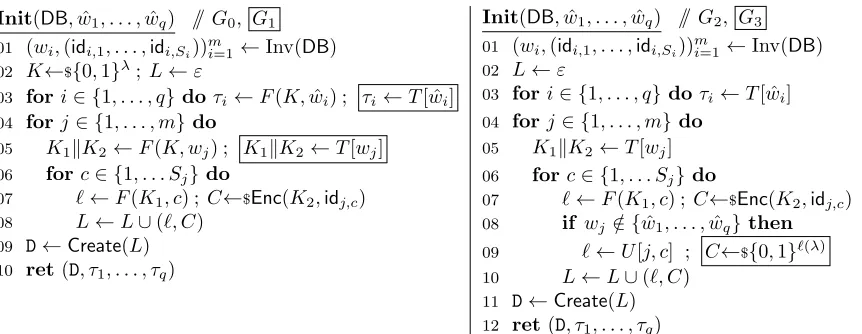
Init(DB,wˆ1, . . . ,wˆq) //G0, G1 01 (wi,(idi,1, . . . ,idi,Si))mi=1←Inv(DB) 02 K←${0,1}λ; L←ε
03 fori∈ {1, . . . , q}do τi←F(K,wˆi) ; τi←T[ ˆwi] 04 forj∈ {1, . . . , m}do
05 K1kK2←F(K, wj) ; K1kK2←T[wj] 06 forc∈ {1, . . . Sj}do
07 ℓ←F(K1, c) ; C←$Enc(K2,idj,c) 08 L←L∪(ℓ, C)
09 D←Create(L) 10 ret(D, τ1, . . . , τq)
Init(DB,wˆ1, . . . ,wˆq) //G2, G3 01 (wi,(idi,1, . . . ,idi,Si))
m
i=1←Inv(DB) 02 L←ε
03 fori∈ {1, . . . , q}doτi←T[ ˆwi] 04 forj∈ {1, . . . , m} do
05 K1kK2←T[wj] 06 forc∈ {1, . . . Sj}do
07 ℓ←F(K1, c) ; C←$Enc(K2,idj,c) 08 if wj∈ {/ wˆ1, . . . ,wˆq}then
09 ℓ←U[j, c] ; C←${0,1}ℓ(λ) 10 L←L∪(ℓ, C)
11 D←Create(L) 12 ret(D, τ1, . . . , τq)
Figure 6: GamesG0–G3 for the proof of Theorem6. G1 andG3 include the boxed code whileG0 andG2 do not. The notationL←L∪(ℓ, C) means that (ℓ, C) i
savesDBand an empty listQsrch as state. Then, for a search inputw,Lincrements i, adds (i, w) toQsrch and outputsDB(w) and a setsp(w, Qsrch), called thesearch pattern forw, defined by
sp(w, Qsrch) ={j: (j, w)∈Qsrch}.
The search pattern indicates which other queries were also for the keywordw, and represents the fact that our scheme will send the same message when a search is repeated.
We deal with non-adaptiveL-security first.
Theorem 6 Πbas is correct and L-secure against non-adaptive attacks if F is a secure PRF and(Enc,Dec) is RCPA-secure.
We prove security and correctness separately.
Proof of security: We make the simplifying assumption that the adversary never repeats a query because our search protocol is deterministic it is clear that this will not help it. In this case the search pattern is always a singleton, and thus we omit it. The remaining output from the non-adaptive leakage function is (N, V1, . . . , Vq), i.e. the size ofDBand the sets of identifiers for each search.
Before giving the simulator we consider games G0, . . . , G3 in Figure 6. G0 will compute a distribu-tion identical to SSENARealΠ(λ),G3 will compute a distribution that can be simulated perfectly and the remaining games are hybrids.
The first gameG0responds to a single query toInit. It computesDand the client-message transcriptsτi (which each consist of a single message) as specified in the non-adaptive game. It selects a keyK and then for each query ˆwi it computes τi as F(K,wˆi), and then it for each keyword in the chosen DBit computes the label/ciphertext pairs usingK and then creates the dictionary. We have
Pr[G0] = Pr[SSENARealA
Π(λ) = 1]. (1)
The next gameG1is likeG0but includes the boxed code. Now every evaluation ofF(K,·) is immediately overwritten using the entry from a tableT. Recall that our convention specifies that when an entry is being accessed for the first time, it is chosen at random and then used thereafter. This means that all of theτiare uniform and independent strings, and similarly theK1kK2 on line 05 are uniform and independent.
We claim there is an efficient adversaryB such that
AdvprfF,B1(λ) = Pr[G0]−Pr[G1]. (2)
01 L←ε
02 (wi,(idi,1, . . . ,idi,Si)) m
i=1 ←Inv(DB) 03 fori∈ {1, . . . , q} doτi←Fn(0,wˆi) 04 forj∈ {1, . . . , m} do
05 K1kK2←Fn(0, wj)
06 forc∈ {1, . . . Sj} doℓ←F(K1, c) ; C←$Enc(K2,idj,c) ; L←L∪(ℓ, C) 07 D←Create(L)
08 ret(D, τ1, . . . , τq),
and it runsAuntil it halts with some output thatB1uses as its own. It is straightforward to check thatB1 is efficient and that
Pr[PRFRealB1
F (λ) = 1] = Pr[G0] and Pr[PRFRand B1
F (λ) = 1] = Pr[G1], which gives (2).
Next we consider G2. This game is likeG1except that it deletes some irrelevant code (i.e., the selection of values that are immediately overwritten) and handles unqueried keywords differently, namely in the new code in lines 08 and 09. Those lines implement a change where ifwj was not amongst the queried keywords, then the labelℓis selected at random, using our convention for reading from the possibly-uninitialized table U.
We show there exists an efficient adversaryB2such that
AdvprfF,B2(λ) = Pr[G1]−Pr[G2]. (3)
B2 has access to anFn(·,·) oracle, and starts by runningAto get itsInitquery (DB,wˆ1, . . . ,wˆq), and then computes
01 L←ε
02 (wi,(idi,1, . . . ,idi,Si)) m
i=1 ←Inv(DB) 03 fori∈ {1, . . . , q} doτi←T[ ˆwi] 04 forj∈ {1, . . . , m} do
05 K1kK2←T[wj] 06 forc∈ {1, . . . Sj} do
07 ℓ←F(K1, c) ; C←$Enc(K2,idj,c) 08 if wj∈ {/ wˆ1, . . . ,wˆq}thenℓ←Fn[j, c] 09 L←L∪(ℓ, C)
10 D←Create(L) 11 ret(D, τ1, . . . , τq),
finally outputting whatever A outputs. Note that B2 is somewhat unnatural in the way it computesℓ on line 08: If theFn oracle is “real” then it is computingℓ usingF with a uniformly random key, and if it is “random” then it is uniformly random string. But in either case, the key K1 isnot used on line 08 – ℓ is always overwritten. We establish (3) by observing that
Pr[PRFRealB2
F (λ) = 1] = Pr[G1] and Pr[PRFRand B2
F (λ) = 1] = Pr[G2].
This is again straightforward to verify using the observation noted in the previous paragraph. The second case is true as the code syntactically identical, while the first case true even though a fresh random key is used instead ofK1in oracle call on line 08. But sinceK1 is used nowhere else (and in particular not in line 03), this is equivalent.
GameG3is exactly likeG2except that it includes the boxed code on line 09 that replacesCwith a fresh random string when the keyword wj is not one of the queried keywords. We show there exists an efficient adversaryB3 such that
AdvindΠ,B−3rcpa(λ) = Pr[G2]−Pr[G3].
01 L←ε
02 (wi,(idi,1, . . . ,idi,Si)) m
i=1 ←Inv(DB) 03 fori∈ {1, . . . , q} doτi←T[ ˆwi] 04 forj∈ {1, . . . , m} do
05 K1kK2←T[wj] 06 forc∈ {1, . . . Sj} do
07 ℓ←F(K1, c) ; C←$Enc(K2,idj,c)
08 if wj∈ {/ wˆ1, . . . ,wˆq}thenℓ←U[j, c] ;C←E(j,idj,c) 09 L←L∪(ℓ, C)
10 D←Create(L) 11 ret(D, τ1, . . . , τq).
It runsAuntil it halts and then uses the output ofAas its own. We claim that Pr[RCPARealB3
Π (λ) = 1] = Pr[G2] and Pr[RCPARand B3
Π (λ) = 1] = Pr[G3].
As with our other adversaries this is only a matter of verifying that the same computation is performed in each case. A subtlety similar to the above case occurs with the usage ofK2 in the first equality: When the
if statement is executed on line 08,K2is not used as theEoracle will have an internal key (independent of K2). But sinceK2 is used no where else, this is equivalent.
In the final step of the proof we give an efficient simulatorS such that
Pr[G3] = Pr[SSENASimA
L,S(λ) = 1]. (4)
Stakes as input the simplified leakage output (N, V1, . . . , Vq), whereN is a positive integer andVi⊆ {0,1}λ. It responds to the query by computing
01 L←ε
02 fori∈ {1, . . . , q} do
03 τi←${0,1}2λ; K1kK2←τi 04 forc∈ {1, . . .|Vi|}do
05 ℓ←F(K1, c) ; C←$Enc(K2,idj,c) ; L←L∪(ℓ, C) 06 N′←N−PQ
i=1|Vi| 07 forj∈ {1, . . . , N′}do
08 ℓ←${0,1}λ; C←${0,1}ℓ(λ); L←L∪(ℓ, C) 09 D←Create(L)
10 ret(D, τ1, . . . , τq).
In words,S is first picking eachτi to be a random independent string, and then for eachVi it encrypts and labels each identifier usingτi(parsed asK1||K2) and adds them toL. Finally it adds random label/ciphertext pairs toLuntil there are a total ofN pairs and then generates D.
We claim that the distribution of the output of S is identical to that of Init in G3, establishing (4). First observe that in both cases the τi are uniform and independent, so we only need to verify that Dhas the same distribution conditioned on particular values of τi. But then S is computing label/ciphertext values from the same distribution, just in a different order when adding them toL(whileG3 adds random label/ciphertexts pairs when looping over each unqueried keyword,S adds them all at once after processing the queried keywords). Since these values are maintained in lexicographic orderDhas the same distribution inG3 and when sampled byS.
Collecting (1-4), we have
AdvsseΠbas−adap,A,S(λ) = Pr[SSENAReal A
Π(λ) = 1]−Pr[SSENASimAL,S(λ) = 1]
= Pr[G0]−Pr[G3]
= (Pr[G0]−Pr[G1]) + (Pr[G1]−Pr[G2]) + (Pr[G2]−Pr[G3])
=AdvprfF,B1(λ) +Adv
prf
F,B2(λ) +Adv
By the assumption thatF is a secure PRF and Π is RCPA secure, this function is negligible. ✷
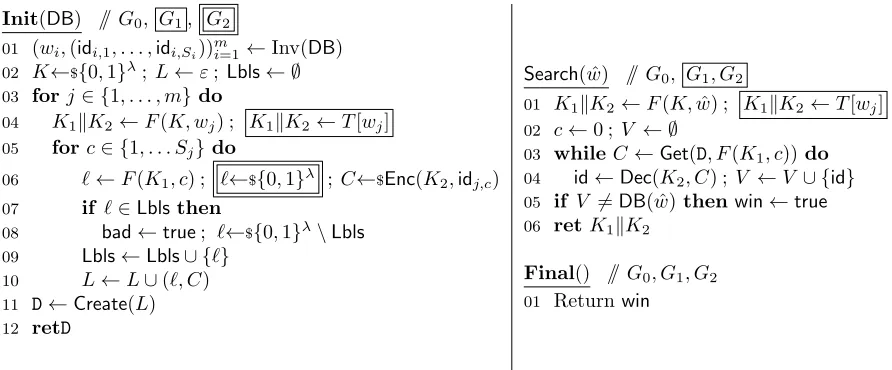
Proof of correctness: We use the games in Figure7. The first gameG0implements the game SSECorAΠ(λ) with the change that, when a label repeats duringInit, abadvariable is set and the offending label is replaced with a fresh one. It is straightforward to check that first G0 will only output 1 if badis set (i.e., repeated labels are the only source of incorrectness and G0 fixes these), and second that G0 produces an identical distribution to real game whenbadis not set. This gives
AdvsseΠ,A−cor(λ) = Pr[SSECorA
Π(λ) = 1]≤Pr[G0sets bad]. (5)
The next game G1 overwrites evaluations of F with random values stored in T (this happens in both
InitandSearch). There exists an efficient adversaryB1 such that
AdvprfF,B1(λ) = Pr[G0sets bad]−Pr[G1setsbad]. (6)
This adversary works very similarly toB1 from the previous proof. We omit the details.
The next gameG2is exactly likeG1except that the labels are chosen at random. We claim there exists an efficient adversaryB2 such that
AdvprfF,B2(λ) = Pr[G1sets bad]−Pr[G2setsbad]. (7)
This adversary simulates the games using its oracle in the obvious way, except that it stops afterInitand declares its output based on ifbadwas set. We omit the details, which are straightforward.
Next we claim that
Pr[G2 setsbad] = negl(λ). (8)
This follows from the observation that Lbls always as polynomial in λ number of elements, so there is a negligible probability that a random ℓ will be in Lbls. The claim follows from a union bound over the polynomial number of labelsℓ.
We complete the correctness proof by collecting (5-8):
AdvsseΠbas−cor,A(λ) = Pr[SSECor A
Π(λ) = 1] = Pr[G0 setsbad]
= (Pr[G0sets bad]−Pr[G1setsbad]) + (Pr[G1 setsbad]−Pr[G2 setsbad]) + Pr[G2setsbad]
=AdvprfF,B1(λ) +Adv
prf
F,B2(λ) + negl(λ)
SinceF is a PRF, this function is negligible and Πbas satifies the correctness requirement.
Adaptive security in the random oracle model. In the random oracle model we can achieve adap-tive security for the sameL ifF is replaced with the random oracle H so F(K, x) :=H(Kkx), and the en-cryption algorithmEnc, on inputsK, m∈ {0,1}λ, chooses a randomr∈ {0,1}λand outputs (r, H(Kkr)⊕m). We denote this variant Πro
bas.
Theorem 7 Πrobas isL-secure against adaptive attacks in the random oracle model.
Proof sketch: This theorem is proved in a similar way to the previous one, except that the simulator programs the random oracle in response to adaptive queries to open the labeled ciphertexts to match the query results as they are revealed. For our version of the PRF and encryption scheme above, the simulator can arrange for the random oracle responses to point at random labels, and for the ciphertexts to decrypt to the revealed results. The only defects in the simulation occur when an adversary manages to query the random oracle with a key before it is revealed, which can be shown to happen with negligible inλprobability. ✷
Init(DB) //G0, G1, G2
01 (wi,(idi,1, . . . ,idi,Si))mi=1←Inv(DB) 02 K←${0,1}λ; L←ε; Lbls← ∅ 03 forj∈ {1, . . . , m}do
04 K1kK2←F(K, wj) ; K1kK2←T[wj] 05 forc∈ {1, . . . Sj}do
06 ℓ←F(K1, c) ; ℓ←${0,1}λ ; C←$Enc(K2,idj,c)
07 if ℓ∈Lblsthen
08 bad←true; ℓ←${0,1}λ\Lbls 09 Lbls←Lbls∪ {ℓ}
10 L←L∪(ℓ, C) 11 D←Create(L) 12 retD
Search( ˆw) // G0, G1, G2
01 K1kK2←F(K,wˆ) ; K1kK2←T[wj] 02 c←0 ; V ← ∅
03 whileC←Get(D, F(K1, c))do 04 id←Dec(K2, C) ; V ←V ∪ {id} 05 if V 6=DB( ˆw)thenwin←true 06 retK1kK2
Final() //G0, G1, G2 01 Returnwin
Figure 7: GamesG0, G1, G2 for the proof of Theorem6. The notationL←L∪(ℓ, C) means that (ℓ, C) is added to L, in order byℓ.
sending the keys K1 and K2, the client computes the labels and encryption pads herself and sends them to the server, who can retrieve the labels and perform the decryption. In general the client will not know when to stop, but we can either have the client retrieve a server-stored encrypted counter first, or have the server send a “stop” message when all of the results have been found. Note that the required additional communication is proportional to the size of the result-set and can overlap the disk access as well as the return of results. Hence, the resulting scheme should perform in practice as good as the prior schemes.
Asymptotic efficiency. TheEDBconsists of a dictionary holdingN =P
w∈W|DB(w)|identifier/ciphertexts pairs. Searching is fully parallelizeable if the dictionary allows parallel access, as each processor can inde-pendently computeF(K1, c) and retrieve/decrypt the corresponding ciphertext.
Relation to [6]A prior SSE scheme by Chase and Kamara used a dictionary, but in a crucially different way. There, a single label was associated with the entire setDB(w), and thus security requires padding all of the result sets to the maximum size. We instead associate one label with each result for a keyword (so if there areT documents with a keyword, then there areT independent labels in our scheme but only 1 label in the Chase-Kamara scheme). This allows us to avoid padding and enable parallel searching, resulting in significant storage savings and performance gains on large datasets.
3.1
Efficient extensions
We give a sequence of three schemes (denoted Πpack,Πptr,Π2lev, with names explained below) that exhibit the techniques in our most practical Π2lev construction.
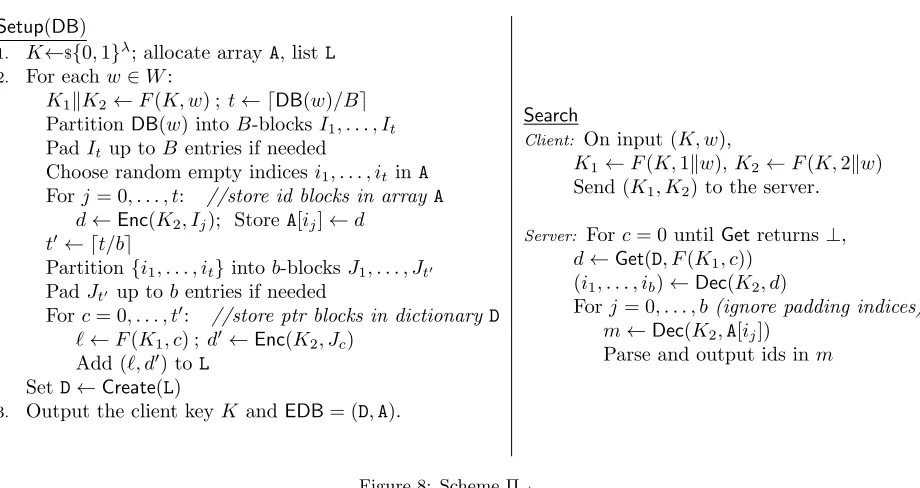
Reducing dictionary retrievals: Πpack. During a search forw, our basic construction performs|DB(w)| retrievals from the dictionary, each with an independent and random-looking tag. Even an external-memory efficient dictionary will perform relatively poorly when the dictionary is stored on disk.
Most prior schemes suffer from this drawback. To improve locality we modify the basic construction to encrypt several identifiers in each ciphertext. Specifically, we fix a block sizeB, and when building the results list, we processB identifiers at a time and pack them into one ciphertextd, with the same tag. We pad the last block of identifiers up to the same length. Searching proceeds exactly as before, except the server decrypts and parses the results in blocks instead of individually. We denote this variant Πpack.
Setup(DB)
1. K←${0,1}λ; allocate array A, listL 2. For each w∈W:
K1kK2←F(K, w) ; t← ⌈DB(w)/B⌉ PartitionDB(w) intoB-blocksI1, . . . , It PadIt up toB entries if needed
Choose random empty indicesi1, . . . , itin A Forj= 0, . . . , t: //store id blocks in arrayA
d←Enc(K2, Ij); StoreA[ij]←d t′← ⌈t/b⌉
Partition{i1, . . . , it}into b-blocks J1, . . . , Jt′
PadJt′ up tob entries if needed
Forc= 0, . . . , t′: //store ptr blocks in dictionaryD ℓ←F(K1, c) ; d′←Enc(K2, Jc)
Add (ℓ, d′) toL
SetD←Create(L)
3. Output the client keyK andEDB= (D,A).
Search
Client: On input (K, w),
K1←F(K,1kw),K2←F(K,2kw) Send (K1, K2) to the server.
Server: Forc= 0 untilGetreturns⊥,
d←Get(D, F(K1, c)) (i1, . . . , ib)←Dec(K2, d)
Forj= 0, . . . , b(ignore padding indices) m←Dec(K2,A[ij])
Parse and output ids in m
Figure 8: Scheme Πptr.
prove security against non-adaptive or adaptive attacks under the same assumptions, but with the leakage function LB that starts by outputting P
w∈W⌈|DB(w)|/B⌉ instead of
P
w∈W|DB(w)|. We note that this leakage is incomparable to the original leakage (see the discussion at the end of this section).
Theorem 8 Πpackis correct andLB-secure against non-adaptive attacks ifF is a secure PRF and(Enc,Dec) is RCPA-secure.
This can be proved via a simple extension of the proof for the basic construction. The essential observation is that the server only needs to know how many of the packed blocks to create in the encrypted index. Similar to before, we can achieve adaptive security in the random oracle model or by increasing communication. We omit the details of this analysis due to space and since we will not use Πpack as it is.
Further reduction via pointers: Πptr. Πpackwould be inefficient when returning very large setsDB(w), as the server still performs⌈|DB(w)|/B⌉dictionary retrievals. MakingB large results in too much padding when the dataset contains many keywords only appearing in a few≪B documents.
We address this tension by modifying the scheme again, calling the new variant Πptr. Πptr packages the identifiers into encrypted blocks of B as before, but it stores these blocks in random order in external memory and not in the dictionary (technically, we say they are stored in an array). The scheme will now use the dictionary to store encrypted blocks of b pointers to these encrypted blocks. To search, the server will retrieve the encrypted pointers from the dictionary and then follow them to the encrypted identifiers.
Πptris described in Figure8. In this scheme, theEDBconsists of a dictionaryDholding encrypted blocks ofb pointers and an array Aholding blocks of B encrypted identifiers for a given keyword, where b andB are block size parameters to be chosen. The setup algorithm stores blocks of encrypted results in random locations in A, and then stores encrypted pointers to those locations in D, with labels that allow retrieval similar to the prior variants.
We can show that this variant achieves the security for the leakage functionLb,B which initially outputs
P
w∈W⌈|DB(w)|/B⌉and
P
w∈W⌈|DB(w)|/(bB)⌉, which are the number of blocks inDandArespectively, and
later leakages are just the identifiers as before. We omit this analysis and defer to our main construction.
not find a setting of B and b that gave an acceptable trade-off between index size (due to padding) and search time. Small setsDB(w) still resulted in a large block of sizeB in the dictionary and a large block of sizeb in the array, while huge sets still required many retrievals from the dictionary.
Thus we again modify the scheme to extend the ideas before, calling the new variant Π2lev. The crucial difference is that setsDB(w) can be processed and stored differently based on their sizes, with an extra level of indirection for very large sets that explains the name. Care must be taken to do this with an acceptable form of leakage.
Below we describe the Πpack variant formally. At a high level, it works as follows. It classifies the sets DB(w) assmall,medium, orlarge. For small sets, it will store the identifiers directly in the dictionary (so no pointers are used, similar to the packed variant Πpack). For medium size sets, it will store them as in Πptr, with a block of pointers in the dictionary and then blocks of identifiers in the array. Finally large sets are stored differently, with two levels of indirection: The dictionary is now used to hold pointers that point to blocks of pointers in the array, which point to the identifier blocks.
In Π2levwe again fix parametersbandBto be sizes of blocks in an dictionaryDand arrayArespectively. The scheme classifies each of the result setsDB(w) with|DB(w)| ≤bassmall, sets of sizeb <|DB(w)| ≤Bb as medium, and finally sets of sizeBb≤ |DB(w)|< B2b as large. We will always setb, B so that no set is larger thanB2b.
Small sets fit completely in a block of the top-level dictionaryD, and are stored there. Medium sets will be stored as in the previous variant but with a single block of at mostbpointers inDand the corresponding blocks of identifiers inA. These sets consist of betweenb+ 1 and bBidentifiers.
Finally, for large sets we store a block of at most b pointers in D. In each of the b positions pointed to in A, we store another block of at mostB pointers to other positions inA. Finally, these pointers point to blocks of encrypted identifiers. Figure9 describes theSetup(DB) function of Π2lev in more detail.
To search, the client works as with the other variants by sendingK1, K2. The server computes the label ℓ ← F(K1,0), and retrieves d ← Get(D, ℓ), and decrypts d using K2. If it finds identifiers here, then it outputs them and stops. Otherwise, it uses the pointers to retrieve blocks fromA. If those blocks contain identifiers then it outputs them. Otherwise it follows the next level of pointers to finally find the identifiers, which it decrypts and outputs.
Security. We prove security for the leakage functionLm,b,B that initially outputsm=|W|and the value
S= X
w:|DB(w)|>b
⌈|DB(w)|/B⌉+ X w:|DB(w)|>bB
|DB(w)|/B2
.
The value m is the number of data items in D, and the value S is the number of blocks in A. This is leakingSitself, which is defined by the above sum, and not the individual summands, resulting leakage that is incomparable to our other variants and to prior schemes. On search queries L has the same leakage as before.
Theorem 9 Π2lev is correct and Lm,b,B-secure against non-adaptive attacks if F is a secure PRF and (Enc,Dec)is RCPA-secure.
Proof: We need to describe a simulator that, given the output of Lm,b,B, satifies Definition5. This means an efficient adversary generatesDBand a list ofqqueries ˆw1, . . . ,wˆq. Our simulator must generateEDBand client messagesτ1, . . . , τq to simulate search queries.
The high-level approach for the simulator is the same as in the proof of Theorem 6. For each of the queried keywords it will choose random keys (K1, K2) to use as the client transcript and then arrange for the correct identifiers for each query to be found in EDBusing those keys. Then it will use the rest of its leakage to padEDBwith random labels and ciphertexts.
Setup(DB)
1. K←${0,1}λallocate list L, array A
2. For each w∈W such that DB(w)is small (|DB(w)| ≤b): K1kK2←F(K, w) ; t← ⌈|DB(w)|/B⌉
Encrypt and store a single block of pointers in dictionary D: PadDB(w) tobelements
ℓ←F(K1,0) ;d←Enc(K2,DB(w)) Add (ℓ, d) toL
3. For each w∈W such that DB(w)is medium (b <|DB(w)| ≤Bb): K1kK2←F(K, w) ; t← ⌈|DB(w)|/B⌉
Divide identifiers into blocks, encrypt, and store them array A:
PartitionDB(w) intoB-blocks I1, . . . , Itand padItup toB elements if necessary Choose random empty indicesi1, . . . , it inA
Forj= 1, . . . , tdo: d←Enc(K2, Ij) ; A[ij]←d
Encrypt and store a single block of pointers in dictionary D:
Pad{i1, . . . , it} tobelements if necessary ℓ←F(K1,0) ; d′←Enc(K2, i1k · · · kib) Add (ℓ, d) toL
4. For each w∈W such that DB(w)is large (Bb <|DB(w)| ≤B2b): K1kK2←F(K, w) ; t← ⌈|DB(w)|/B⌉; t′← ⌈t/B⌉
Divide identifiers into blocks, encrypt, and store them array A:
PartitionDB(w) intoB-blocks I1, . . . , Itand padItup toB elements if necessary Choose random empty indicesi1, . . . , itinA
Forj= 1, . . . , tdo: d←Enc(K2, Ij) ; A[ij]←d
Divide pointers into blocks, encrypt, and store them array A:
Partition{i1, . . . , it} intob-blocksJ1, . . . , Jt′ and padJt′ to B elements if necessary
Choose random empty indicesi′
1, . . . , i′t′ inA
Forj= 1, . . . , t′ do: d←Enc(K
2, Jj) ; A[i′j]←d
Encrypt and store a single block of second-level pointers in dictionary D:
Pad{i′
1, . . . , i′t′} tobelements if necessary
ℓ←F(K1,0) ; d′′←Enc(K2, i′1k. . .ki′b) Add (ℓ, d′′) toL
5. D←Create(L)
Output the client key KandEDB= (D,A).
Figure 9: Setup for SSE Scheme Π2lev.
using K1 and K2. This partially populates Land A. Finally, the simulator padsLto contain m entries by adding random label/ciphertext pairs, and it padsAtoS entries by adding random ciphertexts.
Proving this simulator correct proceeds exactly as in the proof of Theorem 6. We omit the numerous
details. ✷
We can prove the following adaptive security theorem either in the random oracle model or by increasing communication. The technique is exactly the same as with Πbas, but with modifications to program the pointer structure adaptively.
Theorem 10 Π2lev is correct andLm,b,B-secure against adaptive attacks in the random oracle model.
• When storing identifiers in the dictionary (in the small case), it packs up to b of them together, but when storing pointers there it packs b′ in the same amount of space.
• When storing identifiers in the array (in the medium and large cases), it packs up toBof them together, but when storing pointers there it packsB′ together in the same amount of space.
This causes an analogous change to the value S leaked, which can be calculated similarly. We omit the formal analysis (which is almost identical to that of Π2lev).
Leakage discussion. The leakage functions LB,Lb,B,Lm,b,B are non-standard. First consider LB, and how it compares to L which outputs N = P
w∈W|DB(w)|. Any input DBwith m unique keywords, each with |DB(w)| ≤b, will be indistinguishable under LB, but many of them will not be under L. A similar incomparability goes in the other direction. We are not aware of a scenario where this difference is important for reasonably small B. The function Lb,B leaks strictly more information than LB (actually Lb), but it also does not appear to be harmful. Finally, Lm,b,B leaks this type of size informationand the number of keywords m. The numberm seems to be the most useful information for an adversary, but in prior work it has been considered acceptable. It is possible to modify the scheme to avoid leaking exactlym, say by storing blocks of a different size in the dictionary.
4
Dynamic Constructions
We extend our static SSE constructions to support changes to the database. Our dynamic SSE constructions will consist of a statically encrypted databaseEDBusing any of the schemes described above, and an auxiliary encrypted databaseEDB+ which is maintained to be of the form of a basic dictionary-based scheme. The
EDB+is initially empty and changes as updates happen.
Add-only scheme: Π+bas. We start with an extension of Πbas, denoted Π+bas that supports additions only, meaningadd,edit+ inputs from the client duringUpdate. Π+bas is simpler and possibly interesting in its own right.
To support additions we use a dictionary D+ which is initially empty and to which a pair (ℓ, d) is added with each keyword addition; hereℓis a label computed from the keyword and a keyword-specific counter, and dis the encryption of the recordidinvolved in the addition operation. Search for a keywordwis performed by the server by first searching Das in the static case, then re-computing all labels corresponding to w in D+. The latter labels are computed using aw-specific key provided by the client and a running counter.
Note that addition operations involving keyword w require the client to know the current value of the w-specific counter. For this, the scheme maintains a dictionary Dcount associating each keyword that was ever added viaedit+ oraddwith its current counter value. Dcount can be stored at the client or stored at the server and retrieved by the client for performing update operations. We formalize a scheme Π+bas where the client stores locally the dictionaryDcountand discuss below a stateless variant. We assume throughout that the client never tries to add a record/keyword pair that is already present - it is easy, but messy, to extend our scheme and the leakage profile to handle this.
In Π+bas, Setup(DB) is exactly as in Πbas except that the client also initializes Dcount to be an empty dictionary and keeps it as state, and the server initializes an empty dictionaryD+ that is stored withEDB. We also modify the scheme to save an additional key K+ (which could be derived to save space). We next give the update protocol.
Update: We only specify the protocol with client inputop∈ {add,edit+}. The parties work exactly the same on either type of operation. To update the client has inputid,Wid.and proceeds as follows:
Forw∈Wid:
K1+kK2+←F(K+, w)
Add (ℓ, d) toLin lexicographic order SendLto the server.
When inserting (w, c) intoDcount, we assume that it will overwrite any previous entry (w,·) if it exists. Finally, the server adds each (ℓ, d)∈L toD+. This completes the update protocol.
To complete Π+bas we describe the protocolSearch.
Search: On inputw, the client computesK1kK2←F(K, w);K1+kK +
2 ←F(K+, w) and send (K1, K2, K1+, K + 2) to the server.
Upon receiving the message, the server computes its output as follows:
Forc= 0 untilGetreturns⊥,
d←Get(D, F(K1, c)) ; id←Dec(K2, d) Output eachid
Forc= 0 untilGetreturns⊥,
d←Get(D+, F(K1+, c)) ; id←Dec(K2+, d) Output eachid
Intuitively, the server is repeating the search procedure from Πbas twice: Once with (K1, K2) and D, and then with (K1+, K2+) andD+.
Leakage profile for Π+bas. Let us first give some intuition for the leakage of Π+bas. Initially the leakage is exactly like Πbas, where only the size of DBis leaked. Upon an edit+ oraddquery, if the keywords being added were not previously searched for, then the server learns nothing other than number of record/keyword pairs added (not even the if the operation wasedit+ vs. add). If, however, one (or more) of the keywords were previously searched for, then the server can reuse its keys from before to detect the presence of these keywords (this type of leakage is inherent when the keys provided to the server for searching are deter-ministically generated and the same each time). The leakage on a search is similar to before, except now for record/keyword pairs in D+ the server can recognize when they were added. The order for pairs in D generated at setup time is still hidden, however.
We proceed with the formal definition ofL+ for adaptive security. Amongst its state, it will keep a list Qdescribing all queries issued so far, where an entry ofQis of the form (i,op, . . .), meaning a counter, the operation type, and then the one or more inputs to the operation.
On initial inputDB,L+ creates a state consisting of a counteri←0, an empty listQandDB, and a set IDinitialized to contain all of the identifiers in DB. Let us define thesearch pattern sp(w, Q) of a keyword with respect toQto be the indices of queries that searched for the keywordw, i.e.
sp(w, Q) ={j: (j,srch, w)∈Q}.
For an identifieridand keywordw, theadd pattern ofid, w with respect toQis the indices that addedwto the documentid, i.e.
ap(id, w, Q) ={j: (j,add,id,Wid)∈Q, w∈Wid} ∪ {j: (j,edit+,id,Wid)∈Q, w∈Wid}.
Finally, we let theadd pattern of keyword wwith respect toQandIDbe the set of all identifiers to whichw was ever added (via aaddoredit+ operation) along with the indices showing when they were added. That is,
AP(w, Q,ID) ={(id,ap(id, w, Q)) :id∈ID,ap(id, w, Q)6=∅}. L+ produces outputs for the initial query,edit+
andaddupdates, and search queries as follows: • On initial inputDBit saves state as defined above and outputsN=P
w∈W|DB(w)|.
• For a search queryw,L+ appends (i,srch, w) toQand incrementsi. Then it outputssp(w, Q),DB(w), andAP(w, Q,ID).
• Update queries for edit+ and add operations are handled similarly. For a query (edit+/add,id,Wid), L+ first appends (i,edit+
(lexicographically ordered) set of search patterns
{sp(w, Q) :w∈Wid}. If any of the search patterns was non-empty, then it also outputsid.
While subtle in its formulation,L+ is essentially the best possible leakage for an SSE scheme that generates the same search keys on repeated searches.
In words, the search query leakage includes sp(w, Q) andDB(w) for obvious reasons. The add pattern of w, AP(w, Q,ID), is the set of id matching w added later along with “history” information ap(id, w, Q) indicating when they added. The order information represents that the server can look atD+ and see when eachidwas added by rewinding and re-running searches. For updates Π+bas leaksonly the size of the update if the added keywords have not been searched for. If any of them have been searched for, then the server learns that “a keyword with search patternsp(w, Q) was added” via the set of search patterns in the update leakage. Finally it learns theid being updated because it has the ability to search for any of its keywords. Each of these leakage components is unavoidable for a deterministic SSE scheme, and we regard them as minimal.
Theorem 11 Π+basis correct andL+-secure against non-adaptive attacks ifF is a secure PRF and(Enc,Dec) is RCPA-secure.
Proof sketch: We briefly describe the required simulator; it can be shown correct via the same type of proof used for Theorem 6. The simulator builds the initialEDB exactly as in that proof, and initially sets D+to empty. To answer search queries it selects random keysK1, K2, K1+, K2+, with repetitions as described by the search pattern.
Finally we need simulate update queries. More precisely, the simulator needs to simulate the message sent by the client, which consists of several label/data pairs. The simulator must decide for each pair sent if it is supposed to be random (and meaningless) or if the pair should be computed with one of the keys used for a search query transcript. It does this using both the add pattern leakage from the search queries and the leakage from update queries which include theid to encrypt when the addition includes a keyword that was previously searched.
Checking that the simulator is correct involves the same techniques as the proof of Theorem6. We omit these many details, which are all small extensions of that proof. ✷
Stateless client variant. Above, the client keeps a dictionaryDcountcontaining one counter per keyword that is added after initialization. We could modify the scheme so that the client is stateless by storingDcount in encrypted form at the server and having the client download and re-encryptall ofDcountfor each update (note that the size ofDcountis as the number of distinct keywords added viaaddandedit+ andnotthe total number of keywords in the set W). In this variant the server will learn how manynew keywords are added each time by watching ifDcount grows.
Dynamic scheme Πdynbas. We now augment the Πbas scheme with del and edit− operations to obtain our fully dynamic scheme Πdynbas. We will implement deletions by maintaining a revocation list and having the server discard results that have been revoked.
To delete a record/keyword pair (id, w) from the server’s storage, the client will generate a pseudorandom revocation identifier and send it to the server. During searches, the client will give the server a key that allows it to recompute revocation identifiers, which it will then use to filter out deleted results. This complicates our addition protocols. To add a pair that was previously deleted, the protocol must “unrevoke” that pair by having the server delete its revocation identifier.
We now formally specify Πdynbas. Setupis exactly the same as Π+bas, except that the server also initializes an emptyset Srev. As a data structure,Srev will support additions, deletions, and membership testing. The scheme now keeps an additional keyK−, which can be derived from a master key to save space.
Forw∈Wid do
K1−←F(K−, w),revid←F(K1−,id) AddrevidtoLrev in lexicographic order SendLrev to the server.
The server receivesLrev and adds eachrevidtoSrev. This completesUpdatefor thedelandedit−operations. Next we define Update for op ∈ {add,edit+}. On input (add/edit+,id,Wid), the client performs a com-putation similar to the listLcomputation in Π+bas, except that it also includes the appropriaterevidvalues. It then awaits a response from the server specifying which additions resulted in a true addition and which caused an “unrevocation”, and uses this information to increment the correct counters. In code, the client does the following:
Forw∈Wid:
K1+kK2+←F(K+, w) ; K−
1 ←F(K−, w) c←Get(Dcount, w); Ifc=⊥thenc←0 ℓ←F(K1+, c) ; d←Enc(K2+,id) revid←F(K1−,id)
Add (ℓ, d,revid) toLin lexicographic order SendLto the server.
The server generates its response r ∈ {0,1}|L| as follows. For the i-th pair (ℓ, d,revid) ∈ L in order, if revid∈Srev, it sets the i-th bit of rto 1 and deletes revidfrom Srev. Else, it clears that bit to 0 and adds (ℓ, d) to D. Finally, it sendsrto the client.
Now the client increments the counters for keywords corresponding to 0 bits in r. It processes the keywords w∈ Wid in order of their labels in L. For the i-th keyword w in that order, if the i-th bit of r is 0 it computesc←Get(Dcount, w), increments c, and inserts (w, c) intoDcount. This completes the update protocol.
The last component of Πdynbas is the search protocol.
Search: On client input w, it sets K1− = F(K−, w), and then computes (K1, K2, K1+, K2+) as in Π+bas. It sends (K1, K2, K1+, K2+, K1−) to the server. The server computes the result identifiers using the first four keys exactly as in Π+bas, except before outputting eachidit computesrevid=F(K1−,id) and tests ifrevid∈Srev. If so, it discardsidinstead of outputting it.
Leakage function. We now define the leakage profileLdyn. It will maintain a list of query informationQ and set of identifiersIDlike L+ from above. Below we use the same definitions forsp,ap,APas inL+, and define the following analogous patternsdp,DPfor deletions:
dp(id, w, Q) ={j: (j,del,id,Wid)∈Q, w∈Wid} ∪ {j: (j,edit−,id,Wid)∈Q, w∈Wid}.
and
DP(w, Q,ID) ={(id,dp(id, w, Q)) :id∈ID,dp(id, w, Q)6=∅}.
Intuitively,dp(id, w, Q) is the set of indices of queries that deleted wfromid, and DP(w, Q,ID) is the set of identifiers form whichwwas deleted, along with the corresponding deletion pattern.
• On first inputDB,Ldyninitializes a counteri←0, empty listQ, setIDto be identifiers inDB. It saves DB, i,ID, Qas state, and outputsN =P
w∈W|DB(w)|.
• On search inputw,Ldynappends (i,srch, w) toQ, incrementsi, and outputssp(w, Q),DB(w),AP(w, Q,ID), andDP(w, Q,ID).
• On update input (add/edit+,id,Wid), it appends (i,add/edit+,id,Wid) toQ, addsidtoID, and increments i. It outputsadd,|Wid|and the set
• On update input (del/edit−,id,Wid), it appends (i,del/edit−,id,Wid) toQ, addsidtoID, and increments i. Then it computes its output exactly as in theadd/edit+case above, except that it outputsdelinstead ofaddas the first component.
The leakage on searches is minimal: It consists of all patterns of searches, deletions, and additions that can be derived once the server has the ability to search for a keyword and rewind the database. For leakage on updates, the server will learn when/if that identifier has had the same keywords added or deleted before, and also when/if the same keywords have been searched for. This comes from observing therevidvalues, which will repeat every time the same identifier/keyword pair is added or deleted. Note that, if same keyword is added/deleted from two documents, then this information is not leaked until it is searched for (contrast this with [15] which leaks this information always).
We have the following theorem.
Theorem 12 Πdynbas is correct and Ldyn-secure against non-adaptive attacks if F is a secure PRF and (Enc,Dec)is RCPA-secure.
Proof sketch: The simulator is very similar to the one for the add-only version of the scheme. It chooses the keysK1, K2, K1+, K
+ 2, K
−
1 for each search at random, which repetitions specified by the search pattern, and it sets up the initialEDBin the same way. It simulates addition instructions in exactly the same way (note that the server message sent back to the client is deterministically computable from the server state and does not need to be simulated). To simulate deletions, we observe that they are exactly like additions but without additional ciphertexts to associate with labels, so the leakage (which is the same as in additions)
is easily enough to give a consistent simulation. ✷
Asymptotic Analysis. To add a file the client sends one label/ciphertext/revidper record/keyword pair being changed. For deletions, the Dcount dictionary is not involved. The client just sends one revid per document/keyword to be deleted. Assuming the dictionaries D, D+, and the revocation list are fully read-parallel, and the number of deletions is much smaller than the size of the EDB, each search operation continues to have the same order run-time complexity as in the basic static construction of Figure5.
Discussion and comparison to prior work. Our scheme Πdynbas is unsatisfying in some situations as it does not reclaim space after deletions. While this is a drawback, all known dynamic SSE schemes [15,16,22] have severe drawbacks in different dimensions, and no scheme has achieved an ideal combination of leakage, index size, and full functionality like reclaiming space.
The scheme of [22] has no security proof, and the scheme of [15] has a worst-case quadratic size encrypted index. The dynamic scheme in [16] has much more leakage than our scheme, effectively leaking the pattern of all intersections of everything that is added or deleted, whether or not the keywords were searched for. For an example, suppose{w1, w2, w3}are added toid1,{w1, w2} are added toid2, and{w1} is added toid3. Then [16] will leak that exactly one common keyword was added to all three and that exactly two common keywords were added to the first two (but not the third) and so on. This structural “equality pattern” is the sort of leakage that we do not leak.
Not reclaiming space allows our implementations to be much simpler and also gives us the flexibility to apply various efficiency optimizations (as in section 3 A) to the static scheme which seem hard to achieve when in-place updates have to be supported. As our data structures are more compact than prior work, the overall space requirements will be lower anyway for some number of deletes. In particular, as compared to prior work [15] we are not forced to estimate an upper bound (by necessity, conservative) on the maximum database size.
In some settings where SSE is used as a component, the encrypted database is re-encrypted for security reasons [14]. In these settings we can reclaim space and combine the auxiliary data structure with the main static data structure while re-encrypting.