ISSN 2286-4822
www.euacademic.org DRJI Value: 5.9 (B+)
Extraction, identification and antimicrobial activity
of phenolic compounds associated with HPLC in
extracts of
Teucrium polium
wild plant
MUTHANNA J. MOHAMMED University of Mosul, College of Education for Pure Sciences Biology Department AWAB YOUNUS Independent researcher, Vienna, Austria
Abstract
Teucrium polium plants have been used in traditional medicine for treatment of different diseases. The aim of this study was to investigate phenolic contents by high-performance liquid chromatography (HPLC) and the antimicrobial activity of Teucrium polium extracts against six types of pathogenic bacteria (three Gram-positive and three Gram-negative). The HPLC analysis showed that extracts consist of phenolic compounds (Catechol, Coumarin and Cinnamic acid). Cultures were treated with extracts in separate treatments; both herbal extracts significantly inhibited the growth of all six types of bacteria in 200 and 100 mg/ml concentrations comparing with the very similar inhibition of two antibiotics as controls (Amikacin and Gentamycin). The lowest concentrations (50, 25 and 12.5) showed lower inhibition comparing with the extracts with high concentrations for all six types of bacteria.
Keywords: HPLC, Teucrium polium, Catechol, Coumarin, Cinnamic acid, Amikacin, Gentamycin.
INTRODUCTION
drugs with less side effects which were derived from natural source. Every year, abundant new compounds were isolated from traditional medicine or herbal. This also indicates that the isolated compounds from herbal plants play a very important role in pharmaceutical industry; however, a lot of herbal plants still have not been explored for their phytochemical constituents (Hostettmann K. et al. 1998; Balandrin M. F. et al. 1985).
Teucrium polium L. (felty germander) is a wild growing, flowering species; it is a perennial, aromatic plant, 20–50 cm high, with green-grayish leaves and white to light pink flowers, that occurs from June to August and is found abundantly in Southwestern Asia, Europe (Mediterranean region), and North Africa (Djabou et al., 2012). Traditionally, T. polium has been used for the treatment of different diseases in humans such as gastrointestinal disorders (kidney and liver diseases, abdominal and intestinal pain), inflammation, eczema, urinary tract inflammation, diabetes, and rheumatic diseases (Abu-Irmaileh and Afifi, 2003; Everest and Ozturk, 2005). This plant is mainly used in traditional medicine to improve mental performance (Perry et al., 1996). Numerous in vivo and in vitro studies have confirmed different biological activities of T. polium such as anti-inflammatory and anti-rheumatoid (Tariq et al., 1989), antimicrobial (Balmekki et al., 2013), anti-hypertensive (Suleiman et al., 1988) and hypoglycaemic properties (Kasabri et al., 2011). Moreover, many studies reported that different extracts of T. polium exhibit significant free radical scavenging activity, hydroxyl radical scavenging, and antioxidant activity in vitro (Kadifkova-Panovska et al., 2005).
MATERIAL AND METHODS
Plant material collections
In May 2019, aerial parts of the selected species of flowering plant Teucrium polium were collected from the natural population in the territory of Mosul. The taxonomic authenticity of the samples was conducted at the college of education for pure sciences, University of Mosul. They were dried under ambient laboratory conditions, sealed and stored until needed for the experiment.
Preparation of plant extract
Dried powdered plants material (32g) was successively extracted by mixing with 800 ml solvent for 24 h at room temperature. Each of the homogenates was filtrated and the residue was re-extracted for complete exhaustion. Each filtrate was concentrated to dryness by evaporated under vacuum and re-dissolved in respective solvents, ethanol, ethyl acetate and n-hexane.
Separation of phenols
Different sizes of columns used for the separation of phenols associated with silica gel mesh size 60-120 and by using different percentages of solvents to make many fractions. This was followed by using TLC technique to separate all phenols which detected in this study.
High-performance liquid chromatography (HPLC) analysis of phenols
The extracts were analyzed by HPLC system (Shimadzu, Kyoto, Japan) Separation was achieved on a Luna C18 (250×4.6 mm I.D., 5 mm) (Phenomenex, Torrance, CA, USA) column at 30 oC, with 1.0
ml/min flow rate. The chromatography data were processed using LC Solution computer software (Shimadzu).
Antimicrobial activity
Staphylococcus aureus, Staphylococcus epidermidis, Bacillus cereus, Escherichia coli, Proteus vulgaris and Salmonella typhimurium.
RESULTS AND DISCUSSION
The results of the study are presented in Figures 1-5 and Tables 1 and 2.
HPLC identification
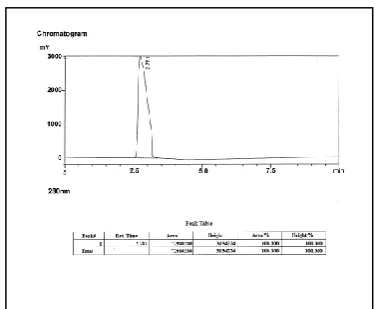
A chromatogram of isolated Catechol is shown in Figure 1 and the chromatogram of control Catechol is shown in Figure 2.
Figure 1: Catechol identification by HPLC in the extract of Teucrium polium.
The chromatograms in both Figure 1 and 2 are largely identical and refer to the identification of the first phenolic compound of extracts of T. polium which is Catechol. The Reproducible peak shapes were obtained under optimum conditions.
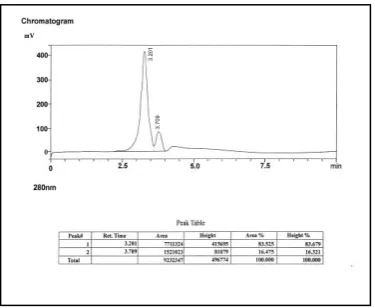
The chromatograms of extracts of T. polium are presented in Figure 3 shows the polyphenolic compounds Coumarin are Cinnamic acid.
Figure 3: Coumarin and Cinnamic acid identification by HPLC in the extract of T.
polium.
The chromatogram of controls Coumarin and Cinnamic acid are shown in Figure 4 and 5.
Figure 5: HPLC chromatogram of Cinnamic acid.
The chromatograms in Figure 3 are largely identical with chromatograms of controls of Coumarin and Cinnamic acid in Figure 4 and 5 which refers to the identification of phenolic compounds in extracts of T. polium which are Coumarin and Cinnamic acid.
Antimicrobial activity
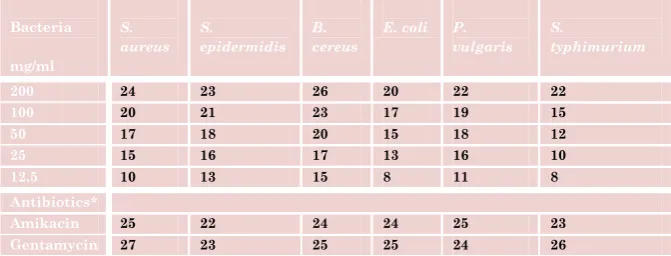
The results of the antimicrobial activity of Teucrium polium extracts against six types of pathogenic bacteria (three Gram-positive and three Gram-negative) are presented in Tables 1 and 2.
Table 1: Aantimicrobial activity of Catechol isolated from Teucrium polium extract.
Bacteria
mg/ml
S. aureus
S.
epidermidis B. cereus
E. coli P. vulgaris
S.
typhimurium
200 24 23 26 20 22 22
100 20 21 23 17 19 15
50 17 18 20 15 18 12
25 15 16 17 13 16 10
12.5 10 13 15 8 11 8
Antibiotics*
Amikacin 25 22 24 24 25 23
Gentamycin 27 23 25 25 24 26
Table 2: Aantimicrobial activity of Coumarin and Cinnamic acid isolated from
Teucrium polium extract.
Bacteria mg/ml S. aureus S. epidermidis B. cereus
E. coli P. vulgaris
S.
typhimurium
200 27 28 25 26 28 22
100 24 26 24 23 27 19
50 22 20 20 19 23 16
25 18 18 17 16 20 13
12.5 13 12 10 14 18 9
Antibiotics*
Amikacin 25 22 24 24 25 23
Gentamycin 27 23 25 25 24 26
*Disc diameter 6 mm.
Both results in Tables 1 and 2 shows significantly inhibition of the growth of all six types of bacteria in 200 and 100 mg/ml concentrations comparing with the very similar inhibition of two antibiotics as controls (Amikacin and Gentamycin). The lowest concentrations (50, 25 and 12.5) showed lower inhibition comparing with the extracts with high concentrations for all six types of bacteria. The present results showed that all the extracts possess good antimicrobial activity against selected test pathogenic bacteria. These results explain that certain plants showed potential antimicrobial activity against these bacteria which can be used as very good treatment for many diseases. Overall, these extracts showed appreciable activity against selected test bacteria and that justify their use in our traditional system of medicine to cure various diseases.
CONCLUSION
REFERENCES
1. Abu-Irmaileh B. E. and Afifi F. U. (2003). Herbal medicine in Jordan with special emphasis uncommonly used herbs. J of Ethnopharmacol 89: 193–197.
2. Balandrin M. F., Klocke J. A., Wurtele E. S., and Bollinger W. H. (1985). Natural plant chemicals: sources of industrial and medicinal materials. Science, 228 (4704):1154–1160.
3. Balmekki N., Bendimerad N., Bekhechim C. and Fernandez X. (2013). Chemical analysis and antimicrobial activity of Teucrium polium L. essential oil from Western Algeria. J Med Plants Res 7: 897-902.
4. Bruneton, J. (1995). Pharmacognosy phytochemistry
medicinal plants. Lavoisier pub., Paris, France, 3rd ed., P 68 . 5. Djabou N., Muselli A., Alkali H., Dib M. E., Tabti B., Varesi L.
and Costa J. (2012). Chemical and genetic diversity of two
Mediterranean subspecies of Teucrium polium L.
Phytochemistry83: 51–62.
6. Everest A. and Ozturk E. (2005). Focusing on the ethnobotanical uses of plants in Mersin and Adana provinces (Turkey). J Ethnobiol Ethnomed 6: 1-6.
7. Hostettmann K., Potterat O., and Wolfender J. L. (1998). The Potential of Higher Plants as a Source of New Drugs. CHIMIA International Journal for Chemistry. 52 (1–2):10–17.
8. Kadifkova-Panovska T., Kulevanova S. and Stefova M. (2005). In vitro antioxidant activity of some Teucrium species (Lamiaceae). Acta Farm 55: 207-214.
9. Kasabri V., Afifi F. U. and Hamdan I. (2011). In vitro and in vivo acute antihyperglycemic effects of five selected indigenous plants from Jordan used in traditional medicine. J Ethnopharmacol 133: 888-896.
10. Perry N., Court G., Bidet N., Court J. and Perry EK (1996). European herbs with cholinergic activities: potential in dementia therapy. Int J Geriatr Psychiatry 11: 1063–1069. 11. Suleiman M.S., Abdul-Ghani A.S., Al-Khalil S. and Amin R.
12. Tariq M., Ageel A.M., Al-Yahya M.A., Mossa J.S. and Al-Said M.S. (1989). Anti-inflammatory activity of Teucrium polium. Int J Tissue React 11: 185-188.
13. Waterman P., and Mole S. (1994). Analysis of phenolic plant metabolites. Blackweerballisll Scientific Pubs., Oxford, UK, 4th ed., P 312.