Performance Evaluation in Situation Based Routing
Protocol in Wireless Sensor Network
Gurpal Singh
Dept. of Computer Science and engineering Lovely Professional University Jalandhar, Punjab
Deepak Sharma, Khushjeet Kaur Sandhu
Dept. of Computer Science and engineering, SBSSTC, Ferozepur Punjab
Abstract- Wireless sensor networking environment provide us with a sub-divided
group of smaller nodes, with the use of
which we sense any situation,
communication and working environment.
The disposal of these sensing elements is
used to sense corporal phenomena of many
applications. The testing analysis in wireless
sensor network has become very vigorous.
To meet the specific design target the usage
of network protocols of sensor networks are
very significant. In this paper, we discuss
LEACH and PEGASIS Protocol and how
the network performance can be improved
for the network according to the situation
that has been occurred in the network by
using both the protocols simultaneously. We
will evaluate the performance in terms of
assumptions, energy models and
performance metrics.
Introduction
-
A Wireless Sensor Networks (WSN) is a set of hundreds or thousands ofmicro sensor nodes that have capabilities of
sensing, establishing wireless
communication between each other and
doing computational and processing
operations. Sensor networks have a wide
variety of applications and systems with
vastly varying requirements and
characteristics. The sensor networks can be
used in Military environment, Disaster
management, Habitat monitoring, Medical
and health care, Industrial fields, Home
networks, detecting chemical, Biological,
radiological, nuclear, and explosive material
etc. Deployment of a sensor network in
these applications can be in random fashion
(e.g., dropped from an airplane) or can be
Planted manually (e.g., fire alarm sensors in
a facility). For example, in a disaster
management application, a large number of
sensors can be dropped from a helicopter.
Networking these sensors can assist rescue
operations by locating survivors, identifying
risky areas, and making the rescue team
more aware of the overall situation in the
disaster area.
Figure 1 shows the schematic diagram of
sensor node components in which sensor
nodes are
shown as small circles. Basically, each
sensor node comprises sensing, processing,
transmission, mobilizer, position finding
system, and power units (some of these
components are optional like the mobilizer).
The same figure shows the communication
architecture of a WSN. Sensor nodes are
usually scattered in a sensor field, which is
an area where the sensor nodes are
deployed. P [6]
P
Figure 1. Structural view of sensor network [4]
Each of these scattered sensor nodes has the
capability to collect and route data either to
other sensors or back to an external base
station(s). A base-station may be a fixed
node or a mobile node capable of connecting
the sensor network to an existing
communications infrastructure or to the
Internet where a user can have access to the
reported data. P [6]
In general, classification of a WSN routing
methodology can be done into two main
categories; based on network structure or
based on the protocol operation. Depending
on the network structure, different routing
schemes fall into this category. A sensor
network can be nonhierarchical or flat in the
sense that every sensor has the same role
and functionality. Therefore the connections
between the nodes are set in short distance
to establish the radio communication.
Alternatively, a sensor network can be
hierarchical or cluster-based hierarchical
model, where the network is divided into
clusters comprising of number of nodes.
Cluster head, which is master node, within
each respective cluster is responsible for
routing the information to other cluster head.
Another class of routing protocols is based
on the location information of the sensor
nodes either estimated on the basis of
incoming signal strengths or obtained by
small low-power GPS receivers or even by
combination of the two previous methods.
Location-based protocols use this
information to reduce the latency and energy
consumption of the sensor network. Our
work in this paper is based on hierarchal
schema to analyze the network
performance.P [6]
The WSN is built of nodes - from a few to
several hundreds or even thousands, where
each node is connected to one (or sometimes
several) sensors. Each such sensor network
node has typically several parts:
a0T0T32TUradioU0T32T0T32TUtransceiverU0T32T0Twith an
internal0T0T32TUantennaU0T32T0Tor connection to an external
antenna, a0T0T32TUmicrocontrollerU32T, an electronic
circuit for interfacing with the sensors and
an energy source, usually a0T0T32TUbatteryU0T32T0Tor an
embedded form of0T0T32TUenergy harvestingU32T.
A0T0T32TUsensor nodeU0T32T0Tmight vary in size from that
of a shoebox down to the size of a grain of
dust, although functioning motes of genuine
microscopic dimensions have yet to be
created. The cost of sensor nodes is similarly
variable, ranging from a few to hundreds of
dollars, depending on the complexity of the
individual sensor nodes. Size and cost
constraints on sensor nodes result in
corresponding constraints on resources such
as energy, memory, computational speed
and communications bandwidth. The
topology of the WSNs can vary from a
simple0T0T32TUstar networkU0T32T0Tto an advanced0T0T32TU
multi-hopU0T32T0T32TUwireless mesh networkU32T. The propagation
technique between the hops of the network
can be routing or flooding.
P
P
Figure1(a): Typical multi-hop wireless sensor network architecture
Problem Formulisation-After reading so many papers on LEACH and PEGASIS
protocol, I have formulated that if we use
Situation Based Routing Protocol the
overhead in the network will decrease hence
the performance of the wireless sensor nodes
can be enhanced.I have taken two scenarios,
in first scenario node are becoming dead in a
shorter time period and in second scenario
nodes are working for longer duration by
enhancing their level of energy. Using
Situation Based Routing Protocol in wireless
sensor networks, the lifetime of the system
will improve, As in this we will be using
two protocols simultaneously to enhance the
performance. In LEACH, if we have group
of nodes then Cluster head has been elected
on the basis of energy of nodes from it and
that cluster headpasses the data of every
other node to the base station.
But in PEGASIS node transmits the data to
the nearest node, then elects a leader (one of
the node from the group that transmit the
data) out of the nodes and then data is
transmitted to the base station.
But when we use Situation Based Protocol
first we will apply LEACH Protocol on the
nodes i.e. when cluster head send data to the
base station then we will apply PEGASIS
Protocol,but in this cluster head will not
send data to the base station instead it will
send data to the other cluster head from
group of nodes and we will select a leader
cluster head out of them and that will send
data to the base station. This will improve
lifetime of the network.
By using both the protocols we can work
according to the situation that can occur in
the wireless sensor network, this will reduce
the overhead and lifetime of the network
will improve.
Methodology-In this paper im introducing the concept of Situation Based Protocol first
we will apply LEACH Protocol on the nodes
i.e. when cluster head send data to the base
station then we will apply PEGASIS
Protocol,but in this cluster head will not
send data to the base station instead it will
send data to the other cluster head from
group of nodes and we will select a leader
cluster head out of them and that will send
data to the base station. This will improve
lifetime of the network.
RESULT
Simulation Scenario-
Work on Matlab- Matlab is a numerical computing environment and programming
language. Matlab allows easy matrix
manipulation, plotting of function and data,
implementation of algorithm, creation of
user interfaces and interfacing with
programs.
Using Situation Based Routing Protocol in
wireless sensor networks, the lifetime of the
system will improve, As in this we will be
using two protocols simultaneously to
enhance the performance. In LEACH, if we
have group of nodes then Cluster head has
been elected on the basis of energy of nodes
from it and that cluster head passes the data
of every other node to the base station.
But in PEGASIS node transmits the data to
the nearest node, then elects a leader (one of
the node from the group that transmit the
data) out of the nodes and then data is
transmitted to the base station.
But when we use Situation Based Protocol
first we will apply LEACH Protocol on the
nodes i.e. when cluster head send data to the
base station then we will apply PEGASIS
Protocol, but in this cluster head will not
send data to the base station instead it will
send data to the other cluster head from
group of nodes and we will select a leader
cluster head out of them and that will send
data to the base station. This will improve
lifetime of the network.
By using both the protocols we can work
according to the situation that can occur in
the wireless sensor network, this will reduce
the overhead and lifetime of the network
will improve.
Threshold frequency of LEACH Protocol
In LEACH protocol we calculate the
threshold frequency by the formula
described below :
P
Fig. 4.1
Deployment of Wireless Sensor Nodes
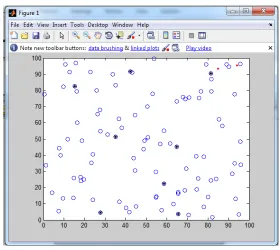
In figure 4.2 number of nodes are 50 and
they are deployed in a network out of which
groups of nodes are formed and nodes are
sending data to the cluster head.
P
Fig. 4.2
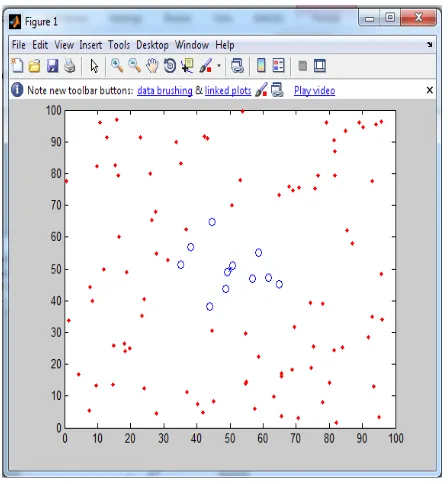
In the figure 4.3 random pattern of nodes
have been generated in which nodes are
sending data to the base station, the base
station is the cross mark at the center, out of
these node with the highest energy is chosen
as the cluster head which can send data to
farther places.
P
Fig.4.3
In figure 4.4 we can see that pattern of nodes
is changing as all the nodes are sending to
the base station.
P
Fig. 4.4
In figure 4.5 cluster head is sending data to
the base station and the node whose energy
is decreasing is becoming dead. In the figure
below few of the nodes are becoming dead.
P
Fig. 4.5
In figure 4.6 all the nodes are dead after
sending the data, the node with the highest
energy become dead in the last.
P Fig. 4.6
In figure 4.7 the graph depicts that all the
nodes after a certain time are becoming
dead, it is a slow process as we can see that
the graph is declining slowly and after that
all the nodes reached the dead point.
P
Fig. 4.7
Conclusion and Future work-Routing in sensor networks is a new area of research,
with a limited but rapidly growing set
of research results. In this article we present
a comprehensive survey of routing
techniques in wireless sensor networks that
have been presented in the literature. They
have the common objective of trying to
extend the lifetime of the sensor network
while not compromising data delivery. This
will reduce the overhead and improve
lifetime of the network. Although many of
these routing techniques look promising,
there are still many challenges that need to
be solved in sensor networks. We highlight
those challenges and pinpoint future
research directions in this regard. In future
we can introduce heterogeneity in terms of
energy in which some percentage of the
nodes will have more energy than other
nodes using both the protocols. We can
enhance the performance of the network by
increasing the energy of some nodes in the
network which will help to increase the
lifetime of the network.
References-1. Ahmed A. Ahmed, Hongchi Shi, and Yi
Shang, “A Survery On Network
Protocols For Wireless Sensor
Networks”, Department of Computer
Engineering & Computer Science.
2. Fan Xiangning, Song Yulin,
“ Improvement on LEACH Protocol of
Wireless Sensor Network”, IEEE
2007 .
3. Feng Sen, Qi Bing, Tang Liangrui, “An
Improved Energy-Efficient
PEGASIS-Based Protocol in Wireless Sensor
Networks”, IEEE 2011.
4. Ian F. Akyildiz, Weilian Su, Yogesh
Sankarasubramaniam, and Erdal
Cayirci, “A Survey on Sensor
Networks” , IEEE 2002
5. Jason Lester Hill,“System Architecture
for Wireless Sensor Networks”.
6. Laiali Almazaydeh, EmanAbdelfattah,
Manal Al- Bzoor, and Amer Al-
Rahayfeh, “Performance Evaluation of
Routing Protocols In Wireless Sensor
Networks”, April 2010.
7. Stephanie Lmdsey and CauligiS.
Raghavendra, “PEGASIS:
Power-Efficient Gathering in Sensor
Information Systems”, IEEE 2002.
8. Wendi Rabiner Heinzelman, Anantha
Chandrakasan, and Hari Balakrishnan ,
“Energy-Efficient Communication
Protocol for Wireless Microsensor
Networks, IEEE 2000.
9. WU Xiaoping, Ling Hong, LI Gang,
“An Improved Routing Algorithm
Based On LEACH Protocol”, IEEE
2010.
10.Ying Miao, “ Applications of Sensor Networks”.
I. Websites:
32TU
http://www.jlhlabs.com/jhill_cs/jhill_thesis. pdf
32TU
http://en.wikipedia.org/wiki/Wireless_sensor _network
32TU
http://www.sensor-networks.org/
32TUhttp://rajeshkrishnan.com/pubs/krishna n_ahn06.pdf
![Figure 1. Structural view of sensor network [4]](https://thumb-us.123doks.com/thumbv2/123dok_us/7845520.1300659/2.612.70.305.254.496/figure-structural-view-sensor-network.webp)