Ultra Low-Power implementation of ECC on the
ARM Cortex-M0+
Ruan de Clercq, Leif Uhsadel, Anthony Van Herrewege, Ingrid Verbauwhede K.U. Leuven,
Department of Electrical Engineering - ESAT/COSIC and iMinds
Kasteelpark Arenberg 10, 3001 Heverlee-Leuven,
Leuven, Belgium
mail:
[email protected]
AbstractIn this work, elliptic curve cryptography (ECC) is used to make an efficient implementation of a public-key cryptography algorithm on the ARM Cortex-M0+. The goal of this implementation is to make not only a fast, but also a very low-power software implementation. To aid in the elliptic curve parameter selection, the energy consumption of different instructions on the ARM Cortex-M0+ was measured and it was found that there is a variation of up to 22.5% between different instructions. The instruction set architecture (ISA) and energy measurements were used to make a simulation of both a binary curve and a prime curve implementation, and the former was found to have a slightly faster execution time with a lower power consumption. Binary curve arithmetic use instructions which requires less energy than prime curve arithmetic on the target platform. A new field multiplication algorithm is proposed, calledL´opez-Dahab with fixed registers, which is an optimization of the
L´opez-Dahab(LD) algorithm. The proposed algorithm has a performance improvement of 15% over theLD with rotating registersalgorithm (which is the current fastest optimization of theLDalgorithm). A software implementation that uses the proposed algorithm was made in C and assembly, and on average our implementation of a random point multiplication requires 34.16 µJ, whereas our fixed point multiplication requires 20.63 µJ. The energy consumption of our implementation beats all known software implementations on embedded platforms, of a point multiplication, on the same equivalent security level by a factor of 7.4.
I. INTRODUCTION
A typical application for public-key cryptography in the ultra low-power domain is for Wireless Sensor Network (WSN). A WSN is an ad-hoc wireless network that consists of a number of nodes and one or more base stations. WSNs require security, because they communicate through an insecure communication medium and they often operate unattended. As these devices are made to be economically viable, they have a limited amount of energy, computation power, memory and communication abilities. A node’s lifetime is also directly influenced by the amount of energy that it uses to perform computations and is therefore also directly influenced by the efficiency of its algorithms.
Due to their high computational requirements, RSA [1] and DSA [2] are considered to be impractical for use in WSNs, where the devices are very constrained in processing power and energy. ECC [3], [4] is an attractive alternative due to its low computational and memory requirements, and is particularly useful in hybrid cryptosystems where PKC is used for key exchange, and symmetric cryptography is used for the efficient encryption of data. Digital signatures are also useful for WSNs, as they can guarantee the authenticity, and integrity of the data. To perform a key exchange the Elliptic Curve Diffie-Helman exchange (ECDH) can be used, and for generating digital signatures the Elliptic Curve Digital Signature Algorithm (ECDSA) could be used.
The ARM Cortex-M0+ [5] is a low cost, ultra low-power microcontroller that provides great performance due to its 32-bit architecture, and it features a small but powerful instruction set. The authors are convinced that the chosen platform is appropriate for WSNs not only because of its specs, but also as first integrations of this unit are already announced [6]. As this processor has only been available since 2012, we do not know of any other PKC implementations optimized for this architecture. By being the first to make an implementation on this architecture we are setting a benchmark to which the performance of future implementations can be measured.
We now present to you the new state of the art in low-power software implementations of ECC on the ARM Cortex-M0+. Efficient long number arithmetic will be performed on the architecture using assembly optimizations for the processor’s instruction set. The results will be compared to the existing solutions in the ultra low-power domain, as well as to a standard library which have been compiled on ARM.
The rest of the paper is organized as follows. First, we will discuss related work in the low-power domain, followed by a discussion on the methods that were used to perform the parameter, and algorithmic selection for our implementation. Next, we describe our results, and compare it with the results from implementations found in literature and in software libraries. Subsequent, we discuss some ideas for future work, and finally we provide a general conclusion.
II. RELATEDWORK
multiplication method, as our implementation is based on this. The LD method and window parameter w will be discussed in more detail later. A number of low-power implementations exist in the literature; however, in the past a lot of the focus has gone towards software implementations on existing WSNs like the 8-bit MICA2 and MICAz (which both contain the ATMega128L) and the 16-bit TelosB (which contains the MSP430). Only a small number of implementations were found in the literature for ARM microcontrollers like the IMote2 (which contains the ARMv5TE based PXA271), and the ARM7TDMI. Szczechowiak et al. [8] made binary curve, and prime curve implementations for the Tmote Sky and the MICA2, based on the MIRACL library. Multiplication on prime curves use Hybrid multiplication [9], and multiplication on binary curves use the Karatsuba-Ofman multiplication algorithm. For binary fields they used binary Koblitz curves as no expensive doubling operations are required. For their fixed point multiplication in prime fields they did some pre-computation with the Comb method andw= 4. Their point multiplications in prime fields was found to be faster than in binary.
Kargl et al. made software implementations on the ATMega128L for prime, and binary fields [10]. For multiplication in the binary field they use LDwithw= 4, and a Montgomery-ladder algorithm which provides a constant execution time for point multiplication.
B. Oliveira et al. [11] made an implementation for the PXA27x on an underlying binary field of order 2271. They made an
optimization of the LD algorithm, called the LD with rotating registers method. They also performed immediate reduction of the upper half of the words instead of writing them to memory for later reduction. Assembly optimizations were used for field arithmetic.
P. Szczechowiak et al. [12] made an implementation in2271that uses theLDwithw= 8, and 2-bit scanning. Two pointers are used to access the appropriate bytes in memory, thereby avoiding a multi-precision shift of the partial product vector.
Aranha et al. [13] made an optimization to the LD algorithm, called LD with rotating registers, where the memory accesses of intermediate values are reduced by making use of a rotating register scheme. In their implementation on the ATMega128L, they interleave multiplication with the reduction operation, and modular squaring is done with the table-based method interleaved with the reduction step so that the upper half of the words which are produced by squaring doesn’t need to be written to memory.
S. Erdem [14] made several binary curve implementations for the ARM7TDMI using the operand-scanning method combined withLDwithw= 4.
Gouvea et al. [15] made implementations on prime curves, binary curves, and binary Koblitz curves for MSP430 microcontrollers. Comba [16] multiplication is used for 160-bit prime curves, and Karatsuba-Ofman [17] multiplication is used for 256-bit prime curves. For binary fields they use LD multiplication for the 163-bit underlying field, and Karatsuba-Ofman with LDfor the 283-bit underlying field.
III. METHODS
In this section, we present you with the methods that were used to perform the parameter and algorithmic selection that is necessary to make an efficient and low-power ECC implementation. First, we will discuss the model that was used to make a curve selection. Next, we will discuss some of the algorithmic choices that was made.
A. Matching a curve to the architecture
In order to make an efficient and low-power implementation it is necessary to select the appropriate curve for the architecture of the target platform. A model was made to determine the instruction usage, cycle count, and energy usage of a specific curve. For the model we considered only Binary Koblitz, and prime curves. Efficient algorithms and coordinate systems were selected to perform a point multiplication. The core of this model consisted of an analysis of the instructions required for performing a field multiplication algorithm, as this is most dominant routine in terms of execution time in an ECC. From this we estimated the execution times for performing a point multiplication, and we came to two conclusions: (1) Binary Koblitz curves will lead to a slightly faster implementation (2) Binary curves require less power than prime curves, due to the binary curve arithmetic using many XOR and shift instructions, whereas prime curves require instructions which requires less energy (shift and XOR vs multiply and ADD) on the target platform (See section IV-A).
B. Field arithmetic algorithms
Here we will discuss some of the different field arithmetic algorithms that were used during analysis and implementation. 1) Multiplication: Consider two binary polynomials x(z) and y(z) of degree at most m−1. The output of the field multiplication function should produce the result of the polynomial multiplication x(z)·y(z).
lookup table is computed with T(u)←u(z)·y(z) for all polynomials u(z)of degree lower than w. The number of words required to store the lookup table is given by:
2w(n+ 1) , if degree(y) > nW−(w−1),
2w(n) , if degree(y) ≤nW −(w−1), (1)
wherenis the number of words needed for the field parameter. This means that if the degree of the most significant word ofy
is smaller or equal toW−(n−1), then the lookup table will fit into2wnwords. This is due to the fact that while generating
the lookup table, y gets shifted byw−1which causes the polynomial to overflow into the next word.
We propose a new optimization to the (LD)field multiplication algorithm, and call it theL´opez-Dahab with fixed registers method. This algorithm aims to reduce the number of memory operations by keeping as many words of the internal state vector as possible inside registers. The most frequently used words are stored inside fixed register positions, and the least frequently used words are stored inside memory. On the target platform it is feasible to store a maximum of nine words inside registers.
Algorithm 1 shows theLD with fixed registersfor n= 8, and a register count ofn+ 1.The vectorv denotes the internal state vector of 2n words which contains the intermediate results, which are stored inside memory, as well as fixed register positions. The n+ 1most frequently used words are stored inside registers (r), and the remaining n−1 words are stored inside memory (m). It was observed thatv[3· · ·12]are the most frequently usedn+ 1elements and are therefore stored inside the registers. v[0· · ·2]and v[13· · ·15] are the least frequently usedn−1 elements insidev and are therefore stored inside memory.
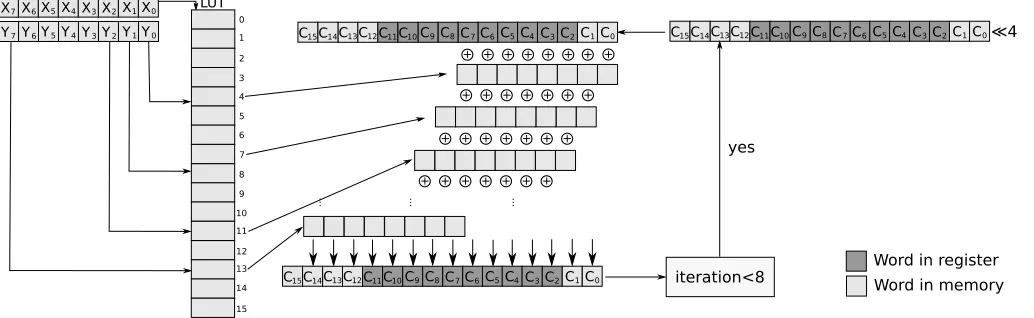
Fig. 1 provides a visual representation of the algorithm. All the light colored squares represents words which are stored in memory, and all the dark colored squares represents words which are stored in registers. First the lookup table (indicated with LUT) is computed from the input parameter x. Each cell inside the LUT represents 8 words stored in memory. The vectorC
contains the partial products of the multiplication, and consists of words stored inside memory, as well as in registers. The vector y is split into sections of w bits, and these sections are used as an index into the LUT. The index is used to read a cell in the LUT, and add it to C. As each cell contains 8 words, 8 words are read from the LUT, and then added toC. The lookup and add process is repeated 8 times, each time offset by one more word. After the eighth lookup, C is left shifted by 4 bits. This is repeated 8 times, but in the final iteration the shift is not required.
In order to reduce the number of memory operations the field multiplication algorithm can be interleaved with the reduction algorithm.
Algorithm 1 L´opez-Dahab with fixed registersmultiplication inF2m for n= 8. Input:x(z) =x[0· · ·n−1], y(z) =y[0· · ·n−1]
Output: v(z) =v[0· · ·2n−1] =x(z)y(z)
Note: v denotes the internal state vector composed of n − 1 memory addresses and n + 1 registers. v ←
(m[0], m[1], m[2], r0, r1,· · ·, rn, m[3], m[4], m[5], m[6]).
1: ComputeT(u)←u(z)y(z)for all polynomialsu(z)of degree lower than w
2: v[0· · ·2n−1]←0
3: forj← dW/we −1downto 0 do
4: fork←0ton−1 do
5: u= (x[k]j·W)& 0xF 6: forl←0ton−1 do
7: v[l+k]←v[l+k]⊕T[u][l]
8: end for
9: end for 10: if (j6= 0)then
11: v(z) =v(z)·zw
12: end if
13: end for
14: returnv
2) Reduction: Since the curve we are using has a sparse reduction polynomial, the reduction can be efficiently computed one word at a time.
C0 C1 C2 C3 C4 C5 C6 C7 C8 C9 C10 C11 C12 C13 C14 C15 X0 X1 X2 X3 X4 X5 X6 X7 iteration<8 yes Y0 Y1 Y2 Y3 Y4 Y5 Y6 Y7 LUT
Word in register Word in memory C0 C1 C2 C3 C4 C5 C6 C7 C8 C9 C10 C11 C12 C13 C14 C15 C0 C1 C2 C3 C4 C5 C6 C7 C8 C9 C10 C11 C12 C13 C14
C15 ≪4
Fig. 1. The proposedLD with fixed registersalgorithm inF2m forn= 8. The lookup table LUT is generated from the input scalarx. The main loop is executed 8 times forw= 4. The input parameteryis split up into sections ofwbits which are used as an index for the LUT.
u and v. This allows for performing a fast calculation of the degree of the polynomial and a reduced number of memory operations in the variable field shift function.
4) Squaring: Squaring is done by means of a 16-bit lookup table with 256 entries, requiring 4 kB. To reduce redundant memory operations, modular reduction is interleaved with the squaring functions. The lower half of the output of the squaring operation is kept inside the registers and the upper half is expanded and then immediately reduced. The upper half of the elements are therefore not required to be stored first and reduced later.
C. Analysis of multiplication algorithms
As field multiplication is the most dominant routine in terms of execution time in an ECC, three field multiplication methods were analyzed to determine the best match for the target platform. For all three methods a window size of w = 4is used, where a single precomputation table of 16nwords (4 kB) is required. This is valid under the assumption that the scalary is short.
For both the analysis of the LD with rotating registers, and theLD with fixed registers methods, we assume thatn+ 1registers are available for storing the partial products.
TABLE I
ESTIMATED CYCLE REQUIREMENTS FOR FIELD MULTIPLICATION INF2233.
Method Read Write XOR
A 16n2+ 23n 8n2+ 30n 8n2+ 30n−7
B 8n2+ 39n−8 46n 8n2+ 38n−7
C 8n2+ 24n+ 1 31n+ 1 8n2+ 30n−7
Method A:LD
Method B:LD with rotating registers Method C:LD with fixed registers
The number of shift operations remain constant at42n−21
for all three methods
TABLE II
ESTIMATED CYCLE REQUIREMENTS FOR FIELD MULTIPLICATION INF2233.
Method Read Write XOR Shift Total∗
A 1208 752 745 315 4980
B 816 368 809 315 3492
C 689 233 745 315 2968
Method A:LD
Method B:LD with rotating registers Method C:LD with fixed registers
The total number of shift operations is constant at42n−21
for all three methods
∗ Memory operations are assumed to require two cycles per
operation
the LD method to the LD with rotating registers method, we see a drastic reduction in the number of memory operations due to the implementation of the rotating register scheme, which minimizes the storing of intermediate values in memory. When comparing theLD with fixed registersmethod to theLD with rotating registers, we see a further reduction of memory accesses due to the more efficient usage of registers. TheLD with fixed registershas a performance increase of 15% over the LD with rotating registersmethod, and a performance increase of 40%
over the standard LDmethod.
As we would like to make an implementation that will have the fastest possible execution time we made an implementation with the LD with fixed registersalgorithm, which has the lowest estimated cost of only 2968 cycles.
D. Point multiplication
Point multiplication is the operation of multiplying a scalar kwith a point P on an elliptic curve, and it is responsible for the majority of the execution time of an ECC system. It is defined by the repeated addition of the pointP with itself,k−1
times:
kP =P+P+· · ·+P
| {z }
k−1additions
.
Point multiplication can be done by multiplying a scalar with either a fixed point, or with a random point. For the fixed point multiplication, the point can be seen as a constant, and therefore some precomputations can be done on this point in order to speed up the multiplication.
IV. RESULTS
This section will be used to present our key results. First, we will discuss the measurements setup, and the results from our measurements. Next, we will present two implementations, and compare them to the state of the art low-power implementations implementations found in literature, as well as in software libraries
A. Measurements setup and results
In order to determine the energy usage of different instructions as well as cryptographic software implementations, a system was designed to measure the power consumption of the target platform.
The power consumption for a number of different instructions were measured in order to investigate the effect of different field arithmetic algorithms on the overall power consumption. Table III shows the results of energy measurements for instructions which are relevant to prime and binary field arithmetic. A variation in energy consumption of up to 22.5% was observed between different instructions. The ADD instruction was found to be the most energy hungry, requiring 6.9% more energy than any other measured instruction. This is important for the choice of the underlying field because binary field arithmetic require a large amount of shift (LSL and LSR) and XOR instructions, whereas on prime field arithmetic require a large amount of MUL and ADD instructions.
TABLE III
THE ENERGY USED PER CYCLE FOR DIFFERENT INSTRUCTIONS. THE CLOCK FREQUENCY IS48MHZ.
Instruction Energy [pJ]
LDR 10.98
LSR 12.05
MUL 12.14
LSL 12.21
XOR 12.43
ADD 13.45
B. Comparison with other libraries
Table IV and Table V shows the proposed implementation compared with low power implementations found in literature, as well as in software libraries. In the cases where the energy consumption were not provided in the author’s results, the values are estimated from the typical energy consumption values found in [19], [20]. Both the ARM7TDMI, and the PXA271 are more powerful platforms than the ARMv6-M based ARM Cortex-M0+ because they both have larger instruction sets; however, the ARM Cortex-M0+ uses less energy than either the ARM7TDI or the PXA271.
The MIRACL Crypto SDK [22] is an open-source Elliptic Curve Crypto SDK that supports many different platforms. It is a C library with some field arithmetic in assembly for many of its supported the platforms. Some timings for this library can be found in [21] and are also listed in Table IV.
TABLE IV
TIMINGS FOR POINT MULTIPLICATIONS. ALL TIMINGS ARE GIVEN IN MILLISECONDS AND ENERGY IS GIVEN IN MICROJOULES(µJ). THEATMEGA128L RUNS AT7.37MHZ EXCEPT WHEN INDICATED WITHa,THEMSP430RUNS AT8.192MHZ,THEARM7TDMIRUNS AT80MHZ,AND THEARM
CORTEX-M0+RUNS AT48MHZ.
Multiply Platform Author Curve [ms] [µJ]
ARM7TDMI MIRACL [21] P-192 38r 182.4e ARM7TDMI MIRACL [21] P-224 53r 254.4e ATMega128L Aranha et al. [13] K-163 320r 9600e ATMega128La Kargl et al. [10] 167-bitb 763r 24840e ATMega128L Aranha et al. [13] K-233 730r 21900e
Cortex-M0+ This workkG sect233k1 39.70f 20.63m
Cortex-M0+ This workkP sect233k1 59.18r 34.16m
Cortex-M0+ RelickP K-233 115.7r 69.48m Cortex-M0+ RelickG K-233 117.1f 70.26m MSP430F1611 NanoECC [8] P-160 720f 8847m MSP430F1611 NanoECC [8] K-163 1040f 12780m aRuns at 8MHz.
mEnergy values obtained by measurement. eEnergy values obtained by estimation. f Fixed-point multiplication.
pA custom prime curve is used. r Random point multiplication.
TABLE V
AVERAGE CYCLE TIMES FOR MODULAR MULTIPLICATION AND MODULAR SQUARING ON DIFFERENT PLATFORMS.
Word
Author Platform size Sqr Mul Field
S. Erdem [14] ARM7TDMI 32 348 4359 F2228
S. Erdem [14] ARM7TDMI 32 389 5398 F2256
Aranha et al. [13] ATMega128L 8 570 4508 F2163
Aranha et al. [13] ATMega128L 8 956 8314 F2233
Kargl et al.[10] ATMega128L 8 - 2593 F160
Kargl et al.[10] ATMega128L 8 663 5490 F2167
P. Szczechowiak et al. [12]
ATMega128L 8 1581 13557 F2271
Gouvea [15] MSP430Xa 16 630 741
F160
Gouvea [15] MSP430Xa 16 199 3585
F2163
Gouvea [15] MSP430Xa 16 1369 1620
F256
Gouvea [15] MSP430Xa 16 325 8166 F2283
This work Cortex-M0+ 32 395 3672 F2233
TinyPBC [11] PXA271 32 187 2025 F2271
TinyPBC [11] PXA271b 32 187 1411
F2271
aThis model has a long 32-bit multiplier
bThis model (wMMX) has a SIMD instructions set.
In the following text we will present two implementations. First, we will present an implementation that relies exclusively on the RELIC toolkit to make all its computations. Next, we present an implementation that was largely developed in C and assembly, but also makes use of the RELIC toolkit to perform some calculations. The curve and algorithmic parameters for both implementations were chosen to match each other as close as possible.
1) RELIC implementation: The RELIC toolkit was used to make an implementation with the following configuration: A binary Koblitz curve of order 2233 is used. The left-to-right wTNAF method with w= 4 was used for point multiplication.
Point additions are done in mixed LD-affine coordinates. Fast reduction is done because the reduction polynomial is trinomial. Inversion is performed with the Extended Euclidean algorithm and squaring is done using the table-based method. The easy-to-understand arithmetic option is selected but this could be replaced with calls to the GMP library. However, we were unable to get the GMP library cross-compiled for the ARM Cortex-M0+ and were therefore unable to test this feature.
The RELIC implementation was measured to have an average power consumption of 600 µW while performing a random point multiplication, and 600.5 µW while performing a fixed point multiplication. This implementation requires an average of 5621045 cycles, and 72.5 µJ for a random point multiplication, and only 5553828 cycles, and 71.6 µJ for a fixed point multiplication. The average cycle time and energy usage of this implementation is compared to others in Table IV.
implemented in C and assembly.
Our proposed implementation was measured to have an average power consumption of 577.2 µW for a random point multiplication, and 519.6 µW for a fixed-point multiplication. On average our implementation of the random point multiplication requires 2814827cycles, and 36.6 µJ, whereas our fixed point multiplication requires1864470 cycles, and 24.6 µJ. Therefore our implementation has a cycle count that is 1.99 times faster than the RELIC implementation for random point multiplication, and has a cycle count which is 2.98 times faster than the RELIC implementation for fixed point multiplication. The average execution time and energy usage of this implementation is compared to others in Table IV and Table V. The C and assembly implementations’ cycle times for the field arithmetic routines are shown in Table VI. The accumulated execution time for different operations are shown in Table VII for both a random point multiplication (kP), as well as a fixed point multiplication (kG).
TABLE VI
AVERAGE CYCLE TIMES FOR FIELD ARITHMETIC ALGORITHMS INF2233.
Operation C language Assembly
Modular Squaring 419 395
Inversion 141 916
-LD with rotating registers 5 592 -LD with fixed registers 5 964 3 672
kP 3 516 295 2 761 640
kG 2 494 757 1 864 470
TABLE VII
TOTAL ACCUMULATED TIMINGS PER OPERATION FOR RANDOM POINT MULTIPLICATION(kP),AND FIXED POINT MULTIPLICATION(kG).
Operation kP kG
TNAF Representation 178 135 185 926 TNAF Precomputation 398 387 0 Multiply 1 108 890 821 178 Multiply Precomputation 249 750 184 950
Square 362 379 342 294
Inversion 139 936 139 656 Support functions 377 350 376 392 Total 2 814 827 1 864 470
V. FUTUREWORK
The current implementation doesn’t execute in constant-time and is therefore at risk of a power analysis attack. It would be very interesting to see the results of an implementation where the point multiplication routine is implemented in constant-time by using an algorithm like the Montgomery-Ladder [24] method.
VI. CONCLUSION
We made an ECC implementation based on a binary Koblitz curve in F2233, because we estimated that it will lead to
a faster implementation with a lower energy consumption than a prime curve implementation with an equivalent security level. A new field multiplication algorithm was proposed, called the L´opez-Dahab with fixed registers, which is an optimization of the L´opez-Dahab(LD) algorithm. Our proposed algorithm has a cycle count of 3672 cycles, and a performance improvement of15%over theLD with rotating registersalgorithm. Our implementation of a random point multiplication requires2814827cycles, and 34.16 µJ, whereas our fixed point multiplication requires1864470cycles, and 20.63 µJ. The energy consumption of our implementation beats all known software implementations on embedded platforms, of a point multiplication, on the same equivalent security level by a factor of 7.4.
REFERENCES
[1] R. Rivest, A. Shamir, and L. Adleman, “A Method for Obtaining Digital Signatures and Public-Key Cryptosystems,”Communications of the ACM, vol. 21, pp. 120–126, 1978.
[2] David W. Kravitz, “Digital signature standard,”U.S. Patent No. 5,231,668, 1993.
[3] N. Koblitz, “Elliptic Curve Cryptosystems,”Mathematics of Computation, vol. 48, no. 177, pp. 203–209, Jan. 1987.
[4] V. S. Miller, “Use of elliptic curves in cryptography,” in Lecture notes in computer sciences; 218 on Advances in cryptology—CRYPTO 85. New York, NY, USA: Springer-Verlag New York, Inc., 1986, pp. 417–426. [Online]. Available: http://dl.acm.org/citation.cfm?id=18262.25413
[5] ARM, “Cortex-M0+ Technical Reference Manual, Revision: r0p1,” 2012, accessed: 2013-06-06.
[6] I. Freescale Semiconductor, “MKW01Z128, Highly-integrated, cost-effective single-package solution for sub-1 GHz applications, Rev. 3, 5/7/2013,” 2013, accessed: 2013-06-06.
[8] P. Szczechowiak, L. B. Oliveira, M. Scott, M. Collier, and R. Dahab, “NanoECC: Testing the Limits of Elliptic Curve Cryptography in Sensor Networks.” in EWSN, ser. Lecture Notes in Computer Science, R. Verdone, Ed., vol. 4913. Springer, 2008, pp. 305–320. [Online]. Available: http://dblp.uni-trier.de/db/conf/ewsn/ewsn2008.html#SzczechowiakOSCD08
[9] N. Gura, A. Patel, A. Wander, H. Eberle, and S. C. Shantz, “Comparing elliptic curve cryptography and RSA on 8-bit CPUs,” inCryptographic Hardware and Embedded Systems-CHES 2004. Springer, 2004, pp. 119–132.
[10] A. Kargl, S. Pyka, and H. Seuschek, “Fast arithmetic on ATmega128 for elliptic curve cryptography,”International Association for Cryptologic Research Eprint archive, 2008.
[11] L. B. Oliveira, M. Scott, J. L´opez, and R. Dahab, “TinyPBC: Pairings for authenticated identity-based non-interactive key distribution in sensor networks,” inIn Networked Sensing Systems, 2008. INSS 2008. 5th International Conference on, 2008, pp. 173–180.
[12] P. Szczechowiak, A. Kargl, M. Scott, and M. Collier, “On the application of pairing based cryptography to wireless sensor networks,” inProceedings of the second ACM conference on Wireless network security. ACM, 2009, pp. 1–12.
[13] D. F. Aranha, L. B. Oliveira, J. L´opez, and R. Dahab, “Efficient implementation of elliptic curve cryptography in wireless sensors,” Advances in Mathematics of Communications, vol. 4, no. 2, pp. 169–187, 2010.
[14] S. S. Erdem, “Fast software multiplication inF2[x]for embedded processors,”Turkish Journal of Electrical Engineering & Computer Sciences, 2012.
[15] C. P. L. Gouvˆea, L. B. Oliveira, and J. L´opez, “Efficient software implementation of public-key cryptography on sensor networks using the MSP430X microcontroller,”J. Cryptographic Engineering, vol. 2, no. 1, pp. 19–29, 2012. [Online]. Available: http://dblp.uni-trier.de/db/journals/jce/jce2.html# GouveaOL12
[16] P. G. Comba, “Exponentiation cryptosystems on the IBM PC,”IBM systems journal, vol. 29, no. 4, pp. 526–538, 1990. [17] A. Karatsuba and Y. Ofman, “Multiplication of multidigit numbers on automata,” inSoviet physics doklady, vol. 7, 1963, p. 595.
[18] D. Hankerson, A. J. Menezes, and S. Vanstone,Guide to Elliptic Curve Cryptography. Secaucus, NJ, USA: Springer-Verlag New York, Inc., 2003. [19] K. Piotrowski, P. Langendoerfer, and S. Peter, “How public key cryptography influences wireless sensor node lifetime,” inProceedings of the fourth
ACM workshop on Security of ad hoc and sensor networks, ser. SASN ’06. New York, NY, USA: ACM, 2006, pp. 169–176. [Online]. Available: http://doi.acm.org/10.1145/1180345.1180366
[20] D. G. Chinnery and K. Keutzer, “Closing the power gap between ASIC and custom: an ASIC perspective,” inProceedings of the 42nd annual Design Automation Conference. ACM, 2005, pp. 275–280.
[21] Certivox Ltd., “Benchmarks and Subs,” https://wiki.certivox.com/display/EXT/Benchmarks+and+Subs?sortBy=createddate, Oct. 2012, accessed: 2013-05-28.
[22] ——, “MIRACL Cryptographic Library,” https://certivox.com/solutions/miracl-crypto-sdk/, 2013, accessed: 2013-05-28.