Comparative Analysis On High Performance Concrete Of M45 & M50
1N. SHILPASREE ,
2Dr. B. RAMESH BABU,
3S. NIRAMALA
1
M.Tech Dept of CIVIL Engineering, ALITS College, Affiliated to JNTUA, AP, India.
2
Principal , ALITS College, Affiliated to JNTUA, AP, India
3
Associate Professor Dept of CIVIL Engineering , ALITS College, Affiliated to JNTUA, AP, India
ABSTRACT
:- Modification in cement concrete to
improve its strength and durability is need of the
hour. Cement concrete has many drawbacks
such as low tensile strength, susceptibility to
chemical attack, corrosion of reinforcement and
low durability. Research is being carried out to
overcome these drawbacks.
The use of blended cement is becoming common
in these days. This is as an attempt made by
researches in the direction of utilization of
materials which are available in nature
abundantly. The new admixture ‘SikaCim’ is one
such organic material which is being tested and
used in recent times. This organic chloride free
liquid admixture is found to be satisfactory in
improving
the
characteristics
of
cement
concrete. While there is much to be done in
order to standardize the properties of admixture,
an attempt is made in the present work to
investigate the influence of the admixture
‘SikaCim’ on the compressive strength and
workability of concrete. The experimental study
of this investigation consists of concrete mix for
target mean strength. The mix was worked out
giving certain proportions by keeping the water
cement ratio constant for different mixes of M50
and M45. The mix is obtained with water-cement
ratio 0.35 for M45 and 0.3 for M50. For this
mix the different percentages of admixture i.e.
0%, 0.1%, 0.15%, 0.2%, 0.25% and 0.3% by
weight of cement. These percentages were added
in mix of cement: fine aggregate: coarse
aggregate in the ratio 1:1.707:2.852 for M50
and 1:1.534:2.562 for M45. Specimens were
tested up to failure to study the behaviour in
compression..
I. INTRODUCTION
Advances in cement and concrete research are
continuous and ongoing despite advances in the
production of accelerated setting and high
strength cement ,the development of Portland
cement with varying controlled setting times and
high compressive strength and higher rate of
strength development would be highly beneficial
to the cement and the construction industries,
especially in the area of new materials
,admixtures , reduced usage of cement, self
curing concrete, self compacting concrete,
economical production of concrete. For example
producing ready mix concrete transportable to
longer distances ,enhancing initial setting time
beyond
30
minutes,
will
revolutionize
construction
industry,
enabling
quality
construction practices in inaccessible places.
Reduced usage of water in concrete production
and curing could be yet another for reaching
global research effort. While achieving the
above objectives ,concrete durability and
strength requires to be enhanced.
strength when compared to conventional
concrete. This concrete contains one or more of
cementious materials such as fly ash, Silica
fume or ground granulated blast furnace slag and
usually a super plasticizer. The term „high
performance‟ is somewhat pretentious because
the essential feature of this concrete is that it‟s
ingredients and proportions are specifically
chosen so as to have particularly appropriate
properties for the expected use of the structure
such as high strength and low permeability.
Hence High performance concrete is not a
special type of concrete. It comprises of the
same materials as that of the conventional
cement concrete. The use of some mineral and
chemical admixtures like Silica fume and Super
plasticizer enhance the strength, durability and
workability qualities to a very high extent.
High Performance concrete works out to be
economical, even though it‟s initial cost is
higher than that of conventional concrete
because the use of High Performance concrete in
construction enhances the service life of the
structure and the structure suffers less damage
which would reduce overall costs.
Concrete is a durable and versatile construction
material. It is not only Strong, economical and
takes the shape of the form in which it is placed,
but it is also aesthetically satisfying. However
experience has shown that concrete is vulnerable
to deterioration, unless precautionary measures
are taken during the design and production. For
this we need to understand the influence of
components on the behaviour of concrete and to
produce a concrete mix within closely controlled
tolerances.
The conventional Portland cement concrete is
found deficient in respect of :
1. Durability in severe environs (shorter service
life and frequent maintenance)
2. Time of construction (slower gain of strength)
3. Energy absorption capacity (for earthquake
resistant structures)
4. Repair and retrofitting jobs.
II. RELATED WORK
M. Myint Lwin, Formerly Washington State
Department of Transportation
Washington State Department of Transportation
(WSDOT) has developed and used
high-performance concrete (HPC) mixes containing
fly ash and silica fume in several highway
bridges since 1992. The concrete has high
compressive strength attaining 10,000 psi (69
MPa) by 28 days, low chloride permeability
averaging less than 1,000 coulombs by 56 days,
and generally lower shrinkage and creep values
than conventional concrete. In 1995, WSDOT
was interested in expanding the use of
high-performance concrete and participated in a
demonstration project sponsored by the Federal
Highway Administration (FHWA). The project,
known as SR 18 over SR 516 east-bound in
King
County,
consists
of
a
three-span
continuous prestressed concrete bridge. The
center span has a length of 137 ft (42 m) and the
end spans are each 80 ft (24 m) long. The
roadway deck is 38 ft (11.6 m) wide, carrying
two 12-ft (3.7-m) lanes and 4-ft (1.2-m) and
10-ft (3.0-m) wide shoulders. The bridge is located
in earthquake zone “C” with an earthquake
acceleration coefficient equal to 0.25g. The
design complies with the new AASHTO LRFD
Bridge Design Specifications. Construction of
this project started in July 1996 and the bridge
was completed and opened to traffic in
October1997.
Laszlo Dunaszegi, Stantec Consulting Ltd.,
Calgary.
years and then transfers the bridge to the federal
government.
III. EXPERIMENTAL STUDY
The experimental programme involved the
casting and testing of 144 cube specimens of
concrete
of
standard
size
(150mmx150mmx150mm)
for
testing
on
workability and compressive strength of M45
and M50. The concrete cubes were divided into
6 groups of 0%, 0.1%, 0.15%, 0.2%, 0.25%,
0.3% admixture by weight of cement. For each
percentage 12 cubes were tested. Universal
Testing Machine was used to test the specimens.
MATERIAL PROPERTIES
Ordinary Portland cement(Ultra Tech cement) of 53 grade confirming to IS : 12269-1987 is used
Physical Properties of cement are evaluated from laboratory tests.
Consistency: This test is done as per IS: 8112-1989. The consistency was found to be 32 % with 7 mm reading in the vicat apparatus
Initial setting time: Initial setting time of cement is 30 minutes.
Final setting time : Final setting time of cement is 600 minutes.
Specific Gravity of cement :This test has
been done as per test procedure mentioned in the IS code 269-1989. Specific Gravity of
cement is found to be 3.14
Fineness: fineness of cement by sieve analysis is found to be 3%
COARSE AGGREGATE
Crushed stone aggregate (angular) 20 mm
maximum size confirming to IS 383-1970
requirements has been used .
Specific Gravity of coarse aggregate is 2.61
Fineness modulus of coarse aggregate is found
to be 7.44
WATER :
Potable water was used for mixing and curing. ADMIXTURE
SikaCim admixture was used which is a water reducing admixture.
A. MIX DESIGN PROCEDURE FOR M 50 GRADE CONCRETE
Grade Designation = M-50
Type of cement = ultratech 53 grade cement Admixture = Sikacin
Specific Gravity of Cement = 3.14 Fine Aggregate = Zone-II
Specific gravity of sand = 2.55
Specific gravity of Coarse Aggregate = 2.61 Maximum water cement ratio = 0.45(from IS456) Mix Calculation: -
1. Target Mean Strength ,f'ck=fck+t.S where fck=compressive strength of concrete
S=standard deviation (value of S is 5 from table 1 IS 12062-2009)
t=a standard value depending upon the accepted proportion of low results and
number of tests=5
f'ck=50 + ( 5 X 1.65 ) = 58.25 Mpa
2. Selection of water cement ratio:- Assume water cement ratio = 0.32
3. Calculation of water: - Approximate water content for 20mm max. Size of aggregate = 180 kg /m3 (As per Table No. 2 , IS : 10262 ).
As plasticizer is proposed we can reduce water content by 20%.
Now water content = 180 X 0.8 = 144 kg /m3 4. Calculation of cement content:- Water cement ratio = 0.32
Water content per cum of concrete = 144 kg Cement content = 144/0.32 = 450 kg / m3
5. Calculation for C.A. & F.A.: [ Formula's can be seen in earlier posts]-
Volume of concrete = 1 m3
Volume of cement = 450 / ( 3.15 X 1000 ) = 0.1433 m3
Volume of water = 144 / ( 1 X 1000 ) = 0.1440 m3 Total weight of other materials except coarse aggregate = 0.1433 + 0.1440 = 0.2873 m3
Volume of coarse and fine aggregate = 1 – 0.2873 = 0.7127 m3
Volume of F.A. = 0.7127 X 0.38 = 0.2708 m3 (from table3 IS10262-2009)
Volume of C.A. = 0.7127 – 0.2708 = 0.4418 m3 Therefore weight of F.A. = 0.2708 X 2.55 X 1000 = 690.54kg
Therefore weight of C.A. = 0.4418 X 2.61 X 1000 = 1153.098 kg
B. MIX DESIGN PROCEDURE FOR M45 GRADE CONCRETE
Grade Designation = M-45
Type of cement = ultratech 53 grade cement Admixture = Sikacin
Specific Gravity of Cement = 3.14 Fine Aggregate = Zone-II
Specific gravity of sand = 2.55
Specific gravity of Coarse Aggregate = 2.61 Maximum water cement ratio = 0.45(from IS456) Mix Calculation: -
1. Target Mean Strength ,f'ck=fck+t.S where fck=compressive strength of concrete
S=standard deviation (value of S is 5 from table 1 IS 12062-2009)
t=a standard value depending upon the accepted proportion of low results and
number of tests=5
f'ck=45 + ( 5 X 1.65 ) = 53.25 Mpa
2. Selection of water cement ratio:- Assume water cement ratio = 0.35
3. Calculation of water: - Approximate water content for 20mm max. Size of aggregate = 180 kg /m3 (As per Table No. 2 , IS : 10262 ).
As plasticizer is proposed we can reduce water content by 20%.
Now water content = 180 X 0.8 = 144 kg /m3 4. Calculation of cement content:- Water cement ratio = 0.35
Water content per cum of concrete = 144 kg Cement content = 144/0.35 = 411.4 kg / m3 5. Calculation for C.A. & F.A.: [ Formula's can be seen in earlier posts]-
Volume of concrete = 1 m3
Volume of cement = 411.4 / ( 3.15 X 1000 ) = 0.1306 m3
Volume of water = 144 / ( 1 X 1000 ) = 0.1440 m3 Total weight of other materials except coarse aggregate = 0.1306 + 0.1440 = 0.2749 m3
Volume of coarse and fine aggregate = 1 – 0.2749 = 0.7251 m3
Volume of F.A. = 0.7251 X 0.38 = 0.2755 m3 (from table3 IS10262-2009)
Volume of C.A. = 0.7251 – 0.2755 = 0.4495 m3 Therefore weight of F.A. = 0.2755 X 2.55 X 1000 = 702.54kg
Therefore weight of C.A. = 0.4495 X 2.61 X 1000 = 1173.35 kg
Water : Cement : Fine aggregate : Coarse aggregate =0.35 : 1 : 1.707 : 2.852
RESULTS
A. TEST RESULTS OF M45:
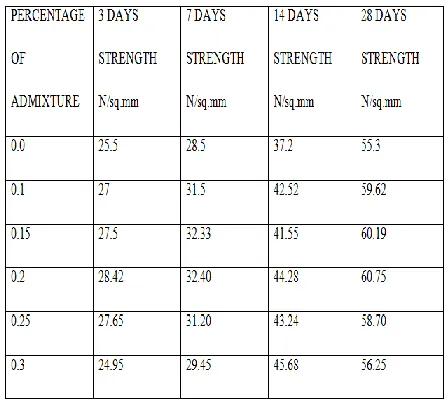
TABLE 1; compressive strength of concrete for different percentages of admixtures for M45 grade:
TEST RESULTS OF M50:
Fig 1: compressive strength at 7 days (N/sq.mm) Comparison of M45 and M50 for different % of Admixture
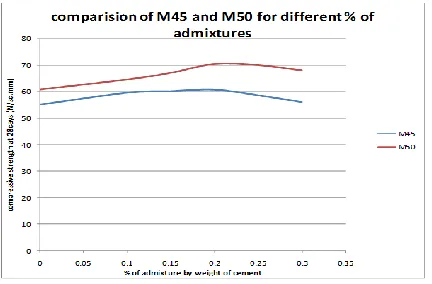
Fig 2: compressive strength at 28 days (N/sq.mm) Comparison of M45 and M50 for different % of Admixture
CONCLUSION
Results of the experimental investigation on the compressive strength of concrete cubes of M45 and M50 when added with different % of admixtures to the weight of cement is reported .
The maximum compressive strength of concrete is achieved at 0.2% of admixture.
The rate of gain of strength is maximum at 0.15% admixture .
The incremental increase in strength is more to M50 compare to that of M45.
The optimum percentage of admixture for M45 and M50 is 0.2% of admixture to cement weight. The compressive strength of concrete cubes increased by15% with the addition of admixture.
REFERENCES
1. A. MEYER , "Experiences in the Use of Super plasticizers in concrete", ACI special publication No.62 PP21-36(1979)
2.V.M. Malhotra , "Super Plasticizers and plasticisers in concrete", CANTMENT Report M.R.P.-M.S.L 77-213, PP-20
3.Neville, "Properties of Concrete", The English Language Book Society and Pitman Publishing.
4.M.S. Shetty, "Textbook of concrete technology", Chand & co.,New Delhi, 1996
5.IS : 9013-1999 "Concrete Admixtures and Specifications"
6.ASTMC 494 Standard Specification for Chemical Admixtures for concrete
7.ASTMC 260 Standard Specification for Air -Entraining Admixtures for concrete
8. ACI-350R Hot Weather Concreting
9. ACI-360R Cold Weather Concreting
10.ACI-308 Standard practices for curing concrete
11.B . Foster, "Symposium on effect of water reducing admixtures and set retarding admixtures on properties of concrete" IBID Press, PP 240-6
12. High-Performance Concrete Case Study-PC FOR DURABILITY OF THE CONFEDERATION BRIDGE by Laszlo Dunaszegi, Stantec Consulting Ltd., Calgary
13. High-Performance Concrete Case Study-Washington State HPC Showcase Bridge by
M. Myint Lwin, Formerly Washington State Department of Transportation
14. SikaCim® admixture for concrete & mortars-www.sikacim.com -Product Data Sheet Edition 2011-10_1 SikaCim®