
The Energy Budget for Wireless Security: Extended Version
⋆Dave Singel´ee1
, Stefaan Seys1
, Lejla Batina1,2
, and Ingrid Verbauwhede1 1
K.U.Leuven ESAT-COSIC and iMinds
Kasteelpark Arenberg 10, B-3001 Leuven-Heverlee, Belgium
2
Radboud University Nijmegen, CS Dept./Digital Security group Heyendaalseweg 135, 6525 AJ Nijmegen, The Netherlands
Abstract. Due to the numerous security and privacy risks, applications deployed in wireless networks require strong cryptographic protection. Reducing the energy cost of cryptographic algorithms and protocols that run on wireless embedded devices, is a crucial requirement when developing security and privacy solutions for wireless networks. The goal of this work is to give an insight to the global energy cost of secure wireless communications. We will compare the energy cost of different wireless standards and a wide range of cryptographic primitives. To illustrate these numbers, we will evaluate the energy consumption of several authentication schemes for RFID. The results show that both computation and communication cost are important factors in the energy budget, and clearly connected to the security and privacy properties of the wireless applications.
Keywords: Wireless Security, RFID, Authentication, Cryptography, Energy Consumption.
1 Introduction
Today, an increasing number of wireless embedded systems – such as ambient intelligence, the Internet of Things, smart dust, e-health applications – are used in our daily life. Var-ious security and privacy risks arise in these environments. To tackle these threats, there is a clear need for cryptographic algorithms and protocols. However, adding these security and privacy solutions to wireless applications also has a cost. Since most wireless embed-ded devices typically have an extremely limited power, energy and area budget, conventional cryptographic mechanisms are not directly applicable to wireless networks. Therefore, vari-ous efficient, lightweight cryptographic solutions have been proposed for wireless networks, to achieve the desired security and privacy properties.
When cryptographic protocols are run on wireless embedded devices, this requires energy from the battery, which is limited. Therefore it is important to explore the global energy
cost of secure wireless communications. The two most important factors contributing to the energy cost are the ‘computation’ cost and the ‘communication’ cost. There is a clear trade-off between these two components. Some protocols rely on light-weight computations on the resource-constrained device, but require a lot of communication with a reader, server or terminal. Other protocols maybe require heavy public-key operations but only need a small amount of communication. The goal of this article is to get some insight into this computation/communication trade-off, and provide a more holistic overview of the actual cost of carrying out security protocols in a wireless environment. This article extends the work that has been presented in [36].
The rest of this article is structured as follows. Sect. 2 demonstrates the complex ambiguity of the cost of deploying security techniques in a wireless system. Various cost requirements and trade-offs are presented. In Sect. 3, we give an overview of the communication cost of differ-ent wireless standards. In Sect. 4, we discuss the computation cost of differdiffer-ent cryptographic algorithms. We mainly focus on common cryptographic primitives such as a symmetric block cipher, a symmetric stream cipher, a cryptographic hash function, or an asymmetric crypto-graphic primitive. To illustrate these cost figures, Sect. 5 describes four RFID authentication protocols which are solely based on these common cryptographic primitives, and evaluates the energy cost of these protocols. We conclude the article in Sect. 6.
2 Costs versus benefits
Cost as well as benefits are difficult to measure concepts. One of the main requirements when designing an embedded system is to minimize the cost. However, there are many aspects to cost. For example, one can try to minimize the area, such as the number of gates or the number of transistors. This is a typical approach for hardware designs. However, in software design, one will measure the memory footprint. Another cost component for (security) implementations is the execution time needed for carrying out cryptographic primitives. One could also measure the design time and design effort, since this also influences the cost of developing the embedded system. Another important requirement is to minimize the energy and/or power consumption of the implementation. Finally, one should also take into account the cost of physical security, i.e. the cost of preventing physical attacks such as side-channel and fault injection attacks.
It is impossible to minimize all these cost requirements simultaneously as there will always be various design trade-offs. For example, one can decrease the clock frequency to minimize the power consumption. However, this will have a negative impact on the execution time of the algorithm. Furthermore, this could also result in an increased energy consumption too, since it takes longer to complete the necessary operations.
cost requirements.Wireless sensor nodes are typically battery operated devices. Therefore, the total amount of energy taken from the battery is important. On the other hand, a passive RFID tag consists of a small chip that is powered during the communication with a reader. The power available to the RFID chip is very limited, while the energy supply is virtually unlimited. These two cases are intrinsically different in terms of implementation strategies as well as for the cost issues. Namely, the peak power consumed by a tag is the main concern in the RFID scenario, while it influences the total energy only partially in the wireless sensor node case.
When evaluating the cost of wireless security protocols, one can identify two main com-ponents: communication cost and computation cost. The communication cost is associated with the wireless transmission and reception of data. It includes all the radio parts, the digital and analog circuits to process, transmit and receive the information bits. Computation cost is associated with the execution of the cryptographic algorithms on the embedded platform. The discussion above clearly shows that one first has to thoroughly study the setting and the wireless system in which the security measures will be deployed. Some techniques can be implemented with a small footprint, but are rather slow and energy consuming. Other methods could be optimal in terms of energy, but require a large number of gates to be implemented or consume a large peak power. One has to specify which implementation requirements are important, and which cost parameters are only secondary. Depending on the wireless system, the most optimal choice could be one particular cryptographic algorithm, while this algorithm could be unfavorable for other wireless systems. Note that in this discussion, we did not yet take into account the security and privacy properties of the cryptographic algorithm. Increasing the security and/or privacy protection will most likely also increase the cost. This makes the cost evaluation of various cryptographic operations on wireless embedded devices even more complex. We will illustrate this more in detail in Sect. 5.
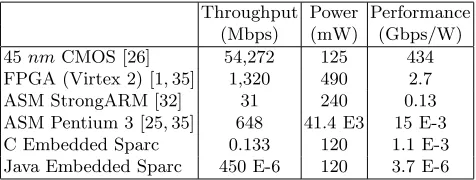
It is important to fix the target platform when comparing the energy cost of various techniques and wireless standards. The difference in platform and implementation options has a significant influence on the energy cost. For example, the energy difference between a hardware and a software implementation of the same cryptographic algorithm can vary over many orders of magnitude. This is illustrated in table 1, which shows various AES implementations [34]. If we compare these numbers, one can notice that the performance difference between an ASIC implementation in 45 nmCMOS and an implementation in Java on an embedded micro-processor is more than 8 orders of magnitude. That is why one mainly uses ASIC, FPGA or low level assembly implementations for applications which require low energy.
Throughput Power Performance (Mbps) (mW) (Gbps/W) 45nmCMOS [26] 54,272 125 434 FPGA (Virtex 2) [1, 35] 1,320 490 2.7 ASM StrongARM [32] 31 240 0.13 ASM Pentium 3 [25, 35] 648 41.4 E3 15 E-3 C Embedded Sparc 0.133 120 1.1 E-3 Java Embedded Sparc 450 E-6 120 3.7 E-6
Table 1: Performance and power comparison of various AES implementations.
information, typically expressed in J/bit. The energy numbers given in the rest this article are used to give an indication of the cost and to provide insight into the alternatives.
3 Communication cost of different wireless standards
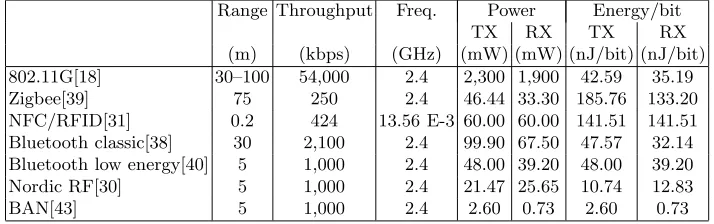
The energy cost of wireless communication is a significant component in the total energy budget. In this section, we have compared different wireless standards which are currently in use and which are aimed mostly at “low power” applications. The different wireless standards are GSM, Wifi, 802.11, Bluetooth, Zigbee, RFID and a state-of-the-art Body Area Network (BAN).
Table 2 shows that the numbers vary substantially for different standards. Wireless LAN (802.11G) has a TX (transmit) and RX (receive) power usage that is orders of magnitude higher than the other standards. Clearly this is because WLAN was designed for high speed throughput and low latency, while the other standards in the table were designed for low power budgets. Nevertheless, when comparing energy per bit, WLAN has the same performance as Bluetooth. Zigbee has a rather high energy per bit requirement in order to achieve its range of about 75m. When comparing Bluetooth classic with the low energy version, we can see that the power consumption has clearly dropped, but with the penalty of a lower throughput. This results in virtually no change in energy per bit. Finally, we can see that the ultra low power design of Vidojkovic, et al. [43], achieves the same performance as the widely used Nordic RF module with a much smaller energy and power budget.
4 Cost of cryptographic operations on embedded platforms
Range Throughput Freq. Power Energy/bit
TX RX TX RX
(m) (kbps) (GHz) (mW) (mW) (nJ/bit) (nJ/bit) 802.11G[18] 30–100 54,000 2.4 2,300 1,900 42.59 35.19 Zigbee[39] 75 250 2.4 46.44 33.30 185.76 133.20 NFC/RFID[31] 0.2 424 13.56 E-3 60.00 60.00 141.51 141.51 Bluetooth classic[38] 30 2,100 2.4 99.90 67.50 47.57 32.14 Bluetooth low energy[40] 5 1,000 2.4 48.00 39.20 48.00 39.20 Nordic RF[30] 5 1,000 2.4 21.47 25.65 10.74 12.83 BAN[43] 5 1,000 2.4 2.60 0.73 2.60 0.73
Table 2: Performance and energy comparison of wireless standards.
block cipher particularly designed for low-end devices such as RFID tags. As a public-key primitive, Elliptic Curve Cryptography (ECC) has proven to be the best choice for constrained environments ever since its invention in the mid 80’s. As a consequence, a majority of research on compact low-power public-key hardware architectures for RFID is dedicated to ECC [15, 24]. To complete the study we also choose one cryptographic hash function and one stream cipher. For the hash function we look at the SHA3 competition and compare the cost of some of the finalists [21]. Unfortunately, as a result of the heavy security requirements from NIST, each of these finalists is quite large and power hungry. As stream cipher we select Trivium [8], a light weight version of the eStream portfolio. Finally, we also give the cost of generating an
n-bit random number. This is also an important building block of a cryptographic system, since most cryptographic algorithms and protocols rely on the use of random numbers.
4.1 Symmetric block ciphers
There are various designs of symmetric block ciphers, among which some target low-cost em-bedded devices. In this section, we give the cost and performance numbers for AES, PRESENT and KATAN implementations on an ASIC platform.
There exist several very compact hardware implementation of AES that are suitable for low-cost applications [10, 12, 29]. We give detailed numbers for the most compact one of Moradi et al. [29] of AES-128, which occupies only 2400 GEs and requires 226 cycles for encryption.
with the smallest block size as this results in the smallest circuit area (of only 802 GEs). The relevant numbers are given in Table 3. Although the libraries used for the two design are not the same, 0.18 µm and 0.13 µmtechnology respectively, which effects power consumption, it is evident that both ciphers are suitable for the envisioned low-cost applications. The some-what higher energy per bit for PRESENT is mainly due to the number of cycles (more than double compared to AES and KATAN) and the high power consumption.
Tech. Throughput Freq. Area Latency Power Energy per bit (µm) (kbps) (MHz) (GEs) (# cycles) (µW) (pJ/bit) AES-128 [29] 0.18 56.64 0.1 2400 226 3.7 65.33 KATAN32 [20] 0.13 12.5 0.1 802 256 0.38 30.48 PRESENT [33] 0.18 11.4 0.1 1075 563 2.52 221.73 Table 3: Performance and energy numbers of AES, KATAN and PRESENT on ASIC.
4.2 Symmetric stream cipher: Trivium
Stream ciphers are very important symmetric-key primitives that are often used to secure wireless communications. The eSTREAM project (as a part of ECRYPT NoE project 2004-2008) had as main goal to identify a portfolio of new stream ciphers, that were divided into two groups: software and hardware (efficient).
One of the remaining three hardware candidates of the project is a stream cipher Triv-ium [8]. Table 4 gives the main characteristics of TrivTriv-ium when deployed for RFID applica-tions, i.e. on an ASIC platform using 0.13 µmstandard cell libraries. The numbers were given in the work of Good and Benaissa [14]. Among several implementation variants, we show the most compact one and the one with the lowest energy per bit.
Throughput Freq. Area Latency Power Energy per bit (Mbps) (MHz) (GEs) (# cycles) (µW) (pJ/bit) Trivium [14] 0.10 0.1 2599 13,140 5.54 55.36 Triviumx64 [14] 6.40 0.1 4921 240 14.31 2.23
4.3 Elliptic Curve Cryptography
In the past, there has been a substantial amount of papers investigating public-key cryp-tography for very constrained environments. Most of the papers considered Elliptic Curve Cryptography (ECC) as the most suitable public-key primitive, some examples are [15, 24].
In Table 5, we give the relevant numbers for two ECC implementations on an ASIC. The first implementation is based on an architecture presented in [24]. The proposed processor for ECC over GF(2163
) is able to perform EC scalar multiplications as well as general modular arithmetic (additions and multiplications) which are needed for cryptographic protocols. The circuit is fabricated in a 0.13 µm CMOS technology. Another state-of-the-art solution is the silicon chip ECCon, an Elliptic Curve Cryptography processor for application in Radio-Frequency Identification. The chip is produced in a 0.18 µm CMOS technology and the architecture is detailed in [15]. Both chips are using the same binary field for the underlying arithmetic and the size (for both) is around 15 kgates. We notice that although the numbers for power are similar, there is a big difference in the energy numbers. This is due to the performance issues, i.e. the difference in the number of cycles.
Technology Latency Frequency Power Energy per bit (µm) (# cycles) (KHz) (µW) (nJ/bit) ECC [24] 0.13 86,244 100 7.3 38.59 ECC [15] 0.18 296,000 106 8.57 146.82
Table 5: Performance and energy numbers of ECC on ASIC.
As a platform comparison, the work presented in [22] presents a lightweight implementa-tion of the elliptic curve Diffie-Hellman (ECDH) key exchange for ZigBee-compliant sensor nodes equipped with an ATmega128 processor running the TinyOS operating system. This is a popular platform for embedded security applications. For one point multiplication on this platform, the minimal energy consumption is estimated as 17.04 mJ (when the point is fixed). Although, the authors have investigated an implementation over a 192-bits long prime field, the difference is still more than 2 orders of magnitude.
4.4 Cryptographic hash function
competition for designing a new hash function. They were all evaluated on a fixed hardware platform, i.e. a SASEBO board. All the results were obtained under the same conditions and synthesized in 90 nm CMOS technology. The results are given in Table 6 and more details can be found in [21].
Throughput (@ 250 MHz) Energy per bit (Mbps) (pJ/bit)
SHA256 2000 2
Blake 6000 2.5
Grøstl 13000 2.5
JH 4600 2
Keccak 15000 1
Skein 6700 6
Table 6: SHA3 ASIC (90nm) synthesis [21].
4.5 Random number generator
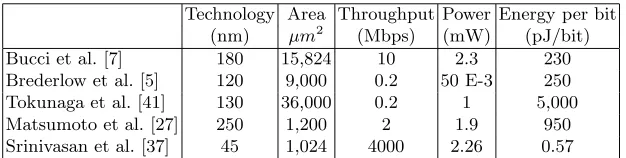
Many cryptographic primitives and protocols require the generation of true random numbers. Various ASIC implementations of cryptographic random number generators have been de-scribed in the literature. One of the first low-energy designs was proposed by Bucci et al. [7], who integrated a high-speed random number generator on a smartcard IC. Brederlow et al. [5] presented a random number generator design that utilizes the noise produced by single-oxide traps in small area MOSFETs, in combination with built-in redundancy. To improve the robustness to undesired deterministic noise, an important feature in the design of random number generators, Tokunaga et al. [41] introduced a metastability-based random number generator. Matsumoto et al. [27] proposed a very compact random number generator based on the use of SiN MOSFETs. The current state-of-the-art random number generator design was proposed by Srinivasan et al. [37]. They have implemented a high-throughput random number generator in 45 nm CMOS technology. The numbers of these different ASIC designs are shown in Table 7.
were mainly designed to have a smaller circuit area (such as [27]), or to have a better robust-ness against environmental noise and supply voltage variations (such as [41]). This explains the variance in the energy numbers of the different implementations.
Designing a random number generator on a microcontroller is a challenging and rather un-explored research domain. Nevertheless, some attempts have already been made. For example, Hlav´aˇc, L´orencz and Had´aˇcek have presented a design to generate true random numbers on an Atmel AVR microcontroller, using external oscillators [16]. However, this solution mainly aims to improve the bit rate, which was relatively low in previously proposed designs, and does not really focus on low energy or power consumption.
Technology Area Throughput Power Energy per bit (nm) µm2
(Mbps) (mW) (pJ/bit) Bucci et al. [7] 180 15,824 10 2.3 230 Brederlow et al. [5] 120 9,000 0.2 50 E-3 250 Tokunaga et al. [41] 130 36,000 0.2 1 5,000 Matsumoto et al. [27] 250 1,200 2 1.9 950 Srinivasan et al. [37] 45 1,024 4000 2.26 0.57
Table 7: Performance and energy numbers of random number generators on ASIC.
5 Energy cost of RFID authentication protocols
Most RFID systems require the deployment of an authentication protocol, in which the RFID tag authenticates itself to a reader and/or server. Depending on the cryptographic building blocks being used in the authentication protocol, various security and privacy requirements can be met. Some protocols proposed in the literature are designed to merely offer tag-to-server authentication, while others also offer mutual authentication, or provide various means of privacy protection. The protocols also differ in terms of scalability and key management complexity. Of course, these security and/or privacy properties have an influence on the energy cost of these protocols.
compare the communication-computation trade-off in the energy cost of the protocols. Note that we discuss these authentication protocols merely for illustrative reasons. We do not want to make any recommendations on deploying (or not using) a particular RFID authentication protocol.
Before we can compute the energy cost, we first need to make some general assumptions. Since the protocols are deployed in an RFID system, we assume that RFID is used as a communication standard. To generate random numbers, which is required in each of the protocols, we use the design of Bucci et al. [7]. Furthermore, we assume that the protocols are implemented on an active RFID tag, which is operated by a battery.
5.1 Basic zero-knowledge device authentication protocol of Engbert et al.
Protocol description Engberg, Harning and Jensen were one of the first to propose an RFID authentication protocol [11]. They presented a modular zero-knowledge protocol which relies exclusively on the use of a cryptographic hash function. The authors also discuss how their protocol can be extended to offer advanced security and privacy protection. In this paper, we limit ourself to the basic authentication protocol. During a protocol run, the reader sends an authenticated request to a particular tag, upon which the latter authenticates itself to the reader. Therefore, the protocol is designed to search for a specific RFID tag. Such type of authentication protocols are denoted by RFID search protocols in the literature.
The protocol works as follows. The reader and RFID tag share a unique symmetric keyK. To search for a particular RFID tag, the reader first generates two random numbers N1 and
N2. These numbers are then combined with the keyK in an authentication request, which is
sent to the tag. When receiving this request, the tag first combines the nonce N1 and the key
K to recover the nonce N2. Next, it uses this nonce and the key K to check the last part of
the message. If these checks are successful, the request is authorized and the tag computes a hash function on the XOR of the nonces N1 and N2 and the keyK. This response is sent to
the reader, which then verifies its correctness.
K
Reader
K
Tag
N1, N2 ∈R{0,1}k
N1kN2⊕h(N1⊕K)kh(N2⊕K)
ComputeN1, N2
h(N1⊕N2⊕K)
Check response
Fig. 1: RFID search protocol based on cryptographic hash function [11]
The basic protocol provides unilateral authentication, since the tag authenticates itself to the reader. To prevent replay attacks, the tag could store the current value of the nonce
N1. Any authentication request that contains a nonceN1 that is lower or equal to the value
stored in the tag’s memory, is ignored. Otherwise, the tag updates the valueN1in its memory.
The authors suggest to use the current time (e.g., in seconds) as nonce N1. This mechanism
ensures that the request is fresh and originates from the reader. It also prevents tracking attack, since an attacker cannot replay a request to track a particular tag. The basic protocol does not offer any “advanced” privacy protection. However, one could extend the protocol by requiring the key K to be updated by applying a cryptographic hash function, after each successful run of the protocol. This would ensure forward privacy3
. However, this approach requires careful attention to key synchronization.
Energy cost The search protocol described in Fig. 1 has a security parameter k. Both the key size and the bitlength of the random nonces are equal to this parameter. In this paper, we assume that k equals 128. Furthermore, we also have to choose which hash function will be used in the protocol. Let us assume that the SHA256 algorithm or the SHA-3 candidate
3
JH is used. Since the output of these hash functions is too large, one needs to truncate it to 128 bits. By making these assumptions, we can compute the energy cost of the protocol, which is equal to 72,454 nJ. Of this cost, the computation cost is equal to 768 pJ, and the communication cost to 72,453 nJ.
5.2 ISO 9798-2 mutual entity authentication protocol based on AES
Protocol description Most RFID authentication protocols are challenge-response protocols which use symmetric and/or asymmetric cryptographic primitives. Protocols for symmetric challenge-response techniques based on encryption are defined in the ISO/IEC 9798-2 stan-dard [19]. Feldhofer et al. [13] proposed to employ these symmetric challenge-response proto-cols in the context of RFID networks, using the symmetric block cipher AES. The standard both defines a unilateral and a mutual authentication protocol. The latter is shown in Fig. 2 and works as follows: The reader sends a random numberrB to the tag. The tag encrypts rB and a self-generated random numberrAwith the shared keyKand sends it to the reader. The latter decrypts the message, checks if rB is correct, and getsrA. Next, the reader changes the sequence of the random numbers, encrypts it with K, and sends it to the tag. The tag checks the result and verifies the identity of the reader. The unilateral authentication protocol, in which the tag authenticates itself to the reader, works similar. Instead of three rounds, it contains only two steps. The reader sends a random nonce, and the tag responds with the encryption of this challenge.
Properties The protocol shown in Fig. 2 is designed to provide mutual entity authentication. It offers privacy protection against an adversary which does not know the secret key K (this is denoted byweak privacy in the privacy framework of Vaudenay [42]). The adversary needs to decrypt the second protocol message to link various protocol runs to the same tag. The unilateral entity authentication protocol does not offer any privacy protection. Replaying a challenge results in a tag replying with the same nonce, which can be used to track the tag. For privacy reasons, one also has to take care of how to use the symmetric block cipher (e.g., AES) in the protocol. If the first output block of the cipher only depends on the key K
and the challenge rA, then reusing the same challenge would result in the first output block being equal. This can then be used by an attacker to trace a tag. One should however note that the authentication protocols defined in the ISO/IEC 9798-2 standard are not specifically designed to be used in RFID networks. Therefore, providing privacy protection was not one of the design requirements. The mutual entity authentication protocol is not scalable. On average, the reader has to carry out n/2 decryptions in the second protocol step, where n
K
Reader
K
Tag
rB∈R{0,1}k
rB
rA∈R{0,1}k EK(rAkrB)
CheckrB
ComputerA
EK(rBkrA)
Check response
Fig. 2: Mutual entity authentication using a symmetric block cipher [19]
Energy cost The mutual entity authentication protocol described above has a security parameterk. The size of the random noncesrAandrB is equal tokbits, while the key size is equal to 2kbits. In this paper, we assume thatkequals 64. We can then compute the energy cost of the protocol, which is equal to 45,314 nJ. This cost encompasses a computation cost of 31.444 nJ and a communication cost of 45,283 nJ.
5.3 PEPS protocol of Billet et al.
the authentication responses of the protocol. The key stream G(K, IV) is viewed as the concatenation Gt(K, IV)kGr(K, IV)kGs(K, IV) of three subsequences of respective lengths
l,l, and k. ThusGt and Gr producel-bit sequences while Gs produces a k-bit sequence. The protocol, which is shown in Fig. 3 works as follows [3]. First the reader randomly generates an authentication challenge a of length n/2 bits and sends it to the tag. At the receipt ofa, the tag (whose current key value is denoted byK) randomly generates an/2-bit numberb, derives the initial valueIV =akb, and computesG(K, IV) using the stream cipher
G. Then it sendsGt(K, IV) to the reader. The reader authenticates the tag by searching a tag index i and a key K′ ∈ {K
i, Ki,new} such that Gt(K′, IV) = Gt(K, IV). If the reader finds such an index i then the tag is considered as successfully authenticated as tag Ti, otherwise the authentication protocol has failed. If the tag has been authenticated as tag Ti, the reader updates the current key pair associated with tag Ti to (K′, Gs(K′, IV)). Next the reader computes the responseGr(K′, IV) and sends it back to the tag. At the receipt of the reader’s
answer, the tag checks whether Gr(K′, IV) = Gr(K, IV). If this equality holds, it replaces
its current key value K byGs(K, IV). If the reader is not successfully authenticated, it keeps its current key value.
Properties The PEPS protocol provides mutual entity authentication under the assumption that the underlying stream cipher is secure. In each protocol run, the tag updates its secret key K when the reader is successfully authenticated. As a result, the protocol offers forward privacy under the assumption that the maximum number of authentications an adversary can disturb is not too large. This is denoted byalmost forward private. More details can be found in [3]. As many other RFID protocols based on symmetric cryptographic primitives, it is not scalable. On average, the reader has to compute n/2 outputs of the stream cipher, where n
denotes the number of tags in the RFID system.
Energy cost As was already described above, the PEPS protocol has various security pa-rameters: n,k and l. By carefully selecting the appropriate values for these parameters, one can tune the security and privacy properties of the protocol. For simplicity reasons, we assume that n=k=l = 128. We can then compute the energy cost of the protocol, which is equal to 72,489 nJ. This cost encompasses a computation cost of 35.978 nJ and a communication cost of 72,453 nJ.
5.4 ECC-based Randomized Schnorr protocol
Randomized Schnorr protocol [6], proposed by Bringer, Chabanne and Icart. Before we will describe the protocol, let us first introduce some notation. The reader and the tag each have a private key, which are denoted byy and xrespectively. The key size is typically 163 bits. We denoteP as the base point on a Elliptic Curve, and the public key of the reader as Y =yP. In this equation, yP denotes the point derived by the point multiplication operation in the Elliptic Curve group. Each tag has a unique public key xP. One should note that, although the name suggests that it can be publicly known, a tag should not reveal its public key during the execution of the protocol, as this would cause tracking attacks.
The protocol is shown in Fig. 4 and works as follows. The protocols starts by the tag generating two random numbersr1andr2. Next, it computes two points on the elliptic curve:
T1 = r1P and T2 = r2Y, and sends them to the reader. When receiving these points, the
reader responds with a random challenge c. Next, the tag computes the responsev using the challengec, the random numbersr1 and r2, and its private keysx. This response is sent back
to the reader, to prove the tag’s identity. The reader can check the response,using its private key y, by performing the following computation:
c−1
[vP −T1−y− 1
T2] =?xP
If the correct private keyx is used, the output of the computation is equal to the tag’s public keyX.
Properties The Randomized Schnorr protocol provides unilateral authentication, as the tag authenticates itself to the reader. The security properties of the protocol are based on the security of the Schnorr scheme against active impersonation attacks under the OMDL as-sumption. The latter was proved in [2]. Bringer, Chabanne and Icart show that a relevant active adversary against the Randomized Schorr protocol can be transformed into a relevant active adversary against the Schnorr scheme [6]. The protocol also offers narrow-strong pri-vacy in the theoretical pripri-vacy framework of Vaudenay [42], under the assumption that the Decisional Diffie-Hellman (DDH) is hard to solve. It does not offer any protection against a wide attacker [23], which has access to the result of the authentication protocol in the reader (accept or reject the tag’s authentication claim). The Randomized Schnorr protocol is scalable, as the reader computes the public key of the tag to verify an authentication claim.
a result, the tag only needs to send 164 instead of 326 bits. By making these assumptions, we can compute the energy cost of the protocol, which is equal to 105,203 nJ. This cost encompasses a computation cost of 12,655 nJ and a communication cost of 92,548 nJ.
5.5 Performance comparison
The energy cost of the four RFID authentication protocols is summarized in table 8. An important observation is that for all these protocols, the communication cost is significantly larger than the computation cost. Therefore, to optimize the energy cost, one must reduce the communication overhead.
Cryptographic Key Nonce Energy Communication cost Computation cost primitive size size cost Absolute Relative Absolute Relative
(bits) (bits) (nJ) (nJ)) % (nJ) % Engbert et al.[11] SHA-256 128 128 72,454 72,453 99.999 0.77 1.03 E-3 ISO 9798-2[19] AES 128 64 45,314 45,283 99.93 31.44 0.07 PEPS[3] Trivium 128 64 72,489 72,453 99.95 35.98 0.05 Randomized Schnorr[6] ECC 163 163 105,203 92,548 87.97 12,655 12.03
Table 8: Energy comparison of the authentication protocols using RFID radio.
If a communication technology with a lower energy cost would have been used, the trade-off between computation and communication cost would be completely different. To illustrate this more in detail, let us assume that instead of RFID, the devices would communicate via a very low-cost radio that is also used in Body Area Networks (BANs) [43]. In that scenario, the computation cost becomes a more important factor, as is shown in table 9. However, except for the authentication protocol based on ECC, the communication cost remains the largest component in the total energy cost.
Cryptographic Key Nonce Energy Communication cost Computation cost primitive size size cost Absolute Relative Absolute Relative
(bits) (bits) (nJ) (nJ)) % (nJ) % Engbert et al.[11] SHA-256 128 128 613.89 613.12 99.87 0.77 0.13 ISO 9798-2[19] AES 128 64 504.40 472.96 93.77 31.44 6.23 PEPS[3] Trivium 128 64 675.34 639.36 94.67 35.98 5.33 Randomized Schnorr[6] ECC 163 163 14,051 1,396 9.93 12,655 90.07
6 Conclusions
Body Area networks, sensor networks, RFID, NFC and many more wireless technologies will offer novel experiences to the human in the Future Internet of Things. All of these applications carry security and privacy risks. Many novel cryptographic algorithms and protocols with varying security and privacy properties have been proposed to solve these issues.
In this article, we aim at connecting these security and privacy properties with the imple-mentation constraints, more specifically with the limited power and energy budgets of many applications. By taking both the communication and computation cost into account, we aim at providing a more holistic insight into the actual cost of security protocols. The trade-off be-tween the security and privacy properties, the energy cost of cryptographic computations and wireless communication, has been illustrated by evaluating the total energy cost of various RFID authentication schemes. These numbers have demonstrated that for all these protocols, the communication cost is significantly larger than the computation cost. This clearly shows that one primarily needs to reduce the former to decrease the total energy cost in the wireless system.
Acknowledgments
This work was supported in part by the Research Council KU Leuven: GOA TENSE (GOA/11/007), by the Flemish Government, FWO G.0550.12N, G.00130.13N, FWO G.0876.14N, by the Her-cules Foundation AKUL/11/19, and by the European Commission through the ICT pro-gramme through Horizon 2020 research and innovation propro-gramme under grant agreement 644052 HECTOR. The authors would also like to thank Vladimir Roˇzi´c for his useful input on random number generators.
References
1. Amphion. www.amphion.com
2. M. Bellare, and A. Palacio. GQ and Schnorr Identification Schemes: Proofs of Security Against Imperson-ation under Active and Concurrent Attacks. In M. Yung (Ed.),Advances in Cryptology (CRYPTO’02), Lecture Notes in Computer Science, volume 2442, pages 162–177. Springer-Verlag, 2002.
3. O. Billet, J. Etrog, and H. Gilbert. Lightweight Privacy Preserving Authentication for RFID Using a Stream Cipher. In S. Hong, and T. Iwata (Eds.),17th International Workshop on Fast Software Encryption (FSE ’10), Lecture Notes in Computer Science, volume 6147, pages 55–74. Springer-Verlag, 2010. 4. A. Bogdanov, L. Knudsen, G. Leander, C. Paar, A. Poschmann, M. Robshaw, Y. Seurin, and C. Vikkelsoe.
5. R. Brederlow, R. Prakash, C. Paulus, and R. Thewes. A Low-Power True Random Number Generator using Random Telegraph Noise of Single Oxide-Traps. In Proceedings of the 53rd Solid-State Circuits Conference (ISSCC ’06), pages 1666–1675, IEEE International, 2006.
6. J. Bringer, H. Chabanne, and T. Icart. Cryptanalysis of EC-RAC, a RFID Identification Protocol. In M. Franklin, L. Hui, and D. Wong (Eds.), International Conference on Cryptology and Network Security (CANS’08), Lecture Notes in Computer Science, volume 5339, pages 149–161. Springer-Verlag, 2008. 7. M. Bucci, L. Germani, R. Luzzi, A. Trifiletti, and M. Varanonuovo. A High-Speed Oscillator-Based Truly
Random Number Source for Cryptographic Applications on a Smart Card IC. InIEEE Transactions on Computer, volume 52(4), pages 403–409, April 2003.
8. C. De Canni`ere. Trivium: A Stream Cipher Construction Inspired by Block Cipher Design Principles. In Sokratis K. Katsikas, Javier Lopez, Michael Backes, Stefanos Gritzalis, and Bart Preneel (Eds.), Proceed-ings of the 9th International Conference on Information Security (ISC ’06), Lecture Notes in Computer Science, volume 4176, pages 171–186. Springer-Verlag, 2006.
9. C. De Canni`ere, O. Dunkelman, and M. Knezevic. KATAN and KTANTAN - A Family of Small and Efficient Hardware-Oriented Block Ciphers. In C. Clavier, and K. Gaj (Eds.), Proceedings of the 11th International Workshop on Cryptographic Hardware and Embedded Systems (CHES ’09), Lecture Notes in Computer Science, volume 5747, pages 272–288. Springer-Verlag, 2009.
10. D. Canright. A Very Compact S-Box for AES. In J.R. Rao and B. Sunar (Eds.), Proceedings of the 7th International Workshop on Cryptographic Hardware and Embedded Systems (CHES ’05), Lecture Notes in Computer Science, volume 3659, pages 441–455. Springer-Verlag, 2005.
11. S.J. Engberg, M.B. Harning, and C.D. Jensen. Zero-knowledge Device Authentication: Privacy & Security Enhanced RFID preserving Business Value and Consumer Convenience. InSecond Annual Conference on Privacy, Security and Trust (PST ’04), pages 89–101. 2004.
12. M. Feldhofer, J. Wolkerstorfer, and V. Rijmen. AES Implementation on a Grain of Sand. InIEE Proceed-ings of Information Security, volume 152(1), pages 13–20. 2005.
13. M. Feldhofer, S. Dominikus, and J. Wolkerstorfer. Strong Authentication for RFID Systems using the AES Algorithm. In M. Joye, and J. J. Quisquater (Eds.), Proceedings of the 6th International Workshop on Cryptographic Hardware and Embedded Systems (CHES’04), Lecture Notes in Computer Science, volume 3156, pages 357–370. Springer-Verlag, 2004.
14. T. Good and M. Benaissa Hardware performance of eStream phase-III stream cipher candidates. In
Proceedings of SASC 2008 - The State of the Art of Stream Ciphers, Lausanne, Switzerland, February 13-14, 2008, pages 163–174, 2008.
15. D. Hein, J. Wolkerstorfer, and N. Felber. ECC is Ready for RFID - A Proof in Silicon. In R. Avanzi, L. Keliher, and F. Sica (Eds.),Selected Areas in Cryptography, Lecture Notes in Computer Science, volume 5381, pages 401–413. Springer-Verlag, 2009.
16. J. Hlav´aˇc, R. L´orencz, and M. Had´aˇcek. True Random Number Generation on an Atmel AVR Micro-controller. InProceedings of the 2nd International Conference on Computer Engineering and Technology (ICCET ’10), pages 493–495, IEEE International, 2010.
17. A. Hodjat, and I. Verbauwhede. The Energy Cost of Embedded Security for Wireless Sensor Networks. In G. Griffin, T. La Porta, and S. Phoha (Eds.),Sensor Network Operations, John Wiley & Sons, pages 510–522, 2006.
18. Intel. Intel Wireless WiFi Link 5300 Module quick specs datasheet. 2008. Online:http://h18000.www1. hp.com/products/quickspecs/13085_na/13085_na.PDF
19. ISO/IEC 9798-2. Information Technology – Security Techniques – Entity Authentication – Part 2: Mech-anisms Using Symmetric Encipherment Algorithms, 1999.
21. M. Knezevic, K. Kobayashi, J. Ikegami, S. Matsuo, A. Satoh, U. Kocabas, J. Fan, T. Katashita, T. Sug-awara, K. Sakiyama, I. Verbauwhede, K. Ohta, N. Homma, and T. Aoki. Fair and Consistent Hardware Evaluation of Fourteen Round Two SHA-3 Candidates. To appear in IEEE Transactions on VLSI, 13 pages, 2011.
22. C. Lederer, R. Mader, M. Koschuch, J. Großsch¨adl, A. Szekely, S. Tillich. Energy-Efficient Implementation of ECDH Key Exchange for Wireless Sensor Networks. InInformation Security Theory and Practices — WISTP 2009, pages 112–127. September 2009.
23. Y. K. Lee, L. Batina, D. Singel´ee, and I. Verbauwhede. Low-Cost Untraceable Authentication Protocols for RFID (extended version). In S. Wetzel, C. N. Rotaru, and F. Stajano (Eds.),Proceedings of the 3rd ACM Conference on Wireless Network Security (WiSec ’10), pages 55–64. ACM, 2010.
24. Y. K. Lee, K. Sakiyama, L. Batina, and I. Verbauwhede. Elliptic Curve Based Security Processor for RFID. InIEEE Transactions on Computer, volume 57(11), pages 1514–1527, November 2008.
25. H. Lipmaa. AES Candidates: A survey of implementations. http://www.tcs.hut.fi/ hel-ger/aes/rijndael.html.
26. S.K. Mathew, F. Sheikh, M. Kounavis, S. Gueron, A. Agarwal, S.K. Hsu, H. Kaul, M.A. Anders, and R. K. Krishnamurthy. 53 Gbps NativeGF(24
)2
Composite-Field AES-Encrypt/Decrypt Accelerator for Content-Protection in 45nm High-Performance Micro-Processors. InIEEE Journal of Solid-State Circuits, volume 46(4), pages 767–776, April 2011.
27. M. Matsumoto, S. Yasuda, R. Ohba, K. Ikegami, T. Tanamoto, and S. Fujita. 1200µm2
Physical Random-Number Generators Based on SiN MOSFET for Secure Smart-Card Application. In Proceedings of the 55th Solid-State Circuits Conference (ISSCC ’08), pages 414–624, IEEE International, 2008.
28. G. de Meulenaer, F. Gosset, F.-X. Standaert, and O. Pereira. On the Energy Cost of Communications and Cryptography in Wireless Sensor Networks, (extended version). InIEEE Int. Workshop on Security and Privacy in Wireless and Mobile Computing, Networking and Communications (SecPriWiMob ’08), pages 580–585. IEEE, October 2008.
29. A. Moradi, A. Poschmann, S. Ling, C. Paar, H. Wang. Pushing the Limits: A Very Compact and a Threshold Implementation of AES. In K. Patterson (Ed.),Advances in Cryptology (EUROCRYPT 2011), Lecture Notes in Computer Science, volume 6632, pages 69–88, Springer-Verlag, 2011.
30. Nordic Semiconductors. nRF24L01 Single Chip 2.4GHz Transceiver Product Specification. 2007. Online: http://www.nordicsemi.com/eng/content/download/2730/34105/file/nRF24L01_Product_ Specification_v2_0.pdf
31. NXP Semiconductors. NXP NFC controller PN544 for mobile phones and portable equipment. 2010. Online:http://www.nxp.com/acrobat_download2/literature/9397/75016890.pdf
32. D.A. Osvik, J.W. Bos, D. Stefan, and D. Canright. Fast software AES encryption. In S. Hong, and T. Iwata (Eds.),Proceedings of the 17th international conference on Fast software encryption (FSE’10), Lecture Notes in Computer Science, volume 6147, pages 75–93. Springer-Verlag, 2010.
33. C. Rolfes, A. Poschmann, G. Leander, and C. Paar. Ultra-Lightweight Implementations for Smart Devices - Security for 1000 Gate Equivalents. Inproceedings of the 8th IFIP WG 8.8/11.2 International Conference on Smart Card Research and Advanced Applications (CARDIS ’08), Lecture Notes in Computer Science, volume 5189, pages 89–103, Springer-Verlag, 2008.
34. P. Schaumont, and I. Verbauwhede. Domain specific codesign for embedded security. InComputer, volume 36(4), pages 68–74, 2003.
35. P. Schaumont, and I. Verbauwhede. Domain Specific Tools and Methods for Application in Security Processor Design. In Kluwer Journal for Design Automation of Embedded Systems, volume 7(4), pages 365–383, 2002.
37. S. Srinivasan, S. Mathew, V. Erraguntla, and R. Krishnamurthy. A 4Gbps 0.57pJ/bit Process-Voltage-Temperature Variation Tolerant All-Digital True Random Number Generator in 45nm CMOS. In Pro-ceedings of the 22nd International Conference on VLSI Design (VLSI Design ’09), pages 301–306, IEEE International, 2009.
38. Texas Instruments. Texas Instruments Bluetooth BRF6100 and BRF6150 Product bulletin. 2004. Online:
http://focus.ti.com/pdfs/wtbu/TI_brf6100_6150.pdf
39. Texas Instruments. Texas Instruments CC2520 2.4 GHz IEEE 802.15.4/Zigbee RF Transceiver datasheet. 2007. Online:http://www.ti.com/lit/ds/symlink/cc2520.pdf
40. Texas Instruments. Texas Instruments CC2540 2.4-GHz Bluetooth low energy System-on-Chip datasheet. 2011. Online:http://www.ti.com/lit/ds/symlink/cc2540.pdf
41. C. Tokunaga, D. Blaauw, and T. Mudge. True Random Number Generator with a Metastability-Based Quality Control. InProceedings of the 54th Solid-State Circuits Conference (ISSCC ’07), pages 404–611, IEEE International, 2007.
42. S. Vaudenay. On privacy models for RFID. In K. Kurosawa (Ed.), Advances in Cryptology (ASI-ACRYPT’07), Lecture Notes in Computer Science, volume 4833, pages 68–87. Springer-Verlag, 2007. 43. M. Vidojkovic, H. Xiongchuan, P. Harpe, S. Rampu, Zhou Cui, Li Huang, K. Imamura, B. Busze,
K
Reader
K
Tag
a∈R{0,1}n/
2
a
b∈R{0,1}n/
2
IV =akb
GtkGrkGs=G(IV, K) bkGt
For each tagi, find:K′∈ {K
i, Ki,new}
ComputeG′
tkG′rkG′s=G(IV, K′)
CheckG′ t=?Gt
If match found: (Ki, Ki,new)←(K
′, G′ s)
G′ r
CheckG′ r=?Gr K←Gs
y,X=xY
Reader
x,Y =yP
Tag
r1, r2∈R{0,1}k T1=r1P
T2=r2Y
T1, T2
c∈R{0,1}k
c
v=r1+r2+cx
v
c−1
[vP−T1−y− 1
T2] =?X


![Table 6: SHA3 ASIC (90 nm) synthesis [21].](https://thumb-us.123doks.com/thumbv2/123dok_us/7922449.1315449/8.612.199.406.126.215/table-sha-asic-nm-synthesis.webp)
![Fig. 1: RFID search protocol based on cryptographic hash function [11]](https://thumb-us.123doks.com/thumbv2/123dok_us/7922449.1315449/11.612.176.424.68.258/fig-rfid-search-protocol-based-cryptographic-hash-function.webp)
![Fig. 2: Mutual entity authentication using a symmetric block cipher [19]](https://thumb-us.123doks.com/thumbv2/123dok_us/7922449.1315449/13.612.154.422.70.300/fig-mutual-entity-authentication-using-symmetric-block-cipher.webp)

![Fig. 3: Stream cipher based PEPS authentication protocol [3]](https://thumb-us.123doks.com/thumbv2/123dok_us/7922449.1315449/21.612.119.450.119.472/fig-stream-cipher-based-peps-authentication-protocol.webp)
