Analysis of Optimized Solar and DG based
Hybrid Power System for different loading
condition
Vipin1, Shekhar Verma2
PG Student, Dept. of EE, E max Engineering College, Ambala, Haryana, India1
Assistant Professor, Dept. of EE, E max Engineering College, Ambala, Haryana, India2
ABSTRACT: Lack of quality electricity supply in the remote areas is one of the main hindering factors of global development. Many countries around the world are trying to utilize renewable energy sources for remote electrification including developing countries. This paper proposes a new method to determine the placement and sizing of diesel generators (DGs), photovoltaic solar panels (PV) and batteries for off-grid systems. In this work, our objective is to reduce the total system cost while fulfilling the load demand and maintaining the grid power quality, among other constraints. This study analyzes the techno-economic feasibility of the solar PV-diesel hybrid system with different load conditions. From the techno-economic evaluation, it is observed that the optimum time to run the agriculture load is during the daytime. In this case, the solar PV has the highest contribution to meet the energy demand with the slightly increased cost of electricity.
KEYWORDS: Diesel Generator, Solar Panel, Optimal loading, System balancing.
I.INTRODUCTION
Being a developing country, Bangladesh is struggling to provide electricity to a major portion of the country; most ofthem are very remote. Approximately 40% of the population has no access to electricity [25]. However, the government has been trying to utilize the renewable energy sources, particularly solar PV to address the electricity crisis of the remote areas [6]. Therefore, utilities operating in remote areas are now interested in integrating PV based electricity generation into their network due to its long-term sustainable performance and environment-friendly attributes. However, regardless of this success, there are certain limitations of thiselectrification option that includes- the poorest demographic
II.SYSTEM MODEL AND ASSUMPTIONS
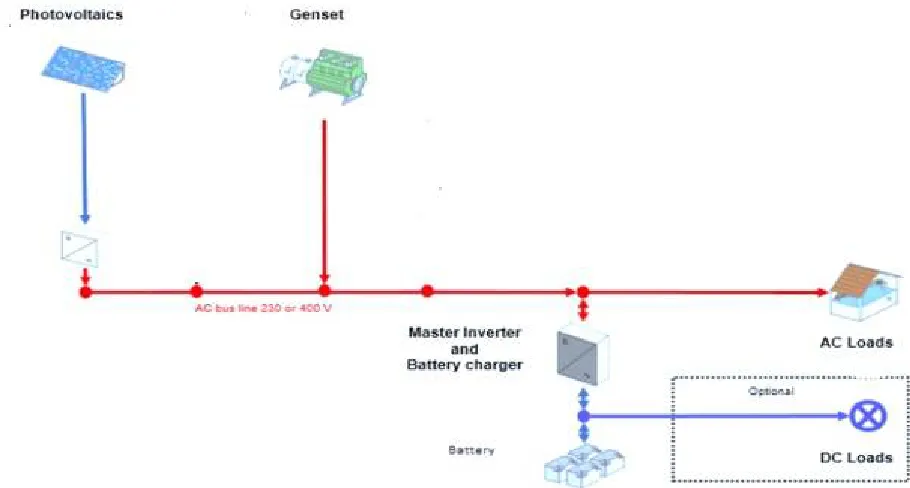
The system design is presented in Figure 1. It comprises ofa main threephase AC grid and resistive loads. To avoid the community’sdiscomfort related to the emission of pollution and noise, theGenset are placed at the initial point, while the solar panelsand batteries can be installed on any side.DC/AC converters are used to optimize the power generationfrom the solar panels. They operate as maximum powerpoint tracking devices (MPPT) so that the solar panels cangenerate their maximum power. Nevertheless, if this powerlevel affects the grid quality, this converter canshift the operational point of the solar panels to reduce thegenerated power. To charge and discharge the batteries, abidirectional DC/DC converter is employed. The DC gridsformed by the solar panels and batteries are then connected tothe main AC grid by a DC/AC inverter.
Figure 1 PV solar and Diesel generation connected on grid system
III. SIMULATION MODEL
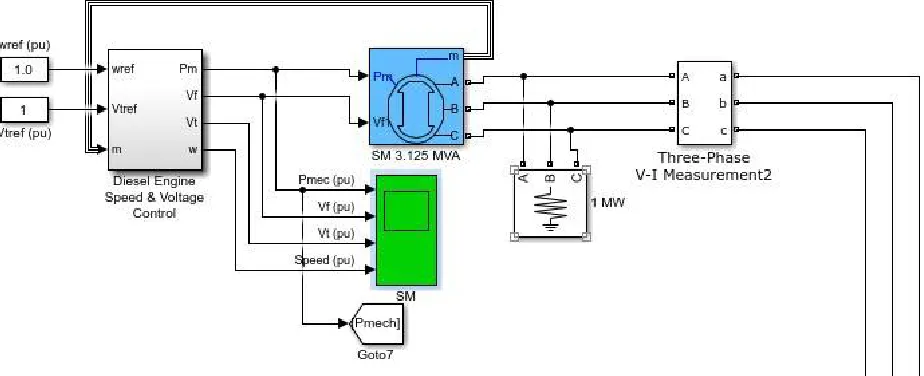
The Simulink based model is presented in figure 2 having a utility grid of conventional sources integrated with a solar plant which is constituted of solar panel with MPPT. To make the system fully oriented with 24 hour supply a diesel generation plant is also implemented in the system as a backup supply source. Solar plant can supply the electricity to the overall system only in daytime. For obtaining the supply in night timing it is necessary to have a storage unit by virtue of which system can get supply from that storage device by means of converters.
Figure 2 Simulink model of hybrid system integrated with solar and diesel plant
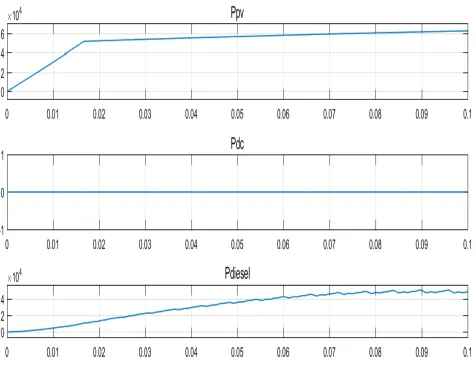
From the measuring unit we got some waveform at starting point of system in which we get power output of pv panel, power of dc unit and power we are getting from diesel generation. The simulation is very low here to just to identify the wave of complete system behaviour. One thing is to be notified that power from dc unit is zero is in case if solar is running and diesel is also running then no need to run battery power.
The permissible minimum loading for diesel generators varies from manufacturer to manufacturer. It has also been considered in the PV-diesel network (without any storage) that the operating spinning reserve is equal to 100% of the PV output plus 10% of the average hourly load. PV output is unpredictable and thus operating with a spinning reserve strategy equal to the total PV capacity has been adopted for maintaining high system reliability. In the simplified PV steady-state power output model, the PV output is only related to solar radiation and ambient temperature.
( ) = ( )(1 + ( ) − ))(1)
( ) = ( ) + 0.0123[1 + 0.031 ( )](1−0.042 ) ( ) (2)
( ) = 0.5[( + ) + ( − ) sin ] (3)
Where pvf is the PV array derating factor, STC P is themaximum output power under standard test conditions(STC)(the sunlight intensity is 1000W / m2 and theambient temperature is 25_), G(t) is the actual sunlightintensity, STC G is the sunlight intensity under the STC,the value of K is 0.45%/ oC, K is power temperaturecoefficient, T(t) is the surface
temperature of the PVarray at time t, T (t) air is the ambient temperature, STC Tis the surface temperature of the PV array
under STC,value of STC T is 25, Tmaxis the maximum temperature of the day, Tminis the minimum temperature of the day,
t is the moment of average temperature, Vmis the current wind speed. the The possibility of power quality issues, due to
increasing levels of PV penetration, might occur but this is beyond of the scope of this study. Nonetheless, optimization has been performed with constraints that should ensure acceptable power quality.
Figure 4 Simulink model of PV model and MPPT
Energy storage devices can buffer the variable PV system output to provide smoother diesel loading. These storage devices help to align energy production and consumption, when short-term energy imbalance occurs, and when integrated with variable energy sources, the combined system becomes dispatchable for short periods. In this study, a Li-ion battery energy storage system has been considered. When a significant amount of PV output drops rapidly, off line diesel generators may start but they require 1-2 minutes to synchronize with operating generator(s). The batteries will discharge during this transient period to prevent severe frequency decline, which if not arrested may lead to cascading tripping of the generators and system blackout.
The Battery Model block consists of the battery bank and controller. The Battery Model has the second highest priority
to supply the load. Once the RTU is installed at load location, it will regulate the power output of the diesel generator, the PV array, and the battery bank through digital/analog output capabilities that enable equipment to be switched “on” and “off.” The control settings and set point configurations are programmed into the memory of the RTU. These set points of the RTU can be changed while the simulation is in progress in order to further optimize the system.
IV.RESULT ANALYSIS
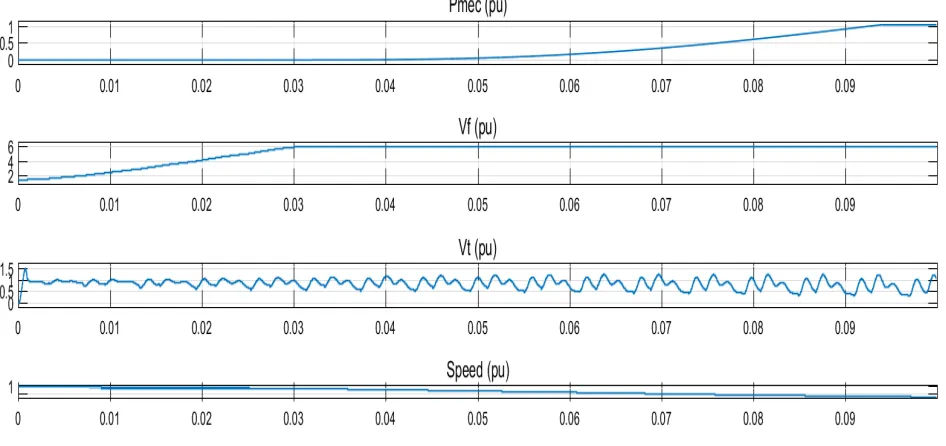
When moving to the side of diesel generation speed of governor and terminal voltage of generator varies according to their phenomenon value as represented in figure 4. The value of different parameter of diesel are represented in per unit. Their effective value represents the system behaviour.
Figure 4 Showing the pu unit value of different parameter getting from diesel generation unit
The diesel generation is illustrated above with different parametric value. Similarly, solar generation power and voltage are displaying below. First one shows the power generated from solar unit and second waveform having voltage waveform. Energy storage devices can buffer the variable PV system output to provide smoother diesel loading. These storage devices help to align energy production and consumption, when short-term energy imbalance occurs, and when integrated with variable energy sources, the combined system becomes dispatchable for short periods.
V.CONCLUSION
The study has attempted to explore the possibilities of integrating solar PV and diesel into systems networks to reduce the fossil fuel consumption and to promote environment-friendly solar PV resources for electricity generation. It has been demonstrated that integrating a good amount of centralised PV generation capacity into diesel network is techno-economically feasible. The design of an energy storage system needs to be aligned with the solar unit and the excess amount of electricity which can be stored. Distributed PV systems could be an excellent choice, as soon as consumers can bear the higher PV-battery upfront cost. By integrating the diesel an independency occurs in the system behavior. This above gien results illustrate the system integration with solar pv and diesel. And find optimum results in this system total power generation from solar PV and diesel is 111.3 kW and system costing is about one lakh dollar. The different issues regarding environmental health are also analyzed in index form in per unit. CO2 having the pollution
index 0.6848 where as NOx have 0.01524.
REFERENCES
[1] R. W. Wies, R. A. Johnson, A. N. Agrawal and T. J. Chubb ,’Economic Analysis and Environmental Impacts of a PV with Diesel-Battery
System for Remote Villages,’ IEEE Transaction on power system, vol 20, pp 692-700, 2004.
[2].Yang, JM, Cheng, KWE, Wu, J & Dong, ‘The study of the energy management system based-on fuzzy control for distributed hybrid wind-solar
power system’, Proceedings of the First International Conference on Power Electronics Systems and Applications, pp. 113- 117, 2004.
[3]. Zhenhua Jiang, ‘Power management of hybrid photovoltaic - fuel cell power systems’, IEEE Power Engineering Society General Meeting, 2006.
[4]. Li Wei, ‘Modeling, Control and Simulation of a Small Photovoltaic Fuel Cell Hybrid Generation System’, Proceedings of the International
Conference on Computational Intelligence and Software Engineering, pp. 1-6,2009.
[5]. V. Eynde, NW, Chowdhury, S & Chowdhury, ‘Modeling and simulation of a stand-alone photovoltaic plant with MPPT feature and dedicated
battery storage’, IEEE, Power and Energy Society General Meeting, pp. 1-8, 2010.
[6]. Raju, RGG, Vinothkumar, M, Kamalakannan, N & Subramaniam, NP 2011, ‘A hybrid alternative energy system with photovoltaic and fuel cell’,
proceedings of the International Conference on Green Technology and Environmental Conservation, pp. 278-284.
[7]. Kumaravel, S & Ashok, ‘Adapted multilayer feed forward ANN based power management control of solar photovoltaic and wind integrated
power system’, IEEE PES, Innovative Smart Grid Technologies - India, pp. 223-228, 2011.
[8]. Majumdar, S, Sapalok, A & Chakraborty, ‘Modeling components of a DC coupled photovoltaic system with maximum power point tracking’,
Proceedings of IEEE 5th International Conference on power India, pp. 1-6,2012.
[9]. Moritz Hill &Rollie Armstrong, ‘ A PV/Diesel Hybrid Power-Case Study’ , Project “Zimbi” , CRONIMET Chrome South Africa (Pty.) Ltd.,
Johannesburg, South Africa, 2012.
[10]. Krieger, EM & Arnold, ‘Effects of undercharge and internal loss on the rate dependence of battery charge storage efficiency’, Journal of Power
Sources, 210 (2012), pp. 286– 291, 2012.
[11]. Guishi Wang, Ciobotaru, M &Agelidis, ‘Power Smoothing of Large Solar PV Plant Using Hybrid Energy Storage’, IEEE Transactions on
Sustainable Energy, vol. 5, no. 3, pp. 834-842, 2014.
[12]. Patterson, M, Macia, NF & Kannan, AM 2015, ‘Hybrid Microgrid Model Based on Solar Photovoltaic Battery Fuel Cell System for Intermittent
Load Applications’, IEEE Transactions, on Energy Conversion, vol. 30, no. 1, pp. 359-366,2015.
[13] Taskin Jamal, Md. AsaduzzamanShoeb, GM Shafiullah, Craig E Carter and Tania Urmee,’A Design Consideration for Solar PV-Diesel Remote
Electricity Network: Australia Perspective’ IEEE Innovative Smart Grid Technologies,2016.
[14] Takahiro Kushida and Rikiya Abe,’ Optimal design of a grid connected PV-diesel hybrid system’, Environment and Electrical Engineering
(EEEIC),2016.
[15]. Carlos at. el, ‘Development of a Microcontroller-Based Photovoltaic Maximum Power Point Tracking Control System’, IEEE Transactions on
Power Electronics, vol. 16, no. 1, pp. 46-54,2001
[16]. H. Wicaksana, M. M. Muslim, S. F. Hutapea, A. Purwadi and Y. Haroen, ‘Design, Implementation and Techno-Economic Analysis of Hybrid
PV-Diesel for Off-Grid System in Sebira Island’, IEEE Power Engineering and Renewable Energy,2016.
[17]. P. C. Sekhar and S. Mishra, ‘Storage Free Smart Energy Management for Frequency Control in a Diesel-PV-Fuel Cell-Based Hybrid AC
Microgrid’ IEEE Transactions on Neural Networks and Learning Systems, vol 27, pp 1657-1671, 2015.
[18]. Tong Liu1, Qian Zhang1, Jinjin Ding1, Tao Rui and Qunjing Wang, ‘Grid-connected/Island Optimal Operation of PV-Diesel-Battery
Microgrid with Plug-In Electric Vehicles’ ,IEEE Automation (YAC), 32nd Youth Academic Annual Conference of Chinese Association, 2017.
[19]. EftichiosKoutroulis, Kostas Kalaitzakis& Nicholas C Voulgaris , ‘Development of a Microcontroller-Based Photovoltaic Maximum Power
Point Tracking Control System’, IEEE Transactions on Power Electronics, vol. 16, no. 1, pp. 46-54,2001.
[20]. Yeong-Chau Kuo, Tsorng-Juu Liang &Jiann-Fuh Chen, ‘Novel Maximum-Power-Point-Tracking Controller for Photovoltaic Energy
Conversion System’, IEEE Transactions on Industrial Electronics, vol. 48, no. 3, pp.594-601, 2001.
[21]. Dong-Yun Lee, Hyeong-Ju Noh, Dong-seok Hyun & Ick Choy , ‘An Improved MPPT Converter Using Current Compensation Method for
Small Scaled PV-Applications’, Proceedings of IEEE conference on Applied Power Electronics ,Vol. 1, pp. 540-545,2003.
[22]. Sridhar, R, Jeevananthan, S, ThamizhSelvan, N & Sujith Chowdary, ‘Performance Improvement of a Photo Voltaic Array Using MPPT (P&O)
Technique’, IEEE,pp.191-195, 2010.
[23]. Ferdous, SM, Mahir Asif Mohammad, Farhan Nasrullah, Ahmed MortuzaSaleque&ShahriarMuttalib, ‘Design and Simulation of an Open
Voltage Algorithm based Maximum Power Point Tracker for Battery Charging PV System’, 7th International IEEE Conference on Electrical and
Computer Engineering, pp.908-911,2012.
[24]. Sandeepan Majumdar, Apoorva Sapalok&NiladriChakraborty , ‘Modeling Components of a DC Coupled Photovoltaic System with Maximum
Power Point Tracking’, Proc of IEEE conference on Power India, pp.1-6, 2012.
[25]. KaranjkarDnyaneshwar, S, Chatterji, S, Amod Kumar &Shimi, ‘Fuzzy adaptive proportional-integral-derivative controller with dynamic
set-point adjustment for maximum power set-point tracking in solar photovoltaic system’, Systems Science & Control Engineering: An Open Access
Journal, vol. 2, no 1, pp. 562-582, 2014.
[26]. Lihua Wang, Xueye Wei, Yuqin Shao, Tianlong Zhu &, Junhong Zhang , ‘MPPT of PV array using stepped-up chaos optimization algorithm’,
Turkish journal of Electrical Engineering and computer science, pp.1-13, 2015.
BIOGRAPHY