Advances and Applications in Bioinformatics and Chemistry 2017:10 65–78
Advances and Applications in Bioinformatics and Chemistry
Dovepress
submit your manuscript | www.dovepress.com 65
M E T H O D O L O G Y
open access to scientific and medical research
Open Access Full Text Article
Computational tool for optimizing the essential
oils utilization in inhibiting the bacterial growth
Noha E El-Attar1
Wael A Awad2
1Basic Science Department, Faculty of Engineering, Delta University, Mansoura, Egypt; 2Mathematics & Computer Science Dept. Faculty of Science, PortSaid University, PortSaid, Egypt
Abstract: Day after day, the importance of relying on nature in many fields such as food, medi-cal, pharmaceutical industries, and others is increasing. Essential oils (EOs) are considered as one of the most significant natural products for use as antimicrobials, antioxidants, antitumorals, and anti-inflammatories. Optimizing the usage of EOs is a big challenge faced by the scientific researchers because of the complexity of chemical composition of every EO, in addition to the difficulties to determine the best in inhibiting the bacterial activity. The goal of this article is to present a new computational tool based on two methodologies: reduction by using rough sets and optimization with particle swarm optimization. The developed tool dubbed as Essential Oil Reduction and Optimization Tool is applied on 24 types of EOs that have been tested toward 17 different species of bacteria.
Keywords: essential oils, reduction, optimization, rough sets, particle swarm optimization
Introduction
Nature is rich in antibacterial, antifungal, and antioxidant products. Plants are consid-ered as one of the important anti-organism producers. Plants produce various types of secondary metabolites that are characterized by their biological properties, for use against predators and microbial pathogens. One of these secondary metabolites, which have an effective antimicrobial activity, is the “essential oil” (EO).1 EOs, also known as essences, volatile oils, etheric oils, or aetheroleum, are natural products that can be produced from different parts of the plants (e.g., flowers, leaves, stems, seeds, fruit, or barks of aromatic plants). The EOs consist of several types of compounds, which are usually liquid, volatile, limpid, with lower density than water, and soluble in organic solvents. Extracting the EOs from different parts of the plants can be done by various chemical techniques such as “steam distillation”, “solvent extraction”, “expression under pressure”, “supercritical fluid”, and “subcritical water extraction”.2
Thus, due to the efficiency of EOs as antimicrobials, antioxidants, antitumoral, antifungal and anti-inflammatories, they are widely used in different fields such as the cosmetic industry (e.g., ingredients of fragrances, decorative cosmetic, fine fra-grances, and flavoring), the food industry (e.g., aromas and flavors), the pharmaceutical industry (e.g., active components of medicines and as antibacterials/antimicrobials), and aromatherapy.3
Although the EOs are characterized by their efficiency as antibacterial organisms, their effective degree is varied according to their chemical composition, which may vary due to their agriculture, geographic location, seasonal variability, and climatic Correspondence: Noha E El-Attar
Basic Science Department, Faculty of Engineering, Delta University, Costal International Road in front of Industrial Area, Mansoura, Gamasa, Egypt Email [email protected]
Journal name: Advances and Applications in Bioinformatics and Chemistry Article Designation: METHODOLOGY
Year: 2017 Volume: 10
Running head verso: El-Attar and Awad
Running head recto: Computational tool for EOs utilization in inhibiting the bacterial growth DOI: http://dx.doi.org/10.2147/AABC.S138944
Advances and Applications in Bioinformatics and Chemistry downloaded from https://www.dovepress.com/ by 118.70.13.36 on 19-Aug-2020
For personal use only.
This article was published in the following Dove Press journal: Advances and Applications in Bioinformatics and Chemistry 5 September 2017
Dovepress
El-Attar and Awad
factors and according to the part of the plant (fruit, leaves, etc.).4 Nowadays, the determination of the bioactivity of the EOs from their chemical composition is a well-established idea among the scientific community. However, practically, the traditional experimental methods usually have many limitations. Characterizing the complexity of the chemical interactions among the components of EOs is a significant limitation. In addition, defining the relations between these components and the attacked microbes is another limitation.3 Thus, the importance of using the computational models instead has increased. Developing a computational tool to select the EOs that have antimicrobial activities depending on knowing their effective compounds only and without complex laboratory analysis can save money and time and enhance consistency of final products. Generally, the compu-tational tools (e.g., artificial neural networks [ANNs], genetic algorithm [GA], and particle swarm optimization [PSO]), especially those that are based on mathematical or statistical models (e.g., rough sets [RS] and fuzzy logic), can enhance the ability of determining the relationships among the EOs’ compounds such as the chemical interactions, synergisms, and antagonisms. Accordingly, these tools may be very useful in classifying, optimizing, and predicting the antibacterial activity of a certain EO depending on the historical analysis of other EOs.5
One of the main challenges faced by scientific researchers in determining the antimicrobial activity of the EOs is the huge number of compounds that constitute the oil and which compounds have the significant antimicrobial effects. In this article, a new computational tool is presented based on RS and PSO algorithms. The proposed tool uses the RS algorithm as a reduction mathematical model to solve the problem of the huge number of EO compounds, which accordingly improves the optimization process that is based on PSO to determine the most proper EO for every type of bacteria.
Related work
In spite of the importance of applying artificial computing in biological systems, it is still not widespread in usage. Some researchers have tended to use the artificial computing tools in predicting the antimicrobial effects of EOs, while others have tried to use these tools in classifying the EOs according to their antibacterial activities.
Daynac et al have developed a computational model to evaluate the use of the ANNs for predicting the antimicrobial activity of EOs. The suggested model was fast artificial neural network (FANN) software that used 49 EOs with definition of their chemical compositions as the network inputs; the
output data reflected the antimicrobial activity of these EOs against four common pathogens: “Staphylococcus aureus”, “Escherichia coli”, “Candida albicans”, and “Clostridium perfringens”. The ANN has proved its efficiency in predict-ing >70% of the antimicrobial activities within a 10 mm maximum error range by disk diffusion assays.5
Neves et al have presented a decision system for predict-ing the biological activity of the Schinus characterized by a variability in its chemical composition depending on its geographical and seasonal growing. The proposed study was conducted with the objective to characterize the found-ing of a computational framework that uses the knowledge representation and reasoning techniques to set the structure of the information and the associated inference mechanisms by using a logic programming-based approach to the knowledge representation and reasoning complemented with a computa-tional framework based on ANNs. This model has achieved an accuracy of ~85% in predicting the pharmacological activity of the Schinus EOs.2
Another direction of using the artificial computing is the optimization process. Rajkovic et al have developed two optimization models to predict the antifungal effects for mixing the EOs of “Thymus vulgaris L.” and “Cinnamomum cassia L.”. The two proposed models are the response surface methodology (RSM) and the ANN combined with the GA. Both of the two models have tended to optimize the variables of the mixture process (i.e., time of action, concentration of individual or mixture EOs, and their mass ratio). Based on the mean relative percent deviation (MRPD), both of the two models have provided a good quality of prediction for the antifungal effect in terms of the three predefined independent variables. Nevertheless, due to the low value of the MRPD for the ANN – GA model, it has achieved more accuracy in predicting the antifungal effect of the EO mixture than the RSM model (±10.7% for RSM and ±0.1% ANN – GA).6
Problem formulation
The EO is a complex mixture of a huge number of com-pounds. Some of these compounds are characterized by their high antimicrobial activity such as aldehydes, phenols, and terpene alcohols (e.g., cinnamaldehyde, citral, carvacrol, eugenol, and thymol), while other compounds such as ketones or esters (e.g., β-myrcene, α-thujone, and geranyl acetate) have a limited activity against the microbes. On the other hand, EOs that contain terpene hydrocarbons were usually inactive in facing the microbial infection.7 The traditional chemical methods used for extracting and analyzing the EOs to determine their chemical composition are usually
Advances and Applications in Bioinformatics and Chemistry downloaded from https://www.dovepress.com/ by 118.70.13.36 on 19-Aug-2020
Dovepress Computational tool for EOs utilization in inhibiting the bacterial growth expensive and complicated due to the variation in the
struc-ture and concentration percentage of the EO compositions.3 Developing a computational tool may have a significant role in decreasing the time and cost of chemical analysis and in determining the most proper EO that has the optimal anti-bacterial activity, especially for the scientific industries that are based on using the EOs as antibacterials or antioxidants.
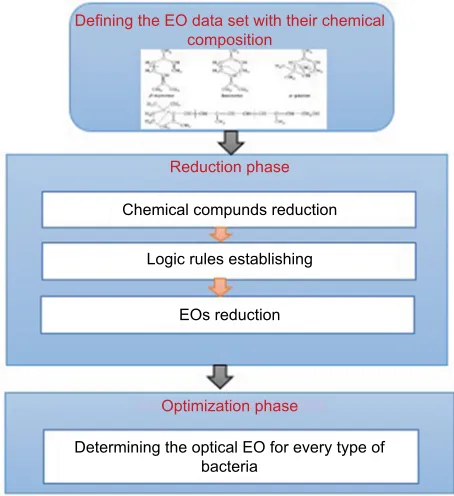
This article presents a new optimization tool based on EO reduction (Essential Oil Reduction and Optimization Tool [EOROT]) for enhancing the classification process of the EOs according to their antibacterial influence rate. The developed EOROT tool is based on three main phases. Determining the EOs’ chemical composition is the first phase. Second, reducing the huge number of these chemical compounds by specifying the main antibacterial compounds and establishing some logic rules to finding the relation between these compounds. Finally, finding the EOs that have high antibacterial activities and searching for the most-suited EO for every type of the bacteria. Figure 1 shows a brief illustration for the methodology of EOROT.
Data set of EOs
Initially, analyzing the EOs is the first stage in the “EOROT” algorithm. The target of this stage is to determine all the compounds and their concentration percentages in the composition of EOs. This stage is the base of the reduction process, which will specify the significant compounds and remove the noninfluential ones.
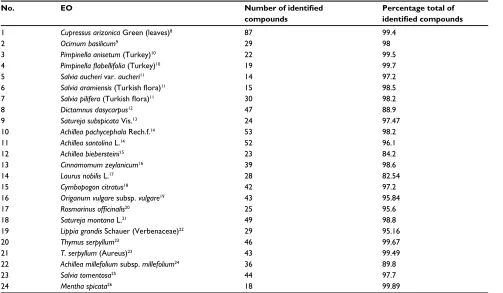
The experimental study in this research is based on 24 types of plant EOs as a sample for antibacterial EOs, which are common in inhibiting the same types of bacteria. These EOs have >850 compounds; Table 1 lists the number of the identified compounds in every EO and their concentration percentage (the complete data is available in the Supplemen-tary material section).8–26
Reduction and rules of extraction
methodology
Recently, the emergence of the huge real-time data sets has increased the need for using the data mining and machine learning, which have proved their efficiency in dealing with these types of data. However, many data sets contain unnec-essary features that may cause undesirable increase in the processing time. Therefore, the need for reducing the dimen-sion size of the data set becomes a necessary stage in the data mining process.27 The reduction process refers to simplifying a data set by reducing its dimensionality through removing a subset of attributes from the original data set while retaining the same predictive accuracy. Generally, the reduction has a number of important benefits for the machine learning and data mining algorithms. It reduces the computation time of the induction algorithm, saves the computational cost, and also improves the accuracy of the induced rules.28 RS approach was originally proposed by Pawlak.29 It is defined as a mathematical approach that can obtain high-quality
Figure 1 Methodology of the proposed EOROT.
Abbreviations: EOROT, Essential Oil Reduction and Optimization Tool; EO, essential oil.
Defining the EO data set with their chemical composition
Reduction phase
Chemical compunds reduction
Logic rules establishing
EOs reduction
Optimization phase
Determining the optical EO for every type of bacteria
Advances and Applications in Bioinformatics and Chemistry downloaded from https://www.dovepress.com/ by 118.70.13.36 on 19-Aug-2020
Dovepress
El-Attar and Awad
classifiers called reduct from the total data set attributes. This “reduct” can be used to predict the decision outputs just like using the original set.28 In general, in the RS approach, the information is represented in the form of condition attri-butes C and decision attriattri-butes D.30 The relation between the condition and the decision attributes in RS is defined by the indiscernibility degree of the data points handled using the concept of sets’ approximation. There are two main types of the approximation in RS, upper and lower, which are denoted as R(X) and R(X), respectively; they are defined as follows in Equations 1 and 2:
R X
(
)
={
x U x∈ | R∩X ≠ ∅}
(1)R (X) = x U x
{
∈ | R ⊆X}
(2)According to the determined upper and lower approximation of the sets, the accuracy of the classification results can be quantified as follows:
αc= R X
(
)
/ R X(
)
(3)These approximations are the base of finding the reduc-tion for data set. They can also be used to deduce the rules between the condition and decision attributes. The syntax of the decision rules usually has the form of logic expression or if … then rule.30,31
Optimization methodology
The aim of the optimization is to determine the best-suited solution to a problem under a given set of constraints. The optimization problem is represented as an intelligent search problem where one or more agents are used to determine the optimal solution on the search landscape for the desired problem population.32 There are several kinds of numerical optimization methods such as neural network, gradient-based search, GA, ant colony, and PSO.32,33 PSO is one of the most famous optimization methods that has proved its efficiency in searching for the optima. Generally, it is a population-based algorithm that can be easily implemented and applied to solve various optimization problems by searching for the optimal solution within the available solutions based on social behav-ior patterns of organisms that live and interact within large groups. PSO incorporates swarming behaviors observed in flocks of birds, schools of fish, or swarms of bees.34
Table 1 Number of identified compounds in the EOs
No. EO Number of identified
compounds
Percentage total of identified compounds
1 Cupressus arizonica Green (leaves)8 87 99.4
2 Ocimum basilicum9 29 98
3 Pimpinella anisetum (Turkey)10 22 99.5
4 Pimpinellaflabellifolia (Turkey)10 19 99.7
5 Salvia aucheri var. aucheri11 14 97.2
6 Salvia aramiensis (Turkish flora)11 15 98.5
7 Salvia pilifera (Turkish flora)11 30 98.2
8 Dictamnus dasycarpus12 47 88.9
9 Satureja subspicata Vis.13 24 97.47
10 Achillea pachycephala Rech.f.14 53 98.2
11 Achillea santolina L.14 52 96.1
12 Achillea biebersteini15 23 84.2
13 Cinnamomum zeylanicum16 39 98.6
14 Laurus nobilis L.17 28 82.54
15 Cymbopogon citratus18 42 97.2
16 Origanum vulgare subsp. vulgare19 43 95.84
17 Rosmarinus officinalis20 25 95.6
18 Satureja montana L.21 49 98.8
19 Lippia grandis Schauer (Verbenaceae)22 29 95.16
20 Thymus serpyllum23 46 99.67
21 T. serpyllum (Aureus)23 43 99.49
22 Achillea millefolium subsp. millefolium24 36 89.8
23 Salvia tomentosa25 44 97.7
24 Mentha spicata26 18 99.89
Abbreviation: EO, essential oil.
Advances and Applications in Bioinformatics and Chemistry downloaded from https://www.dovepress.com/ by 118.70.13.36 on 19-Aug-2020
Dovepress Computational tool for EOs utilization in inhibiting the bacterial growth
Proposed EOROT
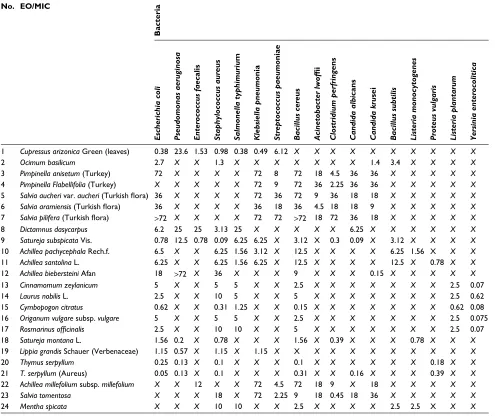
The suggested EOs presented in Table 1 are commonly characterized by their antibacterial effects, especially for certain types of bacteria listed in Table 2. The influence of the EO on inhibiting the bacteria activity can be measured by several methods such as the minimum bactericidal con-centration (MBC) and minimum inhibitory concon-centration (MIC).8 The selected 24 EOs were tested on 17 types of bacteria, and the activities of the EOs against these bacteria were studied via the presence or the absence of inhibition zones according to MIC measure, as displayed in Table 2.8–26 The MIC can be defined as the lowest concentration of the EO at which the bacteria do not show visible growth after overnight incubation.8
It is commonly known that the activity of the bacteria may be repressed by more than one type of anti-organisms, as shown in Table 2. The EO, which is labeled as one of the most famous anti-organisms (anti-bacteria), can inhibit the bacteria growing with variant ratios according to the MIC rate. Testing the EOs against the bacteria and measuring the MIC can be done via many types of antimicrobial screening methods such as well-diffusion method and disk diffusion method (DDM). This research is based on the second method.24 Some EOs have limited impact on specific types of bacteria, while others have wide anti-bacterial impact. Thus, it is a difficult issue to determine the EOs that contain the suitable antibacterial compounds that can achieve the desired inhibition for the bacterial growth due to the huge number of compounds in
Table 2 EOs and their MIC percentage rate on the selected bacteria
No. EO/MIC
Bacteria
Escherichia coli Pseudomonas aeruginosa Enterococcus faec
alis
Staphylococcus aur
eus
Salmonella typhimuriu
m
Klebsiella pneumo
nia
Streptococcus paeumo
niae
Bacillus cere
us
Acinetobacter lwof
fii
Clostridium perfring
ens
Candida albi
cans
Candida kru
sei
Bacillus subtilis Listeria monocytogenes Proteus vulgaris Listeria plantarum Yersinia enterocolitica
1 Cupressus arizonica Green (leaves) 0.38 23.6 1.53 0.98 0.38 0.49 6.12 X X X X X X X X X X
2 Ocimum basilicum 2.7 X X 1.3 X X X X X X X 1.4 3.4 X X X X
3 Pimpinella anisetum (Turkey) 72 X X X X 72 8 72 18 4.5 36 36 X X X X X
4 Pimpinella Flabellifolia (Turkey) X X X X X 72 9 72 36 2.25 36 36 X X X X X
5 Salvia aucheri var. aucheri (Turkish flora) 36 X X X X 72 36 72 9 36 18 18 X X X X X
6 Salvia aramiensis (Turkish flora) 36 X X X X 36 18 36 4.5 18 18 9 X X X X X
7 Salvia pilifera (Turkish flora) >72 X X X X 72 72 >72 18 72 36 18 X X X X X
8 Dictamnus dasycarpus 6.2 25 25 3.13 25 X X X X X 6.25 X X X X X X
9 Satureja subspicata Vis. 0.78 12.5 0.78 0.09 6.25 6.25 X 3.12 X 0.3 0.09 X 3.12 X X X X
10 Achillea pachycephala Rech.f. 6.5 X X 6.25 1.56 3.12 X 12.5 X X X X 6.25 1.56 X X X
11 Achillea santolina L. 6.25 X X 6.25 1.56 6.25 X 12.5 X X X X 12.5 X 0.78 X X
12 Achillea biebersteini Afan 18 >72 X 36 X X X 9 X X X 0.15 X X X X X
13 Cinnamomum zeylanicum 5 X X 5 5 X X 2.5 X X X X X X X 2.5 0.07
14 Laurus nobilis L. 2.5 X X 10 5 X X 5 X X X X X X X 2.5 0.62
15 Cymbopogon citratus 0.62 X X 0.31 1.25 X X 0.15 X X X X X X X 0.62 0.08
16 Origanum vulgare subsp. vulgare 5 X X 5 5 X X 2.5 X X X X X X X 2.5 0.075
17 Rosmarinus officinalis 2.5 X X 10 10 X X 5 X X X X X X X 2.5 0.07
18 Satureja montana L. 1.56 0.2 X 0.78 X X X 1.56 X 0.39 X X X 0.78 X X X
19 Lippia grandis Schauer (Verbenaceae) 1.15 0.57 X 1.15 X 1.15 X X X X X X X X X X X
20 Thymus serpyllum 0.25 0.13 X 0.1 X X X 0.1 X X X X X X 0.18 X X
21 T. serpyllum (Aureus) 0.05 0.13 X 0.1 X X X 0.31 X X 0.16 X X X 0.39 X X
22 Achillea millefolium subsp. millefolium X X 12 X X 72 4.5 72 18 9 X 18 X X X X X
23 Salvia tomentosa X X X 18 X 72 2.25 9 18 0.45 18 36 X X X X X
24 Mentha spicata X X X 10 10 X X 2.5 X X X X 2.5 2.5 X X X
Abbreviations: EO, essential oil; MIC, minimum inhibitory concentration.
Advances and Applications in Bioinformatics and Chemistry downloaded from https://www.dovepress.com/ by 118.70.13.36 on 19-Aug-2020
Dovepress
El-Attar and Awad
their chemical composition as shown in Table 1. Herein, the importance of the reduction process appears in an attempt to abstract the chemical compounds and retain only those that have a high antibacterial impact.
The reduction process based on the RS theory is the first step in the proposed EOROT algorithm. It is divided into three phases. 1) It begins with reducing the number of the compounds for every EO by keeping only the compounds that affect the EO concentration. This process depends on defining the threshold value for the compound’s concentration percentage by 2% and ignoring the compounds that do not exceed this threshold. 2) After the reduction of compounds, the RS starts establishing some logic rules; these rules can help in determining the EOs that have a high antibacterial effect generally without testing them on certain types of bacteria as defined in the following equation:
FA = {(E ˄ V.H) ˅ (E ˄ H) ˅ (D ˄ V.H) ˅ (D ˄ H) ˅ (D ˄ L) ˅ (C ˄ V.H) ˅ (C ˄ H) ˅
(C ˄ L) ˅ (B ˄ V.H) ˅ (B ˄ H) ˅ (B ˄ L) ˅ (B ˄ N) ˅ (A ˄ V.H) ˅ (A ˄ H) ˅ (A ˄ L) ˅
(A ˄ N)} (4)
where the symbols A, B, C, D, E, and F are the concentration percentage rates of the compound in the EO and the symbols V.H, H, N, and L are the antibacterial activity degrees for these compounds. Table 3 displays these symbols and their significances. 3) The last phase in the reduction process is applying the extracted rules to constringe the number of EOs by finding the significant antibacterial EOs only. The pseudo code of the EOROT algorithm is presented in Box 1.
After completing the reduction phase, the optimization process begins its role in the EOROT algorithm. Generally, the optimization process is a popular computational technique that tends to find the optimal solution to the current problem. The main purpose of the optimization phase in EOROT is to find the proper EO that can inhibit the bacteria with the best MIC. PSO is the optimization algorithm that is used in EOROT; it is based on defining the population of the cur-rent problem that consists of some particles (i.e., bacteria and EOs) represented by a matrix P = [Ni * Mj], where N is
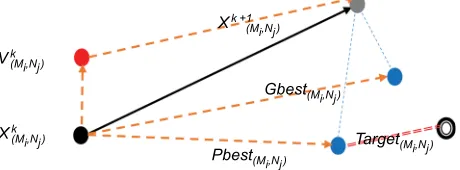
the bacteria and M is the EO. For every bacteria, the target is to find the inhibitory EO with minimum MIC. Thus, the searching process begins by initializing the bacteria and the EO’s MIC degree and changing the velocity of the search until the optimal solution is reached. This method reduces time and cost substantially, where the algorithm takes into consideration how to optimize the number of EOs that affects the bacteria to achieve a high utilization of one EO in inhibit-ing multiple types of bacteria. Figure 2 displays how the PSO works in order to find the optimal EO for the selected bacteria.
In Figure 2, X M N k
i, i
( ) represents the initial value of the
particles (i.e., the initial bacteria and EO), Pb ste (M Ni, i) and
GbestM N
i i
( , ) are the best suggested positions for the current particle, and the Target(M Ni, i)is the optimal solution (i.e., the
EO with the minimum MIC that can inhibit this bacteria). In the search process, every particle moves with a certain veloc-ity VkM N
i, i
( ) that determines its new position, and the search
will stop when the new position becomes close to the target.
Implementation and results
analysis of EOROT
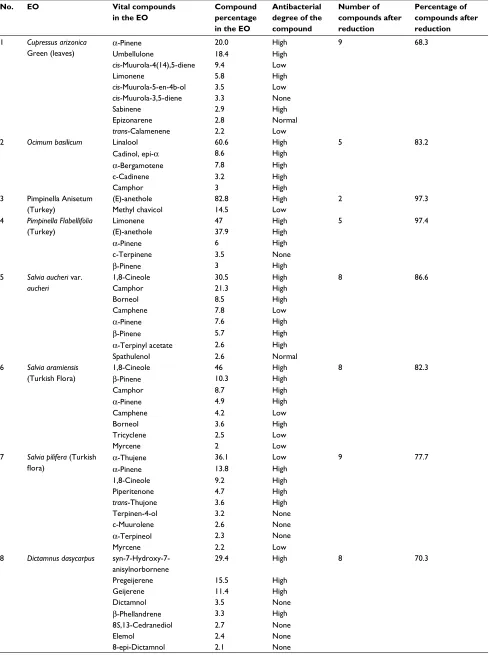
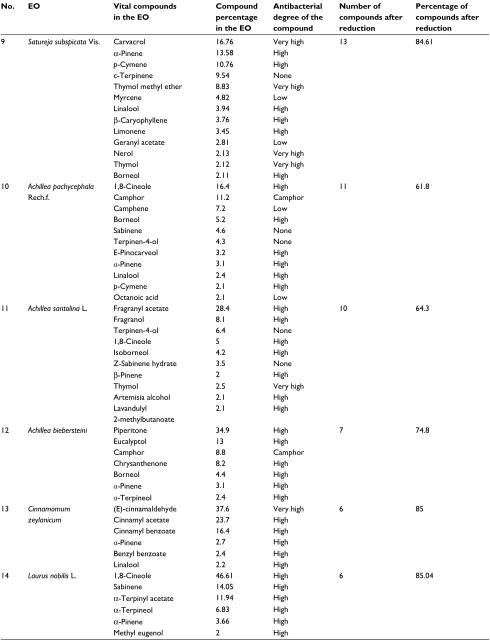
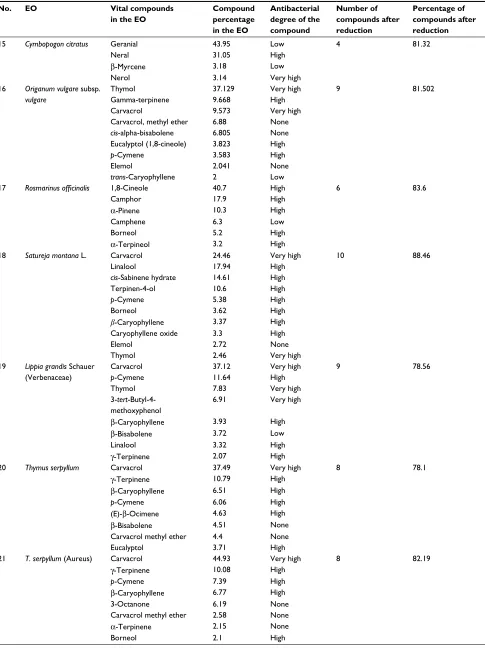
In this section, the EOROT will be practically applied on the 24 EOs, which are represented in Table 1. The suggested EOs have >850 compounds; many of them are not vital compounds in the chemical compositions. As discussed in the previous section, the first phase in EOROT is the reduction process that is based on the reduction of compounds and establishing of logic rules. Table 4 displays the results after implementing the process of compounds’ reduction.
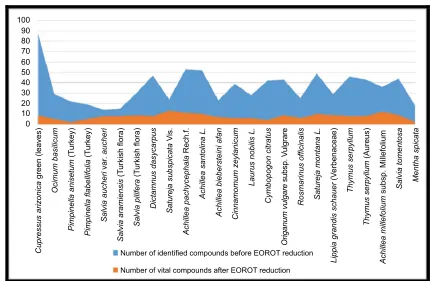
By completing the compound’s reduction process, the noninfluential compounds in the EO’s composition will be neglected according to the indiscernibility relation in the RS algorithm that preserves only the core of these compounds that have a vital impact in the EO’s activity. Figure 3 displays the difference between the number of EOs’ compounds before and after applying the reduction process using EOROT.
After reducing the EOs’ compounds, the EOROT contin-ues its job by filtering the 24 EOs to find the ones that have a high antibacterial activity. The logic rules that are defined in Equation 4 will be applied to calculate the accuracy rate
Table 3 Significance of compound concentration percentage and antibacterial degree
Symbol Significance of concentration percentage Symbol Significance of antibacterial activity degree
A ≥70 V.H Very high
B <70 and ≥50 H High
C <50 and ≥30 N Normal
D <30 and ≥10 L Low
E <10 and ≥2
Advances and Applications in Bioinformatics and Chemistry downloaded from https://www.dovepress.com/ by 118.70.13.36 on 19-Aug-2020
Dovepress Computational tool for EOs utilization in inhibiting the bacterial growth
a for every EO, which is considered as the measurement parameter in determining the antibacterial activity degree for the EO. Accuracy rate a is predefined in our algorithm with the value 0.6; thus, the EOs that have an accuracy rate
<0.6 will be neglected as they do not contain effective anti-bacterial compounds. Table 5 presents the final results of the
Figure 2 Scenario of PSO processing on the selected population of bacteria and EOs.
Abbreviations: PSO, particle swarm optimization; EO, essential oil.
V k (Mi,Nj)
X k +1 (Mi,Nj)
Gbest(Mi,Nj)
Target(Mi,Nj)
Pbest(Mi,Nj)
X k (Mi,Nj)
EOROT reduction process. As it is displayed, the number of EOs is reduced to 19 and thus achieves a high accuracy rate in antibacterial activity.
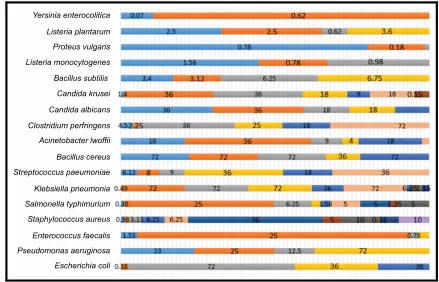
The extracted EOs from the reduction process (i.e., 19 EOs) are tested toward 17 types of bacteria, and as it is dis-played in Table 2, each type of bacteria can be discouraged by more than an EO with different ratios of MIC. Figure 4 gives a brief overview of the MIC values for the EOs on every type of bacteria.
Therefore, the optimization process, which is considered as the last and substantial phase in EOROT tool, begins its work. The target of the optimization is to determine the opti-mal solution to inhibit the growth of the existing bacteria. Thus, deciding the optimal solution is related to two issues: EOROT will search for the EO that achieves the bacterial activity’s inhibition with the less MIC rate, and at the same
Abbreviation: EOROT, Essential Oil Reduction and Optimization Tool. Reduction stage
1. Set the information system of antibacterial plants A=(U,A)
2. Define the indiscernibility matrix M(A)=(cij)
3. Build the discernibility function FA for the information system A as in Equation (1). 4. Reduce M attributes using laws of Rough sets (Upper, and Lower Laws).
5. Define d as number of non-empty rows of reduced M. 6. Build families sets of R0, R1, R2,………… Rd in the as follows: 7. Begin:
8. R0 is empty 9. For i= 1 to d
10. Ri=Si ∪Ti, where Si={R∈Ri-1:R ∩ Ci ≠∅}, and Ti R a a C R R R C
i i i
=
(
∪{ }
)
∈ , ∈ , ∩ =∆
11. Calculate the accuracy α for each Ri 12. End
13. If αi< 0.6
14. Remove dispensable attribute form each element of Rd
15. REDA (A)=Rd Optimization Stage
16. Set the Population P as a matrix P= [Ni*Mj] where N is the bacteria type and M is the plant 17. Set the particle is Pij which is the bacteria i on plant j
18. For each particle
19. Initialize position and velocity 20. End For
21. Do
22. For each particle
23. Find in the particle neighborhood, the particles with the best fitness as Pbest and Gbest. 24. Calculate Pi velocity according to the velocity equation
25. Vij(k+1)=wvij+c1r1[pbest-xij(k)]+c2r2[gbest-xij(k)]
26. Update Pi position according to the position equation 27. Xij(k+1)=xij(k)+vij(k+1)
28. If the new position for Pi is less than its current position then 29. Modify the velocity and position for Pi and Pbest and Gbest
30. Else
31. Modify the velocity of Pi and keep its old position 32. End For
33. While maximum iterations or minimum error criteria is not attained
Box 1 Pseudo code of EOROT
Advances and Applications in Bioinformatics and Chemistry downloaded from https://www.dovepress.com/ by 118.70.13.36 on 19-Aug-2020
Dovepress
El-Attar and Awad
No. EO Vital compounds
in the EO
Compound percentage in the EO
Antibacterial degree of the compound
Number of compounds after reduction
Percentage of compounds after reduction
1 Cupressus arizonica
Green (leaves) α
-Pinene 20.0 High 9 68.3
Umbellulone 18.4 High
cis-Muurola-4(14),5-diene 9.4 Low
Limonene 5.8 High
cis-Muurola-5-en-4b-ol 3.5 Low
cis-Muurola-3,5-diene 3.3 None
Sabinene 2.9 High
Epizonarene 2.8 Normal
trans-Calamenene 2.2 Low
2 Ocimum basilicum Linalool 60.6 High 5 83.2
Cadinol, epi-α 8.6 High
α-Bergamotene 7.8 High
c-Cadinene 3.2 High
Camphor 3 High
3 Pimpinella Anisetum (Turkey)
(E)-anethole 82.8 High 2 97.3
Methyl chavicol 14.5 Low
4 Pimpinella Flabellifolia
(Turkey)
Limonene 47 High 5 97.4
(E)-anethole 37.9 High
α-Pinene 6 High
c-Terpinene 3.5 None
β-Pinene 3 High
5 Salvia aucheri var.
aucheri
1,8-Cineole 30.5 High 8 86.6
Camphor 21.3 High
Borneol 8.5 High
Camphene 7.8 Low
α-Pinene 7.6 High
β-Pinene 5.7 High
α-Terpinyl acetate 2.6 High
Spathulenol 2.6 Normal
6 Salvia aramiensis
(Turkish Flora)
1,8-Cineole 46 High 8 82.3
β-Pinene 10.3 High
Camphor 8.7 High
α-Pinene 4.9 High
Camphene 4.2 Low
Borneol 3.6 High
Tricyclene 2.5 Low
Myrcene 2 Low
7 Salvia pilifera (Turkish
flora) α
-Thujene 36.1 Low 9 77.7
α-Pinene 13.8 High
1,8-Cineole 9.2 High
Piperitenone 4.7 High
trans-Thujone 3.6 High
Terpinen-4-ol 3.2 None
c-Muurolene 2.6 None
α-Terpineol 2.3 None
Myrcene 2.2 Low
8 Dictamnus dasycarpus
syn-7-Hydroxy-7-anisylnorbornene
29.4 High 8 70.3
Pregeijerene 15.5 High
Geijerene 11.4 High
Dictamnol 3.5 None
β-Phellandrene 3.3 High
8S,13-Cedranediol 2.7 None
Elemol 2.4 None
8-epi-Dictamnol 2.1 None
Table 4 Compounds of the EOs after the EOROT reduction process
(Continued)
Advances and Applications in Bioinformatics and Chemistry downloaded from https://www.dovepress.com/ by 118.70.13.36 on 19-Aug-2020
Dovepress Computational tool for EOs utilization in inhibiting the bacterial growth
No. EO Vital compounds
in the EO
Compound percentage in the EO
Antibacterial degree of the compound
Number of compounds after reduction
Percentage of compounds after reduction
9 Satureja subspicata Vis. Carvacrol 16.76 Very high 13 84.61
α-Pinene 13.58 High
p-Cymene 10.76 High
c-Terpinene 9.54 None
Thymol methyl ether 8.83 Very high
Myrcene 4.82 Low
Linalool 3.94 High
β-Caryophyllene 3.76 High
Limonene 3.45 High
Geranyl acetate 2.81 Low
Nerol 2.13 Very high
Thymol 2.12 Very high
Borneol 2.11 High
10 Achillea pachycephala
Rech.f.
1,8-Cineole 16.4 High 11 61.8
Camphor 11.2 Camphor
Camphene 7.2 Low
Borneol 5.2 High
Sabinene 4.6 None
Terpinen-4-ol 4.3 None
E-Pinocarveol 3.2 High
a-Pinene 3.1 High
Linalool 2.4 High
p-Cymene 2.1 High
Octanoic acid 2.1 Low
11 Achillea santolina L. Fragranyl acetate 28.4 High 10 64.3
Fragranol 8.1 High
Terpinen-4-ol 6.4 None
1,8-Cineole 5 High
Isoborneol 4.2 High
Z-Sabinene hydrate 3.5 None
β-Pinene 2 High
Thymol 2.5 Very high
Artemisia alcohol 2.1 High
Lavandulyl 2-methylbutanoate
2.1 High
12 Achillea biebersteini Piperitone 34.9 High 7 74.8
Eucalyptol 13 High
Camphor 8.8 Camphor
Chrysanthenone 8.2 High
Borneol 4.4 High
a-Pinene 3.1 High
a-Terpineol 2.4 High
13 Cinnamomum
zeylanicum
(E)-cinnamaldehyde 37.6 Very high 6 85
Cinnamyl acetate 23.7 High
Cinnamyl benzoate 16.4 High
a-Pinene 2.7 High
Benzyl benzoate 2.4 High
Linalool 2.2 High
14 Laurus nobilis L. 1,8-Cineole 46.61 High 6 85.04
Sabinene 14.05 High
α-Terpinyl acetate 11.94 High
α-Terpineol 6.83 High
α-Pinene 3.66 High
Methyl eugenol 2 High
Table 4 (Continued)
(Continued)
Advances and Applications in Bioinformatics and Chemistry downloaded from https://www.dovepress.com/ by 118.70.13.36 on 19-Aug-2020
Dovepress
El-Attar and Awad
No. EO Vital compounds
in the EO
Compound percentage in the EO
Antibacterial degree of the compound
Number of compounds after reduction
Percentage of compounds after reduction
15 Cymbopogon citratus Geranial 43.95 Low 4 81.32
Neral 31.05 High
β-Myrcene 3.18 Low
Nerol 3.14 Very high
16 Origanum vulgare subsp.
vulgare
Thymol 37.129 Very high 9 81.502
Gamma-terpinene 9.668 High
Carvacrol 9.573 Very high
Carvacrol, methyl ether 6.88 None
cis-alpha-bisabolene 6.805 None
Eucalyptol (1,8-cineole) 3.823 High
p-Cymene 3.583 High
Elemol 2.041 None
trans-Caryophyllene 2 Low
17 Rosmarinus officinalis 1,8-Cineole 40.7 High 6 83.6
Camphor 17.9 High
α-Pinene 10.3 High
Camphene 6.3 Low
Borneol 5.2 High
α-Terpineol 3.2 High
18 Satureja montana L. Carvacrol 24.46 Very high 10 88.46
Linalool 17.94 High
cis-Sabinene hydrate 14.61 High
Terpinen-4-ol 10.6 High
p-Cymene 5.38 High
Borneol 3.62 High
b-Caryophyllene 3.37 High
Caryophyllene oxide 3.3 High
Elemol 2.72 None
Thymol 2.46 Very high
19 Lippia grandis Schauer (Verbenaceae)
Carvacrol 37.12 Very high 9 78.56
p-Cymene 11.64 High
Thymol 7.83 Very high
3-tert -Butyl-4-methoxyphenol
6.91 Very high
β-Caryophyllene 3.93 High
β-Bisabolene 3.72 Low
Linalool 3.32 High
γ-Terpinene 2.07 High
20 Thymus serpyllum Carvacrol 37.49 Very high 8 78.1
γ-Terpinene 10.79 High
β-Caryophyllene 6.51 High
p-Cymene 6.06 High
(E)-β-Ocimene 4.63 High
β-Bisabolene 4.51 None
Carvacrol methyl ether 4.4 None
Eucalyptol 3.71 High
21 T. serpyllum (Aureus) Carvacrol 44.93 Very high 8 82.19
γ-Terpinene 10.08 High
p-Cymene 7.39 High
β-Caryophyllene 6.77 High
3-Octanone 6.19 None
Carvacrol methyl ether 2.58 None
α-Terpinene 2.15 None
Borneol 2.1 High
Table 4 (Continued)
(Continued)
Advances and Applications in Bioinformatics and Chemistry downloaded from https://www.dovepress.com/ by 118.70.13.36 on 19-Aug-2020
Dovepress Computational tool for EOs utilization in inhibiting the bacterial growth
No. EO Vital compounds
in the EO
Compound percentage in the EO
Antibacterial degree of the compound
Number of compounds after reduction
Percentage of compounds after reduction 22 Achillea millefolium
subsp. millefolium
Eucalyptol (1,8-cineole) 24.6 High 12 79.3
Camphor 16.7 High
α -Terpineol 10.2 High
β-Pinene 4.2 High
Borneol 4 High
Bisabolol oxide II 3.8 Low
Bisabolone oxide 3.3 Low
Sabinene 2.8 High
Terpinen-4-ol 2.8 None
α-Pinene 2.4 High
Camphene 2.4 High
α-Bisabolol 2.1 Low
23 Salvia tomentosa β-Pinene 39.7 High 9 75.8
α-Pinene 10.9 High
Camphor 9.7 High
Borneol 4.3 High
Camphene 2.4 None
Caryophyllene 2.3 High
Viridiflorol 2.3 None
Limonene 2.2 High
α-Caryophyllene 2 High
24 Mentha spicata Carvone 78.76 High 2 90.26
Limonene 11.5 High
Abbreviation: EO, essential oil.
Table 4 (Continued)
Figure 3 Comparison between the EOs’ numbers before and after the reduction process.
Abbreviations: EO, essential oil; EOROT, Essential Oil Reduction and Optimization Tool.
Cupressus arizonica
green (leaves)
Ocimum basilicum
Pimpinella anisetum
(T
urkey)
Pimpinella flabellifolia
(T
urkey)
Salvia aucheri
va
r.
aucher
i
Salvia aramiensi
s
(T
urkish flora)
Salvia pilifera
(T
urkish flora)
Dictamnus dasycarpus Satureja subspicata
Vi
s.
Achillea pachycephal
a
Rech.f.
Achillea santolina L.
Achillea biebersteini afan Cinnamomum zeylanicum
Number of identified compounds before EOROT reduction
100 90 80 70 60 50 40 30 20 10 0
Number of vital compounds after EOROT reduction
Laurus nobilis L.
Cymbopogon citratus
Origanum vulgare
subsp.
Vu
lgrare
Rosmarinus officinalis Satureja montana L.
Lippia grandis schauer
(V
erbenaceae)
Thymus serpyllum
Thymus serpyllum
(Aureus
)
Achillea millefolium
subsp. Millefolium Salvia tomentos
a
Mentha spicat
a
Advances and Applications in Bioinformatics and Chemistry downloaded from https://www.dovepress.com/ by 118.70.13.36 on 19-Aug-2020
Dovepress
El-Attar and Awad
time, it will try to maximize the utilization of the selected EO in inhibiting multiple types of the existing bacteria as displayed in Table 6.
Thus, it could be concluded that the proposed compu-tational tool “EOROT” enhances the process of finding the
optimal EO that can inhibit the growth activity of the bac-teria with the best MIC rate. In addition, EOROT takes into consideration how to boost the utilization of the available EOs, for instance Thymus serpyllum can be used to inhibit the activity of E. coli, Pseudomonas aeruginosa, Bacillus cereus, and Proteus vulgaris as evidenced in Table 6.
Table 5 EOs after completing the EOROT reduction process
No. EO Accuracy rate
1 Ocimum basilicum 0.9
2 Pimpinella anisetum (Turkey) 0.84
3 Salvia aucheri var. aucheri 0.74
4 Salvia aramiensis (Turkish flora) 0.71
5 Dictamnus dasycarpus 0.63
6 Satureja subspicata Vis. 0.69
7 Achillea pachycephala Rech.f. 0.68
8 Achillea santolina L. 0.70
9 Achillea biebersteini Afan 0.89
10 Cinnamomum zeylanicum 0.85
11 Laurus nobilis L. 0.89
12 Cymbopogon citratus 0.77
13 Rosmarinus officinalis 0.85
14 Satureja montana L. 0.79
15 Lippia grandis Schauer (Verbenaceae) 0.79
16 Thymus serpyllum 0.657
17 T. serpyllum (Aureus) 0.695
18 Salvia tomentosa 0.71
19 Mentha spicata 0.9
Abbreviations: EO, essential oil; EOROT, Essential Oil Reduction and Optimization Tool.
Figure 4 MIC values for the EOs on every type of bacteria.
Abbreviations: MIC, minimum inhibitory concentration; EO, essential oil.
Yersinia enterocolitica Listeria plantarum Proteus vulgaris Listeria monocytogenes Bacillus subtilis Candida krusei Candida albicans Clostridium perfringens Acinetobacter lwoffii Bacillus cereus Streptococcus paeumoniae Klebsiella pneumonia Salmonella typhimurium Staphylococcus aureus Enterococcus faecalis Pseudomonas aeruginosa Escherichia coli
Table 6 Optimal MIC for inhibiting the bacteria activity
Bacteria EO MIC
Escherichia coli Thymus serpyllum (Aureus) 0.05
Pseudomonas aeruginosa T. serpyllum (Aureus) 0.13
Bacillus cereus T. serpyllum (Aureus) 0.31
Proteus vulgaris T. serpyllum (Aureus) 0.39
Enterococcus faecalis Satureja subspicata Vis. 0.78
Staphylococcus aureus S. subspicata Vis. 0.09
Clostridium perfringens S. subspicata Vis. 0.3
Candida albicans S. subspicata Vis. 0.09
Salmonella typhimurium Cupressus arizonica Green (leaves) 0.38
Klebsiella pneumonia C. arizonica Green (leaves) 0.49
Streptococcus paeumoniae C. arizonica Green (leaves) 6.12
Listeria plantarum Cymbopogon citratus 0.62
Yersinia enterocolitica C. citratus 0.08
Acinetobacter lwoffii Salvia aramiensis (Turkish flora) 4.5
Candida krusei Achillea biebersteini Afan 0.15
Bacillus subtilis Mentha spicata 2.5
Listeria monocytogenes Satureja montana L. 0.78
Abbreviations: MIC, minimum inhibitory concentration; EO, essential oil.
Advances and Applications in Bioinformatics and Chemistry downloaded from https://www.dovepress.com/ by 118.70.13.36 on 19-Aug-2020
Dovepress Computational tool for EOs utilization in inhibiting the bacterial growth Therefore, according to the extracted information from
the EOROT tool, it can also be used to predict the efficiency of the EOs in inhibiting other types of bacterial activities.
Conclusion
Reliance on natural products has become an important trend in many fields as the alternative medicine, which depends on using the natural anti-organisms in fighting bacteria, fungi and tumoral infections. One of the most efficient anti-organisms extracted from the plants is the EO that proves its efficiency as antibacterial agents. This article presents a new computational tool known as EOROT in an attempt to determine the best and optimal EO in inhibiting the activity of the bacteria growth. Furthermore, EOROT has the ability to increase the EO’s utilization by using it in inhibiting mul-tiple kinds of bacteria, which, in turn, will save the cost of materials. On the other hand, the extracted information from the EOROT tool could be used to predict the efficiency of the EOs in inhibiting the other types of bacterial activities that may decrease the time also. The weak point in this research is the limited number of EOs and types of bacteria used in the case study, with the research based on only 24 EOs tested toward 17 kinds of bacteria. Thus, in the future work, the EOROT will be developed to handle a larger number of data and also it will be enhanced to predict the activity of the EOs.
Disclosure
The authors report no conflicts of interest in this work.
References
1. Zuzarte M, Salgueiro L. Chapter 2: Essential oils chemistry. Bioactive Essential Oils and Cancer. Springer; 2015:19–28.
2. Neves J, Martins M, Candeias F, et al. Logic programming and artificial neural networks in pharmacological screening of Schinus essential oils. Int J Biol Biomol Agric Food Biotechnol Eng. 2015;9(7):728–733. 3. Chamorro E, Zambón S, Morales W. Study of the chemical composition
of essential oils by gas chromatography. Gas Chromatography in Plant Science, Wine Technology, Toxicology and Some Specific Applications. InTech; 2012:307–324.
4. Maida I, Nostro A, Pesavento G, et al. Exploring the anti-Burkholderia cepacia complex activity of essential oils: a preliminary analysis. Evid Based Complement Alternat Med. 2014;2014:1–10.
5. Daynac M, Cortes-Cabrera A, Prieto J. Application of artificial intel-ligence to the prediction of the antimicrobial activity of essential oils. Evid Based Complement Alternat Med. 2015;2015:1–10.
6. Rajkovic K, Pekmezovic M, Barac A, Nikodinovic-Runic J. Inhibitory effect of thyme and cinnamon essential oils on Aspergillus flavus: optimization and activity prediction model development. Ind Crops Prod. 2015;65:7–13.
7. Dhifi W, Bellili S, Jazi S, Bahloul N, Mnif W. Essential oils’ chemical characterization and investigation of some biological activities: a critical review. MDPI Med J. 2015;3(25):1–16.
8. Chéraif I, Jannet H, Hammami M, Khouja M, Mighri Z. Chemical com-position and antimicrobial activity of essential oils of Cupressus arizo-nica Greene. Biochemical Systematics and Ecology. 2007;35:813–820.
9. Hussain A, Anwar F, Sherazi S, Przybylski R. Chemical composi-tion, antioxidant and antimicrobial activities of basil (Ocimum basilicum) essential oils depends on seasonal variations. Food Chem. 2008;108(3):986–995.
10. Tepe B, Akpulat H, Sokmen M, et al. Screening of the antioxidative and antimicrobial properties of the essential oils of Pimpinella anisetum and Pimpinella flabellifolia from Turkey. Food Chem. 2006;97:719–724. 11. Kelen M, Tepe B. Chemical composition, antioxidant and antimicrobial
properties of the essential oils of three Salvia species from Turkish flora. Bioresour Technol. 2008;99(10):4096–4104.
12. Lei J, Yu J, Yu H, Liao Z. Composition, cytotoxicity and antimicrobial activ-ity of essential oil from Dictamnus dasycarpus. Food Chem. 2008;107: 1205–1209.
13. Skocibusic M, Bezic N, Dunkic V. Phytochemical composition and antimicrobial activities of the essential oils from Satureja subspicata Vis. growing in Croatia. Food Chem. 2006;96:20–28.
14. Motavalizadehkakhky A, Shafaghat A, Zamani H, et al. Composi-tions and the in vitro antimicrobial activities of the essential oils and extracts of two Achillea species from Iran. J Med Plants Res. 2013;7(19):1280–1292.
15. Sokmen A, Sokmen M, Daferera D, et al. The in vitro antioxi-dant and antimicrobial activities of the essential oil and methanol extracts of Achillea biebersteini Afan (Asteraceae). Phytother Res. 2004;18(6):451–456.
16. Boniface Y, Philippe S, Rose de Lima H, et al. Chemical composi-tion and antimicrobial activities of Cinnamomum zeylanicum Blume dry leaves essential oil against food-borne pathogens and adulterated microorganisms. Int Res J Biol Sci. 2012;1(6):18–25.
17. Cherrat L, Espina L, Bakkali M, Garcia-Gonzalo D, Pagan R, Laglaoui A. Chemical composition and antioxidant properties of Laurus nobilis L. and Myrtus communis L. essential oils from Morocco and evaluation of their antimicrobial activity acting alone or in combined processes for food preservation. Soc Chem Ind. 2013;94:1197–1204.
18. Tajidin E, Ahmad S, Rosenani A, Azimah H, Munirah M. Chemi-cal composition and citral content in lemongrass (Cymbopogon citratus) essential oil at three maturity stages. Afr J Biotechnol. 2012;11(11):2685–2693.
19. Vazirian M, Mohammadi M, Farzaei M, Amin G, Amanzadeh Y. Chemical composition and antioxidant activity of Origanum vulgare subsp. vulgare essential oil from Iran. Res J Pharmacogn. 2015;2(1): 41–46.
20. Zaouali Y, Bouzaine T, Boussaid M. Essential oils composition in two Rosmarinus officinalis L. varieties and incidence for antimicro-bial and antioxidant activities. Food Chem Toxicol. 2010;48(11):3 144–3152.
21. Mihajilov-Krstev T, Radnovic D, Kitic D, et al. Chemical composi-tion, antimicrobial, antioxidative and anticholinesterase activity of Satureja montana L. ssp montana essential oil. Cent Eur J Biol. 2014;9(7):668–677.
22. Sarrazin S, Oliveira R, Barata L, Mourão R. Chemical composi-tion and antimicrobial activity of the essential oil of Lippia grandis Schauer (Verbenaceae) from the western Amazon. Food Chem. 2012;134(3):1474–1478.
23. Wesołowska A, Grzeszczuk M, Jadczak D, Nawrotek P, Struk M. Comparison of the chemical composition and antimicrobial activ-ity of Thymus serpyllum essential oils. Not Bot Horti Agrobo. 2015;43(2):432–438.
24. Candan F, Unlu M, Tepe B, et al. Antioxidant and antimicrobial activity of the essential oil and methanol extracts of Achillea mille-folium subsp. millemille-folium Afan. (Asteraceae). J Ethnopharmacol. 2003;87(2–3):215–220.
25. Tepe B, Daferera D, Sokmen A, Sokmen M, Polissiou M. Antimicrobial and antioxidant activities of the essential oil and various extracts of Salvia tomentosa Miller (Lamiaceae). Food Chem. 2005;90:333–340. 26. Shahbazi Y. Chemical composition and in vitro antibacterial activity of
Mentha spicata essential oil against common food-borne pathogenic bacteria. J Pathog. 2015;2015:916305.
Advances and Applications in Bioinformatics and Chemistry downloaded from https://www.dovepress.com/ by 118.70.13.36 on 19-Aug-2020
Dovepress
Advances and Applications in Bioinformatics and Chemistry
Publish your work in this journal
Submit your manuscript here: https://www.dovepress.com/advances-and-applications-in-bioinformatics-and-chemistry-journal Advances and Applications in Bioinformatics and Chemistry is an
inter-national, peer-reviewed open-access journal that publishes articles in the following fields: Computational biomodelling; Bioinformatics; Com-putational genomics; Molecular modelling; Protein structure modelling and structural genomics; Systems Biology; Computational Biochemistry;
Computational Biophysics; Chemoinformatics and Drug Design; In silico ADME/Tox prediction. The manuscript management system is com-pletely online and includes a very quick and fair peer-review system, which is all easy to use. Visit http://www.dovepress.com/testimonials. php to read real quotes from published authors.
Dovepress
El-Attar and Awad27. Hedar A, Omar M, Sewisy A. Rough sets attribute reduction using an accelerated genetic algorithm. 16th IEEE/ACIS International Confer-ence on Software Engineering, Artificial IntelligConfer-ence, Networking and Parallel/Distributed Computing (SNPD). 2015.
28. Huang K, Chang T, Chang S. Rough set-based dataset reduction method using swarm algorithm and cluster validation function. 48th Hawaii International Conference on System Sciences. 2015:1483–1492. 29. Pawlak Z. Rough sets. Int J Inform Comput Sci. 1982;11:341–356.
30. Pałkowski Ł, Błaszczyński J, Krysiński J, et al. Application of rough
set theory to prediction of antimicrobial activity of bis-quaternary ammonium chlorides. Lect Notes Comput Sci. 2012;7414:107–116.
31. Bing Z, Fu J. Algorithm on rule extraction based on rough set and neural network theory. The 6th International Forum on Strategic Technology. 2011:1137–1140.
32. Das S, Abraham A, Konar A. Particle swarm optimization and dif-ferential evolution algorithms: technical analysis, applications and hybridization perspectives. Adv Comput Intell Ind Syst Stud Comput Intell. 2008;116:1–38.
33. Crisan M. Convergence and Hybrid Information Technologies. Vukovar: Intech; 2010.
34. El-Attar N. Prediction Resources Scheduling in Cloud Computing Systems. Germany: Lambert Academic Publishing; 2016.
Advances and Applications in Bioinformatics and Chemistry downloaded from https://www.dovepress.com/ by 118.70.13.36 on 19-Aug-2020