Gain Scheduling of PID Controller for Level
Control System & Comparative Analysis of
PID Controllers
Prof.V.K.Jadhav1, Sheetal.N.Gawale2
Assistant Professor, Dept. of Instrumentation, Pravara Rural Engineering College, Loni, Ahmednagar,
Maharashtra, India 1
PG Student [Instrumentation Engineering], Dept. of Instrumentation Engineering, Pravara Rural Engineering College,
Loni, Maharashtra, India2
ABSTRACT: Proportional-integral-derivative (PID) controllers are widely used in industrial control systems because of the reduced number of parameters to be tuned. They providecontrol signals that are proportional to the error between the reference signal and the actual output (proportional action), to the integral of the error (integral action), and to the derivative of the error (derivative action), namely.
The main features of PID controllers are the capacity to eliminate steady state error of the response to a step reference signal,(because of integral action) and the ability to anticipate output changes (when derivative action is employed).Since the 60s, the empirical or classical gain-scheduling (GS) control has been used for controlling non-linear and time varying systems. But, this control methodology achieves closed loop stability, without guarantees, for slowly varying parameters.One source for the change in dynamics will be the known nonlinearities. It is then possible to change the parameters of the controller by monitoring the operating conditions of the process. This idea is called gain scheduling, since the scheme was originally used to accommodate changes in process gain only.
Gain scheduling is easy to implement in computer-controlled systems, provided that there is support in the available software. Gain scheduling based on measurements of operations of the process is a good way to compensate for variations in process parameters or known nonlinearities of the process. If we use the informal definition of adaptive controller, Gain scheduling is a very useful technique for reducing the effects of parameter variations.
KEYWORDS: proportional-integral-derivative (PID) controllers, Gain scheduling, Gain scheduled controller, Nonliniearities.
I.INTRODUCTION
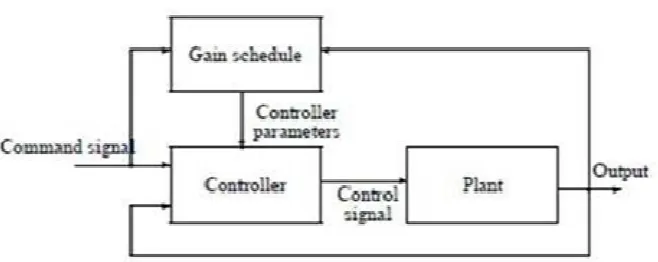
It is sometimes possible to find auxiliary variables that correlate well with the changes in process dynamics. It is then
Figure 1.1: Schematic diagram of Gain scheduled Controller
II.SYSTEM MODEL AND ASSUMPTIONS
Gain Scheduling PID Controller design for Level Control system
Gain scheduling is an adaptive control system. It is used for robust control design. This method is suitable if the changes in the parameters of the plant are frequent and more. In this method the set of controller parameters are found for different set of plant sets. Normally for such control strategy it is necessary to have the plant dynamics of sluggish nature. The feedback controller can be simple PID controller. In the literature it is observed that the researchers have tuned different sets of PID controller for variation in the parameters of the plant. These PID controllers can be fractional order PID controller. The advantage of PID is that it has 5 tuning parameters as compared to 3 parameters of PID controller. Due to more number of tuning parameters the number of sets of FOPID can be reduced for the same variation in the plant. The literature have proved that the FOPID controller are more robust and gives improved characteristics for the set of specifications. In the literature there is no work on FOPID gain scheduling controller.
Further the method can be extended by optimization techniques.
2.1 Experimental application
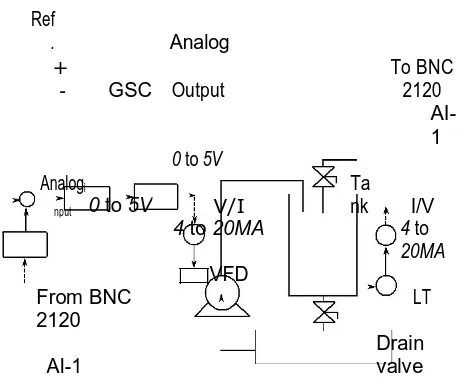
2.2 For real time implementation of Gain Scheduling PID Controller, an experimental set-up of level system is used and it is shown in Fig. 5.4. The system is interfaced with personnel computer using NI PCI 6024E data acquisition card with BNC 2120 connection board. The input voltage signal applied to the variable frequency drive (VFD) through voltage-to-current converter which adjust the inlet flow of tank with the help of positive displacement pump driven by a 230V, 50Hz motor. The controller signal, in the range of 0 − 5V is given to BNC 2120 analog
output channels and then converted into 4 − 20mA corresponds to (0 − 50Hz) input to variable frequency.
2.3 drives (VFDs). A level transmitter (LT) is installed on tank to provide 4 − 20mA corresponds to 0 − 100%
Figure 2.1: Experimentation set-up
Ref
. Analog
GSC
To BNC 2120 +
Output
-0 to 5V
AI-1
Analogi
nput 0 to 5V V/I
Ta
nk I/V
4 to 20MA 4 to
20MA VFD
LT From BNC
2120
AI-1
Drain valve
Figure 2.2: Schematic diagram of controller for experimentation
( ) = . X
Similarly in above simulation example, here also the performance of Gain Scheduling controller is compared with convential PID controllers. And for convential PID controller KP = 4.375, KI = 0.125 are
the parameter values.
IV). Steps to design gain scheduling PID Controller
• Obtain the system transfer function and system details
• Set t=4
• Determine y for the previous u, i.e. u(t-1) = u(1) • Determine e(t) = H - y(t); where H is the set point
• Determine/ Update kp, ki and kd of the PID controller using ZN method based on the e(t) • Determine controller output
• Set the controller output as u(t) • Set the controller output as u(t)
• Repeat the process from Step 4 until all the samples are.
2.4 Steps to determine PID controller parameters:
• Reduce the integrator and derivative gains to 0.
• Increase Kp from 0 to some critical value Kp =Kc at which sustained oscillations occur. • Note the value Kc and the corresponding period of sustained oscillation,Tc
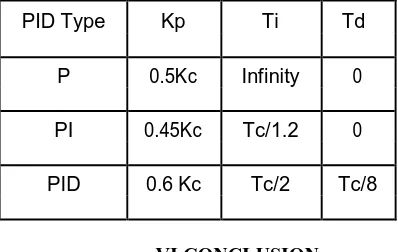
• The controller gains are now specified as follows:
PID Type Kp Ti Td
P 0.5Kc Infinity 0
PI 0.45Kc Tc/1.2 0
PID 0.6 Kc Tc/2 Tc/8
VI.CONCLUSION
2.5 Result of Gain Scheduled PID Controller
Figure 2.4: Characterstics of error change in Gain Scheduled PID Controller
to zero.the high indication of error indicates the high deviation of level from the setpoint.
Figure 2.5: Updates of Gain Scheduled PID Controller gain
Figure b) shows the gain scheduling Process.The gain Scheduling process includes regular updates of the controller gain Kp,Ki,Kd.The update usally occur when there is deviation or change in set point.Since error is high in the initial sample the gain are often updated and eventually reach a stable value.
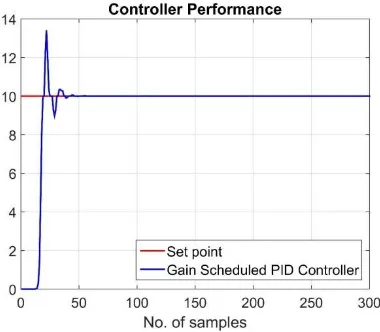
Figure c) shows the level of the tank with gain scheduled PID Controller achieved over a time,Initially it produces high deviation from the set point and over the period it has been closer to the set point.
REFERENCES
[1] D.Richard and H.Robert Bishop, Modern Control Systems 9th ed., PrenticeHall Inc., New Jersey-07458, USA, Chapters 1, 5, pp.1-23, pp. 173-206,2001
[2] D.Pradeepkannan,S.Sathiyamoorthy,Implementation of Gain Scheduled PID Controller for a Nonlinear Coupled Spherical Tank Process , International Journal of Mechanical and Mechatronics Engineering IJMME-IJENS, Vol:14 No:06,PP-93-98.
[3] L Ginalber,O.Serra and T.CarlosCesar,Development Method for a Robust PID Fuzzy Controller of LPV Systems, Fuzzy-IEEE 2009, Korea, August 20-24, 2009,PP-826-830.
[4] B Krishna,SGangopadhyay and m George, Design and Simulation of Gain Scheduling PID Controller for Ball and Beam System , International Confer-ence on Systems, Signal Processing and Electronics Engineering (ICSSEE’2012) December 26-27, 2012 Dubai (UAE),PP-199-203.
[5] V.Puig, Y.Bolea and J. Blesa,“Robust Gain-Scheduled Smith PID Controllers for Second Order LPV Systems with Time Varying Delay”,textit IFAC Conference on Advances in PID Control ,PID’12 Brescia (Italy), March 28-30, 2012
[6] K.Lee.Fitzpatrick, Applications of linear parameter-varying control for Aerospace systems ,University of Florida:2003..
[7] B Krishna,SGangopadhyay and m George, Design and Simulation of Gain Scheduling PID Controller for Ball and Beam System , International Confer-ence on Systems, Signal Processing and Electronics Engineering (ICSSEE’2012) December 26-27, 2012 Dubai (UAE),PP-199-203.
[8] Rugh WJ, Shamma JS. Research on gain scheduling, Automatica, 36, 2000, 1401-1425.
[10] Boyd SP and Barratt H. Linear Controller Design-Limits of Per- formance. Prentice-Hall, Engle-wood Cliffs, NJ, 1991 .3.
[10] K. Astrom, K. and T.Hagglund, ‘’PID Controllers: Theory, Design, and Tuning’’, Instrument Society of America, ISBN 1-55617-516-7, 1995 [11] D. Maiti, A. Acharya M. Chakraborty, A. Konar, R. Janarthanan, “Tuning PID and Fractional PID Controllers using the Integral Time Absolute Error Criterion” 4th International Conference on Information and Automation for Sustainability, 2008 , pp. 457-462 .