Sharemind: a framework for fast privacy-preserving
computations
Dan Bogdanov1,2, Sven Laur1, and Jan Willemson1,2 1
University of Tartu
{db,swen,jan}@ut.ee 2
AS Cybernetica
Abstract. Gathering and processing sensitive data is a difficult task. In fact, there is no common recipe for building the necessary information systems. In this pa-per, we present a provably secure and efficient general-purpose computation sys-tem to address this problem. Our solution—SHAREMIND—is a virtual machine for privacy-preserving data processing that relies on share computing techniques. This is a standard way for securely evaluating functions in a multi-party computa-tion environment. The novelty of our solucomputa-tion is in the choice of the secret sharing scheme and the design of the protocol suite. We have made many practical de-cisions to make large-scale share computing feasible in practice. The protocols of SHAREMINDare information-theoretically secure in the honest-but-curious model with three computing participants. Although the honest-but-curious model does not tolerate malicious participants, it still provides significantly increased privacy preservation when compared to standard centralised databases.
1
Introduction
Recent years have significantly altered the methodology of collecting and processing information. The large-scale adoption of online information systems has made both the use and abuse of personal data easier than before. This has caused an increased aware-ness about privacy issues among individuals. In many countries, databases containing personal, medical or financial information about individuals are classified as sensitive and the corresponding laws specify who can collect and process sensitive information about a person.
Another option is to consider the problem as a multi-party computation task, where the data donors want to securely aggregate data without revealing their private in-puts. However, the corresponding cryptographic solutions quickly become practically intractable when the number of participants grows beyond few hundreds. Moreover, data donors are often unwilling to stay online during the entire computation and their computers can be easily taken over by adversarial forces. As a way out, we propose a hierarchical solution, where all computations are done by dedicatedminerparties who are less susceptible for external corruption. More precisely, we assume that only a few miner parties can be corrupted during the computation. Consequently, we can use se-cret sharing and share computing techniques for privacy-preserving data aggregation. In particular, data donors can safely submit their inputs by sending the corresponding shares to the miners. As a result, the miners can securely evaluate any aggregate statistic without further interaction with the data donors.
Our contribution. The presented theoretical solution does not form the core of this
pa-per. Share computing techniques have been known for decades [BOGW88,CCD88,Bea91] and thus all important results are well established by now. Hence, we focused mainly on practical aspects and developed the SHAREMINDframework for privacy-preserving computations. The SHAREMINDframework is designed to be an efficient and easily programmable platform for developing and testing various privacy-preserving algo-rithms. More precisely, it consists of the computation runtime environment and a pro-gramming library for creating private data processing applications. As a result, one can develop secure multi-party protocols without the explicit knowledge of all implementa-tion details. On the other hand, it is also possible to test and add your own protocols to the library, since the source code of SHAREMINDis freely available [SM007].
To assure maximal efficiency, we have made some non-standard choices. First, the SHAREMINDframework uses an additive secret sharing scheme over the ring Z232. Besides the direct computational gains, such a choice also simplifies many share com-puting protocols. When a secret sharing protocol is defined over a finite fieldZp, then any overflow in computations causes modular reductions that corrupt the end result. In the SHAREMINDframework, all modular reductions occur modulo232and thus results always coincide with the standard32-bit integer arithmetic. On the other hand, standard share computing techniques are not applicable for the ringZ232. In particular, we were forced to roll out our own multiplication protocol, see Sect. 4.
Secondly, the current implementation of SHAREMIND supports the computation-ally most efficient setting, where only one of three miner nodes can be semi-honestly corrupted. As discussed in Sect. 3, the corresponding assumption can be enforced with a reasonable practical effort. Additionally, we discuss extending the system to more complex settings in Sect. 7.
results. In particular, we compare our results with other implementations of privacy-preserving computations [MNPS04,BDJ+06,YWS06]. Finally, we conclude our pre-sentation with some improvement plans for future, see Sect. 7.
2
Cryptographic Preliminaries
Theoretical attack model. In this article, we state and prove all security guarantees
in theinformation-theoretical setting, where each participant pair is connected with a private communication channel that provides asynchronous communication. In other words, a potential adversary can only delay or reorder messages without reading them. We also assume that the communication links are authentic, i.e., the adversary cannot send messages on behalf of non-corrupted participants. The adversary can corrupt par-ticipants during the execution of a protocol. In the case ofsemi-honestcorruption, the adversary can only monitor the internal state of a corrupted participant, whereas the adversary has full control over maliciouslycorrupted participants. We consider only threshold adversaries that can adaptively corrupt up tot participants. Such an attack model is well established, see [BOCG93,BOKR94,HM00] for further details.
As a second restriction, we consider only self-synchronising protocols, where the communication can be divided into distinct rounds. A protocol isself-synchronising if the adversary cannot force (semi-)honest participants to start a new communication round until all other participants have completed the previous round. As a result, we can analyse the security of these protocols in the standard synchronised setting with a rushing adversary [CCD88,Bea91], where all communication rounds take place at pre-agreed time intervals and the corrupted participants can send out their messages after receiving messages form honest participants.
Secure multi-party computation. Assume that participantsP1, . . . ,Pnwant to
com-pute outputsyi =fi(x1, . . . , xn)wherex1, . . . , xn are corresponding private inputs. Then the security of a protocolπthat implements the described functionality is defined by comparing the protocol with the ideal implementationπ◦, where all participants sub-mit their inputsx1, . . . , xnsecurely to the trusted third partyTthat computes the neces-sary outputsyi =fi(x1, . . . , xn)and sendsy1, . . . , ynsecurely back to the respective participants. A malicious participantPi can halt the ideal protocol π◦ by submitting
xi =⊥. Then the trusted third partyTsends⊥as an output for all participants. Now a protocolπis secure if for any plausible attackAagainst the protocolπthere exists a plausible attackA◦against the protocolπ◦that causes comparable damage.
For brevity, let us consider only the stand-alone setting, where only a single protocol instance is executed and all honest participants carry out no side computations. Let
The efficiency constraint has several interpretations. In the asymptotic setting, the running times arecomparableifτidis polynomial inτre. For fixed time boundτre, one must decide an acceptable time boundτidby herself. In either case, all security proofs in this article are suitable, since they assure thatτid≤c·τrewherecis relatively small constant.
In our setting, a real world attack A is plausible if it corrupts up to t partici-pants. The corresponding ideal world attack A◦ is plausible if it corrupts the same set of participants as the real world attack. For further details and standard results, see [Bea91,DM00,Can00,Can01].
Universal composability. Complex protocols are often designed by combining several
low level protocols. Unfortunately, the stand-alone security is not enough to prove the security of the compound protocol and we must use more stringent security definitions. More formally, let%h·ibe a global context that uses the functionality of a protocolπ. Then we can compare real and ideal world protocols%hπiand%hπ◦i. Letφ,ψ,ψ◦ denote the input and output vectors of the compound protocols%hπiand%hπ◦i. Then a protocolπisperfectly universally composableif for any plausibleτre-time attackA against%hπithere exists a plausibleτid-time attackA◦against%hπ◦isuch that for any input distributionφ←Dthe output distributionsψandψ◦coincide and the running timesτreandτid are comparable. See the manuscript [Can01] for a more formal and precise treatment.
Secret sharing schemes. Many solutions for secure multiparty computations are based
on secret sharing. Asecret sharing schemeis determined by a randomised sharing al-gorithmDeal:M → S1×. . .× Snand a recovery algorithmRec:S1×. . .× Sn→
M ∪ {⊥}whereMis the set of possible secrets andS1, . . . ,Snare the sets of possible shares. For brevity, we use a shorthand[[s]]to denote the shares[s1, . . . , sn]generated by the sharing algorithmDeal(s).
Ak-out-of-nthreshold secret sharing schememust satisfy two additional require-ments. First, the reconstruction algorithm must output a correct value for all shares
[ˆs1, . . . ,sˆn]that are obtained from a valid sharing[s1, . . . , sn]by altering at mostn−k original shares. Second, the distribution ofk−1sharessi1, . . . , sik−1must be always independent of the secret s, i.e., a collection ofk−1shares reveals no information about the secrets.
3
Privacy-Preserving Data Aggregation
we introduce a framework for privacy-preserving computations that eliminates the need for unconditional trust. Our SHAREMINDframework uses secret sharing to split
con-fidential information between several nodes (miners). As a result, data donors do not have to trust any of them. Instead, it is sufficient to believe that the number of collab-orating corrupted nodes is below the prescribed thresholdt. The latter can be achieved with physical and organisational security measures such as dedicated server rooms and software auditing.
By sending the shares of the data to the miners, data donors effectively delegate all rights over the data to the consortium of miners. Furthermore, it is relatively easy to assure that a set of miners fulfils the necessary security requirements, whereas it is essentially impossible to make justified assumptions about all data donors. As a re-sult, protocols withouttrust transfermust be secure even if the majority of data donors are malicious. Although such protocols for honest minority do exist [Yao86,GL90], they have many drawbacks [CK89,CKL03]. First, we cannot construct protocols, where data donors just submit their inputs. Instead, they have to be active throughout the en-tire computational process. Secondly, we must use computationally expensive crypto-graphic primitives to assure provable security. Therefore, the corresponding protocols quickly become practically intractable if the number of analysed data items grows be-yond few thousand records.
Note that physical and organisational security measures are sufficient to assure semi-honest behaviour if there are only a few miners. Indeed, it is not too far-fetched to assume that potential adversaries can install only passive logging programs into well-protected miner nodes. Classical limits proved by Chor and Kushilevitz [CK89] indicate that the use of computationally slow cryptographic primitives is unavoidable if semi-honestly corrupted participants are in majority. Hence, it is advantageous to consider settings, where the total number of minersnis larger than2t. Analogous theoretical limits for malicious corruption [CCD88,BOGW88] imply thatn >3tor we again have to use relatively slow cryptographic primitives.
Although a larger number of miner nodes increases the level of tolerable corruption, it also makes assuring semi-honest behaviour much more difficult. In the reality, it is difficult to find more than five independent organisations that can provide adequate protection measures and are not motivated to collaborate with each other. Also, note that the communication complexity of multi-party computation protocols is roughly quadratic in the number of minersn. For these reasons, only models with three to five miner nodes are relevant in practice.
Logic unit Instructions
Input data Results
Logic unit Stack
Persistent storage
Logic
unit Stack
Persistent storage
Stack Persistent
storage
MPC
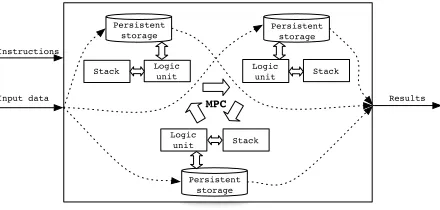
Fig. 1.Deployment diagram of Sharemind. The input data and instructions are delivered to miner nodes that use multi-party computation techniques to execute programs step by step and finally return the end results.
fields. As a result, it is easy to implement secure addition and multiplication modulo primepor in the Galois fieldGF(2k). However, the integer arithmetic in modern com-puters is done modulo232. Hence, the most space- and time-efficient solution is to use additive secret sharing schemes overZ232. There is no need to implement modular arith-metic and we do not have to compensate the effect of modular reductions. On the other hand, we have to use non-standard methods for share computing, since Shamir secret sharing scheme does not work overZ232. We discuss these issues further in Sect. 4.
The high level description of the SHAREMINDframework is depicted in Fig. 1. Es-sentially, one can view SHAREMINDas a virtual processor that provides secure storage for shared inputs and performs privacy-preserving operations on them. Each miner node Pihas a localdatabasefor persistent storage and a localstackfor storing intermediate results. All values in the database and stack are shared among all minersP1, . . . ,Pnby using anadditive secret sharingoverZ232. That is, each minerPi has a local sharesi of a secret valuessuch that
s1+s2+· · ·+sn≡s mod 232
and anyn−1 element subset{si1, . . . , sin−1}is uniformly distributed. Initially, the database is empty and data donors have to submit their inputs by sending the corre-sponding shares privately to miners who store them in the database. We describe this issue more thoroughly in Sect. 4.2.
After the input data is collected, a data analyst can start privacy-preserving compu-tations by sending instructions to the miners. Each instruction is a command that either invokes a share computing protocol or just reorders shares. The latter allows a data ana-lyst to specify complex algorithms without thinking about implementation details. More importantly, the corresponding complex protocol is guaranteed to preserve privacy, as long as the execution path in the program itself does not reveal private information. This restriction must be taken into account when choosing data analysis algorithms for implementation on SHAREMIND.
f takes the top shares[[u]]of the stack and pushes the resulting shares[[f(u)]]to the stack top. Analogously, a binary stack instruction⊗takes two top most shares[[u]]and
[[v]]and pushes[[u⊗v]]to the stack. For efficiency reasons, we have also implemented vectorised operations to perform the same protocol in parallel with many inputs at once. This significantly reduces the number of rounds required for applying similar operations on large quantities of data.
The current implementation of SHAREMINDframework provides privacy preserv-ing addition, multiplication and greater-than-or-equal comparison of two shared values. It can also multiply a shared value with a constant and extract its bits as shares. Share conversion from Z2 to Z232 and bitwise addition are mostly used as components in other protocols, but they are also available to the programmer. We emphasise here that many algorithms for data mining and statistical analysis do not use other mathematical operations and thus this instruction set is sufficient for most applications. Moreover, note that bit extraction and arithmetic primitives together are sufficient to implement any Boolean circuit with a linear overhead and thus the SHAREMINDframework is also Turing complete. We acknowledge here that there are more efficient ways to evaluate Boolean circuits like Yao circuit evaluation [Yao86,LP04] and we plan to include pro-tocols with similar properties in the future releases of SHAREMIND.
We analyse the security of all share manipulation protocols in the information-theoretical attack model that was specified in Sect. 2. In particular, we assume that miners are connected to each other via secure channels. We can use strong symmetric encryption and authentication primitives to achieve a similar level of security in prac-tical applications. As a result, we obtain only computational security guarantees in the real world. The latter is unavoidable if we want to achieve a cost-efficient and universal solution, as building dedicated secure channels is currently expensive. As a final detail, note that asynchronous communication allows us to omit the central synchronisation service and thus reduce network delays that have significant impact on the overall effi-ciency.
4
Share Computing Protocols
All computational instructions in the SHAREMINDframework are either unary or bi-nary operations over unsigned integers represented as elements ofZ232 or their vec-torised counterparts. Hence, all protocols described in this section have the following structure. Each minerPiuses sharesuiandvias inputs to the protocol to obtain a new sharewisuch that[[w]]is a valid sharing off(u)oru⊗v. In the corresponding idealised implementation, all miners send their input shares to the trusted third partyTwho re-stores all inputs, computes the corresponding outputwand sends back newly computed shares[[w]]←Deal(w). Hence, the output shares[[w]]are independent of input shares and thus no information is leaked about the input shares if we publish all output shares
[[w]].
Although share computing protocols are often used as elementary steps in more complex protocols, they themselves can be composed from even smaller atomic oper-ations. Many of these atomic sub-protocols produce output shares that are never pub-lished. Hence, it makes sense to introduce another security notion that is weaker than universal composability. We say that a share computing protocol isperfectly simulat-ableif there exists an efficient universal non-rewinding simulatorSthat can simulate all protocol messages to any real world adversaryAso that for all input shares the output distributions ofAandShAicoincide. Most importantly, perfect simulatability is closed under concurrent composition. The corresponding proof is straightforward.
Lemma 1. A protocol is perfectly simulatable if all its sub-protocols are perfectly
sim-ulatable.
Proof (Sketch). Since all simulators Si of sub-protocols are non-rewinding, we can construct a single compound simulatorS∗that runs simulatorsSiin parallel to provide the missing messages toA. As each simulatorSiis perfect, the final view ofAis also
perfectly simulated. ut
However, perfect simulatability alone is not sufficient for universal composability. Namely, output shares of a perfectly simulatable protocol may depend on input shares. As a result, published shares may reveal more information about inputs than necessary. Therefore, we must often re-share the output shares at the end of each protocol. The corresponding ideal functionality is modelled as follows. Initially, the miners send their shares[[u]]to the trusted third partyT. Then the partyTrecoversu ← Rec([[u]])and sends new shares[[w]]←Deal(u)back to the miners.
For the basic setting with three miners, the simplest re-sharing protocol is the fol-lowing. First, each minerPi generates a random maskri ← Z232 and sends it to the right neighbour Pi+1 (the miner P3 sends r3 toP1). Next, each miner Pi outputs
wi ← ui+ri−1−ri. As a result, the output shares have indeed the correct distri-butionDeal(u). Moreover, for fixed valuesui,wi,ri, there is only a single consistent valueri−1in the real execution. Hence, we can construct a non-rewindinginterfaceI0 between the ideal world and a real world adversaryA. The interfaceI0 forwards the input shareuiof corrupted minerPi to the trusted third partyT, provides randomness
ri←Z232toPi, and givenwiformTsendsri−1←wi−ui+rito the corrupted party Pi. As the trusted third partyT draws the output shares from the correct distribution, the simulation is perfect and the output distributionsψandψ◦in the real and the ideal world coincide. Moreover, the output distributionsψ andψ◦remain identical even if we execute the re-sharing protocol as a sub-task in larger computational context%h·i, as the interfaceI0 is non-rewinding (see the manuscript [Can01] for further details.). Also, note that the construction of the interface makes sense only in the semi-honest model, where the adversary cannot alter the value ofri.
The next lemma shows that perfect simulatability together with re-sharing assures universal composability in the semi-honest model. In the malicious model, one needs extractability of inputs and additional correctness guarantees against malicious behaviour.
Lemma 2. A perfectly simulatable share computing protocol that ends with perfectly
Proof. LetSbe the perfect simulator for the share computing phase andI0the interface for the re-sharing protocol. Then we can construct a new non-rewinding interfaceIfor the whole protocol:
1. It first submits the inputs of the corrupted minersPito the trusted third partyTand gets back the output shareswi.
2. Next, it runs possibly in parallel the simulatorSand the interfaceI0with the output shareswito simulate the missing protocol messages.
Now the output distributionsψandψ◦coincide, since the sub-routinesSandI0 per-fectly simulate protocol messages andI0assures that the output shares of corrupted par-ties are indeedwi. The latter assures that the adversarial outputψa◦is correctly matched together with the outputs of honest parties. Since the interfaceIis non-rewinding, the claim holds even if the protocol is executed in a larger computational context%h·i. ut
4.1 Protocols for Atomic Operations
As the SHAREMINDframework is based on additive sharing, it is straightforward to implement share addition and multiplication with a public constantc by doing only local operations, since[u1+v1, . . . , un+vn]and[cu1, . . . , cun]are valid shares of
u+vandcu. However, note that these operations are only perfectly simulatable, since the output shares depend on input shares.
A share multiplication protocol is another important atomic primitive. Unfortu-nately, we cannot use the standard solutions based on polynomial interpolation and re-sharing, since Shamir secret sharing scheme fails in the ringZ232. Hence, we must roll out our own multiplication protocol. By the definition of the additive secret sharing scheme
uv=
n X
i=1
uivi+ n X
j6=i
uivi mod 232 (1)
and thus we need sub-protocols for computing shares ofuivj. For clarity and brevity, we consider only a sub-protocol, whereP1has an inputx1andP2has an inputx2and the minerP3helps the others to obtain shares ofx1x2. Du and Atallah were the first to publish the corresponding protocol [DA00] although similar reduction techniques have been used earlier. Fig. 2 depicts the corresponding protocol. Essentially, the correctness of the protocol relies on the observation
x1x2=−(x1+α1)(x2+α2) +x1(x2+α2) + (x1+α1)x2+α1α2 .
The security follows from the fact that for uniformly and independently generated
α1, α2←Z232 the sumsx1+α1andx2+α2have also uniform distribution.
Lemma 3. The Du-Atallah protocol depicted in Fig. 2 is perfectly simulatable.
Proof. Let us fix inputsx1andx2. ThenP1 receives two independent uniformly dis-tributed values andP2receives two independent uniformly distributed values.P3 re-ceives no values at all. Hence, it is straightforward to construct a simulatorSthat
1. P3generatesα1, α2←Z232and sendsα1toP1andα2toP2.
2. P1computesx1+α1and sends the result toP2.
P2computesx2+α2and sends the result toP1.
3. Parties compute shares ofx1x2:
(a) P1computes its sharew1 =−(x1+α1)(x2+α2) +x1(x2+α2)
(b) P2computes its sharew2 = (x1+α1)x2
(c) P3computes its sharew3 =α1α2
Fig. 2.Du-Atallah multiplication protocol
Execute the following protocols concurrently:
• Compute locally sharesu1v1,u2v2andu3v3.
• Use six instances of the Du-Atallah protocol for computing shares ofuivjwherei6=j.
• Re-share the final sum of all previous sub-output shares.
Fig. 3.High-level description of the share multiplication protocol.
Fig. 3 depicts a share multiplication protocol that executes six instances of the Du-Atallah protocol in parallel to compute the right side of the equation (1). Since the protocols are executed concurrently, the resulting protocol has only three rounds, see App. B for the explicit description.
Theorem 1. The multiplication protocol depicted in Fig. 3 is perfectly universally
com-posable.
Proof. Lemma 1 assures that the whole protocol is perfectly simulatable, as the local computations and the instances of Du-Atallah protocol are perfectly simulatable. Since the output shares are re-shared, Lemma 2 assures that the protocol is also universally
composable. ut
The described multiplication protocol requires a total of three rounds and27 mes-sages. For comparison, note that the classical multiplication protocol based on Shamir secret sharing has two rounds and9messages. On the other hand, recall that Shamir secret sharing is not possible over Z232 and computing overZp requires additional safeguarding measures against modular reductions. Moreover, the first round of our multiplication protocol is independent of inputs and can be precomputed. Hence, the effective round complexity of both protocols is still comparable.
4.2 Protocol for Input Gathering
increasing the support of their favourite candidate. Secondly, the data donors want to submit their data as fast as possible without extra work. In particular, they are unwilling to prove that their inputs are in the valid range.
There are two principal ways to address these issues. First, the miners can use multi-party computation protocols to detect and eliminate fraudulent entries. This is compu-tationally expensive, since the evaluation of correctness predicates is a costly operation. Hence, it is often more advantageous to use such an input gathering procedure that guar-antees validity by design. For instance, many data tables consist of binary inputs (yes-no answers). Then we can gather inputs as shares overZ2to avoid fraudulent inputs and later use share conversion to get the corresponding shares overZ232.
Let[u1, u2, u3]be a valid additive sharing overZ2. Then we can express the shared valueuthrough the following equation over integers:
f(u1, u2, u3) :=u1+u2+u3−2u1u2−2u1u3−2u2u3+ 4u1u2u3=u .
Consequently, if we treatu1, u2, u3as inputs and compute the shares off(u1, u2, u3) over Z232, then we obtain the desired sharing ofu. More precisely, we can use the Du-Atallah protocol to compute the shares[[u1u2]],[[u1u3]],[[u2u3]]overZ232. To get the shares[[u1u2u3]], we use the share multiplication protocol to multiply[[u1u2]]and the shares[[u3]]created byP3. Finally, all parties use local addition and multiplication routines to obtain the shares off(u1, u2, u3)and then re-share them to guarantee the universal composability. The resulting protocol has only four rounds, since we can start the first round of all multiplication protocols simultaneously, see App. C for further details. The total number of exchanged messages is50.
Theorem 2. The share conversion protocol is perfectly universally composable.
Proof. The proof follows again directly from Lemmata 1 and 2, since all sub-protocols are perfectly simulatable and the output shares are re-shared at the end of the protocol.
u t
As a final detail, note that input gathering can even be an off-line event, if we make use of public-key encryption. Namely, if everybody knows the public keys of the miners, then they can encrypt the shares with the corresponding public keys and then store them in a public database. Later miners can fetch and decrypt their individual shares and fill their input database.
4.3 Protocols for Bit Extraction and Comparison
As the first step, note that it is easy to generate shares of a random numberr←Z232 such that we also know the corresponding bit shares[[r(31)]], . . . ,[[r(0)]]. Each minerPi first chooses 32random bits r(31)
i , . . . , r (0)
i . After that the miners use the share con-version protocol to convert the corresponding shares[[r(31)]], . . . ,[[r(0)]]over
Z2to the shares of[[r(31)]], . . . ,[[r(0)]]over
Z232. Finally, the miners use local operations to com-pute shares
[[r]] = 231·[[r(31)]] + 230·[[r(31)]] +· · ·+ 21·[[r(1)]] + 20·[[r(0)]] .
As the second step, we construct a bit extraction protocol that given input shares
[[u]]produces shares of its bits[[u(31)]], . . . ,[[u(0)]]. This is a versatile operation that can be used as a building block for many bit-based operations. The corresponding protocol is following. First, the miners generate shares[[r]]of a random number with known bit decomposition. Then they compute the difference [[a]] = [[u]]−[[r]] and publish the corresponding shares. Since the difference has uniform distribution, the valuealeaks no information about inputs. As a result, we have reduced the problem of extracting the bits ofuto computing the bitwise sum ofa+r, as each miner knows the public value
aand has the shares of random bitsr(31), . . . , r(0).
Computing bitwise sum is a more complicated procedure, since we need to take care of carry bits. The bitwise addition protocol takes inkelement share vectors[[u(k)]], . . . ,[[u(0)]] and[[v(k)]], . . . ,[[v(0)]]and outputs shares[[w(k)]], . . . ,[[w(0)]]such thatw(i)is thei-th bit of the sumu+v. As all inputs are bits, we can iteratively compute the shares[[w(i)]] using the classical addition algorithm. However, the corresponding protocol hasΘ(k)
rounds, since we cannot compute carry bits locally.
A more round efficient alternative is to use the standard look-ahead carry construc-tion to perform the carry computaconstruc-tions in parallel. By the recursive applicaconstruc-tion of the carry look-ahead principle, we can reduce the number of rounds toΘ(logk). The cor-responding iterative algorithm together with the explanation of the carry look-ahead principle is given in App. A
Again, we can execute some of the sub-protocols in parallel and thus save some rounds. Namely, the resulting bitwise addition protocol has 8 rounds and 87 messages. The corresponding bit extraction protocol has 12 rounds and sends out 139 messages. Note that although each of these messages contains more than one value, we can con-sider them as a single message for performance concon-siderations. Both protocols are also universally composable, since all sub-protocols are universally composable. Hence we can see that the following theorem holds.
Theorem 3. The bitwise addition protocol is perfectly universally composable. The
share extraction protocol is perfectly universally composable.
Finally, we describe how to implement GTE predicate if both arguments are guar-anteed to be in Z231 ⊆ Z232. The latter allows us to define the predicate GTE :
Z231×Z231 → {0,1}as follows:
GTE(x, y) =
(
1, if the last bit of the differencex−yis 1,
0, otherwise.
It is straightforward to see that the definition is correct for unsigned and signed inter-pretation of the arguments as long as both arguments are in the rangeZ231. Since the rangeZ231 is sufficient for most practical computations, we have not implemented the extended protocol yet.
Theorem 4. The greater-than-or-equal protocol is perfectly universally composable.
Proof. The protocol is universally composable, since the bit extraction protocol that is used to splitx−yinto bit shares is universally composable. ut
5
Practical Implementation
The main goal of the SHAREMINDproject is to provide an easily programmable and flexible platform for developing and testing various privacy preserving algorithms based on share computing. The implementation of the SHAREMINDframework provides a li-brary of the most important mathematical primitives described in the previous section. Since these protocols are universally composable, we can use them in any order, possi-bly in parallel, to implement more complex algorithms. These algorithms remain secure as long as the execution path is independent from input data. Hence, one cannot use ex-plicit if-then constructions. However, this shortcoming is not essential, since all if-then constructions can be rewritten using the following oblivious selection technique:
ifathenx←yelsex←z ⇐⇒ x←a·y+ (1−a)·z .
As a result, one can implement a wide range of algorithms.
The software implementation of SHAREMINDis written in the C++ programming language and is tested on Linux, Mac OS X and Windows XP. The “virtual processor” of SHAREMINDconsists of the minerapplication which performs the duties of a se-cure multiparty computation party and thecontrollerlibrary for developing controller applications that work with the miners.
Miners have an operation scheduler for ordering and executing received operations. When a computational operation is requested from the miner, it is scheduled for execu-tion. When the operation is ready to be executed, the miners run the secure multi-party computation protocols necessary for completing the operation. Like in a standard stack machine, all operations read their input data from the stack and write output data to the stack upon completion.
We stress that the described way of running programs on SHAREMINDis perfect for testing and developing algorithms. For real-world applications, we propose a slightly different architecture. To avoid unauthorised commands, the miners must be configured with the identities of each other and all possible controllers. This can be achieved by using public-key infrastructure.
In the development scenario, the controller library interprets programs and passes each subsequent command to the miners. In a real-world application, programs will be signed by an appropriate authority and run by the miners. The controller will request a complete analysis instead of a single operation. This gives the miners more control over program execution and publication of aggregation results and avoids attacks, where the controller can construct malicious queries from basic operations.
6
Performance Results
To evaluate the limitations and bottlenecks of share computing, we have measured the performance of the SHAREMIND framework on various computational tasks. In the following, we present the performance results for scalar product and vectorised comparison. These tests are chosen for two reasons. First, together these benchmarks cover the most important primitives of SHAREMIND: addition, multiplication and com-parison. More importantly, scalar product is one of the most fundamental operations used in data mining algorithms. Second, other secure multi-party computation sys-tems [MNPS04,BDJ+06,YWS06] have also implemented at least one of these bench-marks.
Both tests got twon-element vectorsa1, . . . , an andb1, . . . , bn as inputs. In the scalar product test, we computed the suma1b1+a2b2+· · ·+anbn. In the compari-son test, we evaluated comparicompari-sonsai ≥bifori = 1, . . . , n. All input datasets were randomly generated and the corresponding shares were stored in the share databases of SHAREMIND. For each chosen vector size, we performed a number of experiments and measured the results. To identify performance bottlenecks, we measured the time complexity in these three computation phases:
1. the local computation time including scheduling overhead; 2. time spent while sending data to other parties;
3. time spent while waiting for data from other parties.
be executed after it. The tests were performed on four desktop computers in a comput-ing cluster. Each machine contained a dual-core Opteron 175 processor and 2 GB of RAM, and ran Scientific Linux CERN 4.5. The computers were connected by a local switched network allowing communication speeds up to 1 gigabit per second.
As one would expect, the initial profiling results showed that network delays have significant impact on the performance. In fact, the number of rounds almost completely determines the running time provided that the messages sent over the network have rea-sonable size. Consequently, it is advantageous to execute as many operations in parallel as possible.
The SHAREMINDframework allows the developer to perform several instances of the same operation at once. For example, the developer can multiply or compare two vectors elementwise. The messages exchanged by the parties will be larger, but the com-putation will be more efficient, because the networking layer can send larger packages with relative ease. Still, vectors may sometimes become too large and this may start to hinder the performance of the networking layer. To balance the effects of vectorisation, we implemented a load balancing system into the SHAREMINDframework. We fixed a certain threshold after which miners start batch processing of large vectorised queries. In each sub-round, a miner processes a fragment of its inputs and sends the results to the other miners before continuing with the next fragment of input data.
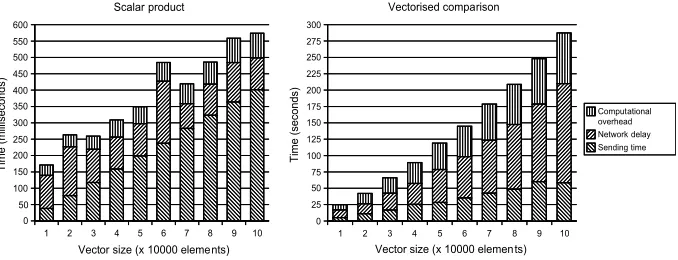
Vectorisation and batch processing decrease the time which would otherwise be spent waiting for inputs from the other miners. Note that this does not cause any addi-tional security issues as the composition theorems that apply to our protocols also cover parallel executions. Fig. 4 shows how the optimisations have minimised the penalty caused by network delays.
As seen on Fig. 4 the impact of network delay during scalar product computation is already small—the miners do not waste too many CPU cycles while waiting for inputs. Note, that the performance of the scalar product operation depends directly on the multiplication protocol, because addition is a local operation and therefore very fast. Further optimisations to the implementation of the multiplication protocol can only lead to marginal improvements. For the parallel comparison, the effect of network delay is more important and further scheduling optimisations may decrease the time wasted while waiting for messages. In both benchmarks, the time required to send and receive messages is significant and thus the efficiency of networking can significantly influence performance results.
6.1 Experimental Results and Analysis
The performance data was gathered by running a series of experiments on a data ta-ble of the given size. Fig. 4 depicts average running times for test vectors with up to
1 2 3 4 5 6 7 8 9 10 0 50 100 150 200 250 300 350 400 450 500 550 600 Scalar product Computational overhead Network delay Sending time
Vector size (x 10000 elements)
Time
(milliseconds)
1 2 3 4 5 6 7 8 9 10 0 25 50 75 100 125 150 175 200 225 250 275 300 Vectorised comparison Computational overhead Network delay Sending time
Vector size (x 10000 elements)
Time (seconds)
Fig. 4.Performance of the SHAREMINDframework.
relatively small delays made an impact on our execution time. We remind here that the benchmark characterises near-ideal behaviour of the SHAREMINDframework, since no network congestion occurred during the experiments and the physical distance between the computers was small. In real world applications, the effect of network delays and the variance of running times can be considerably larger.
We compared the performance of SHAREMINDwith some known implementations of privacy-preserving computations [MNPS04,BDJ+06,YWS06]. The FAIRPLAY sys-tem [MNPS04] is a general framework for secure function evaluation with two parties that is based on garbled circuit evaluation. According to the authors, single compari-son operation for32-bit integers takes 1.25 seconds. A single SHAREMINDcomparison takes, on average, 500 milliseconds. If we take into account the improvements in hard-ware we can say that the performance is similar when evaluating single comparisons. The authors of FAIRPLAYnoticed that parallel execution gives a speedup factor of up 2.72 times in a local network. Experiments with SHAREMINDhave shown that paral-lel execution can increase execution up to27times. Hence, SHAREMINDcan perform parallel comparison more efficiently. The experimental scalar product implementation in [YWS06] also works with two parties. However, due to the use of more expensive cryptographic primitives, it is slower than SHAREMINDeven with precomputation. For example, computing scalar product of two100000-element binary vectors takes a min-imum of 5 seconds without considering the time of precomputation.
better performance with larger input vectors in both scalar product and vectorised com-parison. A SHAREMINDmultiplication takes, on the average, from 0.006 to57
mil-liseconds, depending on the size of the vector. More precisely, multiplication takes less than3milliseconds for every input vector with more than50elements. The timings for comparison range from3milliseconds to about half a second which is significantly less than674milliseconds per operation.
From the results we see that vectorisation significantly improves the throughput of the system. Performing many similar operations in parallel is more optimal than per-forming the same number of individual operations. The multiplication protocol scales better than the GTEprotocol because of the smaller round and message count. We ac-knowledge that it might not be possible to rewrite all algorithms to perform operations in parallel, but we note that algorithms which make use of vectorisation will run faster when implemented in the SHAREMINDframework.
7
Conclusion and Future Work
In this paper, we have proposed a novel approach for developing privacy-preserving ap-plications. The SHAREMINDframework relies on secure multi-party computation, but it also introduces several new ideas for improving the efficiency of both the applications and their development process. The main theoretical contribution of the framework is a suite of computation protocols working over elements in the ring of32-bit integers instead of the standard finite field. This non-standard choice allowed us to build simple and efficient protocols.
We have also implemented a fully functional prototype of SHAREMINDand showed that it offers enhanced performance when compared to other similar frameworks. Be-sides that, SHAREMINDalso has an easy to use application development interface al-lowing the programmer to concentrate on the implementation of data mining algorithms and not to worry about the privacy issues.
However, the current implementation has several restrictions, most notably it can use only three computing parties and can deal with just one semi-honest adversary. Hence the main direction for future research is relaxing these restrictions by develop-ing computational primitives for more than three parties. We will also need to study the possibilities for providing security guarantees against active adversaries. Another aspect needing further improvement is the application programmer’s interface. A com-piler from a higher-level language to our current assembly-like instruction set is defi-nitely needed. Implementing and benchmarking a broad range of existing data-mining algorithms will remain the subject for further development as well.
References
[AA01] Dakshi Agrawal and Charu C. Aggarwal. On the design and quantification of privacy preserving data mining algorithms. InPODS. ACM, 2001.
[BDJ+06] Peter Bogetoft, Ivan Damg˚ard, Thomas Jakobsen, Kurt Nielsen, Jakob Pagter, and Tomas Toft. A practical implementation of secure auctions based on multiparty inte-ger computation. InFinancial Cryptography, volume 4107, 2006.
[Bea91] Donald Beaver. Secure multiparty protocols and zero-knowledge proof systems tol-erating a faulty minority.J. Cryptology, 4(2):75–122, 1991.
[Bih03] Eli Biham, editor. Advances in Cryptology - EUROCRYPT 2003, International Conference on the Theory and Applications of Cryptographic Techniques, Warsaw, Poland, May 4-8, 2003, Proceedings, volume 2656 ofLecture Notes in Computer Science. Springer, 2003.
[BOCG93] Michael Ben-Or, Ran Canetti, and Oded Goldreich. Asynchronous secure computa-tion. InSTOC, pages 52–61, 1993.
[BOGW88] Michael Ben-Or, Shafi Goldwasser, and Avi Wigderson. Completeness theorems for non-cryptographic fault-tolerant distributed computation (extended abstract). In
STOC[DBL88], pages 1–10.
[BOKR94] Michael Ben-Or, Boaz Kelmer, and Tal Rabin. Asynchronous secure computations with optimal resilience (extended abstract). InPODC, pages 183–192, 1994. [Can00] Ran Canetti. Security and composition of multiparty cryptographic protocols.
Jour-nal of Cryptology, 13(1):143–202, 2000.
[Can01] Ran Canetti. Universally composable security: A new paradigm for cryptographic protocols. InFOCS, pages 136–145, 2001.
[CCD88] David Chaum, Claude Cr´epeau, and Ivan Damg˚ard. Multiparty unconditionally se-cure protocols (extended abstract). InSTOC[DBL88], pages 11–19.
[CFIK03] Ronald Cramer, Serge Fehr, Yuval Ishai, and Eyal Kushilevitz. Efficient multi-party computation over rings. In Biham [Bih03], pages 596–613.
[CK89] B. Chor and E. Kushilevitz. A zero-one law for boolean privacy. InSTOC ’89: Proceedings of the twenty-first annual ACM symposium on Theory of computing, pages 62–72, New York, NY, USA, 1989. ACM Press.
[CKL03] Ran Canetti, Eyal Kushilevitz, and Yehuda Lindell. On the limitations of universally composable two-party computation without set-up assumptions. In Biham [Bih03], pages 68–86.
[DA00] Wenliang Du and Mikhail J. Atallah. Protocols for secure remote database access with approximate matching. 7th ACM Conference on Computer and Communica-tions Security (ACMCCS 2000), The First Workshop on Security and Privacy in E-Commerce, Nov. 1-4, 2000. Athens, Greece.
[DBL88] Proceedings of the Twentieth Annual ACM Symposium on Theory of Computing, 2-4 May 1988, Chicago, Illinois, USA. ACM, 1988.
[DFK+06] Ivan Damg˚ard, Matthias Fitzi, Eike Kiltz, Jesper Buus Nielsen, and Tomas Toft. Un-conditionally secure constant-rounds multi-party computation for equality, compar-ison, bits and exponentiation. In Shai Halevi and Tal Rabin, editors,TCC, volume 3876 ofLecture Notes in Computer Science, pages 285–304. Springer, 2006. [DM00] Yevgeniy Dodis and Silvio Micali. Parallel reducibility for information-theoretically
secure computation. In Mihir Bellare, editor,CRYPTO, volume 1880 ofLecture Notes in Computer Science, pages 74–92. Springer, 2000.
[ESAG02] Alexandre V. Evfimievski, Ramakrishnan Srikant, Rakesh Agrawal, and Johannes Gehrke. Privacy preserving mining of association rules. InKDD, pages 217–228. ACM, 2002.
[GL90] Shafi Goldwasser and Leonid A. Levin. Fair computation of general functions in presence of immoral majority. In Alfred Menezes and Scott A. Vanstone, editors,
[HM00] Martin Hirt and Ueli M. Maurer. Player simulation and general adversary structures in perfect multiparty computation.Journal of Cryptology, 13(1):31–60, 2000. [LP04] Yehuda Lindell and Benny Pinkas. A proof of yao’s protocol for secure
two-party computation. Cryptology ePrint Archive, Report 2004/175, 2004. http: //eprint.iacr.org/.
[MNPS04] Dahlia Malkhi, Noam Nisan, Benny Pinkas, and Yaron Sella. Fairplay - secure two-party computation system. InUSENIX Security Symposium, pages 287–302. USENIX, 2004.
[SM007] The SHAREMINDproject. The official webpage ishttp://sharemind.cs.ut. ee. The source code is published online athttp://www.sourceforge.net/ projects/sharemind/, 2007.
[Yao86] Andrew Chi-Chih Yao. How to generate and exchange secrets (extended abstract). InFOCS, pages 162–167, 1986.
[YWS06] Zhiqiang Yang, Rebecca N. Wright, and Hiranmayee Subramaniam. Experimental analysis of a privacy-preserving scalar product protocol. Comput. Syst. Sci. Eng., 21(1), 2006.
A
Fast Bitwise Addition Algorithm
The main drawback of the textbook addition algorithm is slow propagation of car-ries. Letu(k). . . u(0)andv(k). . . v(0)be the bit representations ofk-bit integers and let
c(k), . . . , c(0)represent the corresponding carry bits. The textbook addition algorithms computes carries iteratively
c(i)←u(i)·v(i)+ (1−u(i)·v(i))·c(i−1)·(u(i)+v(i))
with the base casec(0)←0. However, carries do not always propagate through the ad-dition. In fact, a pairu(i)= 0andv(i)= 0always kills the propagating carry. Similarly, the carry bit is propagated further only if one of the digits is1. Therefore, we can sig-nificantly speed up the carry computations if we split the number into smaller chunks and use flagsp(k), . . . , p(0)that indicate whether the next carry update can propagate to the carryc(i).
In a nutshell, the carry look-ahead algorithm computes set and propagate flags by recursively merging adjacent blocks of bits until we get a single block. Letc(p), . . . , c(q) andc(q−1), . . . , c(r)denote carry bits set so far. Letp(i+q)denote that the carry propa-gates from the beginning of the blockc(p), . . . , c(q)to theith position, i.e.,u(q+i−1). . . u(q)+
v(q+i−1). . . v(q)= 2i−1. Then we must set
s(i+q)←s(i+q)+p(i+q)s(q−1)
and p(i+q)←p(i+q)p(q−1)
to merge the corresponding blocks. In the base case, blocks are one bit wide and we must set
s(i)←u(i)v(i) and p(i)←u(i)+v(i)−2s(i) .
If the carry bits are known then computing the corresponding bit representation is easy:
w(i)←u(i)+v(i)−2s(i)+s(i−1)
The corresponding share computing algorithm is depicted below.
Algorithm 1: Protocol for the bitwise addition of two vectors
Data: Shared bit vectors[[u(n−1)]], . . . ,[[u(0)]]and[[u(n−1)]], . . . ,[[u(0)]].
Result: Shared bit vector[[w(n−1)]], . . . ,[[w(0)]]such thatw=u+v. Round 1
forj←0ton−1do
Compute shares[[p(j)]]←[[u(j)]] + [[v(j)]]. Compute shares[[s(j)]]←[[u(j)]] · [[v(j)]]. Rounds 2...log2n+ 1
fork←0tolog2n−1do
for`←0to2k−1do
form←0to 2kn+1−1do
Compute shares
[[s(2k+`+2k+1m)]]←[[s(2k+`+2k+1m)]] + [[p(2k+`+2k+1m)]]·[[s(2k+2k+1m−1)]]. Compute shares[[p(2k+`+2k+1m)]]←[[p(2k+`+2k+1m)]] · [[p(2k+2k+1m−1)]]. Compute shares[[w(0)]]←[[u(0)]] + [[v(0)]]−2·[[s(0)]].
forj←1ton−1do
B
Share multiplication protocol
Algorithm 2: Protocol for multiplying two shared values
Data: Shared values[[u]]and[[v]].
Result: Shared value[[w]]such thatw=uv.
Round 1
P1generatesr12, r13, s12, s13, t12←Z232. P2generatesr23, r21, s23, s21, t23←Z232. P3generatesr31, r32, s31, s32, t31←Z232. All values∗ij are sent fromPitoPj. Round 2
P1computesˆa12←u1+r31,ˆb12←v1+s31,ˆa13←u1+r21,
ˆb
13←v1+s21.
P2computesˆa23←u2+r12,ˆb23←v2+s12,ˆa21←u2+r32,
ˆb
21←v2+s32.
P3computesˆa31←u3+r23,ˆb31←v3+s23,ˆa32←u3+r13,
ˆb32←v3+s13.
All values∗ij are sent fromPitoPj. Round 3
P1computes:
c1←
u1ˆb21+u1ˆb31+v1ˆa21+v1ˆa31−ˆa12ˆb21−ˆb12ˆa21+r12s13+s12r13−t12+t31,
w1←c1+u1v1. P2computes:
c2←
u2ˆb32+u2ˆb12+v2ˆa32+v2ˆa12−ˆa23ˆb32−ˆb23ˆa32+r23s21+s23r21−t23+t12,
w2←c2+u2v2. P3computes:
c3←
u3ˆb13+u3ˆb23+v3ˆa13+v3ˆa23−ˆa31ˆb13−ˆb31ˆa13+r31s32+s31r32−t31+t23,
C
Share conversion protocol
Algorithm 3: Protocol for converting shares fromZ2toZ232
Data: Bit shares[[u]]of a bituoverZ2.
Result: Shares[[w]]ofuoverZ232. Round 1
P1generatesr12, r13, s12, s13, t12←Z232. P1computess1←r12r13−s12−s13. P2generatesr23, r21, s23, s21, t23←Z232. P2computess2←r23r21−s23−s21. P3generatesr31, r32, s31, s32, t31←Z232. P3computess3←r31r32−s31−s32. All values∗ij are sent fromPitoPj. Round 2
P1computesˆb12←r31+u1,ˆb13←r21+u1. P2computesˆb23←r12+u2,ˆb21←r32+u2. P3computesˆb31←r23+u3,ˆb32←r13+u3.
Additionally,P3sharesu3:c31, c32←Z232,c33←u3−c31−c32. All values∗ij,i6=jare sent fromPitoPj.
Round 3
P1computesab1←s31−r31ˆb21,ac1←ˆb31ˆb13+s21−ˆb31r21,bc1←s1,
c1←c31.
P2computesab2←ˆb12bˆ21+s32−ˆb12r32,ac2←s2,bc2←s12−r12ˆb32,
c2←c32.
P3computesab3←s3,ac3←s23−r23ˆb13,bc3←ˆb23ˆb32+s13−ˆb23r13,
c3←c33.
Multiply shares of[[ab]]and[[c]]to get[[abc]]. Round 4
D
Bit extraction protocol
Algorithm 4: Protocol for extracting bit shares from a shared value
Data: Shared value[[u]].
Result: Shares[[u(31)]], . . . ,[[u(0)]]of all bits ofu. Round 1
P1generatesr(0) 1 , . . . , r
(31) 1 ←Z2. P2generatesr(0)
2 , . . . , r (31) 2 ←Z2. P3generatesr(0)
3 , . . . , r (31) 3 ←Z2. Convert shares[[r(i)]]over
Z2to shares[[r(i)]]overZ232. Round 2
Compute shares[[r]]←231·[[r(31)]] + 230·[[r(30)]] +· · ·+ 20·[[r(0)]]. Compute shares[[v]]←[[u]]−[[r]]and broadcast sharesv1, v2, v3. Round 3
P1computesa1←v1+v2+v3and finds its bitsa (0) 1 , . . . , a
(31) 1 . P2initialisesa2←0and setsa
(0) 2 , . . . , a
(31) 2 ←0. P3initialisesa3←0and setsa(0)3 , . . . , a
(31) 3 ←0.
Add[[a(31)]], . . . ,[[a(0)]]and[[r(31)]], . . . ,[[r(0)]]bitwise to compute
[[u(31)]], . . . ,[[u(0)]].
E
Greater-than-or-equal comparison protocol
Algorithm 5: Protocol for evaluating the greater-than predicate.
Data: Shared values[[u]]and[[v]].
Result: Shares[[w]]such thatw=GTE(u, v).
All partiesPicomputedi←ui−vi.