Available online:
https://edupediapublications.org/journals/index.php/IJR/
P a g e | 1049Communicative Language Teaching (Clt) In Efl Context: Exploring
Afghan Efl Lecturers’ Perceived Challenges in Implementing Clt
Abdullah Noori M.Ed.
Assistant Professor Department of English, Kabul University
ORCID: 0000-0003-2141-3675
Email:
[email protected]
Phone: +93773 448 807
ABSTRACT
Numerous studies have been conducted to investigate the implementation of Communicative Language Teaching (CLT) in ESL and EFL contexts, but those conducted in EFL context, have reported that the application of CLT was challenging. Still, as far as the Afghan EFL context is concerned, there is a lack of empirical research investigating the issue. Hence, the purpose of this study is to explore afghan EFL lecturers’ perceived challenges in practicing CLT. The study also aims to examine if there is any significant relationship among teachers use of CLT, the perceived challenges, and their demographic profiles. This study uses a quantitative research approach in which a survey questionnaire was given to EFL lecturers teaching in a public university. The results of the study revealed that the EFL lecturers had positive perceptions of using CLT activities, as there were evidence of a number of major CLT activities conducted in their classrooms. The results also revealed that they faced certain challenges that
prevented them from implementing CLT
effectively. Furthermore, significant correlation was found between students’ related challenges and teachers’ perceptions of using CLT; however, no significant correlations were found among teachers’ demographic profiles and CLT perceived challenges. This research is significant since it could be used as a resource presenting a comprehensive picture of CLT implementation in EFL classrooms in Afghanistan.
Keywords: Communicative Language Teaching (CLT), Perceptions, Challenges, Afghan, EFL Lecturers
1. INTRODUCTION
English language, in its universal, developmental, networking and technological signification, has connected nations to knowledge and information. Thus, with the aim of quickening the process of connecting the world and competing in the global economy, countries have strived to enhance their human capital that would have the capacity to communicate successfully in English (Littlewood, 2007). They have attempted to address the communicative needs and inserted necessary reforms to their educational curriculum. These reforms have caused a transformation in the use of Communicative Language Teaching (CLT) as the dominant approach established on the theory of communication (Littlewood, 2007; Richards and Rodgers, 2001).
Available online:
https://edupediapublications.org/journals/index.php/IJR/
P a g e | 1050 Rodgers, 2001; Littlewood, 2007). Hymesdescribed communicative competence as the feature of competence which empowers learners to express and deduce communications and to exchange implications interpersonally inside particular settings. Larsen-Freeman (2000) adds that in verbal speech, communicative competence implicates recognising “when to say and how to say what to whom” (p. 121). Hymes coined the notion of communicative competence -the usage of language in a social settings- when he counteracted Chomsky’s linguistic competence and performance model. According to Chomsky, the structural theories of language were not elucidated satisfactorily enough. However, Chomsky’s focus was more on linguistic competence of the students, in which the students were required to produce correct grammatical sentences. The problem was that students were not able to use the grammatical structures they had acquired in real life communication outside the class. Thus, it was established that to communicate only having linguistic competence was not enough (Richards & Rodgers, 2001),
Before the emergence of CLT, teaching methodologies, such as Grammar-Translation and Audio-Lingual approaches were widely used, but they were mostly concerned with repetition and memorisation of forms (Kumar, Philip, and Kalaiselvi, 2013). However, as time passed it was realised that repetition and memorisation of forms were not enough, and the focus was shifted to advance the aptitude to use language for practical ends. Henceforth, the traditional methodologies gave way to CLT.
Ever since CLT was introduced in the 1960s, it is has developed in its scope and still is the most widely used and dominant teaching approach throughout the world (Larsen-Freeman, 2000). Sauvignon (2002) asserts that English language teachers in many countries have been swayed to embrace CLT since this approach is in total harmony with today’s learners’ educational needs and caters in the best manner to their communicative needs. CLT was initially introduced as an ESL approach; hence, in a short while, many western countries adopted this new
language teaching approach. In the meantime, CLT quickly reached to other non-native English nations in the world as well. However, a number of studies report that the application of CLT in specific contexts, especially EFL context, was challenging (Alzaidi, 2011; Li, 1998; Chang & Goswami, 2011; Hiep, 2007; Incecay & Incecay, 2009; Ellis, 1994; Karavas-Doukas, 1996).
1.1. Background of the Study
Available online:
https://edupediapublications.org/journals/index.php/IJR/
P a g e | 1051 2017). According to Rababah (2003), the criticalproblem of the students, in this regard, is that they are not able to practice the grammatical structures they have learned in the classroom into actual communicative situations outside their classes. Rababah further adds that the inability of students to achieve communicative goals using English language is mostly due to the teaching methods on top of the learning environment. In other words, students learn the rules of grammar and structures of the English language, but they cannot apply the rules to a practical conversation. Although, the Afghan Ministry of Higher Education (MoHE), promotes student-centered learning and the use of CLT in the classroom, but according to and Somaiya (2017), still, EFL teachers at the higher educational institutes employ the traditional language teaching methods. In the classrooms, teachers are the authoritative figures, and the class relies only on learning from the textbook. The classes are exam-oriented as in the exams, merely reading and writing skills are tested while speaking and listening skills are overlooked (Noori, 2017).
1.2. Statement of the Problem
Though the Afghan Ministry of Higher Education (MoHE) recommends the implementation of CLT, many teachers still do not implement CLT at all, or if they do, it is to a minimal extent (Somaiya, 2017). This lack of implementing CLT, as the available literature suggests, might be due to particular challenges that EFL teachers encounter in their classes. Li (1998) categorises those challenges as follows:
(1) ‘students related challenges’ such as low proficiency of students in English;
(2) ‘teachers related challenges’ such as lack of sufficient CLT training opportunities;
(3) ‘system-related challenges’ for instance, large classes; and
(4) ‘CLT related challenges’ such as, lack of appropriate instruments to assess communicative competence (Li, 1998).
There are many studies carried out to explore the perceptions of EFL teachers of CLT, and the challenges they face in the application of this method (e.g., Chang, 2011; Almohanna, 2010; and Alzaidi, 2011; Mustafa, 2009; Li, 1998; Burnaby and Sun, 1989). However, there is a lack of empirical research investigating the situation in Afghanistan. Consequently, the present study aims to explore afghan EFL lecturers’ perceptions of CLT and the perceived challenges in implementing CLT. To be precise, in this study the following research questions are being explored:
1.3. Research Questions
1 What are the perceptions of EFL teachers toward using CLT classroom activities? 2 What are the challenges EFL teachers’
face in the implementing CLT?
3 Is there any significant relationship between the perceived challenges in a CLT classroom and EFL teachers’ perceptions of using CLT classroom activities?
4 Is there is any significant relationship between EFL teachers’ demographic profiles and their perceptions of using CLT classroom activities?
2. LITERATURE REVIEW
The Communicative Language Teaching approach (CLT) is grounded on the theory of language as communication (Larsen-Freeman, 2000). According to McGroarty (1984), researchers have defined CLT in diverse ways, and there is no commonly agreed upon model of CLT. Thus, CLT is often defined in terms of its general principles and characteristics (Ellis, 2003); (Nunan, 1991). These principles and characteristics make CLT distinctive in terms of the materials, assessment, activities, and the roles of the teachers and students from other traditional teaching methodologies.
2.1. CLT Principles
Available online:
https://edupediapublications.org/journals/index.php/IJR/
P a g e | 1052 communication, and meaning in CLT isacknowledged to be of utmost significance (Larsen-Freeman, 2000). According to Richards & Rodgers (2001), ‘learner-centeredness’ and ‘experience-based view’ of teaching a language is another distinctive aspect of CLT. Moreover, Richards (2006) explores the central principle of CLT as:
Make real communication the focus of language learning.
Provide opportunities for learners to experiment and try out what they know.
Be tolerant of learners’ errors as they indicate that the learners are building up their communicative competence.
Provide opportunities for learners to develop both accuracy and fluency. Link the different skills such as speaking, reading, and listening together, since they usually occur so in the real world.
Let students induce or discover grammar rules. (p.20).
2.2. Materials in CLT
In CLT, learning and teaching materials are of utmost importance. CLT advocates the use of authentic materials in the classrooms focusing on instructions based on real-life situations, utilising authentic materials, and the importance of maximising student interaction in the classroom. Richards and Rodgers (2001) assert that “materials play a primary role in promoting communicative use” (p.168). Utilising authentic materials motivate the students to learn and also presents them with opportunities to interact in real communication. In a typical CLT activity, for instance, the use of authentic materials would be if the teachers ask the students to watch a television program or listen to a radio program and then write their reaction to that particular program. Another use of authentic material could be seen in the activity when a teacher uses weather forecast attempting to teach students
about making further predictions (Larson-Freeman, 2000).
2.3. Assessment in CLT
In a CLT classroom, language teachers do not merely assess accuracy but also fluency of the students. Larsen-Freeman (2000) suggests that in any CLT evaluation, teachers need to utilise “a real communicative function” (p. 132). For example, if a teacher is assessing students writing skill, s/he probably might ask the students to write a letter to a friend. In this type of assessment, the teachers are informally assessing their students and teachers’ role is of a “facilitator or co-communicator” (p. 132).
2.4. The Roles of Teachers and Students in a CLT Classroom
In a CLT classroom, the students carry out activities in the class cooperatively rather than individually. Richards (2006) explains the advantages of the pair and group work activities for students as follows:
They can learn from hearing the language used by other members of the group;
They will produce a greater amount of language than they would use in teacher-fronted activities.
Their motivational level is likely to increase.
They will have the chance to develop fluency.
Moreover, the students are expected to take part in class activities actively and are deemed to be active members in the process of language learning (Richards, 2006).
Available online:
https://edupediapublications.org/journals/index.php/IJR/
P a g e | 1053 Allwright (1984) asserts that in a CLT classroom,one cannot just presume that a learner is simply a learner and a teacher is simply a teacher because as a matter of fact, both learner and teacher are the managers of the learning process. According to Breen and Candlin (1980), a teacher has two principal roles in a CLT classroom: first, the teacher facilitates the practice of communication amongst students in the class. Second, the teacher functions as a self-regulating participant in class. Similarly, Larsen-Freeman (2000) labels the key role of the students in a CLT classroom as ‘communicators’. She adds that as communicators, students are involved in the process of negotiating meaning, where they attempt to send and receive messages successfully.
2.5. Activates in a CLT Classroom
The roles of students and teachers aslo implies that in a CLT classroom appropriate activities need to be designied which would result in meaningful communication. As activities in a CLT classroom concentrate on communication, they have several distinctive characteristics; for example, meaningful communication, information gap, choice, and feedback that make them communicative. Various types of activities could be found in a CLT classroom amongst which role plays, information-gap activates, and jigsaw activities, information-transfer activities, communication games, discussion, debates, and prepared talks, and oral presentations are the most common activities.
Since the purpose of the current study is to explore afghan EFL lecturers’ perceptions of CLT and the perceived challenges in implementing CLT; therefore, it is essential to provide an account of how do EFL teachers around the world perceive CLT and what challenges they are facing while implementing this method.
2.6. CLT Challenges in EFL Context
The application of a teaching method which is developed in region and applying it in
another region has its complications and challenges (Holliday 1994; and Sullivan 1996). Therefore, he same could be said about CLT, which initially was developed in the Western context, in accordance with the needs and culture of the western society.
In South Korea, Li (1998) studied the perceptions of teachers and students toward the implementation of CLT. The findings of study endorsed that the teachers in South Korea faced several similar challenges in the implementation of CLT in their classes. Li (1998) explicitly looked into the perceived difficulties in adopting CLT among eighteen South Korean secondary English school EFL teachers. The EFL teachers were studying at a Canadian university at the time. The study used a written questionnaire to collect data and also conducted semi-structured interviews with 10 of the participants. The results of the study showed that the teachers are reporting that they encountered certain challenges in applying CLT in their classes. The challenges reported by the Korean teachers fell into four categories: those caused by 1) the teacher, 2) by the students, 3) by the educational system, and 4) by CLT itself' (Li, 1998).
1) Problems related to the teachers, for example, poor proficiency in spoken English, insufficient coaching in CLT, misinterpretation of CLT and its principles, and the lack of time in creating original teaching materials. 2) Problems related to the students, such as
poor proficiency level in English, not enough incentive toward communication, and insufficient participation in class.
3) Problems are related to the system of education in the countries, such the emphasis of the exams on grammar, large class sizes, and little assistance for the teachers.
Available online:
https://edupediapublications.org/journals/index.php/IJR/
P a g e | 1054 Li (1998) asserts that there is a clashbetween the underlying principle of CLT and what is suited for the EFL contexts. Thus, first this mismatch ought to be addressed, and only then EFL teachers in countries like South Korea could apply CLT effectively.
Karim (2004) conducted a study in Bangladesh with the purpose to investigate EFL teachers' perceptions, toward communicative activities, CLT method, and their outlooks concerning CLT. The results of the study indicate that teachers' perceptions toward communicative activities and CLT approach match with their reported classroom practices. The participants in the study had positive perceptions toward CLT and revealed that they do use certain communicative practices in their classroom teachings. The study also found certain discrepancies between teachers' perceptions and class practices. Karim adds that the discrepancies were not a result of teachers' misconceptions about CLT or their lack of knowledge; but it was potential because of the certain challenges they encounter in their use of CLT such as lack of resources, large classes, deficiency of backing of the administration, and traditional exams system.
In Indonesian context, Mustafa (2009) investigated the applicability of CLT. In this study, Mustafa revealed that the application of CLT in Indonesia has not proven beneficial for the students. He further adds that the use of CLT in the current educational system of the country is very problematic. This study identified some of the critical challenges teacher faced in the application of CLT in Indonesia. The reported challenges were related to the lack of confidence of the teachers to use the target language in class, large classes, and the shortage of time whcih prevented the students from social communication. Other challenges were the emphasis of school on written exams, lack of useful authentic materials, and the lack of opportunities for students to use English other than the classroom.
Another study in Saudi context was carried out by Alzaidi's (2011). The study inclines to investigate the extent to which CLT was
applied by EFL teachers in intermediate state schools for girls. The result of the investigation reveals that the EFL teacher had positive attitudes toward CLT and also had knowledge of the underlying principle of CLT. However, as the researcher reports that after observation, he found out the in classroom practice, the teachers did not use CLT. Instead, they merely used materials combined with traditional teaching methods. Some of the reasons why CLT was not applied according to the study were the curriculum load and students’ deficiency in English which inflicted adverse effects on the application of CLT.
The brief account of the studies discussed above reveal that the challenges EFL teachers encountered in their respected institutions were almost the same and fell under the four categories identified by Li (1998): 1) the teachers, 2) the students, 3) the educational system, and 4) CLT itself.
3. RESEARCH METHODOLOGY
3.1 Research Design
As the current research tries to explore afghan EFL lecturers’ perception of CLT and the perceived challenges in it implementation, a descriptive quantitative survey research method is considered to be suitable. Creswell (1994) defines quantitative research as a type of research that is explaining phenomena by collecting numerical data that are analysed using mathematically based methods. Furthermore, a questionnaire is often used in a survey method.
3.2. Population & Sampling
Available online:
https://edupediapublications.org/journals/index.php/IJR/
P a g e | 1055 The rationale why the researcher has chosen theparticular public university and the participant is due to their accessibility.
3.3. Research Instrument
For this study, the questionnaire is adapted from Li’s (1988) study that investigates the challenges EFL teachers face in applying CLT. Minor changes were made to the questionnaires to suit the purpose and context of the current study.
3.4. Validity of the Questionnaire
Before the questionnaire was given for pilot testing, to establish the validity of the instrument, the researcher consulted the collegues for constructive feedback and comments. Collegues were consulted regarding the context, content, structure, and to ensure that the questions included in the questionnaire covered all features of the research and its objectives (Collis & Hussey, 2009). It was also done to ensure that
correct wording was used, and that grammatical errors that can influence the result of the study were addressed.
3.5. Reliability of the Questionnaire
In order to examine the internal reliability of the questionnaire, the coefficient alpha method, used to evaluate internal reliability (Huck, 2008), was calculated using Statistical Package for Social Sciences (SPSS, edition 23.0). Based on the data gathered, the reliability of the instrument was calculated .791 which is acceptable.
3.6. Data Analysis Procedure
The data in this study were analyzed using Statistical Package for Social Sciences (SPSS) software version 23. In the meantime, for each item, the mean scores and the standard deviation were calculated. To be more precise, the mean scores were categorized in to three categories of low, moderate, and high.
Low < 2.50
Moderately High > 2.51 < 3.50
High > 3.51
4. FINDINGS 4.1 Demographic
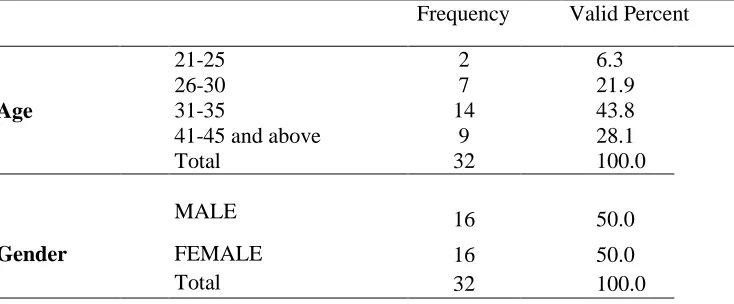
Table 4.1 below illustrates the demographics of the respondents in this study. Table 4. 1: Frequency Table: Demographics
Frequency Valid Percent
21-25 2 6.3
26-30 7 21.9
Age 31-35 14 43.8
41-45 and above 9 28.1
Total 32 100.0
MALE 16 50.0
Gender FEMALE 16 50.0
Available online:
https://edupediapublications.org/journals/index.php/IJR/
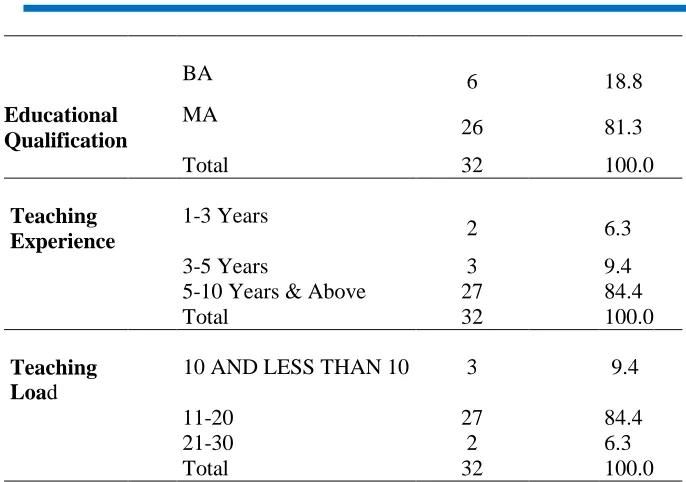
P a g e | 1056BA 6 18.8
Educational Qualification
MA
26 81.3
Total 32 100.0
Teaching Experience
1-3 Years
2 6.3
3-5 Years 3 9.4
5-10 Years & Above 27 84.4
Total 32 100.0
Teaching Load
10 AND LESS THAN 10 3 9.4
11-20 27 84.4
21-30 2 6.3
Total 32 100.0
4.2 RQ1: What are respondents’ perception of using CLT classroom activities?
In this section of the questionnaire the respondents were asked to indicate ‘Which of the following listed classroom activities you currently use as part of your English language teaching?’ The purpose of the question was to explore respondents’ actual use of CLT classroom activities. In this section, both communicative and non-communicative activities were listed, and the respondents were
asked to choose a value point on a scale of 1-4 in which (1=Never Use and 4=Always Use). The results are presented in Table 4.1 below in terms of mean scores and standard deviation.
Table 4.1 below indicates respondents’ perceptions toward their use of CLT (favourable items) and non-CLT (unfavourable items) classroom activities.
Table 4. 2: Respondents’ Perceptions of Using Classroom Activities
Mean Std. Deviation
1. *Grammar explanation 2.91 .69
2. Group discussion 3.84 .60
3. Pair work 3.88 .61
4. *Translation 2.94 .88
5. *Dictionary vocabulary exercises 2.84 .88
6. Simulations / role play 2.88 .83
7. Reading and reporting from websites 2.03 .89
8. *Reading Aloud 2.53 .92
9. *Pronunciation drills 2.34 .87
10. Games 2.63 .79
11. Listening to audio tape and answering questions 2.47 1.08 12. Call on students to orally respond to any issue/topic 3.25 .718
13. *Reading and reciting dialogue 2.19 .78
Available online:
https://edupediapublications.org/journals/index.php/IJR/
P a g e | 1057 Overall on a Scale of 1-4 Unfavourable Items 2.63 .47Overall on a Scale of 1-4 for all items 2.98 .21
The overall mean score of favourable items is M=3.00 (SD=.39) indicating respondents moderately high use of CLT activities. On the other hand, for unfavourable items (non-communicative activities), the overall mean score is M=2. (SD=.47) which indicates that the respondents also have a moderate use of non-communicative activities as well. Finally, the overall all mean score for all items (favourable & unfavourable) is M=2.98. The overall mean score designates that the respondents in the study revealed that they utilise a number of major CLT activities in their teachings, but they also use traditional non-CLT activities as well.
4.3. Research Question 2: What are respondents’ perceptions of the challenges in CLT classrooms?
Research question two aims to examine ‘What are the challenges Afghan EFL teachers face in the application of CLT?’ The items listed in this section are categorised into four sub-categories, explicitly: 1) challenges related to teachers; 2) challenges related to students; 3) challenges related to the educational system; and 4) challenges related to CLT method itself. The teachers were asked to select from a four-point Likert scale: (1=Not a challenge at all) (2=Minor challenge) (3=Challenge) (4=Major challenge).
4.3.1. Teacher-Related Challenges
Table 4.2 indicates respondents perceived challenges in adopting CLT in terms of teacher-related challenges.
Table 4. 3: Respondents’ Perceptions of CLT Challenges Related to Teachers
Mean Std. Deviation a. Teachers’ proficiency in spoken English is not sufficient. 2.53 1.24 b. Teachers lack the knowledge about the appropriate use of
language in context
2.59 1.19
c. Teachers lack the knowledge about the target language (English) culture
2.72 .81
d. There are few opportunities for teachers to get CLT training 2.50 1.05 e. Teachers have little time to develop materials for
communicative classes
2.41 1.01
f. Teachers have misconceptions about CLT 2.84 1.02
Overall Perceptions on a scale of 1-4 2.59 .65
4.3.2. Student-Related Challenges
Table 4.3 indicates respondents’ perceptions of CLT challenges related to students. Table 4. 4: Respondents’ Perceptions of CLT Challenges Related to Students
Mean Std. Deviation g. Students have low-level English proficiency 3.37 .93 h. Students have a passive style of learning 2.96 .80 i. Students resist participating in communicative class activities 2.32 .94 j. Students lack motivation for developing communicative
competence
2.75 .95
Overall Perceptions on a scale of 1-4 2.85 .57
Available online:
https://edupediapublications.org/journals/index.php/IJR/
P a g e | 1058 Table 4.4 illustrates respondents’ perceptions of CLT challenges related to the educational system. Table 4. 5: Respondents’ Perceptions of CLT Challenges Related to the Educational SystemMean Std. Deviation k. There is a lack of enough support from administration 2.00 1.01 l. Teachers lack authentic materials such as newspapers,
magazines, movies, etc.
2.53 1.06
m.Traditional view on teachers’ and learners’ role is not compatible with CLT
2.75 .67
n. Classes are too large for the effective use of CLT 3.44 .56 o. Grammar-based examinations have a negative impact on
the use of CLT
3.28 .84
Overall Perceptions on a scale of 1-4
2.80 .61
4.3.4. CLT Related Challenges
Table 4.5 illustrates respondents’ perceptions of challenges related to the CLT method itself.
Table 4. 6: Respondents’ Perceptions of CLT Challenges Related to CLT Itself
Mean Std. Deviation p. There is a lack of effective and efficient instruments to assess
communicative competence
2.99 .86
q. CLT does not take into account the differences between EFL and ESL teaching contexts
1.91 .93
r. Western educational assumptions are not suitable within Asian contexts.
2.09 1.03
Overall Perceptions on a scale of 1-4
2.23 .61
4.4. Research Question 3: Is there any significant relationship between CLT perceived challenges and EFL teachers’ use of CLT activities
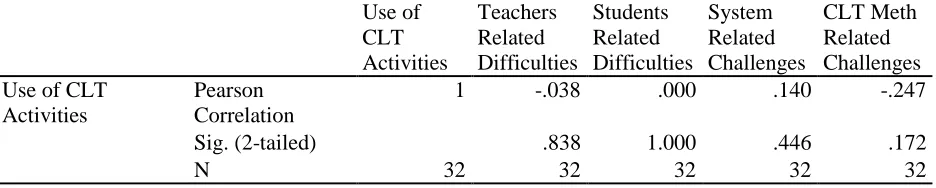
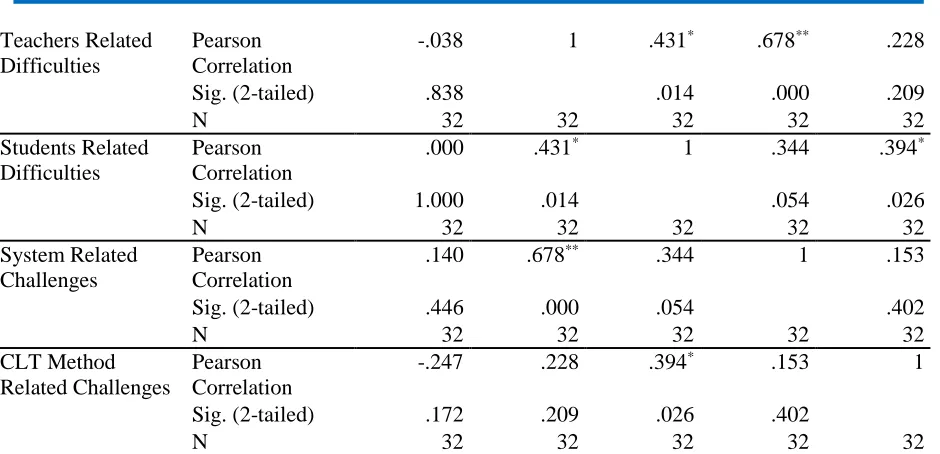
Research question 3 aims to determine if there is any significant relationship between the challenges in a CLT classroom (teacher related, students related, system related, and CLT related) and respondents’ perceptions of the use of CLT classroom activities. Pearson product-moment multiple correlation analysis was performed. Table 4.6 displays the results of Pearson product-moment correlation analysis.
Table 4. 7: Correlation among teachers use of CLT activities and CLT Challenges Use of
CLT Activities
Teachers Related Difficulties
Students Related Difficulties
System Related Challenges
CLT Meth Related Challenges Use of CLT
Activities
Pearson Correlation
1 -.038 .000 .140 -.247
Sig. (2-tailed) .838 1.000 .446 .172
Available online:
https://edupediapublications.org/journals/index.php/IJR/
P a g e | 1059 Teachers RelatedDifficulties
Pearson Correlation
-.038 1 .431* .678** .228
Sig. (2-tailed) .838 .014 .000 .209
N 32 32 32 32 32
Students Related Difficulties
Pearson Correlation
.000 .431* 1 .344 .394*
Sig. (2-tailed) 1.000 .014 .054 .026
N 32 32 32 32 32
System Related Challenges
Pearson Correlation
.140 .678** .344 1 .153
Sig. (2-tailed) .446 .000 .054 .402
N 32 32 32 32 32
CLT Method Related Challenges
Pearson Correlation
-.247 .228 .394* .153 1
Sig. (2-tailed) .172 .209 .026 .402
N 32 32 32 32 32
*. Correlation is significant at the 0.05 level (2-tailed). **. Correlation is significant at the 0.01 level (2-tailed).
The multiple correlation analysis reveals that there only one positive and moderately low (r=.394) but significant correlation (p = .026) between CLT Students related challenges and respondents’ use of CLT activities. However, no significant correlation was found among teachers use of CLT activities, CLT teachers’ related challenges, and system related, and CLT method related challenges.
4.5. Research Question 4: Is there any significant relationship between teachers’ demographic profiles and perceptions of CLT activities
Table 4.7 below displays the descriptive statistics and the independent sample t-test results looking at the difference between male and female respondents use of CLT activities. The results of the t-test disclose that there is no significant mean score difference between male and female respondents use of CLT classroom activities (t (30) = 1.23 & p-value=.230).
Table 4. 7: Independent Samples t-test: Relationship between gender and the use of CLT activities
Gender N Mean Std.
Deviation t df
Sig. (2-tailed) Overall Perception: The use of
CLT Class Activities
MALE 16 2.79 .20 1.226 30 .230 FEMALE 16 2.70 .22
Available online:
https://edupediapublications.org/journals/index.php/IJR/
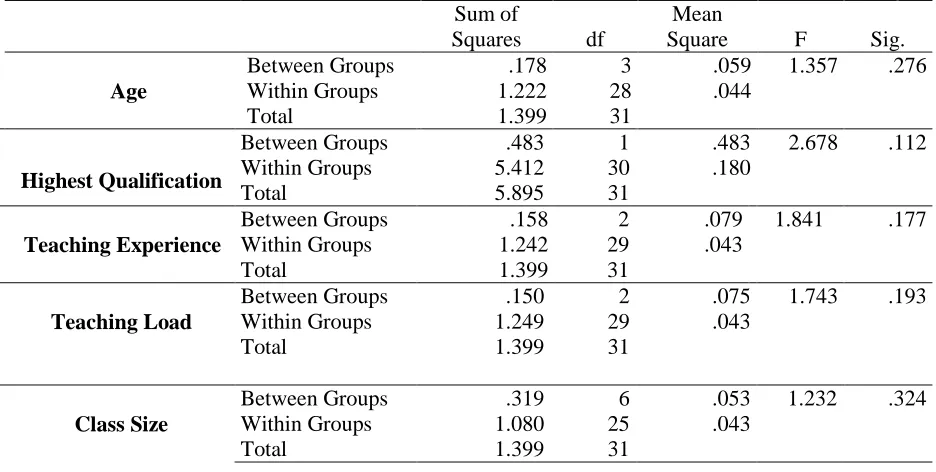
P a g e | 1060 Table 4. 8: One-Way ANOVA for Relationship between Demographic Profile and Respondents Use of CLT ActivitiesSum of
Squares df
Mean
Square F Sig.
Age
Between Groups .178 3 .059 1.357 .276
Within Groups 1.222 28 .044
Total 1.399 31
Highest Qualification
Between Groups .483 1 .483 2.678 .112
Within Groups 5.412 30 .180
Total 5.895 31
Teaching Experience
Between Groups .158 2 .079 1.841 .177 Within Groups 1.242 29 .043
Total 1.399 31
Teaching Load
Between Groups .150 2 .075 1.743 .193
Within Groups 1.249 29 .043
Total 1.399 31
Class Size
Between Groups .319 6 .053 1.232 .324
Within Groups 1.080 25 .043
Total 1.399 31
4. DISCUSSION
4.1. RQ1 Revisited: What are the
perceptions of Afghan EFL teachers toward the use of CLT classroom activities?
The results of the study revealed that the teachers utilise a number of major CLT classroom activities in their own teachings. The results indicate that the teachers expressed that they frequently practice CLT activities such as discussions, pair work, group work, and interactive dialogues in their classes. However, there were certain inconsistencies in their responses as well. First, the majority of the respondents conveyed that they do not use ‘Games’, a very common CLT activity. Teachers’ lack of confidence in using games for language purposes with adults at the university level could be a potential issue in this regard. Or, it could also be attributed to the size of their classes, as it is difficult to utilise games in large classes. Second, inconsistencies were discovered in terms of using non-communicative activities such as ‘Pronunciation drills’, ‘Reading and reciting dialogues’ and ‘Reading Aloud’ as majority of the respondents indicated that used them in their
classes. Using pronunciation drills, as a communicative activity is understandable because it is necessary for the students to accomplish accuracy in pronunciation. This is also in harmony with the principle of CLT method that acknowledges the significance of both fluency and accuracy. Moreover, the use of activities such as ‘Reading and reciting dialogues’ and ‘Reading Aloud’ could be beneficial for the students to produce their own conversations. Students can pick up sentence structures and vocabularies from the readings and later use them in conversations.
4.2. RQ2 Revisited: What are the potential challenges Afghan EFL teachers’ face in the application of CLT?
Available online:
https://edupediapublications.org/journals/index.php/IJR/
P a g e | 1061 language were the main challenges toward theapplication of CLT. This finding is in line with the results of several studies such as Ansarey (2012); Al-Mohanna, (2010), Mustafa (2009), Liao (2000), Li (1998), Burnaby and Sun (1989). All these researches came to the conclusion that Grammar-based examinations, large classes, and low proficiency of students in EFL classes were amongst the key challenges toward the effective and practical implementation of CLT method in EFL contexts.
4.3. RQ3 Revisited: Is there any significant relationship between the
challenges in a CLT classroom and teachers use of CLT classroom activities?
The results obtained for research question five reveal no significant relationship between the potential challenges in a CLT classroom and teachers’ perceptions of CLT classroom activities, except for:
A positive significant relationship was found between CLT students’ related challenges and teachers’ perceptions of using CLT activities.
4.4. RQ4 Revisited: Is there is any significant relationship between EFL teachers’ demographic profiles and their perceptions of the use of CLT classroom activities?
Studies conducted to explore the perceptions of teachers toward CLT report that demographic profiles of the participants affect their perceptions to a certain extent. Wong (1998) found teaching experience an influential factor affecting teachers’ perceptions of CLT. Her findings reveal that the more teachers were experienced (12 years of experience or more) that more positive they were toward CLT, and inclined to apply the method in their classes. However, the data analysis presented in Chapter Four revealed that most of the demographic factors (teaching experience, gender, and highest level of qualification) didn’t have a significant
relationship with Afghan EFL teachers’ perceptions of the use of CLT activities. However, certain age categories, and class size were found significantly correlated to respondents’ perceptions of using CLT classroom activates.
5. CONCLUSION
The majority of the studies carried out to look into the perception of teachers toward CLT reveal certain challenges toward it effective implementation, and state that due to the diversity of ESL and EFL contexts, CLT method is not a very suitable for EFL context. However, the results of the current study indicate otherwise. The findings of the study suggest that the Afghan EFL lecturers in this study had positive perceptions of CLT as they indicated that they utilised the method into practice.
Despite the positive perceptions, the teachers in the study perceived certain challenges regarding CLT that obstructed its effective use. The challenges identified by the teachers in this study were not so diverse from the parallel studies conducted in other EFL contexts. The challenges were investigated in five main categories: (teacher related challenges, students related challenges, system related challenges, and administration related challenges, and CLT related challenges). The challenges observed in the current study ranged from the phenomenon of large classes, teaching load, grammar-based exams, lack of administrative support, students’ low proficiency in the English language, and lack of motivation of students to involve in communicative students.
Surprisingly, unlike other studies, the questionnaire results indicate that the demographic factors of gender, teaching experience, and teaching load did not significantly affect the Afghan EFL teachers’ perceptions of CTL.
Available online:
https://edupediapublications.org/journals/index.php/IJR/
P a g e | 1062 application of CLT. This is because therespondents in this study revealed that they practice some major CLT activates in their classes.
6. Suggestions for Further Research
The following suggestions for further research are proposed which might help look into the subject of this study more thoroughly.
6.1. This study only investigated the perceptions of teachers toward CLT. However, a study that will also examine the perceptions of the students will better explain the condition of CLT in the Afghan context.
6.2. For correlational studies, further research in other public and private universities would be useful.
6.3. The study only relied on a quantitative method in which data collection was collected via a survey questionnaire. Hence, using other instruments such as interviews and especially class observations would drive even better results as it would help the researchers to understand better how much of teachers’ theoretical knowledge of CLT is reflected in their actual classroom practice.
7. REFERENCES
[1]. Afghanistan Ministry of Education. (1390 [2011]). Afghanistan Education Curriculum. Kabul: Ministry of Education. [2]. Al-Mohanna, A. (2010). English language teaching in Saudi Arabian context: How communicatively oriented is it. Journal of
King Saud University-Languages and
Translation, 22, 69-88.
[3]. Allwright, R. (1948). The importance of interaction in classroom language learning. Applied Linguistics, 5, 156-171.
[4]. Breen, M. P., & Candlin, C. N. (1980). The essentials of a communicative curriculum in language teaching. Applied linguistics, 1(2), 89-112.Collis, J., & Hussey, R. (2013). Business
research: A practical guide for undergraduate and postgraduate students. Palgrave Macmillan. [5]. Brown, H. D. (2001). Teaching by principles: An Interactive approach to language
pedagogy. New York: Addison Wesley
Longman, Inc.
[6]. Burnaby, B., & Sun, Y. (1989). Chinese teachers’ views of western language teaching: context informs paradigm. TESOL Quarterly, 23(2), 219-238.
[7]. Darmal, D. (2009). Assessment Practice and Perception of Social Science Instructors in Afghanistan.
[8]. Deckert, G. (2004). The communicative approach: addressing frequent failure. English teaching Forum, 42(1), 12-17.
[9]. Ellis, R. (2003). Task-based language learning and teaching. New York: Oxford University Press.
[10]. Hiep, P. H. (2007). Communicative language teaching: Unity within diversity. ELT Journal, 61(3), 193-201.
[11]. Holliday, A. (1994). The house of TESEP and the communicative approach: The special needs of state English language education.
[12]. Hu, G. (2002). Potential cultural resistance to pedagogical imports: The case of communicative language teaching in China. Language, Culture, and Curriculum, 15(2), 93-105.
[13]. Huck, S. W., Cormier, W. H., & Bounds, W. G. (1974). Reading statistics and research (pp. 74-102). New York: Harper & Row.
[14]. Incecay, G., & Incecay, V. (2009). Turkish university students’ perceptions of communicative and non-communicative activities in EFL classroom. Procedia Social and Behavioral Sciences, 1, 618-622.
[15]. Karavas-Doukas, E. (1 996). Using attitude scales to investigate teachers' attitudes to the communicative approach. ELT Journal, 50(3), 187-196.
Available online:
https://edupediapublications.org/journals/index.php/IJR/
P a g e | 1063 [17]. Krejcie, R. V., & Morgan, D. W. (1970).Determining sample size for research activities. Educational and psychological measurement, 30(3), 607-610.
[18]. Larsen-Freeman, D. (Ed.). (2000). Techniques and principles in language teaching (2nd ed.). Oxford: Oxford University Press.
[19]. Li, D. (1998). "It's always more difficult than you plan and imagine": Teachers' perceived difficulties in introducing the communicative approach in South Korea. TESOL Quarterly, 32 (4), 677-703.
[20]. Littlewood, W. (2007). Communicative and task-based language teaching in East Asian classrooms. Language Teaching, 40, 243-249. [21]. Liu, G. (2005). The trend and challenge for teaching EFL at Taiwanese universities. Regional Language Centre Journal, 36(2), 211-221.
[22]. McGroarty, M., (1984). Some meanings of communicative competence for second language students. TESOL Quarterly 18(2), 257–272.
[23]. Ministry of Education of the Islamic
Republic of Afghanistan. (2010). Annual
Progress Report.
http://moe.gov.af/Content/files/1389_Annual_R eport_%20English.pdf
[24]. Musthafa, B. (2009). Communicative
language teaching in Indonesia: Issues of theoretical assumptions and challenges in the classroom practice. Journal of Southeast Asian Education, 2 (2). ERIC database, (ED462833).
Retrieved from
http://www.eric.ed.gov/PDFS/ED462833.pdf
[25]. Noori, A. (2017). Issues Causing Girls’ Dropout from Schools in Afghanistan.
International Journal for Innovative Research in Multidisciplinary Field. 3(9), 111-116.
[26]. Noori, A., Shafie, N. H., Mashwani, H. U., & Tareen, H. (2017). Afghan EFL Lecturers’ Assessment Practices in the Classroom. Imperial Journal of Interdisciplinary Research, 3(10), 130-143.
[27]. Nunan, D. (1991). Communicative tasks and the language curriculum. TESOL Quarterly, 25(2), 279-295.
[28]. Qasemi, A. S. (2015). An Investigation of English Language Needs of Engineering Undergraduates at Jawzjan University. In Proceedings.
[29]. Rababah, G. (2003). Communication and linguistic problems facing Arab learners of English. Indian journal of applied linguistics, 29(1), 127-142.
[30]. Richards, J. C., & Rodgers, T. (2001). Approaches and methods in language teaching (2nd ed.). New York: Cambridge University Press.
[31]. Richards, J. C. (2006). Communicative
language teaching today. New York:
Cambridge University Press.
[32]. Somaiya. (2017). The Implementation of Communicative Language Teaching Approach in Journalism Faculty of Kabul University. Kabul University: Kabul
[33]. Sullivan, P. (2000). Playfulness as mediation in communicative language teaching in a Vietnamese classroom. Sociocultural theory and second language learning, 115-131.