INTERNAL CONTROL SYSTEMS AND FINANCIAL PERFORMANCE OF PUBLIC INSTITUTIONS OF HIGHER LEARNING IN VIHIGA COUNTY, KENYA
GOVEDI ANDREW KISANYANYA
D53/OL/CTY/24934/2014
A RESEARCH PROJECT SUBMITTED TO THE SCHOOL OF BUSINESS IN PARTIAL FULFILLMENT OF THE REQUIREMENTS FOR THE AWARD OF DEGREE OF MASTER OF BUSINESS ADMINISTRATION (FINANCE OPTION)
OF KENYATTA UNIVERSITY.
ii
DECLARATION
This research project is my original work and has not been presented for the award of a degree in any other University
Signature ………. Date………
Govedi Andrew Kisanyanya D53/OL/CTY/24934/2014
Supervisor:
This research project has been submitted for examination with my approval as the University supervisor
Signature ……….. Date………
Dr. Job Omagwa,
Department of Accounting & Finance, School of Business,
iii
DEDICATION
This research project is dedicated to my family, especially my loving wife Salome, daughters
Caroline, Molvin and Gladwell and sons Christopher and Alvin, whose prayers and support has seen me through this work. To my dear wife: thanks for giving me the time and the peace
iv
ACKNOWLEDGEMENTS
This research project could not have been possible without the valuable input of a number of
groups whom I wish to acknowledge. First and foremost, great thanks to God for His grace and the gift of life during the period of the study. I also wish to appreciate my supervisor, Dr.
v
TABLE OF CONTENTS
DECLARATION……….……….ii
DEDICATION……….………iii
ACKNOWLEDGEMENT……….……….………..…....iv
TABLE OF CONTENTS ………..………..………….……… v
LIST OF FIGURES ………..………..………….……….……ix
LIST OF TABLES ………..………..………….………..… x
ABBREVIATIONS AND ACRONYMS ………xi
OPERATIONAL DEFINITION OF TERMS……….….…..……….…xii
ABSTRACT…..……….………..………...……xiv
CHAPTER ONE………...1
INTRODUCTION………... 1
1.1 Background to the Study………..1
1.1.1 Internal Control Systems………...2
1.1.2 Financial Performance….………..……..…….……… 4
1.1.3 Internal Control and Financial Performance………....……… 6
1.1.4 Public Institutions of Higher Learning……….….………6
1.2 Statement of the problem……….………7
1.3 Research Objectives……….8
1.3.1 General Objectives ………..………..………...…8
1.3.2 Specific Objectives ….………..………....……...………….…8
1.4 Research Questions………..…9
1.5 Scope of the Study……….……….….9
1.6 Significance of Study……….………10
1.7 Organization of Study………...……….………...10
CHAPTER TWO……….………...12
LITERATURE REVIEW……….……….…12
vi
2.2 Theoretical Review……….………12
2.2.1 Agency theory……….12
2.2.2 Stewardship Theory………13
2.2.3 Positive Accounting Theory……….………..14
2.2.4 Attribution Theory……….……….………15
2.3 Internal Control Systems ……….……….…15
2.4 Financial Performance ……….……….17
2.5 Empirical Review………...17
2.5.1 Internal Control Systems and Financial Performance…………..………...…17
2.6 Summary of Literature and Research Gaps……….……….………..………...19
2.7 Conceptual Framework……….………..………...21
CHAPTER THREE …….………..………...22
METHODOLOGY……….…………22
3.1. Introduction……….………..22
3.2 Research Design………..………..….22
3.3 Target Population……….………..…21
3.4 Sampling Design………....23
3.5 Data Collection Instrument…...…………..…………..………...…..24
3.6 Data Collection Procedure………...24
3.7 Validity and Reliability of Study Instructions…….……….….24
3.7.1 Validity of Study Instruments.…..….………..……….…..…24
3.7.2 Reliability of Study Instruments……..………….………..………...25
3.8 Data Analysis and Presentation ……….………25
3.9 Ethical Considerations ……….………..26
CHAPTER FOUR …….………..………...27
DATA ANALYSIS, PRESENTATION & INTERPRETATION..……….…..27
4.1 Introduction………...27
4.2 Response Rate………27
vii
4.3.1 Gender……….27
4.3.2 Work Duration……….28
4.4 Descriptive Analysis of study variables……….29
4.4.1 Control Activities………29
4.4.2 Risk Assessment………..…32
4.4.3 Control Environment………...34
4.4.4 Information and Communication………37
4.4.5 Monitoring………..40
4.4.6 Financial Performance……….43
4.5 Multiple Linear Regression………46
4.5.1 Model Summary………..…47
4.5.2 Analysis of Variance………...…47
4.5.3 Regression Coefficients………..…48
4.6 Discussion of Findings………..………50
CHAPTER FIVE …….………..………...54
SUMMARY, CONCLUSSION & RECOMMENDATION……….……..54
5.1 Introduction………54
5.2 Summary of the Study………54
5.3 Conclusion of the Study………..………..56
5.5 Recommendations of the Study………..58
5.5 Limitations of the Study…………..………..59
5.6 Contribution to Knowledge………..……….…60
5.7 Suggestions for Further Study………..……….60
REFERENCES …………..………61
Study Questionnaire ………..……….…...65
APPENDICES ………..……….…72
viii
ix
LIST OF FIGURES
Figure 2.1: Conceptual Framework………. 21
Figure 4.1: Gender of the Respondents………. 28
Figure 4.2: Duration of Work………28
Figure 4.3: Presence of Control Activities………..………. 29
Figure 4.4: Impact of Control Activities……….………. 30
Figure 4.5: Annual Expenditure on Control Activities……….. 31
x
LIST OF TABLES
Table 3.1 Sample size …..………. 23
Table 4.1 Control Activities………..……… 30
Table 4.2 Risk Assessment and Financial performance……… 32
Table 4.3 Risk Assessment……… 33
Table 4.4 Annual Expenditure on Risk Assessment….……….……… 34
Table 4.5 Control Environment……….……… 34
Table 4.6 Control Environment and Financial Performance….……….… 35
Table 4.7 Control Environment……….……….… 35
Table 4.8 Annual Expenditure on Control Environement …….……… 36
Table 4.9 Information and Communication……… 37
Table 4.10 Information and Communication and Financial Performance….……….…38
Table 4.11 Information and Communication….……….…38
Table 4.12 Annual Expenditure on Information and Communication……..………..…39
Table 4.13 Monitoring …..……….……40
Table 4.14 Monitoring and Financial Performance………40
Table 4.15 Financial Monitoring………41
Table 4.16 Annual Expenditure on Financial Monitoring….………42
Table 4.17 Internal Controls……..……… 43
Table 4.18 Financial Controls and Financial Performance………44
Table 4.19 Stable Finacial Performance……… 44
Table 4.20 Financial Performance….……… 44
Table 4.21 Financial Performance.……… 45
Table 4.22 Model Summary……..……… 47
Table 4.23 Analysis of Variance ……..……… 48
xi
ABBREVIATIONS AND ACRONYMS
ACCA Association of Chartered Certified Accountants COSO Committee of Sponsoring Organizations
CPD Continuing Professional Development ERP Enterprise Resource Planning
ETTC Eregi Teachers Training College
IFRS International Financial Reporting Standards IGA Income Generating Activities
KAFUCO Kaimosi Friends University College
KFCST Kaimosi Friends College of Science & Technology KTTC Kaimosi Teachers Training College
MOE Ministry of Education
NACOSTI National Commission for Science Technology and Innovation SAS Statement of Auditing Standards
xii
OPERATIONAL DEFINITION OF TERMS
Communication This is the transmission or exchange of information between two or more persons. The message emanates from the source to the receiver and back to the source as feedback.
Control Environment Control environment is the set of standards, processes, and structures that provide the basis for carrying out internal control
across the organization.
Decision making Relates to the act of making up your mind about a position or opinion or judgment reached after consideration.
Financial Performance Is a subjective measure of how well a firm can use assets from its primary mode of business and generate revenues.
Internal Control Systems Is a process for assuring achievement of an organization's objectives in operational effectiveness and efficiency, reliable financial reporting, and compliance with laws, regulations, and
policies.
Internal control This is a continuous process in which the board of directors, senior management and all level of personnel, take part and whose aim is to ensure that all the established goals will be
reached.
Internal Controls It refers to systematic measures such as reviews, checks and balances, methods and procedures instituted by organizations to
provide reasonable assurance that its financial reports are reliable, its operations are effective and efficient, and its
xiii
Internal control system This is the process by which organizations maintain environments that encourage incorruptibility and deter fraudulent activities by management and employees.
Information & Communication It’s the means by which information is disseminated throughout the organization. It enables personnel to receive a
clear message from senior management that control responsibilities must be taken seriously.
Monitoring Activities Ongoing evaluations, separate evaluations or some combination of the two are used to ascertain whether each of the five components of internal control is present and functioning.
Management This is the process of planning, controlling, directing, and coordinating and evaluating ideas, activities, and programmes to achieve the aims and objectives of an organization.
Public Institution This is the name that is applied to a school or college that is run for the public to use.
Planning This is the process of setting goals, developing strategies and out lining tasks and schedules to accomplish the goals.
xiv ABSTRACT
1
CHAPTER ONE INTRODUCTION 1.1 Background to the Study
Financial performance is the ability of an organization to run its operations efficiently to be able
to create profits (Sebbowa, 2009). This study used Ray and Kurt’s definition of systems of internal control. Internal control Systems comprises of different elements hence this study only considered five aspects of internal control. These variables included; control activities, Control
environment, Risk assessment, Monitoring as well as Information and communication. The dependent variable of the study was financial performance and it was measured in terms of
financial reporting, surplus as well as financial accountability. Donald & Delno (2009) stated that over the past two decades, institutions have capitalized on internal control systems to improve organizational productivity.
Due to the compelling needs of organizational certifications, institutions have had to install and
implemented effective internal controls to facilitate effective and efficient financial reporting. The five objectives that guide the design of effective internal controls are system reliability,
timely financial reports preparations, asset protection, resource optimization, error detection and prevention of fraud (Alvin et al., 1993). A reliability of financial reporting is depended on the efficiency of internal controls that provide efficiency transactions, effective book keeping and
adequate system authorization. In addition, it is imperious that institutions have good disclosure of the summarized accounting information (Sebbowa, 2009).
Generally, internal control systems greatly influence the nature, type and quality of financial reporting. Dixon et al., (1990) stated that when an organization has effective measures of
2
efficient reporting process, more reliable reports and increased financial accountability. One of the administrative responsibilities of the organization is preparation of trustworthy, accurate and
timely financial information that enhance effective management of the organization.
An institution of higher learning offers education and research and grants academic awards at levels of Postgraduate, Degree, Diploma, and Certificate in a variety of subjects as guided by the institutions’ statutes. In Kenya, public institutions of higher learning are created under the Act of
Parliament to conduct research in different fields with the help of their qualified staff (Onsongo, 2007). The success of an institution is measured by its ability to conduct outreach programs,
extension services and research. In 1990s, Kenyan economy was liberalized and parastatals were privatized creating massive changes in the nature of service delivery and development of performance goals as well as strategies (Slack, 2007).
Public institutions of higher learning, like other government institutions and parastatals, operate
within such an environment and are therefore environment dependent. Public institutions of higher learning have been changing to survive and compete effectively due to economic
instability, liberation, and new government policies. Vihiga County is one of the 47 counties in the Republic of Kenya. Vihiga County is home to Kaimosi Teachers Training College, Kaimosi Friends University College, Eregi Teachers Training College and Kaimosi Friends College of
science and technology. This research sought to establish how financial performance of public institutions is affected by internal control systems in Vihiga County, Kenya.
1.1.1 Internal Control Systems
Saleemi (2008) stated that internal controls are systems put in place by the management of an
3
efficient control system to enable the organisation achieve its set goals (COSO, 1994). Control environment is a key characteristic of organizational management because it comprises of the
organizational attitude and policies concerning internal audit (Theofanis et al., 2011).
In addition, internal control environment is the basis of other internal control elements and it provides the structures for internal control (Sudsomboon & Ussahawanitchakit, 2009). Effective control environment helps to minimize cases of fraud and provide superior internal control
activities (Amudo & Inanga, 2009). Therefore, for effective financial operations in public institutions of higher learning, there is need to create an effective internal control environment.
Risk assessment is the ability of an organisation to identify and analyze the possible threats to its organizational goals (Theofanis et al., 2011).
Similarly, Sudsomboon and Ussahawanitchakit (2009) stated that risk assessment is the ability of an organisation to identify and analyze the possible threats to financial statements
preparations to ensure that they comply with Generally Accepted Accounting Principles. Organizational management team should be able to determine the possible threats to
organizational performance and work towards minimizing them by taking all the necessary precautions. Risk should be maintained within the possible lowest and acceptable standard. In line with this, public institutions should have regular risk assessment as well risk management
strategies.
Control activities are mechanisms, procedures and policies put in place in an organisation to facilitate implementation of the directives given by the management of the organisation (Aikins, 2011; Rezaee, Elam & Sharbatoghlie, 2001). Proper documentation and implementation of
4
risks. They include; separation of duties, reconciliation of bank statements, daily cash deposits among others.
Information and communication is the course of ascertaining, capturing, and properly
communicating financial objectives of the organisation by the management to the employees (Aldridre & Colbert, 1994; Theofanis et al., 2011). Scholars have shown that information and communication is a key ingredient in internal control system because it influences the nature of
working relations across the different organizational levels (Amudo & Inanga, 2009). Therefore, there is need for the management to adequately and clearly communicate to the staff their duties
and responsibilities to enhance organizational performance.
Effective internal control system requires regular monitoring to ensure effective and efficient
system performance over time. Monitoring of internal control systems ensures quality reviews and audits. Theofanis et al., (2011) indicate that monitoring of organizational operations
increases efficiency of the internal control system (Amudo & Inanga, 2009). Therefore, monitoring help the management of an organisation to assess whether organizational policies
drafted are effectively and efficiently implemented by the staff of the organisation.
1.1.2 Financial Performance
Gerrit and Abdolmohammadi, (2010) poised that organizational performance is the total of its activities and process. In institutions of higher learning, financial performance can be either
financial or non-financial. Financial performance can be enhanced by minimizing fraud and irregularities in the systems which will in turn improve shareholders’ confidence that the
management is effectively using their resources to provide better and quality services at most
5
surplus out of its financial operations. Informed decisions are usually made by the management of the organization based on the regularly generated financial reports (Hayes et al., 2005).
Management of an organization is able to account for the resources that they were given based on the financial reports hence the need for regular financial analysis. Emasu (2010) further
stated that accountability can be financial, social or political in nature.
Whittington and Pany (2001) states that internal controls should be comprehensive by covering
financial operations and reporting including adhering to financial laws. They also said that internal controls should be distributed to both the staff and management. They also stated that
internal control include; preparations of programs, analysis of organizational activities and function as well as verification and distribution of reports. Internal control devices include; setting up standards of production, budgetary techniques, employee training, and inspection
among others.
Bakibinga (2001) stated that there is need to separate management and ownership of the business to enhance accountability and proper stewardship through financial statements. Managers are stewards of owners’ resources and they are expected to utilize these resources well
to be able to meet the expectations of the owners as well as organizational goals and objectives. Financial statements are the medium of communication that the managers use to communicate to
their owners and show how effective their stewardship skills are because financial records give a clear indication of the financial performance of the organization. Morris (2011) believed that
6 1.1.3 Internal Control and Financial Performance
Internal control is a set of procedures and standards set by an organization to ensure proper,
reliable and effective financial reporting, efficient financial operations and compliance to laws and regulations (Donald & Delno, 2009). They help an organization to meet its set performance
goals, profit targets as well as prevent misuse and loss of funds. In brief, internal controls give directions to organizations, helping them avoid throwbacks and bombshells along the way (Jenning et al., 2008).
Organizational performance is measured by the organizational productivity against the set
organizational goals with the help of proper management and insistent dedication (Donald and Delno 2009). Effective non-profits are driven by the mission of the organization, customer-oriented and sustainable. Organizational performances include both the financial performance
and non-financial performance (Jenning et al., 2008).
Financial performance is normally measured by sales turnover, return on investment, and return on equity shares as well as return on capital employed. The advantages of accounting measures
to institutions are important since governments expect them to publish their audited financial reports. Measures of non-financial performance of an organization include; stakeholder relations, suppliers and investors relations while measures of financial performance of an
organization include; maximizing returns on investment at minimal costs, development of new products, increase market share as well as organizational communication. However, the base for
good long-term performance of an organization is customer value (David, 2001). 1.1.4 Public Institutions of Higher Learning in Vihiga County, Kenya
In almost all African countries, majority of public institutions receive monetary aid from their
7
of Africa has been experiencing poor financial performance coupled with speedy population progression. Therefore, the small size of the national bread has had to be shared by the many
governmental departments with majority of it going to provision of basic needs to the citizens, hence the financial aid to institutions of higher learning has been shrinking annually. In recent
years, international donors and governments have put institutions of higher learning to task to justify their financial expenditures (Abagi, 1999).
Vihiga County is home to Kaimosi Friends University College, Kaimosi Friends College of Science and Technology, Kaimosi Teachers Training College and Eregi Teachers Training
College. Kaimosi Friends University College offers various academic awards namely; Degrees, Diplomas, and certificates in various fields of study. Eregi Teachers Training College and Kaimosi Teachers Training College offer Diplomas and P1 certificates in teacher training,
whereas Kaimosi Friends College of Science and Technology offers various Diplomas and certificates in various technical courses.
1.2 Statement of the problem
The internal control is an essential tool for corporate governance to enhance effective and
reliability of financial reporting (Skaife et al., 2007). It also provides total assurance that the targets set by the organization will be achieved (Gerrit & Abdolmohammadi 2010). Normally, internal control systems are set up by organization to aid them in meeting their objectives,
ensure generation of reliable financial reports, increase organizational compliance to financial regulations as well as prevent loss of organizational resources (Emasu, 2010). Active
involvement and proper financial management of public Institutions of Higher Learning by their management has fostered growth and prosperity of these institutions.
8
control and financial performance is an understudied area, (Gerrit & Abdolmohammadi, 2010). Some of the challenges experienced concerning internal controls include; low liquidity ratios,
untimely financial reporting, low accountability, frauds and mismanagement of funds. Mohammed, (2003) researched on the effect of the internal controls of Ethiopian Airlines in
Nairobi, Esmailjee, (1993) carried out a case study of internal controls of Nyayo Bus Service Corporations in Nairobi and Chira, (2009) found out that various internal control systems do exist in the banking and transport industries although more weight had been given to operational
controls compared to other types of controls.
Simiyu (2011) found that middle institutions of learning in Kenya had a number of internal control challenges. They included liquidity problems, poor financial accountability, and untimely generations of financial reports, frauds, and misuse of institutional funds. However, the
study did not focus on the study variables of this study as well as none of them were conducted in Vihiga County. This study was motivated by the fact that there are many unaddressed areas
about internal control in relation to financial performance of tertiary institutions and the fact that there are no earlier related empirical studies on internal control systems and financial
performance in institutions of higher learning in Vihiga County, Kenya. 1.3 Research Objectives
The study was anchored on a general and specific objectives captured below.
1.3.1 General Objective
To establish the effect of internal control systems on financial performance of institutions of
higher learning in Vihiga County, Kenya 1.3.2 Specific Objectives
The specific objectives of the study were:
9
(ii) To establish the effect of risk assessment on financial performance of public institutions of higher learning in Vihiga County, Kenya.
(iii) To evaluate the effect of control environment on financial performance of public institutions of higher learning in Vihiga County, Kenya.
(iv) To establish the effect of information and communication on financial performance of public institutions of higher learning in Vihiga County, Kenya.
(v) To establish the effect of monitoring on financial performance of public institutions of
higher learning in Vihiga County, Kenya.
1.4 Research Questions
The study sought to answer the following research questions in view of the respective specific objectives:
(i) What is the effect of control activities on financial performance of public institutions of
higher learning in Vihiga County, Kenya?
(ii) What is the effect of risk assessment on financial performance of public institutions of
higher learning in Vihiga County, Kenya?
(iii) What is the effect of control environment on financial performance of public institutions
of higher learning in Vihiga County, Kenya?
(iv) What is the effect of information and communication on financial performance of public institutions of higher learning in Vihiga County, Kenya?
(v) What is the effect of monitoring on financial performance of public institutions of higher learning in Vihiga County, Kenya?
1.5 Scope of the Study
A study was conducted to establish the effect of internal control on financial performance of Public Institutions of Higher Learning in Vihiga County, Kenya. The management and staff in
10
population of the study since they are well informed on the subject under research. The study covered a period of five years, thus from the year 2011 to the year 2015.
1.6 Significance of Study
The recommendations of the study are of interest to the management of public institutions of
higher learning who would be interested to come up with various ways in which to improve their efficiency and effectiveness through the use of proper internal control system in all their operations. Furthermore the study helps to inculcate scientific and inductive thinking and
promotes the development of logical habits and thinking by all staff in the organization. Government and policy makers will gain insight on the critical role of internal controls in the
financial performance of public institutions of higher learning. Other institutions will benefit through the understanding of the important role that the internal control systems play in enhancing accountability and effect on financial performance.
This study is of interest to academicians and future researchers who will be undertaking other
researches related to this. This is because it increases their knowledge on internal control and provides the necessary information to be incorporated into their work. The study also helps them
come up with better proposals on internal control and their effects on financial performance of public institutions of higher learning in Vihiga County, Kenya.
1.7 Organization of the Study
The study comprises of five chapters. Chapter one has the background of the study, statement of
the problem, objectives of the study, and research questions, scope and significance of the study and the organization of the study. Chapter two reviews the supporting theories and empirical studies been done on the study objectives and also a conceptual framework for the study.
11
Higher Learning in Vihiga County. This entailed the research design, target population and sample, data collection and data analysis procedures used in the study. Chapter four was on data
12
CHAPTER TWO LITERATURE REVIEW
2.1 Introduction
This chapter reviewed the literature advanced in the area of internal control systems on financial performance of companies. The chapter commences with a highlight of various theories relevant
to this study. The theories include: the agency theory, stewardship theory, positive accounting theory, and attribution theory which form the basis of the concept of internal control systems. To
assist in identification of existing gaps in the literature, empirical literature is reviewed in this chapter. A conceptual framework is also presented based on the study objectives.
2.2 Theoretical review
A theory is a group of principles designed to provide vivid explanations on certain facts or phenomena and they have been globally tested and agreed upon by scholars (Creswell, 2006). The theories that were used in the study are: Stewardship theory, Positive accounting ttheory,
Agency theory and the Attribution theory.
2.2.1 Agency theory
This theory was designed in 1976 by Jensen and Meckling. Agency is used to define the nature of the relationship between principal (s) and agent (s) in a contract setting where the agent is given some decision making power. It is also used to define the relationship between managers
and investors by defining the duties and responsibilities ran by the manger on behalf of the investor and the reward that the manager receives from the investor (Jensen & Mckling, 1976).
Agency theory states that a company comprises of a number of contracts between investors and managers. The theory further states that managers are more informative than investors making it
13
the interest of both the manager and investor, the contract should draft in a manner that captures the two interests. A good agent-principal relationship is whereby the investor has systems that
enable them to effectively monitor the work of their managers (Jussi & Petri, 2004).
The theory also state that incomplete contract information on the expectation of the investors as well as the managers could have adverse effects on the general performance of the organization. This is because the managers will have inadequate knowledge on what is expected of them by
the agents leading to under-performance. Therefore, this theory assumes the nature of the relationship between managers and agent is based on wealth maximization (Jensen & Meckling,
1976). This theory is relevant to the study since internal control mechanisms are established in organizations to minimize agency cost and improve general organizational performance (Payne, 2003; Abdel-Khalik, 1993).
In relation to the study, the owners of the institutions of higher learning have given mandate to
the management of these institutions to effectively manage their resources and ensure smooth running of the institution on a daily basis through delegation of duty. Effective internal control
systems ensure that investors interests are well taken care of. In addition, this theory supports existence of control activities, control environment and risk management.
2.2.2 Stewardship Theory
Davis, Schoorman and Donaldson (1997) define a steward as a person who ensures that the investor’s wealth is well protected in order to maximize organizational profits. Donaldson and
Davis (1991) states that this theory focuses on the ability of the management of the organization to align their goals with the institutional goals. They further state that stewards’ satisfaction and motivation is driven by the success of the organization. Donaldson and Davis (1991) argue that
14
independence between employees or management and investors. Fama (1980) opposes that myth that advancement career development is necessary for managers to be good overseers while
Shleifer, Andlei and Vishny (1997) contends that the financial return given to the investors by the managers creates good reputation and it also encourages the investors to re-invest with them.
In Agency theory, Meckling and Jensen (1994) states that agency cost is usually lower when the investors form part of the management of the organization for monitoring purposes. However,
stewardship theory is complete opposite of the agency theory since it does not advocate for investors monitoring of the organizational performance through internal audit. Nonetheless,
Donaldson and Davis (1991) further note that better financial returns are experienced when these theories are jointly exercised in an organization. In this study, the steward theory supports the fact that managers of institutions of higher learning act as caretakers of suppliers, shareholders,
consumers, creditors and employees of these institutions.
2.2.3 Positive Accounting Theory
This theory was developed by Watts and Zimmerman in 1986 and it states which accounting method a firm is supposed to use and which one it is not supposed to use. This theory assumes
that people are opportunistic and they are driven by self-interest in wealth creation and maximization (Deegan & Unerman, 2006). Based on this theory, organizations embrace internal control systems that will cater for the needs of the managers and investors to monitor operational
costs of the organization.
Accounting research can either be positive or normative research. Positive accounting researches forecast and explain certain accounting elements. Theories aligned to positive accounting research are normally called positive theories. They are based on observations that can be tested
15
2006). This theory explains the existence of monitoring, risk assessment, control activities as well as control environment in the public institutions of higher learning.
2.2.4 Attribution Theory
This theory was developed by Fritz Heider in 1958. Attribution theory explains how behavior and events are interpreted as well as their causes (Schroth & Shah, 2000). Reffett (2007) asserted that assessors attribute difference in handling similar situations to difference in
personality while the difference is attributed to situational behavior. Similar sentiments were shared by Wilks and Zimbelman (2004) and Schroth & Shah (2000). Similarly, assessors often
deduce internal control failure on auditors’ negligence as well as generation of revenue. Bonner et al. (1998) said that when fraud that could affect the financial performance of an organization is not pointed out by the auditor, he/or she is likely to be sued. Reffett’s (2007) further stated that auditors’ inability to detect fraud risk can be very detrimental for an organization.
Attribution theory stated that auditing determiners the efficiency of internal control systems of the organization. Therefore, they need to have an adequate understanding of the organizational internal control for proper revenue generation. This theory is relevant to the study since it
proposes that control activities like internal audits are key elements of control systems that they help to prevent fraud.
2.3 Internal Control Systems
Whittington and Pany (2001), defines control environment as a a composition of leadership
style, organizational mission and vision as well as the ethical values of the organisation that guides the day to day operations of the institution (Verschoor, 1999). They provide a ground for the formation of internal control systems as well as its operational framework. Though at times,
16
committees are always not independent and boards of management have inadequate time to play their supervisory role.
The effectiveness and efficiency of internal control and its operations ensure reliability of
financial reporting as well as provide aid in obedience to regulations and laws (Whittington & Pany, 2000). The risks that organizations go through keep changing from time to time with the change in organizational goals, organizational structure and control environment. Therefore, a
sound internal control system is dependent on consistent and systematic risk evaluation of the company since the role of internal control is to help an organisation manage and control its risk
in order for it to achieve maximum profit (John, 2011).
Ray and Pany (2001) states that another key ingredient of internal control is control activities.
The authors define control activities as procedures and policies put in place under the directives of the management to ensure proper financial management. They include; physical controls to
assets and records, reviews of financial performance, performance forecasting, information processing and separations of duties.
Another key element of internal control is monitoring (Aikins, 2011; Rezaee, Elam and Sharbatoghli, 2001). The role of monitoring internal control is ensure that that they reliable in
executing its operations through regular and systematic routine evaluations. Monitoring also included non-routine activities like periodic audits (Whittington & Kurt 2001). Designed
internal control is expected to be of great significance to the management and the finance team (Ogneva, Subramanyam, & Raghunandan, 2007). Currently, almost all kinds of organisation have embraced internal control by coming up with policies aimed at protecting their assets and
17 2.4 Financial Performance
Stoner (2003) defines performance as the ability of the organization to have efficient
operations, maximum profit margins and survival tactics in the harsh and risky working environment. Sollenberg and Anderson (1995) states that financial performance is a subjective
measure of how well a firm can use assets from its primary mode of business and generate revenues. Dixon et al (1990) states that suitable measures of performance are aimed at redirecting the organizational path to be in line with its strategic goals.
According to Salim (2003, financial performance of an organisation is assessed based on the
organisational output in relations to organisational objectives. Organizations normally put in place a number of operations to evaluate and monitor its ability to meet its goals through evaluating employees’ responsiveness to new skill and knowledge, embracing new technology
and structures and investing capital in the operations of the organisation (Schneider & Wilner, 1990). There is need to have key performance indicators in an organisation to aid in monitoring
organisational processes, operations and note any significance difference in the observed output from the expected output (Keror, 2012). This will go a long way in providing a platform in
addressing the possible weaknesses, failures and threats to the success of the organisation.
2.5 Empirical Review
The study reviewed various empirical literatures, which is captured below.
2.5.1 Internal Control System and Financial Performance in Tertiary Institutions
A study carried out by Ndiwa (2014) examined the influence of internal control systems on
financial performance of African Institute of Research and Development Studies.The study was conducted in African Institute of Research and Development Studies campuses only. The study
18
strategies and audit department. However, the audit department did not have adequate staff. The study established the existence of a positive relationship between financial performance and
internal control. In addition, the staff of the audit department had a significant effect on the general finance performance of the institution. The study showed lack of effective checks and
balance and security to reduce theft and fraud due audit department having inadequate staff.
Ndifon (2014) studied the role of internal control activities on the financial performance in
tertiary institutions in Nigeria. The study was carried out at Cross River State College of Education, Akamkpa. The findings of the study indicated that all the control activities in the
institution were spearheaded by the management. In addition, there was separation of duties among the employees in the finance department and there was consistent supervision of work by the superiors. In addition, the school conducted annually external audit of financial statements.
However, there existed no statistical significant relationship between financial performance and internal control activities. The study showed lack of effective transactional checks and balance
and security to reduce theft and fraud. In addition, the college failed to conduct regular staff training.
Mwakimasinde, Odhiambo and Byaruhanga (2014) examined how financial performance of sugarcane out grower companies in Kenya was influenced by internal control systems. The
regression findings that study showed a statistical significant relationship between financial performance and internal control systems. Kinyua (2015) analysed how financial performance of
19
The findings in the Kinyua (2015) study were seconded by the findings of Mawanda (2008) that stated that effective implementation of proper control systems may improve the financial
performance of an organization. The Researcher set out to establish the causes of persistent poor financial performance from the perspective of internal controls. The investigation recommends
competence profiling in the Internal Audit department which should be based on what the University expects the internal audit to do and what appropriate number staff would be required to do this job. The study therefore acknowledged role of internal audit department to establish
internal controls which have an effect on the financial performance of organizations.
Kamau, (2014) explored how financial performance of manufacturing firms in Kenya were affected by internal controls. The study found out that most of the companies had proper control environment which positively influenced their financial performance, the staffs of the companies
under study were well trained on financial management systems and the organisations had security systems to protect their assets and prevent fraud. Regression analysis indicated the
existence of a significant positive financial performance and internal control. Palfi and Muresan (2009) studied the significance of proper internal control system in the baking industry. The
study findings showed teamwork between the management and internal audit department through regular meetings. Abu Musa (2010) found out that many banks in Saudi had embraced information technology and communication and they also had proper and effective security
controls. In addition, the management and staff of the bank were well trained in computerized accounting information systems (Simiyu, 2011).
2.6 Summary of Literature and Research gaps
20
In addition, little is known on the influence of risk assessment and monitoring on financial performance of learning institutions. Also, majority of the studies have concentrated on the
banking industry and other business oriented organisation with little attention paid to public institutions of higher learning.
Moreover, from the literature reviews done it has been found out that realization of positive financial performance and value for money depends on whether firms have Internal Controls.
Non-compliance to the internal controls is one of the major hindrances to the attainment of positive financial performance in public institutions of higher learning. Whereas a lot has been
done on control environment and control activities there is little done about internal audit in relation to value for money; what is greatly studied is value for money audits. Weak, non-compliance, non-existent or absent public financial management functions (Internal Control
Systems) are likely to negate any advantages that might be inherent in achieving positive financial performance of a firm.
Therefore, there is need to establish the relationship between the internal control systems and
financial performance of public institutions of higher learning in Vihiga County, Kenya. It can be concluded from the literature that Control Environment, Control Activities, Risk Assessment, Information and Communication and Monitoring are significant predictors of financial
21 2.7 Conceptual Framework
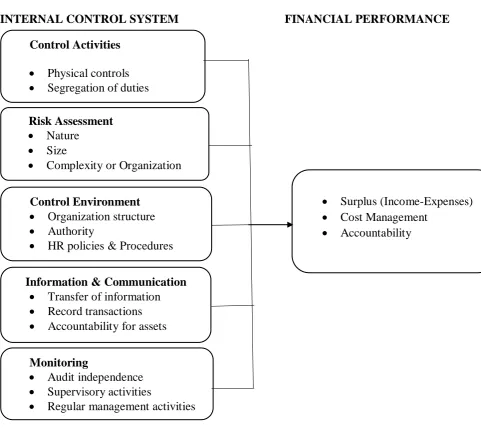
A conceptual framework is a diagram that shows how the variables of the study are interrelated.
It shows the relationship between the independent and dependent variable of the study.
INTERNAL CONTROL SYSTEM FINANCIAL PERFORMANCE Ris
Independent Variables Dependent variables
Figure 2.1: Conceptual framework Source: Researcher, 2017 Monitoring
Audit independence Supervisory activities
Regular management activities Risk Assessment
Nature Size
Complexity or Organization Control Activities
Physical controls Segregation of duties
Information & Communication Transfer of information Record transactions Accountability for assets Control Environment Organization structure Authority
HR policies & Procedures
Surplus (Income-Expenses) Cost Management
22
CHAPTER THREE
RESEARCH METHODOLOGY 3.1. Introduction
This chapter describes the research methodology of the study that was used to achieve the objective
of the study. Research methodology is the procedural plan that is adopted by the researcher to
validly, objectively, economically and accurately answer the research questions. It is a detailed
explanation of the procedures and techniques that shall be used while collecting, processing and
analyzing data. This section of the study therefore describes the research design, target population
and area, sampling frame, sample and sampling technique, data collection instruments, procedures,
analysis management and the ethical considerations that the study shall use.
3.2 Research design
A research design is an outline used to describe how a research will be conducted (Kothari,
2007). This study employed a cross-sectional descriptive survey design since it provides a clear outcome and the characteristics associated with it at a specific point in time. The descriptive
design was relevant for this study particular study since it focuses at one point in time and does not require several rounds of monitoring. The descriptive survey attempted to document current conditions to describe what exists at the moment (Mouser & Katton, 1989). The study employed
both quantitative and qualitative data.
3.3 Target Population
Kombo and Tromp (2011) stated that a population is a group of items, objects or individuals where a study can obtain its sample. Cooper and Schindler (2011) stated that a population is the total group of items/people that the researcher intends to draw inference while Kothari (2011)
poised that population is the universe of the researcher. Target population is the category of a population that contains the desired characteristics of a study (Cooper & Schindler, 2011;
23
The target population for the study comprised employees in accounting/finance, administration and operations departments in the four public institutions of higher learning in Vihiga County.
The number of staff in the accounts/finance, administration and operations departments in the four public institutions of higher learning in Vihiga County was 40 staff for KAFUCO, 36 staff
for KTTC, 33 staff for ETTC and 31 staff for KFCST, totaling to 140 employees. 3.4 Sampling Design
A sample is a subsection of a population that a researcher intends to interview to be
representation of the total population while sampling is deliberate rather than haphazard methods of selecting subjects for observation to enable scientists to infer conclusions about a population
(Kothari, 2007). Mugenda and Mugenda (2003) proposed that a good sample should be between 10-30% of the total study population. The study focuses attention to the entire population of the four institutions. The information needed could be obtained from those who were involved in
monitoring and enforcing controls at the institutions. Accordingly, the finance, administration and Operations departments were considered for the study. A purposive sampling approach was
used in this study to allow the research to pick concerned staff especially from the accounts/finance, administration, and operations department within the four public institutions
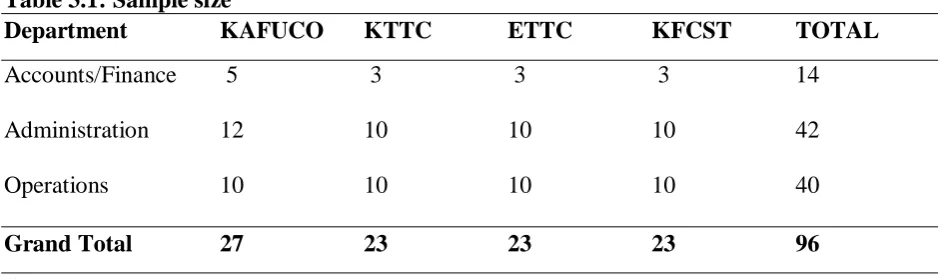
of higher learning in Vihiga. The sample of the study included 96 staff at the institutions of higher learning in Vihiga County as shown in table 3.1
Table 3.1: Sample size
Department KAFUCO KTTC ETTC KFCST TOTAL
Accounts/Finance 5 3 3 3 14
Administration 12 10 10 10 42
Operations 10 10 10 10 40
Grand Total 27 23 23 23 96
24 3.5 Data Collection Instrument
Primary data in this study was collected using a semi-structured questionnaire. The
questionnaire was deemed to be the best data collection tool because the study participants are literate. In addition, the use of questionnaire ensured that the researcher upholds respondents’
anonymity and confidentiality while allowing the researcher to collect data faster from a wide population (Kothari, 2007). The questionnaire was divided into two sections where section one deals with demographic information while section two deals with the study variables. Secondary
data was collected from the institutions’ audited financial records. This data helped in reinforcing the findings of the primary data as well as providing additional data that the
questionnaire could not collect. 3.6 Data Collection Procedure
An introductory letter from Kenyatta University’s graduate school and a research permit from
NACOSTI were used to introduce the researcher to the respondents. The researcher administered the questionnaire himself to offer assistance to the respondents where needed and
to enhance the reliability of the data collected. The researcher used drop and pick method to give adequate time to the respondents. Physical contact between the researcher and the respondents
allowed them to have a good rapport which reduced suspicion and motivated the respondents to honestly answer the questions in the questionnaire.
3.7 Validity and Reliability
3.7.1 Validity of Study Instruments
Validity is used to measure the accuracy of a data collection tool in line with the study
objectives. In cases where the validity of the data collection tool is established, the data collected using that tool is believed to accurate and in line with the study objectives (Mugenda & Mugenda, 2003). In addition, the validity of the data collection instrument is improved by using
25 3.7.2 Reliability of Study Instrument
Reliability is the measure of internal consistency of the items in a data collection tool (Hair et
al., 1998). The researcher ensured the reliability of the questionnaire by conducting a reliability test analysis using Cronbach’s Alpha on SPSS. If the Cronbach's Alpha co-efficient of the items
is 0.70 and above, then the questionnaire is said to be reliable. To determine the reliability of the findings, Cronbach's alpha correlation coefficient of was computed at 95% confidence interval for all the variables under study. Total Cronbach's alpha correlation coefficient was found to be
0.852, which indicated that the level of internal consistency for the items was 85.2 percent. Fraenkel and Wallen (2000) states that items are considered reliable if they yield a reliability
coefficient of 0.70 and above. Therefore, the study showed the existence of acceptable level of inter-item consistence.
3.8 Data Analysis and Presentation
Data analysis is the process of data cleaning, coding and editing as well as error checking. Data was analyzed using descriptive (mean and standard deviation) and multiple regression analysis.
Statistical Package for Social Science (SPSS) was utilized in data analysis. Data was presented using charts and tables. Regression analysis was used to show the statistical relationship of the
variables as shown:
Y= βo+ β1x1 + β2x2 + β3x3 + β4x4 + β5x5 + ɛ Where:
Y = Financial Performance X1 = Control environment
X2 = Risk assessment X3 = Control Activities
X4= Information and Communication
26 ɛ = Error term
3.9 Ethical Considerations
Ethics is a branch of philosophy that deals with the conduct of people and guides the norms or standards of behaviour of people and relationships with each other (Kovacs, 1985; Blumberg et
al, 2005). In line with this, the researcher informed all the participants the objective of the study and asked them to participate voluntarily. The researcher maintained respondents’ anonymity and kept confidentiality of the collected data. In addition, the researcher sought permission to
conduct research from relevant authorities. The researcher ensured that nothing could be traced back to any of the respondents should the findings of this study be published. Where possible,
27
CHAPTER FOUR
DATA ANALYSIS, PRESENTATION AND INTERPRETATION
4.1 Introduction
This chapter contains presentation and interpretation of the data collected in the study. The first
section presents the response rate, reliability test and demographic characteristics of the respondents. The second section presents the findings of the study and discussions based on the objectives that the study sought to achieve. The study then compares and contrasts the findings
with other studies and literature.
4.2 Response Rate
Out of the total 96 questionnaires that were sent to the respondents, 70 of them were dully filled and returned by the respondents. Hence, this constituted a response rate of 72.9%. This was
considered a very reliable response rate for generalizations of study findings since according to Zikmund et al., (2010) a response rate of 70 percent and above is said to be a reliable response rate.
4.3 Demographics Analysis
4.3.1 Gender Analysis
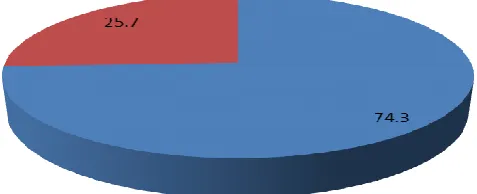
The study sought to establish the gender of the respondents. The findings of the study revealed that 74.3 percent of the respondents were male while only 25.7 percent of them were female. The study findings imply that there were more male than female in the departments that were
28
Figure 4.1: Gender of the Respondents Source: Research data, 2017 4.3.2 Work Duration
The respondents were asked to state the number of years that they had worked in their respective institutions. The findings reveal that majority of the respondents, thus 74.3 percent had relevant
work experience having worked for the institutions for a period of more than 5 years. Hence it can be revealed that the majority are those directly involved the implementation of the Internal Control System. Therefore, their responses are deemed to reflect what actually takes place in the
institution. Figure 4.2 shows the findings of the study.
29 4.4 Descriptive Analysis
4.4.1 Control Activities
The respondents were asked whether their respective institutions had adequate and effective control activities. The findings of the study revealed that majority of the respondents, 61.4
percent stated that their respective institutions had adequate and effective control activities with a mean of 1.39 and standard deviation of 0.49. These results were influenced by existence of
proper allocation and distribution of resources and segregation of duties. Figure 4.3 shows the findings of the study.
Figure 4.3: Presence of Control Activities Source: Research data, 2017
The respondents were further asked to state whether control activities affected financial
performance of their institutions. The findings of the study indicated that majority of the respondents, 77.1 agreed that control activities affected financial performance by ensuring
30
Figure 4.4: Impact of Control Activities Source: Research data, 2017
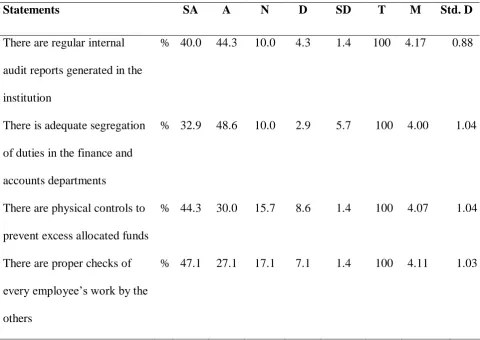
The study sought to determine the effect of control activities on the financial performance of
public institutions of higher learning in Vihiga County, Kenya. The findings are presented in a five point Likerts scale where SA=strongly agree (5), A=agree (4), N=neutral (3), D=disagree
(2), SD=strongly disagree (1), T=total, M=mean and Std. D= standard deviation. The results of this analysis are as provided below in table 4.1
Table 4.1: Control Activities
Statements SA A N D SD T M Std. D
There are regular internal
audit reports generated in the institution
% 40.0 44.3 10.0 4.3 1.4 100 4.17 0.88
There is adequate segregation of duties in the finance and accounts departments
% 32.9 48.6 10.0 2.9 5.7 100 4.00 1.04
There are physical controls to prevent excess allocated funds
% 44.3 30.0 15.7 8.6 1.4 100 4.07 1.04
There are proper checks of every employee’s work by the
others
31 Source: Research data, 2017
The study in table 4.1 found that majority of the respondents agreed that there were regular
internal audit reports generated in their institutions, there was adequate segregation of duties in the finance and accounts departments, there were physical controls to prevent excess allocated
funds and there was proper checks of every employee’s work by the others as well as adequate corrective action was taken to address weaknesses in audit reports. These findings were seconded by the findings of Mawanda (2008) that stated that effective implementation of proper
control systems may improve the financial performance of an organization. Table 4.1 above shows the findings of the study.
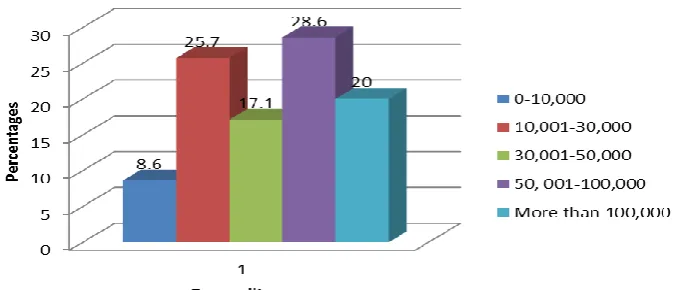
Finally, the study sought to establish the average annual expenditure (in Kenya Shillings) their institutions spent on control activities. The findings of the study revealed the mean annual expenditure was between 30,001-50,000 Kshs. (3.25) and the standard deviation was 1.28.
Figure 4.5 illustrates the findings of the study.
Figure 4.5: Annual Expenditure on Control Activities
Source: Research data, 2017 There is adequate corrective
action taken to address
weaknesses in audit reports
32 4.4.2 Risk Assessment
The study sought to establish whether their institutions had proper risk assessment program.
Majority of the respondents agreed that their institutions had proper risk assessment program because they carried out continuous financial assessment of their organizations coupled with regular, timely and profound audits. The mean response was 1.33 and the standard deviation
was 0.47. Figure 4.6 illustrates the findings of the study.
Figure 4.6: Existence of Risk Assessment Program Source: Research data, 2017
Table 4.2: Risk Assessment and Financial Performance
Item Response Percentage Mean Standard
Deviation Does risk assessment affect financial
performance of the institution?
Yes 71.4 1.29 0.46
No 28.6
Source: Research data, 2017
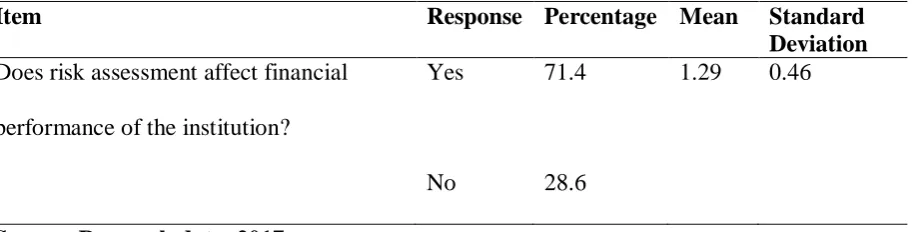
The respondents were further asked whether risk assessment affected financial performance of their institutions. The findings of the study indicated that majority of the respondents agreed that
33
institutions’ assets and enhancing financial performance. These findings have been supported by
the mean of 1.29 and a standard deviation of 0.46. Table 4.2 above illustrates the findings of the
study.
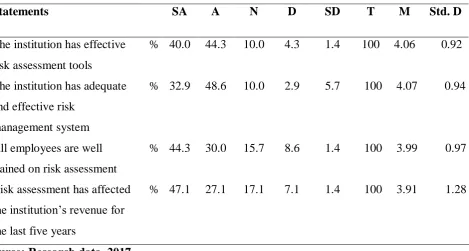
The study sought to establish the effect of risk assessment on the financial performance of public institutions of higher learning in Vihiga County, Kenya. The results of this analysis are as provided below in table 4.3
Table 4.3: Risk Assessment
Source: Research data, 2017
The findings in table 4.3 of the study revealed that majority of the respondents agreed that their institutions had effective risk assessment tools and adequate and effective risk management
system. The results also indicated that all employees were well trained on risk assessment and risk assessment affected the institution’s revenue for the last five years.
Statements SA A N D SD T M Std. D
The institution has effective risk assessment tools
% 40.0 44.3 10.0 4.3 1.4 100 4.06 0.92
The institution has adequate and effective risk
management system
% 32.9 48.6 10.0 2.9 5.7 100 4.07 0.94
All employees are well trained on risk assessment
% 44.3 30.0 15.7 8.6 1.4 100 3.99 0.97
Risk assessment has affected the institution’s revenue for the last five years
34
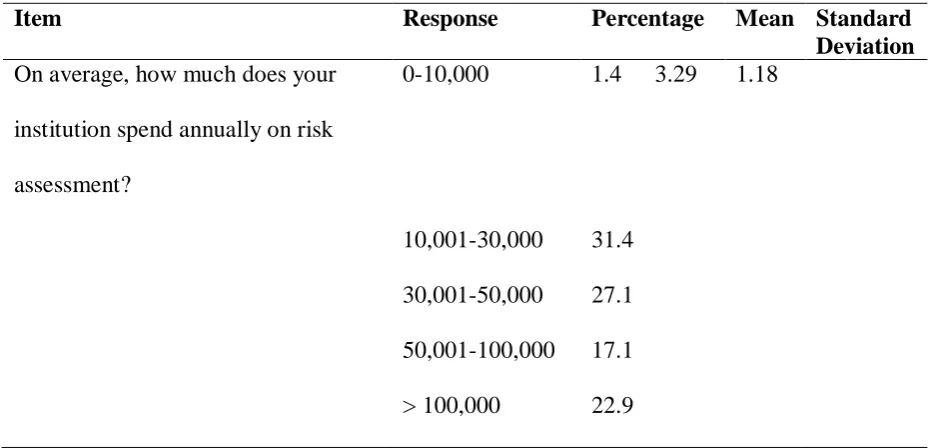
Finally, the respondents were asked to state the average annual expenditure (in Kenya Shillings) their institutions spent on risk assessment program. The results of this analysis are as provided in
table 4.4
Table 4.4: Annual Expenditure on Risk Assessment
Item Response Percentage Mean Standard
Deviation On average, how much does your
institution spend annually on risk
assessment?
0-10,000 1.4 3.29 1.18
10,001-30,000 31.4
30,001-50,000 27.1 50,001-100,000 17.1 > 100,000 22.9
Source: Research data, 2017
The findings in table 4.4 of the study revealed the mean annual expenditure was between 30,001-50,000 Kshs (3.29) and the standard deviation was 1.18.
4.4.3 Control Environment
The study sought to establish whether their institutions had proper control environment. The results of this analysis are as provided below in table 4.5
Table 4.5: Control Environment
Item Response Percentage Mean Standard
Deviation Does the institution have conducive
control environment?
Yes 62.9 1.37 0.49
No 37.1
35
The findings indicate that majority of the respondents thus 62.9 percent agreed that their institutions had proper control environment while a smaller percentage thus 37.1 percent of them
stated otherwise. Table 4.5 above illustrates the findings of the study.
The respondents were further asked whether control environment affected financial performance
of their institutions. The results of this analysis are as provided below in table 4.6
Table 4.6: Control Environment and Financial Performance
Item Response Percentage Mean Standard
Deviation Does control environment affect financial
performance of the institution?
Yes 71.4 1.29 0.46
No 28.6
Source: Research data, 2017
Table 4.6 above shows that the control environment is positively related to financial performance with a percentage of 71.4 and a standard deviation of 0.46. The results seem to agree with Mawanda’s (2008) assertion of that effective implementation of proper control
systems may improve financial performance of the organization.
The study sought to evaluate the effect of control environment on the financial performance of public institutions of higher learning in Vihiga County, Kenya. The table below presents the
results. The results of this analysis are as provided below in table 4.7
Table 4.7: Control Environment
Statements SA A N D SD T M Std. D
Our institution has effective control environment
% 34.3 35.7 14.3 11.4 4.3 100 3.84 1.15
The institution finance and audit departments are
36 Source: Research data, 2017
The findings in table 4.7 of the study revealed that based on a scale of 1 to 5, majority of the
respondents agreed that their institutions had effective control environment and adequately staffed finance and audit departments. The results also indicated that the staff was well trained on accounting and financial management system, senior staff authorized access to valuable
information and their institution accounting and financial management system safeguarded the institutions’ assets.
Finally, the respondents were asked to state the average annual expenditure (in Kenya Shillings) their institutions spent on control environment program. The results of this analysis are as provided below in table 4.8
Table 4.8: Annual Expenditure on Control Environment
Item Response Percentage Mean Standard
Deviation On average, how much does your
institution spend annually on control environment?
0-10,000 1.4 3.29 1.18
10,001-30,000 31.4 30,001-50,000 27.1 adequately staffed
Staff are well trained on accounting and financial management system
% 42.9 34.3 18.6 0 4.3 100 4.11 1.00
Senior staff authorizes access to valuable information
% 37.1 35.7 15.7 8.6 2.9 100 3.96 1.07
The institution accounting and financial management system safeguards the institutions’ assets