Available Online atwww.ijcsmc.com
International Journal of Computer Science and Mobile Computing
A Monthly Journal of Computer Science and Information Technology
ISSN 2320–088X
IMPACT FACTOR: 6.199
IJCSMC, Vol. 8, Issue. 11, November 2019, pg.18 – 23
Application of Radicalism Diagnose for
Student based on Fuzzy Inference System
Suyikno
1; Faris Mushlihul Amin
2; Achmad Teguh Wibowo
3¹Study program in Constitutional Law, Faculty of Syariah and Law, Sunan Ampel State Islamic University Surabaya, Indonesia
²Information Systems Study Program, Faculty of Science and Technology, Sunan Ampel State Islamic University Surabaya, Indonesia
³Information Systems Study Program, Faculty of Science and Technology, Sunan Ampel State Islamic University Surabaya, Indonesia
1
[email protected]; 2 [email protected]; 3 [email protected]
Abstract— Radicalism is an ideology and understanding that wants to make changes to social and political systems using violent/extreme methods. In Indonesia, there has been this understanding, especially in matters of religion. Radical groups in Indonesia want the formation of an Islamic state, which all regulations and governance governed according to the rules in the Qur'an and Al-Hadith. So that understanding spread to the realm of education. This research was conduct by applying the Fuzzy Inference System method using four variables, namely the nature of tolerance, socio-economic and political, the potential for radicalism, and religious understanding. The results of this study are expected to detect people who exposed to radicalism in the campus area.
Keywords— Radicalism, Fuzzy Inference System, Expert System
I. INTRODUCTION
It has been noted by various institutions that cases related to the understanding of intolerance and acts of radical religious violence in Indonesia are now increasing. The Wahid Foundation's Freedom of Religion / Belief (KBB) report, and also the National Violence Monitoring System (NVMS) dataset have shown a trend of intensification of violence and intolerance from 2008 to 2016 of 7.2% per year. The expert system is used to find solutions in this study.
The root system is used to find a solution that considered good enough so that every job can run even though it is not the optimal solution[1]. Furthermore, by paying attention to the things mentioned above, this study tries to obtain empirical data that is quite complete and can be trusted to know indicators of understanding radicalism in students. This study uses the Takagi Sugeno fuzzy method.
references with the parameters of religious understanding and social, economic, and political parameters with cultural understanding parameters. The fifth process to determine the value based on the rule base. And the last method determined conclusions based on rule-based values. This solution can detect people who exposed to radicalism.
II. METHODOLOGY
A. Expert system
The expert system is a branch of science from Artificial Intelligence that combines science with computer science that is used to achieve a solution to the problems of a scientific field[2]–[4].
B. Population and Sample
The community in this study were students at Islamic colleges, namely Sunan Ampel State Islamic University in Surabaya, Maulana Malik Ibrahim State Islamic University of Malang, and Jember State Islamic Institution.
C. System planning
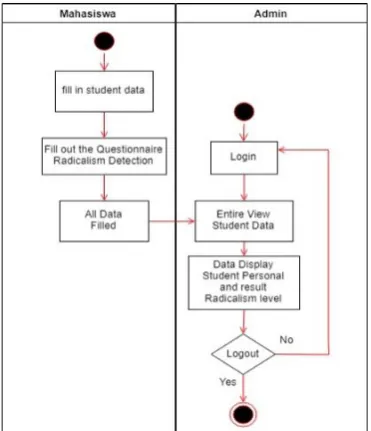
Before the application development stage, the system design done by making use case diagrams and activity diagrams. Use case diagrams are used to determine the workflow of users who use the system, while the activity diagram is used to determine the processes that exist on the system based on the user. The use case diagram used in this study shown in Fig 1.
Fig 1. Use Case Diagram of Radicalism Detection Application
The use case diagram in Figure 1 shows that there are two actors, namely user and admin, in using the application. Users fill in biodata without having to log in and can fill out questions raised by the system. While the admin required for login to see results obtained from the processing of answers made by the user.
The activity diagram in Figure 2 shows there is a process from each user. The method of students starts from filling out biodata and filling in all the questions that have done. The admin process starts from logging in, looking at student data, and seeing the results of the fuzzy process.
D. Fuzzy Takagi Sugeno
Fuzzy logic has been widely using in recent years in problems involving reason estimates[5]. Fuzzy logic is an appropriate way to map an input space into an output space. An example of mapping shown in Fig 3.
Fig 3. Example of Input-Output Mapping Figure 3 is an example of input and output mapping from:
1. The warehousing manager tells the production manager how much inventory is at the end of this week. Then the production manager will determine the number of goods that must produce tomorrow.
2. Restaurant waiters provide services to guests. Then guests will provide appropriate tips on whether or not the services provided.
3. You tell me how cool the room you want, I will adjust the fan rotation in this room[6]
One of the popular fuzzy methods at this time is the fuzzy Takagi Sugeno method. This method relies on continuous-time measurement [7], [8].
III.LITERATURE SURVEY
Determining the parameters is done by studying literature and conducting interviews with several experts. The research used from a book with author Yusuf Qordowi entitled Ash Shahwah Al Islamiyah bainal Juhud wa At Tatharruf (1406 H) which mentions The characteristics of radical religious groups, among others: claiming a single truth, prioritizing worship in appearance and jihadists, using methods the way of violence, easy to forgive others, closed to society, and apolitical. Interviews with several experts also defined the nature of radicalism as an attitude that craved total and revolutionary change by overturning existing values drastically through violence and extreme actions.
Based on the explanation above, the researcher defines the parameters used in determining radicalism. There are four main parameters based on literature and interview results, namely:
1) Tolerance
2) Understanding Religious
3) Social, Economical, Political
4) Understanding Culture
A. Fuzzy Sugeno Implementation
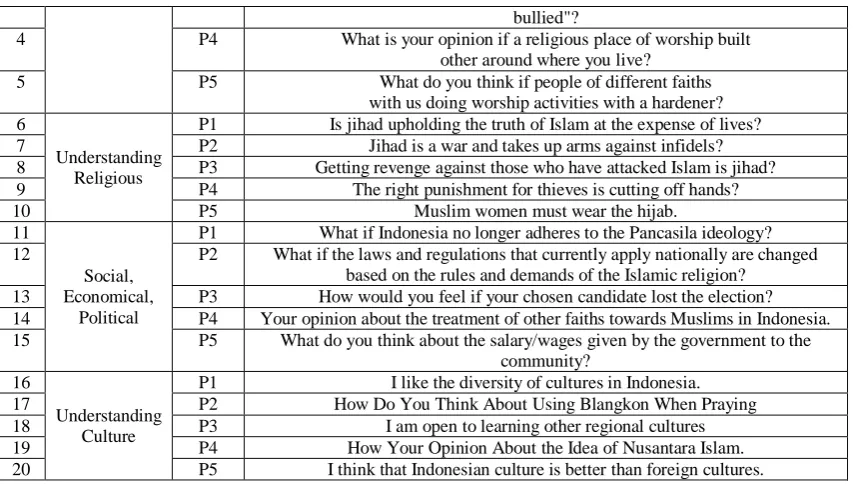
At this stage, it determined alternative outcomes after being asked questions about radicalism. Details of the alternative results represented as Radical, Moderate, and Permissive. Then there are 5 questions from each parameter represented by the initials P = {{P1, P2, P3, P4, P5}, {P1, P2, P3, P4, P5}, {P1, P2, P3, P4, P5}, {P1, P2, P3, P4, P5}}. Data for question explanation shown in Table 1.
TABLE I
List of Questions for Each Parameter.
No. Parameter Initials Question
1
Tolerance
P1 What do you think about "people who respect other people of different ethnic
groups and different religions"?
2 P2 What do you think about "helping different people
trust when he needs help "?
bullied"?
4 P4 What is your opinion if a religious place of worship built
other around where you live?
5 P5 What do you think if people of different faiths
with us doing worship activities with a hardener? 6
Understanding Religious
P1 Is jihad upholding the truth of Islam at the expense of lives?
7 P2 Jihad is a war and takes up arms against infidels?
8 P3 Getting revenge against those who have attacked Islam is jihad?
9 P4 The right punishment for thieves is cutting off hands?
10 P5 Muslim women must wear the hijab.
11
Social, Economical,
Political
P1 What if Indonesia no longer adheres to the Pancasila ideology?
12 P2 What if the laws and regulations that currently apply nationally are changed
based on the rules and demands of the Islamic religion?
13 P3 How would you feel if your chosen candidate lost the election?
14 P4 Your opinion about the treatment of other faiths towards Muslims in Indonesia.
15 P5 What do you think about the salary/wages given by the government to the
community? 16
Understanding Culture
P1 I like the diversity of cultures in Indonesia.
17 P2 How Do You Think About Using Blangkon When Praying
18 P3 I am open to learning other regional cultures
19 P4 How Your Opinion About the Idea of Nusantara Islam.
20 P5 I think that Indonesian culture is better than foreign cultures.
Each sub-parameter has a weighting rating. For the parameters of tolerance and religious understanding, have four values which represented as Bad, Medium, Good, Very Good, while for social, economic, political, and cultural values parameters have three benefits that described as bad, moderate, and good.
TABLE II
Membership Functions of Tolerance Parameters and Religious Understanding
No Nama Nilai 1 Nilai
2
Nilai 3 Nilai 4
1 Buruk 0 0 1 2
2 Sedang 1 2 2 3
3 Baik 2 3 3 3.5
4 Sangat Baik 3 3.5 4.1 4.1
TABLE III
Membership Function Social, Economic, Political and Cultural Understanding
No Nama Nilai 1 Nilai 2 Nilai 3 Nilai 4
1 Buruk 0 0 1 2
2 Sedang 1 2 2 3
3 Baik 2 3 4.1 4.1
The membership function of each parameter is represented using the fuzzy triangle numbers shown in Table 2 and Table 3.
TABLE IV
Fuzzy Inference Tolerance Parameters with Religious Understanding
Toleransi/Paham Keagamaan
Buruk Sedang Baik Sangat
Baik
Buruk X1/A X2/A X3/B X4/B
Sedang J1/A J2/B J3/C J4/C
Baik H1/A H2/B H3/C H4/C
Sangat Baik K1/A K2/B K3/C K4/C
TABLE V
Fuzzy Inference Social, Economic, Political Parameters with Cultural Understanding
Sosial, Ekonomi, Politik/Paham Kebudayaan
Buruk Sedang Baik
Buruk X1/A X2/B X3/B
Sedang J1/A J2/B J3/C
Baik H1/B H2/C H3/C
The calculation of the formula of fuzzy inference on tolerance parameters and religious understanding is shown in Table 4 as follows:
B: ((X2 + X3 + J2 + H2 + K2) * P) + Q C: ((J3 + J4 + H3 + H4 + K3 + K4) * P) + Q
Where P is a constant for the coefficients X, J, H, and K, and Q is a constant for linear equations. The P-value in formula A is 1.5, formula B is 2.5, formula C is 3.5, and for Q value is 0. While the formula calculation of the fuzzy inference parameters on social, economic, political, and cultural values is shown in Table 5 as follows:
A: ((X1 + J1) * P) + Q
B: ((X2 + X3 + J2 + H1) * P) + Q C: ((J3 + H2 + H3) * P) + Q
Where P is a constant for the coefficients of X and J, and Q is a constant for linear equations. The P-value in formula A is 1, formula B is 2, formula C is 3, and the value of Q is 0.
TABLE VI Rule Base
Nilai Hasil
3,39 ≤ x ≤ 4,06 Radikal
4,07 ≤ x ≤ 4,561 Moderat
4,562 ≤ x ≤ 5,53 Permisif
The value obtained after going through the fuzzy inference process can represent as in Table 6.
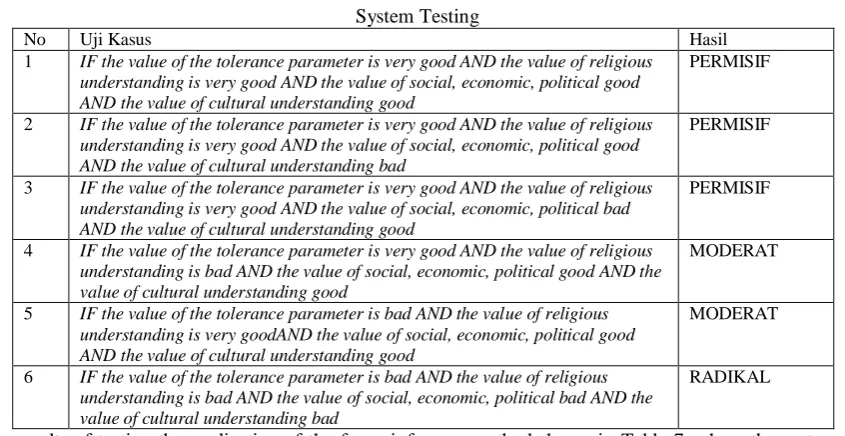
TABLE VII System Testing
No Uji Kasus Hasil
1 IF the value of the tolerance parameter is very good AND the value of religious understanding is very good AND the value of social, economic, political good AND the value of cultural understanding good
PERMISIF
2 IF the value of the tolerance parameter is very good AND the value of religious understanding is very good AND the value of social, economic, political good AND the value of cultural understanding bad
PERMISIF
3 IF the value of the tolerance parameter is very good AND the value of religious understanding is very good AND the value of social, economic, political bad AND the value of cultural understanding good
PERMISIF
4 IF the value of the tolerance parameter is very good AND the value of religious understanding is bad AND the value of social, economic, political good AND the value of cultural understanding good
MODERAT
5 IF the value of the tolerance parameter is bad AND the value of religious understanding is very goodAND the value of social, economic, political good AND the value of cultural understanding good
MODERAT
6 IF the value of the tolerance parameter is bad AND the value of religious understanding is bad AND the value of social, economic, political bad AND the value of cultural understanding bad
RADIKAL
The results of testing the application of the fuzzy inference method shown in Table 7, where the system is following manual calculations. The results of these calculations represented in Table 6.
IV.CONCLUSIONS
Based on the results of the analysis and discussion, it can concluded that the system created can diagnose radicalism accurately. This result is evidenced by comparing the effects of system testing with manual calculations.
R
EFERENCES
[1] E. Kristinawati, “SISTEM INFORMASI KEPEGAWAIAN BERBASIS WEB SEBAGAI PENDUKUNG KEPUTUSAN PIMPINAN DI STEKOM SEMARANG Eunike Kristinawati,” pp. 1–13, 2013.
[2] H. A. S. Al Rekhawi and S. S. A. Naser, “Rickets Expert System Diagnoses and Treatment,” Int. J. Eng. Inf. Syst., vol. 1, no. 4, pp. 149–159, 2017.
[3] S. S. A. Naser and R. M. AlDahdooh, “Lower Back Pain Expert System Diagnosis,” J. Multidiscip. Eng. Sci. Stud., vol. 2, no. 4, pp. 441–446, 2016.
[5] S. Samanta, M. Pal, and A. Pal, “Some more results on bipolar fuzzy sets and bipolar fuzzy intersection graphs,” J. fuzzy Math., vol. 22, no. 2, pp. 253–262, 2014.
[6] S. Kusumadewi, Artificial Intelligence (Teknik dan Aplikasinya). 2003.
[7] Y. Wang, Y. Xia, C. K. Ahn, and Y. Zhu, “Exponential stabilization of takagi-sugeno fuzzy systems with aperiodic sampling: An aperiodic adaptive event-triggered method,” IEEE Trans. Syst. Man, Cybern. Syst., vol. 49, no. 2, pp. 444–454, 2019.