Mutual Tenure Headed For the Cloud
Thokala Babu& N.Siddaiah1M.Tech Student, Dept. of CSE, Shree Rama Educational Society Group of Institutions, Tirupati, A.P.
2Assistant professor, Dept. of CSE, Shree Rama Educational Society Group of Institutions, Tirupati, A.P.
ABSTRACT
In this paper, we first formally characterize
a thought of shared possession inside a
document get to control display. We at that
point propose two conceivable instantiations
of our proposed shared possession display.
Our first arrangement, called Commune,
depends on secure document dispersal and
plot safe mystery sharing to guarantee that
all entrance allows in the cloud require the
help of a concurred limit of proprietors. As
such, Commune can be utilized in existing
mists without adjustments to the stages. Our
second arrangement, named Comrade,
influences the block chain innovation so as
to achieve agreement on access control
choice. In contrast to Commune, Comrade
necessitates that the cloud can interpret get
to control choices that achieve agreement in
the block chain into capacity get to control
rules, in this way requiring minor
alterations to existing mists. We examine the
security of our proposition and look
at/assess their execution through usage
utilizing Amazon S3.
Index Terms:Cloud Sanctuary, Communal
Possession, Circulated Prosecution,
Blockchain Innovation.
I.INTRODUCTION
Despite the fact that the cloud guarantees an
advantageous route for clients to share
documents and easily take part in joint
efforts, regardless it holds the idea of
individual record possession. That is, each
solitary client, who can singularly choose
regardless of whether to allow or deny any
entrance demand to that document.
However,the singular possession isn't
reasonable for various cloud-based
applications and joint efforts. Consider a
situation where various research associations
and mechanical accomplices need to set up a
common cloud archive to work together on a
joint research project. If all members
contribute their exploration endeavors to the
task, at that point they might need to share
the responsibility for coordinated effort
documents with the goal that all entrance
choices are settled upon among the
proprietors. There are two primary
contentions why this might be liked to
singular proprietorship. Initial, a sole
proprietor can manhandle his rights by
singularly settling on access control choices.
The people group includes various tales
where clients disavow access to shared
records from different teammates. Second,
regardless of whether proprietors are happy
to choose and believe one of them to settle
on access control choices, the chosen
proprietor might not have any desire to be
considered responsible for gathering and
accurately assessing other proprietors'
arrangements. For instance, inaccurate
assessments may bring about negative
notoriety or money related punishments.
II.PROPOSED SYSTEM
we address the issue of conveyed
implementation of shared proprietorship
inside distributed storage suppliers. By
appropriated implementation, we mean
requirement where access to records in a
common store is allowed if and just if t out
of n proprietors independently bolster the
give choice. In this manner, we present the
Shared-Ownership record get to control
shared possession, and to formally express
the given implementation issue. We at that
point propose two instantiations of the SOM
model to implement shared proprietorship
approaches in a circulated fashion. More
specifically, we give extra formal insights
concerning the SOM demonstrate. We
likewise propose another instantiation of the
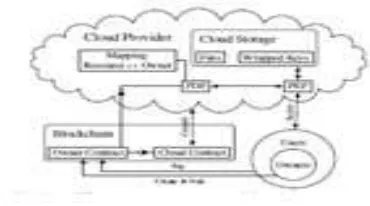
SOM demonstrate, Comrade that uses
usefulness from the blockchain so as to
achieve agreement on access control
choices. Not at all like the Commune
structure proposed, Comrade requires
participation from the cloud supplier that is
relied upon to interpret get to control
choices that achieved accord in the
blockchain into capacity get to control rules.
Friend, nonetheless, shows impressively
preferable execution over Commune. We
send a keen contract instantiating Comrade
inside the Ethereum blockchain, interface it
to Amazon distributed storage, and contrast
its execution with the one of Commune as
for the document estimate and the quantity
of clients. We formalize the idea of shared
proprietorship inside a record get to control
demonstrate named SOM, and use it to
characterize a novel access control issue of
appropriated requirement of shared
possession in existing clouds. We propose a
first arrangement, called Commune, which
distributive upholds SOM and can be
conveyed in a rationalist cloud stage.
Cooperative guarantees that (I) a client can't
peruse a document from a common archive
except if that client is conceded perused
access by in any event t of the proprietors,
and (ii) a client can't compose a record to a
mutual store except if that client is allowed
compose access by at any rate t of the
owners. We propose a second arrangement,
named Comrade, which use usefulness from
the blockchain innovation so as to achieve
Companion improves the execution of
Commune, however necessitates that the
cloud can interpret get to control choices
that achieved accord in the blockchain into
capacity get to control rules, thus requiring
minor changes of existing clouds. We
assemble models of Commune and Comrade
and assess their execution inside Amazon S3
regarding the record estimate and the
quantity of clients.
Fig 1.Overview of Comrade. Access control
decisions depend on the evaluation of a
smart contract executed within the
blockchain
III.PERFORMANCE COMPARISION
we characterize the idea of shared
possession, and formally instantiate it in a
record get to control demonstrate named
SOM.Our principle inspiration for building
this model is three-overlay: (I) to decisively
characterize the perfect arrangement of
highlights that we trust a model, which
implements shared proprietorship, ought to
give; (ii) to plan the issue of conveyed
requirement all the more correctly by
concentrating on SOM's formal depiction;
and (iii) to give a point of reference to
investigate SOM's authorization
arrangements, including our own.
A. The Notion of Shared Ownership.
In a record framework, we see the thought
of shared possession as pursues. Each
document can have at least one proprietor,
and they cooperatively make an entrance
decision. To make this idea progressively
couple (O;R), where R is a tuple
(Subject;File;Action), and O is one of File's
proprietors. Naturally, a proprietor
qualification speaks to a (one-sided) choice
by a proprietor O to concede a demand
R.We then characterize a T-out-of-N
document get to control arrangement,
additionally called a limit approach, as
pursues.
Definition 1 (Threshold Policy). A
T-out-of-N (edge) get to control approach for a
document File is a tuple (T;Owners;File)
where T is a number speaking to a limit,
Owners are the File's proprietors. We
characterize a requirement work g : Reqs
TPolicies P(Creds) 7! fgrant; denyg, where
Reqs is a lot of requests, TPolicies is a lot of
edge approaches, and Creds is a lot of every
single imaginable qualification.
B. SOM’s Overview.
We present a document get to control show
that embraces this idea with regards to a
record get to control model. It additionally
further characterizes how proprietorship can
be designated and revoked, and how
documents' edges can be changed. Our
display, named SOM, accepts documents as
the main secured resources. We don't
concentrate on indexes (or other document
groupings).Each record is made by one
client.
IV.CONCLUSION
We presented a novel idea of shared
proprietorship and we portrayed it through a
formal access control display, called
SOM.We then propose two conceivable
instantiations of our proposed shared
possession show. Our first arrangement,
called Commune,relies on secure record
dispersal and plot safe mystery sharing to
cloud require the help of a concurred edge of
proprietors. All things considered,
Commune can be utilized in existing
freethinker mists without adjustments to the
platforms.Our second arrangement, named
Comrade, influences the blockchain
innovation so as to achieve accord on access
control decision.Unlike Commune, Comrade
necessitates that the cloud can decipher get
to control choices that accomplished
agreement in the blockchain into capacity
get to control rules. Friend, however,shows
preferred execution over Commune.
REFERENCES
[1] N. Li, B. N. Grosof, and J.
Feigenbaum, “Delegation logic: A
Logic-based Approach to Distributed
Authorization,” in TISSEC, 2003.
[2] Y. Gurevich and I. Neeman,
“DKAL: Distributed-Knowledge
Authorization Language,” in CSF ’08.
[3] M. O. Rabin, “Efficient Dispersal of
Information for Security, Load
Balancing,and Fault Tolerance,” in Journal
of the Association for Computing
Machinery.
[4] Satoshi Nakamoto, “Bitcoin: A
Peer-to-Peer Electronic Cash System.”
[5] F. Zhang, E. Cecchetti, K. Croman, A. Juels, and E. Shi, “Town Crier: An
Authenticated Data Feed for Smart
Contracts,” ser. CCS ’16, 2016.