Journal of Pain Research
Dove
press
P e R s P e c t i v e s
open access to scientific and medical research
Open Access Full text Article
A comparison between acute pressure block of
the sciatic nerve and acupressure: methodology,
analgesia, and mechanism involved
Danping Luo1,2
Xiaolin Wang1
Jiman He1,3
1Pain Medicine Program, Nanfang
Hospital, southern Medical University, Guangzhou, People’s Republic of china; 2the First Affiliated Hospital
of Guangdong college of Pharmacy, Guangzhou, People’s Republic of china; 3Department of Medicine,
Brown University, Providence, Ri, UsA
correspondence: Jiman He
Pain Medicine Program, Nanfang Hospital, southern Medical University, People’s Republic of china
tel +86 20 62786221 Fax +86 20 87280770 email [email protected]
Abstract: Acupressure is an alternative medicine methodology that originated in ancient China. Treatment effects are achieved by stimulating acupuncture points using acute pressure. Acute pressure block of the sciatic nerve is a newly reported analgesic method based on a current neuroscience concept: stimulation of the peripheral nerves increases the pain threshold. Both methods use pressure as an intervention method. Herein, we compare the methodology and mechanism of these two methods, which exhibit several similarities and differences. Acupressure entails variation in the duration of manipulation, and the analgesic effect achieved can be short- or long-term. The acute effect attained with acupressure presents a scope that is very different from that of the chronic effect attained after long-term treatment. This acute effect appears to have some similarities to that achieved with acute pressure block of the sciatic nerve, both in methodology and mechanism. More evidence is needed to determine whether there is a relation-ship between the two methods.
Keywords: acupressure, acute pressure block, sciatic nerve, pain
Background
Acupressure is an alternative medicine methodology that originated in ancient China and is a popular therapy worldwide. Acupressure involves application of acute pres-sure on the acupuncture points to achieve treatment effects that are similar to those
of the acupuncture method.1–3 According to traditional Chinese medicine (TCM),
stimulating these points can correct imbalance in the flow of qi through channels known
as meridians, rebalancing yin and yang and subsequently treating diseases.4 Instead of
using a thin needle to stimulate the specific points, acupressure uses the fingers, elbow, fist, etc to stimulate the acupuncture points. Acupressure displays therapeutic effects for several types of diseases. There are several types of pressure points; pressure to
each is applied differently, and each creates a different effect accordingly.5
Acute pressure block of the sciatic nerve is a newly reported analgesic method,6–10
based on a current neuroscience concept: stimulation of the peripheral nerves increases the pain threshold. The method works well to alleviate various types of clinical pain
but not experimental cold pressor pain or intense pain.6,7,9 Some physicians, patients,
and scientists have interpreted this method as another approach for delivering the previ-ously described analgesic method, acupressure. Herein, we compare the methodology and mechanism of these two methods. An understanding of these aspects is important for their application in clinical practice and improvement of their efficacy.
The theoretical target objects of the two methods are different. Acupressure uses
pressure to stimulate specific acupuncture points for therapeutic purposes.4 In contrast,
Journal of Pain Research downloaded from https://www.dovepress.com/ by 118.70.13.36 on 24-Aug-2020
For personal use only.
Number of times this article has been viewed
This article was published in the following Dove Press journal: Journal of Pain Research
Dovepress Luo et al
Yao Yang Guan
Ci Liao Pang Guang Yu Xiao Chang Yu
Cheng Fu
Yin Men
Fu Xi Guan Yuan Yu
Da Chang Yu
Hui Yang
Sciatic nerve
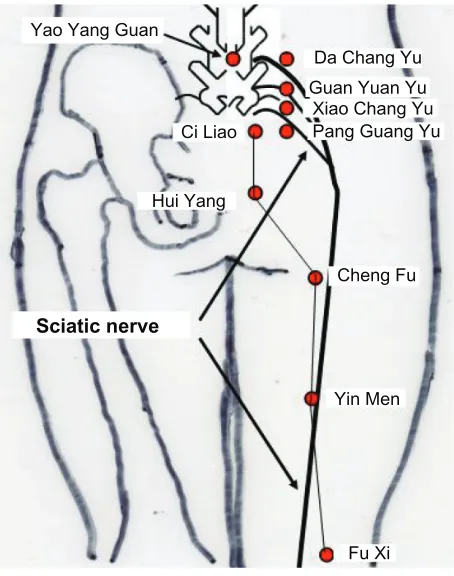
Figure 1 thesciatic nerve and some acupuncture points.
acute pressure block of the sciatic nerve method uses pressure to stimulate the sciatic nerve.6–9 The stimulation site is an area
rather than a point, and stimulation of a larger area provides better pain relief. Many acupuncture points are located over nerves (Figure 1). Thus, pressure over a larger area may cause stimulation of several points. Future studies are required to examine the rationale behind them.
These methods entail different degrees of pressure application. The optimal method for applying acupressure focuses on a point, using, for example, the thumbs, fingers, elbows, or suitable devices; however, the optimal method for acute pressure block of the sciatic nerve is to apply pressure to a larger area, using, for example, the palms of the hands, the flat surfaces of the fists, or suitable devices.
The amount of pressure required is usually approximately
10 kg to 20 kg per hand area for a man of average size.6–9
Therefore, although the thumbs, fingers, or elbows are ideal for stimulating the acupuncture points in the acupressure method, they are not ideal for acute pressure block of the sciatic nerve, because the area required for this method is much larger. These reasons may indicate that the mechanisms involved in the two methods are different.
Theoretically, each acupuncture point usually is effective for one or a few types of diseases,5 whereas acute
pres-sure block of the sciatic nerve has been shown to work for
more general areas of the body. In TCM, a disease is generally perceived as disharmony (or an imbalance) in the functions or interactions of the meridians, such as yin, yang, xue, and
zang-fu.11 Therefore, the appropriate therapy is recommended
on the basis of which “pattern of disharmony” can be iden-tified.12,13 There are 360 acupuncture points,14 each with its
own therapeutic significance. The selection of which point to target is a key step in acupressure practice, and selection of the correct acupuncture point is essential to achieve good
treatment outcomes.5 Various principles are proposed for
selecting these points.15 For example, a common method for
choosing acupuncture points is to select nearby points, which means points are selected in a local area that is adjacent to the disease-affected area.
Although the only target of acute pressure block of the sciatic nerve method is the sciatic nerve, this treatment pro-vides relief from various pains in different areas of the body. According to reports, the acute pressure block method is most effective for dental pain, which originates far from the sciatic
nerve, compared with pain resulting from other diseases.6,8
This observation shows that the working mechanisms may be different for the two methods.
Acupuncture is usually considered to not have a physi-cally verifiable anatomic or histological basis, whereas the acute pressure block method has an associated anatomic structure, the sciatic nerve. Acupuncture points are located along meridians that connect acupuncture points across the anatomy and affect a specific organ or other part of the body. TCM recognizes 360 points and twelve “regular” and eight
“extraordinary” meridians.16 In addition, a number of less
customary channels branching off from the regular
merid-ians have been recognized.17 A 1997 National Institutes of
Health consensus4 stated that “Despite considerable efforts to
understand the anatomy and physiology of the ‘acupuncture points,’ the definition and characterization of these points remains controversial”. Scientific research has not found any histological or physiological correlates for qi, meridians, or
acupuncture points.18–20 However, the method of acute
pres-sure block of the sciatic nerve has an associated anatomic structure, the sciatic nerve. The sciatic nerve is large and the longest single nerve in humans.
The mechanisms underlying the analgesic effect of the acupressure and the acute pressure block of the sciatic nerve methods may be different. Traditional Chinese acupuncture is a philosophy that focuses more on prevention than treatment of illnesses. In the general theory of TCM, bodily functions are regulated by an energy called qi, which flows through the body. Acupuncture points are mainly located at specific
Journal of Pain Research downloaded from https://www.dovepress.com/ by 118.70.13.36 on 24-Aug-2020
Dovepress Acupressure and acute pressure block
locations along the meridians. The meridians are believed to connect the various parts of the entire body and to associate with the yin, yang, and qi. Yin and yang are opposite motions that are interdependent of each other. Disruptions to the flow
of qi along the meridians will cause diseases,4,21 and
stimu-lating these points can regulate the meridian system, restore the balance of qi, yin, and yang, and subsequently help the
body to recover from diseases.4,21
Current scientific studies on the mechanism of action of these acupuncture points have suggested that the insertion of needles involves recruitment of the body’s own pain reduc-tion system, possibly accompanied by an increased release
of endorphins, serotonin, norepinephrine, or γ-Aminobutyric
acid.4,22 However, endogenous opioids and other molecular
secretions need time to reach their effective level. Although acupressure on some points can generate a faster analgesic effect (within a few minutes),23–25 the mechanism for this
faster analgesic effect remains unknown.
The mechanism for acute pressure block of the sci-atic nerve is based in general on current progress in neurobiology: Stimulation of peripheral nerves increases
the pain threshold.26–28 Chemical,29 mechanical,3 or
electrical31 block of the sciatic nerve has reportedly
gen-erated analgesic effects. According to the gate control theory of pain,31 stimulation of large-diameter afferent
fibers inhibits second-order neurons in the dorsal horn and prevents the further transmission of impulses carried by small-diameter fibers; the resulting analgesic effect is considered rapid and short-lived and is thought to involve
spinal dorsal horn wide dynamic range neurons.31–33
Wide dynamic range neurons are the first synaptic relay point for afferent pathways and play an important role in
modifying the transmission of noxious input.34,35 A recent
study showed that acute pressure on the rat sciatic nerve caused immediate inhibition of wide dynamic range
neu-ron responses.10 Thus, the gate control theory of pain may
explain the immediate analgesic effect of the acute pressure block of the sciatic nerve method.
Sensory transduction in nerves is accomplished by ion channel proteins, which are gated pores that allow the exchange of ions across the cell membrane. Acid-sensitive ion channel proteins, which were shown to be expressed in the neurons of the mammalian central and peripheral ner-vous systems, are proposed to constitute mechanoreceptors and to play an important role in responses to mechanical stimuli.36–39 To date, four acid-sensitive ion channel proteins
have been found to be expressed in the sciatic nerve.40 Thus,
the molecular mechanism of pain inhibition by acute pressure
block of the sciatic nerve may involve pressure activation of acid-sensitive ion channel proteins.
The time required to generate the analgesic effect differs between the two methods. The time required to achieve a treatment effect by activation of the acupuncture points varies greatly depending on the nature of the disease being treated. A common course of treatment may initially involve dozens of treatments spaced at approximately weekly intervals that are
later extended to monthly intervals.41–42 Acupressure
stimula-tion of some acupuncture points can also exert acute effects that last several minutes to several hours after a single
treat-ment.43 For example, acupressure on the acupuncture point
yao yang guan can provide relief of acute sciatica pain13 and
requires long-term treatment for an effect.44,45 However, the
time required for acute pressure block of the sciatic nerve
to generate an analgesic effect is only a few minutes.6–10 The
marked difference in the time required to generate treatment effects may be attributable to differences in the mechanisms between the two methods.
More evidence is needed to clarify the effectiveness of the two methods in other diseases. According to TCM, energy (qi) flow through the body is essential for health, and disruptions of this flow are believed to be responsible for various diseases. Stimulating acupuncture points removes blocks in qi and helps it flow back into balance. Acupressure is considered a potentially useful strategy for the manage-ment of multiple symptoms. Therapeutic effects on various diseases have been studied, including different pain patholo-gies, nausea, osteoarthritis, vomiting, rheumatoid arthritis, allergic rhinitis, and insomnia. The results of these studies are controversial. Although consistent data on the positive effects of acupressure therapy have been reported for some
conditions, such as low back pain, nausea, and vomiting,46–47
the evidence for its positive effects on other pathological conditions is not conclusive.
A report from the American Academy of Pain Medicine’s
24th Annual Meeting48 shows that acupressure can work on
non-painful discomfort, such as fullness, bloating, nausea, and vomiting; the method has a smaller effect on non-painful
discomfort than it does on pain.48 However, more studies are
needed to confirm these results.
Is there a relationship between
acupressure and acute pressure
block of sciatic nerve method?
Both methods involve application of acute pressure to achieve treatment effects. Both methods alleviate pain and discomfort from a number of diseases. Are these observations
attribut-Journal of Pain Research downloaded from https://www.dovepress.com/ by 118.70.13.36 on 24-Aug-2020
Dovepress Luo et al
able to mere coincidence, or does a relationship exist between the two methods?
Yao yang guan (or waist yang guan), is beneficial for acute sciatica pain and low back pain. This acupuncture point is located below the spinous process of the fourth lumbar vertebra, where branches of the sciatic nerve extend from the spinal cord (Figure 1). As seen in a few studies, effective pressure on any accessible area along the sciatic nerve will provide rapid pain relief, but the effectiveness is reduced if the pressure is applied distant from the sciatic nerve.6,7,9 Is the relief from sciatica pain attributable to
stimulation of the acupuncture point or to stimulation of the sciatic nerve?
Acupuncture points shown on the TCM map49–51 are found
in areas close to the nerve. Figure 1 displays the sciatic nerve through the low back and leg, as well as the distribution of some acupuncture points on the lower back and leg. Of note, the locations of the sciatic nerve path and the acupuncture points are close to each other. This raises the question of whether acupressure exerts its treatment effect via stimulation of adjacent nerves. Studies have shown that direct stimulation of peripheral nerve sensory fibers increases the pain threshold in a manner similar to that caused by the standard
acupunc-ture technique.52,53 Although current scientific research may
explain some aspects of TCM, it is far from understanding of the old theory, which was passed down from generation to generation.
Conclusion
The present report compares the major similarities and differences between acupressure and acute pressure block of the sciatic nerve. Treatment effects for acupressure are achieved with great variation in duration. Accordingly, the underlying mechanism appears to vary greatly. The acute effect attained with acupressure presents a scope that is very different from that of the chronic effect attained after long-term treatment. This effect appears to have more similarities to that achieved with acute pressure block of the sciatic nerve, both in methodology and mechanism. Many aspects of the two methods are unknown, and more evidence is therefore required to determine whether a relationship exists between the two. Further studies aimed at clarifying this relationship are important for improvements in the efficacy of these two methods.
Acknowledgments
No external funding was obtained for this project. This work was solely supported by department sources.
Author contributions
Jiman He conceived the study, wrote the manuscript, and had final approval of the version to be published. Danping Luo and Xiaolin Wang wrote the manuscript, revised the content, and had final approval of the version to be published.
Disclosure
The authors report no conflicts of interest in this work.
References
1. Nepp J, Wedrich A. Conjuctivitis sicca: a comparison of traditional Chinese and Western medical symptoms. Acupunct Med. 1994;12(2): 88–92.
2. Bertrand SW. Inroads to integrative health care: registered nurses’ personal use of traditional Chinese medicine affects professional iden-tity and nursing practice. J Evid Based Complementary Altern Med. 2010;15(1):14–30.
3. Dundee JW. Studies with acupuncture/acupressure as an antiemetic.
Acupunct Med. 1988;5:22–24.
4. Acupuncture. National Institute of Health Consensus Development Conference Statement. November 3–5, 1997;15(5):1–34. Available at http://consensus.nih.gov/1997/1997acupuncture107html.htm. Accessed July 3, 2013.
5. Li Z. The point, Yao Yang Guan, prevents acute sciatica pain. In: Small
Acupuncture Points, Big Health. Chinese Science Culture Publishing
House; 2009.
6. He J, Jiang X, Zhao B, et al. Acute pressure block of the sciatic nerve relieves clinical pain but not cold pressor pain. Clin J Pain. 2010;26(4): 332–338.
7. He J, Wu B, Jiang X, Zhang F, Zhao T, Zhang W. A new analgesic method, two-minute sciatic nerve press, for immediate pain relief: a randomized trial. BMC Anesthesiol. 2008;8:1.
8. He J, Chen Q. General responses to questions regarding acute sciatic nerve pressure for pain relief. Pain Med. 2010;11(7):1139–1140. 9. He J, Wu B, Zhang W, Ten G. Immediate and short-term pain relief
by acute sciatic nerve press: a randomized controlled trial. BMC
Anesthesiol. 2007;7:4.
10. Wang W, Tan W, Luo D, et al. Acute pressure on the sciatic nerve results in immediate inhibition of the wide dynamic range neuronal response.
BMC Neurosci. 2012;13:147.
11. Wiseman N, translator-editor; Ellis A, translator. Fundamentals of
Chinese Medicine. Taos, NM: Paradigm Publications; Saint Paul, MN,
USA. 1996.
12. Ergil MC, Ergil KV. Pocket Atlas of Chinese Medicine. Stuttgart: Thieme; 2009.
13. Flaws B, Finney D. A Handbook of TCM Patterns and Their Treatments, 6th ed. Boulder, CO: Blue Poppy Press; Boulder, CO, USA. 2007. 14. Lu G-D, Needham J. Celestial Lancets: A History and Rationale of
Acupuncture and Moxa. New York: Routledge; 2002.
15. McDonald J. Missing the point: a discussion of strategies for acupunc-ture of point selection. Pacific J Oriental Med. 1999;15:26–38. 16. Lin Y. Map of Jing luo. Fujian, China: Fujian Science and Technology
Publishing House; Fujian, People’s Republic of China. 1985. 17. Aung SKH, Chen WPD. Clinical Introduction to Medical Acupuncture.
New York: Thieme Medical Publishers; 2007.
18. Bauer M. The final days of traditional beliefs? Part one. Chin Med
Times. 2006;1:31.
19. Ahn AC, Colbert AP, Anderson BD, et al. Electrical properties of acu-puncture points and meridians: a systematic review. Bioelectromagnetics. 2008;29(4):245–256.
20. Mann F. Reinventing Acupuncture: A New Concept of Ancient Medicine. London: Butterworth Heinemann; 1996.
Journal of Pain Research downloaded from https://www.dovepress.com/ by 118.70.13.36 on 24-Aug-2020
Journal of Pain Research
Publish your work in this journal
Submit your manuscript here: http://www.dovepress.com/journal-of-pain-research-journal
The Journal of Pain Research is an international, peer-reviewed, open access, online journal that welcomes laboratory and clinical findings in the fields of pain research and the prevention and management of pain. Original research, reviews, symposium reports, hypoth-esis formation and commentaries are all considered for publication.
The manuscript management system is completely online and includes a very quick and fair peer-review system, which is all easy to use. Visit http://www.dovepress.com/testimonials.php to read real quotes from published authors.
Dovepress
Dove
press
Acupressure and acute pressure block
21. Singh S, Ernst E. The truth about acupuncture. In: Trick or Treatment:
The Undeniable Facts About Alternative Medicine. New York: Norton
and Co; 2008:39–90.
22. Sun Y, Gan TJ, Dubose JW, Habib AS. Acupuncture and related techniques for postoperative pain: a systematic review of randomized controlled trials. Br J Anaesth. 2008;101(2):151–160.
23. Kober A, Scheck T, Greher M, et al. Prehospital analgesia with acupressure in victims of minor trauma: a prospective, randomized, double-blinded trial. Anesth Analg. 2002;95(3):723–727.
24. Hsieh LL, Kuo CH, Yen MF, Chen THH. A randomized controlled clini-cal trial for low back pain treated by acupressure and physiclini-cal therapy.
Prev Med. 2004;39(1):168–176.
25. Hsieh LL, Kuo CH, Lee LH, Yen AM, Chien KL, Chen TH. Treatment of low back pain by acupressure and physical therapy: randomised controlled trial. BMJ. 2006;332(7543):696–700.
26. Chung JM, Lee KH, Hori Y, Endo K, Willis WD. Factors influencing peripheral nerve stimulation produced inhibition of primate spinotha-lamic tract cells. Pain. 1984;19(3):277–293.
27. Hanai F. Effect of electrical stimulation of peripheral nerves on neuro-pathic pain. Spine (Phila Pa 1976). 2000;25(15):1886–1892. 28. Jørum E. The analgesic effect of peripheral nerve stimulation in various tests
of nociception in rats. Acta Physiol Scand.1988;133(2):131–138. 29. Sotgiu ML, Biella G, Riva L. A study of early ongoing activity in
dorsal horn units following sciatic nerve constriction. Neuroreport. 1994;5(18):2609–2612.
30. Yao T, Andersson S, Thoren P. Long-lasting cardiovascular depressor response following sciatic stimulation in spontaneously hypertensive rats: evidence for the involvement of central endorphin and serotonin systems. Brain Res. 1982;244(2):295–303.
31. Melzack R, Wall PD. Pain mechanisms: a new theory. Science. 1965;150(3699):971–979.
32. Wall PD. Dorsal horn electrophysiology. In: Handbook of Sensory
Physiology: Somatosensory System. Iggo A, editor. Berlin:
Springer-Verlag; 1973;2:253–270.
33. Cohen ML, Arroyo JF, Champion GD, Browne CD. In search of the pathogenesis of refractory cervicobrachial pain syndrome: a deconstruction of the RSI phenomenon. Med J Aust. 1992;156(6): 432–436.
34. Coghill RC, Mayer DJ, Price DD. Wide dynamic range but not nociceptive-specific neurons encode multidimensional features of prolonged repetitive heat pain. J Neurophysiol. 1993;69(3):703–716. 35. Schaible HG. Spinal mechanisms contributing to joint pain. Novartis
Found Symp. 2004;260:4–22.
36. Geffeney SL, Goodman MB. How we feel: ion channel partnerships that detect mechanical inputs and give rise to touch and pain perception.
Neuron. 2012;74(4):609–619.
37. Höger U, French AS. Extracellular acid increases the open probability of transduction channels in spider mechanoreceptors. Eur J Neurosci. 2002;16(12):2311–2316.
38. Kang S, Jang JH, Price MP, et al. Simultaneous disruption of mouse ASIC1a, ASIC2 and ASIC3 genes enhances cutaneous mechanosensitivity. PLoS One. 2012;7:e35225.
39. Price MP, Thompson RJ, Eshcol JO, Wemmie JA, Benson CJ. Stomatin modulates gating of acid-sensing ion channels. J Biol Chem. 2004;279(51):53886–53891.
40. Alvarez de la Rosa D, Zhang P, Shao D, White F, Canessa CM. Functional implications of the localization and activity of acid-sensitive channels in rat peripheral nervous system. Proc Natl Acad Sci U S A. 2002;99(4):326–331.
41. Itoh K, Kitakoji H. Effects of acupuncture to treat fibromyalgia: a pre-liminary randomized controlled trial. Chin Med. 2010;5:11.
42. Hsieh LL, Liou HH, Lee LH, Chen TH, Yen AM. Effect of acupressure and trigger points in treating headache: a randomized controlled trial.
Am J Chin Med. 2010;38(1):1–14.
43. Mirbaqher-Ajorpaz N, Adib-Hajbaghery M, Mosaebi F. The effects of acupressure on primary dysmenorrhea: a randomized controlled trial.
Complement Ther Clin Pract. 2011;17(1):33–36.
44. Wollaston DE, Xu X, Tokumaru O, Chen JD, McNearney TA. Patients with systemic sclerosis have unique and persistent alterations in gastric myoelectrical activity with acupressure to Neiguan point PC6.
J Rheumatol. 2005;32(3):494–501.
45. Pirrie W. Acupressure. Br Med J. 1867;2(348):171–177.
46. Griffiths JD, Gyte GM, Paranjothy S, Brown HC, Broughton HK, Thomas J. Interventions for preventing nausea and vomiting in women undergoing regional anaesthesia for caesarean section. Cochrane
Database Syst Rev. 2012;9:CD007579.
47. Allais G, Rolando S, Castagnoli Gabellari I, et al. Acupressure in the control of migraine-associated nausea. Neurol Sci. 2012;33 Suppl 1: S207–S210.
48. He J. Immediate relief of non-painful discomfort with an acute sciatic nerve press. Pain Med. 2008;9:88–141. Available from http://aapm.con-fex.com/aapm/2008am/techprogram/P2949.HTM. Accessed July 17, 2013.
49. Xu G. Applied Acupuncture Points. Shenyang. Science Tech Publishing; 2009.
50. Gang W, Li S, Huang Y, et al. Standard acupuncture appoint WHO. Peo-ple Publishing; Beijing, PeoPeo-ple’s Republic of China. 2010:89–111. 51. Hesketh T, Zhu WX. Health in China: traditional Chinese medicine:
one country, two systems. BMJ. 1997;315(7100):115–117.
52. Lim TW, Loh T, Kranz H, Scott D. Acupuncture: effect on normal subjects. Med J Aust. 1977;1(13):440–442.
53. Chen L, Tang J, White PF, et al. The effect of location of transcutaneous electrical nerve stimulation on postoperative opioid analgesic requirement: acupoint versus nonacupoint stimulation. Anesth Analg. 1998;87(5):1129–1134.
Journal of Pain Research downloaded from https://www.dovepress.com/ by 118.70.13.36 on 24-Aug-2020