Article
1
“I’ve only just heard about it”: Complementary and
2
Alternative Medicine Knowledge and Educational
3
Needs of Clinical Psychologists in Indonesia
4
Andrian Liem
5
School of Psychology, the University of Queensland, Australia; [email protected]
6
Abstract: Background and objectives: The inadequate knowledge of complementary and alternative
7
medicine (CAM) among health professionals may put their clients at risk because clients they then
8
would find information about CAM from unreliable sources. Clinical psychologists (CPs), as health
9
professionals, have also the opportunity to provide psychoeducation on the latest CAM scientific
10
research to their clients. The current study aimed to explore knowledge and educational needs of
11
CAM among CPs in Indonesia because previous studies on exploring CAM knowledge and
12
educational needs of CAM were primarily conducted in Western countries. Materials and Methods:
13
Data were collected through semi-structured face-to-face interviews with 43 CPs in public health
14
centers (PHCs) in Indonesia. Most interviews were conducted at the PHCs where the participants
15
worked, and lasted for 55 minutes on average. The interview recordings were transcribed and were
16
analyzed using deductive thematic analysis. Results:Five main themes emerged within participants’
17
responses regarding CAM knowledge and educational needs. First (CAM understanding),
18
participants’ responses ranged from those with little or no prior knowledge of CAM treatments and
19
uses, to those with much greater familiarity. Second (source of knowledge), participants’ access
20
ranged widely in terms of references, from popular to scientific literature. Third (why is it
21
important?), participants identified CAM essentially as part of Indonesian culture and it was
22
therefore crucial to have this cultural knowledge. Fourth (the challenges and what is needed?), the
23
challenges for improving participants’ knowledge came from personal and institutional levels.
24
Fifth (what and how to learn?), participants advised that only CAM treatments that fit in brief
25
psychotherapy sessions should be introduced in professional training. Conclusions: This qualitative
26
study discovered that CAM was neither well-known nor understood widely. Participants advised
27
that professional associations and health institutions should work together in enhancing
28
knowledge of CAM and incorporating CAM education into psychology education.
29
Keywords: complementary and alternative medicine; integrative medicine; knowledge; training
30
and education; psychology; mental health; qualitative
31
32
33
1. Introduction
34
The WHO defines complementary and alternative medicine (CAM) as “a broad set of health
35
care practices that are not part of that country’s own tradition or conventional medicine and are not
36
fully integrated into the dominant health-care system. They are used interchangeably with
37
traditional medicine in some countries” [1]. Systematic reviews of CAM efficacy and effectiveness on
38
mental disorders treatment have been conducted abundantly. For example, acupuncture,
39
hypnotherapy, and meditation showed good benefit for posttraumatic stress disorder [2]; and herbal
40
medicine, particularly St. John’s wort, was reported to ameliorate mild-to-moderate depressive
41
symptoms [3]. Moreover, the use of CAM treatments, particularly yoga and energy healing, in
42
palliative care significantly improved the quality of life of cancer survivors [4]. In addition,
43
yoga-based interventions are a promising non-pharmacological option for the management of
44
depression and anxiety symptoms amongst expectant mothers [5].
45
Despite a growing body of scientific evidence of CAM treatments for the management of
46
various medical conditions, systematic reviews still show methodological flaws and heterogeneity of
47
data [6, 7]. Furthermore, these reviews constrain their conclusions about the efficacy and safety of
48
CAM treatments. Therefore, it is anticipated that health professionals would report inadequate
49
knowledge about CAM treatments. For example, nurses in Australian hospitals reported that they
50
had very little or no knowledge of CAM [8]; and Indonesian provisional clinical psychologists
51
reported low knowledge of CAM and predominantly relied on their friends (without psychological
52
education background) and colleagues for learn about CAM [9]. In addition, various mental health
53
professionals in the USA (e.g. psychologists and psychiatrists) also reported a general lack of CAM
54
knowledge that hindered their decision in integrating CAM treatments into conventional
55
psychotherapy [10].
56
The inadequate knowledge of CAM among health professionals may put their clients in risky
57
situation because they then would find information about CAM from unreliable sources [11].
58
Moreover, a survey of CAM use in 25 countries found that up to 20% of people with severe mental
59
disorders only rely on CAM [12]. A study among American parents of children with Autism
60
Spectrum Disorder found that the participants did not disclose their use of CAM history with their
61
physicians because they believe that the physician is not-educated about CAM treatments [13].
62
Therefore, one of the recommendations in the White Paper of integrative mental health care is to
63
develop a comprehensive education by integrating CAM into conventional health education
64
curricula and training [14].
65
The CAM education and integration into the health education curriculum have been developed
66
in health sciences since the early 2000s under various names (e.g. integrative medicine, integral
67
medicine, and holistic health) [15-17]. This curriculum development particularly occurred in medical
68
schools in the USA where it was strongly supported by government through research and education
69
grants. For example, more than 60% of medical schools in the USA include courses in CAM after the
70
USA government funded educational projects to accelerate the integration of CAM education in
71
medical curricula [15, 18]. The emerge of CAM integration into medical education curricula,
72
especially in high and middle-economic countries, aligned with physicians’ and medical students’
73
positive attitude towards CAM education [19, 20]. Similar to this finding, Australian psychologists
74
also demonstrated their agreement towards the need for psychologists to be knowledgeable about
75
CAM treatments [21].
76
A systematic review examining the effectiveness of CAM education for physicians and medical
77
students found that education of CAM did not only improve the knowledge of CAM but also
78
participants’ communication skills and changed their attitudes towards CAM to be more positive
79
[22]. Moreover, behavioral changes appeared in the form of more CAM referrals, and
80
nonjudgmental discussions about CAM with clients as well as with participants’ peers. Similar
81
findings were also found in a retrospective evaluation survey of a unique elective course for
82
fourth-year medical students, Humanistic Elective in alternative medicine, Activism, and Reflective
83
Transformation (HEART) [23]. The evaluation survey was completed by 73% of 168 alumni of
HEART from the 2002 to 2009 cohorts from various states in the USA. Participants perceived that the
85
CAM knowledge that was given in the program had improved their communication skills with
86
clients and expanded their point of view. This study showed that CAM education may enhance
87
health professionals’ sense of humanism through exploring the preferences of the client.
88
The arising of this CAM education integration tends to be more advanced in medical programs
89
compared to other health programs, including psychology. Clinical psychologists (CPs), as health
90
professionals, also have the opportunity to provide psychoeducation on the latest CAM scientific
91
research to their clients [24, 25]. CPs should be able to refer their clients to CAM practitioners,
92
especially for those who cannot use psychotic drugs or who reject conventional psychotherapies [24,
93
26, 27]. However, previous studies on exploring CAM knowledge and educational needs of CAM
94
were primarily conducted in WEIRD (Western, educated, industrial, rich, and democratic) countries
95
[28].
96
For instance, 9 of 22 studies in a critical review on medical students’ knowledge of CAM were
97
conducted in the UK and USA [19]. Moreover, the amount of literature covering psychologists’ CAM
98
knowledge and educational needs of CAM is very limited. Understanding these aspects is critical
99
because it can be considered as a reference for professional psychology associations, psychology
100
faculties, and the government to review their regulations and basic competency of CPs related to
101
CAM and in implementing integrative medicine services. Furthermore, recognizing the CPs’
102
knowledge and educational needs of CAM will enlighten the areas in need of attention within
103
education curricula and ongoing professional development training of CPs.
104
Therefore, the current study aimed to explore knowledge and educational needs of CAM
105
among CPs in Indonesia as a non-WEIRD country. Three research questions were addressed in this
106
qualitative study: (a) how do CPs explain their knowledge of CAM?, (b) how do CPs describe, if any,
107
their need of CAM education?; and (c) how do CPs describe knowledge of CAM influences, if any,
108
on their educational needs about CAM? This research may also be important for other Southeast
109
Asian countries because of their proximity in terms of culture and psychology education history
110
with Indonesia [29-31].
111
2. Materials and Methods
112
2.1. Study Design and Procedure
113
A qualitative method was used because this methodology facilitates the researcher to
114
profoundly investigate and comprehensively understand psychologists’ knowledge and educational
115
needs of CAM [32, 33]. The qualitative design of this current study was constructed based on
116
constructivist epistemology. This epistemological approach intended to explore the dynamic reality
117
of participants’ knowledge and educational needs of CAM that constructed by society [34]. There is
118
no absolute objectivity in this epistemology because researcher’s and participant’s values and
119
interests are entangling in the interpretation process [35].
120
Data were collected through semi-structured face-to-face interviews using an interview
121
schedule that will be explained in the Instruments section. All interviews were conducted by the
122
researcher between November 2016 and January 2017 in two areas of Special Region of Yogyakarta
123
Province, Indonesia. Prior to this fieldwork, the researcher obtained research permission from the
124
Indonesian Clinical Psychologist Association (IPK), which arranged for potential participants to be
125
mailed a posted letter containing an information sheet and endorsement letter from the IPK. In this
126
introduction letter, the researcher explained the aim of the study and asked whether the clinical
127
psychologists were willing to be interviewed. Also, they were informed that they may choose not to
128
participate without any consequences, however none of them sent an opt-out email to the
129
researcher. Before the face-to-face interview, each participant was given the chance to ask questions
130
related to the research and asked to sign the consent form. All participants voluntarily agreed to be
131
interviewed and were audio-recorded at their suggested time and place. They received a
132
compensation of Rp 100,000 (equal to AUD 10).
2.2. Participants
134
A purposive sampling method for maximum variation [36] was used to select all CPs in public
135
health centers (PHCs) in two areas of Special Region of Yogyakarta Province, Indonesia. A total of 43
136
participants were interviewed. Participants were aged from 25 to 42 years and they had been
137
practicing as psychologists for between 10 months and 18 years. There was only one male
138
participant and therefore the pronoun ‘she’ is used to discuss all interview responses in this thesis to
139
maintain participants’ anonymity. Most interviews were conducted at the PHCs where participants
140
worked and interviews lasted for 55 minutes, on average.
141
2.3. Instruments
142
The interview schedule used in this qualitative study was part of a larger mixed-methods study
143
that aimed to investigate knowledge of, beliefs and attitudes toward, experience of, and educational
144
needs regarding CAM of CPs in Indonesia. Interview schedule was selected as a guideline (i.e.
145
semi-structured) because of its flexibility for the interviewer to re-arrange or explore beyond the
146
interview aspects based on a participant’s responses [37]. Five aspects were explored within the
147
interview schedule. The first aspect was knowledge of CAM; questions included how they defined
148
CAM, and how it was different from conventional medicine. The second aspect was the participant’s
149
experience, both in their personal and professional lives, in using CAM. The third aspect was
150
spiritual-religious therapy (SRT), including the participants’ attitudes towards it and their
151
experience with clients using it. The fourth aspect concerned CAM integration into psychological
152
services, including regulation from government and professional associations, the best CAM
153
integration models, and the challenge to integrate CAM into psychological services and education.
154
The last aspect explored the participant’s educational needs regarding CAM. However, this study
155
only discussed the findings from first and fifth aspects. Findings from the other aspects had been
156
reported separately [38] because of the diverse scope of analysis of these aspects. In addition, the
157
interview schedule had been piloted and the results of the pilot interviews had been reported
158
elsewhere [39].
159
2.4. Data Analysis
160
Data analysis was initiated by transcribing the interview audio-recordings. The first five
161
audio-recordings were initially transcribed by the researcher and given to the research assistant (RA)
162
as examples of the standards for all transcripts. Then, recordings six to ten were transcribed by the
163
RA and were evaluated for the standards assigned by the researcher before the RA transcribed the
164
eleventh interview recording. The researcher reviewed the transcriptions of all audio recordings for
165
accuracy by comparing the texts with the audio recording. This process also allowed the researcher
166
to develop familiarity with the data.
167
Afterwards, the interview transcripts were analyzed using deductive thematic analysis due to
168
its flexibility to both report and examine explicit and latent contents; and appropriate to explain
169
specific findings in the mixed-method study [40, 41]. Thematic analysis guidelines from previous
170
studies [40, 41] were followed, including 1) coding (e.g. K for knowledge and E for educational
171
need), 2) searching for themes (re-organization of the coded data/transcripts), and 3) analysis of the
172
re-organized data by considering the consistency of the coding, themes, and sub-themes.
173
2.5. Ethics Statement
174
This research was conducted in accordance with the Declaration of Helsinki; and the protocol
175
was reviewed and granted ethics approval by the Ethics Committee of the School of Psychology at
176
the University of Queensland (16-PSYCH-PHD-08-JH). Prior to the interviews, all participants were
177
given a research information sheet and consent form. The consent forms were collected and stored
178
safely in a locked filling cabinet. In the interview transcripts, participants’ personal identifiable
179
3. Results
181
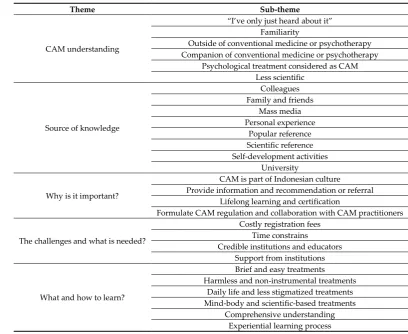
Five main themes emerged within participants’ responses regarding CAM knowledge and
182
educational needs: (a) CAM understanding, (b) source of knowledge, (c) why is it important?, (d) the
183
challenges and what is needed?, and (e) what and how to learn? A summary of the themes and
184
sub-themes is presented in Table 1. Participant’s number is used in brackets to represent extracts and
185
quotes. For example, (P6) represents a quote from Participant 6.
186
Table 1. Themes and sub-themes for CAM knowledge and educational needs.
187
Theme Sub-theme
CAM understanding
“I’ve only just heard about it”
Familiarity
Outside of conventional medicine or psychotherapy Companion of conventional medicine or psychotherapy
Psychological treatment considered as CAM Less scientific
Source of knowledge
Colleagues Family and friends
Mass media Personal experience
Popular reference Scientific reference Self-development activities
University
Why is it important?
CAM is part of Indonesian culture Provide information and recommendation or referral
Lifelong learning and certification
Formulate CAM regulation and collaboration with CAM practitioners
The challenges and what is needed?
Costly registration fees Time constrains
Credible institutions and educators Support from institutions
What and how to learn?
Brief and easy treatments Harmless and non-instrumental treatments
Daily life and less stigmatized treatments Mind-body and scientific-based treatments
Comprehensive understanding Experiential learning process
3.1. CAM Understanding
188
The first of the five themes was how participants understood the meaning of CAM. Responses
189
ranged from those with little or no prior knowledge of CAM treatments and uses, to those with
190
much greater familiarity. Also, participants defined CAM differently due to the wide range of
191
understanding of CAM. Each sub-theme is presented in six paragraphs below.
192
Almost a third of participants expressed that they had never heard of CAM at all before, as
193
exemplified, “I’ve only just heard about it. My colleagues were asking me about this [CAM], but I,
194
myself, know nothing.” (P6). Due to their lack of CAM knowledge, they were neither able to define
195
nor mention an example of CAM treatments. Participants also felt unsure if some psychological
196
techniques that they have combined into their practice were categorized as CAM or not. However,
197
all participants could provide examples once they knew what the term meant.
198
Alternative medicine was perceived to be more familiar than complementary medicine among
199
participants. They also mentioned certain CAM treatments perceived as alternative medicine, for
200
example, “… alternative medicine that uses jamu-jamuan[traditional herbals medicine] …” (P31).
201
Participants said that the term alternative medicine is easily found in daily life and understood
202
because many alternative medicine practitioners advertise their services in newspapers or distribute
203
leaflets on the street.
CAM was understood as a treatment outside conventional psychotherapy or practiced
205
personally by clients in their homes. CAM was also defined as a psychological treatment performed
206
by a person without a psychology education background. Participants perceived that CAM includes
207
treatments that are not provided by a physician, as illustrated: “… from something to be consumed
208
like tonic, to some actions to be done like exorcism by dukun[shaman].” (P12).
209
Participants identified CAM as a treatment combined with conventional medicine or
210
psychotherapy, for example, pregnant clients with hypertension and anxiety used relaxation
211
techniques in conventional psychotherapy and joined yoga to manage blood pressure and anxiety
212
levels (P15). It was emphasized that clients usually proactively searched and used CAM based on
213
their own beliefs and culture. Participants also explained that CPs may integrate CAM into
214
conventional psychotherapy as a professional strategy for psychologists to be accepted by
215
Indonesian people. For example, “We use the basic of CBT [cognitive-behavioral therapy] but
216
inserted with religious teachings to adjust to what people understand and believe.” (P30).
217
Three participants recognized psychological treatment, including psychotherapy and
218
counselling, as a part of CAM. They explained that this understanding was based on the
219
biomedicine paradigm and system in conventional health services where clients meet with a
220
physician on the first occasion and then are referred to a CP if needed. Therefore, participants
221
perceived that psychological treatment provided by a CP aims to complement physician’s
222
intervention by supporting physical healing and creating holistic health for clients.
223
CAM was also understood as a non-(or less) scientific treatment. The main reason given was the
224
lack of systematic research or inadequate scientific evidence for CAM: “… either me who is not
225
following the trend or what. But I feel that I haven’tfound a lot research [report] about CAM.” (P4).
226
Participants also highlighted that anyone can be a CAM practitioner without sufficient conventional
227
medical education. In addition, there is no single guideline on how to use CAM, so every
228
practitioner might have a different technique, compared to the strict directions for prescribing drugs
229
among physicians. Clients’ beliefs and placebo effect were recognized by participants as two factors
230
why CAM appears effective.
231
3.2. Source of CAM Knowledge
232
Based on the interviews, eight sources (sub-themes) for gaining CAM knowledge were
233
identified (see Table 1). Participants access ranged widely in terms of references, from popular to
234
scientific literature. Also, participants’ personal experiences of using CAM, relations with family and
235
friends, and discussions with colleagues contributed to the enhancement of their CAM knowledge.
236
Each source is presented in separate paragraphs below.
237
Participants enhanced their CAM knowledge through their colleagues, both other health
238
professionals and CPs. For example, some gained knowledge about dietary-supplements from
239
discussions with nutritionists at the public health centers (PHCs). But the knowledge they obtained
240
was very basic due to time constrains to talk with other health professionals. Provisional CPs
241
(psychologists completing a professional internship in clinical psychology under the supervision of
242
registered clinical psychologist) who did internships with the participants could also be a source of
243
CAM knowledge because they had more up-to-date information. Participants also gained CAM
244
knowledge through assisting their colleagues’ research on specific CAM treatments, for example,
245
yoga and SRT. Participants also had discussions with senior CPs and strongly believed whatever
246
their seniors said, especially the executive members of professional associations. For example,
247
Participant 15 exemplified, “She said, ‘Rather than listening to classical music, why we don’t listen to
248
gending [traditional Javanese music instrument] or tilawah [Quran recitation].’ I haven’t read the
249
journal [articles] yet. But if she spoke like that, it must have a [scientific] basis.” (P15).
250
Family members, including partners and parents, were the most influential persons to develop
251
CAM knowledge and behavior amongst participants. Parents-in-law could also be a source of CAM
252
knowledge for participants, as described by Participant 42, “…my husband’s parents, in fact, prefer
253
[to use] herbal [medicine] and my husband as well. So we also try to [use this with] our children.”
254
(P42). But not all participants believed strongly with their family, and rather had more trust in
conventional health professionals. Friends also acted as a CAM knowledge source. These friends
256
were not from psychology nor any health education background. They could be participants’
257
neighbors or members of the same group activity. For example, “I know that treatment [SRT] also
258
from friends. Sometimes we attend the same [religious] discussion forum.” (P14).
259
Both printed and electronic mass media were used by participants to gain knowledge about
260
CAM. Sources included magazines, newspapers, radio, and television (TV). Four participants said
261
that they obtain basic information about ruqyah (exorcism in Islam) as part of SRT from religious
262
programs on TV, for example, “I haven’t had clear [scientific] information about ruqyah. What I
263
know is just from what I have seen on the television.” (P16). Participant 5 explained that the CAM
264
knowledge she received from the radio helped her to discuss it with her clients, particularly with
265
those from low socio-economic status (SES) backgrounds, because they also listened to the same
266
program.
267
Some participants knew particular CAM treatments from their own experience. For example,
268
Participant 10 and Participant 15 practice yoga and meditation so they can explain to clients what
269
they feel and the potential benefits of those treatments. In line with this, Participants 5 and 13 shared
270
their stories with clients about herbal medicine consumption, especially during their pregnancy and
271
when they were breastfeeding.
272
Numerous popular references were used by participants as their resource for CAM knowledge.
273
For example, Participant 16 illustrated her experience with exploring dietary-supplements benefits
274
for pregnant women through popular health articles on the internet. Search engines, such as Google,
275
were also used to find out about CAM’s history or benefits. Five participants had looked for
276
information on social media, including YouTube: “… now there is a lot [of instrumental music] on
277
YouTube, sometimes I search for it there.” (P22). Some popular books about CAM treatments, such
278
as music therapy and dietary-supplements, were also read to increase participants’ knowledge of
279
CAM effectiveness.
280
Scientific journals and text books were used by some participants to find out about the
281
effectiveness of particular CAM treatments, such as SRT, yoga, and music therapy. Two of the
282
participants were also adjunct lecturers and they read articles about CAM reviewed by their
283
students. Participants also read journals and text books about CAM for their undergraduate or
284
master theses. However, participants disclosed that sometimes they did not have time to search or
285
could not find articles about CAM.
286
Participants increased their CAM knowledge by taking self-development activities, such as
287
attending seminars, training, and workshops. They joined the programs because of their interest in
288
the particular CAM treatment or specific developmental stage, for example, acupuncture for
289
children with autism. Information from self-development activities were seen as more valid than
290
popular sources or references from the internet: “… [information from] browsing sometimes is not
291
supported by robust study … I am confident to discuss [with clients] if have joined a seminar and
292
obtained [more credible] information about it [CAM].” (P24).
293
“There was a course named Prophetic Counselling … in that counselling and psychotherapy,
294
religious values were inserted.” (P5). This example represented participants from Islamic
295
universities in several provinces who obtained their knowledge about CAM, particularly SRT, in
296
their lectures. However, some participants felt it difficult to understand the working mechanisms of
297
SRT. In contrast, participants from a non-religious university stated that they were taught nothing
298
about CAM knowledge in lectures. They indicated CAM was not discussed at all in the curriculum
299
due to the lack of scientific evidence to support it. Participants also gained CAM knowledge from
300
informal discussions or observing behaviors from their lecturers. For example, “Sometimes lecturers
301
in the class said, ‘That’s it, give a massage at here.’ Then unconsciously, I try to apply this
302
[acupressure] to clients.” (P8).
303
3.3. Why is It Important?
304
Four sub-themes, presented in four paragraphs below, were identified when participants
305
explained why CAM knowledge and education are important (see Table 1). Essentially, CAM was
identified as part of Indonesian culture and it was therefore crucial to have this cultural knowledge.
307
As health professionals, participants mentioned CAM knowledge and education were needed to
308
educate clients and as part of participants’ professional development. Eventually, knowledge and
309
education of CAM were needed in drafting CAM integration regulations and designing
310
collaborative work with CAM practitioners in the future.
311
Participants perceived CAM as a part of Indonesian culture and daily life. Therefore, they
312
commented that CPs need to have cultural sensitivity, including knowledge of CAM so that they are
313
able to understand clients more, and give psychoeducation about various CAM treatments.
314
Additionally, participants acknowledged that conventional psychotherapy which they learnt and
315
practiced was rooted in Western perspectives that do not always culturally fit Indonesian people’s
316
understandings:
317
“Our [psychotherapy] is oriented more to the West. So, is it culturally appropriate? Need
318
modification because [we] meet with clients at PHC from diverse cultures and who use CAM …
319
Consequently, CPs need cultural sensitivity like CAM understanding to understand their clients
320
better and be able to answer questions about CAM.” (P19).
321
Participants said that their clients still perceive CPs as having the same role as physicians. For
322
example, in palliative care such as part of cancer treatment, clients often asked participants’ advice
323
in choosing chemotherapy or herbal medicine. Therefore, participants emphasized that CAM
324
knowledge and education is needed for CPs in providing information and safe recommendations or
325
referrals for clients. Participant 28 summarized why CAM knowledge is important:
326
“[Clinical] recommendations are expensive. It’s OK if clients recover. But, if their condition
327
becomes worse, then it is dangerous … when a client asks about CAM, the CP should be able to
328
answer even if only with a short explanation. If the CP’s response is only ‘I do not know’ then it can
329
lessen the CP’s credibility and trust from the client. Also, it will increase the risk of the client looking
330
up information from invalid [not credible] sources which, in the end, endangers the client.” (P28).
331
Participants explained that their clients came from various backgrounds and with numerous
332
problems. Therefore, they need to keep up-to-date information and upgrade their knowledge and
333
skills, including about CAM. Thus, knowing and learning about CAM could be part of lifelong
334
learning, and CPs might specialize in one particular CAM treatment. In addition, participants
335
suggested that CAM education undertaken by CPs could be used as one requirement to renew their
336
registration. They also highlighted that CPs need to be certified before integrating CAM into their
337
practice. Participants suggested that their profession might learn from other health professions that
338
already integrate CAM into their practice, for example, “Like ob-gyns [obstetrics and gynecologists],
339
they can do hypnobirthing. That will make their services more optimal.” (P39).
340
Participants mentioned that regulation is strongly needed if CAM is to be integrated into
341
psychological services. However, CPs must have the knowledge of CAM prior to formulating such
342
regulations. Therefore, CAM education is strongly recommended for CPs since, “Not all CPs have
343
[CAM] knowledge or have been taught about CAM so there is a need for CAM education.” (P38).
344
Apart from regulation, CAM knowledge and education are essential for participants when planning
345
collaboration with CAM practitioners.
346
3.4. The Challenges and What is Needed?
347
Four sub-themes relating to challenges were identified from the interviews, which are
348
presented separately in four paragraphs below. The challenges for improving participants’
349
knowledge came from personal and institutional levels. Financial and time constrain issues hindered
350
participants to participate in CAM workshops. Additionally, participants expressed that the content
351
of CAM seminars was too basic and did not meet their needs in clinical practice. Approval from
352
participants’ institutions to attend CAM self-development activities was another challenge faced.
353
Participants criticized the expensive cost to join CAM seminars, training, or workshops to
354
improve their knowledge and skills. Participants’ income as a CP at a PHC, which is lower than
355
other health professionals, is insufficient to cover the registration fees. Additionally, participants
regretted that some high-cost training did not make them certified to do a particular treatments
357
hence they were not cost-effective.
358
Working at a PHC demands time and energy, said participants. Consequently, it is difficult for
359
participants to increase their knowledge by regularly joining CAM self-development activities.
360
When a particular training event is held in a different city and on a weekend, it is still hard to take
361
part if they have a child. Moreover, searching for and reading the latest journal articles were
362
considered time-consuming for some participants, so they would just practice what they learnt from
363
university.
364
Participants underlined that it is a challenge to find a trainer who is an expert in CAM as well as
365
understands psychology. Most CAM training facilitators were from non-psychology backgrounds,
366
so what they explained was too basic or irrelevant from what participants needed. Also, it is
367
important to know the competency of the educator in CAM, as Participant 12 criticized, “Who is
368
assessing their competence?” (P12). Furthermore, finding credible CAM education institutions that
369
are recognized by other health professionals is another issue to face. As an alternative solution,
370
participants suggested that professional associations might organize CAM training so that it is
371
perceived as more credible.
372
Participants explained that it is difficult to ask permission from their institutions to attend CAM
373
training and workshops that are held during the work week. Participants also perceived that their
374
institutions, PHCs and the Health Department, show less support by offering insufficient training
375
and funding. However, some institutions supported participants through providing facilities, for
376
instance, a computer and internet connection in the participant’s room so they could search for CAM
377
references in a timely manner.
378
3.5. What and How to Learn?
379
This last theme presented some principles of CAM education needed by participants and is
380
merged into six sub-themes (Table 1) which are written in six paragraphs below. Participants
381
advised that only CAM treatments that fit in brief psychotherapy sessions should be introduced in
382
professional training. Since CAM was perceived as part of Indonesian culture, participants
383
suggested CPs should know about the CAM treatments commonly used in daily life. Regarding
384
their professionalism, participants emphasized only less harmful and scientific-based CAM
385
treatments should be included in psychology education. Lastly, participants recommended
386
comprehensive content and experiential learning strategies when teaching CAM for CPs.
387
Due to time constrains and pressures at PHCs, participants agreed that treatments should be
388
made easy to conduct during brief sessions and should be introduced as part of psychology
389
education. For example, music therapy should be taught because it can be used anywhere, as should
390
acupressure because of its simplicity. It was found that Neuro-Linguistic Programming (NLP) was
391
the most commonly endorsed treatment, followed by hypnotherapy, brain gym, and Eye Movement
392
Desensitization and Reprocessing (EMDR). Those treatments were favored because they produce
393
quick effects and clients like them.
394
Participants explained that stigma towards mental disorders still occurs in Indonesia and it
395
discourages people from visiting psychology services. Therefore, participants suggested that CPs
396
should learn and use treatments that become part of clients’ everyday lives, for instance, massage
397
therapy and herbal medicine. By integrating these treatments, participants indicated that this would
398
encourage people to come to CPs and help reduce the stigma. Participants agreed that SRT should be
399
taught in professional programs because spirituality and religion are very important to Indonesian
400
people’s lives: “Our people are relatively religious, whatever their religion. Thus, therapies with
401
spirituality and religious influences need to be taught.” (P34).
402
Participants showed their concern regarding clients’ safety when using CAM in psychological
403
practice. Therefore, they suggested CPs should only learn less harmful and non-instrumental
404
treatments such as acupressure and meditation. Acupuncture and herbal medicine were the least
405
recommended treatments because participants were not taught about them at university and they
406
did not have a license to practice them. However, participants suggested that CPs need to know
about herbal medicine, as exemplified: “CPs also need to know about pharmacology, and herbal
408
medicine can be inserted into that topic within lectures.” (P12).
409
Mind-body treatments, such as yoga and meditation, were proposed by participants to be
410
included in psychology education because of the connection between physical and psychological
411
conditions. However, not all Islamic universities might want to teach it: “But about yoga and
412
meditation, Islamic universities tend to reject [to teach them] because they’re basically from either
413
Buddhism or Hinduism.” (P20). Participants also highlighted that the CAM treatments taught in
414
psychology programs have to be scientifically-based. Therefore, some participants doubted
415
hypnotherapy would be taught, as illustrated, “… not all CPs favor hypnotherapy because the
416
scientific evidence is still weak.” (P23).
417
Participants disclosed that information about CAM is rare in psychology programs and
418
undervalued compared to conventional psychotherapy. Therefore, participants commented that
419
every aspect of CAM is important to be taught because this will make them more confident and
420
understand CAM more comprehensively. Basic information, such as CAM philosophy and history,
421
is essential in order to find common ground and avoid dissenting opinions among CPs. However,
422
some participants also emphasized that practical information, such as working mechanisms and side
423
effects, also need to be known.
424
Role-plays and visits to CAM practitioners or inviting CAM practitioners to the classroom were
425
the most recommended ways to learn about CAM for participants. These hands-on experiences and
426
learning strategies may enhance their knowledge and skills with CAM. Participants also suggested
427
that the educators should be able to teach CAM based on what CPs need in their practices, for
428
example, by using case studies.
429
4. Discussion
430
This current qualitative study aimed to explore Indonesian CPs’ knowledge and educational
431
needs of CAM. Lack of CAM knowledge among participants in this study supports a similar finding
432
which was reported by Australian psychologists [42]. CAM, particularly complementary medicine,
433
is an unfamiliar term and was interpreted with various meanings. In line with previous studies in
434
the psychology community in Indonesia [43] and psychologists in Australia [44], participants in this
435
qualitative phase also perceived that CAM has inadequate scientific evidence to support it.
436
Time constrains and pressures in PHC discussed by participants might explain why only a few
437
of the participants read scientific journals as their references for CAM. But the difficulty in finding
438
research published on CAM in psychology journals might illustrate that the mainstream psychology
439
journals have a low acceptance rate for CAM studies, as was found in previous studies [24, 44, 45].
440
This phase also discovered that the actions and statements by lecturers and executive members of
441
professional associations may also be used as references, even when not supported by adequate
442
scientific evidence.
443
The interviews revealed three reasons for the importance of CAM knowledge and education for
444
participants. First, CAM was perceived as part of clients’ culture and participants often received
445
questions from clients related to CAM treatments. Therefore, cultural sensitivity (i.e. non-prejudiced
446
attitude towards CAM treatments) to be able to answer clients’ questions might be achieved by
447
learning more about CAM. Second, CAM knowledge was needed to provide psychoeducation on
448
the latest CAM scientific research to their clients as suggested in a previous study [24]. Moreover,
449
accurate information about CAM is essential to protect clients from the malpractice of CAM
450
practitioners as also mentioned by Australian psychologists [44]. Lastly, CAM education was
451
needed in order to formulate the regulation of CAM integration into psychological services, a view
452
which was also found in previous studies among health professionals in Australia and Bahrain [46,
453
47].
454
Participants mentioned several challenges in increasing their knowledge about CAM. The main
455
barriers included that to join self-development activities, such as training and workshops, is
456
financially expensive and that they had little time to do so. Another challenge was related to the
457
relatively low income in PHCs that was not enough for participants to update their knowledge and
skills about CAM. Some PHCs provide financial support for participants to join self-development
459
activities but in limited amount. Therefore, participants expected their institution to raise the budget
460
and professional associations to organize inexpensive CAM training and workshops. Working
461
pressure in PHCs also inhibited participants from upgrading their knowledge about CAM because
462
of the difficulty in getting permission from the institution to attend such workshops. Professional
463
associations were expected to supervise the credibility of CAM education institutions and the
464
trainers as well. This finding aligned with psychologists in Australia who also emphasized the
465
importance of professional associations’ surveillance of CAM training and practice [42]. Participants
466
expected that professional associations would acknowledge the credits from CAM workshops as one
467
component of psychology practice-license renewal.
468
There was dissenting opinion among participants about which CAM treatments should be
469
learnt by CPs. Based on efficiencies demanded by PHCs, numerous participants recommended NLP
470
to be inserted into psychology education so they could use these in their practice. Conversely, some
471
participants discouraged CAM treatments with insufficient scientific evidence, including NLP, from
472
being taught by psychology faculties. Mind-body treatments, such as meditation, were perceived as
473
a safe CAM treatment that CPs may learn and practice. This finding supported the previous study
474
that found that psychologists in Australia showed positive attitudes towards meditation integration
475
into conventional psychotherapy [44]. However, in this qualitative phase, it was also explored that
476
Islamic universities might not teach meditation and yoga because these treatments are rooted in
477
different religions’ teachings. As part of Indonesian peoples’ everyday lives, participants suggested
478
that SRT should be taught in psychology education. This supports previous research where
479
physicians in Indonesia also showed positive acceptance towards SRT in conventional medicine [48].
480
Despite several procedures taken to support the trustworthiness of this qualitative study, there
481
were three limitations need to be considered. First, the sex proportion was imbalance where only one
482
male participant interviewed. The analysis might not accurately represent male clinical
483
psychologists’ knowledge and educational needs of CAM. Therefore, the future study may
484
investigate knowledge and educational needs of CAM among males CPs. Second, all interviews
485
were conducted individually that had a disadvantage when participant shared very limited
486
responses due to his/her insufficient knowledge on the topic. Hence, individual interviews can be
487
enriched by combining it with focus group interviews where additional layer of data may be
488
obtained from interaction between participants. Third, psychological education in Indonesia may
489
share similarity with other Southeast Asian nations, however, findings from Indonesian CPs may
490
not be entirely able to be generalized in different cultural settings. Therefore, future study may be
491
conducted cross-culturally with other psychologists from different nations as participants to be
492
compared with the current findings.
493
5. Conclusions
494
This qualitative study with 43 clinical psychologists in Indonesia discovered that CAM was
495
neither well-known nor understood widely among participants. Participants explained reasons why
496
CAM knowledge and education were important for them. For example, having cultural sensitivity,
497
including knowledge of CAM, is essential to understand clients better. Therefore, participants
498
advised that professional associations and health institutions should work together in enhancing
499
knowledge of CAM and incorporating CAM education into psychology education.
500
Funding: The author is supported by the Indonesia Endowment Fund for Education Scholarship (LPDP RI) for
501
the author’s doctoral degree (20150122082410) at the University of Queensland. The views expressed are the
502
author’s own.
503
Acknowledgments: Data of this study is part of the author’s doctoral thesis on CAM among clinical
504
psychologists in Indonesia. The author thanks the Indonesian Clinical Psychology Association (IPK HIMPSI)
505
for the permission to collect data and psychologists who participated in the interviews. The author thanks
506
Annie E. Pohlman, PhD for the invaluable feedback and discussion; and Rachmania P Wardhani, BA (Hons I),
507
for the proofreading.
508
Conflicts of Interest: The author declares no conflict of interest.
References
511
1. WHO, WHO traditional medicine strategy 2014-2023. 2013.
512
2. Wahbeh, H., et al., Complementary and Alternative Medicine for Posttraumatic Stress Disorder
513
Symptoms: A Systematic Review.Journal of Evidence-Based Complementary & Alternative Medicine, 2014.
514
19: p. 161-175.
515
3. Ng, Q.X., N. Venkatanarayanan, and C.Y.X. Ho, Clinical use of Hypericum perforatum (St John's wort)
516
in depression: A meta-analysis.Journal of Affective Disorders, 2017. 210: p. 211-221.
517
4. Shneerson, C., et al., The effect of complementary and alternative medicine on the quality of life of
518
cancer survivors: a systematic review and meta-analyses.Complementary Therapies in Medicine, 2013. 21:
519
p. 417-429.
520
5. Ng, Q.X., et al., A meta-analysis of the effectiveness of yoga-based interventions for maternal
521
depression during pregnancy.Complementary Therapies in Clinical Practice, 2019. 34: p. 8-12.
522
6. Kantor, M., The role of rigorous scientific evaluation in the use and practice of complementary and
523
alternative medicine.Journal of the American College of Radiology, 2009. 6: p. 254-262.
524
7. Ng, Q.X., et al., A Systematic Review of the Role of Prebiotics and Probiotics in Autism Spectrum
525
Disorders.Medicina, 2019. 55: p. 1-10.
526
8. Shorofi, S.A. and P. Arbon, Complementary and alternative medicine (CAM) among Australian
527
hospital-based nurses: Knowledge, attitude, personal and professional use, reasons for use, CAM
528
referrals, and socio-demographic predictors of CAM users.Complementary Therapies in Clinical Practice,
529
2017. 27: p. 37-45.
530
9. Liem, A. and P.A. Newcombe, Indonesian provisional clinical psychologists' knowledge, attitudes,
531
and behaviours towards complementary-alternative medicine (CAM). Complementary therapies in
532
clinical practice, 2017. 28: p. 204-211.
533
10. Clevenger, S.F., Knowledge and attitudes towards utilizing complementary and alternative medical
534
(CAM) treatments by mental health practitioner from various disciplines. Journal of Traditional and
535
Complementary Medicine, 2018. in press.
536
11. Wardle, J.L. and J. Adams, Indirect and non-health risks associated with complementary and
537
alternative medicine use: An integrative review. European Journal of Integrative Medicine, 2014. 6: p.
538
409-422.
539
12. de Jonge, P., et al., Complementary and alternative medicine contacts by persons with mental
540
disorders in 25 countries: Results from the World Mental Health Surveys.Epidemiology and Psychiatric
541
Sciences, 2018. 27: p. 552-567.
542
13. DeFilippis, M., The use of complementary alternative medicine in children and adolescents with
543
autism spectrum disorder.Psychopharmacology Bulletin, 2018. 48: p. 40-63.
544
14. Sarris, J., et al., Integrative mental healthcare White Paper: Establishing a new paradigm through
545
research, education, and clinical guidelines.Advances in Integrative Medicine, 2014. 1: p. 9-16.
546
15. Ross, C.L., Integral healthcare: The benefits and challenges of integrating complementary and
547
alternative medicine with a conventional healthcare practice.Integrative Medicine Insights, 2009. 4: p.
548
13-20.
549
16. Burke, A., et al., Developing the complementary and alternative medicine education infrastructure:
550
baccalaureate programs in the United States. The Journal of Alternative and Complementary Medicine,
551
2004. 10: p. 1115-1121.
17. Bruguier, E., Allied health and nursing academic programs at new jersey county colleges: Holistic
553
health and complementary and alternative medicine content. Complementary Health Practice Review,
554
2008. 13: p. 155-170.
555
18. Maizes, V., et al., The evolution of integrative medical education: The influence of the University of
556
Arizona Center for Integrative Medicine.Journal of Integrative Medicine, 2015. 13: p. 356-362.
557
19. Joyce, P., J. Wardle, and C. Zaslawski, Medical student attitudes towards complementary and
558
alternative medicine (CAM) in medical education: a critical review. Journal of Complementary and
559
Integrative Medicine, 2016. 13: p. 333-345.
560
20. Olchowska-Kotala, A. and J. Barański, Polish physicians’ attitudes to complementary and alternative
561
medicine.Complementary Therapies in Medicine, 2016. 27: p. 51-57.
562
21. Ligorio, D.V. and G.C.B. Lyons, Exploring differences in psychological professionals' attitudes
563
towards and experiences of complementary therapies in clinical practice.Australian Psychologist, 2018.
564
Online First: p. 1-12.
565
22. Quartey, N.K., et al., Complementary and alternative medicine education for medical profession:
566
Systematic review.Evidence-Based Complementary and Alternative Medicine, 2012. 2012: p. 1-13.
567
23. Dossett, M.L., et al., A medical student elective promoting humanism, communication skills,
568
complementary and alternative medicine and physician self-care: an evaluation of the HEART
569
program.Explore: The Journal of Science and Healing, 2013. 9: p. 292-298.
570
24. Barnett, J.E., et al., Complementary and alternative medicine for psychologists: An essential resource. 2014,
571
Washington, D.C: American Psychological Association.
572
25. Pilkington, K., Current research on complementary and alternative medicine (CAM) in the treatment
573
of depression: Evidence-based review, in Understanding Depression, K. YK, Editor. 2018, Springer. p.
574
311-322.
575
26. White, K.P., Psychology and complementary and alternative medicine.Professional Psychology: Research
576
and Practice, 2000. 31: p. 671-681.
577
27. Lake, J., C. Helgason, and J. Sarris, Integrative mental health (IMH): Paradigm, research, and clinical
578
practice.Explore: The Journal of Science and Healing, 2012. 8: p. 50-57.
579
28. Nielsen, M., et al., The persistent sampling bias in developmental psychology: A call to action.Journal
580
of Experimental Child Psychology, 2017. 162: p. 31-38.
581
29. Supratiknya, A., Networking among Southeast Asian psychological societies to improve services.
582
Buletin Psikologi, 2006. 14: p. 79-88.
583
30. Geerlings, L.R., C.L. Thompson, and A. Lundberg, Psychology and culture: exploring clinical
584
psychology in Australia and the Malay Archipelago.Journal of Tropical Psychology, 2014. 4: p. 1-12.
585
31. Lombard-Salmon, C. and M. Sidharta, Traditional Chinese Medicine and Pharmacy in
586
Indonesia–Some Sidelights.Archipel, 2007. 74: p. 165-204.
587
32. Alqahtani, M.M.J., et al., Are we meeting cancer patient needs? Complementary and alternative
588
medicine use among Saudi cancer patients: A qualitative study of patients and healthcare
589
professionals’ views.European Journal of Integrative Medicine, 2018. 24: p. 54-60.
590
33. Smith, G.D. and S.C. Wu, Nurses’ beliefs, experiences and practice regarding complementary and
591
alternative medicine in Taiwan.Journal of Clinical Nursing, 2012. 21: p. 2659-2667.
592
34. Yilmaz, K., Comparison of quantitative and qualitative research traditions: Epistemological,
593
theoretical, and methodological differences.European Journal of Education, 2013. 48: p. 311-325.
35. Slevitch, L., Qualitative and quantitative methodologies compared: Ontological and epistemological
595
perspectives.Journal of Quality Assurance in Hospitality & Tourism, 2011. 12: p. 73-81.
596
36. Etikan, I., S.A. Musa, and R.S. Alkassim, Comparison of convenience sampling and purposive
597
sampling.American Journal of Theoretical and Applied Statistics, 2016. 5: p. 1-4.
598
37. Dikko, M., Establishing construct validity and reliability: Pilot testing of a qualitative interview for
599
research in takaful (Islamic insurance).The Qualitative Report, 2016. 21: p. 521-528.
600
38. Liem, A., Beliefs, attitudes towards, and experiences of using complementary and alternative
601
medicine: A qualitative study of clinical psychologists in Indonesia. European Journal of Integrative
602
Medicine, 2019. 26: p. 1-10.
603
39. Liem, A., Interview schedule development for a sequential explanatory mixed method design:
604
Complementary-alternative medicine (CAM) study among Indonesian psychologists. International
605
Journal of Social Research Methodology, 2018. 21: p. 513-525.
606
40. Braun, V. and V. Clarke, Using thematic analysis in psychology. Qualitative Research in Psychology,
607
2006. 3: p. 77-101.
608
41. Guest, G., K.M. MacQueen, and E.E. Namey, Applied thematic analysis. 2012, Los Angeles: Sage
609
Publications.
610
42. Wilson, L.A.M. and K.M. White, Integrating complementary and alternative therapies into
611
psychological practice: A qualitative analysis.Australian Journal of Psychology, 2011. 63: p. 232-242.
612
43. Liem, A. and K.D. Rahmawati, The meaning of complementary, alternative and traditional medicine
613
among the Indonesian psychology community: A pilot study.Journal of Integrative Medicine, 2017. 15: p.
614
288-294.
615
44. Hamilton, K. and V. Marietti, A qualitative investigation of Australian psychologists' perceptions
616
about complementary and alternative medicine for use in clinical practice.Complementary Therapies in
617
Clinical Practice, 2017. 29: p. 105-110.
618
45. Collinge, W., R. Wentworth, and S. Sabo, Integrating complementary therapies into community
619
mental health practice: An exploration.The Journal of Alternative and Complementary Medicine, 2005. 11:
620
p. 569-574.
621
46. Dayhew, M., J. Wilkinson, and M. Simpson, Complementary and alternative medicine and the search
622
for knowledge by conventional health care practitioners.Contemporary Nurse, 2009. 33: p. 41-49.
623
47. Al Sayyad, A.S., et al., Knowledge, attitude and practice of primary health care physicians in Bahrain
624
towards complementary and alternative medicine (CAM).Middle East Journal of Family Medicine, 2015.
625
13: p. 52-59.
626
48. Ramakrishnan, P., et al., Religious/spiritual characteristics of Indian and Indonesian physicians and
627
their acceptance of spirituality in health care: A cross-cultural comparison. Journal of Religion and
628
Health, 2015. 54: p. 649-663.