THE
DEVELOPMENT
AND
VALIDITY
OF
BEHAVIORAL
INSTRUMENT OF MOBILE LEARNING APPLICATIONS USAGE
AMONG UNDERGRADUATE STUDENTS
Syaza Hazwani Zaini1+
Faridah Hanim Yahya2
Siti Rahaimah Ali3
Nor Hasnida Che Md Ghazali4
Zahari Suppian5
Noor Fadzliana Ahmad Jaafar6
1,2,3,4,5,6Department of Educational Studies, Faculty of Human Development,
Universiti Pendidikan Sultan Idris, Perak, Malaysia.
(+ Corresponding author)
ABSTRACT
Article History Received: 6 April 2020 Revised: 11 May 2020 Accepted: 15 June 2020 Published: 25 June 2020
Keyword
s
Exploratory factor analysis (EFA)
M-Learning Mobile app UTAUT UTAUT2 Technology use Technology acceptance.
The emergence of m-learning is perceived to support the success of the 2015-2025 Malaysia Education Blueprint. Access to education through mobile devices is not just a requirement today but has become a necessity for students and educators to achieve. Therefore, this study aims to develop and validate eight constructs to observe the behavior of acceptance and the use of mobile learning application among students in public universities. This study involved 120 respondents amongst undergraduate students in Universiti Pendidikan Sultan Idris, Malaysia who were randomly selected from the study population. Exploratory Factor Analysis (EFA), is done to measure the suitability of each item and validate the Acceptance and Use of Mobile Learning Application Instrument among Bachelor Degree students. EFA results find that all load factor values exceed 0.5; all items are accepted and no items are dropped. Based on the analysis conducted, it can be concluded that the instruments used have high degree of validity and reliability to determine the acceptance and use of Mobile Learning Application among students.
Contribution/ Originality: This study contributes to the body of knowledge as it successfully explore and validate constructs in determining the acceptance and usage factors of m-Learning among higher education students.
1. INTRODUCTION
M-Learning has been introduced in the educational system which aimed at supporting the teaching and learning (T&L) process. M-Learning means enhanced learning with the use of mobile devices and mobile communications that can take place anywhere and anytime, and take advantage of the learning opportunities offered by mobile technology (Cheung, Yuen, & Tsang, 2011; Chuang, 2009). M-Learning is seen to have the potential to support more democratic, flexible, autonomous, comprehensive learning and support formal and informal learning
International Journal of Asian Social Science
ISSN(e): 2224-4441 ISSN(p): 2226-5139
DOI: 10.18488/journal.1.2020.107.360.367 Vol. 10, No. 7, 360-367.
through the mobile app. Mobile app allows users to access a variety of information, content, entertainment and so on to help users perform tasks more easily (Pollara, 2011).
Online learning using this electronic method is one of the key tools in widening access to education, improving teaching and learning quality, while enabling learning tailored to the needs of students. Therefore, the use of apps for learning purposes is a necessity that has a positive impact on students because by simply filling in android-based learning app software on smartphones, all learning activities can be easily carried out wherever the students are and whenever they need.
The rapid advancement of technology has witnessed the ever increasing relevance of mobile app usage in T&L including the institutions of higher education. According to the NMC Horizon Project (2016) there has been an increase in the number of tertiary institutions moving from conventional to technology-based methods. A study by Abu-Al-Aish (2014) on students in the Public Universities found that most students are more prepared for the implementation of m-Learning since the ownership of mobile devices is high while also accustomed to the implementation of e-Learning. Students also agree that m-learning will make the learning process more interesting and flexible and save time. In addition, it will improve communication between students and lecturers (Abu-Al-Aish, Love, & Hunaiti, 2012; Ooms, Linsey, Webb, & Panayiotidis, 2008).
The study conducted by Subramaniam and Harun (2013) found that students have positively received the use of mobile devices in learning sessions. This is because mobile devices are promoting the m-Learning environment even more among students especially in institutions of higher education. A study by Abu-Al-Aish (2014) shows that students have a positive view on the usage of m-Learning in their learning activities and perceive it as a support system for conventional learning.
Access to education via mobile has become a necessity for students and educators. Consequently with the rapid growth of information technology, the challenge of embracing this technology in the social environment is increasing(Venkatesh & Bala, 2008). Studies by Nassuora (2013) show that despite the widespread use of mobile devices, students are still not ready to adapt to mobile learning technology in the T&L process. From a pedagogical aspect, mobile learning applications are seen as a burden in the T&L process. This is because mobile learning depends on continuous internet access. In addition, the location also affects the speed of the internet. A study conducted by Wang, Wu, and Wang (2009) found that students were more likely to use smartphones for entertainment purposes than for educational purposes. Abu-Al-Aish (2014) in his study added technical issues, institute infrastructure and student readiness were also contributing to the issues in the process of implementing m-Learning.
It is found that most studies related to m-Learning focus on the readiness of students using m-Learning Ismail, Azizan, and Gunasegaran (2016);Shorfuzzaman and Alhussein (2016);Nurulhuda and Norfadzliah (2017) student attitudes towards m-Learning. Furthermore, most studies are aimed at investigating the factors that influence the acceptance and usage of students in the m-Learning environment of Uğur, Koç, and Koç (2016) and Wu (2016) but lack research focusing on mobile app usage research in m-Learning environment. Therefore, it is necessary to conduct a study on the Usage Behaviour of Mobile Learning Application among students.
This study aims to develop and validate the Application Instrument of Mobile Learning Application among Students of Bachelor Degree in Universiti Pendidikan Sultan Idris. In particular, this study aims to:
i. Develop a Behavioral Acceptance and Usage of Mobile Learning Application Instrument among students. ii. Verify Behavioral Acceptance and Usage of Mobile Learning Application among students.
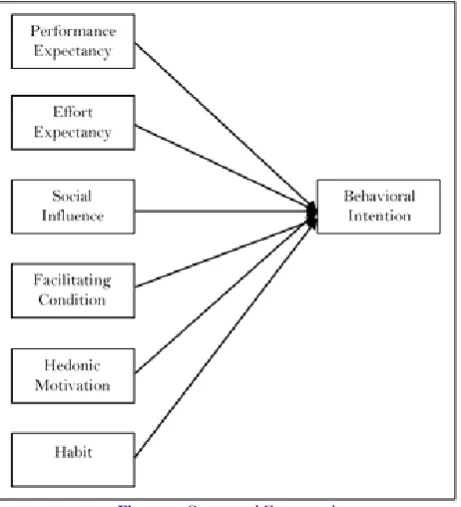
Figure-1. Conceptual Framework
2. RESEARCH METHODOLOGY
The study was conducted at Universiti Pendidikan Sultan Idris (UPSI), Perak, Malaysia. A total of 120 students from UPSI Bachelor's Degree (ISM) students were selected as survey respondents. This number is sufficient because the number of samples required for implementing EFA is at least 100 as suggested by Hair, Black, Babin, and Anderson (2010). The data were obtained by using questionnaires consisting of two parts, namely Part A and Part B. Part A consists of student demographic factors, while part B consists of seven constructs such as performance expectations, initiative expectations, social influences, behavioral conditions, hedonic motivation, habits and behavioral intentions of students. Each item in each construct is measured using a Likert Interval Scale. The rating scale used is from 1 (strongly disagree) to 6 (strongly agree). To determine the validity of the instrument construct, the researcher performed Exploratory Factor Analysis (EFA) to measure the suitability of each item in the construct before the instrument is used at the Confirmatory Factor Analysis (CFA) level. The data was analyzed using SPSS version 23 software to run Exploratory Factor Analysis to see the suitability of the item before the actual survey was conducted.
3. RESEARCH FINDINGS
3.1. Exploratory Factor Analysis (EFA) for Performance Expectancy Construct
Exploratory Factor Analysis (EFA) with Varimax rotations on 7 items of Performance Expectancy Construct to identify items that fall within the construct. Kaiser-Meyer-Olkin (KMO) Sampling Adequacy value is 0.876 which is more than 0.7 indicates the existing data is suitable for Principal Component Analysis. Bartlett’s Test of Sphericity was significant (p <0.001) indicating the relationship between items was sufficient for EFA.
Table-1. Performance expectancy EFA results.
Item Factor
PE1 I found that the mobile app for learning purpose are useful in my everyday life .708 PE2 Using the mobile app for learning purposes tends to increase my chances of getting better grades .727 PE3 Using the mobile app helps me solve things related to learning more quickly .745 PE4 Using the mobile app increases my learning productivity .887 PE5 The Mobile app has a positive impact on my learning .820 PE6 Using the mobile app can improve my learning efficiency .748
PE7 Mobile app makes my learning easier at university .747
Eigen Value
Variance percentage explained 59.467 4.163
Amount of variance explained = 59.467%
Kaiser-Meyer-Olkin (KMO) Sampling Adequacy = .876 Bartlett’s’s Test of Sphericity, x2 =, 417.248 p<.000
3.2. Exploratory Factor Analysis (EFA) for Effort Expectancy Construct
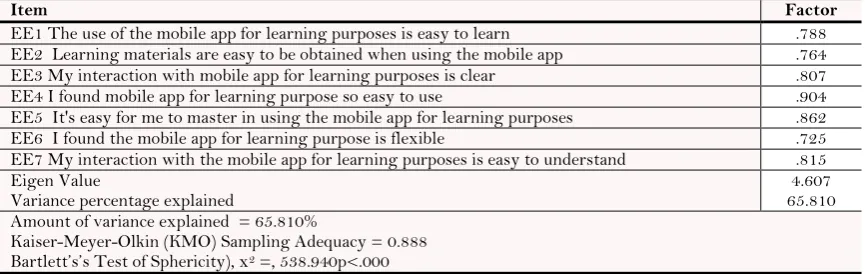
Exploratory Factor Analysis (EFA) with Varimax rotation is carried out on seven items in the Effort Expectancy Construct to identify those construct items. The Kaiser-Meyer-Olkin (KMO) Sampling Adequacy value is 0.888 which is more than 0.7 indicates the existing data is suitable for Principal Component Analysis. Bartlett's Test of Sphericity was significant (p <0.001) indicating the relationship between items was sufficient for EFA.
The percentage variance explained for this factor was 65.810%. Based on the rotated component matrix, only one factor is identified with an eigenvalue greater than 1 with a factor load greater than 0.5. Comparison with items in the original construct found that no item needed to be dropped because all items had a load value greater than 0.5. The EFA results for the Expected Initiative Construct can be referred in Table 2:
Table-2. Effort expectancy EFA results.
Item Factor
EE1 The use of the mobile app for learning purposes is easy to learn .788 EE2 Learning materials are easy to be obtained when using the mobile app .764 EE3 My interaction with mobile app for learning purposes is clear .807 EE4 I found mobile app for learning purpose so easy to use .904 EE5 It's easy for me to master in using the mobile app for learning purposes .862 EE6 I found the mobile app for learning purpose is flexible .725 EE7 My interaction with the mobile app for learning purposes is easy to understand .815 Eigen Value
Variance percentage explained 65.810 4.607
Amount of variance explained = 65.810%
Kaiser-Meyer-Olkin (KMO) Sampling Adequacy = 0.888 Bartlett’s’s Test of Sphericity), x2 =, 538.940p<.000
3.3. Exploratory Factor Analysis (EFA) for Social Influence Construct
Exploratory Factor Analysis (EFA) with Varimax rotation is carried out on seven items in the Social Influence Construct to identify the construct items. The Kaiser-Meyer-Olkin (KMO) Sampling Adequacy value is 0.852 which is more than 0.7 indicates the existing data is suitable for Principal Component Analysis. Bartlett's Test of Sphericity was significant (p <0.001) indicating the relationship between items was sufficient for EFA.
The percentage variance explained for this factor was 64.161%. Based on the rotated component matrix, only one factor is identified with an eigenvalue greater than 1 with a factor load greater than 0.5. Comparison with items in the original construct found that no item needed to be dropped because all items had a load value greater than 0.5. The EFA results for the Social Influence Construct can be referred in Table 3.
3.4. Exploratory Factor Analysis (EFA) for Facilitating Condition Construct
Table-3. Social influence EFA results
Item Factor
SI1 Lecturer thinks I need to use the mobile app for learning purpose .781 SI2 My friends think I need to use the mobile app for learning purposes .849 SI3 The Family also thinks I need to use the mobile app for learning purposes .846 SI4 Friends help a lot in the use of mobile apps for learning purposes .818 SI5 The community around me supports the use of the mobile app for learning purposes .736 SI6 I should use the mobile app for learning purposes because most of my friends are also using it .804 SI7 The suggestions from friends have influenced my decision to use the mobile app for learning purposes .766 Eigen Value
Variance percentage explained 64.161 4.491
Amount of variance explained = 64.161%
Kaiser-Meyer-Olkin (KMO) Sampling Adequacy = 0.852 Bartlett’s Test of Sphericity), x2 = 529.696, p<.000
The percentage variance explained for this factor was 64.093%. Based on the rotated component matrix, only one factor is identified with an eigenvalue greater than 1 with a factor load greater than 0.5. Comparison with items in the original construct found that no item needed to be dropped because all items had a load value greater than 0.5. The EFA results for the Facilitating Condition Construct can be referred in Table 4:
Table-4. Facilitating condition EFA results.
Item Factor
FC1 Internet access is sufficient for learning purposes using the mobile app .747 FC2 I have enough knowledge to use the mobile app for learning purposes .815 FC3 I can rely on materials on the Internet if I encounter problems while using the mobile app for
learning .828
FC4 I can get help from others when I'm having trouble using the mobile app for learning purposes .731 FC5 Mobile Learning Application is equivalent to the other technologies that I use for learning .874 Eigen Value
Variance percentage explained 64.093 3.205
Amount of variance explained = 64.093%
Kaiser-Meyer-Olkin (KMO) Sampling Adequacy = 0.830 Bartlett’s Test of Sphericity, x2 = 265.880, p<.000
3.5. Exploratory Factor Analysis (EFA) for Hedonic Motivation Construct
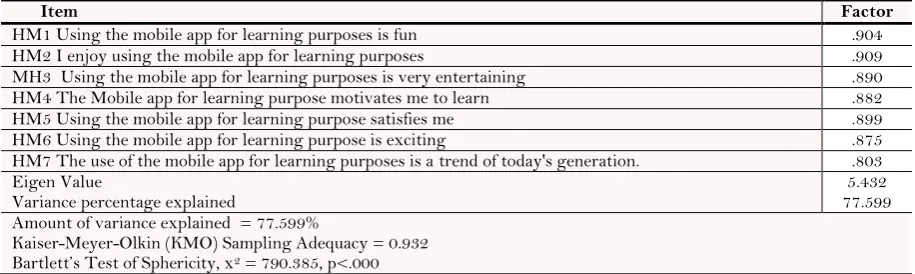
Exploratory Factor Analysis (EFA) with Varimax rotation over seven items in the Hedonic Motivation construct . The Kaiser-Meyer-Olkin (KMO) sampling Adequacy value is 0.932 which is more than 0.7 indicates the existing data is suitable for Principal Component Analysis. Bartlett's Test of Sphericity was significant (p <0.001) indicating the relationship between items was sufficient for EFA.
The percentage variance explained for this factor was 77.599%. Based on the rotated component matrix, only one factor is identified with an eigenvalue greater than 1 with a factor load greater than 0.5. Comparison with items in the original construct found that no item needed to be dropped because all items had a load value greater than 0.5. The EFA results for the Hedonic Motivation Construct can be referred in Table 5.
Table-5. Hedonic motivation EFA results.
Item Factor
HM1 Using the mobile app for learning purposes is fun .904
HM2 I enjoy using the mobile app for learning purposes .909 MH3 Using the mobile app for learning purposes is very entertaining .890 HM4 The Mobile app for learning purpose motivates me to learn .882 HM5 Using the mobile app for learning purpose satisfies me .899 HM6 Using the mobile app for learning purpose is exciting .875 HM7 The use of the mobile app for learning purposes is a trend of today's generation. .803 Eigen Value
Variance percentage explained 77.599 5.432
Amount of variance explained = 77.599%
3.6. Exploratory Factor Analysis (EFA) for Habit Construct
Exploratory Factor Analysis (EFA) with Varimax rotation on nine Habit Construct items. Kaiser-Meyer-Olkin (KMO) Sampling Adequacy value is 0.885 which is more than 0.7 indicates the existing data is suitable for Principal Component Analysis. Bartlett's Test of Sphericity was significant (p <0.001) indicating the relationship between items was sufficient for EFA.
The percentage variance explained for this factor was 62.516%. Based on the rotated component matrix, only one factor is identified with an eigenvalue greater than 1 with a factor load greater than 0.5. Comparison with items in the original construct found that no item needed to be dropped because all items had a load value greater than 0.5. The EFA results for the Habit Construct can be referred in Table 6:
Table-6. Habit construct EFA results.
Item Factor
H1 The use of the mobile app for learning purposes has become my routine .739
H2 I'm addicted to the mobile app for learning purposes .757
H3 I must use the mobile app for learning purposes .749
H4 Using the mobile app for learning purposes has become a habit to me .817
H5 The use of the mobile app for learning purposes has become part of my daily activities .835
H6 I often use the mobile app for learning purposes at leisure .826
H7 I will be disappointed if I can no longer use the mobile app for learning purposes .795 H8 While using a smartphone, I often use the mobile app for learning purposes .833
H9 I would feel lost if I did not use the mobile app for learning purposes .757
Eigen Value
Variance percentage explained 62.516 5.626
Amount of variance explained = 62.516%
Kaiser-Meyer-Olkin (KMO) Sampling Adequacy = 0.885 Bartlett’s Test of Sphericity, x2 = 727.397, p<.000
3.7. Exploratory Factor Analysis (EFA) for Behavioral Intention Construct
Exploratory Factor Analysis (EFA) with Varimax rotation of seven items on the Behavioral Intention Construct. Kaiser-Meyer-Olkin (KMO) sampling Adequacy value is 0.895 which is more than 0.7 indicates the existing data is suitable for Principal Component Analysis analysis. Bartlett's Test of Sphericity was significant (p <0.001) indicating the relationship between items was sufficient for EFA.
The percentage variance explained for this factor was 72.501%. Based on the rotated component matrix, only one factor is identified with an eigenvalue greater than 1 with a factor load greater than 0.5. Comparison with items in the original construct found that no item needed to be dropped because all items had a load value greater than 0.5. The EFA results for the Intentional Behaviour Construct can be referred in Table 7:
Table-7. Behavioral intention EFA results.
Item Factor
BI1 I aim to continue using the mobile app for future learning purposes .835 BI2 I will always use the mobile app for learning purposes in my daily life .864 BI3 I plan to continue using the mobile app for learning purposes frequently .874 BI4 I would recommend to my friends to use the mobile app for learning purposes .881 BI5 I aim to improve my skills in using the mobile app for learning purposes in the future .883 BI6 I expect that I will often use the mobile app for learning purposes .716 BI7 I aim to improve the use of the mobile app for future learning purposes .893 Eigen Value
Variance percentage explained 72.501 5.075
Amount of variance explained = 72.501%
3.8. Cronbach’s Alpha Coefficient Value Analysis after EFA
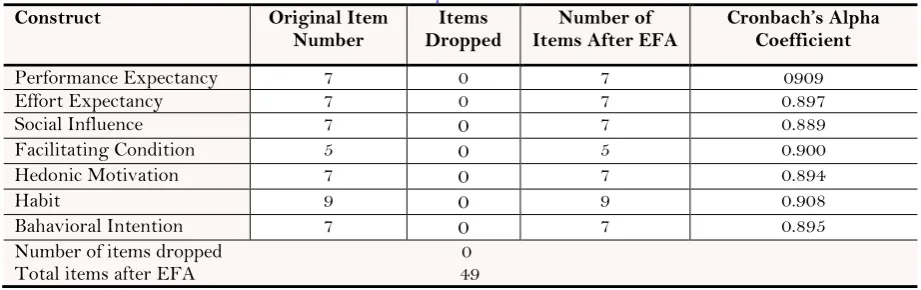
After the factor analysis, the reliability analysis is again carried out aiming at measuring the consistency of each item in the scale used for theoretical construct measurement. The method used to measure reliability is the Cronbach’s Alpha coefficient value. Hair et al. (2010) suggested the minimum value for the Cronbach’s Alpha coefficient value was 0.7 because the item used was adaptation of the existing instrument. Table 8 showed the Cronbach’s Alpha Coefficient Value Analysis after EFA:
Table-8. Cronbach’s Alpha coefficient value after EFA.
Construct Original Item
Number Dropped Items Items After EFA Number of Cronbach’s Alpha Coefficient
Performance Expectancy 7 0 7 0909
Effort Expectancy 7 0 7 0.897
Social Influence 7
0
7 0.889Facilitating Condition 5
0
5 0.900Hedonic Motivation 7
0
7 0.894Habit 9
0
9 0.908Bahavioral Intention 7
0
7 0.895Number of items dropped 0 Total items after EFA 49
4. DISCUSSIONS AND CONCLUSION
EFA results for Expected Performance Construct, Expected Initiative Construct, Social Constructs, Facilitating Condition Construct Hedonic Motivation Constructs, Habit Construct and Intentional Behavior Construct showed no items dropped. However, studies conducted by Fairus, Yunus, and Jabar (2015) against the Small and Medium Industry (SMI) organization show that EFA's results for the Expected Initiative Construct has been dropped. This study has contributed to the knowledge organisation as it successfully explores and validates constructs that are the determinant factor of m-Learning acceptance and usage among users. These determinants are expected performance, expected initiative, social influences, facilitating conditions, hedonic motivation and habits. Next, the UTAUT model uses behavioral intentions as predictors of technology usage behaviors.
This study also contributes to the research methodology especially to instrument development and validity through the Exploration Factor Analysis (EFA). With respect to that, the findings of this study can serve as a starting point for future studies into an in-depth research of m-Learning in order to make the m-Learning system more comprehensive.
Funding: This study was funded by the Universiti Pendidikan Sultan Idris, Malaysia under the
University Research Grant numbered 2018-0235-107-01.
Competing Interests: The authors declare that they have no competing interests.
Acknowledgement: All authors contributed equally to the conception and design of the study.
REFERENCES
Abu-Al-Aish, A. (2014). Toward mobile learning deployment in higher education. London: Brunel University.
Abu-Al-Aish, A., Love, S., & Hunaiti, Z. (2012). Mathematics students’ readiness for mobile learning. International Journal of Mobile and Blended Learning (IJMBL), 4(4), 1-20.
Cheung, S., Yuen, K., & Tsang, E. (2011). A study on the readiness of mobile learning in open education. Paper presented at the IT in Medicine and Education (ITME), 2011 International Symposium on.
Chuang, K.-W. C. (2009). Mobile technologies Enhance the eLearning opportunity. American Journal of Business Education, 2(9), 49-53.
Hair, J. F., Black, W. C., Babin, B. J., & Anderson, R. E. (2010). Multivariate data analysis (7th ed.). Upper Saddle River, New Jersey: Prentice Hall.
Ismail, I., Azizan, S. N., & Gunasegaran, T. (2016). Mobile learning in malaysian universities: Are students ready? International Journal of Interactive Mobile Technologies (iJIM), 10(3), 17-23.Available at: https://doi.org/10.3991/ijim.v10i3.5316. Nassuora, A. B. (2013). Students acceptance of mobile learning for higher education in Saudi Arabia. International Journal of
Learning Management Systems, 1(1), 1-9.
NMC Horizon Project. (2016). NMC horizon report: 2016 higher education edition. Retrieved from: www.nmc.org/publication/nmchorizon-report-2016-higher-education-edition/.
Nurulhuda, S., & Norfadzliah, M. Y. H. A. (2017). M-learning: KKBBM students' readiness for a new age of learning medium. Paper presented at the In National Innovation and Invention Competition Through Exhibition (iCompEx ’ 17).
Ooms, A., Linsey, T., Webb, M., & Panayiotidis, A. (2008). The in-classroom use of mobile technologies to support diagnostic anf formative assessment and feedback. Paper presented at the In Proceeding of the 7th London International Scholarshipof Teaching and Learning Conference, London.
Pollara, P. (2011). Mobile learning in higher education: A glimpse and a comparison of student and faculty readiness, attitudes and perceptions. Neurosurgery. Louisiana State University. Retrieved from http://www.ncbi.nlm.nih.gov/pubmed/17690829. Shorfuzzaman, M., & Alhussein, M. (2016). Modeling learners’ readiness to adopt mobile learning: A perspective from a GCC
higher education institution. Mobile Information Systems, 1(1), 1-10.
Subramaniam, G. K. J., & Harun, R. N. S. (2013). Adoption of mobile technology in higher education: students’ perceptions of english language learning using smart phones. International Journal of Asian Social Science, 3(9), 2084-2089.
Uğur, N. G., Koç, T., & Koç, M. (2016). An analysis of mobile learning acceptance by college students. Journal of Educational & Instructional Studies in the World, 6(2), 39-49.
Venkatesh, V., & Bala, H. (2008). Technology acceptance model 3 and a research agenda on interventions. Decision Sciences, 39(2), 273-315.Available at: https://doi.org/10.1111/j.1540-5915.2008.00192.x.
Venkatesh, V., Thong, J. Y., & Xu, X. (2012). Consumer acceptance and use of information technology: extending the unified theory of acceptance and use of technology. MIS Quarterly, 136, 157-178.Available at: https://doi.org/10.2307/41410412.
Wang, Y. S., Wu, M. C., & Wang, H. Y. (2009). Investigating the determinants and age and gender differences in the acceptance of mobile learning. British Journal of Educational Technology, 40(1), 92-118.Available at: https://doi.org/10.1111/j.1467-8535.2007.00809.x.
Wu, M. (2016). An examination of mobile application use intention through the unified theory of acceptance and use technology model. The Journal of International Management Studies, 11(1), 110–121.