OncoTargets and Therapy
This article was published in the following Dove Medical Press journal:
OncoTargets and Therapy
Dove
press
O r i g i n a l r e s e a r c h
open access to scientific and medical research
Open Access Full Text Article
correlation between high-resolution computed
tomography lung nodule characteristics and egFr
mutation in lung adenocarcinomas
Yunqiang nie1
hongjun liu2
Xiao Tan3
hui Wang1
Fuzhou li4
cuiyun li1
Ping han1
Xin lyv1
Xinyi Xu1
Miao guo5
1Department of respiratory Medicine, linyi People’s hospital, linyi 276000, china; 2Department of internal Medicine, 120 emergency command center of linyi city, linyi 276002, china; 3Department of Pathology, linyi People’s hospital, linyi 276000, china; 4Department of radiology, linyi People’s hospital, linyi 276000, china; 5Department of geriatrics, linyi People’s hospital, linyi 276000, china
Background: The aim of this study was to investigate the correlation of EGFR mutation on the high-resolution computed tomography (HRCT) features in lung adenocarcinoma.
Patients and methods: A total of 121 patients were diagnosed with lung adenocarcinoma from January 2014 to December 2016. The correlation of indexes (gender, age, tumor diameter, and EGFR mutation) was analyzed based on the HRCT characteristics of lung adenocarcinoma.
Results: There were 73 cases of EGFR mutation and 48 cases of wild-type EGFR. One hundred and three cases had pleural indentation that was significant in patients with EGFR mutation than those with wild-type EGFR (P=0.038). Forty-two out of 121 cases exhibited the bronchus cutoff sign. Patients with EGFR mutation were likely to develop the bronchus cutoff sign (P=0.017). Sixty-one out of 121 cases exhibited the lobulation sign, which was significant in patients with EGFR mutation than those with wild-type EGFR (P,0.001). A significant correlation was found between lobulation sign and tumor diameter (P=0.024). Forty-eight out of 121 and 23 out of 121 cases showed the vessel and vacuole signs, respectively. However, patients with EGFR mutation did not exert a significant correlation on either of these signs (P=0.555 and P=0.372, respectively). A statistical significance was not observed in indexes such as age, gender, and tumor diameter on pleural indentation, bronchus cutoff sign, vessel sign, and vacuole sign (P.0.05). Age and gender did not vary significantly in the lobulation sign (P.0.05).
Conclusion: HRCT characteristics such as pleural indentation, bronchus cutoff sign, and lobu-lation sign in lung adenocarcinoma with EGFR mutation were significantly greater than those with wild-type EGFR; however, further study is essential in determining the predictive ability of computed tomography (CT) for EGFR mutations in lung adenocarcinoma.
Keywords: computed tomography, EGFR mutation, lung adenocarcinoma, pleural traction, bronchus cutoff sign
Introduction
The incidence of lung cancer is continually increasing; currently, it is 54.8/100,000 with a 26.9% rate of increase in China from 1972 to 2006. However, the effect of treatment on the disease is not improved substantially, and the overall survival rate is 10%–15%.1 High-resolution computed tomography (HRCT) is primarily used for the early detection of lung adenocarcinoma. Due to the prolonged doubling time of the lesion and since the altered diameter and volume of the lesion cannot be observed in a short period, the assessment of invasiveness mainly relies on the characteristics of HRCT.2 The common computed tomography (CT) signs include pleural traction, lobulation sign, vessel sign, vacuole sign, and bronchus cutoff sign. Early peripheral adenocarcinoma is mainly treated by surgery. When the lesion diameter is small,
correspondence: Miao guo
Department of geriatrics, linyi People’s hospital, 27 Jiefang road, linyi 276000, china
Tel +86 189 5397 1615 Fax +86 21 5764 3271 email [email protected]
Journal name: OncoTargets and Therapy Article Designation: Original Research Year: 2019
Volume: 12
Running head verso: Nie et al
Running head recto: HRCT and EGFR in lung adenocarcinoma DOI: 184217
OncoTargets and Therapy downloaded from https://www.dovepress.com/ by 118.70.13.36 on 25-Aug-2020
Dovepress
nie et al
the pathological diagnosis before an operation, using bronchoscopy or percutaneous pulmonary biopsy, is chal-lenging. In this case, the HRCT characteristics are crucial reference indicators that can impact the early diagnosis, treat-ment, and prognosis of lung adenocarcinoma.3,4 The rate of EGFR mutation is up to 60% in lung adenocarcinoma in the Asian population, and patients with the mutation exhibit sig-nificant invasiveness and poor prognosis.5 Previous studies have shown that patients with EGFR mutation are susceptible to recurrence and distant metastasis after operation.6 Chao et al7 found that the EGFR mutation in Chinese patients was correlated with the recent pathological classification and prognosis of lung adenocarcinoma. The present study aimed to employ a 64-slice CT examination to find lesions, followed by a 0.625 mm reconstruction for evaluating the relationship between the invasiveness of lung adenocarci-noma on the peripheral structures and EGFR mutation. This correlation would elucidate the effect of EGFR mutation on early HRCT imaging characteristics, thereby guiding the clinical treatment.
Patients and methods
general data
ethics statement
This study was approved by the medical ethical committee of Linyi City People’s Hospital as a retrospective study. The requirement for patient informed consent was waived by the ethical committee because of the retrospective nature of this study, but patient data confidentiality was protected. The ID of ethical approval was 30009 with confirmation of compliance with the Declaration of Helsinki.
Methods
A total of 121 patients diagnosed with lung adenocarci-noma in Linyi People’s Hospital from January 2014 to December 2016 were analyzed retrospectively. All patients had undergone a 64-slice enhanced CT scanning. The HRCT characteristics, including pleural indentation, bron-chus cutoff sign, vessel sign, vacuole sign, and lobulation sign, were observed. Moreover, statistical analysis was performed to analyze the effect of EGFR mutation, gender, age, and tumor diameter (largest diameter on axial, sagittal, and coronal sections) on the imaging characteristics. All patients were diagnosed by bronchoscopy biopsy, percuta-neous pulmonary biopsy, or postoperative pathology, and the EGFR mutation was detected. All patients were diag-nosed with lung adenocarcinoma stage I–IIIA for the first time and did not undergo radiotherapy, chemotherapy, or
targeted therapy. The absence of metastasis was confirmed by positron emission tomography-CT or cerebral magnetic resonance imaging, bone emission computed tomography, and abdominal ultrasound.
1. 64-slice CT examination
1) All patients underwent 64-slice unenhanced and post-contrast CT scanning (Light Speed VCT 64; GE Healthcare Bio-Sciences Corp., Piscataway, NJ, USA) with layer thickness and interval of 0.625 mm. The CT scanning ranged from the supe-rior aperture of the thorax to the costophrenic angle. First, the unenhanced scanning was performed, followed by the bolus injection of contrast agent using a high-pressure syringe (iopromide 300, 300 mgI/mL; flow rate, 3 mL/s; total amount, 80 mL; cubital vein injection). The post-contrast scanning was conducted at the delayed stage (30 seconds after venous stage). Three-dimensional reconstruction was performed if necessary, wherein the horizontal plane was considered as the routine layer. Thin-section CT was performed to evaluate the entire lung with a collimation of 0.625 mm. The lung was imaged with a window of -500 to -700 Hounsfield units (HU) and width of 1,500–2,000 HU as the lung window.
2) Evaluation of HRCT characteristics
Two radiologists (10 years of experience in chest imag-ing, respectively), who were blinded to the histological result of the lesion, assessed the HRCT images on both mediastinal (width, 350 HU; level, 40 HU) and lung (width, 1,450 HU; level, -520 HU) windows. The find-ings were inferred by a consensus. The HRCT findfind-ings of each nodule were analyzed as follows: 1) shape (round or oval, lobulated, or irregular); 2) margin (spiculated or smooth); 3) diameter (the largest diameter on axial, sagittal, and coronal sections); 4) bronchus cutoff sign (the responsible bronchus clearly reached the inside of the target lesion); 5) vascular changes (dilated, rigid, convergent, and tortuous). The vessel from the nodule to the hilum was traced to determine its source, which might be pulmonary or bronchial and artery or vein; 6) pleural indentation (indentation of the pleura toward the tumor), including visceral pleura, interlobar fissure pleura, and mediastinal pleura; 7) vacuole, the presence of air in the tumor at the time of diagnosis prior to biopsy or treatment.
3) HRCT reconstructed images (Figure 1) 2. EGFR gene detection
OncoTargets and Therapy downloaded from https://www.dovepress.com/ by 118.70.13.36 on 25-Aug-2020
Dovepress hrcT and egFr in lung adenocarcinoma
Figure 1 a 0.625 mm thin layer was reconstructed to observe the lesion in the sagittal, coronal, and horizontal positions on a lung window image.
Notes: (A) Sagittal position: interlobar fissures and pleural indentation. (B) coronal position: bronchus cutoff sign. (C) horizontal position: vessel sign.
Pathological sections were used to assess the mutation on exons 18, 19, 20, and 21 by scorpion amplification-refractory mutation system-polymerase chain reaction (ARMS-PCR). The gene mutation detection kit was purchased from Amoy Diagnostics Co., Ltd. (Xiamen, China).
statistical analyses
Statistical analysis was performed using the SPSS19.0 software package (IBM Corporation, Armonk, NY, USA). Continuous data were analyzed by unpaired t-test and cat-egorical data by chi-squared test (P,0.05). Multivariate analyses were performed by a logistic regression analysis. ORs and 95% CI were calculated. In all the tests, two-sided P-values of ,0.05 were considered statistically significant.
Results
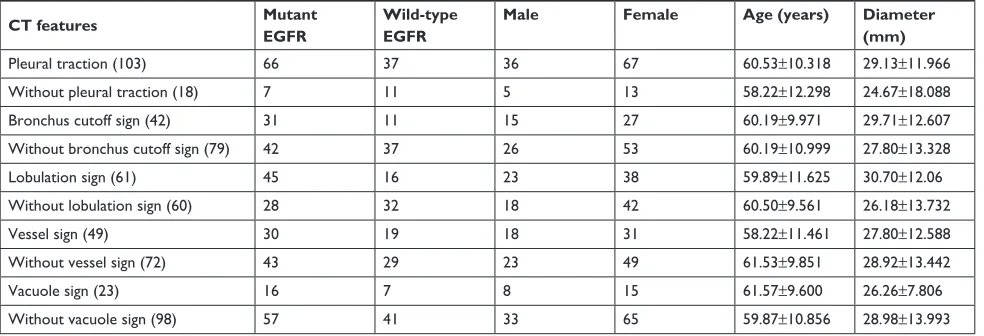
A cohort of 121 patients with peripheral lung adenocarcinoma included 41 males and 80 females. All patients exhibited a single lesion in the lungs. A total of 23 cases were diagnosed using BF260 electronic bronchoscopy biopsy (Olympus Corporation, Tokyo, Japan), 27 cases by percutaneous pul-monary biopsy, and 71 cases by postoperative specimens. All specimens were wrapped in paraffin, followed by con-ventional pathological examination and evaluation of the EGFR mutation. Seventy-three out of 121 cases harbored the EGFR mutation (60.33%), whereas 48 were wild-type EGFR (39.67%). The HRCT characteristics were as fol-lows: 103/121 cases exhibited pleural indentation (85.12%), 42/121 cases showed the bronchus cutoff sign (34.71%), 61/121 cases presented the lobulation sign (50.41%), 48/121
cases showed the vessel sign (39.67%), and 23 cases exhib-ited the vacuole sign (19.01%). The correlation of indexes such as EGFR mutation, gender, age, and tumor diameter with the characteristics of HRCT was analyzed statistically.
hrcT characteristics and egFr mutation
A total of 103 cases exhibited pleural indentation, which included 66 patients with and 37 patients without EGFR mutation, 90.41% sensitivity and 22.92% specificity. Pleu-ral indentation was found to be excessive in patients with EGFR mutation than those with wild-type EGFR (OR =3.193 [95% CI 1.067–9.558], P=0.038). Moreover, 42 cases, including 31 cases of mutation and 11 cases of wild-type EGFR, exhibited the bronchus cutoff sign. Moreover, the bronchus cutoff sign was significantly greater in patients with EGFR mutation than those with wild-type EGFR (OR =2.836 [95% CI 1.20–6.692], P=0.017), 42.47% sensi-tivity and 77.08% specificity. A total of 61 cases, including 45 patients with mutation and 16 patients with wild-type EGFR, presented the lobulation sign. The lobulation sign was observed to a greater extent in patients with EGFR muta-tion as compared to those with wild-type EGFR (OR =4.638 [95% CI 1.963–10.960], P=0.000), 61.64% sensitivity and 66.67% specificity. A significant correlation was found between lobulation sign and tumor diameter (OR =1.036 [95% CI 1.005–1.068], P=0.024). A total of 48 cases, includ-ing 30 patients with mutation and 18 patients with wild-type EGFR, demonstrated the vessel sign. The EGFR mutation did not exhibit any effect on the vessel sign (OR =1.266 [95% CI 0.578–2.773], P=0.555). Furthermore, 23 patients,
OncoTargets and Therapy downloaded from https://www.dovepress.com/ by 118.70.13.36 on 25-Aug-2020
Dovepress
nie et al
Table 1 cT features and correlation factors
CT features Mutant EGFR Wild-type EGFR Male Female Age (years) Diameter (mm)
Pleural traction (103) 66 37 36 67 60.53±10.318 29.13±11.966
Without pleural traction (18) 7 11 5 13 58.22±12.298 24.67±18.088
Bronchus cutoff sign (42) 31 11 15 27 60.19±9.971 29.71±12.607
Without bronchus cutoff sign (79) 42 37 26 53 60.19±10.999 27.80±13.328
lobulation sign (61) 45 16 23 38 59.89±11.625 30.70±12.06
Without lobulation sign (60) 28 32 18 42 60.50±9.561 26.18±13.732
Vessel sign (49) 30 19 18 31 58.22±11.461 27.80±12.588
Without vessel sign (72) 43 29 23 49 61.53±9.851 28.92±13.442
Vacuole sign (23) 16 7 8 15 61.57±9.600 26.26±7.806
Without vacuole sign (98) 57 41 33 65 59.87±10.856 28.98±13.993
Abbreviation: cT, computed tomography.
including 16 patients with EGFR mutation and 7 patients with wild-type EGFR, presented the vacuole sign. However, the EGFR mutation did not exhibit a significant effect on the vacuole sign (OR =1.584 [95% CI 0.557–4.352], P=0.372). Parameters such as age, gender, and tumor diameter did not vary significantly with respect to pleural indentation, bron-chus cutoff sign, vessel sign, and vacuole sign (P.0.05); however, age and gender did not vary significantly on the lobulation sign (P.0.05; Tables 1–6).
A 0.625 mm reconstruction of HRCT characteristics is shown in Figures 2 and 3.
Discussion
Up to 60% EGFR mutation occurs in lung adenocarcinoma in the Asian population and is closely related to the inva-siveness of the cancer. Although the doubling time of lung adenocarcinoma lesion is prolonged, it significantly increases the invasiveness in the patients with EGFR mutation.8–10 The early detection and diagnosis, as well as, invasiveness are primarily dependent on the characteristics observed on the HRCT.11,12 The pathological diagnosis is challenging when the lesion diameter is small. The correlation between the imaging features and genetic mutations indicates the physiological characteristics of the tumor at an early stage,13,14 which provides an insight into the appropriate treatment.15
The early invasiveness of lung adenocarcinoma primarily includes the invasion of the peripheral structures, such as intra-alveolar invasion, interlobular septal invasion, pleural invasion, and local bronchial lumen invasion.16,17 Common HRCT signs include pleural indentation, vacuole sign, lobulation sign, vessel sign, bronchial stiffness, trac-tion, narrowing, and truncation.18 The present study used a 0.625 mm thin-layer CT and reconstructions at sagittal,
coronal, and horizontal positions. Thus, the characteristics of CT images, especially the visceral pleural indentation, interlobar fissure pleural indentation, and mediastinal pleu-ral indentation, were observed from multiple views along with the bronchus cutoff sign. The thin-layer CT illustrates the vessel sign, vacuole sign, and lobulation sign rather adequately.12 The present study found that age, gender, and tumor diameter did not vary significantly on pleural inden-tation, bronchus cutoff sign, vessel sign, and vacuole sign (P.0.05). Age and gender did not vary significantly on the lobulation sign (P.0.05); however, the lobulation signs are prone to appear in tumors of larger diameters (OR =1.036 [95% CI 1.005–1.068], P=0.024). Intriguingly, the EGFR mutation was significantly correlated with the characteristics of some HRCT images. The invasion of tumor on the periph-eral structures led to pleural indentation or direct invasion.19,20 Pleural invasion affected the prognosis of the patients,21,22 and the HRCT-based reconstruction demonstrated 103 cases with visceral pleura, interlobular pleura, and mediastinal pleural indentation. The pleural indentation signs were found to be more in patients with EGFR mutation (OR =3.193 [95% CI 1.067–9.558], P=0.038); Smits et al23 reported that the patients with EGFR mutation were prone to pleural metasta-sis; Rizzo et al24 found an association between EGFR muta-tion and pleural retracmuta-tion. Bronchus cutoff sign suggested that the cancer cells invaded along the alveolar structure and peripheral bronchiole. The tumor tissue was exposed to the bronchial cavity resulting in the bronchus cutoff at the edge of the tumor.17 Hsu et al25 reported that air bronchograms were more common in the tumors with EGFR mutation, and the participation of bronchial wall and HRCT reconstruction identified the bronchial imaging features including the expan-sive and tractive bronchioles around the tumor. Our study
OncoTargets and Therapy downloaded from https://www.dovepress.com/ by 118.70.13.36 on 25-Aug-2020
Dovepress hrcT and egFr in lung adenocarcinoma
Table 2 correlation of egFr, gender, age, and diameter on pleural indentation
Variables Pleural traction
(103)
Without pleural traction (18)
P-value OR 95% CI P-value
Mutant egFr 66 7 0.044 3.193 1.067–9.558 0.038
Wild-type egFr 37 11
Male 36 5 0.553 1.745 0.519–5.868 0.368
Female 67 13
age (years) 60.53±10.318 58.22±12.298 0.396 1.008 0.957–1.062 0.764
Diameter (mm) 29.13±11.966 24.67±18.088 0.183 1.032 0.989–1.076 0.828
Table 3 correlation of egFr, gender, age, and diameter on bronchus cutoff sign
Variables Bronchus cutoff
sign (42)
Without bronchus cutoff sign (79)
P-value OR 95% CI P-value
Mutant egFr 31 42 0.027 2.836 1.20–6.692 0.017
Wild-type egFr 11 37
Male 15 26 0.756 1.438 0.618–3.346 0.400
Female 27 53
age (years) 60.19±9.971 60.19±10.999 1.000 0.990 0.953–1.028 0.316
Diameter (mm) 29.71±12.607 27.80±13.328 0.445 1.015 0.986–1.046 0.306
Table 4 correlation of egFr, gender, age, and diameter on lobulation sign
Variables Lobulation sign
(61)
Without lobulation sign (60)
P-value OR 95% CI P-value
Mutant egFr 45 28 0.002 4.638 1.963–10.960 0.000
Wild-type egFr 16 32
Male 23 18 0.371 2.271 0.941–5.484 0.068
Female 38 42
age (years) 59.89±11.625 60.50±9.561 0.751 0.977 0.941–1.018 0.232
Diameter (mm) 30.70±12.061 26.18±13.732 0.057 1.036 1.005–1.068 0.024
Table 5 correlation of egFr, gender, age, and diameter on vessel sign
Variables Vessel sign (49) Without vessel sign (72) P-value OR 95% CI P-value
Mutant egFr 30 43 0.760 1.266 0.578–2.773 0.555
Wild-type egFr 19 29
Male 18 23 0.585 1.506 0.668–3.397 0.323
Female 31 49
age (years) 58.22±11.461 61.53±9.851 0.093 0.965 0.930–1.001 0.059
Diameter (mm) 27.80±12.588 28.92±13.442 0.645 0.994 0.966–1.023 0.687
Table 6 correlation of egFr, gender, age, and diameter on vacuole sign
Variables Vacuole sign (23) Without vacuole sign (98) P-value OR 95% CI P-value
Mutant egFr 16 57 0.314 1.584 0.557–4.352 0.372
Wild-type egFr 7 41
Male 8 33 0.919 1.087 0.401–2.949 0.870
Female 15 65
age (years) 61.57±9.600 59.87±10.856 0.492 0.982 0.945–1.022 0.571
Diameter (mm) 26.26±7.806 28.98±13.993 0.371 0.123 0.945–1.022 0.377
OncoTargets and Therapy downloaded from https://www.dovepress.com/ by 118.70.13.36 on 25-Aug-2020
Dovepress
nie et al
Figure 2 hrcT characteristics of the 60-year-old male patient.
Notes: (A) Sagittal position showed an interlobar fissure and visceral pleural indentation. (B and C) cT vessel sign, bronchus cutoff sign, and vacuole sign in the horizontal level. The size was 2.7×2.5 cm, and the pathological results showed a moderately differentiated adenocarcinoma, which did not invade the pleura and lymphatic vessels. The evaluation of egFr revealed the mutation on exon 19.
Abbreviations: cT, computed tomography; hrcT, high-resolution computed tomography.
Figure 3 hrcT characteristics of the 55-year-old female patient.
Notes: The vacuole sign was visible on the horizontal (A) and sagittal positions (B); however, there was no significant bronchus cutoff sign (A and B). Pleural interlobar fissure and visceral pleura showed no significant indentation (A and B). The size of the lesion was 2.5×1.8 cm. The pathological diagnosis was invasive mucinous adenocarcinoma, which did not invade the pleura and lymph node. egFr detection did not find any mutation.
Abbreviation: hrcT, high-resolution computed tomography.
suggests that bronchus cutoff sign is correlated with EGFR mutation (OR =2.836 [95% CI 1.20–6.692], P=0.017). Moreover, patients with EGFR mutation were susceptible to the lobulation sign as compared to those with wild-type EGFR (OR =4.638 [95% CI 1.963–10.960], P=0.000), com-mon lobulation sign is primarily moderate or deep, and the tumor with the lobulation sign indicated significant growth
and irregular shape, thereby leading to a poor prognosis,26 Hasegawa et al27 reported that EGFR-mutated adenocarci-noma showed significantly higher frequencies of the lobu-lation sign at HRCT compared to the non-EGFR-mutated type. The CT vessel sign indicated the potential increase in cancerogenesis of the lung nodules significantly.28 Henschke et al4 reported that the lesion hyperplasia with vessel sign was accelerated, which was also a piece of evidence identifying the benign and malignant nodules. This study revealed that the CT vessel sign was not significantly correlated with the EGFR mutation. Furthermore, the vacuole sign indicated that the alveolar structure was not distorted, and the alveo-lar inflation or some necrosis tissues were discharged. This phenomenon was observed frequently in adherent growth or acinar adenocarcinoma, suggesting early invasion.29,30 This study concluded that there is no significant correlation between vacuolar sign and EGFR gene mutation (OR =1.584 [95% CI 0.557–4.352], P=0.372), and Zaibo et al31 reported similar findings.
The HRCT characteristics were manifested as single existence or coexistence of pleural indentation, bronchus cutoff sign, and lobulation sign that might indicate the puta-tive increase in the EGFR mutation significantly. Moreover, the invasiveness of adenocarcinoma was strong, and the prognosis was poor.27,28 These three phenomena were cor-related pathologically.12 A timely surgery could improve the treatment effect in such patients.15 The EGFR muta-tion and different invasive structures would result in the surgical approaches affecting the survival and possibility
OncoTargets and Therapy downloaded from https://www.dovepress.com/ by 118.70.13.36 on 25-Aug-2020
Dovepress hrcT and egFr in lung adenocarcinoma
of recurrence.32 The pulmonary wedge resection might face local or distant recurrence, whereas segmentectomy and pulmonary lobectomy might reduce the recurrence.33–35
Disadvantages of the present study are as follows: our study mainly ascertained the HRCT imaging characteristics of lung adenocarcinoma and evaluated the mutant state of EGFR. However, we did not collect all the CT characteris-tics of non-small-cell lung cancer as well as other related genes. Therefore, further studies using large sample size and multicenter data are essential. In addition, this study was a retrospective analysis that might lead to selection bias.
Conclusion
Patients with lung adenocarcinoma underwent 0.625 mm thin-layer CT and reconstruction and displayed HRCT signs. Statistical analysis obtained the imaging characteristics of patients with EGFR mutation: pleural indentation, lobulation sign, and bronchial truncation sign that were significantly greater than those with wild-type EGFR. These phenomena can provide the reference for clinical treatment. The pleural indentation sign, lobulation sign, and bronchus cutoff sign occurring alone or coexisting with multiple CT signs sug-gested a putative EGFR mutation. In this case, the invasive-ness was enhanced that necessitated appropriate clinical treatment at the earliest. Thus, further studies are essential to predict the EGFR mutations in lung adenocarcinoma using CT.
Acknowledgment
This study was supported by the Project of Medical and Health Science Technology in Shandong Province (2015WS0376).
Author contributions
All authors contributed to data analysis, drafting and revising the article, gave final approval of the version to be published, and agree to be accountable for all aspects of the work.
Disclosure
The authors report no conflicts of interest in this work.
References
1. Torre LA, Bray F, Siegel RL, Ferlay J, Lortet-Tieulent J, Jemal A. Global cancer statistics, 2012. CA Cancer J Clin. 2015;65(2):87–108. 2. Yanagawa M, Tanaka Y, Kusumoto M, et al. Automated assessment of
malignant degree of small peripheral adenocarcinomas using volumetric CT data: correlation with pathologic prognostic factors. Lung Cancer. 2010;70(3):286–294.
3. Zhang J, Wu J, Tan Q, Zhu L, Gao W. Why do pathological stage IA lung adenocarcinomas vary from prognosis?: a clinicopathologic study of 176 patients with pathological stage IA lung adenocarcinoma based on the IASLC/ATS/ERS classification. J Thorac Oncol. 2013;8(9):1196–1202.
4. Henschke CI, Boffetta P, Gorlova O, Yip R, Delancey JO, Foy M. Assessment of lung-cancer mortality reduction from CT Screening.
Lung Cancer. 2011;71(3):328–332.
5. Koh Y, Jang B, Jeon YK, et al. EGFR gene copy number gain is related to high tumor SUV and frequent relapse after adjuvant chemotherapy in resected lung adenocarcinoma. Jpn J Clin Oncol. 2011;41(4):548–554. 6. Ahn HK, Choi YL, Han JH, et al. Epidermal growth factor receptor
mutation and treatment outcome of mediastinoscopic N2 positive non-small cell lung cancer patients treated with neoadjuvant chemoradiotherapy followed by surgery. Lung Cancer. 2013;79(3):300–306.
7. Chao L, Yi-Sheng H, Yu C, et al. Relevance of EGFR mutation with micropapillary pattern according to the novel IASLC/ATS/ERS lung adenocarcinoma classification and correlation with prognosis in Chinese patients. Lung Cancer. 2014;86(2):164–169.
8. Saruwatari K, Ikemura S, Sekihara K, et al. Aggressive tumor microen-vironment of solid predominant lung adenocarcinoma subtype harbor-ing with epidermal growth factor receptor mutations. Lung Cancer. 2016;91:7–14.
9. Zhang Y, Li J, Wang R, et al. The prognostic and predictive value of solid subtype in invasive lung adenocarcinoma. Sci Rep. 2014;4:7163. 10. Liu Y, Kim J, Qu F, et al. CT features associated with epidermal growth factor receptor mutation status in patients with lung adenocarcinoma.
Radiology. 2016;280(1):271–280.
11. Borczuk AC. Assessment of invasion in lung adenocarcinoma clas-sification, including adenocarcinoma in situ and minimally invasive adenocarcinoma. Mod Pathol. 2012;25(Suppl 1):S1–S10.
12. Honda T, Kondo T, Murakami S, et al. Radiographic and pathological analysis of small lung adenocarcinoma using the new IASLC classifica-tion. Clin Radiol. 2013;68(1):e21–e26.
13. Hsu KH, Chen KC, Yang TY, et al. Epidermal growth factor receptor mutation status in stage I lung adenocarcinoma with different image patterns. J Thorac Oncol. 2011;6(6):1066–1072.
14. Usuda K, Sagawa M, Motono N, et al. Relationships between EGFR mutation status of lung cancer and preoperative factors – are they predictive? Asian Pac J Cancer Prev. 2014;15(2):657–662.
15. Cohen JG, Reymond E, Lederlin M, et al. Differentiating pre- and minimally invasive from invasive adenocarcinoma using CT-features in persistent pulmonary part-solid nodules in Caucasian patients.
Eur J Radiol. 2015;84(4):738–744.
16. Zhang Y, Qiang JW, Ye JD, Ye XD, Zhang J. High resolution CT in differentiating minimally invasive component in early lung adenocar-cinoma. Lung Cancer. 2014;84(3):236–241.
17. Qiang JW, Zhou KR, Lu G, et al. The relationship between solitary pulmonary nodules and bronchi: multi-slice CT-pathological correla-tion. Clin Radiol. 2004;59(12):1121–1127.
18. Jiang B, Takashima S, Miyake C, et al. Thin-section CT findings in peripheral lung cancer of 3 cm or smaller: are there any characteristic features for predicting tumor histology or do they depend only on tumor size? Acta Radiol. 2014;55(3):302–308.
19. Ebara K, Takashima S, Jiang B, et al. Pleural invasion by peripheral lung cancer: prediction with three-dimensional CT. Acad Radiol. 2015; 22(3):310–319.
20. Qi LP, Li XT, Yang Y, et al. Multivariate analysis of pleural invasion of peripheral non-small cell lung cancer-based computed tomography features. J Comput Assist Tomogr. 2016;40(5):757–762.
21. Shimizu K, Yoshida J, Nagai K, et al. Visceral pleural invasion is an invasive and aggressive indicator of non-small cell lung cancer. J Thorac
Cardiovasc Surg. 2005;130(1):160–165.
22. Oyama M, Miyagi Maeshima A, Tochigi N, et al. Prognostic impact of pleural invasion in 1488 patients with surgically resected non-small cell lung carcinoma. Jpn J Clin Oncol. 2013;43(5):540–546. 23. Smits AJ, Kummer JA, Hinrichs JW, et al. EGFR and KRAS mutations
in lung carcinomas in the Dutch population: increased EGFR mutation frequency in malignant pleural effusion of lung adenocarcinoma. Cell
Oncol. 2012;35(3):189–196.
24. Rizzo S, Petrella F, Buscarino V, et al. CT radiogenomic character-ization of EGFR, K-RAS, and ALK mutations in non-small cell lung cancer. Eur Radiol. 2016;26(1):32–42.
OncoTargets and Therapy downloaded from https://www.dovepress.com/ by 118.70.13.36 on 25-Aug-2020
OncoTargets and Therapy
Publish your work in this journal
Submit your manuscript here: http://www.dovepress.com/oncotargets-and-therapy-journal OncoTargets and Therapy is an international, peer-reviewed, open access journal focusing on the pathological basis of all cancers, potential targets for therapy and treatment protocols employed to improve the management of cancer patients. The journal also focuses on the impact of management programs and new therapeutic agents and protocols on
patient perspectives such as quality of life, adherence and satisfaction. The manuscript management system is completely online and includes a very quick and fair peer-review system, which is all easy to use. Visit http://www.dovepress.com/testimonials.php to read real quotes from published authors.
Dovepress
Dove
press
nie et al
25. Hsu JS, Huang MS, Chen CY, et al. Correlation between EGFR muta-tion status and computed tomography features in patients with advanced pulmonary adenocarcinoma. J Thorac Imaging. 2014;29(6):357–363. 26. Ikehara M, Saito H, Kondo T, et al. Comparison of thin-section CT and
pathological findings in small solid-density type pulmonary adenocarci-noma: prognostic factors from CT findings. Eur J Radiol. 2012;81(1): 189–194.
27. Hasegawa M, Sakai F, Ishikawa R, Kimura F, Ishida H, Kobayashi K. CT features of epidermal growth factor receptor-mutated adenocar-cinoma of the lung: comparison with nonmutated adenocaradenocar-cinoma.
J Thorac Oncol. 2016;11(6):819–826.
28. Xing Y, Li Z, Jiang S, Xiang W, Sun X. Analysis of pre-invasive lung adenocarcinoma lesions on thin-section computerized tomography. Clin
Respir J. 2015;9(3):289–296.
29. Nakazono T, Sakao Y, Yamaguchi K, Imai S, Kumazoe H, Kudo S. Subtypes of peripheral adenocarcinoma of the lung: differentiation by thin-section CT. Eur Radiol. 2005;15(8):1563–1568.
30. Ding H, Shi J, Zhou X, et al. Value of CT characteristics in predicting invasiveness of adenocarcinoma presented as pulmonary ground-glass nodules. Thorac Cardiovasc Surg. 2017;65(2):136–141.
31. Zaibo L, Dacic S, Pantanowitz L. Correlation of cytomorphology and molecular findings in EGFR+KRAS, + and ALK+ lung adenocarcino-mas. Am J ClinPathol. 2014;141:420–428.
32. Zaric B, Stojsic V, Kovacevic T, et al. Clinical characteristics, tumor, node, metastasis status, and mutation rate in domain of epidermal growth factor receptor gene in Serbian patients with lung adenocarcinoma.
J Thorac Oncol. 2014;9(9):1406–1410.
33. Yendamuri S, Sharma R, Demmy M, et al. Temporal trends in outcomes following sublobar and lobar resections for small (# 2 cm) non-small cell lung cancers – a surveillance epidemiology end results database analysis. J Surg Res. 2013;183(1):27–32.
34. Koike T, Koike T, Yoshiya K, Tsuchida M, Toyabe S. Risk factor analysis of locoregional recurrence after sublobar resection in patients with clinical stage IA non-small cell lung cancer. J Thorac Cardiovasc
Surg. 2013;146(2):372–378.
35. Cañizares MA, Matilla JM, Cueto A, et al. Atypical carcinoid tumours of the lung: prognostic factors and patterns of recurrence. Thorax. 2014; 69(7):648–653.
OncoTargets and Therapy downloaded from https://www.dovepress.com/ by 118.70.13.36 on 25-Aug-2020